



 by Tom Gurney
Tom Gurney BSc (Hons) is an art history expert with over 20 years experience
Published on June 19, 2020 / Updated on November 1, 2026
Email: tomgurney1@gmail.com / Phone: +44 7429 011000
Propellers: Introduction
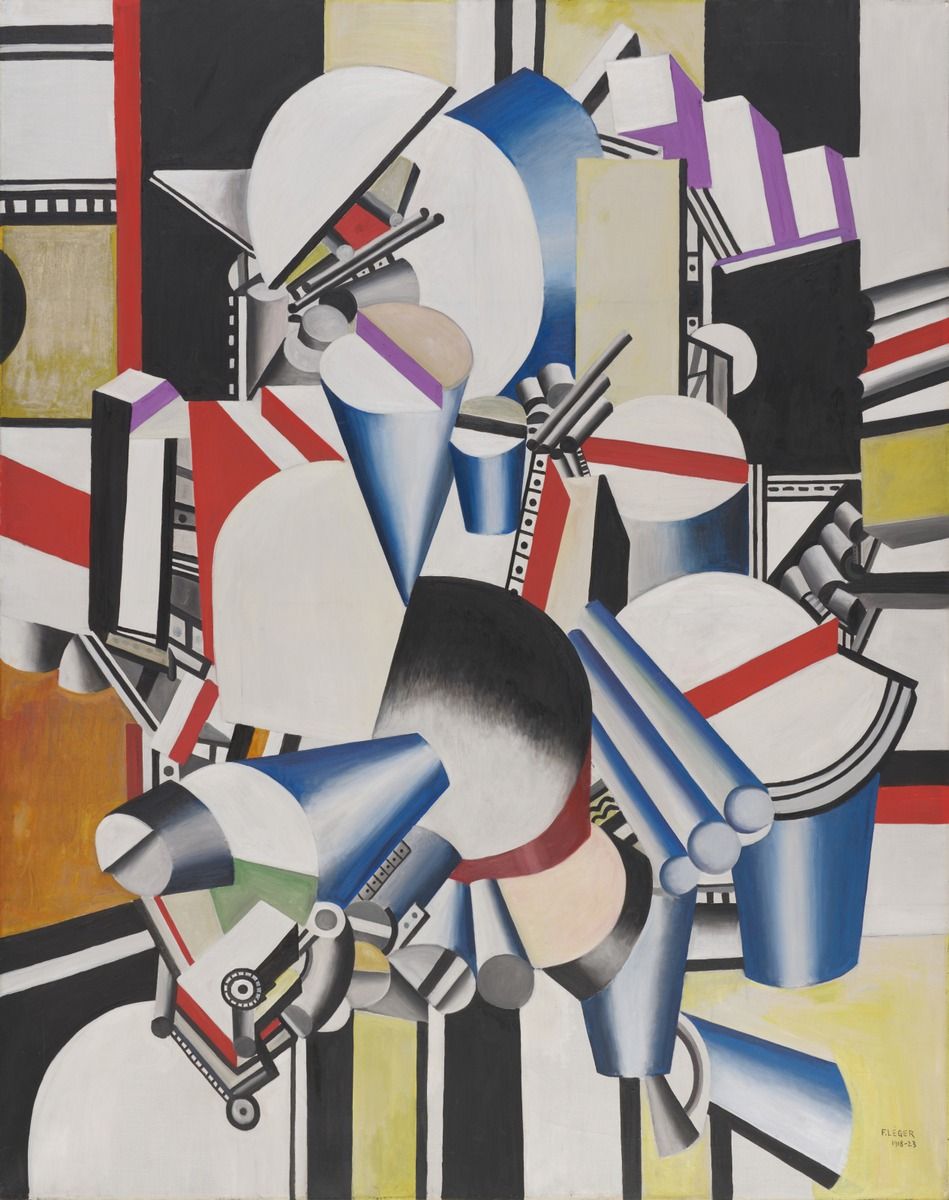
A broad black-and-white blade twists down the middle of Fernand Léger’s Propellers, surrounded by cylinders, striped bands and flashes of yellow. Its edges bend as though the surface were turning towards us and away again. Everything is sharply held in place, yet the eye keeps moving. Painted in 1918, this oil on canvas belongs to the Museum of Modern Art in New York, which records its title simply as Propellers. It measures 80.9 by 65.4 centimetres. [1]
The picture offers the excitement of machinery through a dense arrangement of painted forms. A blue sphere, a purple crosspiece and a green cylinder seem almost tangible; the spaces around them remain difficult to measure. Léger makes the separate parts convincing enough to attract our attention, then places them in relationships that keep a complete machine just beyond recognition.
At a Glance
- ArtistFernand Léger
- SubjectPropellers Second State
- Date1918 [1]
- CollectionMuseum of Modern Art, New York [1]
This work across Fernand Léger’s career
Nudes in the Forest
1909–1911 [2]Contrast of Forms
1913 [3]The Mechanic
1920 [5]Three Women
1921–22 [6]Contents
- A blade that changes as we look
- The crowded edges
- Colour, weight and shallow space
- Machinery after the war
- The propeller as a challenge to painting
- A particular painting within Léger’s work
A blade that changes as we look
The long central form supplies the painting’s strongest movement. Its pale outline curves inward and outward, enclosing alternating areas of light and dark. Near the top, a pointed black wedge rises between lighter surfaces. Farther down, a broad white section crosses towards the left before narrowing again. These successive changes of direction make the form appear to twist around its own length.
The shading intensifies that sensation. White passes through blue-grey into a deep black, lending the surface a rounded fullness. Yet the strongly drawn edges keep interrupting any simple reading of a smooth object. At one moment we seem to see a hollow curve; at another, a projecting blade. Following the whole shape involves a series of small adjustments, each one changing our sense of what lies in front.
A narrow band of black-and-white compartments follows part of its outline. Its repeated marks give the curve a measurable rhythm, like a chain of little steps. The large, swelling surfaces move slowly across the eye, while these small divisions pick out a much quicker beat. Léger can therefore suggest different speeds within the same stationary shape.
Behind the blade, pale circular forms appear on either side. Their curved rims suggest discs partly hidden by the central assembly. Because their centres are obscured, they never become simple wheels with readily located hubs. They offer enough circular structure to reinforce the sense of rotation while leaving the mechanism open to our imagination. MoMA likewise identifies the central forms with propeller blades and the cylinders at the sides with pipework. [1]
The crowded edges
The left side provides a different kind of activity. A short chain of dark cylinders descends diagonally from the upper corner. Pale circular ends make them look cut across, and small bright collars divide one length from the next. Their regular succession establishes a firm direction through a part of the painting otherwise filled with competing angles.
Below them, a lavender crosspiece stands against yellow and orange. Its upright member is unusually clear and continuous. The transverse bar extends behind it, with a rounded end visible on the right. This simple intersection gives the eye a temporary resting place. It is a quiet piece of geometry within a field of more elaborate curves.
The green cylinder crossing upwards from the lower left has a different force. Its pink end faces us, while the long pale side recedes towards the centre. The green edge sharpens its diagonal. It appears to thrust into the central assembly, although the surrounding overlaps make its precise destination uncertain. Together, the lavender upright and green diagonal create a loose crossing that answers the much more restless blade beside them.
At the lower left, the large blue-and-white sphere is interrupted by a red sector. The curved shading suggests a rounded body, but the clean red division reads like a separate painted panel. Its apparent solidity is strong enough to make the slim blue support beneath it seem plausible. Even here, where one object seems briefly easy to understand, Léger makes surface pattern compete with volume.
Along the right edge, the parts crowd more tightly together. A pale cylinder at the top rises behind a stack of little striped sections. Lower down, black tubes, yellow planes and a curved grey bar press against one another. The bar crosses in front of other parts, offering a small pocket of depth. A tall dark cylinder beneath it carries the eye towards the bottom edge. Looking around the margins reveals how carefully the central twist is held inside a framework of uprights and diagonals.
Colour, weight and shallow space
Yellow has a particularly active role. It appears in separated areas across the canvas, sometimes forming a broad field and sometimes a narrow channel between solid-looking pieces. These passages connect visually even when they seem disconnected spatially. The eye can travel from one yellow area to another without following the apparent structure of the machinery.
Red works in shorter, more forceful accents. A broad reddish plane near the upper left cuts diagonally across a pale surface. The red wedge in the sphere answers a lower red panel beside the central disc. These scattered notes interrupt the cooler blues, greys and lavender. They also stop the metallic appearance of the rounded parts from determining the character of the entire picture.
The small patches of dots, stripes and crosshatching matter just as much as the larger colour fields. Behind the green cylinder, a pale panel with black dots reads as a thin patterned surface. Elsewhere, diagonal bars and narrow horizontal strokes create little areas of visual friction. The contrast between these busy marks and the broad shaded volumes makes the latter appear more substantial.
There is no single comfortable viewpoint from which all these parts fall into place. Some circular ends face us almost directly; other cylinders turn away; broad planes tilt at different angles. Each local arrangement offers a possible depth, but the next overlap asks us to reconsider it. The result is a tightly packed space in which things seem heavy without becoming securely located.
The interrupted connections give the picture much of its energy. We might follow a shaft towards a wheel, only to find that the next overlap prevents a secure connection. We move between recognition and pattern, testing the image as an assembly while also enjoying it as an arrangement of colour and line.
Machinery after the war
Propellers belongs to a moment when mechanical forms became especially important to Léger. Rachel Boate’s account for the Metropolitan Museum of Art connects his wartime drawings of artillery, aircraft and soldiers with the mechanical style he developed around the end of the war. She places that style within his broader attempt to convey the pace of modern life. [10]
That context helps explain the range of associations the painting invites. A cylinder may suggest a pipe, a shaft or a fragment of some larger apparatus. Repeated bands can recall mechanical fittings without settling into a technical description. The canvas draws on a world in which manufactured forms had become visually compelling, then gives those forms its own relationships.
A nearby example is the Met’s Mechanical Elements of 1920. Its collection text describes the recurring cones, cylinders and discs of Léger’s mechanical period, approximately 1918–23, and emphasises their shallow pictorial setting. The museum treats these elements as an evocation of machinery rather than a set of identifiable working parts. [11]
That distinction is useful when looking back at Propellers. Trying to name every component soon becomes frustrating, whereas noticing what each shape does opens up the painting. The green diagonal drives across a cluster of curves. The lavender upright steadies a passage of oblique lines. The central blade creates a continuous movement through many disconnected incidents. These are pictorial relationships that remain clear even when a mechanical explanation does not.
Fernand Léger, Mechanical Elements. A related mechanical composition makes the relation of metal-like volumes and flat colour visible.
The propeller as a challenge to painting
MoMA recounts a much earlier encounter with aviation: in 1912, Léger visited a Paris aviation fair with Constantin Brancusi and Marcel Duchamp. According to the anecdote, Duchamp supposedly challenged painting’s ability to rival the beauty of a propeller. The museum’s qualification matters: this is a remembered story, rather than a documented conversation accompanying the 1918 canvas. [1]
The story nevertheless draws attention to a revealing question. How might painting respond to an object whose visual power comes from its engineered form? In this canvas, Léger explores possibilities that belong particularly to painting: incompatible views can coexist, colour can cross between separate things, and a rounded volume can abruptly become a flat division of the surface.
The propeller’s capacity to turn becomes a way of organising our looking. The canvas contains no blurred outline to tell us that a blade is spinning. Instead, the central shape changes direction and apparent depth as we follow it. Its movement develops through our attention, encouraged by the small striped bands, repeated curves and diagonals that surround it.
The Musée national Fernand Léger offers a related perspective in its account of the separate 1924 painting Elément mécanique sur fond rouge. It quotes Léger comparing his invented machine images with imaginary landscapes and stresses his interest in form and colour. The statement accompanies the museum’s discussion of a later work; it describes an approach to mechanical imagery without documenting the making of Propellers. [12]
Seen in that light, the 1918 canvas feels like a constructed environment for the eye. Its parts seem familiar, but their arrangement belongs to this picture alone. The narrow yellow intervals, the unexpected pink end of the green tube and the large dark curve near the top all contribute to a world that painting can assemble freely.

Fernand Léger, The Railway Crossing. Signs and machinery offer another way to build a shallow, interrupted space.
A particular painting within Léger’s work
MoMA’s 1960 annotated checklist already called the work Propellers, with the same dimensions in inches as the current record. In discussing Three Women of 1921, Alfred H. Barr Jr.’s notes grouped Propellers and the museum’s study for The City with an earlier period of comparative abstraction. Barr’s comparison places this canvas within the more abstract phase preceding Léger’s renewed emphasis on monumental figures. [13]
The phrase “comparative abstraction” suits the experience of looking. The title gives us a subject, and the components offer plentiful mechanical suggestions, but neither supplies a complete scene. A human figure or a landscape would provide a familiar scale. Here, the size of one form emerges largely through its contrast with another: the broad blade feels larger beside its tiny bordering compartments; the sphere appears substantial beside the thin blue column.
The painting reached MoMA through the Katherine S. Dreier Bequest and carries the object number 171.1953. The museum’s provenance records its passage from Léger through Galerie L’Effort Moderne and into Dreier’s collection. [1] Its identity is therefore specific, even as the image itself remains open to shifting associations.
Return finally to the long central curve. From a distance it gathers the painting into a strong vertical gesture. Closer looking breaks that gesture into pale rims, dark wedges and soft transitions of blue and grey. The surrounding cylinders and patterned scraps repeatedly draw us away, then send us back. Léger turns the promise of mechanical rotation into a sustained visual experience: a still surface whose parts keep changing their relationships as we look.
Léger in video
Explore abstraction, monumental painting and cinema through films from MoMA and the Centre Pompidou. These videos offer context for Léger’s wider work; the restoration film is in French.
1913 | “Contrast of Forms” by Fernand Léger
MoMA looks at its own 1913 Contrast of Forms, including the painting’s rough surface. This is a different canvas from the Beyeler work covered in this cluster. English.
Watch on YouTubeFernand Léger artworks directory
Works covered in these articles and further documented works. Studies and finished works have separate entries; alternate titles share an entry. This is not a catalogue raisonné.
| Name | Date | Medium |
|---|---|---|
| Acrobats and Clowns from Le Cirque | 1950 | |
| Adieu New York | 1946 | Painting |
| Ballet mécanique | 1924 | Film |
| Big Julie | 1945 | Painting |
| Builders with Aloe | 1951 | Painting |
| Charlot cubiste | 1924 | Sculpture |
| Chimneys on Rooftops | 1911 | Painting |
| Cirque (artist’s book) | 1950 | |
| Composition | 1929 | Painting |
| Composition (Study for Nude Model in the Studio) | 1912 | Drawing |
| Composition of Three Figures | 1932 | Painting |
| Composition with Two Parrots | 1935–39 | Painting |
| Construction Workers Final State | 1950 | Painting |
| Contrast of Forms | 1913 | Painting |
| Derrière le miroir, nos.121–122 (posthumous publication, includes a lithograph after Léger) | 1960 | |
| Drawing for The Card Game | 1917 | Drawing |
| Drawing for The Staircase | 1913 | Drawing |
| En attendant le départ | 1914 | Drawing |
| Grand Parade with Red Background | 1953 | Painting |
| J’ai tué (illustrated book) | 1918 | |
| La Cocarde, l’avion brisé | About 1916 | Drawing |
| La Couseuse | about1910 | Painting |
| La Fin du monde filmée par l’Ange N.-D. (illustrated book) | 1919 | |
| Les Femmes au bouquet (Women with a Bouquet) | 1921 | Painting |
| Man and Woman | 1921 | Painting |
| Man in Profile with Rope: Study for The Constructors | 1950/1 | Drawing |
| Man in the Blue Hat | 1937 | Painting |
| Matinée d’ivresse, from Les Illuminations | 1949 | |
| Mechanical Elements | 1918–23 | Painting |
| Mechanical Elements (Metropolitan Museum) | 1920 | Painting |
| Men in the City | 1919 | Painting |
| Mes voyages (posthumous illustrated book) | 1960 | |
| Mona Lisa with the Keys | 1930 | Painting |
| Nude Model in the Studio | 1912–13 | Painting |
| Nudes in the Forest | 1909–1911 | Painting |
| Propellers Second State | 1918 | Painting |
| Reading | 1924 | Painting |
| Soldier with a Pipe | 1916 | Painting |
| Soldiers Playing Cards | 1917 | Painting |
| Soldiers Playing Cards (front drawing) | 1916 | Drawing |
| Standing Nude, Rear View | 1911 | Drawing |
| Still Life with a Beer Mug | 1921–2 | Painting |
| Still Life with Tankard | 1921 | Drawing |
| Study for The Aviator | 1920 | Drawing |
| The Acrobat and his Partner | 1948 | Painting |
| The Acrobats in the Circus | 1918 | Painting |
| The Alarm Clock | 1914 | Painting |
| The Chalices and the Sponge, stained-glass model | 1950 | Drawing |
| The City | 1919 | Painting |
| The Disks in the City | 1920 | Painting |
| The Mechanic | 1920 | Painting |
| The Railway Crossing | 1919 | Painting |
| The Three Musicians | 1944, after a 1924–25 drawing | Painting |
| The Wheels | 1945 | Drawing |
| Three Women | 1921–22 | Painting |
| Two Women Holding Flowers | 1954 | Painting |
| Umbrella and Bowler | 1926 | Painting |
| Verdun, dessin du front | About 1915 | Drawing |
| Woman with a Book | 1923 | Painting |
| Woman: Costume Design for La Création du monde | c.1922–23 | Drawing |
Discussion
Look again at the images and ideas explored in Propellers. These editorial prompts invite your observations.
Reader Insights
What becomes easier to notice in Propellers Second State when you compare it with Mechanical Elements?
Where does the comparison with The Railway Crossing reveal the clearest change in Léger’s approach?
Which detail would you follow first when returning to the work, and why?
Join the Conversation
Share a detail, comparison or question about Propellers below.
References
- Museum of Modern Art, Fernand Léger. Propellers. 1918, object 171.1953; collection details, MoMA Learning text and provenance. Accessed 31 October 2026. View source.
- Kröller-Müller Museum, Nus dans la forêt / Nude Figures in a Forest, collection record KM 101.045. Current date, medium, identifier, curatorial sections “Distinctive cubist style”, “Geometric shapes” and “‘Battle of volumes’”, and museum reproduction. View source.
- Fondation Beyeler, Contraste de formes, Fernand Léger, current collection record, Inv.90.6: date, medium, dimensions, collection and signature on reverse. View source.
- Philadelphia Museum of Art, The City, 1919, collection record and interpretation; A. E. Gallatin Collection, 1952-61-58. View source.
- National Gallery of Canada, The Mechanic, 1920, accession 14985, collection details and interpretive paragraph; French collection record, Le mécanicien. View source.
- The Museum of Modern Art, Fernand Léger. Three Women. 1921–22, collection record, object 189.1942: artwork image, metadata, 2021 gallery label, publication excerpt, installation history and provenance. View source.
- Musée national Fernand Léger, La Joconde aux clés, collection record and museum commentary (French): object data, owning museum image, artist recollection, sardine tin and symbolic interpretations. The artist’s recollection is consulted as reproduced by the museum; the page does not date it. View source.
- Musée national Fernand Léger, “Les années 50, les constructeurs”, complete Les Constructeurs (définitif) entry and accompanying museum image: title, 1950 date, oil on canvas, 300 × 228 cm, inventory MNFL 94001, 1969 donation and museum-mediated Renault-canteen recollection. View source.
- Musée national Fernand Léger, La Grande Parade sur fond rouge, complete object record and displayed reproduction: 1953, oil on canvas, 114.5 × 156.2 cm, inventory MNFL 96006; donation of Nadia Léger and Georges Bauquier. View source.
- Rachel Boate, “Fernand Léger (1881–1955)”, Metropolitan Museum of Art, May 2018, especially the wartime and immediate postwar discussion. Accessed 31 October 2026. View source.
- Metropolitan Museum of Art, Fernand Léger, Mechanical Elements, 1920, object 1999.363.36, collection entry. Accessed 31 October 2026. View source.
- Musée national Fernand Léger, Elément mécanique sur fond rouge, 1924, object MNFL 97031, collection commentary and quoted artist statement. Accessed 31 October 2026. View source.
- Museum of Modern Art, Fernand Léger, 1960 exhibition release and annotated checklist, notes by Alfred H. Barr Jr., PDF page 2, entries for Propellers and Three Women. Consulted in the saved text capture, 31 October 2026. View source.


