 by Tom Gurney
Tom Gurney BSc (Hons) is an art history expert with over 20 years experience
Published on June 19, 2020 / Updated on November 1, 2026
Email: tomgurney1@gmail.com / Phone: +44 7429 011000
Soldier with a Pipe: Introduction
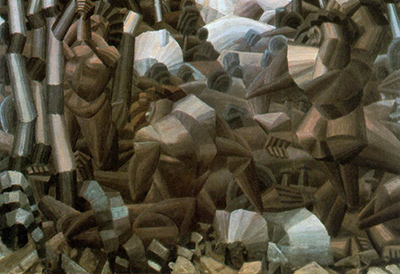
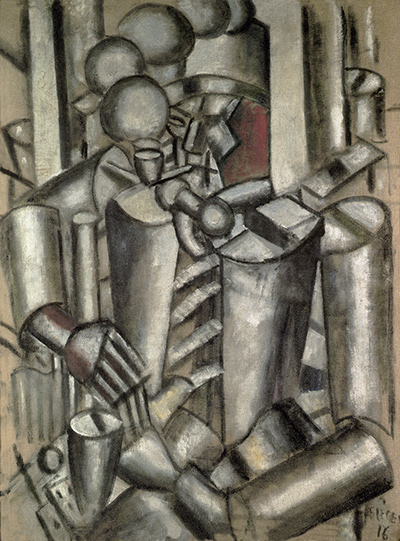
A small pipe holds together a remarkably complicated man. Its bowl sits just left of centre, its narrow stem reaches towards an angular face, and above it smoke rises in a chain of solid-looking discs. Around this ordinary act of smoking, Fernand Léger builds an extraordinary arrangement of cylinders, blocks and dark seams. Soldier with a Pipe, painted in 1916, gives a human figure the weight and articulation of machinery while preserving the intimate scale of a moment's occupation.
The painting belongs to the Kunstsammlung Nordrhein-Westfalen in Düsseldorf. Its French title is Le soldat à la pipe, and the museum records an oil on canvas measuring 130.2 by 97.3 centimetres, inventory number 1028. [1] These dimensions give the figure considerable physical presence. Yet the first encounter is often a search: the soldier has to be found among forms that seem capable of belonging equally to his body, his equipment and the space around him.
At a Glance
- ArtistFernand Léger
- SubjectSoldier with a Pipe
- Date1916 [1]
- CollectionKunstsammlung Nordrhein-Westfalen, Düsseldorf [1]
This work across Fernand Léger’s career
Nudes in the Forest
1909–1911 [2]Contrast of Forms
1913 [3]The Mechanic
1920 [5]Three Women
1921–22 [6]Contents
- Finding the smoker
- The weight of light
- Colour within the grey
- Painting during the war
- Machinery and human company
- A painting with a continuing history
Finding the smoker
Start with the pipe rather than the outlines of the whole figure. The bowl has a pale oval opening, a dark rim and a tapering body. Its stem moves diagonally to the right, towards the lower part of the face. That small connection establishes an action and begins to organise the surrounding pieces. A shape that seemed an isolated wedge becomes part of a cheek; a narrow, sharply lit projection becomes a nose.
The head occupies the upper middle of the canvas, beneath a broad, curved band. Dark marks suggest the eyes, but the face resists the continuity of a conventional portrait. Its planes meet at abrupt angles, and pale highlights separate protruding parts from deep shadows. A red patch immediately to the right makes the head easier to locate, although it also competes with the face for attention. Recognition arrives through a few concentrated clues.
Above the pipe, the smoke behaves unlike smoke. Rounded grey forms overlap as they climb towards the upper edge, each with its own shaded circumference. They have the solidity of balls or circular plates. Their progression supplies an upward movement, but there is little airy dissolution: the last visible forms remain as palpable as the first. Léger makes something fleeting share the substantial presence of the smoker.
The hands offer another route into the image. Low on the left, a reddish, rounded palm gives way to parallel, brightly edged fingers slanting down towards the centre. Higher on the right, a much more angular hand appears as a construction of rectangular pieces. The contrast is striking. The lower hand announces itself through repeated lines; the upper one emerges through a change of direction and a cluster of blocklike planes. Each provides a human foothold inside the larger geometric assembly.
Following these clues does not produce an effortless anatomical diagram. Connections pass behind other shapes or change their apparent direction. The eye can trace an arm and then encounter a cylindrical volume whose place in the body remains uncertain. That difficulty is part of the experience. The figure becomes recognisable through the relation between a pipe, face and hands, while the rest retains an independent life as an arrangement of painted forms.
The weight of light
Large tapered cylinders dominate the middle and lower portions of the picture. Their upper ends appear cut across, exposing curved or elliptical surfaces; their lengths descend through broad bands of light and shade. Smaller tubes repeat the same structure at the sides. These repetitions make the entire canvas feel constructed from a limited set of sturdy components, varied in size and direction.
The highlights are crucial. A pale strip runs along a rounded surface, while a dark band makes the opposite edge turn away. The modelling can suggest the sheen of metal, particularly where a cool grey light meets a deep, almost black seam. Yet the surfaces remain visibly painted. Their pale areas are uneven and rubbed-looking, and their transitions are softer than the crisply outlined silhouette might lead us to expect. The mechanical impression comes from the organisation of light and volume rather than from a polished industrial finish.
Across the lower right, a broad diagonal cylinder presses towards the edge. Elsewhere, tall upright bands establish a competing vertical rhythm. Between these large forms, smaller slanting pieces keep the surface active. The figure is held within this traffic of directions: upward smoke, descending volumes, horizontal or diagonal joints. Even an apparently restful subject generates considerable visual pressure.
The space offers few places to retreat. There is no open landscape or clearly measured room around the soldier. Upright pale strips can suggest structural supports, but they also resemble the cylindrical forms of the figure. Dark lines pass across the ochre ground without establishing a continuous floor or wall. Body and surroundings occupy the same crowded field, so that a distinction discovered in one part of the picture may become uncertain in another.
This compression also affects the smoking gesture. A pipe usually invites us to imagine breath, duration and a pause between activities. Here the smoke is fixed into heavy shapes and the body seems locked into an assembly. We can experience the picture as an interval of stillness, but a densely held stillness, with little empty space around the man.
Colour within the grey
The prevailing colours are grey, black, pale blue and warm ochre. Against them, the red beside the head is unusually forceful. Smaller red passages appear around the lower hand and wrist, while traces of yellow and blue interrupt the lower half. These accents are easy to overlook if the first impression is simply one of a metallic grey figure.
Their placement matters more than their area. The large red patch pulls the eye towards the face, while the reddish hand helps lead it down the left side. Blue inflections cool some of the pale surfaces; the ochre ground warms the spaces between them. The restrained colour makes small differences conspicuous. A subdued palette can support an atmosphere of gravity, but its visible workings also concern separation, emphasis and movement across the canvas.
Seen in colour, the painting has a different balance from a monochrome reproduction. Katharine Kuh's 1953 Léger catalogue reproduces this same composition in black and white, with its pipe, rising discs and distinctive hands clearly identifiable. [10] The museum's colour image reveals how the red near the head participates in the construction, giving the eye a strong stopping point within the repeated grey volumes. [1]
Painting during the war
The date places the work within Léger's military service. Kuh states that he painted Soldier with Pipe while on leave in Paris in 1916, and connects it with the larger Card Players completed the following year. [10] The circumstances help explain why this substantial oil painting needs to be distinguished from the more portable work he could undertake near the front.
The Musée national Fernand Léger describes wartime drawings made on letter cards and the backs of military maps, often accompanying correspondence. Its account presents drawing as a way of continuing to work when painting was impractical. The same museum identifies the gouache-and-pencil La Cocarde, l'avion brisé, about 1916, as an exceptional instance of polychrome work during the period, when colour materials were seldom available to him. [11] Those are separate objects, with their own materials and histories. Together they show how sharply the opportunities for sustained painting differed from those for drawing.
Against those wartime limitations, Soldier with a Pipe gives sustained attention to a familiar object, a human gesture and the turn of solid surfaces. Repeated cylindrical shapes bring these observations into relation with one another. The soldier's everyday occupation becomes a subject large enough to fill a canvas more than a metre high.
War also gave fragmentation a terrible physical meaning. The Biot museum quotes a letter to Jeanne dated 28 March 1915 in which Léger connected Cubist division with the violence inflicted on human bodies. [11] That correspondence gives historical force to the broken anatomy we encounter here. It does not determine every sensation the picture produces, but it makes the tension between an assembled figure and a vulnerable human body especially difficult to ignore.
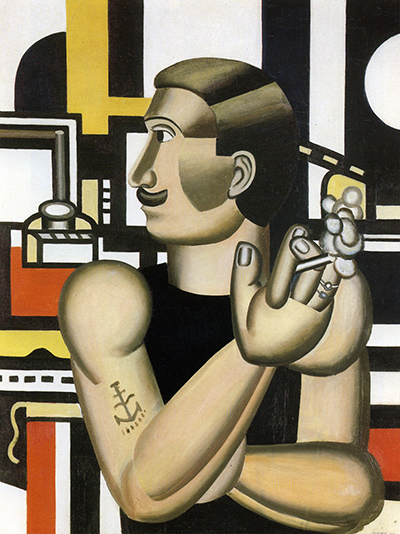
Fernand Léger, The Mechanic. The postwar worker offers another treatment of the single figure and its rounded solidity.
Machinery and human company
Léger's testimony about the war contains more than one kind of encounter. Kuh reproduces his retrospective account of the brilliance of sunlight on a gun's metal breech, an experience he associated with a change in his painting. [10] The light sliding over the cylinders in Soldier with a Pipe offers a visible point of contact with that recollection. It is a connection between an artist's broader account and this painting's appearance, rather than a recorded explanation of this particular canvas.
Human company supplied another essential experience. In a letter to Louis Poughon dated 5 October 1914, excerpted in the Centre Pompidou's teaching dossier, Léger describes the small group of men in his squad as the support that made life bearable. His attention moves towards their distinct temperaments and practical resourcefulness. The dossier also quotes his later recollection of watching men play cards and drawing them. [12] These accounts bring everyday observation and companionship into the same history as the fascination with machinery.
The smoker can sustain both associations. His cylindrical construction makes him appear tough, jointed and almost armoured; the pipe gives him an ordinary human occupation. His face is impersonal in its geometry, yet the act of finding it brings us into a close encounter. Distance and familiarity coexist. Its soldier remains a person even as the forms make his body strange.
Kuh's link to The Card Players is useful here. [10] The 1917 composition expands the subject into a group, whereas the Düsseldorf canvas concentrates our search around one smoker. Keeping attention on this figure reveals how much Léger can achieve through a small number of recognisable signs. A pipe stem reaching the mouth can carry more human specificity than a large, carefully modelled cylinder.
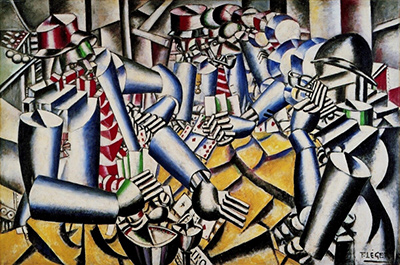
Fernand Léger, Soldiers Playing Cards. The later group makes the relation between mechanical-looking bodies and human company explicit.
A painting with a continuing history
Kuh's catalogue lists the canvas in Rolf de Maré's collection. [10] The current Düsseldorf provenance places it with de Maré from at least 1918 to at least 1954, followed by Philippe Dotremont, Tokutaro Yamamura and Galerie Beyeler. The Kunstsammlung acquired it from Beyeler in 1965. [1] The earlier catalogue thus belongs to the documented history of the painting now in Düsseldorf.
Returning from that history to the canvas, the pipe remains the most direct point of entry. It is small enough to be nearly lost, yet precise enough to gather the surrounding forms into a human action. The smoke then carries the eye upwards while the great cylinders pull it down. Between those opposing movements, Léger holds a soldier together: solid, fragmented, and absorbed in a moment whose simplicity survives the complexity of its making.
Léger in video
Explore abstraction, monumental painting and cinema through films from MoMA and the Centre Pompidou. These videos offer context for Léger’s wider work; the restoration film is in French.
Restaurer un… Fernand Léger
Follow conservation of Composition with Two Parrots, 1935–39, and look at painting on a monumental scale. French-language film.
Watch on YouTubeFernand Léger artworks directory
Works covered in these articles and further documented works. Studies and finished works have separate entries; alternate titles share an entry. This is not a catalogue raisonné.
| Name | Date | Medium |
|---|---|---|
| Acrobats and Clowns from Le Cirque | 1950 | |
| Adieu New York | 1946 | Painting |
| Ballet mécanique | 1924 | Film |
| Big Julie | 1945 | Painting |
| Builders with Aloe | 1951 | Painting |
| Charlot cubiste | 1924 | Sculpture |
| Chimneys on Rooftops | 1911 | Painting |
| Cirque (artist’s book) | 1950 | |
| Composition | 1929 | Painting |
| Composition (Study for Nude Model in the Studio) | 1912 | Drawing |
| Composition of Three Figures | 1932 | Painting |
| Composition with Two Parrots | 1935–39 | Painting |
| Construction Workers Final State | 1950 | Painting |
| Contrast of Forms | 1913 | Painting |
| Derrière le miroir, nos.121–122 (posthumous publication, includes a lithograph after Léger) | 1960 | |
| Drawing for The Card Game | 1917 | Drawing |
| Drawing for The Staircase | 1913 | Drawing |
| En attendant le départ | 1914 | Drawing |
| Grand Parade with Red Background | 1953 | Painting |
| J’ai tué (illustrated book) | 1918 | |
| La Cocarde, l’avion brisé | About 1916 | Drawing |
| La Couseuse | about1910 | Painting |
| La Fin du monde filmée par l’Ange N.-D. (illustrated book) | 1919 | |
| Les Femmes au bouquet (Women with a Bouquet) | 1921 | Painting |
| Man and Woman | 1921 | Painting |
| Man in Profile with Rope: Study for The Constructors | 1950/1 | Drawing |
| Man in the Blue Hat | 1937 | Painting |
| Matinée d’ivresse, from Les Illuminations | 1949 | |
| Mechanical Elements | 1918–23 | Painting |
| Mechanical Elements (Metropolitan Museum) | 1920 | Painting |
| Men in the City | 1919 | Painting |
| Mes voyages (posthumous illustrated book) | 1960 | |
| Mona Lisa with the Keys | 1930 | Painting |
| Nude Model in the Studio | 1912–13 | Painting |
| Nudes in the Forest | 1909–1911 | Painting |
| Propellers Second State | 1918 | Painting |
| Reading | 1924 | Painting |
| Soldier with a Pipe | 1916 | Painting |
| Soldiers Playing Cards | 1917 | Painting |
| Soldiers Playing Cards (front drawing) | 1916 | Drawing |
| Standing Nude, Rear View | 1911 | Drawing |
| Still Life with a Beer Mug | 1921–2 | Painting |
| Still Life with Tankard | 1921 | Drawing |
| Study for The Aviator | 1920 | Drawing |
| The Acrobat and his Partner | 1948 | Painting |
| The Acrobats in the Circus | 1918 | Painting |
| The Alarm Clock | 1914 | Painting |
| The Chalices and the Sponge, stained-glass model | 1950 | Drawing |
| The City | 1919 | Painting |
| The Disks in the City | 1920 | Painting |
| The Mechanic | 1920 | Painting |
| The Railway Crossing | 1919 | Painting |
| The Three Musicians | 1944, after a 1924–25 drawing | Painting |
| The Wheels | 1945 | Drawing |
| Three Women | 1921–22 | Painting |
| Two Women Holding Flowers | 1954 | Painting |
| Umbrella and Bowler | 1926 | Painting |
| Verdun, dessin du front | About 1915 | Drawing |
| Woman with a Book | 1923 | Painting |
| Woman: Costume Design for La Création du monde | c.1922–23 | Drawing |
Discussion
Look again at the images and ideas explored in Soldier with a Pipe. These editorial prompts invite your observations.
Reader Insights
What becomes easier to notice in Soldier with a Pipe when you compare it with Soldiers Playing Cards?
Where does the comparison with The Mechanic reveal the clearest change in Léger’s approach?
Which detail would you follow first when returning to the work, and why?
Join the Conversation
Share a detail, comparison or question about Soldier with a Pipe below.
References
- Kunstsammlung Nordrhein-Westfalen, Düsseldorf, Le soldat à la pipe, 1916. Current object record, colour reproduction, dimensions, inventory 1028, Bauquier 100 and provenance. View source.
- Kröller-Müller Museum, Nus dans la forêt / Nude Figures in a Forest, collection record KM 101.045. Current date, medium, identifier, curatorial sections “Distinctive cubist style”, “Geometric shapes” and “‘Battle of volumes’”, and museum reproduction. View source.
- Fondation Beyeler, Contraste de formes, Fernand Léger, current collection record, Inv.90.6: date, medium, dimensions, collection and signature on reverse. View source.
- Philadelphia Museum of Art, The City, 1919, collection record and interpretation; A. E. Gallatin Collection, 1952-61-58. View source.
- National Gallery of Canada, The Mechanic, 1920, accession 14985, collection details and interpretive paragraph; French collection record, Le mécanicien. View source.
- The Museum of Modern Art, Fernand Léger. Three Women. 1921–22, collection record, object 189.1942: artwork image, metadata, 2021 gallery label, publication excerpt, installation history and provenance. View source.
- Musée national Fernand Léger, La Joconde aux clés, collection record and museum commentary (French): object data, owning museum image, artist recollection, sardine tin and symbolic interpretations. The artist’s recollection is consulted as reproduced by the museum; the page does not date it. View source.
- Musée national Fernand Léger, “Les années 50, les constructeurs”, complete Les Constructeurs (définitif) entry and accompanying museum image: title, 1950 date, oil on canvas, 300 × 228 cm, inventory MNFL 94001, 1969 donation and museum-mediated Renault-canteen recollection. View source.
- Musée national Fernand Léger, La Grande Parade sur fond rouge, complete object record and displayed reproduction: 1953, oil on canvas, 114.5 × 156.2 cm, inventory MNFL 96006; donation of Nadia Léger and Georges Bauquier. View source.
- Katharine Kuh, Léger, Art Institute of Chicago, 1953, pp. 22–23 (PDF pp. 27–28). Reproduction, ownership caption, wartime discussion and artist recollections. View source.
- Musée national Fernand Léger, La Première Guerre mondiale, especially the entries for Sans titre, Verdun, dessin du front and La Cocarde, l'avion brisé. Museum account and excerpt from Léger's letter to Jeanne, 28 March 1915. View source.
- Centre Pompidou, Fernand Léger, teaching dossier, April 2008, sections on war drawings and the excerpt from the letter to Louis Poughon, 5 October 1914. View source.