 by Tom Gurney
Tom Gurney BSc (Hons) is an art history expert with over 20 years experience
Published on June 19, 2020 / Updated on November 1, 2026
Email: tomgurney1@gmail.com / Phone: +44 7429 011000
Soldiers Playing Cards: Introduction
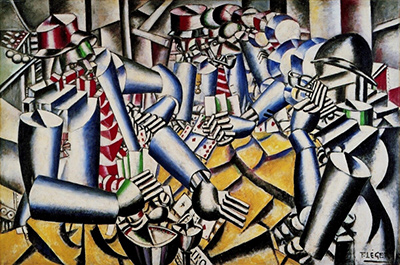
Three soldiers gather over a yellow table, their enormous blue-grey arms surrounding a scatter of playing cards. Fingers spread like parallel bars. Heads divide into polished curves and sharp-edged planes. A helmet, medals and red military caps place this peculiar assembly within the world of the army, while the pipes and cards bring it close to ordinary life. Fernand Léger painted Soldiers Playing Cards, also known by its French title La partie de cartes, in 1917. The oil painting belongs to the Kröller-Müller Museum in Otterlo, under inventory number KM 101.351. [1]
The first impression can be of an almost impenetrable construction. Stay with it, however, and a recognisable social occasion emerges. Each player occupies a different position around the table. Each has something to do with his hands. The little cards give the huge bodies a shared purpose, bringing a moment of concentration and companionship into an image whose surfaces suggest metal.
At a Glance
- ArtistFernand Léger
- SubjectSoldiers Playing Cards
- Date1917 [1]
- CollectionKröller-Müller Museum, Otterlo [1]
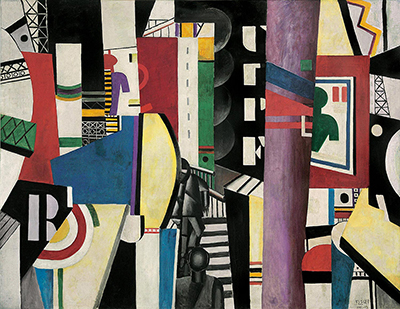
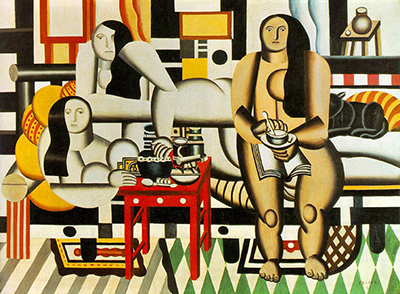
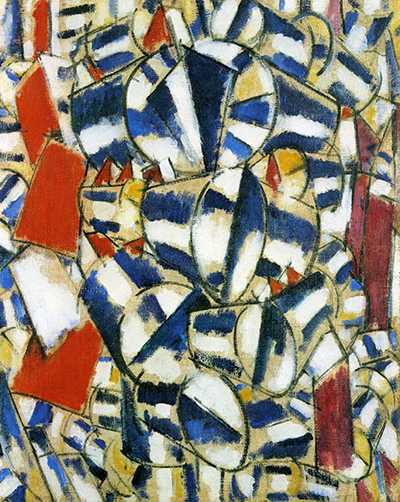
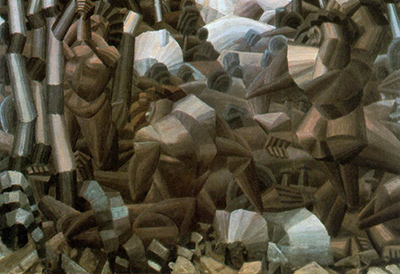
This work across Fernand Léger’s career
Nudes in the Forest
1909–1911 [2]Contrast of Forms
1913 [3]The Mechanic
1920 [5]Three Women
1921–22 [6]Contents
- Finding the players
- A table made of competing directions
- From the front to the canvas
- The drawings and the finished painting
- Why the soldiers appear mechanical
- Impersonality and companionship
Finding the players
The soldier on the left provides a useful starting point. His red-topped cap sits above a face assembled from green, white and dark facets. Beneath it, a long red-and-white passage runs down his chest, accompanied by a small medal. One substantial arm stretches across the foreground, while another reaches inward. The figure has the presence of a solid object placed immediately before us, although its separate parts resist being joined into a continuous anatomy.
Across the table, a second red cap marks the central player. His head and pipe occupy a relatively small area above an emphatic blue torso. The arm descending towards the cards looks disproportionately powerful beside the delicate, striped fingers. These shifts of scale matter more than an anatomically plausible pose: the picture makes us feel the weight of an arm and the precision of a hand as separate experiences.
On the right, the helmeted player turns inward. His dark helmet forms one of the clearest silhouettes in the painting. Below its curved brim, the face breaks into horizontal and diagonal pieces. A pipe projects towards the centre, and an upraised hand brings a set of striped fingers near the mouth. The posture suggests a player considering the game, though the painted face gives us little access to a particular emotion.
The three positions create a loose circuit. Our attention passes from the left soldier's hands towards the cards, rises to the central player and then moves across to the helmeted head. The long limbs repeatedly redirect us into that circuit. We can become absorbed in an isolated cylinder or a bright patch of red, but the activity at the table keeps pulling the pieces together.
A table made of competing directions
The yellow table is essential to the scene's legibility. Its colour separates a common surface from the colder masses around it. Yet it offers little of the reassuring geometry of a familiar tabletop. Dark bands cross its yellow areas, dividing the surface into sloping sections. Parts seem to tip forward, making the cards visible, while the surrounding bodies push against them from several directions.
The cards introduce another scale of looking. Their white rectangles and tiny red or black marks are minute beside the broad sleeves. Some lean against one another; others appear spread across the surface. A few fingers can almost be read as further strips of card. That resemblance gives the handling of the game an unusual intimacy: the bodies and their small possessions have begun to share a visual language.
At the bottom, the gathering of rounded and angular objects further interrupts the table's boundaries. It is possible to follow individual rims, curves and divided surfaces without obtaining a complete inventory of everything present. Léger lets an edge or a highlight become vivid before an object's identity becomes certain. This makes the still-life details part of the painting's activity rather than background accessories.
There is scarcely a place for the eye to rest outside the group. Upright bands and diagonal structures pack the upper background. Small circular forms gather near the upper centre, and a cropped greenish plane enters at the far left. These fragments press the players towards us. The space feels occupied through and through, with every interval claimed by another form.
From the front to the canvas
Léger's wartime drawing provides the historical route into this dense arrangement. Mobilised in 1914, he continued to draw under front-line conditions. The Musée national Fernand Léger describes drawings made on letter cards and on the backs of military maps, often accompanying messages to those at home. In its discussion of a drawing from around 1915, the museum reproduces a letter to Jeanne dated 28 March 1915 in which he connected Cubist fragmentation with the physical destruction of war. [10]
That connection gives a disturbing edge to the painting's divided bodies. Arms and faces are broken into parts, yet the parts also seem exceptionally durable. Some forms resemble hollow sections, others heavy castings. The men look at once vulnerable to disassembly and strong enough to withstand immense pressure.
The Kröller-Müller Museum places the finished painting in Léger's convalescence after a poison-gas attack. The Biot museum also links its making to his recovery and to a selection of front-line drawings. [1] [10] The canvas returns to observations made earlier under very different conditions. Moments among comrades could be reconsidered through the slower work of painting.
That interval helps explain the combination of immediate human activity and elaborate construction. A card game supplies the gestures: holding, waiting, looking and reaching. The finished composition gives those gestures a wider system of repeated curves, abrupt cuts and opposing colours. The picture retains the occasion while allowing its visual structure to become forceful in its own right.
The drawings and the finished painting
The Centre Pompidou's educational dossier discusses Soldats jouant aux cartes, a pencil drawing executed near Verdun in 1916. Measuring just 17 by 12.7 centimetres, it is a separate work on paper. The dossier relates this and other drawings of the subject to the larger oil composition of the following year. It also reproduces Léger's later recollection of watching his comrades play and making sketches beside them. [11]
A further sheet, the Metropolitan Museum of Art's Drawing for “The Card Game”, dates from 1917. Its medium is brush and ink and graphite on paper mounted on board, and it measures 52.7 by 37.8 centimetres. The Met describes its bent arm as a gesture of holding or shielding cards. That small movement connects the study with the finished canvas, where hands make the massive figures intelligible. [12]
The Met's record also connects the study and the painting through their sale: on 5 December 1917, Léger sold this drawing, additional studies and the final oil to his new dealer Léonce Rosenberg. [12] These related works document sustained attention to the subject. Their different dates, materials and scales allow us to see a process extending beyond a single sketching session.
Looking back at the canvas after considering the drawings, its crowdedness feels purposeful. The figures occupy their places with the insistence of structures fitted together. Every enlargement of a limb changes the space left to its neighbours. The game has become a means of bringing several human presences into a tightly interdependent whole.
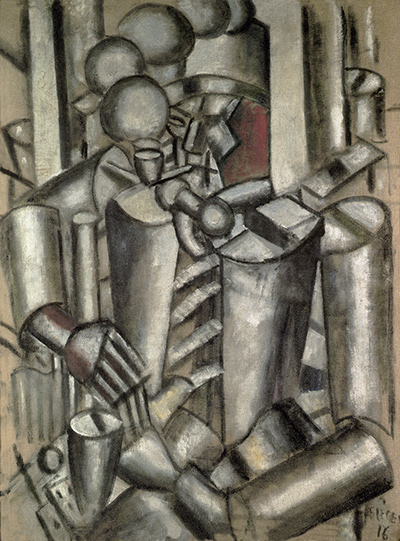
Fernand Léger, Soldier with a Pipe. The wartime single figure provides a comparison for light, volume and the human presence.
Why the soldiers appear mechanical
The owning museum interprets the figures as robot-like, connecting their robust geometry and pipe-shaped arms with the machinery of war. [1] The comparison is persuasive when we look at the abrupt joints, metallic highlights and repeated tubular forms. It describes an effect of the painting rather than the literal identity of its subjects.
The cylinders are particularly striking because their surfaces turn so decisively from dark to light. Along a sleeve, a pale strip swells between deep blue shadows. A sliced end can appear almost diagrammatic, exposing an ellipse where a conventional painted limb would continue. Elsewhere, hard white planes meet black edges without a soft transition. These different treatments place rounded mass beside flat construction.
Katharine Kuh's 1953 catalogue discusses this painting under the title The Card Players. She emphasises its integrated overall pattern and metallic soldiers, while printing Léger's recollection of the brilliance of sunlight on artillery. [13]
That retrospective testimony gives historical depth to the canvas's shining surfaces. Light seems almost a material in itself here, making a curved object expand towards us. Yet the highlights do not establish one consistent room with a single source of illumination. Each part declares its own volume. The separate pieces acquire a strong presence, even as their edges lock them into the surrounding pattern.
Colour helps that negotiation. The great blue-grey forms repeat across the group, while red appears in caps, faces, clothing and card marks. Green accents cut through the cooler passages. Yellow binds the lower centre together. The eye can move through these recurrences even when the anatomy becomes difficult to follow. Colour makes connections that the broken contours interrupt.
Impersonality and companionship
The soldiers' faces offer few of the familiar signs through which a portrait communicates character. Eyes and mouths are subordinated to the larger arrangement of planes. Even the hands repeat a simplified pattern. This can make the group seem impersonal, especially when the cylinders begin to resemble interchangeable parts.
Their relationships tell another story. The players turn towards a shared centre, hold their cards and occupy the same cramped field. They are bound by a practical activity that requires attention to the other participants. The game supplies a small framework of choices and responses within a much larger experience over which soldiers had limited control.
Léger's account of military companionship helps give this reading substance. In a letter to Louis Poughon dated 5 October 1914, reproduced in the Centre Pompidou dossier, he described the small unit as a kind of family and stressed the importance of sociability under extreme conditions. [11] Rachel Boate's Met essay similarly connects his wartime experience with respect for fellow soldiers and workers, and with his wish to make modern art accessible to a broad public. [14]
Those accounts do not turn the painting into a straightforward illustration of solidarity. Its surfaces remain hard, its space compressed and its figures difficult to disentangle. They do, however, make companionship a serious possibility alongside the more unsettling mechanical reading. The closeness can feel sustaining and oppressive at once.
The cards hold those possibilities together. They are fragile-looking pieces of paper among bodies that seem built from heavy material. Their small signs require a kind of looking different from the sweeping apprehension of a great cylinder. In moving between these scales, we encounter both the force of the painted construction and the everyday activity that brought the men together. The game continues to make sense, even when the bodies around it seem to belong to a transformed world.
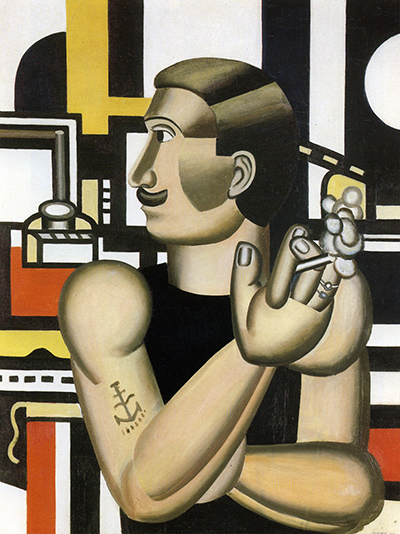
Fernand Léger, The Mechanic. A postwar worker gives the machine-like body another social setting.
Léger in video
Explore abstraction, monumental painting and cinema through films from MoMA and the Centre Pompidou. These videos offer context for Léger’s wider work; the restoration film is in French.
Restaurer un… Fernand Léger
Follow conservation of Composition with Two Parrots, 1935–39, and look at painting on a monumental scale. French-language film.
Watch on YouTubeFernand Léger artworks directory
Works covered in these articles and further documented works. Studies and finished works have separate entries; alternate titles share an entry. This is not a catalogue raisonné.
| Name | Date | Medium |
|---|---|---|
| Acrobats and Clowns from Le Cirque | 1950 | |
| Adieu New York | 1946 | Painting |
| Ballet mécanique | 1924 | Film |
| Big Julie | 1945 | Painting |
| Builders with Aloe | 1951 | Painting |
| Charlot cubiste | 1924 | Sculpture |
| Chimneys on Rooftops | 1911 | Painting |
| Cirque (artist’s book) | 1950 | |
| Composition | 1929 | Painting |
| Composition (Study for Nude Model in the Studio) | 1912 | Drawing |
| Composition of Three Figures | 1932 | Painting |
| Composition with Two Parrots | 1935–39 | Painting |
| Construction Workers Final State | 1950 | Painting |
| Contrast of Forms | 1913 | Painting |
| Derrière le miroir, nos.121–122 (posthumous publication, includes a lithograph after Léger) | 1960 | |
| Drawing for The Card Game | 1917 | Drawing |
| Drawing for The Staircase | 1913 | Drawing |
| En attendant le départ | 1914 | Drawing |
| Grand Parade with Red Background | 1953 | Painting |
| J’ai tué (illustrated book) | 1918 | |
| La Cocarde, l’avion brisé | About 1916 | Drawing |
| La Couseuse | about1910 | Painting |
| La Fin du monde filmée par l’Ange N.-D. (illustrated book) | 1919 | |
| Les Femmes au bouquet (Women with a Bouquet) | 1921 | Painting |
| Man and Woman | 1921 | Painting |
| Man in Profile with Rope: Study for The Constructors | 1950/1 | Drawing |
| Man in the Blue Hat | 1937 | Painting |
| Matinée d’ivresse, from Les Illuminations | 1949 | |
| Mechanical Elements | 1918–23 | Painting |
| Mechanical Elements (Metropolitan Museum) | 1920 | Painting |
| Men in the City | 1919 | Painting |
| Mes voyages (posthumous illustrated book) | 1960 | |
| Mona Lisa with the Keys | 1930 | Painting |
| Nude Model in the Studio | 1912–13 | Painting |
| Nudes in the Forest | 1909–1911 | Painting |
| Propellers Second State | 1918 | Painting |
| Reading | 1924 | Painting |
| Soldier with a Pipe | 1916 | Painting |
| Soldiers Playing Cards | 1917 | Painting |
| Soldiers Playing Cards (front drawing) | 1916 | Drawing |
| Standing Nude, Rear View | 1911 | Drawing |
| Still Life with a Beer Mug | 1921–2 | Painting |
| Still Life with Tankard | 1921 | Drawing |
| Study for The Aviator | 1920 | Drawing |
| The Acrobat and his Partner | 1948 | Painting |
| The Acrobats in the Circus | 1918 | Painting |
| The Alarm Clock | 1914 | Painting |
| The Chalices and the Sponge, stained-glass model | 1950 | Drawing |
| The City | 1919 | Painting |
| The Disks in the City | 1920 | Painting |
| The Mechanic | 1920 | Painting |
| The Railway Crossing | 1919 | Painting |
| The Three Musicians | 1944, after a 1924–25 drawing | Painting |
| The Wheels | 1945 | Drawing |
| Three Women | 1921–22 | Painting |
| Two Women Holding Flowers | 1954 | Painting |
| Umbrella and Bowler | 1926 | Painting |
| Verdun, dessin du front | About 1915 | Drawing |
| Woman with a Book | 1923 | Painting |
| Woman: Costume Design for La Création du monde | c.1922–23 | Drawing |
Discussion
Look again at the images and ideas explored in Soldiers Playing Cards. These editorial prompts invite your observations.
Reader Insights
What becomes easier to notice in Soldiers Playing Cards when you compare it with Soldier with a Pipe?
Where does the comparison with The Mechanic reveal the clearest change in Léger’s approach?
Which detail would you follow first when returning to the work, and why?
Join the Conversation
Share a detail, comparison or question about Soldiers Playing Cards below.
References
- Kröller-Müller Museum, La partie de cartes / Soldiers Playing Cards, 1917, inventory KM 101.351: object information, “Cylinder”, “World War I” and “Robots”, with the owning museum's linked reproduction. Consulted 31 October 2026. View source.
- Kröller-Müller Museum, Nus dans la forêt / Nude Figures in a Forest, collection record KM 101.045. Current date, medium, identifier, curatorial sections “Distinctive cubist style”, “Geometric shapes” and “‘Battle of volumes’”, and museum reproduction. View source.
- Fondation Beyeler, Contraste de formes, Fernand Léger, current collection record, Inv.90.6: date, medium, dimensions, collection and signature on reverse. View source.
- Philadelphia Museum of Art, The City, 1919, collection record and interpretation; A. E. Gallatin Collection, 1952-61-58. View source.
- National Gallery of Canada, The Mechanic, 1920, accession 14985, collection details and interpretive paragraph; French collection record, Le mécanicien. View source.
- The Museum of Modern Art, Fernand Léger. Three Women. 1921–22, collection record, object 189.1942: artwork image, metadata, 2021 gallery label, publication excerpt, installation history and provenance. View source.
- Musée national Fernand Léger, La Joconde aux clés, collection record and museum commentary (French): object data, owning museum image, artist recollection, sardine tin and symbolic interpretations. The artist’s recollection is consulted as reproduced by the museum; the page does not date it. View source.
- Musée national Fernand Léger, “Les années 50, les constructeurs”, complete Les Constructeurs (définitif) entry and accompanying museum image: title, 1950 date, oil on canvas, 300 × 228 cm, inventory MNFL 94001, 1969 donation and museum-mediated Renault-canteen recollection. View source.
- Musée national Fernand Léger, La Grande Parade sur fond rouge, complete object record and displayed reproduction: 1953, oil on canvas, 114.5 × 156.2 cm, inventory MNFL 96006; donation of Nadia Léger and Georges Bauquier. View source.
- Musée national Fernand Léger, La Première Guerre mondiale, especially the commentary on Sans titre, Verdun, dessin du front, around 1915, and its account of La Partie de cartes; includes an excerpt from Léger's letter to Jeanne, 28 March 1915 (in French). Consulted 31 October 2026. View source.
- Vanessa Morisset, Centre Pompidou, Fernand Léger, educational dossier, April 2008, updated 2010: “Soldats jouant aux cartes, 1916” and the reproduced extract of the letter to Louis Poughon, 5 October 1914 (in French). Consulted 31 October 2026. View source.
- Metropolitan Museum of Art, Drawing for “The Card Game”, 1917, object 2016.237.19: curatorial introduction and Artwork Details. Consulted 31 October 2026. View source.
- Katharine Kuh, Léger (Art Institute of Chicago, in collaboration with the Museum of Modern Art and San Francisco Museum of Art, 1953), printed pp. 8 and 22–23, PDF pp. 13 and 27–28: quotation-method note, wartime commentary and reproduction of The Card Players. Kuh notes on printed p. 8 that the artist’s statements were selected from letters, speeches, conversations and articles to illuminate his art; they were not necessarily comments on the particular works beside them. Consulted in the locally captured catalogue text, 31 October 2026. View source.
- Rachel Boate, “Fernand Léger (1881–1955)”, Metropolitan Museum of Art, 1 May 2018, wartime discussion. Consulted 31 October 2026. View source.