



 by Tom Gurney
Tom Gurney BSc (Hons) is an art history expert with over 20 years experience
Email: tomgurney1@gmail.com / Phone: +44 7429 011000
Mechanical Elements (1920): Introduction
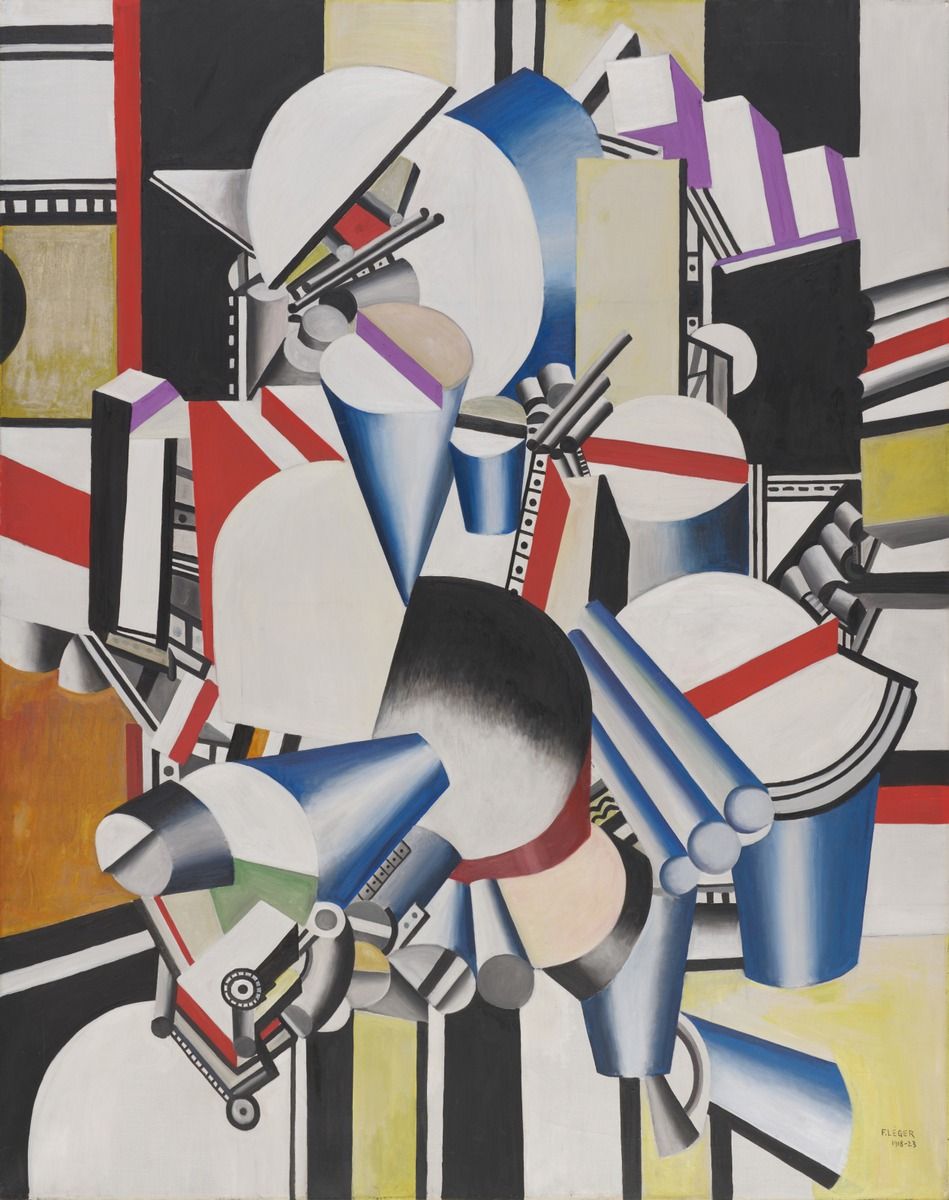
Fernand Léger's Mechanical Elements packs a narrow canvas with forms that seem ready to turn, slide or lock together. Pale cylinders descend between black uprights; a red bracket-like shape grips the right side; green strips interrupt the central assembly. Yet no single action explains the whole construction. The painting makes machinery feel present without showing an engine whose operation we can follow.
This is the 1920 oil painting in the Metropolitan Museum of Art, New York, measuring 92.1 × 59.7 cm and numbered 1999.363.36. The museum catalogues it as Mechanical Elements. Despite their related titles, it is distinct from Léger's different painting of that name in Basel. [1]
At a Glance
- ArtistFernand Léger
- WorkMechanical Elements
- Date1920 [1]
- MediumOil on canvas
- Dimensions92.1 x 59.7 cm [1]
- CollectionThe Metropolitan Museum of Art [1]
- Object number1999.363.36 [1]
This work across Fernand Léger’s career
Nudes in the Forest
1909–1911 [2]Contrast of Forms
1913 [3]The Mechanic
1920 [5]Three Women
1921–22 [6]Contents
- A vertical construction
- Colour against modelled volume
- Black lines and shallow space
- The postwar mechanical period
- Invention rather than a machine diagram
- From elements to a human figure
- The Met painting today
A vertical construction
The first impression is of a structure squeezed upwards. Near the top, a sloping grey form and a red strip enter from the edge rather than ending comfortably inside the composition. Below them, short tubes and pale circular ends appear at different angles. The eye keeps finding a possible continuation, then meeting another piece that interrupts it. The narrow format gives these encounters particular force: there is little empty space into which the assembly can expand.
A heavy black rectangular framework occupies much of the lower left and middle. Its left side bends inward before descending, while its bottom edge cuts firmly across the picture. This is not simply a border around everything else. Some coloured forms sit inside it, others cross it, and others continue below. The framework supplies a measure of stability without establishing a container that explains where all the parts belong.
At the right, the red upright offers a different kind of support. Its squared upper bend surrounds a pale opening, while its lower section extends down beside black and cream shapes. It resembles a handle or bracket, but that resemblance remains provisional. Its colour and broad silhouette matter more immediately than a possible name: it gathers several smaller incidents into one strong vertical accent.
Colour against modelled volume
Léger gives certain grey forms rounded surfaces through light and dark. In the lower centre, a long oblique cylinder passes from a bright edge into shadow. Its pale circular end seems to face towards us. Similar shifts occur in smaller pieces farther left, encouraging the sense that these are solid objects with curved sides rather than outlines filled with colour.
The green diagonal crossing the lower central black area behaves differently. Its comparatively even colour makes it read as a strip laid across the surface. Above it, another green band and a green disc repeat the hue without repeating the shape. Together they connect distant points in the construction. Green is not assigned to a single object; it becomes a way of moving attention through the painting.
Red also changes its role. The large right-hand form is answered by the narrow red near the top and by a curved red sliver near the bottom. These accents differ in scale and direction. The lower sliver, enclosed by a pale shape, feels especially compressed beside the much broader red on the right. Their relationship gives the composition a rhythm that does not depend on identifying either shape as a piece of equipment.
Smaller pink, yellow and blue areas complicate any simple opposition between coloured panels and grey machinery. Pink rectangles interrupt the middle; a dark blue patch anchors the left below them. Yellow occupies narrow openings as well as broader pale passages. Colour repeatedly separates neighbouring forms, then links them to something farther away. It makes the crowded arrangement legible without making its purpose explicit.
Black lines and shallow space
The black framework can look like a solid structure, but it also acts as a flat graphic pattern. Its thick bars divide the canvas with an authority quite different from the shaded cylinders. At the upper right, thinner black lines suggest a rail-like construction receding sideways. There is a hint of architectural space, but no continuous room into which the central forms can be securely placed.
Overlapping edges create local pockets of depth. A pale circle may appear in front of a dark strip; a grey shaft may pass behind another element. These small relationships do not combine into a single dependable perspective. A shape can seem substantial in one passage and abruptly flattened in the next. The painting offers enough depth to make encounters between objects vivid, while refusing the spaciousness of a conventional interior.
Pattern intensifies this uncertainty. Curved parallel lines near the upper centre and the green-and-white wavy strip below the black crossbar introduce repeated marks into an arrangement dominated by larger shapes. Near the lower right, short horizontal strokes and dots sit on pale surfaces. Such passages look deliberately differentiated, but they do not function as explanatory labels. Their visual precision should not be mistaken for engineering information.
The cream areas are equally important. They open small intervals around the assembly and sometimes appear caught between its parts. Because similar pale tones occur within the machinery-like forms, background and object do not remain entirely separate categories. Looking closely means repeatedly deciding whether a light patch is an opening, a surface or the end of a solid piece.
Léger in video
Explore abstraction, monumental painting and cinema through films from MoMA and the Centre Pompidou. These videos offer context for Léger’s wider work; the restoration film is in French.
1913 | “Contrast of Forms” by Fernand Léger
MoMA looks at its own 1913 Contrast of Forms, including the painting’s rough surface. This is a different canvas from the Beyeler work covered in this cluster. English.
Watch on YouTubeThe postwar mechanical period
The Met places Léger's mechanical period at approximately 1918–23 and explains its geometric vocabulary as an evocation of modern technology rather than a depiction of identifiable working components. [1] The title therefore names a field of associations, not a technical specification. Cylinders and brackets can suggest manufacture even when their painted arrangement has no demonstrable practical use.
Rachel Boate situates the development of Léger's postwar mechanical style after his military service in the First World War. She connects his attention to soldiers, workers and technological forms with an effort to represent modern life, and specifically discusses the compressed construction of this 1920 painting. [10] That context helps explain why its hard forms belong to a contemporary visual world rather than an imaginary antique one.
It does not turn every circle into an artillery reference or every upright into a factory building. The picture supplies no particular workplace, named machine or identifiable event. Its strongest evidence is the arrangement itself: abrupt changes of direction, tightly held intervals and contrasting surfaces make a still canvas feel insistently active. Motion is suggested through relationships between shapes, not demonstrated by moving parts.
Invention rather than a machine diagram
Writing about the separate Basel Mechanical Elements of 1918–23, Larissa Dätwyler examines the importance of artistic imagination in Léger's machine imagery. Her chapter opening considers contemporary criticism of his non-functional machinery and argues against treating the painting simply as an unsuccessful representation of a working machine. That discussion concerns Basel, not the Met canvas, but offers a useful distinction between mechanical resemblance and mechanical function. [11]
In the Met painting, a cylinder's light-catching edge can hold our attention even when we cannot trace its connection to another component. The red bracket-like form can organise the right side without fastening anything. These are not deficiencies that a more detailed diagram would necessarily repair. They allow shapes to answer the demands of colour, balance and contrast rather than the requirements of an actual mechanism.
The comparison with the Basel painting is consequently a comparison of approach, not proof that the pictures share a construction history. Their related titles and mechanical vocabulary do not make them interchangeable. The Met canvas rewards attention to its own narrow format, red right-hand upright and green crossings, rather than the transfer of details from another composition.
Fernand Léger, Mechanical Elements, 1918-23, Kunstmuseum Basel. A different painting shown for comparison with the Met canvas.
From elements to a human figure
Léger's The Mechanic, also painted in 1920 and held by the National Gallery of Canada, provides a brief figurative counterpart. The Canadian museum draws attention to the contrast between the figure's rounded, tubular body and the sharp geometry around him. [5] Mechanical-looking form could therefore shape Léger's treatment of a person as well as an assembly of objects.
Without that human figure, Mechanical Elements leaves scale unsettled. A circular end could belong to a small fitting or an enlarged industrial component. Nothing tells us how closely we stand to the construction. The upright canvas may have a bodily presence, but it contains no clearly depicted operator to organise the parts around a task.

Fernand Léger, The Mechanic, 1920. National Gallery of Canada. The rounded figure offers a comparison with the Met painting.
The Met painting today
The Metropolitan Museum records the work's credit as the Jacques and Natasha Gelman Collection, 1998. Its accession number is 1999.363.36. These details establish the painting's museum identity, separately from the collection history of the Basel canvas. [1]
Returning to the image, the absence of a functional explanation becomes productive. The black frame steadies an assembly that colour keeps breaking apart; shaded tubes project towards us while flat strips hold them against the surface. Léger makes mechanical form a problem for looking rather than a lesson in operation. The painting's precision lies in how its differences are organised, not in the machine it might appear to promise.
Fernand Léger artworks directory
Works covered in these articles and further documented works. Studies and finished works have separate entries; alternate titles share an entry. This is not a catalogue raisonné.
| Name | Date | Medium |
|---|---|---|
| Acrobats and Clowns from Le Cirque | 1950 | |
| Adieu New York | 1946 | Painting |
| Ballet mécanique | 1924 | Film |
| Big Julie | 1945 | Painting |
| Builders with Aloe | 1951 | Painting |
| Charlot cubiste | 1924 | Sculpture |
| Chimneys on Rooftops | 1911 | Painting |
| Cirque (artist’s book) | 1950 | |
| Composition | 1929 | Painting |
| Composition (Study for Nude Model in the Studio) | 1912 | Drawing |
| Composition of Three Figures | 1932 | Painting |
| Composition with Two Parrots | 1935–39 | Painting |
| Construction Workers Final State | 1950 | Painting |
| Contrast of Forms | 1913 | Painting |
| Derrière le miroir, nos.121–122 (posthumous publication, includes a lithograph after Léger) | 1960 | |
| Drawing for The Card Game | 1917 | Drawing |
| Drawing for The Staircase | 1913 | Drawing |
| En attendant le départ | 1914 | Drawing |
| Grand Parade with Red Background | 1953 | Painting |
| J’ai tué (illustrated book) | 1918 | |
| La Cocarde, l’avion brisé | About 1916 | Drawing |
| La Couseuse | about1910 | Painting |
| La Fin du monde filmée par l’Ange N.-D. (illustrated book) | 1919 | |
| Les Femmes au bouquet (Women with a Bouquet) | 1921 | Painting |
| Man and Woman | 1921 | Painting |
| Man in Profile with Rope: Study for The Constructors | 1950/1 | Drawing |
| Man in the Blue Hat | 1937 | Painting |
| Matinée d’ivresse, from Les Illuminations | 1949 | |
| Mechanical Elements | 1918–23 | Painting |
| Mechanical Elements (Metropolitan Museum) | 1920 | Painting |
| Men in the City | 1919 | Painting |
| Mes voyages (posthumous illustrated book) | 1960 | |
| Mona Lisa with the Keys | 1930 | Painting |
| Nude Model in the Studio | 1912–13 | Painting |
| Nudes in the Forest | 1909–1911 | Painting |
| Propellers Second State | 1918 | Painting |
| Reading | 1924 | Painting |
| Soldier with a Pipe | 1916 | Painting |
| Soldiers Playing Cards | 1917 | Painting |
| Soldiers Playing Cards (front drawing) | 1916 | Drawing |
| Standing Nude, Rear View | 1911 | Drawing |
| Still Life with a Beer Mug | 1921–2 | Painting |
| Still Life with Tankard | 1921 | Drawing |
| Study for The Aviator | 1920 | Drawing |
| The Acrobat and his Partner | 1948 | Painting |
| The Acrobats in the Circus | 1918 | Painting |
| The Alarm Clock | 1914 | Painting |
| The Chalices and the Sponge, stained-glass model | 1950 | Drawing |
| The City | 1919 | Painting |
| The Disks in the City | 1920 | Painting |
| The Mechanic | 1920 | Painting |
| The Railway Crossing | 1919 | Painting |
| The Three Musicians | 1944, after a 1924–25 drawing | Painting |
| The Wheels | 1945 | Drawing |
| Three Women | 1921–22 | Painting |
| Two Women Holding Flowers | 1954 | Painting |
| Umbrella and Bowler | 1926 | Painting |
| Verdun, dessin du front | About 1915 | Drawing |
| Woman with a Book | 1923 | Painting |
| Woman: Costume Design for La Création du monde | c.1922–23 | Drawing |
Discussion
Look again at the images and ideas explored in Mechanical Elements (1920). These editorial prompts invite your observations.
Reader Insights
Which part first suggests a possible machine, and where does that impression become uncertain?
How do the red upright and green strips direct your eye through the black framework?
What changes when you compare this narrow Met canvas with the separate Basel Mechanical Elements?
Join the Conversation
Share a detail, comparison or question about Mechanical Elements (1920) below.
References
- The Metropolitan Museum of Art, Mechanical Elements, Fernand Léger, 1920, object 1999.363.36. Collection details, credit line and curatorial account. English. View source.
- Kröller-Müller Museum, Nus dans la forêt / Nude Figures in a Forest, collection record KM 101.045. Current date, medium, identifier, curatorial sections “Distinctive cubist style”, “Geometric shapes” and “‘Battle of volumes’”, and museum reproduction. View source.
- Fondation Beyeler, Contraste de formes, Fernand Léger, current collection record, Inv.90.6: date, medium, dimensions, collection and signature on reverse. View source.
- Philadelphia Museum of Art, The City, 1919, collection record and interpretation; A. E. Gallatin Collection, 1952-61-58. View source.
- National Gallery of Canada, The Mechanic, Fernand Léger, 1920, accession 14985. Collection record and interpretation. English. View source.
- The Museum of Modern Art, Fernand Léger. Three Women. 1921–22, collection record, object 189.1942: artwork image, metadata, 2021 gallery label, publication excerpt, installation history and provenance. View source.
- Musée national Fernand Léger, La Joconde aux clés, collection record and museum commentary (French): object data, owning museum image, artist recollection, sardine tin and symbolic interpretations. The artist’s recollection is consulted as reproduced by the museum; the page does not date it. View source.
- Musée national Fernand Léger, “Les années 50, les constructeurs”, complete Les Constructeurs (définitif) entry and accompanying museum image: title, 1950 date, oil on canvas, 300 × 228 cm, inventory MNFL 94001, 1969 donation and museum-mediated Renault-canteen recollection. View source.
- Musée national Fernand Léger, La Grande Parade sur fond rouge, complete object record and displayed reproduction: 1953, oil on canvas, 114.5 × 156.2 cm, inventory MNFL 96006; donation of Nadia Léger and Georges Bauquier. View source.
- Rachel Boate, “Fernand Léger (1881–1955)”, Heilbrunn Timeline of Art History, The Metropolitan Museum of Art, 1 May 2018. English. View source.
- Larissa Dätwyler, “Une mécanique d'imagination”: Fernand Légers malerisches Äquivalent zur schönen Maschine, opening discussion, printed pp. 79–85. German. The painting discussed is the separate Basel work of 1918–23. View source.


