 by Tom Gurney
Tom Gurney BSc (Hons) is an art history expert with over 20 years experience
Published on June 19, 2020 / Updated on November 1, 2026
Email: tomgurney1@gmail.com / Phone: +44 7429 011000
Nudes in the Forest: Introduction
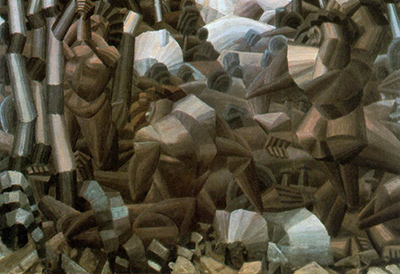
A raised arm is easier to find than a whole person in Fernand Léger’s Nudes in the Forest. Pale tree trunks rise beside dark, jointed bodies, while slabs of rock push between them. A hand or a bent knee briefly brings the scene into focus. Then the eye follows the same curve into something that belongs to the landscape, and the figure begins to disappear again.
Painted in 1909–1911, this large oil on canvas belongs to the Kröller-Müller Museum in Otterlo. Its French title is Nus dans la forêt; the museum uses Nude Figures in a Forest in English. Measuring 120 by 170 centimetres, it gives its encounter between bodies and woodland considerable physical breadth. [1] [2] Across that breadth, separating people from their surroundings becomes the painting’s central pleasure.
At a Glance
- ArtistFernand Léger
- SubjectNudes in the Forest
- Date1909–1911 [1]
- CollectionKröller-Müller Museum, Otterlo [1]
This work across Fernand Léger’s career
Nudes in the Forest (current article)
1909–1911 [1]Contrast of Forms
1913 [3]The Mechanic
1920 [5]Three Women
1921–22 [6]Contents
- Finding the three figures
- A forest made of solid pieces
- The pressure of light and dark
- Cézanne and the meeting of body and landscape
- Construction and the mechanical imagination
- An early Cubist work with its own weight
Finding the three figures
Start at the left, beside the tall cluster of trunks. A figure stands with both arms lifted, the elbows bending into the surrounding tangle. Below and nearer the centre, another nude sits among the angular masses. On the right, a third figure raises one arm. This three-part arrangement, identified in the museum’s commentary, provides a useful first route through the composition. [1]
Recognition comes in pieces. On the right, the head has the compact weight of a carved block, its side dark against the paler forms behind it. The bent arm makes an angular enclosure above and beside the head. Lower down, the broad torso narrows sharply towards the waist before widening again. These changes of direction let us follow a human pose even when the anatomy seems assembled from separate solids.
The left figure is more closely entangled with the uprights around it. Its raised arms enter the same busy region as the trees’ branching forms. The trunks provide a long vertical rhythm; the body interrupts that rhythm with a succession of bends. Looking between the two, we become aware of how much a pose depends on the shapes beside it. The figure gains its presence through the narrow intervals that separate it from the forest.
Near the middle, a broad pale mass suggests the seated figure’s back, with a small dark head above it. A bent leg carries the eye down and across the lower half. This pose spreads laterally, answering the upright weight of the other two figures. The arrangement holds together without giving each person a separate, clearly bounded place. We have to keep moving between the local clue and the larger pattern.
That movement changes the mood of the subject. Faces offer little access to individual character, and the lifted gestures remain difficult to translate into a single action. Attention settles instead on the physical facts of bending, sitting and standing. The bodies seem heavy, but their outlines are restless. They occupy a forest in which almost every neighbouring form can compete with them.
A forest made of solid pieces
The trees at the left are among the clearest forms in the picture. Long bands of light run down them, bounded by darker sides. Their surfaces curve enough to feel cylindrical, yet sharp breaks divide them into sections. They look capable of bearing weight. Around their bases, the smaller green and grey fragments make the ground seem crowded and uneven.
Farther across the canvas, pale rocks present broad faces to the light. Some turn abruptly into shadow; others offer a sloping surface that sends the eye upwards towards another block. A face of rock can resemble a shoulder, while the plane of a torso can momentarily join the stony ground. Léger has given flesh and landscape a common set of building forms.
Their differences remain important. The trunks tend towards long, narrow cylinders. The rocks favour blunt angles and broad facets. The figures combine these possibilities: limbs bend like jointed tubes, while backs and chests form heavier masses. This variety prevents the shared geometry from becoming monotonous. Each group has a recognisable rhythm within the larger construction.
Small details occasionally interrupt that monumental scale. Fingers and toes are indicated with short, parallel divisions. These marks are much smaller than the great planes of torso and rock around them, so they can catch the eye with surprising force. For a moment, an otherwise ambiguous shape becomes a hand. The precision is economical: a few strokes restore the human body without smoothing away its strangeness.
The pressure of light and dark
Léger’s palette is restrained, with green, blue-grey, grey and white identified by the museum. Its commentary preserves his description of the work as a “battle of volumes” and his recollection that the volumes were sufficient without added colour. [1] The phrase captures the force of the painting, though the surface rewards attention to its quiet colour differences as well.
The bodies appear warmer and browner than some of the greenish trunks and stones around them. Such distinctions help the figures emerge, but they are too subtle to isolate them completely. Pale patches occur throughout the scene, carrying the eye from a tree to a rock and onwards to a body. Dark accents similarly pass across categories. Colour gives us clues while allowing the larger pattern to remain continuous.
The strongest contrasts occur where a bright plane meets a deep shadow. They make individual pieces seem emphatically solid. Yet the accumulation of so many separate turns produces a curious effect: the scene feels packed with weight, even as its overall space becomes difficult to measure. We can sense the roundness of a trunk more readily than the distance from that trunk to a figure behind it.
There is little open air in which the eye can rest. Even near the top, pale passages are interrupted by dark uprights, curved fragments and sloping blocks. Down below, the foreground presses towards the edge in a jumble of smaller forms. The canvas’s horizontal spread promises room, but Léger fills that room with competing surfaces. The pressure comes from their proximity as much as from the figures’ gestures.
Cézanne and the meeting of body and landscape
Cézanne provides a crucial precedent for this shared treatment of people and nature. In his study of Léger’s engagement with the older painter, Jean Arrouye connects the forest nudes with Cézanne’s bathers, whose bodily shapes and inclinations can correspond to nearby trees. Arrouye observes that Léger’s figures seem especially close to the rocks around them. This is an account of formal relationships, rather than evidence that Léger copied a particular bather. [2]
The comparison helps explain why the woodland matters. A nude placed outdoors brings two kinds of form into contact: the human body and the irregular growth or structure of the natural world. Here that encounter extends across the entire surface. A figure receives no privileged smoothness, warmth or clarity. The surrounding landscape has an equally emphatic physical presence.
Arrouye also qualifies the familiar story that Cézanne’s advice about cylinders, spheres and cones supplied a ready-made recipe for Cubism. He suggests that the original advice concerned the analysis of underlying structure, while later artists developed its implications in their own ways. He further distinguishes Léger’s handling from Cézanne’s characteristic oblique parallel touches. [2] The inheritance involves choices and transformations.
In this painting, the result is a remarkably firm construction. Where one shape changes direction, a new face often asserts itself with an abrupt edge. The pale rock near the centre has a succession of turns that feels almost carved. The eye can examine those turns individually, then discover their echoes across the figure beside it. Cézanne’s example opens a problem that Léger works through in his own emphatic language.
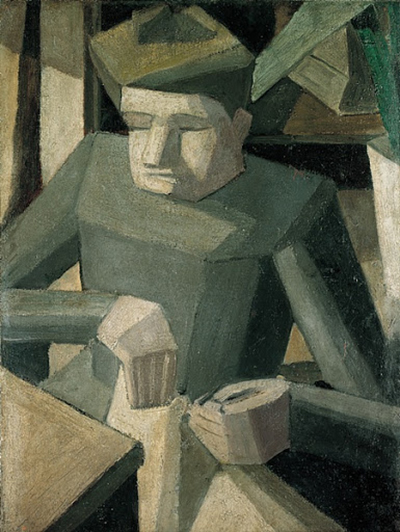
Fernand Léger, La Couseuse. The early seated figure offers another way of constructing a body from planes.
Construction and the mechanical imagination
Writing in 1953, Katharine Kuh described the painting through an architectural and mechanical vocabulary. She emphasised its overall construction and likened the tree trunks to pipes. Her account makes a useful distinction between the solidity of Léger’s forms and an emphasis on fragmentation alone. [10]
The pipe analogy is easy to understand when looking at the left-hand trunks. Their strong highlights and segmented lengths can suggest manufactured parts. Similar impressions arise in the bent limbs, whose large sections meet at abrupt angles. The painting allows these associations while retaining the unevenness and density of woodland. Its mechanical character begins in the way things are shaped and joined.
Architecture offers another helpful comparison. Each mass seems to need support or resistance from its neighbours. A broad, pale form is held in place by a dark wedge; a long upright is braced visually by a diagonal. The composition feels built through these exchanges. Even the smaller fragments at the bottom contribute to the impression of pieces fitted under pressure.
Such organisation makes the picture energetic without requiring us to reconstruct a definite event. The raised arms send attention upwards, the seated body brings it back down, and the rocks divert it sideways. Movement passes through the arrangement of solids. The forest’s apparent commotion has an underlying discipline that becomes clearer as we trace these changes of direction.
An early Cubist work with its own weight
The Kröller-Müller Museum places Léger’s distinctive geometry in relation to Cézanne and to the Cubism of Picasso and Braque. [1] Nudes in the Forest shows how productive that encounter could be. Familiar objects become an arrangement of facets, curves and tonal shifts, while the painted surface competes with the illusion of depth. Léger’s insistence on bulky, strongly modelled forms gives the result its particular character.
His later statements help clarify the ambition behind such formal independence. In a lecture of 5 May 1913, reproduced by the Centre Pompidou, Léger argued that a painting’s realism did not depend on imitation and located it in the organisation of lines, forms and colours. The lecture postdates this canvas, but offers a useful account of the pictorial priorities he was developing. [11]
Those priorities remain tangible here. A body can still be found, but finding it is only one part of looking. Its illuminated planes, the angles around it and the shapes continuing beyond its contour have their own force. Recognition and construction keep modifying one another. Once the seated figure has emerged, the pale masses nearby appear different; once those masses command attention, the figure begins to recede into them again.
Return finally to the raised arms at either side. They provide human points of orientation within a landscape that refuses to become a passive setting. Between them, the seated nude and the great pale rocks spread their weight across the canvas. The whole scene holds together through this exchange of upright and sloping, rounded and angular, illuminated and dark. Léger makes the forest compelling by giving everything in it the power to shape what we see next.
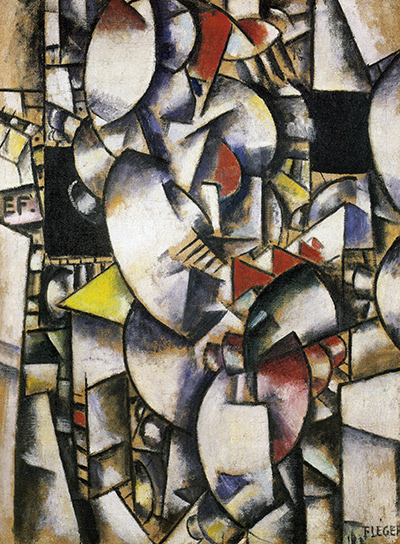
Fernand Léger, Nude Model in the Studio. The later studio painting presses figure and surroundings towards a more difficult threshold of recognition.
Léger in video
Explore abstraction, monumental painting and cinema through films from MoMA and the Centre Pompidou. These videos offer context for Léger’s wider work; the restoration film is in French.
1913 | “Contrast of Forms” by Fernand Léger
MoMA looks at its own 1913 Contrast of Forms, including the painting’s rough surface. This is a different canvas from the Beyeler work covered in this cluster. English.
Watch on YouTubeFernand Léger artworks directory
Works covered in these articles and further documented works. Studies and finished works have separate entries; alternate titles share an entry. This is not a catalogue raisonné.
| Name | Date | Medium |
|---|---|---|
| Acrobats and Clowns from Le Cirque | 1950 | |
| Adieu New York | 1946 | Painting |
| Ballet mécanique | 1924 | Film |
| Big Julie | 1945 | Painting |
| Builders with Aloe | 1951 | Painting |
| Charlot cubiste | 1924 | Sculpture |
| Chimneys on Rooftops | 1911 | Painting |
| Cirque (artist’s book) | 1950 | |
| Composition | 1929 | Painting |
| Composition (Study for Nude Model in the Studio) | 1912 | Drawing |
| Composition of Three Figures | 1932 | Painting |
| Composition with Two Parrots | 1935–39 | Painting |
| Construction Workers Final State | 1950 | Painting |
| Contrast of Forms | 1913 | Painting |
| Derrière le miroir, nos.121–122 (posthumous publication, includes a lithograph after Léger) | 1960 | |
| Drawing for The Card Game | 1917 | Drawing |
| Drawing for The Staircase | 1913 | Drawing |
| En attendant le départ | 1914 | Drawing |
| Grand Parade with Red Background | 1953 | Painting |
| J’ai tué (illustrated book) | 1918 | |
| La Cocarde, l’avion brisé | About 1916 | Drawing |
| La Couseuse | about1910 | Painting |
| La Fin du monde filmée par l’Ange N.-D. (illustrated book) | 1919 | |
| Les Femmes au bouquet (Women with a Bouquet) | 1921 | Painting |
| Man and Woman | 1921 | Painting |
| Man in Profile with Rope: Study for The Constructors | 1950/1 | Drawing |
| Man in the Blue Hat | 1937 | Painting |
| Matinée d’ivresse, from Les Illuminations | 1949 | |
| Mechanical Elements | 1918–23 | Painting |
| Mechanical Elements (Metropolitan Museum) | 1920 | Painting |
| Men in the City | 1919 | Painting |
| Mes voyages (posthumous illustrated book) | 1960 | |
| Mona Lisa with the Keys | 1930 | Painting |
| Nude Model in the Studio | 1912–13 | Painting |
| Nudes in the Forest | 1909–1911 | Painting |
| Propellers Second State | 1918 | Painting |
| Reading | 1924 | Painting |
| Soldier with a Pipe | 1916 | Painting |
| Soldiers Playing Cards | 1917 | Painting |
| Soldiers Playing Cards (front drawing) | 1916 | Drawing |
| Standing Nude, Rear View | 1911 | Drawing |
| Still Life with a Beer Mug | 1921–2 | Painting |
| Still Life with Tankard | 1921 | Drawing |
| Study for The Aviator | 1920 | Drawing |
| The Acrobat and his Partner | 1948 | Painting |
| The Acrobats in the Circus | 1918 | Painting |
| The Alarm Clock | 1914 | Painting |
| The Chalices and the Sponge, stained-glass model | 1950 | Drawing |
| The City | 1919 | Painting |
| The Disks in the City | 1920 | Painting |
| The Mechanic | 1920 | Painting |
| The Railway Crossing | 1919 | Painting |
| The Three Musicians | 1944, after a 1924–25 drawing | Painting |
| The Wheels | 1945 | Drawing |
| Three Women | 1921–22 | Painting |
| Two Women Holding Flowers | 1954 | Painting |
| Umbrella and Bowler | 1926 | Painting |
| Verdun, dessin du front | About 1915 | Drawing |
| Woman with a Book | 1923 | Painting |
| Woman: Costume Design for La Création du monde | c.1922–23 | Drawing |
Discussion
Look again at the images and ideas explored in Nudes in the Forest. These editorial prompts invite your observations.
Which detail first helps you find a person among the trees and rocks?
Reader Insights
What becomes easier to notice in Nudes in the Forest when you compare it with La Couseuse?
Where does the comparison with Nude Model in the Studio reveal the clearest change in Léger’s approach?
Which detail would you follow first when returning to the work, and why?
Join the Conversation
Share a detail, comparison or question about Nudes in the Forest below.
References
- Kröller-Müller Museum, Nus dans la forêt / Nude Figures in a Forest, collection record KM 101.045. Current date, medium, identifier, curatorial sections “Distinctive cubist style”, “Geometric shapes” and “‘Battle of volumes’”, and museum reproduction. Consulted 31 October 2026. View source.
- Jean Arrouye, “Du village à la forêt – Cezanne et Léger”, lecture delivered at the Université de Chicoutimi, Québec, 1995; published by Société Cezanne, 13 November 2017. Opening through the Nus dans la forêt section, including its caption and notes 1–7; French text. Consulted in the saved source capture, 31 October 2026. View source.
- Fondation Beyeler, Contraste de formes, Fernand Léger, current collection record, Inv.90.6: date, medium, dimensions, collection and signature on reverse. View source.
- Philadelphia Museum of Art, The City, 1919, collection record and interpretation; A. E. Gallatin Collection, 1952-61-58. View source.
- National Gallery of Canada, The Mechanic, 1920, accession 14985, collection details and interpretive paragraph; French collection record, Le mécanicien. View source.
- The Museum of Modern Art, Fernand Léger. Three Women. 1921–22, collection record, object 189.1942: artwork image, metadata, 2021 gallery label, publication excerpt, installation history and provenance. View source.
- Musée national Fernand Léger, La Joconde aux clés, collection record and museum commentary (French): object data, owning museum image, artist recollection, sardine tin and symbolic interpretations. The artist’s recollection is consulted as reproduced by the museum; the page does not date it. View source.
- Musée national Fernand Léger, “Les années 50, les constructeurs”, complete Les Constructeurs (définitif) entry and accompanying museum image: title, 1950 date, oil on canvas, 300 × 228 cm, inventory MNFL 94001, 1969 donation and museum-mediated Renault-canteen recollection. View source.
- Musée national Fernand Léger, La Grande Parade sur fond rouge, complete object record and displayed reproduction: 1953, oil on canvas, 114.5 × 156.2 cm, inventory MNFL 96006; donation of Nadia Léger and Georges Bauquier. View source.
- Katharine Kuh, Léger (Chicago: Art Institute of Chicago, in collaboration with the San Francisco Museum of Art and the Museum of Modern Art, New York, 1953), pp. 12–13 (PDF pp. 17–18), illustration and commentary; p. 8 (PDF p. 13), introductory explanation of the use of Léger’s quotations. Consulted in the saved catalogue text, 31 October 2026. View source.
- Centre Pompidou, Fernand Léger, educational dossier, April 2008, “Les contrastes de formes” and “Textes de référence”: extract from Léger’s “Les origines de la peinture contemporaine et sa valeur représentative”, lecture of 5 May 1913. Consulted in the saved French source capture, 31 October 2026. View source.