 by Tom Gurney
Tom Gurney BSc (Hons) is an art history expert with over 20 years experience
Published on June 19, 2020 / Updated on November 1, 2026
Email: tomgurney1@gmail.com / Phone: +44 7429 011000
Fernand Léger’s Quotes and Ideas: Introduction
Fernand Léger’s statements about painting reward a slower reading than a collection of memorable sayings allows. A lecture addresses an audience with objections to answer; a private letter catches a thought under pressure; a recollection gives an earlier experience the shape it acquired afterwards. Each can illuminate his art, but each does a different job. The dates and circumstances matter as much as the force of the words.
Several ideas connect the statements considered here: painting has its own reality; ordinary objects can command attention; the figure can be treated as a compositional element; colour can act beyond an object’s outline. These propositions also raise questions. What happens to human feeling when a body becomes a shape? How can the machine suggest beauty after mechanised warfare? And who gets to encounter the resulting art? Reading Léger through these questions brings his arguments into focus without turning every sentence into a rule for his entire career.
At a Glance
- ArtistFernand Léger
- SubjectQuotes
Contents
- 1913: What does a painting represent?
- Contrast as a way of thinking
- 1914–1916: War letters and the machine
- The human figure: compositional value and human worth
- 1935: An object released from its story
- Colour, architecture and a wider audience
1913: What does a painting represent?
At the Académie d’art Marie Wassilieff on 5 May 1913, Léger challenged the familiar question, “What does that represent?” The Centre Pompidou transcribes an excerpt of this French lecture, Les origines de la peinture contemporaine et sa valeur représentative. His answer separates pictorial realism from successful imitation and locates it in the simultaneous ordering of lines, forms and colours. The English question here is translated from that transcription; the later collected edition cited by the museum is not the source consulted directly.[1]
The practical force of this argument becomes apparent whenever we recognise a subject immediately and then struggle to explain why its painting holds our attention. Identification supplies a noun: a tree, a person, a room. It leaves the relationships within the picture largely untouched. A contour may redirect the eye; a large shape may lend weight to a small one; an interval can separate two elements while making their connection more emphatic. Such relationships need no convincing illusion of distance to become compelling.
Léger’s proposition therefore asks something active of the viewer. Naming the subject begins the encounter, but looking continues through the picture’s decisions. We can ask where a movement starts, where it meets resistance, and what makes one passage seem heavier or quicker than another. These questions offer a way into unfamiliar painting without requiring that every unfamiliar shape conceal an identifiable object. They also make realism a more demanding term: resemblance alone cannot settle the value of the work.
Contrast as a way of thinking
Contrast develops the 1913 argument into a constructive process. A contrast needs a relationship: something can appear large only against a scale, or quiet against a competing activity. That makes the surrounding elements part of what any individual element means to the eye. A curve does different work beside a straight edge than beside another curve. A repeated shape can establish a rhythm; a break in the repetition can sharpen our awareness of that rhythm.
This is a useful approach to Léger because it avoids treating geometric vocabulary as a code to decipher. Calling something cylindrical tells us about a shape. Asking what the cylinder does beside a flat area begins to explain a composition. The same distinction applies to colour. Naming a blue or red does less than considering its extent, position and relation to adjacent colours. Here contrast becomes a method of attention rather than an adjective for anything bright or dramatic.
There is also room for judgement within this approach. Strong opposition does not automatically make a successful painting. A contrast can be so obvious that it exhausts itself immediately, or so scattered that no relationship develops. Léger’s emphasis on pictorial organisation invites us to ask how an opposition sustains attention across the whole work. The question is one of construction, and it remains open to each viewer’s experience.
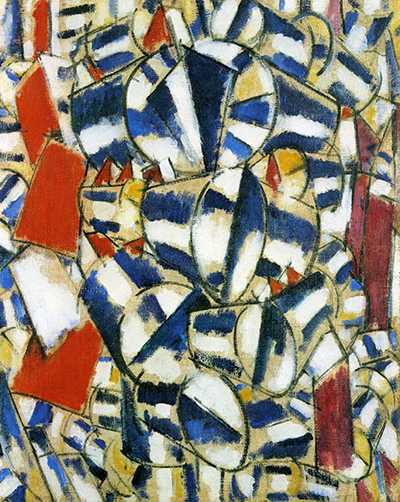
Fernand Léger, Contrast of Forms. A painting in which contrast can be considered without a recognisable narrative.
1914–1916: War letters and the machine
A letter to Louis Poughon dated 5 October 1914, excerpted in French by the Pompidou, describes the small military squad as a source of solidarity under appalling conditions. Léger singles out practical competence and resourcefulness among his companions.[1] Later correspondence is more harrowing. In Christopher Green’s 2026 Metropolitan Museum essay, a letter of 7 November 1916 recounts devastation near Douaumont and sharing a shell hole with a German corpse. Green’s English quotation includes: “One lives with the dead as good companions.” This is a translated passage mediated by Green, rather than a claim to direct consultation of the published French correspondence.[2]
These two moments prevent an easy division between a painter’s formal interests and a soldier’s human experience. The squad letter attends to what people can do for one another when ordinary security collapses. The later letter brings companionship into a terrible proximity with death. Read together, they make the word useful morally complicated: an efficient action can sustain life, while an efficient weapon can destroy it. Competence and machinery cannot be assigned a single emotional value.
The distinction matters when interpreting Léger’s subsequent interest in mechanical forms. Admiration for a manufactured surface or a precise arrangement need not imply approval of every purpose to which technology is put. Equally, the fact of suffering cannot make every mechanical image an accusation. The letters give us grounds to keep both possibilities in view. Their intimacy also resists the tidy story in which the war exists chiefly to explain a change of style. Before becoming evidence about painting, they are communications from someone trying to survive.
Green explicitly distinguishes Léger’s correspondence from the autobiographical mythmaking of his collaborator Blaise Cendrars. His account also identifies rheumatic complaints in the letters concerning Léger’s hospitalisation from 1917.[2] These qualifications change the interpretation. They ask us to resist the dramatic anecdote when a dated document offers a more difficult, less polished experience.
The human figure: compositional value and human worth
Katharine Kuh’s 1953 catalogue Léger supplies an essential warning about reading the artist’s words beside reproductions. Kuh explains that her survey draws on letters, speeches, conversations and articles; a quotation need not refer to the painting it accompanies. On printed page 35 she dates to 1952 a statement about considering the figure through its plastic value and deliberately withholding expression. Elsewhere she prints this undated statement in English: “A painter should not try to reproduce a beautiful thing, but should make the painting itself a beautiful thing.” Its occasion and translation history are not specified there.[3]
The word plastic in this context concerns the organisation of visible form. It does not tell us how much a person matters outside the picture. Confusing those levels would turn a statement about pictorial means into a complete account of Léger’s ethics. Yet the separation creates a genuine tension for a viewer. We habitually seek feeling in a face or gesture. A figure that withholds those familiar signals can frustrate that expectation and direct attention towards scale, balance or the connection between a body and its surroundings.
That frustration need not end the encounter. We can ask whether a figure’s presence emerges through its position in the whole rather than through a readable emotion. We can also remain dissatisfied. Léger’s statement explains a choice; it does not oblige us to find every consequence persuasive. Keeping that freedom makes his theory useful. It gives a viewer a proposition to test instead of an instruction to admire.
Kuh also records the artist considering whether the figure’s increased prominence in his latest work would prove a pictorial improvement or a mistake.[3] That uncertainty is particularly revealing. A theoretical statement could guide an experiment without determining its outcome. It allows us to read Léger’s ideas as working arguments, capable of adjustment as the problems of a painting changed.
1935: An object released from its story
In the French excerpt of his 1935 MoMA lecture, Un nouveau réalisme, la couleur pure et l’objet, transcribed by the Pompidou, Léger describes the object gaining independence from the overarching subject. He uses the example of a tree whose bark, branches and leaves offer possibilities when studied separately. He also credits the cinematic close-up with accelerating attention to the object.[1]
The distinction is between the thing and the role it has been given. Within a story, an object may mainly establish setting or explain an action. Considered separately, it can demand a different kind of scrutiny. Cropping and enlargement alter the conditions of recognition: something familiar may remain identifiable while becoming unexpectedly strange. The viewer knows what it is yet has to learn how to look at it again.
This argument offers a bridge between representation and invention. Starting from an ordinary thing does not prescribe a single pictorial result. Selection changes emphasis, and emphasis changes experience. The artistic decision lies partly in what is allowed to occupy our attention. An apparently modest object can carry a substantial encounter once its customary supporting role falls away. The idea reaches beyond unusual subject matter: it asks how much we overlook precisely because we recognise something too readily.
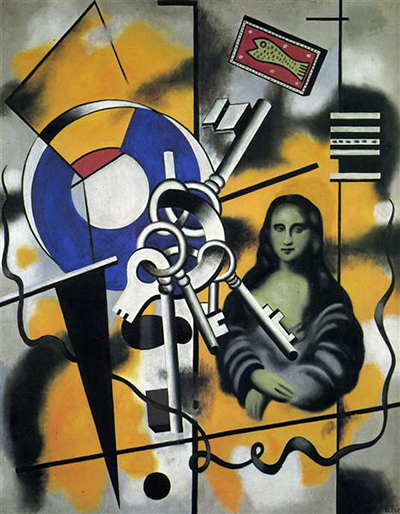
Fernand Léger, Mona Lisa with the Keys. The enlarged keys and reproduced portrait make the isolation of an object visible.
Colour, architecture and a wider audience
The Fondation Beyeler’s German gallery guide offers another mediated statement. Entry 15 connects Adieu New York (1946) with Léger’s recollection of Broadway lighting passing across people and surrounding space. The guide quotes him in German but gives no date for the statement; 1946 dates the painting. Entry 20 explains his view that a mural should serve society and respond to its architecture.[4]
These ideas shift attention from the isolated canvas towards the conditions of seeing. Colour experienced as illumination can reach across boundaries that belong to individual objects. A wall introduces another set of relationships: a picture must encounter the building’s scale, the viewer’s route and the distance from which it is seen. The spectator may be passing through a space rather than standing still before a frame. Such circumstances make the location part of the artistic problem.
The wish for a wider audience also deserves to remain a question. Public placement creates opportunities for encounter; it cannot guarantee comprehension or affection. An accessible location and an immediately accessible visual language are different achievements. Léger’s ideas are most productive when they prompt us to consider both: who can see the work, and what kind of looking it invites. His statements offer ways of approaching those encounters, while the work itself must still earn the attention he sought.
Léger in video
Explore abstraction, monumental painting and cinema through films from MoMA and the Centre Pompidou. These videos offer context for Léger’s wider work; the restoration film is in French.
Restaurer un… Fernand Léger
Follow conservation of Composition with Two Parrots, 1935–39, and look at painting on a monumental scale. French-language film.
Watch on YouTubeFernand Léger artworks directory
Works covered in these articles and further documented works. Studies and finished works have separate entries; alternate titles share an entry. This is not a catalogue raisonné.
| Name | Date | Medium |
|---|---|---|
| Acrobats and Clowns from Le Cirque | 1950 | |
| Adieu New York | 1946 | Painting |
| Ballet mécanique | 1924 | Film |
| Big Julie | 1945 | Painting |
| Builders with Aloe | 1951 | Painting |
| Charlot cubiste | 1924 | Sculpture |
| Chimneys on Rooftops | 1911 | Painting |
| Cirque (artist’s book) | 1950 | |
| Composition | 1929 | Painting |
| Composition (Study for Nude Model in the Studio) | 1912 | Drawing |
| Composition of Three Figures | 1932 | Painting |
| Composition with Two Parrots | 1935–39 | Painting |
| Construction Workers Final State | 1950 | Painting |
| Contrast of Forms | 1913 | Painting |
| Derrière le miroir, nos.121–122 (posthumous publication, includes a lithograph after Léger) | 1960 | |
| Drawing for The Card Game | 1917 | Drawing |
| Drawing for The Staircase | 1913 | Drawing |
| En attendant le départ | 1914 | Drawing |
| Grand Parade with Red Background | 1953 | Painting |
| J’ai tué (illustrated book) | 1918 | |
| La Cocarde, l’avion brisé | About 1916 | Drawing |
| La Couseuse | about1910 | Painting |
| La Fin du monde filmée par l’Ange N.-D. (illustrated book) | 1919 | |
| Les Femmes au bouquet (Women with a Bouquet) | 1921 | Painting |
| Man and Woman | 1921 | Painting |
| Man in Profile with Rope: Study for The Constructors | 1950/1 | Drawing |
| Man in the Blue Hat | 1937 | Painting |
| Matinée d’ivresse, from Les Illuminations | 1949 | |
| Mechanical Elements | 1918–23 | Painting |
| Mechanical Elements (Metropolitan Museum) | 1920 | Painting |
| Men in the City | 1919 | Painting |
| Mes voyages (posthumous illustrated book) | 1960 | |
| Mona Lisa with the Keys | 1930 | Painting |
| Nude Model in the Studio | 1912–13 | Painting |
| Nudes in the Forest | 1909–1911 | Painting |
| Propellers Second State | 1918 | Painting |
| Reading | 1924 | Painting |
| Soldier with a Pipe | 1916 | Painting |
| Soldiers Playing Cards | 1917 | Painting |
| Soldiers Playing Cards (front drawing) | 1916 | Drawing |
| Standing Nude, Rear View | 1911 | Drawing |
| Still Life with a Beer Mug | 1921–2 | Painting |
| Still Life with Tankard | 1921 | Drawing |
| Study for The Aviator | 1920 | Drawing |
| The Acrobat and his Partner | 1948 | Painting |
| The Acrobats in the Circus | 1918 | Painting |
| The Alarm Clock | 1914 | Painting |
| The Chalices and the Sponge, stained-glass model | 1950 | Drawing |
| The City | 1919 | Painting |
| The Disks in the City | 1920 | Painting |
| The Mechanic | 1920 | Painting |
| The Railway Crossing | 1919 | Painting |
| The Three Musicians | 1944, after a 1924–25 drawing | Painting |
| The Wheels | 1945 | Drawing |
| Three Women | 1921–22 | Painting |
| Two Women Holding Flowers | 1954 | Painting |
| Umbrella and Bowler | 1926 | Painting |
| Verdun, dessin du front | About 1915 | Drawing |
| Woman with a Book | 1923 | Painting |
| Woman: Costume Design for La Création du monde | c.1922–23 | Drawing |
Discussion
Look again at the images and ideas explored in Fernand Léger’s Quotes and Ideas. These editorial prompts invite your observations.
Reader Insights
What becomes easier to notice in Quotes when you compare it with Contrast of Forms?
Where does the comparison with Mona Lisa with the Keys reveal the clearest change in Léger’s approach?
Which detail would you follow first when returning to the work, and why?
Join the Conversation
Share a detail, comparison or question about Fernand Léger’s Quotes and Ideas below.
References
- Centre Pompidou, Fernand Léger, teaching dossier, “Textes de référence”: French excerpts of the lecture of 5 May 1913; letter to Louis Poughon, 5 October 1914; and MoMA lecture, 1935. The dossier attributes the lecture excerpts to Fonction de la peinture, Gallimard, 2004, pp. 25–26 and 187–188, and the letter to Fernand Léger, une correspondance de guerre, 1997, pp. 11–12. Those publications were not consulted independently for this article. View source.
- Christopher Green, “La Fin du monde in Context”, Metropolitan Museum of Art, 3 June 2026, introduction and “Léger as combatant,” including the discussion and English translations of the October–November 1916 letters to Poughon. View source.
- Katharine Kuh, Léger, Art Institute of Chicago in collaboration with the Museum of Modern Art and the San Francisco Museum of Art, 1953, printed pp. 8, 31, 35 and 72. Quotations and testimony are cited through Kuh’s English catalogue; no original French wording is inferred. View source.
- Fondation Beyeler, Fernand Léger. Paris–New York, German gallery guide, 2008, entries 15 and 20, PDF p. 3. The artist’s Broadway recollection is paraphrased through the guide’s German presentation; its original occasion is unspecified. View source.