 by Tom Gurney
Tom Gurney BSc (Hons) is an art history expert with over 20 years experience
Published on June 19, 2020 / Updated on November 1, 2026
Email: tomgurney1@gmail.com / Phone: +44 7429 011000
The Acrobat and his Partner by Fernand Léger: Introduction
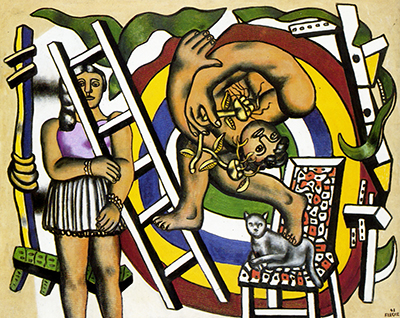
Fernand Léger’s The Acrobat and his Partner turns a circus act into a study of how people and pictures hold together. At the left, a woman stands beside a sloping ladder. Across the centre and right, an acrobat folds his body into an extraordinary loop, his head hanging among his limbs. A striped disc fills much of the space behind him, while a small grey cat sits on a patterned chair below. The combination is exuberant, but the painting’s excitement depends on a carefully maintained balance between the two performers.
Painted in 1948, the work is an oil on canvas measuring 130.2 by 162.6 centimetres. Tate purchased it in 1980; its collection number is T03118. Its French title is L’Acrobate et sa partenaire. [1] Those broad, horizontal proportions give Léger room to place a standing figure beside a tumbling one, making their different postures the organising fact of the scene.
At a Glance
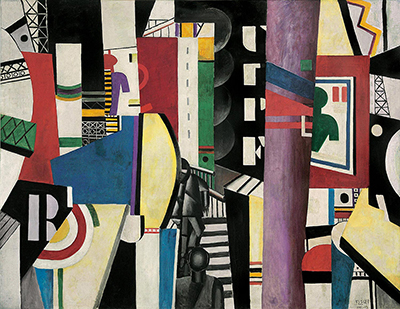
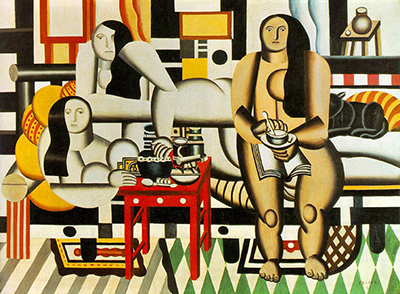
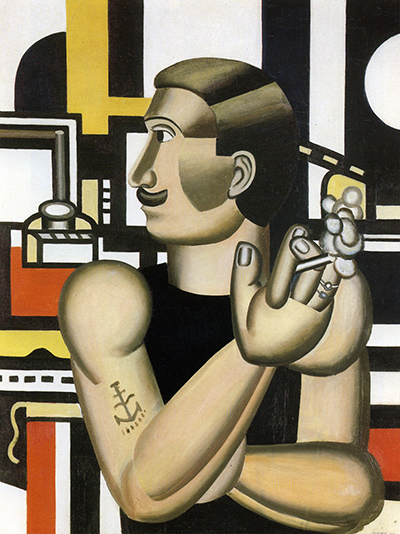
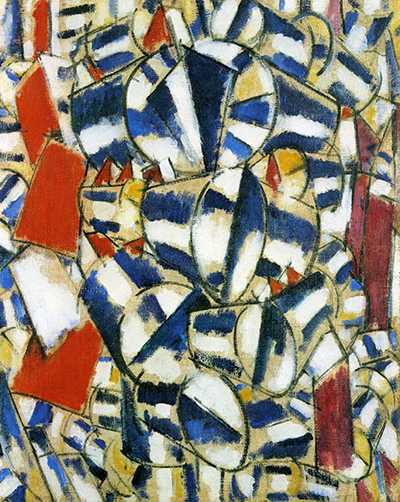
This work across Fernand Léger’s career
Nudes in the Forest
1909–1911 [2]Contrast of Forms
1913 [3]The Mechanic
1920 [5]Three Women
1921–22 [6]Contents
- Following the two performers
- A disc that sets the picture turning
- The cat, the chair and the margins
- Solid bodies in shallow space
- Circus and leisure in Léger’s later work
- The painting in Tate’s collection
Following the two performers
The partner offers the easiest point of entry. Her face is upright and directed towards us, framed by dark hair that falls over one shoulder. A purple upper garment meets a short skirt marked with close black-and-white vertical stripes. Her legs descend towards the lower edge of the canvas, giving her a sense of steadiness even though the surrounding space is crowded with things at odd angles. Her bracelets, fingers and the stripes of her skirt break her substantial silhouette into smaller rhythms.
The ladder crosses the space beside and in front of her. Its pale rails and dark edges make a strong diagonal, descending towards the bottom centre of the picture. Rungs bridge the gap between the rails, creating little frames through which other colours remain visible. We can follow the ladder as a useful object, but we also experience it as a sequence of intersecting bars. Its construction introduces straight lines into a painting dominated by curves.
Tate’s short account identifies the ladder-holding partner as the stabilising presence for the acrobat and his disc. [10] This gives the two figures a practical relationship. The woman participates through support, while the man’s twisted position displays the feat. Their contrasting postures divide the work of performance between them. The title gives her a place within that shared activity: the picture asks us to keep looking at both people.
The acrobat takes longer to decipher. His head is turned downwards, his face appearing within the enclosure of his folded body. A long limb descends diagonally to a bare foot near the lower centre; another bends towards the chair at the right. The upper portion of his body makes a broad rounded arch. Léger compresses the distance between face, torso and extremities until the man seems almost capable of turning through his own centre.
Small facial marks and the articulation of the toes help us recover a person from this arrangement of curves. Yellow flowerlike forms cluster near the face and hands, adding another set of loops to the tangle. Looking moves between the recognition of an acrobat and the enjoyment of an intricate shape. The pose remains difficult enough to sustain curiosity, even after the scene has become familiar.
A disc that sets the picture turning
Behind the acrobat, broad bands of red, yellow, blue and white curve around the centre of the picture. They gather into a great disc whose shape echoes the loop of his body. The disc supplies a larger, simpler version of the rotation suggested by his limbs. Body and background appear caught in the same circular movement, although their edges remain distinct.
That relationship is especially effective because the acrobat’s body has weight. Warm brown flesh, darker passages around the bends, and the broad soles of the feet give him considerable substance. The dark modelling makes his joints look compressed, while the disc’s colour bands sweep behind him in broad, unbroken arcs. The comparison makes the feat legible in visual terms before we have worked out its mechanics.
Léger interrupts the circular movement with the ladder. The straight rails cut across the bands, repeatedly bringing the eye back from the turning centre to a firm diagonal. Another group of pale, black-edged bars rises on the right, enclosing the disc between angular structures. The composition gains energy from the pressure of these different directions: rotation at the centre, an oblique descent at the left, and a more upright arrangement near the right edge.
Tate quotes Léger’s wish to balance “the dynamic and the static.” [10] The phrase fits the painting’s visible organisation. Stillness supplies places from which to register movement: the partner’s upright head, her downward-reaching legs, the ladder’s repeated rungs and the chair’s frame. As the eye travels among them, the acrobat’s curved body seems to gather and release the energy accumulated around it.
The cat, the chair and the margins
The cat introduces a quieter kind of presence. It sits on the chair beneath the acrobat, looking out towards the viewer. Its small face and alert ears are immediately recognisable, and its grey body forms a compact horizontal mass. Its composure makes an engaging neighbour for the contorted performer above. The chair supplies an ordinary place to sit in a scene where the human body is doing something far less ordinary.
Both cat and partner face outwards. Their relative calm frames the acrobat’s inverted face, establishing a series of different ways to occupy the same picture. The animal also draws attention downwards. Without it, the large disc might monopolise the right half; with it, the lower corner becomes a place where looking can pause and begin again.
The chair is highly active in its own way. Its back and seat carry a dense pattern of pale cells, dark divisions and red accents. These small marks contrast with the disc’s broad bands. They also answer the vertical stripes of the partner’s skirt across the lower part of the canvas. The human costume and the piece of furniture become related through pattern, giving the composition connections beyond the central acrobatic act.
At the margins, green ribbons of shape curl around the pale background and pass across the busier centre. A narrow upright at the far left is wrapped by pale loops; nearer the bottom, a green barred form introduces another small structure. These peripheral details prevent the disc from becoming a self-contained target. They lead the eye towards the edges, then redirect it into the encounter between the figures. Even the apparently spare patches of pale ground have a role, allowing the densely outlined objects some breathing room.
Solid bodies in shallow space
Léger gives the figures convincing bulk through enlarged joints, swelling limbs and dark shading. Yet he places them in a space with little depth. There is no long view into a circus tent, and no audience receding behind the performers. The pale ground, disc, ladder and chair overlap close to the picture’s surface. Their relative positions are established through crossings and interruptions rather than a continuous perspective.
The result is a productive tension between physical weight and spatial freedom. The acrobat looks solid enough to require support, while his placement against the disc makes him seem suspended. The partner has a more grounded stance, but her lower legs are cropped by the canvas. Neither performer is enclosed by a fully described floor. This shallow setting presses the act towards us, leaving little room between its spectacle and our position as viewers.
Black contours unify these differences. The same emphatic boundary can describe a cheek, rung, chair leg or coloured band. Within those boundaries, the figures are rounded and shaded while many surrounding areas remain flat. Léger can therefore set unlike things beside one another without losing the painting’s coherence. The eye accepts the whole even while discovering that its parts obey different rules.
This way of organising bodies and objects belongs to a sustained concern in his work. The Fondation Beyeler’s 2008 gallery guide describes Léger’s reuse and recombination of motifs across separate paintings, and his effort to give human figures and objects comparable formal importance. [11] In The Acrobat and his Partner, that equality is visible in the ladder’s commanding diagonal and the chair’s insistent pattern. Equipment contributes as much to the design as the people using it.
Circus and leisure in Léger’s later work
The circus offered Léger a setting where human relationships could become visible through contrasting postures. The Centre Pompidou’s teaching dossier connects his contrasts of figures, objects and abstract elements with a wider interest in bonds between people, including circus performers in peacetime. [12] Here, the relation is particularly concentrated: a pair share a demanding activity, and the painting sustains their connection across two very different bodily positions.
The partner’s attentive presence allows a reading of the scene as an image of cooperation. Her calm gives his precarious posture a counterweight. The ladder connects her steadiness to the space occupied by his folded body. Such a reading grows from their visible relationship; the picture gives it substance through the difference between the standing body and the coiled one.
Leisure was also an important subject in Léger’s later painting. Discussing the separate La grande Julie of 1945, the Beyeler guide places cycling within a growing concern with free time in his late French work. [11] The circus belongs beside those activities as an opportunity to look at bodies released into unusual movements and shared enjoyment. In this canvas, the emphasis falls on the performers themselves and on the equipment that makes their act possible.
Tate places the painting’s completion a few months before Léger attended the Peace Congress in Poland in August 1948. [10] That context situates the canvas within his postwar life. Its specific achievement remains in the scene before us: the rendering of an intricate physical feat as a lucid relationship between support, movement and colour.
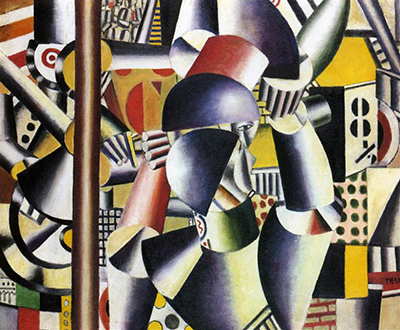
Fernand Léger, The Acrobats in the Circus. The 1918 group makes the transformation of Léger’s circus imagery visible across several decades.
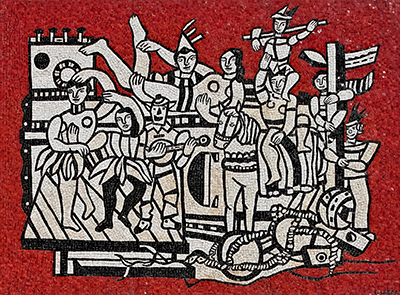
Fernand Léger, Grand Parade with Red Background. The wider parade develops the late company of performers around further objects and signs.
The painting in Tate’s collection
Tate’s 1980 purchase brought this substantial canvas into the collection more than three decades after it was painted. [1] MoMA’s 1998 exhibition checklist records it as L’Acrobate et sa partenaire, confirming the date and dimensions given by Tate. [13] These records locate a particular painting whose individuality lies in its compact cast and tightly connected objects.
Returning to the two performers after following the surrounding forms, their partnership becomes more noticeable. The ladder draws the woman into the rotating field of the disc; the acrobat’s extended limbs reach down towards the steadier world of the chair and cat. Each side of the picture sends something towards the other. Léger makes balance a continuing exchange, held in place by the different contributions of bodies, objects and colours.
Léger in video
Explore abstraction, monumental painting and cinema through films from MoMA and the Centre Pompidou. These videos offer context for Léger’s wider work; the restoration film is in French.
Restaurer un… Fernand Léger
Follow conservation of Composition with Two Parrots, 1935–39, and look at painting on a monumental scale. French-language film.
Watch on YouTubeFernand Léger artworks directory
Works covered in these articles and further documented works. Studies and finished works have separate entries; alternate titles share an entry. This is not a catalogue raisonné.
| Name | Date | Medium |
|---|---|---|
| Acrobats and Clowns from Le Cirque | 1950 | |
| Adieu New York | 1946 | Painting |
| Ballet mécanique | 1924 | Film |
| Big Julie | 1945 | Painting |
| Builders with Aloe | 1951 | Painting |
| Charlot cubiste | 1924 | Sculpture |
| Chimneys on Rooftops | 1911 | Painting |
| Cirque (artist’s book) | 1950 | |
| Composition | 1929 | Painting |
| Composition (Study for Nude Model in the Studio) | 1912 | Drawing |
| Composition of Three Figures | 1932 | Painting |
| Composition with Two Parrots | 1935–39 | Painting |
| Construction Workers Final State | 1950 | Painting |
| Contrast of Forms | 1913 | Painting |
| Derrière le miroir, nos.121–122 (posthumous publication, includes a lithograph after Léger) | 1960 | |
| Drawing for The Card Game | 1917 | Drawing |
| Drawing for The Staircase | 1913 | Drawing |
| En attendant le départ | 1914 | Drawing |
| Grand Parade with Red Background | 1953 | Painting |
| J’ai tué (illustrated book) | 1918 | |
| La Cocarde, l’avion brisé | About 1916 | Drawing |
| La Couseuse | about1910 | Painting |
| La Fin du monde filmée par l’Ange N.-D. (illustrated book) | 1919 | |
| Les Femmes au bouquet (Women with a Bouquet) | 1921 | Painting |
| Man and Woman | 1921 | Painting |
| Man in Profile with Rope: Study for The Constructors | 1950/1 | Drawing |
| Man in the Blue Hat | 1937 | Painting |
| Matinée d’ivresse, from Les Illuminations | 1949 | |
| Mechanical Elements | 1918–23 | Painting |
| Mechanical Elements (Metropolitan Museum) | 1920 | Painting |
| Men in the City | 1919 | Painting |
| Mes voyages (posthumous illustrated book) | 1960 | |
| Mona Lisa with the Keys | 1930 | Painting |
| Nude Model in the Studio | 1912–13 | Painting |
| Nudes in the Forest | 1909–1911 | Painting |
| Propellers Second State | 1918 | Painting |
| Reading | 1924 | Painting |
| Soldier with a Pipe | 1916 | Painting |
| Soldiers Playing Cards | 1917 | Painting |
| Soldiers Playing Cards (front drawing) | 1916 | Drawing |
| Standing Nude, Rear View | 1911 | Drawing |
| Still Life with a Beer Mug | 1921–2 | Painting |
| Still Life with Tankard | 1921 | Drawing |
| Study for The Aviator | 1920 | Drawing |
| The Acrobat and his Partner | 1948 | Painting |
| The Acrobats in the Circus | 1918 | Painting |
| The Alarm Clock | 1914 | Painting |
| The Chalices and the Sponge, stained-glass model | 1950 | Drawing |
| The City | 1919 | Painting |
| The Disks in the City | 1920 | Painting |
| The Mechanic | 1920 | Painting |
| The Railway Crossing | 1919 | Painting |
| The Three Musicians | 1944, after a 1924–25 drawing | Painting |
| The Wheels | 1945 | Drawing |
| Three Women | 1921–22 | Painting |
| Two Women Holding Flowers | 1954 | Painting |
| Umbrella and Bowler | 1926 | Painting |
| Verdun, dessin du front | About 1915 | Drawing |
| Woman with a Book | 1923 | Painting |
| Woman: Costume Design for La Création du monde | c.1922–23 | Drawing |
Discussion
Look again at the images and ideas explored in The Acrobat and his Partner by Fernand Léger. These editorial prompts invite your observations.
Reader Insights
What becomes easier to notice in The Acrobat and his Partner when you compare it with The Acrobats in the Circus?
Where does the comparison with Grand Parade with Red Background reveal the clearest change in Léger’s approach?
Which detail would you follow first when returning to the work, and why?
Join the Conversation
Share a detail, comparison or question about The Acrobat and his Partner by Fernand Léger below.
References
- Tate, The Acrobat and his Partner, T03118, official collection metadata, 2014 open-data release. Title, French title, date, medium, support dimensions and credit line. Consulted 31 October 2026. View source.
- Kröller-Müller Museum, Nus dans la forêt / Nude Figures in a Forest, collection record KM 101.045. Current date, medium, identifier, curatorial sections “Distinctive cubist style”, “Geometric shapes” and “‘Battle of volumes’”, and museum reproduction. View source.
- Fondation Beyeler, Contraste de formes, Fernand Léger, current collection record, Inv.90.6: date, medium, dimensions, collection and signature on reverse. View source.
- Philadelphia Museum of Art, The City, 1919, collection record and interpretation; A. E. Gallatin Collection, 1952-61-58. View source.
- National Gallery of Canada, The Mechanic, 1920, accession 14985, collection details and interpretive paragraph; French collection record, Le mécanicien. View source.
- The Museum of Modern Art, Fernand Léger. Three Women. 1921–22, collection record, object 189.1942: artwork image, metadata, 2021 gallery label, publication excerpt, installation history and provenance. View source.
- Musée national Fernand Léger, La Joconde aux clés, collection record and museum commentary (French): object data, owning museum image, artist recollection, sardine tin and symbolic interpretations. The artist’s recollection is consulted as reproduced by the museum; the page does not date it. View source.
- Musée national Fernand Léger, “Les années 50, les constructeurs”, complete Les Constructeurs (définitif) entry and accompanying museum image: title, 1950 date, oil on canvas, 300 × 228 cm, inventory MNFL 94001, 1969 donation and museum-mediated Renault-canteen recollection. View source.
- Musée national Fernand Léger, La Grande Parade sur fond rouge, complete object record and displayed reproduction: 1953, oil on canvas, 114.5 × 156.2 cm, inventory MNFL 96006; donation of Nadia Léger and Georges Bauquier. View source.
- Tate Shop, Fernand Léger: The Acrobat and his Partner, “About the artwork” and artwork details; owning-institution reproduction. Consulted 31 October 2026. The short artist quotation is reproduced through Tate’s commentary. View source.
- Philippe Büttner, Raphaël Bouvier and Daniel Kramer, Fernand Léger: Paris–New York, gallery guide, Fondation Beyeler, 1 June–7 September 2008, PDF p. 2, entries 8 and 13. German text. Consulted 31 October 2026. View source.
- Centre Pompidou, Fernand Léger, teaching dossier, 2008, “La modernité de Fernand Léger” and “La figure-objet”; also consulted the passages on Composition aux deux perroquets and Adieu New York. French text. Consulted 31 October 2026. View source.
- Museum of Modern Art, Fernand Léger, exhibition checklist, 11 February–12 May 1998, PDF p. 1, entry for L’Acrobate et sa partenaire. Consulted 31 October 2026. Checklist only. View source.