


 by Tom Gurney
Tom Gurney BSc (Hons) is an art history expert with over 20 years experience
Published on June 19, 2020 / Updated on November 5, 2026
Email: tomgurney1@gmail.com / Phone: +44 7429 011000
Mechanical Elements
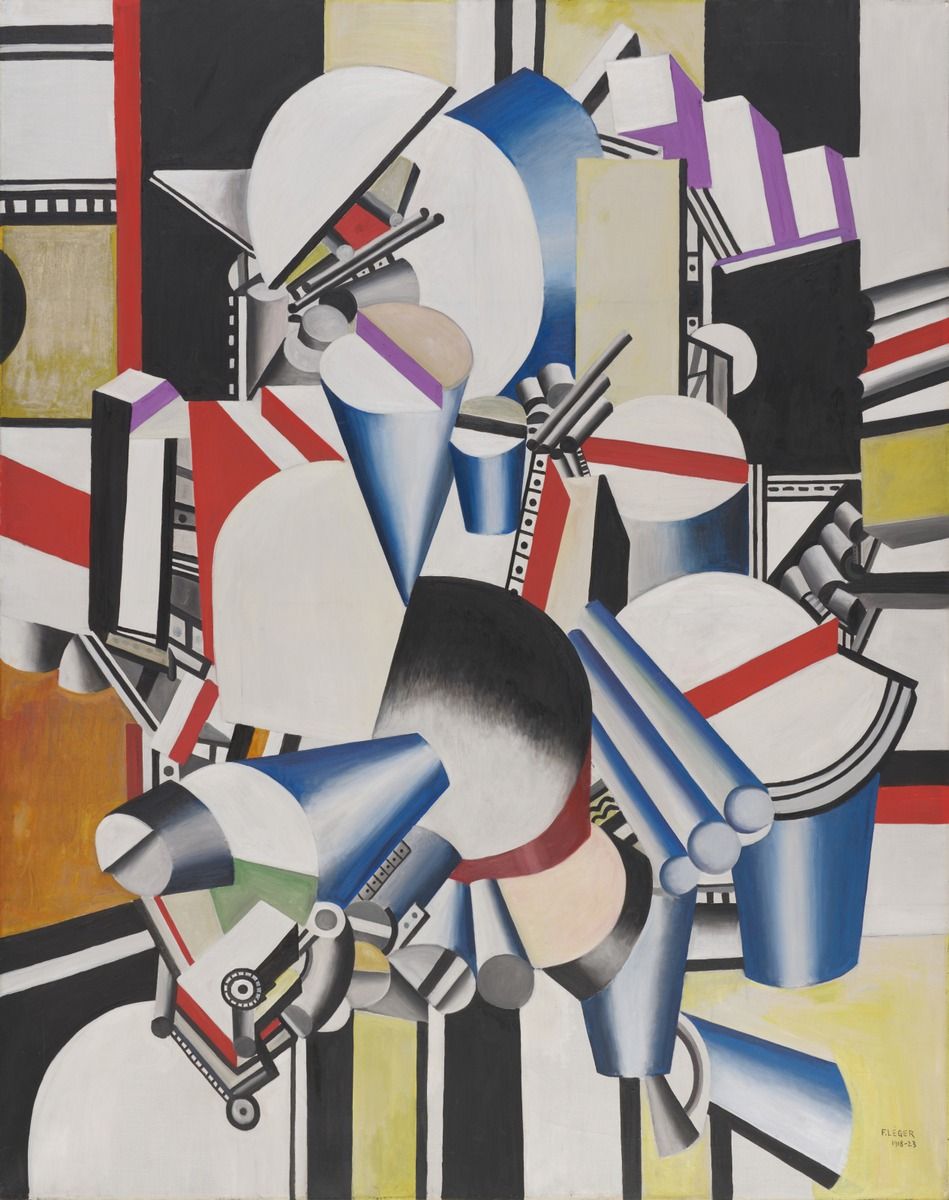
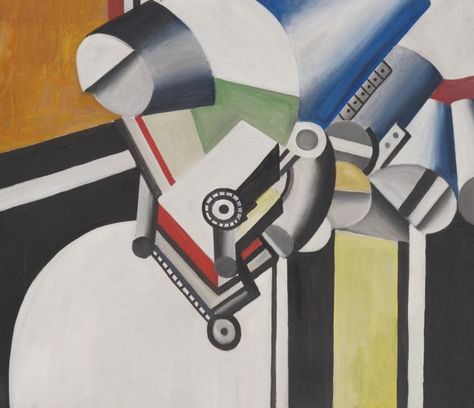
A white disc, a dark circle and a cluster of gleaming tubes compete for attention in Fernand Léger’s Mechanical Elements. Red bands cut through pale surfaces; yellow panels open behind them; black lines pull the crowded arrangement into a grid. The parts look precise enough to belong to a machine, yet their connections never quite explain what that machine would do. Painted in 1918–23, this large oil painting belongs to the Kunstmuseum Basel, where its French title is Les Éléments mécaniques. [1]
Its fascination lies in that difference between apparent certainty and persistent uncertainty. A cylinder seems solid until a stripe makes it flat. Two pieces appear to connect, then a dark gap separates them. Léger gives the eye an abundance of sharply defined information while withholding the coherent mechanism that the title might lead us to expect.
At a Glance
Two moments in Léger’s career
Contents
The Basel painting
The Kunstmuseum Basel identifies this particular canvas as inventory G 1956.14 and credits it as a gift from Raoul La Roche. The lower-right inscription includes Léger’s signature and the date range 1918–23; the museum also records a signature on the back. These are identifying details of one painting, rather than a general label for all the mechanical compositions he made during these years. [1]
The vertical format gives the assembly an almost bodily presence. Its central forms rise and spread, while smaller components extend towards the edges. There is no obvious floor beneath them and no workshop around them. Even the surfaces behind the apparent machinery are divided into coloured rectangles, so that the setting participates in the same construction as the objects.
This absence of an ordinary environment matters. We cannot settle the size of a tube by comparing it with a worker, or judge its weight by seeing it resting on a bench. Relationships inside the painting supply the scale: a narrow striped element makes a nearby broad curve seem massive, while repeated circular ends bind different-sized pieces together.
Finding a path through the parts
Begin at the upper left, where a narrow black-and-white strip resembles a perforated edge. Beside it, a large white disc tilts towards us. A diagonal dark band crosses its face, with a small concentration of red, yellow and grey forms below. The contrast between this open, pale area and its tightly packed neighbours creates a useful starting point in an otherwise crowded picture.
Move downwards to the broad central black circle. Its edge is clear, but its surface grades into grey and white, suggesting a rounded body rather than an empty hole. Immediately around it, thin bars, circular ends and angled pieces prevent the form from becoming isolated. It acts as a visual pause without offering a stable centre from which everything else can be explained.
On the right, parallel tubes descend diagonally across a larger white curved surface marked by a red stripe. Their repeated round ends make a small, emphatic rhythm. Nearby, upright blue-grey cylinders establish a different direction. The eye can follow either group, but neither provides a route through the whole assembly.
At the bottom left, a broad horizontal form projects over a smaller construction of narrow bars and circles. Farther right, another pale curved strip bends around a dark upright shape. Such changes in direction keep returning our attention to the spaces between things. Léger makes the gaps as visually active as the pieces they separate.
Solid forms, flat interruptions
The strongest illusion of metal comes from changes between dark and light. A pale highlight travels along a curved surface, then drops into a dark edge. Against this modelling, Léger places colours that remain conspicuously flat. A red band can cross a rounded shape without appearing to follow all its turning surfaces, interrupting the very solidity that the shading has established.
Writing about this painting in 1976, the curator John Elderfield explained how Léger joined more conventionally modelled mechanical volumes to the flat decorative surface. Their outlines and abrupt cuts help prevent the illusion of depth from becoming an entirely separate world behind the canvas. [2]
Try looking at an outline instead of the object it encloses. The same black contour that makes a pale cylinder seem tangible can also become one segment in a pattern running across the picture. A boundary can therefore serve two purposes at once: describing the edge of something solid and linking that thing to a flat arrangement of lines.
The upper-right purple and white forms offer another change of pace. Their broad, relatively simple divisions contrast with the small rods and rings nearer the centre. They allow the eye to register a larger pattern after becoming absorbed in individual components. Detail and overall structure continually interrupt one another.
Annotated Details from Mechanical Elements
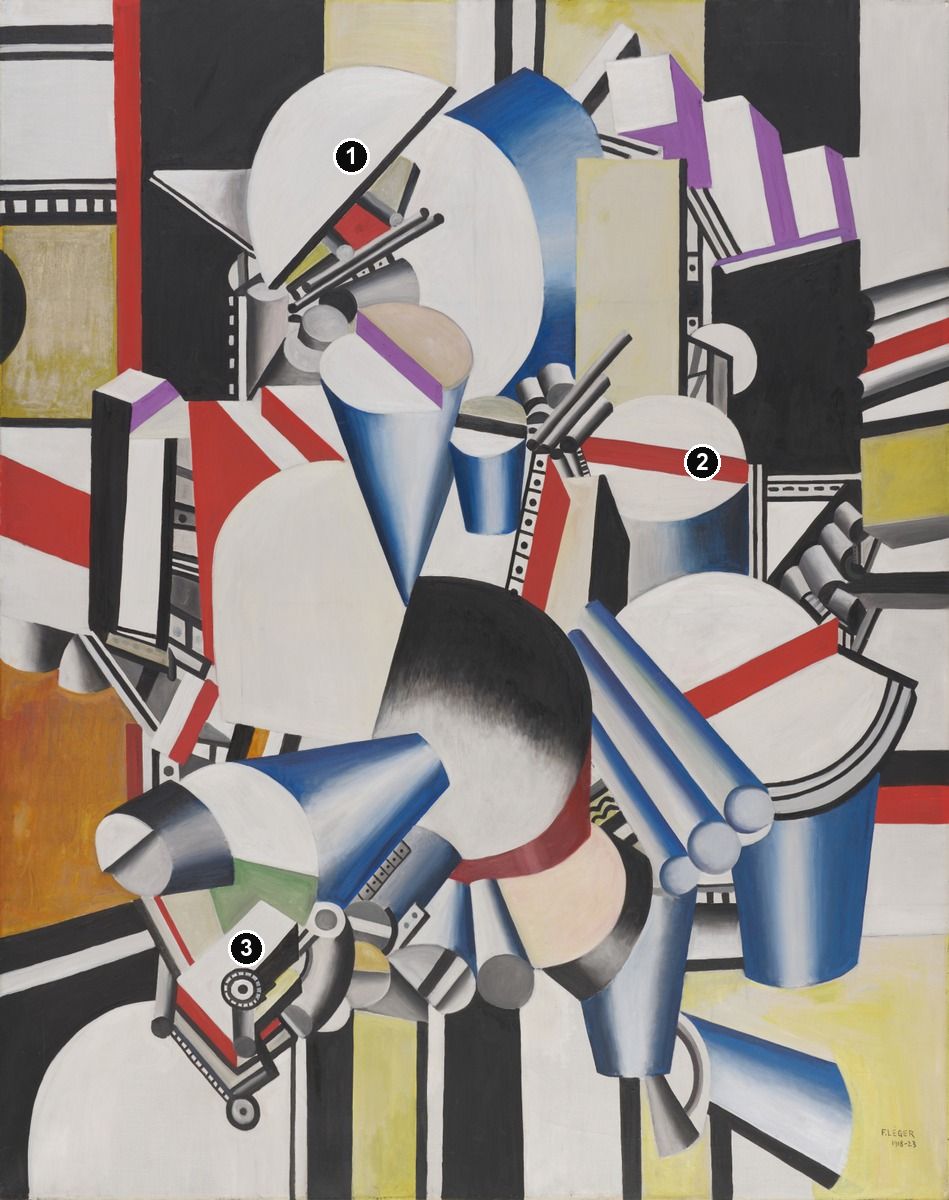
Compare the white disc, the red stripe across a rounded form, and the small framework at the lower left. Each changes the relationship between a solid part and a flat pattern.
Details from MECHANICAL ELEMENTS
Kunstmuseum Basel, G 1956.14, gift of Raoul La Roche. The museum declares its image data public domain. Overview numbered and details cropped directly from the unchanged museum image; no upscaling.
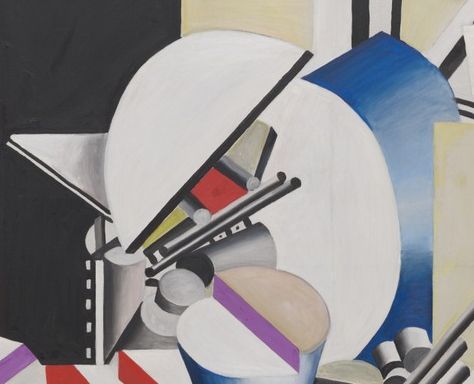
A white disc and a sharp diagonal
The pale circular form suggests a solid part, but its sharp dark diagonal also reads as an independent shape. Follow the boundary between the shaded curve and the flat interruption. [1][2]
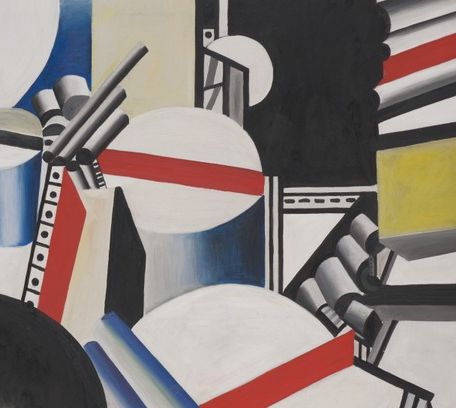
Red crossing a rounded surface
The red band cuts across pale modelling. Nearby tubes point diagonally in another direction, so that the apparent connections remain unsettled. [2]
A small framework of rods and circles
Small circular ends and narrow bars form a denser pattern near the lower left. Their clarity makes them easy to compare, while leaving their practical function unresolved. [1]
Metal and the postwar world
Elderfield places the painting within Léger’s more explicitly mechanical imagery after 1917. He also quotes the artist recalling his wartime encounter with artillery and “the magic of light on white metal”. The phrase concerns Léger’s retrospective account of his artistic development, rather than a specific explanation of every form in this canvas. [2]
It nevertheless sharpens our attention to the painted highlights. The attraction is not simply that a shape resembles a manufactured part. It is also the way a hard surface catches light and becomes a striking visual event. The pale ends of the tubes can seem almost luminous against surrounding black, while small bright accents separate one fragment from another.
Seen this way, the machine is a source of contrasts as much as a subject. Smooth curves meet straight bars; broad planes meet tiny repeated marks; shaded greys meet clear red and yellow. These differences give the painting its energy without requiring us to identify a particular engine or piece of factory equipment.
A machine that does not have to work
The apparent absence of a practical function has not always seemed an advantage. In her study of Mechanical Elements, the art historian Larissa Dätwyler discusses criticism directed at Léger’s machine imagery in 1923. She argues that the painting should be understood through artistic invention rather than judged as an inadequate copy of working machinery. Her account connects its ambiguities with the viewer’s active effort to bring the parts into relationship. [3]
This distinction changes the question we ask. Instead of searching only for the missing bolt or unexplained joint, we can ask what happens when an apparent connection remains uncertain. Does a dark line fasten two pieces together, or cut one away from the other? Is a pale circle the end of a tube, or a flat shape laid across it?
The picture does not make these alternatives feel careless. Its crisp edges and repeated forms encourage exact comparison. Yet precision in the individual parts does not produce a single, mechanically inevitable whole. Looking becomes an exercise in testing connections, with each new possibility bringing another area into view.
One title, different paintings
Léger returned to mechanical forms in distinct works, so the title alone does not identify the Basel canvas. The Metropolitan Museum of Art owns another Mechanical Elements, dated 1920, from the Jacques and Natasha Gelman Collection. That painting has its own inventory number, 1999.363.36, and a considerably smaller, narrower format. [4]
The Met describes Léger’s mechanical period, approximately 1918–23, in terms of recurring geometric components that evoke modern technology without depicting identifiable working parts. This offers a useful comparison with Basel, while leaving the two objects separate. Their similar vocabulary does not make them interchangeable versions with shared ownership histories. [4]
Returning to the larger painting, notice how its recognisable ingredients resist becoming a simple list. The discs are not all treated alike, the tubes do not all run in one direction, and bright colour does not belong to a single class of object. Repetition gives us points of recognition; variation prevents those points from settling into a formula.
A rhythm close to cinema
Elderfield also reads the Basel composition in cinematic terms, as a fragmentation of reality in which close views and broader arrangements coexist. The abrupt changes of scale and direction make that comparison persuasive: looking at the painting can feel less like surveying a continuous room than moving between forceful visual incidents. [2]
Léger’s later film Ballet mécanique, dated 1924, offers a related context. MoMA’s account describes the camera work of Dudley Murphy and the transformation of everyday objects through repetition and editing, alongside human actions. Painting and film remain different works, but both make rhythm possible through the selection and juxtaposition of things. [5]
In the canvas, however, the sequence belongs to the viewer. We can return to the white disc, skip towards the red-striped curve or linger over the little circles near the bottom. The arrangement directs attention strongly without prescribing a single beginning or end.
A later life among machines
The painting’s capacity to speak to later art was made explicit in the Fondation Beyeler’s 2008 exhibition Fernand Léger: Paris–New York. Its gallery guide paired Mechanical Elements with Roy Lichtenstein’s Preparedness of 1968, drawing attention to correspondences in hard, metallic-looking tubes and the use of colour within mechanical structures. This was a comparison of visual relationships, not a reason to collapse the artists’ different works into one style. [6]
Léger’s canvas rewards the same alertness today. At first its forms promise the clarity of manufactured things. With longer looking, the hard edges become routes between competing spatial possibilities. The machinery remains motionless, but the work of assembling, separating and comparing its parts keeps the viewer moving.
Artworks directory
A selection of paintings and works on paper documented in collection records and catalogues. Similar titles identify different objects: the Basel and Met Mechanical Elements, the two Mechanic paintings and the Indianapolis painting and Städel drawing have separate entries. This is not a complete catalogue of Léger’s work. Additional entries labelled “Tate” come from the museum’s October 2014 catalogue. They retain its historical titles, dates and attributions; newer collection records are used where available. The list brings together selected records from these sources. [8]
| Name | Date | Medium |
|---|---|---|
| La Couseuse (The Sewing Woman) | about 1910 | Painting |
| Nude Figures in a Forest | 1909–11 | Painting |
| The Acrobats in the Circus (Basel) | 1918 | Painting |
| Sketch for The Acrobats in the Circus | 1918 | Painting |
| Two Acrobats | 1918 | Painting |
| Le Cirque Médrano | 1918 | Painting |
| Mechanical Elements (Basel) | 1918–23 | Painting |
| The Mechanic (LaM) | 1918 | Painting |
| The Mechanic (Ottawa) | 1920 | Painting |
| Mechanical Elements (Met) | 1920 | Painting |
| Man and Woman (Newfields) | 1921 | Painting |
| Woman with a Cat | 1921 | Painting |
| The Fishermen | 1921 | Painting |
| Homme et femme (Städel drawing) | 1921 | Drawing |
| Three Women | 1921–22 | Painting |
| Two Women | 1922 | Painting |
| Leaves and Shell (Tate N05907) | 1927 | Painting |
| Keys (Composition) (Tate N05990) | 1928 | Painting |
| Playing Card and Pipe (Tate N05991) | 1928 | Painting |
| The King of Hearts (Tate P01711) | 1949 | |
| Les Objets à Réaction Poetique (Tate P80180) | 1931–6 | Photograph |
| Two Women Holding Flowers (Tate T00246) | 1954 | Painting |
| Still Life with a Beer Mug (Tate T02035) | 1921–2 | Painting |
| The Acrobat and his Partner (Tate T03118) | 1948 | Painting |
| Mechanical Elements (Tate T06798) | 1926 | Drawing |
| ABC (Tate T06799) | 1927 | Drawing |
| Three Bottles (Tate T06800) | 1954 | Painting |
| Trees (Tate T06801) | 1923 | Drawing |
| Acrobats and Clowns — Le Cirque design | 1950 | Colour lithograph |
| Composition aux trois figures (Pompidou) | 1932 | Painting |
Frequently Asked Questions
The painting discussed here is in the Kunstmuseum Basel, inventory G 1956.14. The museum credits it as a gift from Raoul La Roche. [1]
The museum dates the Basel painting to 1918–1923 and records that range in its lower-right inscription. The range does not by itself establish an uninterrupted five-year painting process. [1]
Discussion
Follow the apparent machinery until a volume becomes a flat shape or a connection becomes a gap.
Which part of the painting most strongly suggests a solid object to you? Follow its outline: does it remain convincing as a volume, or become part of a flat pattern? Consider how the red bands change your reading of the pale surfaces they cross.
Reader Insights
Which part seems most convincingly solid?
Where does an outline make a surface become flat?
Can you follow a complete mechanism through the painting?
Join the Conversation
Share a detail, comparison or question about Mechanical Elements below.
References
- Kunstmuseum Basel, Les Éléments mécaniques / Mechanical Elements, Fernand Léger, 1918–1923, inventory G 1956.14, Collection Online object 1233. Object fields, signature, credit and image metadata consulted in the museum’s current record, 28 October 2026. View source.Splash image: Les Éléments mécaniques (Mechanical Elements), 1918–23. Kunstmuseum Basel, G 1956.14; gift of Raoul La Roche. Kunstmuseum Basel; museum image declared public domain, re-exported at native size.
- John Elderfield, European Master Paintings from Swiss Collections: Post-Impressionism to World War II (New York: The Museum of Modern Art, 1976), pp.108–109, entry and reproduction for Fernand Léger, Mechanical Elements. Léger’s retrospective statement is quoted through this catalogue. View source.
- Larissa Dätwyler, “«Une mécanique d’imagination». Fernand Légers malerisches Äquivalent zur schönen Maschine,” in Larissa Dätwyler, Aurea Klarskov and Lucas Knierzinger, eds., Imagination und Genauigkeit. Verschränkungen in Künsten und Wissenschaften (Berlin: Neofelis, 2021), pp.79–95; especially pp.79–94. In German; interpretation paraphrased in English. View source.
- The Metropolitan Museum of Art, Mechanical Elements, Fernand Léger, 1920, inventory 1999.363.36, Jacques and Natasha Gelman Collection. Object record and interpretive text, accessed 28 October 2026. View source.
- The Museum of Modern Art, Ballet mécanique, Fernand Léger, 1924, object W591. Collection record, reproducing commentary from Circulating Film Library Catalogue (New York: MoMA, 1984), p.167; accessed 28 October 2026. View source.
- Fondation Beyeler, Fernand Léger. Paris–New York, gallery guide, exhibition 1 June–7 September 2008, no.24, comparison of Les éléments mécaniques (1918–1923) and Roy Lichtenstein’s Preparedness (1968). In German; paraphrased in English. View source.
- Centre Pompidou, La Couseuse, about 1910, AM 1984-578. Collection record and interpretation; accessed 28 October 2026. View source.
- Tate, Tate Collection metadata, artwork_data.csv, October 2014 snapshot, released under CC0. Repository readme states that this dataset is no longer maintained. Downloaded and artist rows inspected 28 October 2026. View source.


