 by Tom Gurney
Tom Gurney BSc (Hons) is an art history expert with over 20 years experience
Published on June 19, 2020 / Updated on October 14, 2023
Email: tomgurney1@gmail.com / Phone: +44 7429 011000
Gelb Rosa (Yellow Pink) by Wassily Kandinsky: Introduction
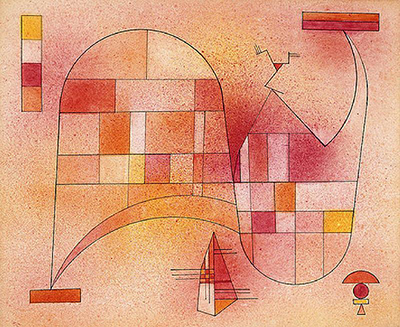
The name “Yellow Rose” has often been attached to this work, but Kandinsky's title was Gelb Rosa: Yellow Pink. The distinction matters. The picture contains no flower to look for. Instead, warm yellows, pinks and reds move through an arrangement of arcs, small colour blocks, checkerboard passages and fine lines. Kandinsky made it in December 1929, during his Bauhaus years, using watercolour, pen and black ink on paper. The title directs attention to a relationship between colours rather than to a hidden botanical subject. [1].
Watch: Wassily Kandinsky
Five museum videos about Kandinsky’s art, sources of inspiration and the relationship between colour and music.
Vasily Kandinsky: Around the Circle
Curator Megan Fontanella introduces Kandinsky and the Guggenheim collection.
Watch on YouTubeAt a Glance
- Artist:Wassily Kandinsky (1866–1944).
- Correct title:Gelb Rosa (Yellow Pink).
- Date:December 1929.
- Medium and size:watercolour with pen and black ink on paper laid on board, 40.5 × 48.1 cm.
- Catalogue:Vivian Endicott Barnett, Kandinsky Watercolours, volume II, number 959, as cited in the Christie's lot record.
- Current location:not established by the accessible sale record; do not assume an auction venue is the work's permanent home.
Where this work sits in Kandinsky’s career
The Blue Rider
1903Composition VII
1913Composition VIII
1923Several Circles
1926Sky Blue
1940Contents
- Following colour and line
- What does Gelb Rosa mean?
- A work on paper from Dessau
- Why the work rewards a second look
- Frequently asked questions
- References
Following colour and line
The picture first presents a broad field of warm, finely varied colour. Pink spreads into areas of yellow and orange, while black lines define a set of shapes without enclosing every wash. A large curved arc crosses the left half. Below it, another curve rises from a horizontal red bar near the bottom edge. Those curves give the page a sense of movement, as if the eye could travel along them before the checkerboard blocks interrupt its path.
The blocks are not a single tidy grid. A larger group sits under the upper arc, with rectangles of red, rose, pale yellow and almost white. A second group bends into a rounded form on the right. Some cells have strong colour; others remain faint. That unevenness keeps the repeated units from becoming mechanical. We see difference within a scheme: a sequence of squares and rectangles that makes small changes in tone easy to notice.
Near the top and right edges, isolated red bars are held away from the central shapes. A slim stack of coloured rectangles stands at the left. A little triangular form at the bottom, and another angular form higher to the right, sharpen the contrast with the arcs. The paper feels populated but not crowded. Gaps between its parts allow the eye to move, and the light ground helps each colour relationship remain distinct.
The small lines deserve as much attention as the bright areas. Fine black outlines steady the checkerboard forms, while longer curves cross open space. Several thin strokes fan out beside the low triangle. Kandinsky uses these marks to connect or separate areas without filling the whole sheet. The result is a watercolour that seems designed through comparison: broad against narrow, curved against straight, saturated against pale.
What does Gelb Rosa mean?
The German words are straightforward: gelb is yellow, and rosa is pink. “Yellow Rose” is an inherited mistranslation of Rosa, which here names a colour. Looking for a rose would make the abstract arrangement seem like a puzzle whose answer is a concealed flower. The source title asks something more direct: notice what yellow and pink do together, where they mingle, where red intensifies them, and where black lines hold them apart. [1].
Titles in Kandinsky's abstract work do not always explain every form. This one gives a point of entry rather than an instruction to decode. Yellow and pink are prominent, but there are other colours and a substantial system of lines. The title therefore identifies a leading relationship, not an exclusive palette. It also makes sense of the way the colours move across several separate shapes rather than settling into one depicted object.
The familiar English label can bring a reader to the work, but it should not turn this abstract colour study into a flower painting.
A work on paper from Dessau
Kandinsky was teaching at the Bauhaus in Dessau when he made this watercolour. During these years he often explored how simple elements—lines, circles, angles and coloured areas—could be arranged to produce different effects. The Guggenheim's teaching material describes his sustained Bauhaus investigation of colour and form. Gelb Rosa belongs to that setting, yet its sprayed and washed colour prevents the geometry from feeling merely rigid. [2]; [1].
The medium matters. Watercolour can produce translucent passages and allow the white of the paper to affect what we see. The auction record specifically notes the sprayed treatment of colour in this work, a method that produces soft gradations beside the crisply ruled or inked forms. Describing it as an oil painting would flatten that contrast and misidentify the object. Its surface is a meeting of liquid colour, granular effects and precise marks. [1].
Christie's suggests a connection with Paul Klee, who lived near Kandinsky in the Bauhaus masters' houses from 1926. The auction house points especially to sprayed watercolour and clear geometric forms. That comparison is useful as an invitation to look at techniques shared or explored in a common setting, but it should not be turned into an undocumented claim that Klee designed any part of Gelb Rosa. Kandinsky's own choices remain visible in the particular balance of arcs, checkerboards and colour transitions on this sheet. [1]; [3].
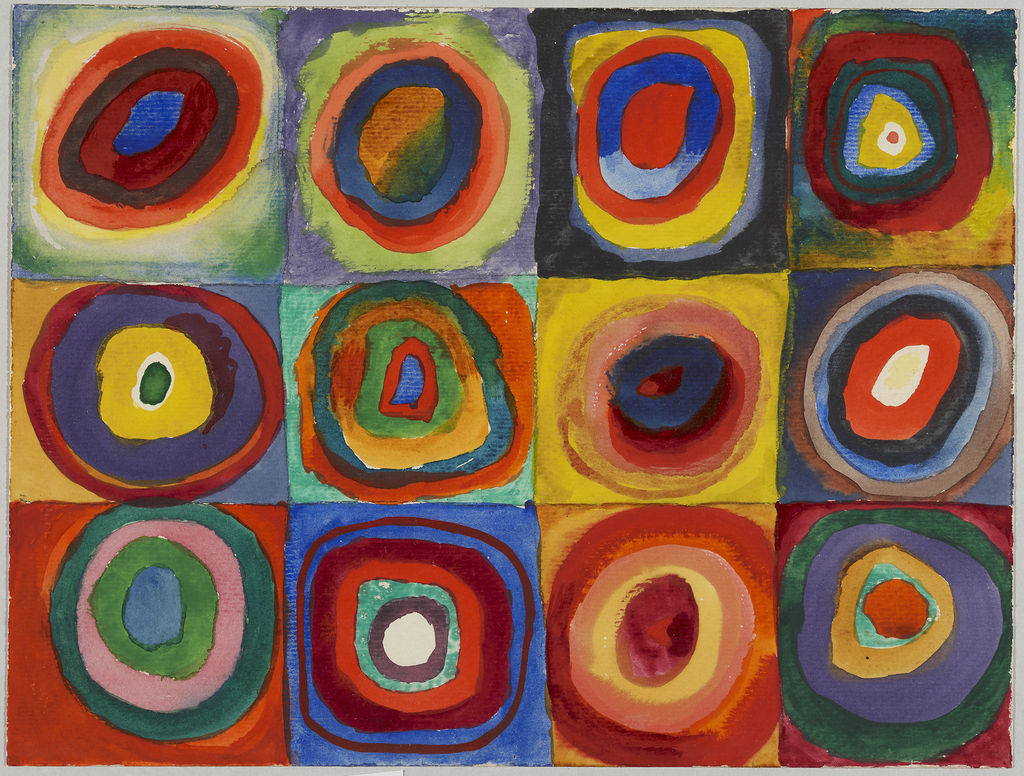
The work can also be set beside Kandinsky's Squares with Concentric Circles, a much earlier colour study on paper. Both use repeated coloured units to make comparisons possible, but they do not pursue the same exercise. The 1913 study places rings in a gridded sequence. Gelb Rosa lets its checkerboard units bend, fragment and meet broad arcs in a freer overall design. The difference shows how varied Kandinsky's uses of repeated forms could be. [4]; [1].
Why the work rewards a second look
At first, the palette may carry the picture: pink, yellow and red spread warmly across the sheet. On another look, its structural decisions become clearer. The strong arc at left and rounded checkerboard at right balance each other without being mirror images. Thin black lines make connections across empty space. Small bars and triangles keep the broad curves from becoming too smooth. The work asks us to move between colour as an atmosphere and colour as something contained in measured units.
That changing experience fits the title better than a hunt for a rose. Gelb Rosa does not need a disguised figure to be specific. It gives us a particular set of relationships, made with the possibilities of watercolour and ink in Kandinsky's Dessau practice. The inherited English error is worth correcting because it changes what a reader is likely to notice first.
Kandinsky artworks directory
Frequently Asked Questions
The documented German title is Gelb Rosa, meaning Yellow Pink. “Yellow Rose” is an older mistranslation. It is not a description of a flower in the work. [1].
Christie's records it as executed in December 1929 and notes the artist's monogram and date at lower left. [1].
No. The lot record identifies watercolour with pen and black ink on paper laid on board, measuring 40.5 × 48.1 cm. [1].
The accessible source gives earlier provenance and exhibition history but does not establish a present owner. A past Christie's sale venue should not be named as the current collection. [1].
Discussion
What do you notice first in Gelb Rosa (Yellow Pink)? Share a close observation or a question about the evidence for this work.
Comments are for comparing what we see and what the cited sources establish.
Reader Insights
Where do yellow and pink meet, and where does black keep them apart?
What changes when the title is read as Yellow Pink rather than Yellow Rose?
Which part of the watercolour would you most like to inspect directly?
Join the Conversation
Add your observation below and tell us which part of the artwork led you to it.
References
- Christie's, Wassily Kandinsky, Gelb Rosa lot record, object description, provenance, exhibition history and essay. View source.
- Solomon R. Guggenheim Museum, Kandinsky teaching materials, Bauhaus context. View source.
- Stiftung Bauhaus Dessau, Masters' Houses, Kandinsky and Klee in Dessau. View source.
- Lenbachhaus, Farbstudie—Quadrate mit konzentrischen Ringen, comparison object. View source.