 by Tom Gurney
Tom Gurney BSc (Hons) is an art history expert with over 20 years experience
Published on June 19, 2020 / Updated on October 14, 2023
Email: tomgurney1@gmail.com / Phone: +44 7429 011000
Impression III (Concert) by Wassily Kandinsky: Introduction
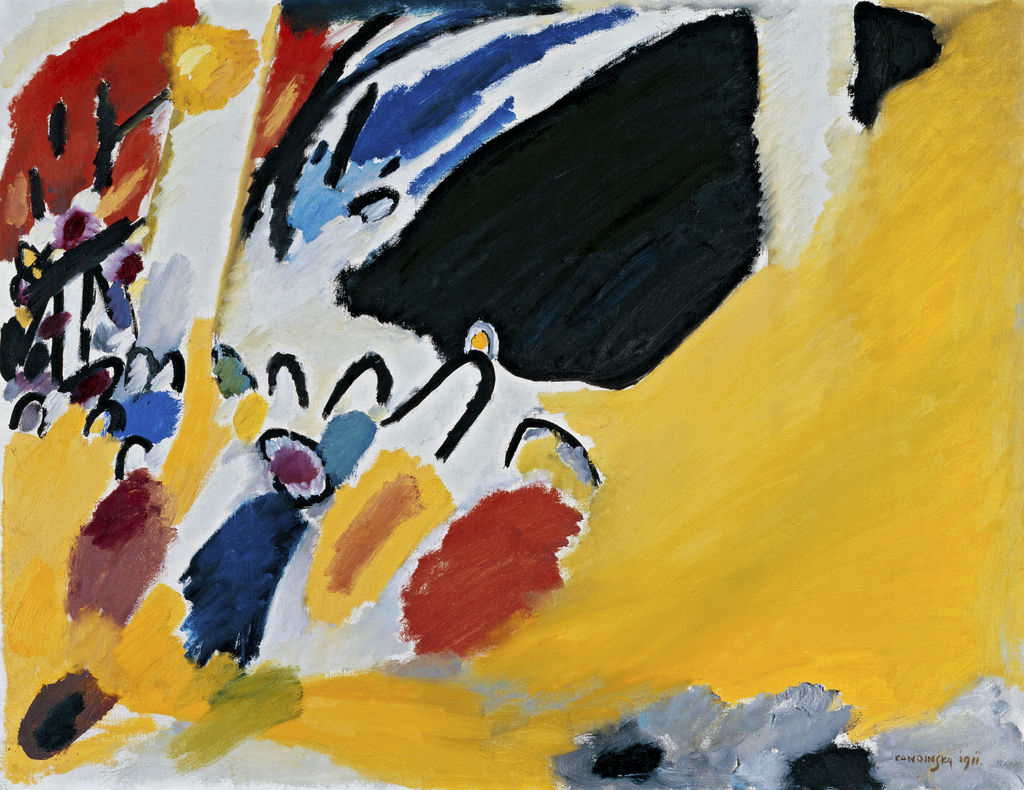
In Impression III (Concert), a black grand piano seems to rise over a group of listeners. The rest of the room is harder to pin down. Yellow spreads across much of the canvas, small patches of red and blue interrupt its movement, and a pale vertical passage opens between the dark forms. Kandinsky painted the work soon after hearing music by Arnold Schönberg in Munich on 2 January 1911. He did not erase the concert from the image. Instead, he reduced what he had seen and heard to a few recognisable shapes and a forceful arrangement of colour. That balance between a particular event and a freer kind of painting makes Impression III one of the clearest ways to see his move toward abstraction. [1]; [5].
Watch: Wassily Kandinsky
Five museum videos about Kandinsky’s art, sources of inspiration and the relationship between colour and music.
Vasily Kandinsky: Around the Circle
Curator Megan Fontanella introduces Kandinsky and the Guggenheim collection.
Watch on YouTubeAt a Glance
- Artist:Wassily Kandinsky (1866–1944).
- Title:Impression III (Concert), also Impression III (Konzert).
- Date:1911, following the Munich concert of 2 January.
- Medium and size:oil on canvas, 78.4 × 100.6 cm.
- Collection:Lenbachhaus, Munich, Gabriele Münter Stiftung, GMS 78.
- Key subject:a concert experience, with a grand piano and an audience still visible within the increasingly free forms.
Where this work sits in Kandinsky’s career
The Blue Rider
1903Composition VII
1913Composition VIII
1923Several Circles
1926Sky Blue
1940Contents
- What can we see in the painting?
- The Munich concert of 2 January 1911
- From the concert to the canvas
- Why did Kandinsky call it an Impression?
- Painting and music without a fixed code
- Kandinsky and Schönberg after the concert
- Where does the painting sit in Kandinsky's work?
- Why it still matters
- Frequently asked questions
- References
What can we see in the painting?
The canvas is easier to enter if the eye begins with its darkest area. A black, slanting form occupies much of the upper half. The Lenbachhaus identifies it as the grand piano. Beneath and beside it, smaller dark curves can be read as the backs of people listening. These are compressed signs of an event rather than carefully described portraits. Kandinsky gives no clearly modelled faces or detailed architectural setting. He retains just enough of the scene for a viewer to understand that people are gathered around an instrument. [1].
The grand piano is unusually active as a painted shape. Its long black mass runs on a diagonal, giving the upper portion a sense of pressure and direction. Its irregular edges resist the look of a diagram. The dark curves below do not form a neat row of seats; they interrupt and echo one another. Looking from one to the next is a little like following a rhythm, though there is no reason to assign them to particular beats in the music. The instrument is recognisable, but Kandinsky has made its weight and movement more important than its construction.
Yellow is the painting's most expansive colour. It occupies and seems to move through a large part of the lower and central field. Against it, the black piano and listener shapes stand out sharply. Yet yellow does not function as a simple background in the manner of a wall painted behind figures. It appears to flow around the other forms, uniting passages that might otherwise read as separate parts of the room. The Lenbachhaus describes black and yellow, with crucial white accents, as the work's dominant colours. Its account treats the yellow area as part of the sensed force of the music. That is a useful interpretation, provided it does not become a claim that yellow translates one exact chord or instrument. [1].
The white passage near the centre is another point of tension. It can be seen as a division between masses of colour, a narrow opening through the crowded composition, or a trace of something Kandinsky saw in the concert room. The Lenbachhaus notes that a comparable vertical division already appears in the preparatory drawings and suggests that it may have begun with an architectural feature. The finished picture does not settle that question. Its white interval also works on its own as a bright, abrupt break in the movement of black and yellow. The drawings therefore help us see how observation became a formal device without proving an exact meaning for every mark. [1].
Small patches of other colours prevent the image from collapsing into a two-colour design. Reds and blues to the left and among the darker forms give the eye places to pause and then move on. Curved black lines lead attention between them. The resulting arrangement feels crowded and open at once: crowded where the listeners gather around the piano, open where yellow claims space beyond the figures. This is a painting of a concert in which the visible room is being overtaken by the experience of being there.
The Munich concert of 2 January 1911
Kandinsky heard Schönberg's music in Munich on 2 January 1911. Franz Marc was among those attending with him. The programme, documented by the Philharmonie de Paris, included Schönberg's first and second string quartets, the three piano pieces of opus 11, and five songs. It presented works from different stages of the composer's early development. The presence of a grand piano in the picture is thus connected to the actual event, but the painting condenses an evening of music into a single visual image rather than showing a literal performance of one specified piece. [2]; [3].
Schönberg was testing how far music could move from familiar tonal expectations. Dissonance and unexpected relationships between sounds mattered to him; the listener could no longer rely on every phrase resolving in a conventional way. Kandinsky recognised a parallel with his own struggle to loosen painting from the obligation to imitate visible objects. A landscape, figure, or concert scene could still be a starting point, but the relationships between colours and forms might carry the picture. The Arnold Schönberg Center describes their 1911 encounter as the beginning of an intense exchange between artists working through related problems in different media. [5].
It matters which musical term we use here. Schönberg's twelve-tone method belongs to a later period, and the Arnold Schönberg Center explicitly treats its development in the 1920s as independent of Kandinsky's Bauhaus style. The music heard in January 1911 is better discussed through its challenge to conventional tonality, its use of dissonance, and the freedom of its formal relationships. Describing the concert as a twelve-tone performance would make Kandinsky's response appear to anticipate a system that Schönberg had not yet developed. [5].
From the concert to the canvas
Kandinsky began drawing in immediate response to the performance. The Arnold Schönberg Center says he sketched on the night of the concert; Lenbachhaus publications place the finished painting shortly afterwards. The dates need to be kept distinct. The early studies record his first response, while the oil painting is a worked image on a much larger scale. Calling the finished canvas an unmediated transcription of sound would overlook Kandinsky's decisions about what to retain, compress, and change. [5]; [1].
The Centre Pompidou holds a charcoal sketch dated to early January 1911 and identified as a study for Impression III. Its sheet measures just 10 × 14.9 cm. Another study in the same collection likewise belongs to the preparation of the painting. Their existence is important for two reasons. They give a material record of Kandinsky's work between the concert and the canvas; and they show that the finished oil was not produced by simply abandoning the observed scene. In the studies, listeners are more legible, including people seated and others standing along the wall, while the striking vertical break is already present. Kandinsky transformed rather than erased these elements. [4]; [4]; [1].
The movement from a small charcoal sheet to a broad oil canvas also changes the relationship between viewer and subject. A sketch can locate the piano and audience within a remembered room. The painting asks the viewer to take in a field of competing forces: dark against light, tight curves against a wide yellow expanse, a dense group against spaces that seem to open. The shapes retain a link to the event, but their arrangement becomes the painting's central subject. That is why the preliminary drawings are valuable evidence without serving as a key that unlocks one fixed translation of the final image.
Why did Kandinsky call it an Impression?
The word Impression can make this canvas sound like a conventional record of something seen quickly. Kandinsky used it in a more deliberate scheme. Around this period he distinguished impressions, improvisations, and compositions. An impression began with an encounter with the external world. An improvisation gave freer expression to an inner experience; a composition was more extensively considered and worked through. These are distinctions in his artistic thinking, not strict mechanical rules that predict how any one picture must look. The Lenbachhaus places Impression III in the first category because a real concert prompted it. The prompt was acoustic as well as visual: Kandinsky had heard music while seeing musicians, a piano, and a room of listeners. [1]; [6].
This distinction helps explain why the grand piano remains readable even as the painting moves away from straightforward depiction. If Kandinsky had intended a faithful illustration, the room, performers, and audience would have demanded fuller description. If he had wished to eliminate any trace of the event, the piano might have disappeared. He chose the more productive position between these possibilities. Recognisable fragments orient the viewer, while the painted relationships between black, yellow, white, and smaller colour notes convey an experience whose force is not reducible to a scene description.
The title also prevents the work from becoming an anonymous experiment in form. Concert identifies the occasion; Impression III places it among works through which Kandinsky tested how an outside stimulus could become a painting. His Impression V (Park), made later in 1911, begins from a different encounter, yet its title shows the same effort to distinguish a direct experience from more inwardly generated imagery. Comparing such works is more useful than treating the three categories as a straight ladder from recognisable pictures to wholly abstract ones. The categories describe different ways of beginning and developing an image, and Kandinsky used them while several modes of painting coexisted in his practice. [7]; [1].
The relationship to Kandinsky's larger Compositions also matters. A painting such as Composition V drew on apocalyptic themes and a complex, studied arrangement. Its title points towards a kind of construction that Kandinsky regarded as especially demanding. Impression III, smaller and attached to an event that had just happened, tests a different possibility: the immediate sensation can set the painting in motion while its final arrangement still demands judgement. The preparation visible in the charcoal studies makes that judgement tangible. Neither the title Impression nor the story of its rapid creation should lead us to imagine that Kandinsky simply put an unfiltered feeling on canvas. [8]; [4].
Painting and music without a fixed code
Music offered Kandinsky a way to think about an artwork that would hold together without copying a visible object. Notes can be related by interval, repetition, contrast, duration, and harmony; their value within a piece is not determined by whether they depict a thing. Kandinsky explored an analogous independence for colour and form. That comparison does not make the painting a score. One cannot listen to Impression III by reading its yellow and black in the order of musical notes, and no documented key assigns each patch to a measure of Schönberg's programme. The analogy concerns the freedom to organise relations and to affect a viewer or listener directly. [1]; [6].
The contrast between the broad yellow field and the black piano can be felt before the piano is identified. Once the instrument becomes apparent, the viewing changes: colour and line still have their own energy, but they also recover something of a crowded performance. This back-and-forth is one of the painting's strengths. It never requires the viewer to choose permanently between looking for an image of a concert and responding to the visual pattern. Kandinsky's move toward abstraction made room for both kinds of encounter. [1].
Kandinsky had been considering a more direct union of sound, colour, and performance in his stage work The Yellow Sound. Its early conception preceded the publication of the Blue Rider almanac, where it appeared. The shared emphasis on yellow is tempting, but Impression III is not an illustration of that stage work. The concert painting arises from the Schönberg evening and has its own piano, audience, and drawing sequence. The stage project shows that Kandinsky's interest in crossing the arts was sustained; it should not flatten distinct artworks into instances of a single colour formula. [1]; [5].
The word synaesthesia often appears in discussions of Kandinsky. In ordinary art writing it may describe a relationship between the senses: a visual work can invite comparison with sound, and a sound can prompt a response imagined in colour. That use of the word does not establish that Kandinsky had a specific neurological condition. The surviving painting, drawings, and theory establish his conscious interest in analogies between music and painting. They do not by themselves supply a clinical diagnosis. Impression III is most illuminating when viewed through what Kandinsky made and wrote, rather than through an unproved explanation of how his senses worked. [1]; [6].
Kandinsky and Schönberg after the concert
The meeting of music and painting continued beyond the canvas. Kandinsky wrote to Schönberg on 18 January 1911, soon after the performance, and Schönberg replied on 24 January. Their letters began a discussion about artistic freedom, form, and the purpose of art. The Arnold Schönberg Center describes an intense exchange in the first years of their acquaintance and a first personal meeting later in 1911. The correspondence gives the painting a documented human context: Kandinsky did not merely borrow the composer's name as a symbol of modern music; he sought out a living artist whose recent work had mattered to him. [5]; [5].
Their relationship also reached the exhibitions and publications around Der Blaue Reiter. Kandinsky invited Schönberg's paintings into the group exhibition and drew him into the almanac. Schönberg was not a professional painter; his visual work stood alongside his music and writing as another way of testing expression. Kandinsky and Franz Marc, meanwhile, were working to bring together artists whose methods differed but who challenged inherited limits. The connection helps place Impression III in an active exchange among painters and musicians, rather than treating it as an isolated experiment prompted by one evening. [5]; [2].
The friendship should not be made too smooth. The Arnold Schönberg Center reports that its most intense personal phase lasted only about three years, even though letters and occasional contact continued. A serious political disagreement later emerged when Schönberg, who was Jewish, heard about antisemitic attitudes at the Bauhaus and mentioned Kandinsky. That episode belongs to the history of the two artists, but it does not need to be projected back onto the January 1911 concert. It reminds us that shared artistic ambitions did not ensure lasting agreement about everything else. [5].
Nor did their artistic paths become one. Schönberg's later twelve-tone method and Kandinsky's increasingly geometric Bauhaus paintings developed in different settings and through different decisions. The Schönberg Center explicitly describes those later developments as independent. The lasting link is more precise: in early 1911, Kandinsky heard a composer working beyond familiar musical conventions and found an artistic counterpart as he explored how painting might exceed representation. Impression III records that encounter without needing to predict either artist's entire later career. [5].
Where does the painting sit in Kandinsky's work?
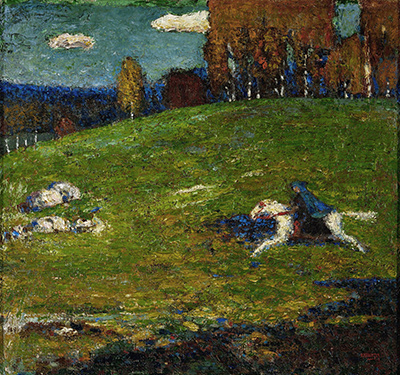
By 1911, Kandinsky had already made landscapes in which strong colour and simplified form carried as much weight as the places depicted. His Murnau paintings show how a hill, building, or path could become a set of intense, flattened relationships. The concert painting takes that process into an interior. A viewer can still discover a piano and people, but they are no longer organised primarily to describe a believable room. Kandinsky is asking whether the disturbance and energy of a performance can determine the picture's structure. The same year brought the break with the New Artists' Association of Munich and the first exhibition of Der Blaue Reiter; Impression III belongs to this moment of rapid experiment and collaboration. [9]; [1].
It also shows that Kandinsky's development cannot be represented as a simple sequence in which objects disappear and never return. Later works may carry traces of riders, boats, landscapes, or city forms even when the first impression is of a free arrangement of colour and line. Here, recognising the piano does not weaken the painting's abstract ambition. It clarifies what Kandinsky did with a recognisable subject: he kept the elements that would anchor the experience, then changed their scale and visual role. The piano becomes a black directional force, the listeners a rhythm of arcs, and the room an unstable field of colour. [1]; [7].
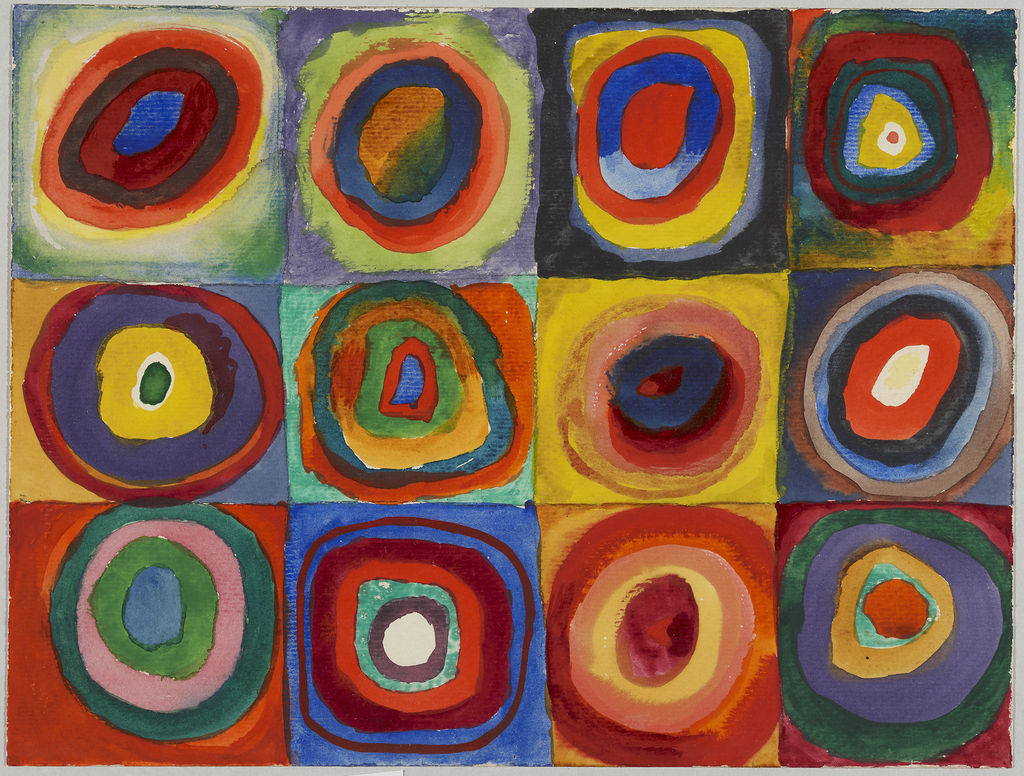
The 1913 colour study commonly called Squares with Concentric Circles makes a useful later comparison. It tests colour relationships in repeated units and is a work on paper, rather than a painted account of an event. The two artworks therefore approach colour from different starting points. Impression III begins with a concert and pushes the visual record towards a powerful colour structure; the later study places changes of colour at the centre of the exercise from the outset. Seeing them together helps resist a familiar shortcut in which every Kandinsky work is treated as the application of one universal colour theory. [10]; [1].
Why it still matters
Impression III joins a dated concert, surviving drawings, a finished canvas, and the subsequent correspondence between two artists. That unusually clear chain of evidence lets us follow an artistic decision rather than merely attaching an abstract painting to an inspiring story. We can see the visible concert being pared down, yet not erased. We can also see that the final work makes demands the drawings do not: yellow has to act across the whole surface, black has to hold together both piano and listeners, and the white interval has to break and reconnect the flow. [4]; [1].
The painting rewards looking in both directions. Begin with the concert, and its forms become unexpectedly free. Begin with the colours, and a piano and audience gradually appear. Neither way of looking cancels the other. Kandinsky's achievement is the sustained tension between them, made from a particular experience in Munich at a pivotal point in his work.
Kandinsky artworks directory
Frequently Asked Questions
Kandinsky heard a programme of Arnold Schönberg's music in Munich on 2 January 1911. It included the string quartets opp. 7 and 10, the three piano pieces op. 11, and five songs. The painting responds to the experience of the evening; it is not securely identified as an illustration of just one item on the programme. [3]; [1].
Yes. The holding museum identifies the diagonal black form as a grand piano and the dark curved shapes below as listeners. The painting greatly simplifies both instrument and audience, so they can also be experienced as active parts of an abstract arrangement. [1].
No. It moves strongly toward abstraction through its handling of colour, scale, and spatial relationships, but identifiable elements of the concert remain. The preparatory drawings make those links easier to trace. [4]; [1].
Discussion
What do you notice first in Impression III (Concert)? Share a close observation or a question about the evidence for this work.
Comments are for comparing what we see and what the cited sources establish.
Reader Insights
How do the black piano shape and broad yellow field affect each other?
What do the two charcoal studies show about the move from concert to canvas?
Which part of the 1911 performance history would help you look at the painting more closely?
Join the Conversation
Add your observation below and tell us which part of the artwork led you to it.
References
- Städtische Galerie im Lenbachhaus und Kunstbau München, Impression III (Konzert) collection record, including object details, provenance, and the museum's work text. View source.
- Lenbachhaus, Der Blaue Reiter bilingual exhibition text, 2021. View source.
- Philharmonie de Paris, Musée de la musique, Kandinsky: la musique des couleurs, concert programme and musical context (French). View source.
- Centre Pompidou, first and second studies for Impression III (Konzert). View source 1 · View source 2.
- Arnold Schönberg Center, Schönberg, Kandinsky, Blauer Reiter and the Russian Avantgarde, exhibition essay; letter archive. View source 1 · View source 2.
- Wassily Kandinsky, Über das Geistige in der Kunst, digitised 1912 edition, Heidelberg University Library (German). View source.
- Centre Pompidou, Impression V. View source.
- MoMA, Kandinsky: Compositions. View source.
- Lenbachhaus, artist biography. View source.
- Lenbachhaus, colour study. View source.