 by Tom Gurney
Tom Gurney BSc (Hons) is an art history expert with over 20 years experience
Published on June 19, 2020 / Updated on October 14, 2023
Email: tomgurney1@gmail.com / Phone: +44 7429 011000
Improvisation 4 by Wassily Kandinsky: Introduction
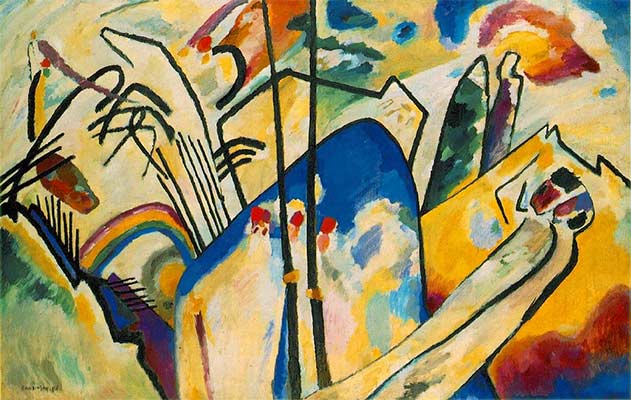
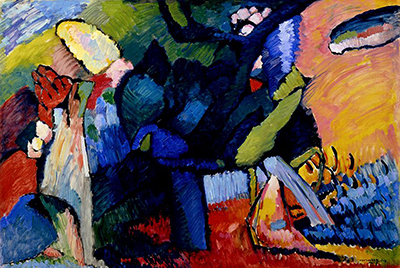
A dark blue-black mass gathers near the centre of this wide canvas, bracketed by vigorous red, green, yellow and blue. Pale and bright passages meet at sharp changes of direction. The eye can search for people or a landscape, but the coloured shapes resist settling into a clearly described place. Wassily Kandinsky painted Improvisation 4 in 1909. The work belongs to the Nizhny Novgorod State Art Museum in Russia. A Tretyakov Gallery Magazine survey of that collection records it as oil on canvas, 107 × 158.5 cm. The museum itself presents the painting in a Russian-language talk by its researcher Nadezhda Yurasova. [1]; [2].
This is an early Improvisation, made before the better-known paintings of 1911–13 in which Kandinsky pushed figures even farther into abstract line and colour. It does not need to be described as a totally objectless image. A study of Kandinsky's exhibition practice groups Improvisation 4 with works in which subjects became increasingly difficult to recognise. It describes loosely sketched figures and landscapes in this period, but classifies this particular canvas as non-representational for its analysis. That distinction leaves room to discuss possible forms without imposing a detailed story. The painted surface allows forms to emerge and retreat as the viewer looks. [4].
Watch: Wassily Kandinsky
Five museum videos about Kandinsky’s art, sources of inspiration and the relationship between colour and music.
Vasily Kandinsky: Around the Circle
Curator Megan Fontanella introduces Kandinsky and the Guggenheim collection.
Watch on YouTubeAt a Glance
- Artist and title:Wassily Kandinsky, Improvisation 4, also called Improvisation No. 4.
- Date:1909, according to museum and exhibition sources.
- Medium and size:Oil on canvas; 107 × 158.5 cm in a Tretyakov Gallery Magazine collection survey. A Museo Thyssen exhibition listing gives 108 × 158.5 cm.
- Collection:Nizhny Novgorod State Art Museum, Russia.
- Visible arrangement:Dark blue-black centre, yellow and orange passages above and to the right, red and blue areas at the sides, with loosely suggested figures or landscape rather than a fully mapped setting.
- Collection history:Works from the State Art Fund entered the Nizhny museum in autumn 1921; a museum-linked exhibition account identifies this painting in the later collection and its 1989 Swedish showing.
- Different object:MoMA's Improvisation 4 is a 1913 woodcut plate from Klänge, not this 1909 oil painting.
- Image:Existing local splash retained. No larger candidate added because rights and photo provenance are not sufficiently clear.
Where this work sits in Kandinsky’s career
The Blue Rider
1903Composition VII
1913Composition VIII
1923Several Circles
1926Sky Blue
1940Contents
- Looking across a broad canvas
- 1909 and the turn toward abstraction
- From the state art fund to Nizhny Novgorod
- Not the Klänge woodcut
- Frequently asked questions
- References
Looking across a broad canvas
The painting is almost one and a half times as wide as it is high. That span allows several coloured groups to press against one another. The dark central mass is especially forceful because it sits among lighter yellow, pale blue and red. At upper right, warm yellow and orange spread in broad, curved strokes. At left, a pale oval and red forms pull attention in another direction. Rather than occupying separate compartments, the areas interrupt and overlap, so the eye keeps moving across the surface. These observations can be tested against the existing reproduction and the museum's identification of the work. [1]; [2].
Near the middle, deep blue and black conceal some of the more tentative contours. White and pale blue below them can seem to open a passage, but its direction is unstable. On the left, a strong red area sits beside light yellow and a smaller blue-green form. The right side has a bright yellow-orange expanse edged by darker blue, then red and white at the lower portion. The result is a rhythmic contrast between dense, shadowed centre and large warm areas on either side. It is a formal description rather than a claim that each passage corresponds to a named person, horse or hill. [1].
An academic account of Kandinsky's early exhibitions calls Improvisation 4 one of the increasingly abstract works he began in 1909. It describes loosely indicated figures and landscape in works of this period, with colour making subjects hard to pin down; its analytical coding treats this canvas as non-representational. This suggests a way to look without forcing a puzzle solution. One can ask where a dark contour begins to resemble a body, then watch it join a larger, non-figurative sweep. A pale patch may suggest sky or open space, but it also works as a change of value beside a dark blue form. The painting's uncertainty is constructed through its colour relationships, not a defect of the viewer's eyesight. [4].
The title Improvisation adds historical context without settling those motifs. Kandinsky distinguished paintings prompted by inner experience from direct records of the visible world. A Nizhny Novgorod museum talk places his Impressions, Improvisations and Compositions within a system of painting concerned with forms beyond straightforward representation. Yet “improvisation” does not prove he made this canvas in a single unplanned burst. Its broad colour masses and counterbalancing forms are deliberate features of a finished oil. A reader can discuss the work's energetic effect without inventing the studio sequence of its strokes. [1].
1909 and the turn toward abstraction
Improvisation 4 belongs to a year in which Kandinsky was testing how far a painting could loosen its subject and still feel consequential. The academic exhibition study notes that he showed expressionist landscapes and imagery drawn from Russian and German stories in the surrounding period, while works such as this one made subjects increasingly difficult to recognise. This is a transition within his practice, not a switch thrown on a single date. The painting retains suggestions of figures and landscape even as the force of colour begins to rival them. [4].
The same study records Improvisation 4 among three such works shown at the Sonderbund exhibition in Düsseldorf in 1910, alongside an early version of Improvisation 5 and Improvisation 7. That exhibition history is important because it shows the painting circulating publicly while Kandinsky's approach was still developing. It was not a later retrospective construction of an abstract beginning. Its 1909 date and 1910 presentation put it at the start of the Improvisation sequence rather than treating it as a late echo of famous 1913 canvases. [4].
A Museo Thyssen exhibition on Russian avant-gardes placed this painting within a display concerned with imagined Russia, folk traditions and strong colour. That is a curatorial context for the 1909 oil, not proof that the canvas depicts a particular folk tale or a view of a real Russian village. The exhibition's colour emphasis fits what can be seen: bright tones do much of the work normally done by descriptive contour. But a broad exhibition theme should not be turned into a specific object title or narrative that the museum has not supplied. [3].
The canvas asks how dark and bright areas compete, and where figures almost come into view. Its early exhibition record matters because viewers encountered that uncertain balance while Kandinsky was still developing his approach. The work's place in a sequence of Improvisations helps date the experiment, but each broad colour passage also deserves attention on its own terms. [1]; [4].
From the state art fund to Nizhny Novgorod
The Nizhny Novgorod collection did not grow only by ordinary direct purchases. Irina Mironova's survey in Tretyakov Gallery Magazine explains that a State Art Fund under the Education Commissariat sent avant-garde works to the city for a proposed Museum of the Culture of Painting. That museum was never realised. In autumn 1921, works by Kandinsky, Malevich, Larionov, Goncharova, Popova, Rozanova and others were transferred to the city's art museum, forming an important part of its avant-garde holding. A later State Russian Museum exhibition catalogue lists Improvisation 4 as received in 1921 from the Museum of Painterly Culture in Nizhny Novgorod. [2]; [6].
Mironova singles out this painting's showing in Sweden in 1989 as significant for the collection's renewed international visibility. That is a documented exhibition milestone, not evidence that the work spent the intervening decades continuously on display. The museum's 2023 notice invited visitors to see Improvisation 4 in its twentieth-century art building at Minin and Pozharsky Square 2/2. The notice establishes that display at the time it was published; current gallery placement should be checked with the museum, since exhibitions change. [2]; [1].
Sources differ slightly on the painting's measured height. The Tretyakov Gallery Magazine collection survey gives 107 × 158.5 cm. Museo Thyssen's 2006 exhibition listing gives 108 × 158.5 cm for the same 1909 oil at Nizhny Novgorod. An article should give the source for its chosen number rather than silently averaging them or treating the difference as evidence of another work. Both agree on the date, oil medium, width and collection identity. [2]; [3].
Not the Klänge woodcut
The name Improvisation 4 also appears on a woodcut plate in Kandinsky's book Klänge (Sounds). The Museum of Modern Art dates that printed work 1913, records it as a woodcut in an illustrated book and assigns it object number 858.1964.27. The Nizhny painting is a much larger 1909 oil on canvas. The two should not be conflated because they share a title. MoMA's discussion of how Kandinsky joined poems, prints and typography in Klänge belongs to the book project; the painting has its own medium, composition and collection history. [5]; [2].
The distinction matters when looking at reproductions, too. The woodcut is a sharply bounded printed design within a book; the oil is a broad surface of overlapping colour, with no fixed typographic frame. Details in one cannot be used as evidence for the other. Compare their museum records before drawing conclusions from a shared title. [5]; [1].
Improvisation 4 is most revealing when treated as a specific 1909 oil rather than an early number in a generic list. Its colour makes possible figures and landscape hard to hold in view. Its movement through early exhibitions and into Nizhny Novgorod's state-formed avant-garde collection gives it a distinct history. The painted image and the later Klänge print may share words, but their objects and materials remain separate. [2]; [5].
Kandinsky artworks directory
Frequently Asked Questions
It is oil on canvas. A Tretyakov Gallery Magazine collection survey gives 107 × 158.5 cm; a Museo Thyssen listing gives 108 × 158.5 cm. [2]; [3].
An academic study calls the canvas non-representational in its analytical classification, while describing how Kandinsky's works of this period could leave figures and landscape difficult to identify. Close looking can still test possible forms without insisting on a fixed scene. [4].
It belongs to the Nizhny Novgorod State Art Museum, Russia. The museum's 2023 notice gave its twentieth-century art building as the place to see it then; check the museum for current display. [1]; [2].
The museum's avant-garde works, including Kandinsky's, were transferred from the State Art Fund arrangement in autumn 1921. An exhibition catalogue lists this painting as received in 1921 from the Museum of Painterly Culture in Nizhny Novgorod. [2]; [6].
Discussion
What do you notice first in Improvisation 4? Share a close observation or a question about the evidence for this work.
Comments are for comparing what we see and what the cited sources establish.
Reader Insights
Where do you first sense a figure or landscape amid the colour?
How does the dark centre change the balance of the warm areas at either side?
What can the 1910 Düsseldorf showing tell us about how early viewers met this painting?
Join the Conversation
Add your observation below and tell us which part of the artwork led you to it.
References
- Nizhny Novgorod State Art Museum, Improvisation 4 museum talk and 2023 display notice. View source 1 · View source 2.
- Irina Mironova, “The Nizhny Novgorod State Arts Museum,” Tretyakov Gallery Magazine, 2005. View source.
- Museo Thyssen-Bornemisza, Russian Avant-gardes, 2006 room listing. View source.
- Exhibiting Abstraction: Strategies in the Propagation of an Avant-Garde 1908–1915. View source.
- Museum of Modern Art, separate Improvisation 4 woodcut from Klänge. View source.
- State Russian Museum Kandinsky exhibition catalogue with the 1921 transfer. View source.