 by Tom Gurney
Tom Gurney BSc (Hons) is an art history expert with over 20 years experience
Published on June 19, 2020 / Updated on October 14, 2023
Email: tomgurney1@gmail.com / Phone: +44 7429 011000
Improvisation 26 (Rowing) by Wassily Kandinsky: Introduction
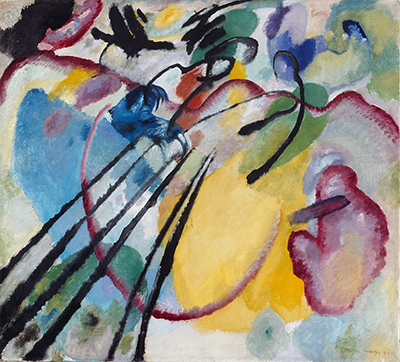
Black diagonals drive across this painting from the lower left toward the centre. Around them, blue, yellow, red and green spread in broad, irregular areas. The picture can initially appear to be a clash of marks without an identifiable subject. Its subtitle supplies one: Rowing. The Lenbachhaus describes the suggestion of a boat with extended oars and bent figures aboard, moving across a shimmering field of colour. Wassily Kandinsky painted Improvisation 26 (Rudern) in 1912, in oil on canvas, 97 × 107.5 cm. The owner's inventory number is GMS 66. [1].
Recognising the boat does not make the painting a straightforward marine scene. The dark diagonals can be oars and independent directional forces at once. The red arc can hold a hull together without sealing it off from the surrounding colour. The Lenbachhaus's essay makes that dual role central to its account: line and colour separate enough to act on their own, yet together they create a new pictorial space. A related small reverse-glass work titled Rudern (Rowing) makes the motif easier to trace, while remaining a separate object with a different medium and inventory number. [1]; [2].
Annotated details in Improvisation 26 (Rowing)
Select a numbered point to examine three close views of the work.
 123
Select a number to reach its detail.
Details from IMPROVISATION 26 (ROWING)
Three close views of the work.
Dark diagonals
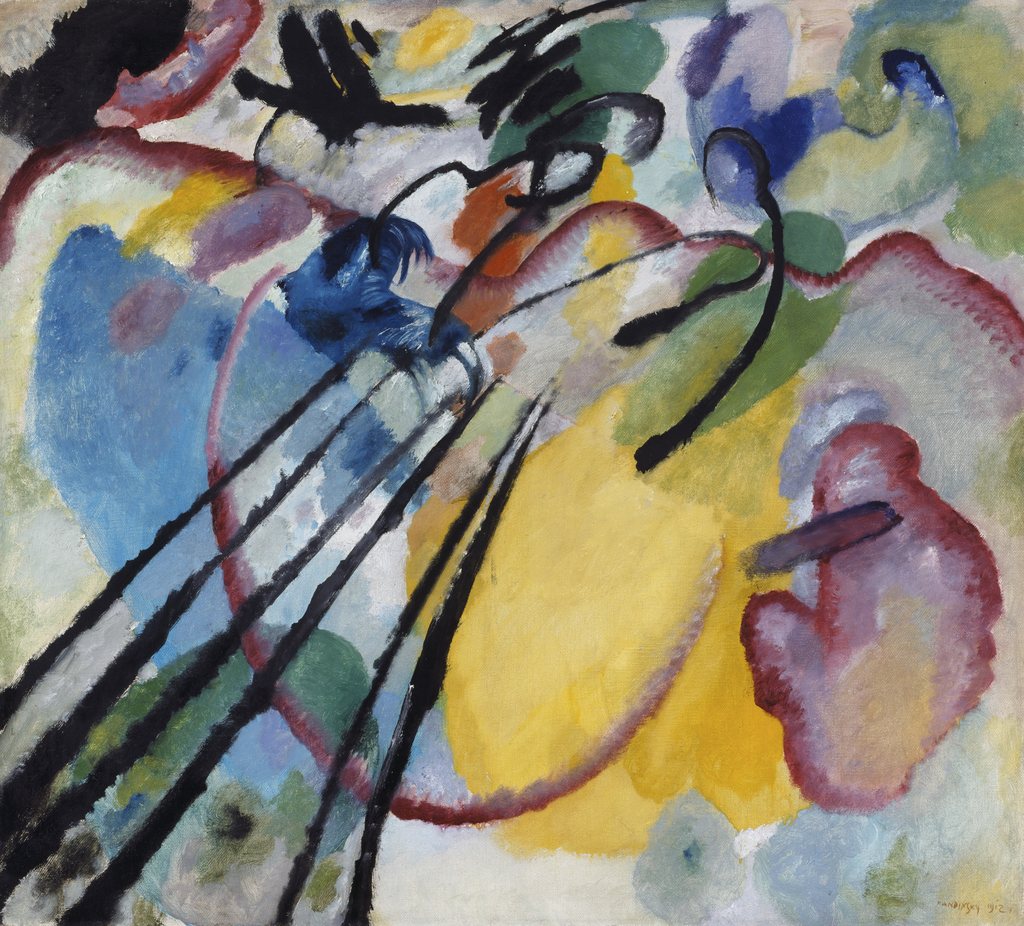
Several long black strokes cut across the lower left.
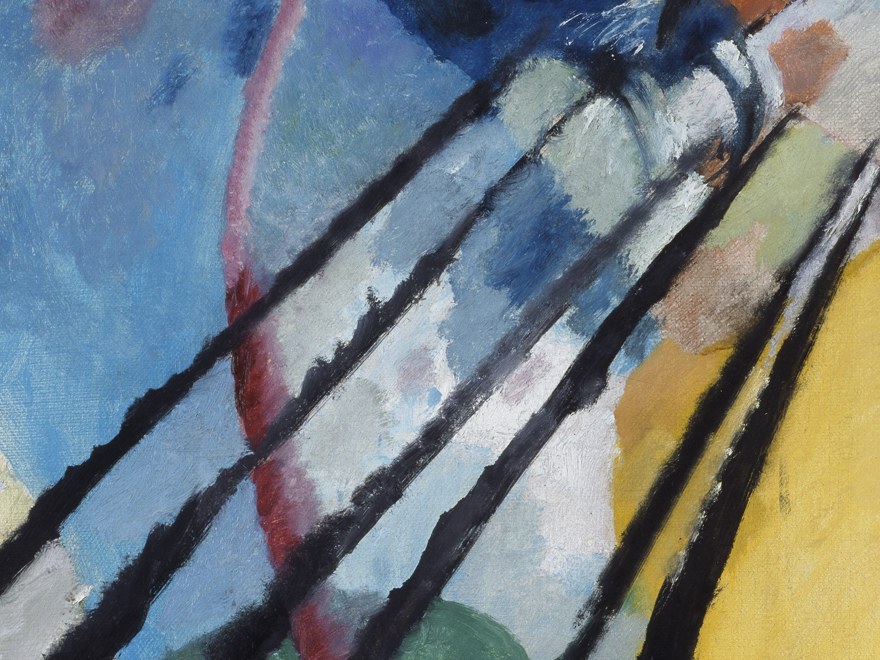
Yellow oval
A warm yellow area holds the centre against the cooler surrounding colours.
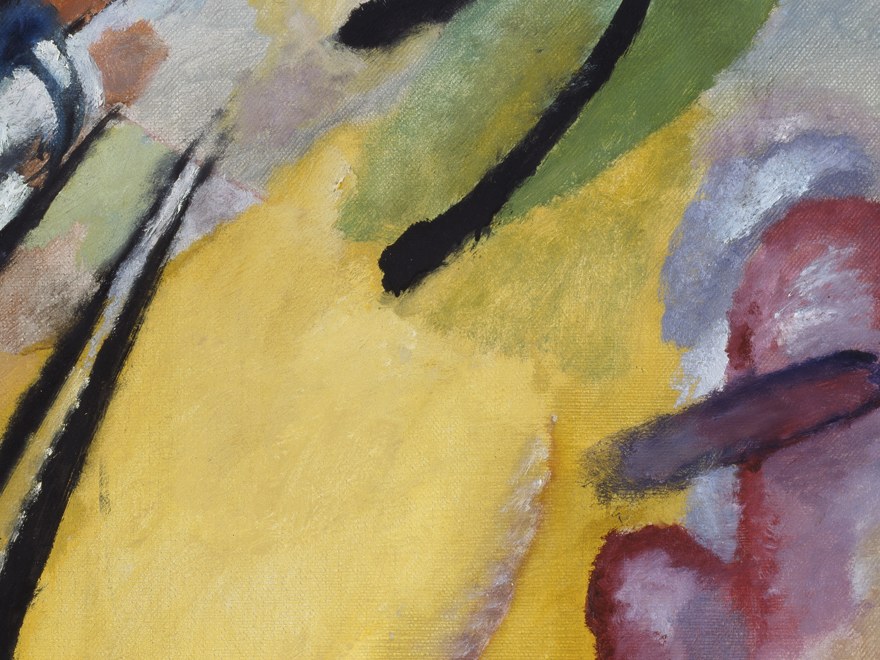
Red form
A soft red shape balances the movement of the black diagonals.
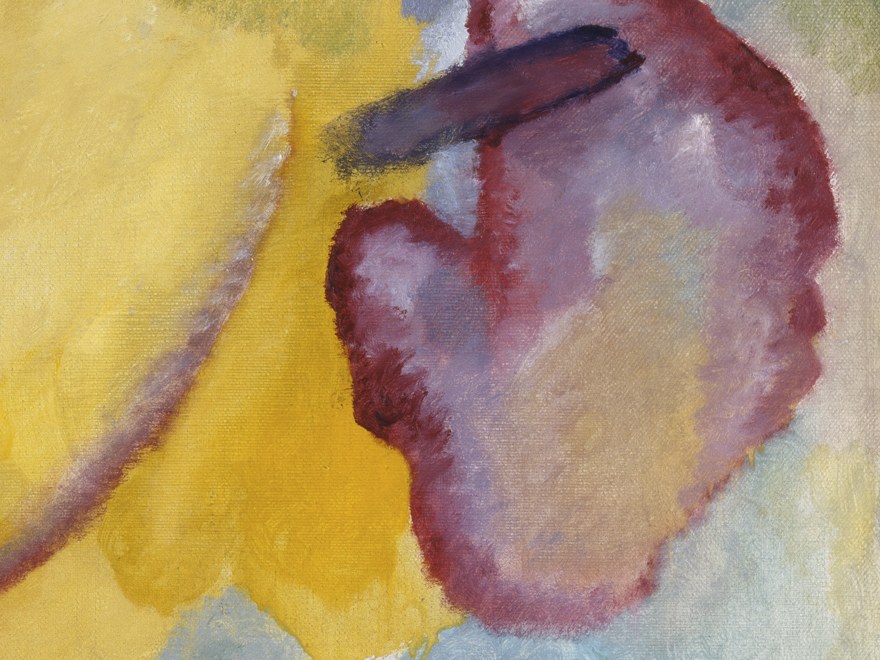
Reproduction from the linked collection record, CC0 1.0. View image source and terms.
Watch: Wassily Kandinsky
Five museum videos about Kandinsky’s art, sources of inspiration and the relationship between colour and music.
Vasily Kandinsky: Around the Circle
Curator Megan Fontanella introduces Kandinsky and the Guggenheim collection.
Watch on YouTubeAt a Glance
- Artist and title:Wassily Kandinsky, Improvisation 26 (Rudern), commonly translated Improvisation 26 (Rowing).
- Date:1912, according to the owning museum.
- Medium and dimensions:Oil on canvas, 97 × 107.5 cm.
- Collection:Städtische Galerie im Lenbachhaus und Kunstbau München, inventory GMS 66; Gabriele Münter Foundation gift, 1957.
- Inscription:Signed lower right,
KANDINSKY 1912. - Subject and form:A suggested boat, outspread oars and bent rowers amid colour fields; black lines and colour function both descriptively and independently.
- Different object:Rudern is a smaller reverse-glass painting of about 1912, GMS 108. Its glass, metal foils and painted frame are not materials used in GMS 66.
- Image:Existing site splash retained. The owner marks its larger download of this exact oil CC0 1.0; an unchanged copy is an optional guide image.
Where this work sits in Kandinsky’s career
The Blue Rider
1903Composition VII
1913Composition VIII
1923Several Circles
1926Sky Blue
1940Contents
- Annotated details
- Finding the boat
- How colour and line make space
- A related Rowing behind glass
- Collection and a closer look
- Frequently asked questions
- References
Finding the boat
The subtitle Rudern means Rowing and names the activity the picture invites us to find. The Lenbachhaus asks the viewer to recognise a boat's schematic body, oars projecting from it and figures bending inside. The boat seems to glide without the clear waterline or surrounding horizon expected from a conventional boating picture. Its motion depends on the long slanting strokes as much as on the imagined action of the rowers. The museum's wording is careful: these are suggestions of figures and a vessel within an ambiguous visual language. The painting does not document a specific crossing, river or crew. [1].
At the left, large pale blue and violet passages set off a cluster of black strokes. Several strokes travel diagonally into the lower edge, creating a sense of thrust that a stationary shore could not provide. Near the centre, a red-orange arc suggests the rounded body of the boat, yet it also sweeps independently across yellow. At the right, a red-violet form is set against light green and blue. If the eye insists on turning every coloured zone into water or land, the picture resists: patches change their apparent depth as their neighbours change. This tension between a named motif and active formal parts is the point of the work's visual construction. [1].
The museum describes the open arc of the boat in a red related to a wavy line higher in the image. It explains that a connected watercolour permits the upper line to be identified as a hill line. The shared red makes two separated parts of the surface answer one another, even while they appear to refer to different things. Black diagonals can point to oars; other black marks can serve as bent backs. But the lines carry energy beyond their outline function. The museum's essay calls attention to the expressive force those marks gain when Kandinsky no longer fills them into complete, solid bodies. [1].
There is a useful limit to identifying the boat. Six dark strokes do not automatically mean six individually depicted people, nor does a high curve make a named mountain. The related reverse-glass object does depict a boat and six oars in more explicit terms, according to a technical research dossier. That comparison illuminates the oil, but the canvas still needs to be described on its own terms. Its colour field and black structure do not line up like a diagram of the glass work. [1]; [3].
How colour and line make space
The Lenbachhaus presents Improvisation 26 as a strong example of Kandinsky changing the relation between line and colour. The lines are no longer simply edges that contain local colour. They run across broad patches, mark directions and suggest bodies while remaining visible as separate strokes. Colour does not merely fill in objects; blue, yellow, red and green are placed so that some zones appear to come forward and others recede. Even where adjacent colours lack firm boundaries, the museum argues, the painting acquires depth without conventional one-point perspective. [1].
One can test that claim by looking from the dark lower-left strokes up to the red arc and across the central yellow. The diagonal creates an apparent route into the picture, but the yellow field then draws attention back to the surface. The boat can feel suspended because the colour patches do not establish a continuous floor or sea underneath it. Blue at left might suggest water, while blue at upper right seems to float near green and violet. This is a more exact account than saying that Kandinsky abandoned reality altogether. The boat persists; its setting has been rearranged so that pictorial movement does much of the work of representation. [1].
The owner's essay relates this approach to Kandinsky's writing in On the Spiritual in Art and to remarks in his 1914 Cologne lecture about colours having differing inward weights and creating a depth that could replace older perspective. The museum connects those ideas to this 1912 canvas as an explanatory frame. The lecture came later than the painting, so it is best treated as evidence of Kandinsky's reflection on his practice, not a dated set of instructions he followed while making GMS 66. [1].
The same essay mentions possible symbolic meanings of Kandinsky's boat motif. Drawing on Armin Zweite's research, it says a boat can carry associations of departure, farewell or liberation, comparable in some respects to his rider imagery. The museum deliberately says such meanings may be involved here. No inscription on this canvas identifies the passengers or their destination. The symbolic account is worth exploring alongside the visible diagonals and floating space, provided it remains a proposal rather than a closed translation. [1].
A related Rowing behind glass
The Lenbachhaus holds a separate, small reverse-glass Rudern, dated about 1912 and inventoried as GMS 108. Its painted frame measures 24.5 × 28.4 cm. The museum's research booklet describes ink, resin-oil paint and applications of tin and aluminium foil behind decorative glass. A multidisciplinary technical dossier records a boat on the left, people suggested inside it and six oars extending in pairs. The glass itself has a wavy structure; the metallic areas can sparkle like reflections or disturbed water. These are material properties of GMS 108, not of the large oil canvas GMS 66. [2]; [3].
The dossier also notes that a 1910 watercolour already shows parallels with both the glass picture and the oil. Because the diagonal oar lines reverse direction in the glass image, its authors propose that the watercolour probably served as a model for the glass work. They observe details returning in the 1912 canvas. This is strong evidence of related motifs across media, but it does not establish a minute-by-minute order for every layer of the oil. The museum's own object record dates the canvas to 1912; the research dossier studies the glass work directly and uses the oil as a comparison. [3]; [1].
This material distinction prevents a common error. The glass work's metallic foils and textured glass have been analysed by conservators; the oil canvas has not thereby been shown to contain those same additions. The painting's floating effect can be explained through its colour and line, as the owner essay does, without transferring the glass object's laboratory findings to it. Similarly, a photographed research figure showing both works should not be reused as a guide image under the oil's CC0 notice: that notice applies to the specific GMS 66 download on the owner's object page. [1]; [3].
Collection and a closer look
The museum records the painting as part of the Gabriele Münter Foundation gift of 1957. It gives the signature at the lower right, KANDINSKY 1912., and currently lists the work as not on display. The catalogue dimensions, 97 × 107.5 cm, make this a substantial painting, nearly square but a little wider than high. The web image helps locate the oars and bright colour but cannot reproduce the original scale of the black strokes or the changes of paint thickness. Its live display status should be checked at the museum when planning a visit. [1].
The page retains its existing artwork image, which has been visually matched to the owner record. The Lenbachhaus explicitly labels its downloadable GMS 66 file CC0 1.0, and an unchanged 2000 × 1808 copy has been saved as an optional larger image for the artist guide. Its source, exact licence statement, credit and hash are recorded. The 400-pixel site splash remains adequate for this page, consistent with treating an upgrade as a convenience rather than a condition of completion. [1]; [4].
The title's concrete action gives the viewer a point of entry, while the painting makes that action hard to pin to a single stable place. Oars become black diagonals, the hull becomes a red arc, and the surrounding water becomes a field whose colours create space on their own. Kandinsky's boat remains present as a motif without limiting what those lines and colours can do. [1].
Kandinsky artworks directory
Frequently Asked Questions
The Lenbachhaus dates the oil painting 1912 and records a lower-right signature reading KANDINSKY 1912. [1].
It is oil on canvas, 97 × 107.5 cm, according to the owner. [1].
The museum describes a suggested rounded boat with extended oars and bent figures. Long black diagonals and a red arc help the eye locate them, though the forms remain partly absorbed by surrounding colour. [1].
It retains the boat and rowing motif named by its subtitle. Its lines and colours also operate independently of those suggested objects, creating movement and depth without conventional perspective. [1].
No. The oil canvas is GMS 66. The separate Rudern of about 1912 is a small reverse-glass work, GMS 108, with decorative glass and metal foil additions. The works share a motif but have different media and inventory numbers. [1]; [2].
It belongs to the Städtische Galerie im Lenbachhaus und Kunstbau München, inventory GMS 66, through the Gabriele Münter Foundation gift of 1957. The current record says it is not on display; check there for changes. [1].
Discussion
What do you notice first in Improvisation 26 (Rowing)? Share a close observation or a question about the evidence for this work.
Comments are for comparing what we see and what the cited sources establish.
Reader Insights
Where do the black diagonals first read as oars?
How does the red hull arc work against the surrounding yellow?
What does the separate glass Rowing clarify, and what remains distinct in this canvas?
Join the Conversation
Add your observation below and tell us which part of the artwork led you to it.
References
- Lenbachhaus, Improvisation 26 (Rudern), GMS 66, object record, Friedel–Hoberg essay and CC0 notice. View source.
- Lenbachhaus, Group Dynamics: The Blue Rider, research booklet on the separate reverse-glass Rudern, GMS 108. View source.
- Bretz et al., 2019 technical dossier for the reverse-glass Rudern, GMS 108. View source.
- Creative Commons, CC0 1.0 Universal. View source.