 by Tom Gurney
Tom Gurney BSc (Hons) is an art history expert with over 20 years experience
Published on June 19, 2020 / Updated on October 14, 2023
Email: tomgurney1@gmail.com / Phone: +44 7429 011000
Moscow I by Wassily Kandinsky: Introduction
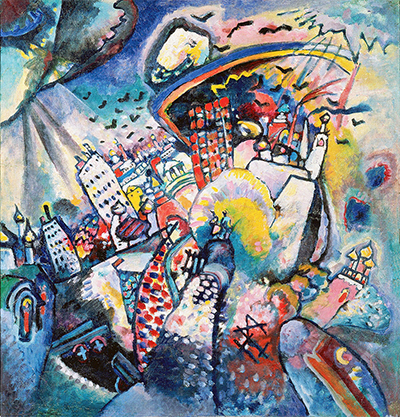
Wassily Kandinsky painted Moscow I in 1916, after returning to Russia during the First World War. The State Tretyakov Gallery owns the oil and catalogues it in Russian as Москва. Красная площадь—Moscow. Red Square. Its closely packed buildings, bright sky and rushing colours evoke a city intensely felt rather than a square mapped from one fixed viewpoint. The title used on this page follows an established English usage; the owner's record anchors the actual object. [1]; [2].
The existing image above shows a city that seems both recognisable and unstable. Towers and roofs are crowded into a small surface, while bands of colour and light hold the fragments together. The Tretyakov's account records Kandinsky's ambition to draw on impressions from across Moscow and combine them into a single image, with an effect he compared to an orchestra. That makes this a useful painting through which to examine his changing balance of observation, memory and invention in the Russian years. [1].
Watch: Wassily Kandinsky
Five museum videos about Kandinsky’s art, sources of inspiration and the relationship between colour and music.
Vasily Kandinsky: Around the Circle
Curator Megan Fontanella introduces Kandinsky and the Guggenheim collection.
Watch on YouTubeAt a Glance
- Artist and date:Wassily Kandinsky, 1916.
- Owner's title:Москва. Красная площадь (Moscow. Red Square); also known in English as Moscow I.
- Medium and dimensions:Oil on canvas, 51.5 × 49.5 cm.
- Collection and number:State Tretyakov Gallery, Ж-1271.
- Acquisition:Gift of G. D. Costakis, 1977.
- Image on this page:Existing site image retained; museum reproductions were used for research only.
Where this work sits in Kandinsky’s career
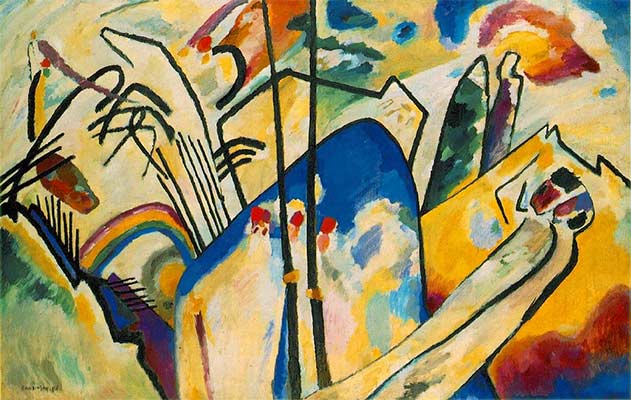
The Blue Rider
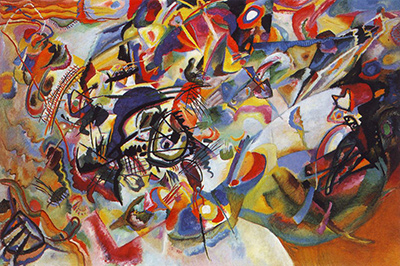
1903Composition VII
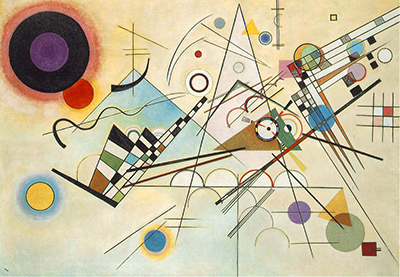
1913Composition VIII
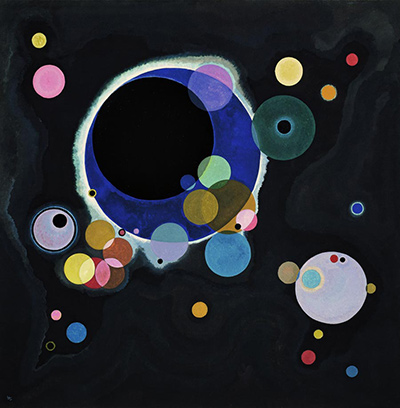
1923Several Circles
1926Sky Blue
1940Contents
- The exact painting and its two titles
- Returning to Moscow in wartime
- Looking through the crowded city
- A composite, not a single window view
- Other Zubovskaya views are separate objects
- Studies and the limits of a neat sequence
- Why the painting matters in the Russian years
- Frequently asked questions
- References
The exact painting and its two titles
The Tretyakov identifies this object with a Russian title that names Moscow's Red Square. Guggenheim teaching materials call it Moscow I and give the same 1916 date, oil medium, measurements and Tretyakov collection. These details establish that the English and Russian names in these sources concern one painting. They do not mean that every image or work titled “Moscow” is interchangeable. Kandinsky made several city pictures in these years, including distinct views from the area around his apartment. [1]; [2].
The painting is nearly square, measuring 51.5 cm high by 49.5 cm wide. That compact format matters to its effect. It has little empty space in which the city can settle into a conventional foreground and distance. Churches, buildings, colour and sky are compressed together. The museum accession, Ж-1271, is a useful safeguard when comparing catalogues: a title can be translated or shortened, while the owner's object number fixes which canvas is being discussed. [1].
The 1977 gift from G. D. Costakis is part of the painting's later history. It does not tell us where Kandinsky first displayed the work or prove that it hangs in a particular room today. A collection record establishes ownership; exhibition and loan arrangements can change. Readers planning a visit should check the museum's current information rather than infer display from a century-old date or from this article. [1].
Returning to Moscow in wartime
Kandinsky left Germany after the outbreak of the First World War in 1914 and returned to Russia. The move interrupted the Munich setting in which he had worked with the Blue Rider circle, but it did not end his artistic work. Paper works, reverse-glass pictures, city views and later large canvases belong to the following years. Guggenheim teaching materials describe a marked reduction in oil painting during 1915. That narrower point should not be turned into a claim that Kandinsky stopped making art. [2]; [6].
Moscow had a special place in Kandinsky's life. He was born there, studied there before deciding on art, and returned with memories as well as a painter's eye. The Tretyakov's essay cites his attachment to the city and describes an upper studio with broad views toward the Kremlin. These circumstances help explain his sustained attention to Moscow. They do not mean that Moscow I is a simple record of what could be seen through a single window. The owner describes a much more deliberate assembly of city elements. [1].
The year 1916 is important here because other Moscow subjects survive from the same period. A window view and a synthetic city painting can answer different artistic questions at the same time. Neither has to be cast as a crude preliminary stage for the other. War and return changed Kandinsky's circumstances, yet close attention to dated objects gives a fuller account than a simple story of disruption followed by recovery. [1]; [4].
Looking through the crowded city
The eye moves among steep rooflines, spires and rounded church forms. Reds and oranges press against blues, greens and pale yellow light. The city seems to rise toward the upper edge rather than recede into a calm, measured distance. A bright atmospheric sweep and small dark accents complicate the boundary between architecture and sky. These are visual relationships a reader can test in the painting; they do not require every patch of colour to stand for a named monument. [1].
The Tretyakov's description recognises churches alongside newer tall buildings and factory smoke. It also notes sunlight, a rainbow and birds. Taken together, those motifs place older architecture, modern city activity and changing weather within one picture. The mixture makes it hard to treat the work as a postcard view of Red Square alone. The owner's reading can guide looking, though some small shapes remain open to more than one visual interpretation in a reproduction. [1].
The painting's crowdedness is structured rather than accidental. Repeated upright forms provide a rhythm; warm clusters are broken by cooler intervals; curved forms answer angular roofs. The apparent rush of the image can therefore be examined as an arrangement of contrasts. Kandinsky's comparison to an orchestra, reported by both the Tretyakov and the Guggenheim, helps explain the ambition: separate impressions are coordinated into one effect. It is an analogy for how he wanted the work to operate, not evidence that each colour corresponds to a particular musical note. [1]; [2].
A composite, not a single window view
The owner essay describes Kandinsky setting out to combine elements gathered from around the city. It also reports that he visited the Kremlin at about eight in the evening to look at churches from an angle he needed before working on a sketch back at Zubovskaya. That specific visit tells us observation mattered. It does not turn the finished oil into a single on-the-spot painting made while he stood in Red Square. A sketch, memory and later adjustment could all contribute to the final image. [1].
The distinction changes how we read the painting. A conventional topographical view invites us to recover the painter's standing point and match landmarks to the same sightline. Moscow I invites those questions but resists a complete answer. Kandinsky was aiming for an encompassing image of Moscow. We can recognise architectural suggestions without forcing the crowded forms into one street map. The owner's account supplies the basis for that reading; it is more precise than inventing a single balcony or a dramatic moment of spontaneous painting. [1].
The title Red Square still matters. It brings the heart of Moscow into the work's identity and may direct attention to church forms associated with it. Yet a named square is not a promise of documentary perspective. Kandinsky's own reported desire to gather different elements makes the apparent tension between title and invented space productive: the city is both a real place and a painted construction. [1].
Other Zubovskaya views are separate objects
The Tretyakov owns a separate Moscow. Zubovskaya Square, dated around 1916. It is an oil on canvas on cardboard, 34.4 × 37.7 cm, and the owner describes it among views connected with Kandinsky's windows. Its accession, Инв.13232, is different from Moscow I. This smaller view is valuable evidence that he worked from his immediate surroundings, but its measurements and image cannot be silently transferred to the Red Square painting. [3]; [1].
The Zubovsky Platz article on this site concerns another distinct painting in the Lenbachhaus. That 1916 oil is on canvas mounted on cardboard and measures 41.8 × 45.8 cm. The Lenbachhaus places it within a series of views from Kandinsky's apartment and discusses his interest in changing light and colour harmonies. The similarity of the place names can hide three separate objects: the Tretyakov Red Square canvas, the Tretyakov Zubovskaya view and the Lenbachhaus Zubovsky picture. Their titles, supports, sizes and collections keep them apart. [4]; [3].
The comparison is more useful when their distinct purposes remain visible. A window series tests how a changing light or framing alters a familiar cityscape. Moscow I pushes many city impressions into a compact and more symbolic field. Both involve looking and colour organisation. The evidence does not require that one was a direct preparatory step for the other, or that one simply replaces an earlier commitment to abstraction. [4]; [1].
Studies and the limits of a neat sequence
The Tretyakov also catalogues an Abstract Composition on paper in relation to Moscow. Red Square. Its account places related studies before and after the painting. That is a warning against presenting one sheet as a definitive final cartoon from which the oil was mechanically copied. Kandinsky's working process could continue across media and after a major canvas had been made. [5].
The existence of such related work supports an account of experiment and revision. It does not mean every line in the paper object has a fixed counterpart in the oil. Nor does it authorize use of the museum's paper-work reproduction in a new download, guide or page design. Its catalogue entry supplies research evidence; any image addition needs its own clearly usable rights statement. The image already inherited on this page is sufficient for the article. [5].
Why the painting matters in the Russian years
Moscow I stands at a point where city, memory and abstract organisation visibly meet. It was made two years after the wartime return and before the institutional work that occupied Kandinsky after the 1917 revolution. That timing makes it neither a final Munich work nor a Bauhaus experiment brought forward by hindsight. It belongs to the specific artistic and personal conditions of his Moscow years. [6]; [1].
The painting also helps resist a false choice between “representational” and “abstract.” Churches and roofs can be recognised, but their arrangement and colour do much more than report a sight. The combination is not a retreat from thinking about relationships among forms. It is one way Kandinsky tested what a city subject could hold. His later geometric pictures pursued other solutions; they should not be treated as the only destination toward which this canvas was moving. [1]; [2].
The Moscow and Russian years guide sets this painting among related oils, paper works and cultural work from 1914 to 1921. Here, the owner record lets us hold onto the painting's particular facts: the 1916 oil, a specific Tretyakov accession, and an unusually ambitious image of the city. A viewer need not solve every shape to appreciate how Kandinsky made many impressions coexist on one small canvas. [1].
Kandinsky artworks directory
Frequently Asked Questions
The State Tretyakov Gallery dates the oil to 1916, during Kandinsky's return to Russia after the outbreak of the First World War. [1].
Yes. The Tretyakov's Russian title translates as Moscow. Red Square; Guggenheim teaching materials use Moscow I for a 1916 oil of the same measurements in that collection. [1]; [2].
It belongs to the State Tretyakov Gallery, accession Ж-1271. The owner records a 1977 gift from G. D. Costakis. Ownership does not guarantee that it is on display during a particular visit. [1].
The Tretyakov describes a composite image assembled from impressions of Moscow. Kandinsky did make separate window views, but the record does not present Moscow I as one literal window panorama. [1]; [4].
The Tretyakov identifies churches, newer buildings, factory smoke, sunlight, a rainbow and birds within a compressed city composition. Some small forms remain ambiguous when seen in reproduction. [1].
Discussion
What do you notice first in Moscow I? Share a close observation or a question about the evidence for this work.
Comments are for comparing what we see and what the cited sources establish.
Reader Insights
Where do the city buildings give way to a more invented space?
How does this composite Moscow differ from a Zubovskaya window view?
Which catalogue fact best keeps Moscow I distinct from the other 1916 city pictures?
Join the Conversation
Add your observation below and tell us which part of the artwork led you to it.
References
- State Tretyakov Gallery, Москва. Красная площадь. Owner title, 1916 oil, dimensions, accession, acquisition and interpretive essay. View source.
- Solomon R. Guggenheim Museum, Kandinsky teaching materials. Moscow I English usage and period context. View source.
- State Tretyakov Gallery, Москва. Зубовская площадь. Separate circa-1916 window-view painting. View source.
- Lenbachhaus, Zubovsky Platz. Separate 1916 window-view painting and apartment context. View source.
- State Tretyakov Gallery, Abstract Composition. Related paper work and study chronology. View source.
- MoMA, Kandinsky artist essay. Wartime return and broader Russian-period context. View source.