 by Tom Gurney
Tom Gurney BSc (Hons) is an art history expert with over 20 years experience
Published on June 19, 2020 / Updated on October 14, 2023
Email: tomgurney1@gmail.com / Phone: +44 7429 011000
Composition X by Wassily Kandinsky: Introduction
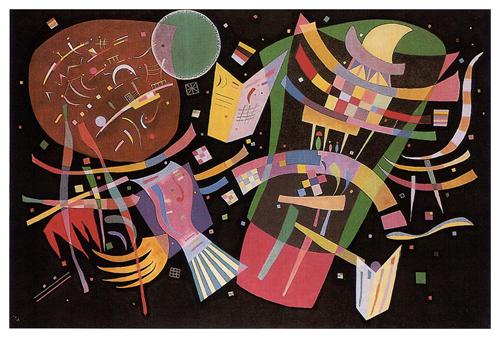
Wassily Kandinsky's Composition X sets bright, varied forms against an almost continuous black ground. Curves, ribbons, gridded marks and shapes that can suggest cut paper or small living things hover across the canvas. Nothing sits on a conventional floor or recedes towards a horizon. The dark field makes colours stand forward, yet the forms are not merely scattered at random. A large brown shape on the left, an upright pale element near the middle and a broad arrangement of curves on the right create a structure that rewards looking beyond the first burst of colour. The Kunstsammlung Nordrhein-Westfalen in Düsseldorf owns this 1939 oil on canvas and records its painted dimensions as 130 × 195 cm, inventory 0220. [1].
This was Kandinsky's tenth and last numbered Composition. MoMA's 1995 catalogue says he worked on it from December 1938 into January 1939. The owning museum records the completed painting as 1939 and notes his “VK 39” signature. Those dates fit together: the work began before the calendar turned and was finished in the year it bears. Its black ground stands apart from the banded colours of Composition IX and the pale field of the Bauhaus-era Composition VIII. The changes show Kandinsky still testing how a major composition could hold free forms in balance near the end of his career. MoMA, Kandinsky: Compositions catalogue, PDF pp. 56–57; [1].
Watch: Wassily Kandinsky
Five museum videos about Kandinsky’s art, sources of inspiration and the relationship between colour and music.
Vasily Kandinsky: Around the Circle
Curator Megan Fontanella introduces Kandinsky and the Guggenheim collection.
Watch on YouTubeAt a Glance
- Artist:Wassily Kandinsky.
- Title:Composition X (Komposition X).
- Date:1939 in the owning collection; MoMA dates the making from December 1938 into January 1939.
- Medium:oil on canvas.
- Painted surface:130 × 195 cm; the frame is recorded separately.
- Collection:Kunstsammlung Nordrhein-Westfalen, Düsseldorf, inventory 0220; acquired in 1980.
- Catalogue number:Roethel/Benjamin 1093.
Where this work sits in Kandinsky’s career
The Blue Rider
1903Composition VII
1913Composition VIII
1923Several Circles
1926Sky Blue
1940Contents
- A first look at the black field
- How black changes every colour
- A field without a horizon
- The left cluster
- The right cluster
- Is the balance really symmetrical?
- Small marks and changes of pace
- The final numbered Composition
- From Composition IX to X
- The owner record and the 1980 acquisition
- Black, silence and speculation
- A route for close looking
- Why Composition X matters
- Frequently asked questions
- References
A first look at the black field
Black covers nearly all the painted background. It is not a small shadow behind one object but the shared setting for many distinct forms. At a glance, the bright colours appear especially vivid because they meet the dark ground directly. Some shapes have crisp edges. Others are thinner, finer or partly open, leaving black visible through them. The resulting image can feel spacious even though the background offers no distant landscape.
On the left, a large rounded brown form contains delicate pale signs and smaller marks. Towards the centre, a vertical pale element and coloured strips offer a different kind of structure. To the right, a broad set of arcing bands and angular pieces creates a more extended cluster. Smaller flecks and thin lines are distributed between these larger groupings. The eye can move from one major form to another, then discover tiny incidents in the dark spaces that at first seemed empty.
The existing reproduction on this page shows the overall design clearly, including the white border surrounding the image file. That border is part of the local photograph, not a claim about the original painted frame. A direct view would be needed to judge exact paint texture, nuanced black tones and the delicacy of each small mark. The broad contrast between ground and forms, and the relation of the major clusters, remain visible in the reproduction.
How black changes every colour
A coloured shape against white can seem bounded and clear; the same hue against black can appear to glow, float or press forward. Composition X uses this difference across the entire canvas. Yellow, pink, green, red and blue passages do not all have identical intensity, but each is affected by the surrounding darkness. Pale colours can seem especially light, while warm bands and muted tones remain distinct rather than merging into one bright mass.
MoMA's catalogue notes that Kandinsky had earlier written of black as a colour associated with stillness and silence. It then asks how he used black here to give the forms heightened colour and visual relief. This is an important tension: an earlier theoretical description does not prevent an artist from choosing black as the principal ground in a later painting. It would be misleading to say that the canvas simply “illustrates” one rule from his writings. The observable fact is that black makes the forms read differently and gives the spaces between them unusual weight. MoMA catalogue, PDF p. 57.
Look where a bright shape stops. The black immediately around its edge can appear to expand, creating a pause before the next mark. Elsewhere, a fine coloured line can be almost swallowed by the ground until the eye adjusts. Kandinsky uses both emphatic and fragile relationships to the same background. The painting therefore has contrasts of volume and quiet within its strong overall colour effect.
A field without a horizon
The dark ground does not tell the viewer whether a shape is near or far in ordinary landscape terms. Forms seem suspended on or before it. A curved strip may pass across another shape, implying one layer in front of another, but there is no consistent room or sky to contain them. This is not a defect in perspective. It is the kind of spatial problem the painting chooses to explore.
The large brown area on the left can seem like an object, an enclosure or simply a broad colour mass. A pale upright near the centre can suggest a page or a sign without becoming a readable text. MoMA's catalogue compares some of the free forms to paper cut-outs and notes a balance around a central axis. Those observations describe their visual character, not a literal collage technique: the owning museum identifies the work as oil on canvas. MoMA catalogue, PDF p. 56; [1].
This uncertain space makes each overlap matter. An arc that crosses a rectangular area can bring one part forward. A small fleck left alone in black can seem far more isolated than a larger form inside a crowded cluster. The painting offers depth through relation rather than through a fixed viewpoint. A viewer may find that the field alternately feels shallow, like a patterned surface, and deep, like an open dark void. Both impressions can arise from the same painted facts.
The left cluster
The broad rounded form at left gives the painting one of its most substantial masses. Its muted brown and red-brown colours are quieter than many of the brighter bands elsewhere. Inside or across it, fine pale signs and short lines create a small-scale activity. The contrast between an enclosing mass and delicate marks makes this section worth lingering over rather than passing it on the way to the brighter right side.
Its shape can invite comparisons with a balloon, a drum or another object, but the owner record does not name such an item. MoMA's catalogue uses a balloon analogy and discusses possible links to earlier Kandinsky motifs. Those are scholarly comparisons, not a settled inventory of depicted objects. The secure observation is that a large warm-toned area holds lighter signs against black and balances a differently shaped cluster across the canvas. MoMA catalogue, PDF p. 57.
The left side also shows how the black ground works at more than one scale. Around the brown form it can feel like a broad open interval; inside smaller gaps it appears as thin punctuation between marks. A viewer moving closer may find that what looked like one quiet mass contains many little directions. This local complexity helps the left side answer the more visibly animated right without copying it.
The right cluster
On the right, coloured arcs, ribbons and angular elements gather into a more buoyant arrangement. Some bands sweep upward or across, while thin marks extend beyond them. A pale curve and darker patches cross the same area. The shapes are distinct enough to be followed separately, yet overlapping enough to feel connected. Their movement can draw the eye toward the upper right before smaller marks pull it back into the field.
MoMA describes this area in terms of floating forms and musical organisation. Musical language can be helpful when it points to rhythm, repetition or counterpoint, but the painting does not literally produce a sound. We can make the visual comparison concrete: a broad curved band is answered by a narrower one; warm and cool colours alternate; isolated small shapes break up longer arcs. These relations make the cluster feel active without requiring a specific melody or instrument. MoMA catalogue, PDF pp. 56–57.
The right side may appear more luminous because several light and bright elements sit close together. Yet black remains visible in the gaps. It separates the bands and prevents them from becoming one continuous object. As on the left, the background participates in the form. The shapes can float precisely because the dark intervals give each a boundary and room.
Is the balance really symmetrical?
MoMA's catalogue sees an overall balance arranged around a central vertical axis. That does not mean the left and right halves mirror each other. One side has a broad brown enclosure with tiny marks; the other is more extended and multicoloured. Their weights differ in type. The eye can still feel a relation between them, mediated by the pale upright and smaller forms near the middle. MoMA catalogue, PDF p. 56.
Test this by mentally covering one side. Without the left mass, the right's arcs might dominate the canvas. Without the right cluster, the left might feel too isolated in the black field. Smaller marks in the lower areas keep the centre from becoming a blank channel between two objects. Balance is thus achieved through differences, not repetition of the same shape in reverse.
This helps explain why a first impression of free floating elements can coexist with a sense of deliberate structure. The forms have varied edges and sometimes playful associations, but their distribution creates relations across the whole width. Calling the work “free” need not mean unplanned. A viewer can enjoy a seemingly spontaneous motif while noticing how its position affects the larger composition.
Small marks and changes of pace
The broad shapes are only one scale of activity. Near the top edge, small diamond-like pieces sit in stretches of black between the larger forms. Across the brown area at upper left, thin pale strokes, loops and short straight marks make a much finer network. A green disc touches its edge, giving the eye a simple round shape before it encounters the intricate lines inside. These details interrupt any reading of the left side as a single block of brown.
The upper right works differently. A broad, striped construction includes a patch of repeated coloured squares. The grid gives that area a measured beat, while curved bands immediately around it bend away from the regular pattern. Neither kind of mark cancels the other. The little squares help the eye hold on to a local order inside the wider flow of arcs and ribbons. Following one band across the grid and back into black makes the painting's changes of pace tangible.
Lower down, narrow pale rays spread from a coloured form, while detached rectangles and dots occupy the surrounding dark. They can be passed over when the painting is seen at thumbnail size. At larger scale, those marks become pauses and links between the clusters. Their position matters because a small pale rectangle in black may attract as much attention as a larger muted area. Kandinsky gives size, colour and isolation different roles in deciding what the eye notices.
This movement from large form to tiny sign is a practical way to look at a complex composition. First trace the continuous sweep of a broad ribbon. Then stop at a square or dot that does not follow it. Return to the whole canvas and ask whether the interruption redirects your gaze. The exercise does not require each mark to stand for an object. It shows how a painting can set an overall structure while leaving local discoveries that resist a single reading. MoMA's account of organised balance and apparently free forms describes this tension; the varied scale of the marks makes it visible in the reproduction. MoMA catalogue, PDF pp. 56–57.
The final numbered Composition
Kandinsky reserved the numbered Composition title for a limited set of paintings. MoMA's 1995 exhibition brought together the seven that survive; the first three were lost during the Second World War. The series began before the First World War, resumed at the Bauhaus with Composition VIII in 1923, and ended with IX and X made in France. The tenth canvas is therefore a conclusion to a long, discontinuous sequence, not the last work Kandinsky ever made. He continued to live and work until 1944. [3]; [1].
The number X can encourage a neat story in which all earlier works lead inevitably to this one. The pictures themselves resist that simplification. A 1911 Composition with rider or apocalyptic motifs and a 1939 canvas of floating free forms have different visual languages. Their shared title signals Kandinsky's continuing interest in complex, deliberate painting, not one unchanging style. Composition X can close the series while opening a fresh problem: how coloured shapes might act within black space.
MoMA's catalogue says it knew of no preparatory drawing for X in its 1995 study corpus. That is a statement about documented surviving material, not proof that Kandinsky made no sketches or planned no relationships. The canvas itself shows considered distribution and recurring forms. An absence in a catalogue should not be turned into a romantic account of an unmediated burst of inspiration. MoMA catalogue, PDF p. 55.
From Composition IX to X
The immediately preceding Composition IX was painted in 1936 and is owned by the Centre Pompidou. Its broad coloured diagonals act as an emphatic ground for small geometric and organic-looking motifs. Composition X retains a variety of free and measured shapes but gives them a nearly uniform black field. The change transforms the viewer's sense of direction. IX pushes along its stripes; X distributes attention among separate clusters across darkness. [4]; MoMA catalogue, PDF pp. 55–57.
The comparison is not a matter of one painting being “more abstract.” Both are nonrepresentational in their overall organisation, and both mix regular with irregular forms. The difference lies in their grounds, their rhythm and the way small motifs are contained. IX often overlays shapes on colour bands. In X, each shape negotiates its position within a larger black interval. A viewer can move from one to the other and see how a background choice changes nearly every formal relationship.
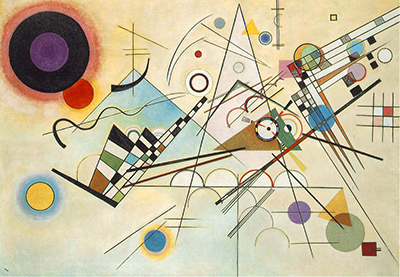
Composition VIII offers a further contrast. Its geometric elements stand in a much lighter field. The circles and lines are sharply visible without the dramatic colour contrast of X's black. This does not make VIII less expressive; it makes its balance and spacing differently apparent. Across these three works, Kandinsky repeatedly reorganised geometry, free form and the space around them rather than settling on one answer after the Bauhaus years.
The owner record and the 1980 acquisition
The Kunstsammlung Nordrhein-Westfalen gives a direct ownership path. Kandinsky held the painting from its creation in 1939 until his death in 1944. Nina Kandinsky then held it until 1980, when the Düsseldorf museum acquired it. The museum's inventory number is 0220. Its record includes the signature, reverse inscription and catalogue raisonné number, all of which help distinguish this object from a reproduction or another late composition. [1].
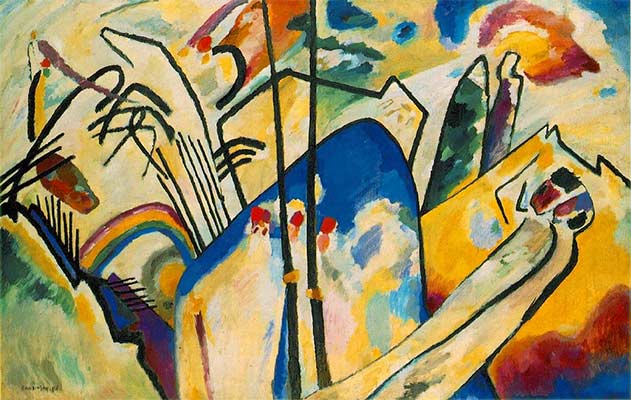
The museum also owns the much earlier Composition IV, acquired in 1965. Having two numbered Compositions in one collection permits a striking comparison across decades. IV is a 1911 canvas of veiled horsemen, forceful line and lighter colour zones. X is a 1939 painting in which bright free forms inhabit black. The shared collection does not imply the works arrived together, and their acquisition dates should not be conflated. [5]; [1].
An online collection record can indicate whether a work is displayed, but that information changes with exhibitions and conservation. The durable page fact is ownership, supported by the museum's catalogue. A viewer planning a visit should consult the museum directly for current display. The existing image here remains useful for broad analysis; it is not a replacement for seeing how a nearly two-metre-wide black field holds light in person.
Black, silence and speculation
Kandinsky's earlier comments about black prompted later writers to connect this painting with silence, finality and the end of life. MoMA's catalogue explores those associations. They are interpretations shaped by the fact that X closed the numbered series and was made before the Second World War. The painting itself does not document a prediction of the war or a conscious farewell to life. Kandinsky lived five more years. A careful account can discuss the expressive black ground without promoting a symbolic reading to a confirmed intention. MoMA catalogue, PDF p. 57.
The colour black is also doing visible work that need not depend on any biographical allegory. It increases the clarity of a pale ribbon, isolates a small square and gives each cluster a distinct interval around it. The shapes can appear to hover because no painted horizon holds them down. These effects can be tested by looking. They do not contradict a spiritual or emotional response; they make such a response more accountable to the actual painting.
Nor is every coloured form a coded reference to an earlier Kandinsky work. MoMA notes analogies with folk cut-outs and motifs he had used before. Those connections can be valuable, especially when supported by specific comparisons. But a viewer should not be asked to decode every sign before appreciating the field as a carefully balanced arrangement. The shapes have visual identities even when their possible sources remain open.
A route for close looking
Begin with the black rather than the colours. Notice where it occupies broad uninterrupted areas and where coloured marks make it thin. Ask whether the painting feels like a single deep space or a shallow surface with shapes laid upon it. Your answer may change between the left and right clusters. That change is useful evidence of how the composition organises space.
Next compare the left brown form with the right set of arcs. Which has more visual weight? Does the pale upright between them act as a divider, a bridge or simply another motif? Follow a small mark away from one large grouping and see whether it points towards another. This is a way to test MoMA's account of overall balance without assuming a mirror image across the centre.
Finally compare the work with IX or VIII. In IX, broad coloured bands already occupy much of the ground. In VIII, the pale ground leaves geometric signs clearly separated. Here the black field creates both space and intense contact with every colour. Ask how the same curved line might feel against either of those other grounds. This thought experiment makes the distinctive choice of X easier to see.
Why Composition X matters
Composition X ends Kandinsky's small numbered series with a new organisation of colour and space. The owner record secures its 1939 date, oil medium, exact painted dimensions and provenance. MoMA's catalogue situates its making across late 1938 and early 1939 and reads the black ground as essential to the heightened appearance of free forms. Those sources support a strong account without requiring a prediction-of-war story or a claim that every mark has a settled symbolic meaning. [1]; MoMA catalogue, PDF pp. 56–57.
The picture rewards repeated shifts of attention. First the black and bright clusters seize the eye; then small signs appear within and between the larger forms; finally a broad balance across the canvas becomes clearer. That experience is why the work is more than a display of colourful shapes on dark paint. It is a deliberate, still surprising way to make separated forms coexist in one field.
Kandinsky artworks directory
Frequently Asked Questions
The Düsseldorf owner dates the finished painting to 1939 and records a “VK 39” signature. MoMA's catalogue says Kandinsky worked on it from December 1938 into January 1939. [1]; [2].
It belongs to the Kunstsammlung Nordrhein-Westfalen in Düsseldorf, inventory 0220. The museum's live record should be checked for current display before a visit. [1].
The painted image measures 130 × 195 cm. The museum separately lists a larger frame at 138 × 203.5 × 7.6 cm. [1].
It is the tenth and final work in his numbered Composition series, but not the last painting he ever made. Kandinsky continued to work until his death in 1944. [3]; [1].
The black field intensifies the contrast and apparent suspension of the coloured forms. MoMA also discusses it against Kandinsky's earlier writing on black. A single, directly documented personal reason for choosing it in 1939 is not established by the sources cited here. MoMA catalogue, PDF p. 57.
The owning museum records Kandinsky, then Nina Kandinsky, then its own collection from 1980. Its inventory number is 0220. [1].
Discussion
What do you notice first in Composition X? Share a close observation or a question about the evidence for this work.
Comments are for comparing what we see and what the cited sources establish.
Reader Insights
Which small mark most changes the balance between the larger forms?
How does the black ground change your sense of distance and colour?
What changes when you compare X with the ground and diagonal bands of Composition IX?
Join the Conversation
Add your observation below and tell us which part of the artwork led you to it.
References
- Kunstsammlung Nordrhein-Westfalen, Komposition X collection record. View source.
- Museum of Modern Art, Kandinsky: Compositions catalogue, 1995. View source.
- Museum of Modern Art, Kandinsky: Compositions exhibition account. View source.
- Centre Pompidou, Composition IX collection record. View source.
- Kunstsammlung Nordrhein-Westfalen, Komposition IV collection record. View source.