 by Tom Gurney
Tom Gurney BSc (Hons) is an art history expert with over 20 years experience
Published on June 19, 2020 / Updated on October 14, 2023
Email: tomgurney1@gmail.com / Phone: +44 7429 011000
Picture with a Black Arch by Wassily Kandinsky: Introduction
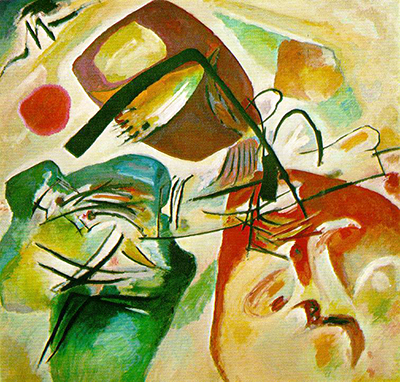
A broad black curve crosses Picture with a Black Arch, Wassily Kandinsky's large 1912 oil painting. Around it, vivid red, blue-green, yellow and pale areas appear to push toward one another without settling into a conventional scene. Centre Pompidou owns the canvas under the German title Mit dem schwarzen Bogen and dates its making to Munich in autumn 1912. The English title here describes the same object: a near-square oil, 189 × 198 cm, that Kandinsky sent to his solo exhibition in Berlin that year. [1].
The arc gives the painting an immediately recognisable focus, but its role is more than drawing attention. It crosses colours that do not align neatly with it and makes the whole field feel suspended between collision and balance. A Centre Pompidou essay connects the curve to the douga, a rounded piece of Russian horse harness, and to Kandinsky's thinking about dissonant construction. Those sources help explain his pictorial choices without turning the image into an illustration of a horse, an orchestra or a single symbolic event. [2].
Watch: Wassily Kandinsky
Five museum videos about Kandinsky’s art, sources of inspiration and the relationship between colour and music.
Vasily Kandinsky: Around the Circle
Curator Megan Fontanella introduces Kandinsky and the Guggenheim collection.
Watch on YouTubeAt a Glance
- Artist and date:Wassily Kandinsky, 1912; made in Munich in autumn.
- Owner's title:Mit dem schwarzen Bogen (Avec l'arc noir); English Picture with a Black Arch or With the Black Arch.
- Medium and dimensions:Oil on canvas, 189 × 198 cm.
- Collection:Centre Pompidou, Musée national d'art moderne, AM 1976-852.
- Acquisition:Gift from Nina Kandinsky, 1976.
- Image on this page:Existing splash retained; the museum's credited photograph has no clear new reuse licence for this project.
Where this work sits in Kandinsky’s career
The Blue Rider
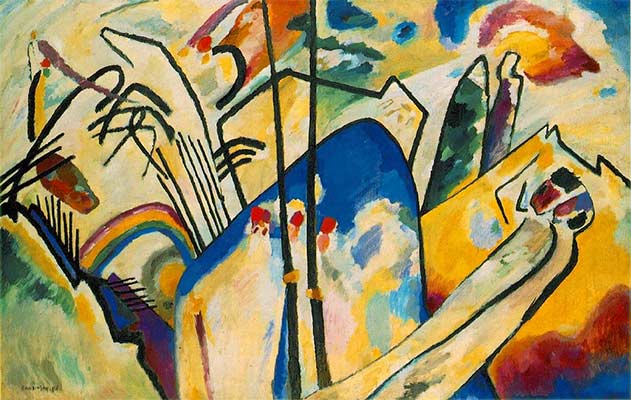
1903Composition VII
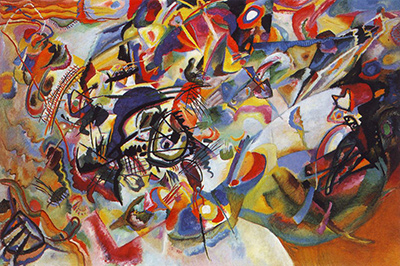
1913Composition VIII
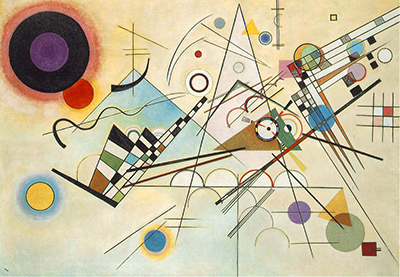
1923Several Circles
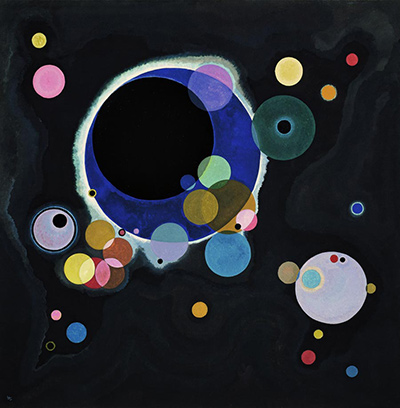
1926Sky Blue
1940Contents
- A nearly square canvas in Munich
- Looking at the black arc and colour masses
- What is a douga ?
- Construction through dissonance
- The Berlin exhibition decision
- Later custody and two Paris exhibitions
- A different painting from In Grey
- Why this painting matters
- Frequently asked questions
- References
A nearly square canvas in Munich
Centre Pompidou catalogues the painting as a signed and dated 1912 oil made in Munich during the autumn. Its 189 cm height and 198 cm width make it almost square and much larger than the reproduction above might suggest. On that scale, the great curve is a bodily line, not merely a small mark in an image file. The colours occupy broad fields while smaller strokes and broken lines disturb them. The relationship between the canvas's strong overall shape and its restless interior is a major part of the work. [1].
The date places the painting after the first Blue Rider exhibition and before Kandinsky's 1913 Composition VII. It is tempting to describe these years as a simple march from recognisable imagery to total abstraction. This canvas is more interesting than a step on that ladder. An arc has a possible source in real harness equipment, yet the picture does not depict a troika. Colour and line organise an independent field while carrying traces of earlier visual experience. [2]; [4].
The owner records the work as catalogue raisonné number 436. That identifier is useful when English translations vary between Picture with a Black Arch, With the Black Arch and Painting with a Black Arch. The inventory AM 1976-852 fixes the museum object. Names guide attention, but the date, dimensions and accession prevent a translation from creating a second painting by mistake. [1].
Looking at the black arc and colour masses
The centre of the painting contains a thick, sweeping black form. It bends across the upper-middle area and sends a dark line downward. Nearby patches of red, blue-green and yellow differ in size and intensity. The arc does not simply outline one of them. It moves across the field as an independent force, at points joining areas and at others setting them apart. Centre Pompidou describes three colour masses held in tension by it. That description can orient a viewer without turning the canvas into a diagram with exactly three sealed compartments. [1].
In the existing image, the left is cooler and broken by green and blue; a strong red shape pushes from the right. Yellow and pale regions open space around them. Smaller strokes seem to flicker within or beyond the broader areas. The result is not symmetrical despite the canvas's near-square format. The black curve pulls attention across the centre, and a sharp, dark accent near the upper left challenges the tidy boundary of the picture. The owner essay specifically notes how an angled mark unsettles that corner. [2].
The structure gives the viewer several possible paths. One can follow the arc from its heavy upper span into its descending stroke, or move between the more substantial colour fields and the scattered smaller marks. These movements are present in the picture whether or not one accepts a musical analogy. The work's complexity arises from the simultaneous pull of line, colour and format. Kandinsky's choices make balance feel provisional rather than serenely fixed. [1].
What is a douga ?
Centre Pompidou relates the title-bearing curve to a douga, the bent wooden arch used in a traditional Russian three-horse harness. This is a specific visual source for the line, not a claim that the whole canvas depicts a vehicle or that a viewer must find three horses in the coloured masses. A remembered form can be transformed until it functions primarily as a pictorial mark. The owner's explanation preserves that connection while acknowledging the work's abstract organisation. [2].
The arc also makes a shape that is neither just a curve nor just a boundary. With other dark strokes it suggests a triangular pressure within the near-square canvas. The owner essay observes that the form unsettles the support's symmetry. This formal effect can be seen without knowing the douga source; knowledge of the source adds another layer rather than replacing direct looking. A practical object from one visual world becomes a moving line in another. [2].
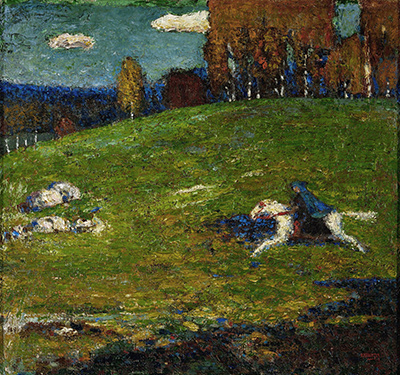
Kandinsky had used Russian-associated motifs earlier, including riders and horses, but one should not flatten all such references into the same meaning. The The Blue Rider article addresses a 1903 landscape with a small mounted figure. This 1912 painting is not a later version of that scene. Its harness-derived arc survives as a formal presence even as representation becomes less stable. [2].
Construction through dissonance
The museum's essay cites a 22 August 1912 letter from Kandinsky to the composer Arnold Schönberg while the canvas was being completed. Kandinsky argued that a picture's construction need not depend on insistent geometric order; dissonance could create a powerful arrangement. The date matters. This is a contemporaneous statement from the year of the painting, not a retrospective explanation written decades later. It supports discussion of deliberate tension among the marks, though it does not name the exact meaning of every colour. [2].
Centre Pompidou compares Kandinsky's visual search with Schönberg's musical dissonance. The analogy is meaningful because the artist addressed the composer and used that word in the cited correspondence. It should not be stretched into a claim that the canvas illustrates a named composition or translates notes into colours one by one. In the painting, dissonance can describe the way a black line cuts across coloured masses and how strong fields seem to meet without merging. The evidence permits a discussion of method, not a secret score. [1].
The black arc appears to hold elements apart even while gathering them into one image. This is why the picture can feel both controlled and near collision. The owner describes its three colour areas as ready to meet, with the arc maintaining tension. A viewer can test that reading against the large red and cooler fields and against the line's refusal to stay inside them. The exact number of perceived areas may vary, but the underlying effect of friction is visible. [1].
The Berlin exhibition decision
The museum cites a 20 September 1912 letter to Herwarth Walden about Kandinsky's first solo exhibition at Der Sturm in Berlin. In it, the artist says he would send the black-arch painting in place of Improvisation 27 for a particular wall. This records a concrete decision about public presentation. It tells us the canvas was finished or ready to be sent by late September, and that Kandinsky considered it a strong substitute in the exhibition. It does not mean the two paintings are versions of one another. [2].
The owner essay says the exhibition's scheduled 1 October opening was delayed one day. This detail is useful for precise chronology, though the artwork's significance does not rest on the one-day shift. More important is that the painting was included in a solo presentation at a key moment of Kandinsky's Munich career. The letter documents his own agency in the choice and avoids a vague claim that it happened to be displayed somewhere in Berlin. [2].
The replaced Improvisation 27 belongs to Kandinsky's different sequence of titles. The evidence only establishes the substitution for display. It does not show that Picture with a Black Arch was relabelled as an Improvisation, or that the two works used the same canvas. The specific German title in the letter helps identify the object now catalogued by Centre Pompidou. [2].
Later custody and two Paris exhibitions
The owner essay says Gabriele Münter kept the canvas until 1926. It was then placed on temporary deposit at the König-Albert Museum in Zwickau. The painting reappears in the museum's record at a 1937 Paris exhibition on independent international art, followed by a 1939 exhibition of Les Réalités nouvelles. Those facts give several points in its public and custodial history. They do not create a continuous, fully documented itinerary for every year between exhibitions. [2].
Nina Kandinsky gave the oil to Centre Pompidou's Musée national d'art moderne in 1976, where it received inventory AM 1976-852. The painting's owner today is established by that record even while its loan location changes. The museum's current page shows a temporary loan in Rome for a dated 2026–27 exhibition. This article does not promise that the painting will be on view in Paris or Rome on an arbitrary future date; the live owner record is the appropriate source for a planned visit. [1].
The existing page image remains useful for looking at the main arrangement. The owner marks the artwork itself public domain but separately credits a modern photograph to Centre Pompidou and Hélène Mauri through GrandPalaisRmn distribution. That credit does not grant a clear new reuse licence for copying that museum photograph into this page or the planned PDF guide. Keeping the inherited image avoids making a fresh rights assumption while still allowing the source record to be cited for research. [1].
A different painting from In Grey
The similar titles can mislead. Kandinsky's 1919 In Grey has an earlier crossed-out black-bow or black-arch wording in its title history. Centre Pompidou owns that painting too, but it is a separate oil from the Moscow period, 129 × 176 cm, inventory AM 81-65-43. Picture with a Black Arch is the 1912 Munich canvas, 189 × 198 cm, AM 1976-852. Dates, sizes and inventory numbers rule out their being one work under two current titles. [3]; [1].
The recurrence of a bow-like shape may be interesting, but it should not flatten seven years of artistic change into a single motif's story. In 1912 the arc organises a bright field of confronting masses. In 1919 the curved sign appears within a denser, grey-grounded canvas and among documented studies. Each has its own context and later history. A comparison can begin with form while preserving the objects' distinct identities. [1].
Why this painting matters
The painting offers an unusually well-documented encounter between visible construction and Kandinsky's words from the same year. The black arc and colour masses can be examined directly; the August letter records his interest in dissonant order; the September letter places the canvas in the Berlin exhibition. These sources do different jobs. The letters should not replace close looking, and the visual pattern should not be inflated into an undocumented story. Together they show deliberate work with tension on a large scale. [2].
Its German title keeps one source form in view, but the image does not require a literal horse scene. Its later English titles should not obscure its exact collection identity. Kandinsky took a curve connected to everyday material culture and made it the centre of a pictorial structure whose colours and lines press against one another. That combination of recognisable trace and abstract force is a strong reason to study this canvas as its own achievement in 1912. [1].
Kandinsky artworks directory
Frequently Asked Questions
Centre Pompidou dates it to autumn 1912 in Munich. A letter cited by the museum shows it was being prepared in August, and a September letter records its substitution into Kandinsky's Berlin solo exhibition. [2].
It belongs to Centre Pompidou's Musée national d'art moderne, inventory AM 1976-852, through Nina Kandinsky's 1976 gift. Current loans and display locations can change. [1].
The museum connects its form to a douga, a curved wooden piece of traditional Russian three-horse harness. In the painting it works as a powerful abstract line rather than an outline of a visible horse. [2].
No specific composition is documented as its subject. The museum cites Kandinsky's 1912 letter to Arnold Schönberg about building a picture through dissonance and draws a comparison with musical thinking. [2].
No. This is a 1912 Munich oil measuring 189 × 198 cm, AM 1976-852. In Grey is a 1919 Moscow-period oil measuring 129 × 176 cm, AM 81-65-43, with its own earlier black-bow title. [1]; [3].
The owner calls the painting public domain but credits the photograph to named modern institutions and a photographer. That record does not give a clear reuse licence for the photograph. The guide can discuss the work without adding this new image. [1].
Discussion
What do you notice first in Picture with a Black Arch? Share a close observation or a question about the evidence for this work.
Comments are for comparing what we see and what the cited sources establish.
Reader Insights
Where does the black arc connect areas, and where does it keep them apart?
How does Kandinsky’s 1912 letter about dissonance change your reading of the colour masses?
What facts distinguish this canvas from the later In Grey?
Join the Conversation
Add your observation below and tell us which part of the artwork led you to it.
References
- Centre Pompidou, Mit dem schwarzen Bogen (Avec l'arc noir), English record. Object facts, acquisition, credits and owner summary. View source.
- Centre Pompidou, French object analysis. Kandinsky's 1912 letters as cited by Christian Derouet, Berlin exhibition, visual analysis and early provenance. View source.
- Centre Pompidou, In Grey. Distinct 1919 canvas and earlier title history. View source.
- MoMA, Kandinsky artist essay. Broader Munich-era context. View source.