 by Tom Gurney
Tom Gurney BSc (Hons) is an art history expert with over 20 years experience
Published on June 19, 2020 / Updated on October 14, 2023
Email: tomgurney1@gmail.com / Phone: +44 7429 011000
Reciprocal Accords by Wassily Kandinsky: Introduction
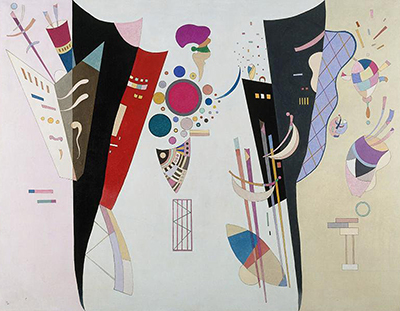
Reciprocal Accords is the established English title on this site for Wassily Kandinsky's 1942 painting Accord réciproque. The French title is the one used by its owner, Centre Pompidou. The work sets two dark, pointed structures around a broad pale central space where small, differently coloured forms gather. It is an oil and Ripolin painting on canvas, 114 × 146 cm, donated by Nina Kandinsky in 1976 and catalogued as AM 1976-863. Its date places it in Kandinsky's last years at Neuilly-sur-Seine under the German occupation of France. [1]; [7].
The painting is often described through balance. Its dark sides are not mirror images, and their pointed lower reaches seem precarious, yet smaller elements appear to brace or answer them. The centre stays open enough for the little forms to move visually across it. The title suggests a relationship rather than a solitary dominant shape. Centre Pompidou also links that relationship to Kandinsky's long inquiry into colour, music and painting. That is an interpretation of the work's structure and title; there is no documented musical score that the canvas literally illustrates. [1]; [6].
Watch: Wassily Kandinsky
Five museum videos about Kandinsky’s art, sources of inspiration and the relationship between colour and music.
Vasily Kandinsky: Around the Circle
Curator Megan Fontanella introduces Kandinsky and the Guggenheim collection.
Watch on YouTubeAt a Glance
- Owner title:Accord réciproque; this route uses the English Reciprocal Accords found in Centre Pompidou English materials.
- Artist and date:Wassily Kandinsky, 1942.
- Medium and size:Oil and Ripolin on canvas, 114 × 146 cm.
- Collection:Centre Pompidou, Musée national d'art moderne, Paris, AM 1976-863.
- Acquisition:Gift of Nina Kandinsky, 1976.
- Preparation:At least two separately catalogued ink studies survive at Centre Pompidou.
Where this work sits in Kandinsky’s career
The Blue Rider
1903Composition VII
1913Composition VIII
1923Several Circles
1926Sky Blue
1940Contents
- An object with several titles
- How the balance works
- What the studies establish
- Music, visual rhythm and the title
- Made during occupation
- After Kandinsky's death
- A late work, not a fixed conclusion
- Frequently asked questions
- References
An object with several titles
The French owner record calls the painting Accord réciproque. Centre Pompidou's English artist biography and 2009 teaching guide translate it as Reciprocal Accords, the title already used by this route. Other English institutional sources use singular Reciprocal Accord. The difference is a translation convention, not evidence for a second 1942 canvas. The accession number AM 1976-863, medium, measurements and French title identify the object securely. When comparing reproductions or publications, these facts are better checks than whether an English caption adds an “s.” [1]; [4]; [5].
The owner's catalogue lists oil and Ripolin on canvas. Ripolin is a branded enamel paint, so describing the work simply as an oil canvas omits part of its documented material. The Pompidou teaching guide uses a more general French term for lacquer; the current object record provides the more specific designation. A photograph does not necessarily reveal which passage uses which material. Material claims should be tied to the catalogue, while visible colour and shape can be discussed from the reproduction. [1]; [5].
The museum also transcribes “VK 42” at lower left and a reverse inscription that includes Kandinsky's number and 1942 date. These markings support the object identity. They do not, by themselves, establish the day or month of painting. The secure catalogue date is the year 1942. It is useful to avoid inventing an exact completion date from the fact that the work was shown later that year. [1].
How the balance works
Look first at the two large dark areas. The left contains a steep black sweep and a strong red passage; the right is another irregular black mass bordered by lighter, patterned forms. Neither side repeats the other. The owner essay describes two large triangular structures standing on fragile points and connected to the canvas edges through small triangular supports. That description turns a first impression of opposed blocks into a more precise question: where does each apparent weight find a visual counterweight? [1].
The broad light centre has its own activity. A magenta circle near the top, smaller coloured disks, gridded marks and curved lines interrupt the pale area. They do not fill it evenly. Some cluster near the dark sides, while others hover farther apart. The eye can cross from one side to the other through these smaller events. This is why “empty centre” would be inaccurate. The centre is relatively open, but its distributed forms contribute to the uneasy balance described by the museum. [1].
Colour differences also keep the large shapes from becoming a symmetrical pair. The pale ground has warmer and cooler zones; the black passages meet red, pink, blue and yellow details. A small bright form can redirect attention even when surrounded by a much larger dark area. The painting asks the viewer to negotiate scale: a massive shape can carry structural weight while a small mark changes the rhythm around it. Kandinsky's long interest in relations among visual elements remains active in this late picture, but it should not be reduced to a classroom chart from the Bauhaus. [1]; [5].
What the studies establish
Centre Pompidou preserves at least two ink studies for Accord réciproque. One, AM 81-65-600, is India ink on paper, 20.8 × 26.1 cm. The other, AM 81-65-601, is likewise an ink study but measures 20.8 × 27 cm. Both are catalogued around 1942 and entered through Nina Kandinsky's 1981 bequest. Their separate accession numbers and slightly different widths matter: they are related sheets, not duplicate metadata for a single drawing. [2]; [3].
The existence of studies demonstrates preparation and revision. A drawing can test the position of a dark vertical form, the width of a central interval or the distribution of smaller marks before colour is applied to canvas. Yet an ink study is not a miniature colour version of the finished painting. Without a direct side-by-side examination, it would be too strong to assign a specific surviving sheet as the final, exact plan that Kandinsky transferred. The records establish that several preparatory works belong to the painting's history. [1]; [2]; [3].
The studies are especially valuable because the painting's apparent playfulness can conceal deliberation. Its balance depends on how much pale space lies between the darker sides and how the small forms make that space active. Documentation of two separate studies complicates any description of the work as a spontaneous scattering of late motifs. It also helps keep the work of 1942 connected to Kandinsky's long practice of testing arrangements before a finished canvas. [1]; [3].
Music, visual rhythm and the title
“Accord” can point to agreement or a musical chord. Centre Pompidou reads the title in relation to Kandinsky's enduring interest in correspondences between sound and colour. The painting can support that kind of analogy: large dark intervals, small bright accents and repeated marks make a rhythm across its surface. But analogy is not transcription. The museum's teaching dossier says painting retains its own means rather than simply imitating music. No cited owner record identifies the canvas with a named composition played in 1942. [1]; [6].
The word “reciprocal” is perhaps more concrete as a looking prompt. How does the left answer the right? Which small shape appears to hold open a gap, and which shifts an apparent weight? Such questions can be asked without deciding that black must equal a low note or pink a high one. Kandinsky's writing often compared visual art with music, yet the visible painting should remain the evidence for claims about its structure. [6]; [1].
The relation is not perfectly harmonious. Centre Pompidou calls the balance unstable. The dark structures appear held and threatened at once, while the little forms escape any rigid ordering. That is more specific than claiming the painting expresses “harmony” in a general, reassuring way. The title can invite the possibility of agreement while the painted forms make that agreement contingent. [1].
Made during occupation
Kandinsky and Nina lived in Neuilly-sur-Seine during the German occupation of France. Centre Pompidou's detailed essay describes restricted visitors and difficulty obtaining art materials by 1942. These circumstances give context to a work using both oil and Ripolin, but they do not prove that every unusual shape or colour was forced by shortage. The museum's account is careful about what can be inferred from the surviving evidence, including unused prepared canvases later found in the studio. [1]; [7].
The painting was shown through Jeanne Bucher in 1942, according to the owner essay. It thus had a public life during the war, however constrained. A precise chronology is more informative than calling Kandinsky entirely isolated. He still painted and exhibited, but the scale of his circle and the availability of materials had changed. The canvas belongs to these specific conditions, rather than to an invented scene in which art-making stopped completely. [1]; [7].
The owner describes Accord réciproque as Kandinsky's penultimate canvas and Tensions délicates as the last important canvas, made in the summer of 1942. This does not make Reciprocal Accords his final artwork. The institutional chronologies document continued work in other forms during 1944. The distinction between “canvas,” “large-format painting” and “work of any kind” matters when discussing an artist's final years. [1]; [7].
After Kandinsky's death
Kandinsky died at Neuilly on 13 December 1944. Centre Pompidou's owner essay says Accord réciproque was placed in the room where friends gathered after his death. The painting then appeared in a 1945 Paris exhibition titled Art concret. These episodes are part of the object's reception history, not clues that retroactively determine the meaning of every 1942 shape. A work can acquire a solemn role after its maker's death while retaining the playful, precarious relations visible on its surface. [1]; [7].
Nina Kandinsky later donated the canvas to the French national collection in 1976. The two ink studies entered separately through her 1981 bequest. Distinguishing those acquisitions helps track the painting and its preparatory evidence as different objects with different accession histories. The owner record provides a stable link for future research even when the painting is loaned to another venue. Its current display location can change, so this article identifies the collection and directs readers to the live museum record for visit planning. [1]; [2].
A late work, not a fixed conclusion
Reciprocal Accords belongs to Kandinsky's final period, but it need not be treated as the culmination of a settled style. The owner record shows a painter still working through how large contrasting structures and tiny mobile elements can occupy one field. Compare the divided colour zones of 1940 Parties diverses or the open blue of Sky Blue; the works share a taste for small, lively forms but organise them differently. A late date does not eliminate experiment. [8]; [9]; [1].
The strongest way into this canvas is to move between its scales. Follow the two dark forms, pause in the pale centre, then notice how a small circle, grid or narrow line alters the exchange. The source records add the date, material, studies and later history. They do not replace the work of looking. Together, the visible painting and its documentation make Reciprocal Accords more than a generic statement about Kandinsky's last years: it is a particular, carefully prepared response to the problem of holding difference in relation. [1]; [3].
Kandinsky artworks directory
Frequently Asked Questions
Centre Pompidou catalogues the painting as Accord réciproque. Its English materials also use Reciprocal Accords, while some institutions translate it in the singular. The French title and accession AM 1976-863 identify the same 1942 canvas. [1]; [4].
The owner record specifies oil and Ripolin on canvas, 114 × 146 cm. Ripolin is an enamel paint brand; the photograph alone does not show exactly which passage uses it. [1].
Yes. Centre Pompidou catalogues at least two distinct India-ink studies from about 1942, AM 81-65-600 and AM 81-65-601. They entered through Nina Kandinsky's 1981 bequest, separately from her 1976 gift of the painting. [2]; [3].
No. Centre Pompidou calls it his penultimate canvas and identifies Tensions délicates as a later important canvas in 1942. Institutional chronologies record that he continued to work in 1944. [1]; [7].
Centre Pompidou reads a relation to Kandinsky's interest in correspondences between visual form and sound. The cited records do not identify a specific composition that this canvas depicts. The title also points to the visual exchange between its large structures. [1]; [6].
Discussion
What do you notice first in Reciprocal Accords? Share a close observation or a question about the evidence for this work.
Comments are for comparing what we see and what the cited sources establish.
Reader Insights
Which small form changes the balance between the two dark sides?
What do the two separately catalogued ink studies establish about preparation?
How does the French owner title affect your reading of the inherited English title?
Join the Conversation
Add your observation below and tell us which part of the artwork led you to it.
References
- Centre Pompidou, Accord réciproque. Painting identity, material, dimensions, interpretation and history. View source.
- Centre Pompidou, study AM 81-65-600. First documented ink study. View source.
- Centre Pompidou, study AM 81-65-601. Separate documented ink study. View source.
- Centre Pompidou, artist biography. English title and Paris-period overview. View source.
- Centre Pompidou, 2009 teaching guide. English title, late composition and 1933 comparison. View source.
- Centre Pompidou, abstraction and music. Painting/music relationship. View source.
- Centre Pompidou, Kandinsky chronology. 1942 exhibition and 1944 death. View source.
- Lenbachhaus, Parties diverses. Distinct 1940 comparison. View source.
- Centre Pompidou Sky Blue. View source.