 by Tom Gurney
Tom Gurney BSc (Hons) is an art history expert with over 20 years experience
Published on June 19, 2020 / Updated on October 14, 2023
Email: tomgurney1@gmail.com / Phone: +44 7429 011000
Composition IX by Wassily Kandinsky: Introduction
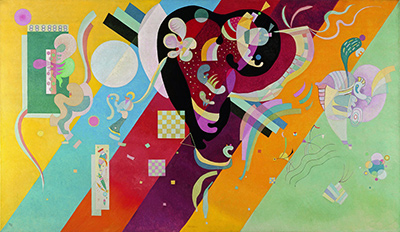
Wassily Kandinsky painted Composition IX in 1936, during his years in France. Wide diagonals of yellow, turquoise, red-orange and green cut across the background. In front of them, small squares, checkerboards, loops and forms with less regular outlines seem to float. A dark, curling shape gathers many of these details near the upper centre. The result is both boldly directed and finely varied. The Centre Pompidou owns the oil on canvas, records its size as 113.5 × 195 cm and lists it under inventory JP 890 BIS P. Its record says Kandinsky first called the painting L'Un et l'Autre—One and the Other—before it became the ninth of his numbered Compositions. [1].
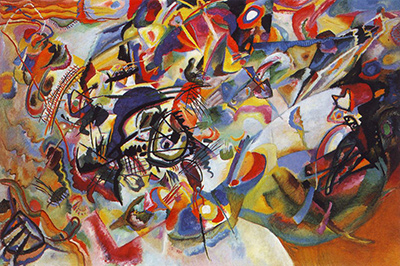
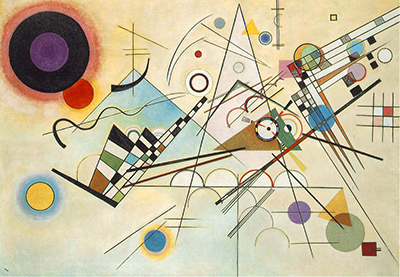
This is a late Composition, made long after the prewar turbulence of Composition VII and the Bauhaus geometry of Composition VIII. The diagonal ground might first seem to dictate every movement, but the scattered smaller forms complicate it. Some are measured and grid-like. Others look soft, organic or almost invented in the act of painting. Christian Derouet, writing for the Centre Pompidou collection, calls the diagonals unusual even within Kandinsky's work of 1936. MoMA's 1995 catalogue similarly discusses the encounter of broad stripes and floating geometric and biomorphic shapes. Together, the sources support a close reading of a painting whose different visual systems share one canvas. [1]; MoMA, Kandinsky: Compositions catalogue, PDF pp. 55–56.
Watch: Wassily Kandinsky
Five museum videos about Kandinsky’s art, sources of inspiration and the relationship between colour and music.
Vasily Kandinsky: Around the Circle
Curator Megan Fontanella introduces Kandinsky and the Guggenheim collection.
Watch on YouTubeAt a Glance
- Artist:Wassily Kandinsky.
- Title:Composition IX; first titled L'Un et l'Autre (One and the Other).
- Date:1936; the owner records inscriptions with “VK 36” and “VK n°626 / 1936”.
- Medium:oil on canvas.
- Dimensions:113.5 × 195 cm.
- Collection:Centre Pompidou, Musée national d'art moderne, inventory JP 890 BIS P.
- Acquisition:purchased by the French state in 1939 and assigned to the museum that year.
Where this work sits in Kandinsky’s career
The Blue Rider
1903Composition VII
1913Composition VIII
1923Several Circles
1926Sky Blue
1940Contents
- First look: diagonals behind a constellation
- The ground is active
- The small forms refuse one family
- The black centre and changing balance
- One and the other
- Kandinsky in France
- Why this is a Composition
- VIII before it, X after it
- A comparison with Dominant Curve
- Surfaces that appear to overlap
- The 1939 acquisition
- Looking closely
- Why Composition IX matters
- Frequently asked questions
- References
First look: diagonals behind a constellation
The broad diagonal bands create an immediate direction from lower left toward upper right. Their colours differ in warmth and intensity: yellow and orange-red push forward, while turquoise and green give other passages a cooler or lighter force. The bands are so wide that they can be read as areas rather than thin lines. They divide the canvas into long zones, yet the smaller forms cross those zones without obeying their boundaries.
Near the upper centre, a black curve bends and loops through a crowded group of red, white, pink and yellow details. Elsewhere, small checkered squares appear against the larger colour planes. A pale circular shape near the left and fine line work on the right add still different scales of form. The eye may first take in the diagonals and then begin a slower inspection of individual motifs. That change of pace is one of the painting's clearest effects.
The existing image on this page makes the overall arrangement easy to see, but a reproduction cannot fully settle the order of overlapping paint or the exact delicacy of each edge. A direct view would let the small motifs be studied while the original width still acts on the viewer. Even here, it is clear that the canvas works with a contrast between large, decisive ground structures and varied, relatively tiny inhabitants.
The ground is active
The coloured diagonals are often called a background, but they do more than sit behind the floating forms. They determine strong routes for the eye and create changing colour contexts for each smaller mark. A checkerboard placed over red-orange reads differently from one set against green. A pale loop can become more visible when it crosses a darker band. The ground therefore participates in the work of every motif layered upon it.
MoMA's catalogue describes the stripes as a solid structure that blocks the infinite, open sense of space associated with some earlier Kandinsky paintings. Shapes overlap and appear to hover in front of them, making depth shallow but unsettled. This is a more useful account than calling the painting simply flat. The diagonal bands hold a plane firmly; small forms seem to move across or above it. Their relation makes a layered space without a conventional horizon. MoMA catalogue, PDF p. 56.
Try following one colour band from its entrance to its exit. It may be interrupted by a pale circle, a checkerboard or the dark central coil. The interruption does not erase its direction. Instead, the canvas asks the viewer to hold two readings at once: a long, broad movement and a field of local events. This is why the diagonals can be both a stabilising structure and a source of energy.
The small forms refuse one family
The scattered shapes do not all seem to belong to a single vocabulary. Some are plainly geometric: grids, squares, parallel strokes and circular outlines. Others curl, spread or branch in ways that evoke living forms without becoming named organisms. The Centre Pompidou describes embryonic and floating motifs along with checkerboard and geometric figures. MoMA calls attention to geometric and biomorphic tendencies together. Those are ways of describing form, not identifications of particular species or objects. [1]; MoMA catalogue, PDF pp. 55–56.
A viewer might be tempted to make a list of creatures hidden in the picture. The owner's record does not require such a catalogue. A rounded, branching sign can feel biological while remaining ambiguous. In contrast, a checkerboard states its regularity immediately. Placing these two kinds of form near each other lets Kandinsky test the difference between measured repetition and an irregular, almost growing contour.
Their scale matters. Most of the motifs are small compared with the broad diagonal bands, but they are not decorative afterthoughts. They can interrupt a strip, draw the eye toward a corner or make a large colour region seem inhabited. A small white shape over a saturated zone may stand out more than a much larger pale passage elsewhere. Looking at their placement is more illuminating than trying to assign a fixed symbolism to each.
The black centre and changing balance
The dark curling cluster near the top centre is among the painting's strongest local attractions. It has enough weight to resist the diagonals' pull. Its loops and enclosed colour fragments can make it feel like a knot of activity, but it does not become a single easily named figure. Because the surrounding bands run on a consistent diagonal, the irregular black curve is felt as a counter-movement.
The central cluster also ties several smaller forms together. Pink, white and red details appear within or near it, while other motifs spread outward into the broader field. One can look from the cluster towards the right, where line work becomes finer, and then return through the checkerboards and pale circle on the left. The painting offers no one-way path. It repeatedly draws the eye away from the largest shapes to something small, then back again.
This balance between a commanding ground and independent local forms may help explain why the work bears the weighty Composition title. It is not merely a set of attractive shapes scattered over stripes. Their differing scales and directions create choices about where to look and how to connect parts. The overall organisation is deliberate, even where the individual motifs look playful or improvised.
One and the other
The Centre Pompidou says Kandinsky initially called the painting L'Un et l'Autre, or One and the Other. A former title is evidence of a way the artist once framed the work, but not a key that reveals exactly what the “one” and “other” are. It might prompt a viewer to notice opposed kinds of form, or the relation between ground and floating shapes. Those are interpretations, not a documented identification of two particular figures. [1].
The later numbered title places the canvas within Kandinsky's smaller group of major works. The Pompidou essay recalls his account of Compositions as works formed slowly and revised deliberately after early ideas. His writings distinguish this process from simple calculation: intention and feeling are both involved. This general theory should not be used to invent a precise diary of how Composition IX was painted. It does, however, warn against equating the lightness of its forms with casual making.
The former title can enrich the act of looking without replacing the owning museum's main title. The page is about the 1936 oil canvas, not two separate paintings called One and the Other and Composition IX. Its record, inscriptions, medium and acquisition all refer to one object. Clear naming matters because a reader may encounter the French title, a translation and a Roman numeral in different sources.
Kandinsky in France
Kandinsky and his wife moved to the Paris area at the end of 1933 and lived in Neuilly-sur-Seine. After years at the Bauhaus in Germany, the move brought a new setting for work. MoMA's catalogue says his painting in France introduced a richer vocabulary of free, biomorphic forms alongside geometric elements. It notes possible affinities with Surrealist imagery while reporting that Kandinsky resisted a simple claim of influence from artists such as Arp and Miró. The combination of geometric and irregular forms in Composition IX fits this late-period development without proving one direct borrowing. MoMA catalogue, PDF p. 55.
The Centre Pompidou similarly places the canvas in his Neuilly period and describes it as a development of formal ideas established at the Bauhaus. That is a relationship across phases, not a claim that all its components originated in one school. Its checkerboards and measured forms can recall earlier geometric work, while its curling, embryonic shapes take the picture elsewhere. The broad diagonals bind those vocabularies into a new whole. [1].
Avoid turning the life context into a direct explanation for every form. The canvas was made in a particular place and year, and Kandinsky's career had changed. A checkerboard is still a checkerboard; a coloured band has a visual role before it is made to stand for exile, renewal or one city. The historical context helps place the work among his late paintings while leaving close observation to do its own work.
Why this is a Composition
Kandinsky had used the title Composition sparingly across his career. MoMA's 1995 exhibition account says he reserved it for ten paintings, seven of which survive. The first seven belong to the years before the First World War; Composition VIII arrived in 1923 at the Bauhaus; IX and X were made in France. The numbering therefore joins canvases that differ considerably in subject, scale and visual method. It marks an ambition rather than a standard format. [3].
The Centre Pompidou notes that IX is the smallest of the numbered group and asks why Kandinsky chose this canvas for the title when he made the larger Dominant Curve in the same year. The question belongs to the museum's interpretation. Size alone clearly did not decide the matter. Composition IX organises a strongly directional ground and many distinct motifs into one field, perhaps making the title apt despite its smaller dimensions. That last thought is an inference from its form, not a recorded explanation by Kandinsky. [1].
MoMA describes one preparatory drawing for IX in its 1995 catalogue. The relative scarcity of surviving studies should not be turned into proof that Kandinsky made no others or that the painting came quickly. Surviving evidence sets a lower bound, not the whole history of thought and revision. The visual organisation itself is complex enough to warrant careful attention, whatever the exact number of lost or unpreserved sheets. MoMA catalogue, PDF p. 55.
VIII before it, X after it
A comparison with Composition VIII makes the change from Bauhaus geometry visible. VIII gives the viewer many sharply defined circles, lines and angles in a comparatively open field. IX also has geometric elements, but its broad stripes occupy the ground while smaller organic-looking marks seem to float before it. Neither work is simply “more abstract” than the other. They solve different problems of scale, depth and balance.
The later Composition X takes another direction, setting multicoloured free forms against a deep black ground. Compared with X, IX is lighter and more banded, its diagonals unmistakably organising the entire surface. The pair marks Kandinsky's final two entries in the numbered series, both made in France, but their grounds and overall mood differ. Looking at them side by side helps resist the idea that the Paris years had a single settled formula. MoMA catalogue, PDF pp. 55–56.
The comparisons also reveal what is special about IX. Its large diagonal bands are unusually declarative. They could overwhelm the smaller forms, yet those details repeatedly attract attention and make the bands feel like a stage for multiple kinds of event. This dual structure is visible even in a modest reproduction. A direct view at the full width would make the difference in scale between band and motif more pronounced.
A comparison with Dominant Curve
The Pompidou essay asks why Kandinsky chose this picture for the next Composition title rather than the larger Dominant Curve, also made in 1936. The comparison is useful because it keeps size from becoming a shortcut for importance. A title such as Dominant Curve directs attention to one governing form, while Composition IX names an arrangement of several competing systems. The titles alone do not prove the reason for Kandinsky's decision, but they suggest different ways to approach the works. [1]; [4].
In IX, no single small motif wins permanent control of the surface. The background has the most obvious direction, yet it is repeatedly crossed and questioned. A pale disk, a checked square and an irregular coil make different demands on attention. This is an inference from the painting, not a statement Kandinsky left about his choice of title. It shows why the smaller canvas can still be ambitious: it holds several visual languages in a tight relation.
The Guggenheim's record places Dominant Curve in Kandinsky's French period and identifies it as a separate 1936 painting. It is a useful neighbouring work rather than a preparatory study or a discarded candidate whose exact role is known. The Pompidou essay's comparison is a question about artistic designation. Treating it as a question lets each canvas retain its own object identity and avoids a claim that IX displaced the other painting in an official competition.
Surfaces that appear to overlap
The sense of hovering forms depends on small changes of edge. A motif outlined crisply against a broad stripe can feel placed in front of it; a paler form with a softer edge may feel less firmly attached to any plane. The large diagonals seem continuous beneath these details, although a viewer must mentally carry them past interruptions. That mental completion gives the stripes strength without making the surface visually simple.
MoMA's catalogue contrasts IX with the open ground of Composition VIII. In IX, layered shapes seem to occupy a shallower, more crowded space. The comparison does not require calling one painting three-dimensional and the other flat. Both are painted surfaces. What changes is the viewer's sense of where a mark sits in relation to the coloured ground and its neighbours. The checkerboards, pale circle and black curl make that relation different in different parts of the same canvas. MoMA catalogue, PDF p. 56.
This varied overlap also changes the pace of looking. A quick glance takes in the bands and the dark knot. A slower pass finds smaller shapes that are easily overlooked, including fine linear passages at the edges. A third look may return to the broad direction and notice that the small motifs have altered it. The painting can feel playful because these discoveries do not arrive in a prescribed order. Its organisation still allows them to be found and connected.
The 1939 acquisition
The Centre Pompidou records a French state purchase in 1939 and museum allocation in the same year. Its overview says this was the only Kandinsky painting to enter a French museum during his lifetime. That makes the acquisition notable within the public collecting history of an artist who lived in France from the 1930s until his death in 1944. It does not mean the picture was his only work in France or that no French private collection held his art. The claim is specifically about a painting entering a French museum while he lived. [1].
Christian Derouet's essay attached to the owner record gives a sharper account. It says Kandinsky deposited the painting at the Musée du Jeu de Paume and that, against an asking figure of 100,000 francs, he received 5,000. That historical price contrast is striking, but it comes from a named museum scholar's essay and should be attributed as such. It cannot be converted into a simple measure of the painting's artistic value or into a modern market comparison. [1].
The record's acquisition details, inscriptions and inventory number secure the object's identity. A temporary exhibition loan should be checked separately through the owner's current record. The enduring fact is that the painting belongs to the French national modern-art collection. [1].
Looking closely
Begin with the diagonals. Count the major bands and notice how their widths and colours vary. Where does a stripe seem to come closest to the viewer? Does the eye move up the slope of the bands or pause at the dark central knot? This first pass shows how strongly the ground directs looking before any individual form is named.
Then move to the small shapes. Compare a checkerboard with one curving, irregular motif. One declares a repeatable pattern; the other seems less predictable. Find a pale circle and trace what happens when it meets a band of different colour. These small encounters can change how a large region feels. They are more informative than a checklist of imagined biological objects.
Look also at the margins, where a stripe enters or leaves the frame. The painting implies that some coloured bands continue beyond what can be seen, while the tiny motifs feel more contained within the canvas. That difference between extended direction and local enclosure helps give the surface its rhythm. It is visible without assigning the shapes a hidden narrative.
Finally step back to see how the two scales coexist. If attention rests only on the sweeping background, the painting can look simpler than it is. If attention stays with tiny details, the bold direction of the bands is lost. Kandinsky's composition holds both levels together. Its former title may suggest a relationship between different kinds of form, but the visible evidence is the painting's organised tension between them.
Why Composition IX matters
Composition IX shows Kandinsky returning to the numbered series in his Paris years without repeating an earlier solution. The Pompidou record secures its 1936 date, oil medium, dimensions, former title and 1939 French state acquisition. The image shows a distinctive structure: wide diagonals supporting and challenging small geometric and organic-looking forms. MoMA's catalogue places that relation within a late vocabulary developed after his move to France. [1]; MoMA catalogue, PDF pp. 55–56.
Its smaller size within the Composition series is part of the story, but not the point of the picture. The painting still spans nearly two metres, and its many local details demand close attention. The state acquisition gives it a distinctive place in French public collections. Above all, it offers an image in which confident direction and floating uncertainty continually revise each other. That is a reason to look again after the first powerful sight of the coloured bands.
Kandinsky artworks directory
Frequently Asked Questions
The Centre Pompidou dates it to 1936. The inscriptions recorded by the museum also include that year. [1].
It belongs to the Centre Pompidou's Musée national d'art moderne, inventory JP 890 BIS P. Its museum record may list a current exhibition loan, so check that live field before planning a visit. [1].
The museum records an oil-on-canvas painting measuring 113.5 × 195 cm. It describes IX as the smallest of Kandinsky's numbered Compositions, though the canvas is still nearly two metres wide. [1].
Yes. The museum says Kandinsky first titled the same painting L'Un et l'Autre, which translates as One and the Other. It is a former title, not a separate canvas. [1].
They strongly organise the background and contrast with floating checkerboards, geometric marks and irregular forms. The Pompidou essay calls the diagonals unusual in Kandinsky's 1936 work; MoMA also describes the two layers as a key to the composition. [1]; MoMA catalogue, PDF pp. 55–56.
The French state bought it in 1939 and assigned it to the museum that year. The Pompidou says it was the only Kandinsky painting to enter a French museum during the artist's lifetime. [1].
Discussion
What do you notice first in Composition IX? Share a close observation or a question about the evidence for this work.
Comments are for comparing what we see and what the cited sources establish.
Reader Insights
Which floating motif most interrupts the diagonal bands for you?
How does the former title One and the Other affect your reading of the geometric and organic forms?
Why might Kandinsky have called this smaller 1936 canvas a Composition?
Join the Conversation
Add your observation below and tell us which part of the artwork led you to it.
References
- Centre Pompidou, Composition IX collection record and Christian Derouet essay. View source.
- Museum of Modern Art, Kandinsky: Compositions catalogue, 1995. View source.
- Museum of Modern Art, Kandinsky: Compositions exhibition account. View source.
- Guggenheim, Dominant Curve in the Solomon R. Guggenheim teaching material. View source.