 by Tom Gurney
Tom Gurney BSc (Hons) is an art history expert with over 20 years experience
Published on June 19, 2020 / Updated on October 14, 2023
Email: tomgurney1@gmail.com / Phone: +44 7429 011000
Landscape near Murnau with Locomotive by Wassily Kandinsky: Introduction
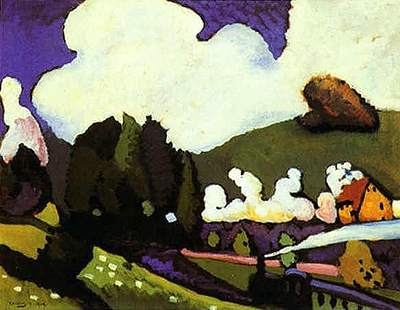
An enormous pale cloud pushes through a violet sky in Landscape near Murnau with Locomotive. Beneath it, dark trees, green slopes and an orange building occupy most of the small painting. The train is present, but it does not take command of the view: it threads through the lower part of a landscape built from bold colour areas. Kandinsky painted the work in 1909, when Murnau was central to his experiments with intensified colour. The Solomon R. Guggenheim Museum in New York identifies it as oil on board, 50.5 × 65.1 cm, accession 50.1295. The owner's German title is Landschaft bei Murnau mit Lokomotive. [1]; [1].
The railway was part of Murnau's everyday surroundings. The Lenbachhaus notes that the Munich–Garmisch line ran below the house Gabriele Münter acquired there in late summer 1909. Kandinsky made another, quite different train picture that year, now at the Lenbachhaus. A third railway painting in a snowy setting followed in 1911 and belongs to the Saint Louis Art Museum. Keeping those objects apart lets this particular Guggenheim landscape be seen for its own composition rather than for details taken from another image. [3]; [4].
Watch: Wassily Kandinsky
Five museum videos about Kandinsky’s art, sources of inspiration and the relationship between colour and music.
Vasily Kandinsky: Around the Circle
Curator Megan Fontanella introduces Kandinsky and the Guggenheim collection.
Watch on YouTubeAt a Glance
- Artist and title:Wassily Kandinsky, Landscape near Murnau with Locomotive (Landschaft bei Murnau mit Lokomotive).
- Date:1909, in the Guggenheim's exhibition checklist and an institutional loan schedule.
- Medium and size:Oil on board, 50.5 × 65.1 cm.
- Collection:Solomon R. Guggenheim Museum, New York, accession 50.1295.
- Visible features:Pale cloud across a violet sky, compact dark trees, green hillside, orange house and a small train low in the scene.
- Known collection route:Possibly acquired first by Rudolf Ibach; with his son-in-law Otto Stangl by 1950; purchased from Stangl through Hilla Rebay by the Guggenheim in 1950.
- Different objects:Lenbachhaus Eisenbahn bei Murnau (1909, GMS 49) and Saint Louis Murnau with Locomotive (1911, 142:1986) are separate paintings.
Where this work sits in Kandinsky’s career
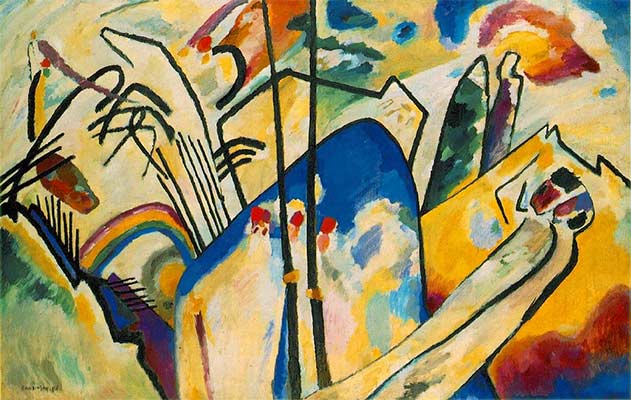
The Blue Rider
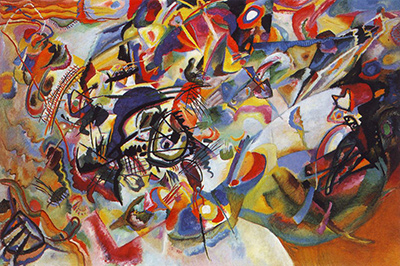
1903Composition VII
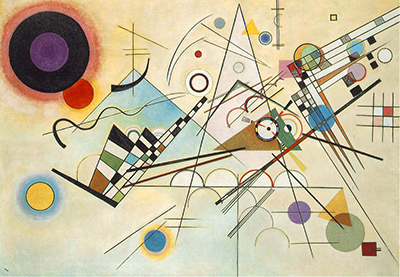
1913Composition VIII
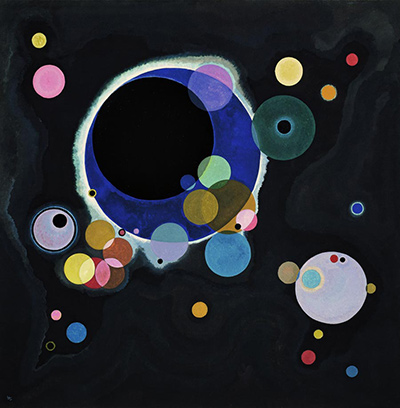
1923Several Circles
1926Sky Blue
1940Contents
- Where the train sits
- A railway in the Murnau landscape
- How the painting reached New York
- Frequently asked questions
- References
Where the train sits
The painting's long shape suits a view across a hillside. A green rise goes from the dark left side toward the lighter right, while a band of rails and shadow cuts across the lower area. The locomotive is relatively small against the mass of trees and cloud. It is easy to read the title and immediately search for a machine; the painting first presents a meeting of colours and silhouettes. The train emerges as one part of that arrangement, not a detailed study of railway engineering. [1]; [1].
At upper left, the pale cloud has a scalloped edge and a great deal of visual weight. It is set against deep violet rather than an ordinary blue sky. The dark trees below form a dense wedge, with only narrow green strips separating some trunks or crowns. Their compact shape resists the cloud's expansion. Further right, an orange house gives a small, clear point of warmth in a field of dark greens. That balance helps the painting stay legible even though much of its landscape has been simplified. [1].
Colour is doing work usually assigned to precise contour and perspective. The hillside is green but not evenly naturalistic; dark passages and bright fragments interrupt it. The white smoke near the railway and the larger pale cloud above do not have identical roles. The former helps identify the machine; the latter dominates the sky and presses down on the whole view. The eye can move between these two pale areas, then return to the narrow train. This back-and-forth is part of the picture's rhythm. [1].
It would be easy to call the work merely a stage before Kandinsky's later abstraction. But its visual decisions stand on their own: he has chosen how much of the railway to reveal, how large to make the cloud, and how sharply to separate the trees from the hill. The subject remains a landscape with a locomotive, yet colour and shape are no longer just a record of local appearance. The Guggenheim's account of Kandinsky's early work describes his continued attraction to expressive colour in paintings of observed places. This 1909 view belongs to that inquiry without requiring a claim that every later abstract form is already present here. [5]; [1].
A railway in the Murnau landscape
The Lenbachhaus records the Munich–Garmisch railway below Münter's Murnau property and calls passing trains a familiar sight there. That is useful local context for why Kandinsky returned to the subject. It does not identify an exact spot from which he painted the Guggenheim picture. The hills, trees and line are arranged on a painted board; a museum record of the railway's route is not a survey of the viewpoint shown in every nearby work. [3].
The same Lenbachhaus essay names Kandinsky's similar, simultaneous Landscape near Murnau with Locomotive in New York while discussing its own Eisenbahn bei Murnau. The Munich painting is 1909 oil on cardboard, 36.1 × 49.2 × 0.4 cm, inventory GMS 49. In its image, a long black train crosses the foreground, telegraph poles stand beside it and a figure at the left appears to wave. None of those precise details should be lifted into a description of the Guggenheim picture. Its different cloud, trees, hill and small train make a different balance. [3]; [1].
Comparing the two 1909 works is more revealing than treating them as duplicates. The Lenbachhaus train cuts the landscape into a strong horizontal foreground, while the Guggenheim painting gives greater weight to sky and hillside. Both place modern transport within colour-rich scenery. The Lenbachhaus's scholars suggest that its almost playful, small-scale railway image may relate to Kandinsky's interest in folk art and painting on glass. That is an interpretation of the Munich work and period, not a documented statement about how this particular New York board was made. [3].
A further comparison is the Saint Louis Art Museum picture Murnau with Locomotive of 1911. Its 95.9 × 104.5 cm oil on canvas is much larger and nearly square; its dominant whites make a snowy scene. Museum conservation work on that canvas has examined its white pigments and surface. Those findings are valuable for the Saint Louis object but cannot be applied to the Guggenheim's much smaller 1909 board without technical evidence about that board itself. The titles share a place and machine, but the paintings are different in date, support, size and visual character. [4]; [4].
How the painting reached New York
The Guggenheim's 2021 exhibition checklist lists the work as a 1909 oil on board, 50.5 × 65.1 cm, accession 50.1295. An Art Gallery of New South Wales schedule for a 2023–24 Kandinsky loan confirms the same object and gives a concise provenance. The schedule says Rudolf Ibach of Barmen, Wuppertal, possibly bought it from Kandinsky. By 1950, it had passed to Ibach's son-in-law Otto Stangl, a Munich dealer. The Guggenheim purchased it from Stangl, through Hilla Rebay, in 1950. [1]; [2].
The word “possibly” matters. It signals that the earliest proposed purchase is not as firmly documented in the cited schedule as the later route through Stangl and Rebay. The painting's presence in the Guggenheim collection since 1950 is supported by its accession number and both institutional records. Filling the earlier gap with a confident sale date would make the record seem more complete than it is. Provenance is part of the painting's history, and its uncertainty should remain visible. [2].
The New York painting holds machine and nature together without turning either into a simple moral. A tiny train can suggest contemporary technology, but the sky and hillside command more space. Kandinsky compresses these elements into a bright, forceful 1909 landscape. Knowing the Murnau railway and the related pictures gives it context; looking closely at its own colours and proportions keeps the work distinct. [1]; [3].
Kandinsky artworks directory
Frequently Asked Questions
The Guggenheim calls it Landscape near Murnau with Locomotive, German Landschaft bei Murnau mit Lokomotive. This page keeps its older “steam locomotive” address for continuity. [1].
It is a 1909 oil on board, 50.5 × 65.1 cm, according to the Guggenheim checklist and the institutional loan schedule. [1]; [2].
It belongs to the Solomon R. Guggenheim Museum, New York, accession 50.1295. Check the museum for its present display location. [1].
No. The Lenbachhaus has another 1909 railway painting, GMS 49, in oil on cardboard and of smaller dimensions. Its foreground train and telegraph poles belong to that image, not to the Guggenheim's 50.1295. [3]; [1].
No. The Saint Louis Art Museum owns Murnau with Locomotive, a larger 1911 oil on canvas, accession 142:1986. Its winter setting and size distinguish it from the 1909 Guggenheim board. [4].
An institutional provenance schedule says it may first have been purchased by Rudolf Ibach, passed to his son-in-law Otto Stangl by 1950, and was bought from Stangl through Hilla Rebay by the Guggenheim in 1950. The first step is explicitly uncertain. [2].
Discussion
What do you notice first in Landscape near Murnau with Locomotive? Share a close observation or a question about the evidence for this work.
Comments are for comparing what we see and what the cited sources establish.
Reader Insights
Where do you first notice the small locomotive against the larger hillside?
How does the huge pale cloud change the balance of the dark trees?
What can the different Lenbachhaus and Saint Louis railway paintings clarify without transferring their details here?
Join the Conversation
Add your observation below and tell us which part of the artwork led you to it.
References
- Solomon R. Guggenheim Museum, Landscape near Murnau with Locomotive, object record and 2021 exhibition checklist. View source 1 · View source 2.
- Art Gallery of New South Wales, Kandinsky loan-protection schedule, p. 9. View source.
- Lenbachhaus, distinct Eisenbahn bei Murnau, GMS 49. View source.
- Saint Louis Art Museum, distinct Murnau with Locomotive, 142:1986 and technical study. View source 1 · View source 2.
- Guggenheim, early paintings account. View source.