 by Tom Gurney
Tom Gurney BSc (Hons) is an art history expert with over 20 years experience
Published on June 19, 2020 / Updated on October 14, 2023
Email: tomgurney1@gmail.com / Phone: +44 7429 011000
Composition (Study for Bild mit zwei roten Flecken) by Wassily Kandinsky: Introduction
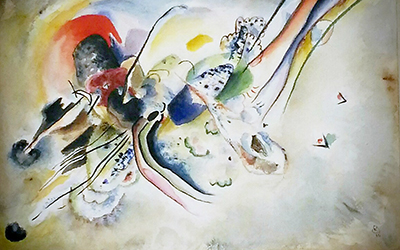
The picture on this page is a particular work on paper, made by Wassily Kandinsky in 1916. Its fuller title is Composition (Study for Bild mit zwei roten Flecken), or Composition (Study for Picture with Two Red Spots). In the image, a busy sweep of colour and line crosses the left side of the sheet while the right side stays remarkably open. Two red accents help orient the eye within the loose arrangement. This is a study connected to a larger oil painting that no longer survives, rather than one of Kandinsky's numbered Compositions. [1].
Watch: Wassily Kandinsky
Five museum videos about Kandinsky’s art, sources of inspiration and the relationship between colour and music.
Vasily Kandinsky: Around the Circle
Curator Megan Fontanella introduces Kandinsky and the Guggenheim collection.
Watch on YouTubeAt a Glance
- Artist:Wassily Kandinsky (1866–1944).
- Title:Composition (Study for Bild mit zwei roten Flecken).
- Date:1916.
- Medium:watercolour and pencil on paper mounted on cardboard.
- Collection:Jucker Collection, Museo del Novecento, Milan.
- National catalogue code:0302039997.
- Related painting:Bild mit zwei roten Flecken, a lost oil known from photographic documentation.
Where this work sits in Kandinsky’s career
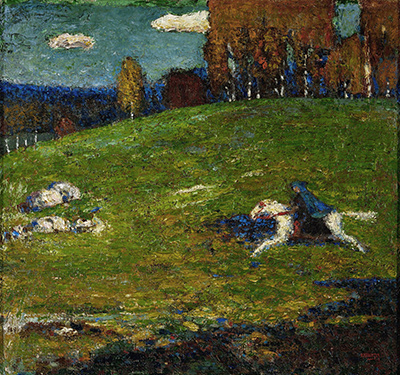
The Blue Rider
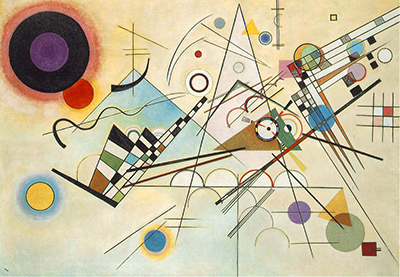
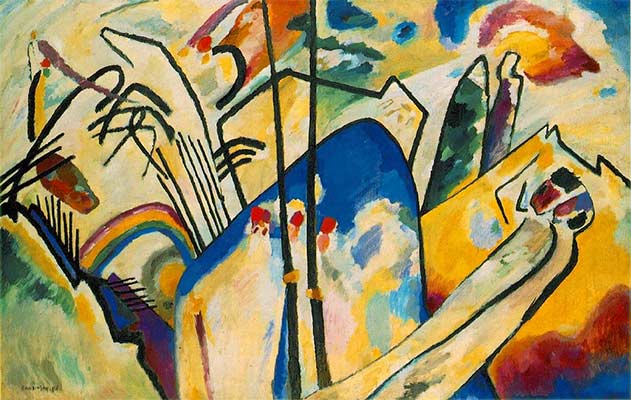
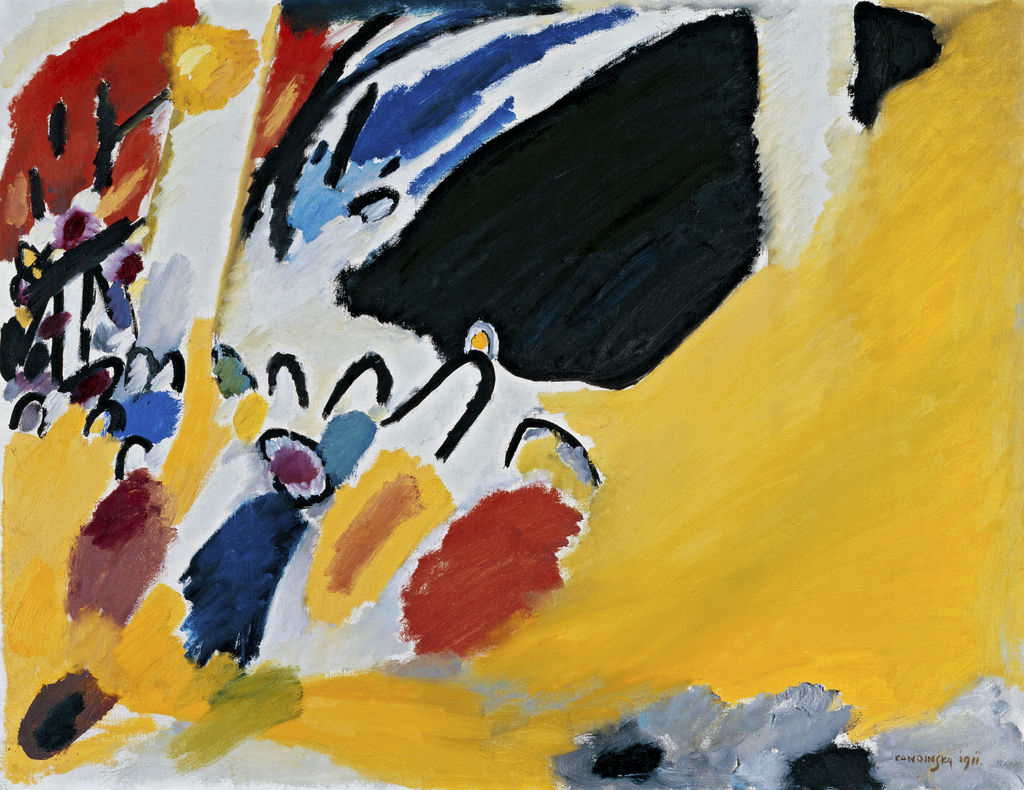
1903Composition VII
1913Composition VIII
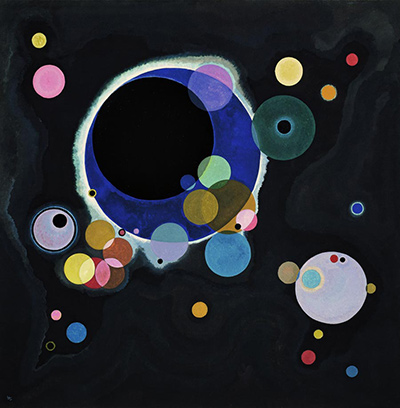
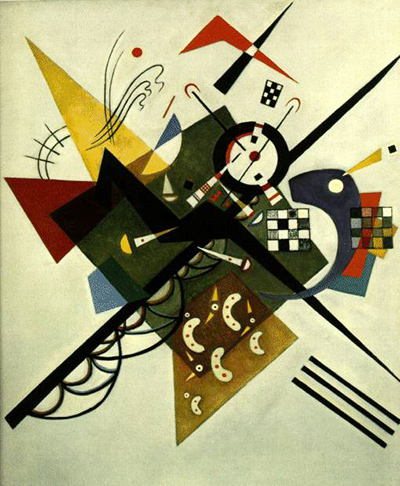
1923Several Circles
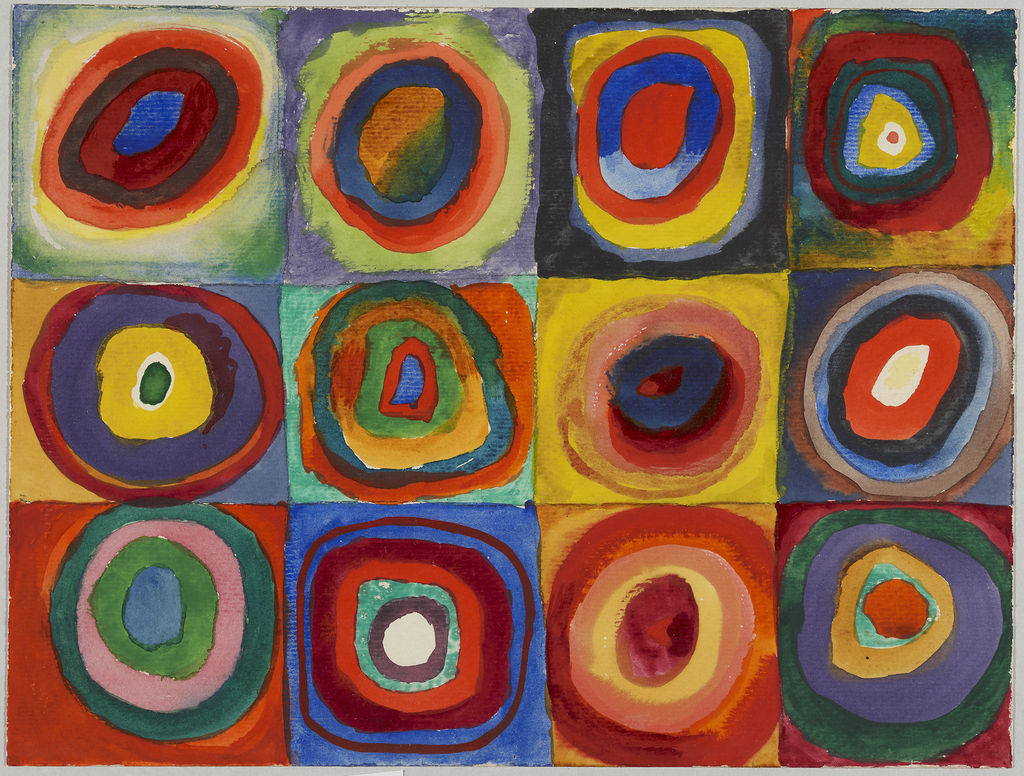
1926Sky Blue
1940Contents
- Looking across the sheet
- A study for a lost painting
- Kandinsky between Russia and Stockholm
- Why the title can mislead
- What to notice on a second look
- Frequently asked questions
- References
Looking across the sheet
The composition seems to move along a diagonal. From the left edge, dark strokes and cloudy passages press toward a lively cluster near the middle. Several long, fine lines then climb toward the upper right. The eye can follow that movement without finding a single solid shape that explains the whole picture. Kandinsky's marks overlap and diverge, offering routes through the sheet instead of a fixed foreground and background.
Near the upper left, a strong red curve is one of the first things to notice. A second red area sits lower and closer to the central group of marks. Their different positions make the red feel like a repeated event rather than a neatly paired symbol. The national catalogue calls the two red spots a focal point and connects them with the artist's interest in red as an active colour. That reading helps explain their prominence, although it does not turn the shapes into a scene with a single answer. [1].
Blue, green and yellow appear in lighter washes around the denser centre. Because the colour is thin in places, one layer can be sensed through another. Darker pencil lines behave differently: they can cut across a pale wash or sharpen its edge without enclosing every patch. Tiny dots and short, broken strokes bring another scale of attention. We move from a broad diagonal gesture to the smallest marks and back again.
The open area on the right is as important as the marks. It leaves room around the two little angular accents that sit apart from the central cluster. The blank paper also makes the thin ascending lines more visible. Kandinsky did not simply fail to fill this part of the sheet. Its relative quiet changes the pressure of the crowded left side and lets the movement seem to continue beyond the coloured forms. The museum catalogue likewise notes that open paper contributes to a sense of suspension. [1].
A study for a lost painting
The words “study for” are central to this object's identity. The Milan catalogue identifies the watercolour as a study for Kandinsky's oil painting Bild mit zwei roten Flecken—Picture with Two Red Spots. It dates the painting to the period between December 1915 and March 1916, when Kandinsky stayed in Stockholm with Gabriele Münter. The institution says the oil is now lost and known through photographs. It also records that the work was later among the art confiscated under the Nazi regime. These claims concern the related oil; the Milan watercolour survives. [1].
Calling this sheet a study does not reduce it to a disposable sketch. Its colour, spacing and changes of touch can be appreciated in their own right. At the same time, the relationship to the lost oil gives the watercolour another purpose for historians: it preserves evidence of Kandinsky working through an arrangement that he pursued on a different support. The national catalogue sees a close structural relationship between the two. Without the oil in front of us, we should resist describing exact differences between them as though both surfaces could still be compared directly.
It is also easy to confuse this work with other Kandinsky pictures whose titles mention red spots. The relevant connection is the one documented by the Milan collection: this 1916 sheet and Bild mit zwei roten Flecken. Other Kandinsky pictures also mention red spots in their titles, but the Milan catalogue specifically links this watercolour with Bild mit zwei roten Flecken. Its national catalogue number, 0302039997, identifies the surviving sheet. [1].
Kandinsky between Russia and Stockholm
The First World War changed where Kandinsky could live and work. He left Germany in 1914 and returned to Russia. The Milan catalogue characterises 1915–17 as a period in which practical and financial difficulties reduced his oil painting output while he made more watercolours and drawings. It describes those works on paper as gaining greater independence as works of art. This sheet belongs to that unsettled period, yet its formal questions continue concerns visible in his earlier Munich years: how a picture can feel active through colour, line and their placement without relying on conventional perspective. [1].
Stockholm is relevant because the catalogue places the making of the related oil there, during Kandinsky's stay with Münter. It does not require us to turn this watercolour into a literal picture of the city. There is no documented Stockholm street or harbour in these marks. The connection is historical and artistic: the study and painting belong to a phase of his work shaped by displacement, travel and a return to the possibilities of abstraction on paper.
The light, open character of the sheet is striking alongside that context. Its marks do not form a heavy wall across the page. They gather, rise and thin out. The viewer can sense energy in the diagonal and the red accents, but any claim that a particular line stands for a particular feeling would go beyond the catalogue's evidence. Kandinsky organised what we see; each viewer must test how its contrasts work in the act of looking.
Why the title can mislead
“Composition” is a broad word in Kandinsky's art. He also made a group of numbered, usually large and ambitious Compositions, including Composition IV, Composition VII and later Composition VIII. The title of this Milan sheet lacks a number, and the institutional record identifies it by its relation to Bild mit zwei roten Flecken. Its relationship to a lost painting, and its use of watercolour on paper, distinguish it from those numbered works. [1]; [3].
The word still suits the sheet. Kandinsky composes a field of relationships: a thick dark accent against a hairline stroke, red against pale blue and yellow, dense activity against unmarked paper. Its structure can be felt without assigning each mark to a depicted object. But that observation is about this 1916 watercolour. It is not evidence that the work is a missing numbered entry in the series.
The sheet later entered Riccardo Jucker's collection in 1960. According to the national catalogue, it joined Milan's civic collections with the Jucker Collection in 1992. That history explains why the original can be located at the Museo del Novecento today even though the related oil has been lost. The watercolour and lost oil have separate histories, even though the study joins them artistically. [1].
What to notice on a second look
Try beginning with the pale right edge rather than with the red curve. Follow the thin strokes back toward the central gathering of shapes. Then find the separate red accents and see how far apart they feel. This reversal of the usual left-to-right scan makes the sheet's balance clearer. Its quiet space is active in directing attention, even where almost no colour is present.
The watercolour also rewards looking for changes in material. Some colour appears as a wash that passes softly into the paper. Other marks are crisp and insistent. Kandinsky let these different kinds of touch meet without smoothing them into one uniform surface. The result is an intimate record of experimentation and a complete visual experience: a surviving work that helps us think about a painting we can no longer inspect directly.
Kandinsky artworks directory
Frequently Asked Questions
No. The Milan collection identifies it as a 1916 watercolour study for Bild mit zwei roten Flecken. The numbered Compositions are separate works. [1].
No. This surviving work is watercolour and pencil on paper mounted on cardboard. The related oil painting is lost. [1].
It is in the Jucker Collection at Milan's Museo del Novecento, within the city's civic museum collections. [1].
The title of the related oil was Bild mit zwei roten Flecken, meaning Picture with Two Red Spots. The museum identifies two red areas as a focal point in this study. The title names a visual feature; it does not establish a hidden figurative subject. [1].
Discussion
What do you notice first in Composition (Study for Picture with Two Red Spots)? Share a close observation or a question about the evidence for this work.
Comments are for comparing what we see and what the cited sources establish.
Reader Insights
What role does the open paper at the right play beside the denser diagonal?
How does knowing this is a 1916 study change your comparison with the numbered Compositions?
What could a surviving photograph of the lost oil tell us that this study cannot?
Join the Conversation
Add your observation below and tell us which part of the artwork led you to it.
References
- Italian Ministry of Culture, national catalogue record 0302039997, Composizione. motivi decorativi astratti, with Regione Lombardia / Museo del Novecento catalogue data. View source.
- Museo del Novecento via Google Arts & Culture, Composition (Study for “Bild mit zwei roten Flecken”), partner object record. View source.
- Museum of Modern Art, Kandinsky: Compositions exhibition catalogue, context for the distinct numbered series. View source.