 by Tom Gurney
Tom Gurney BSc (Hons) is an art history expert with over 20 years experience
Published on June 19, 2020 / Updated on October 14, 2023
Email: tomgurney1@gmail.com / Phone: +44 7429 011000
The Cow by Wassily Kandinsky: Introduction
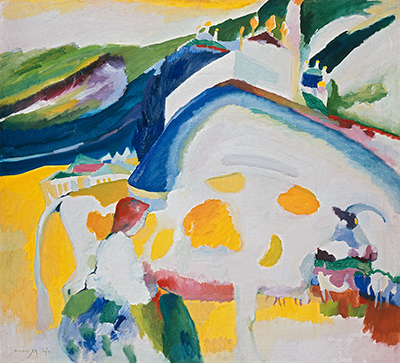
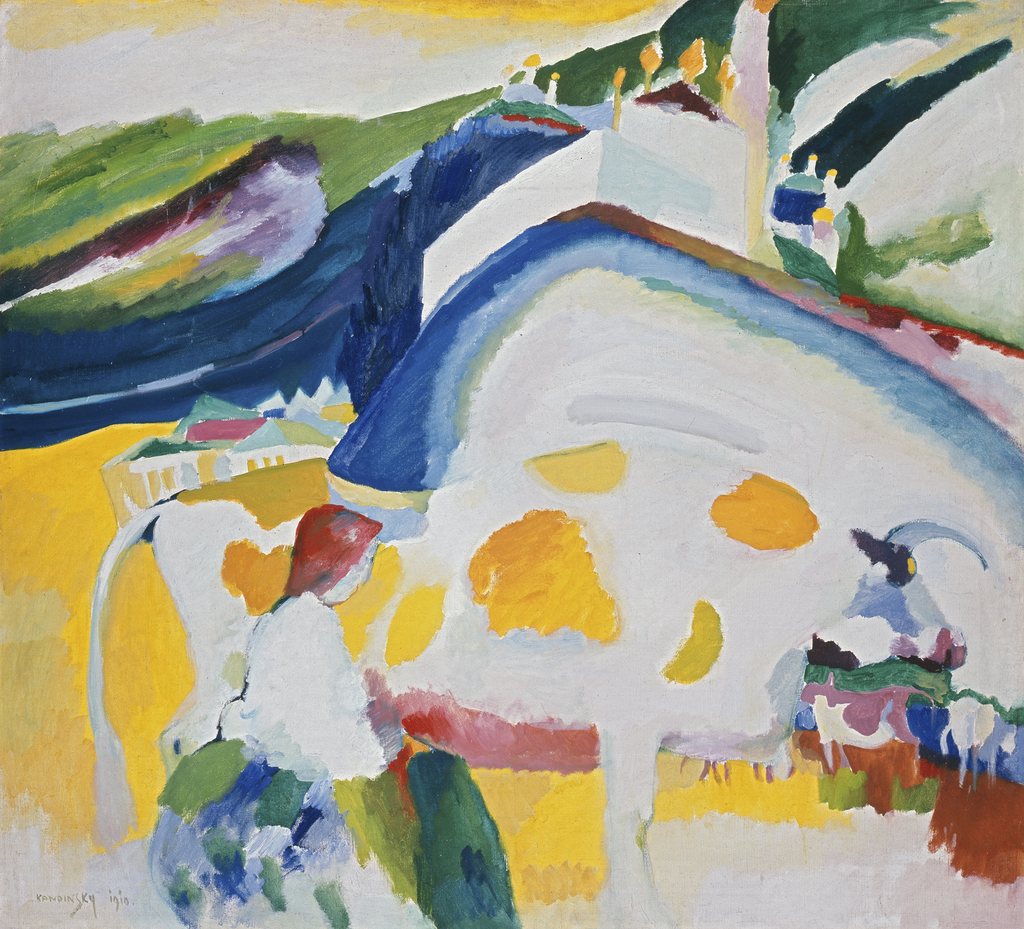
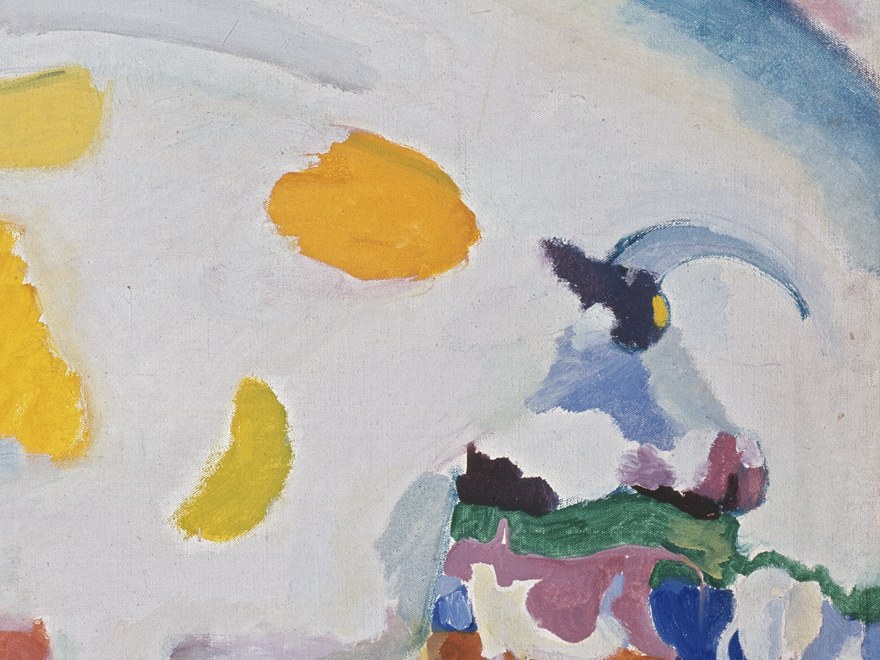
Wassily Kandinsky's The Cow (Die Kuh) is a 1910 oil on canvas in Munich's Lenbachhaus. A pale cow fills the foreground while a young farmer milks it, but the animal is surprisingly difficult to separate from the surrounding white and yellow fields. Behind it, a mountain seems to repeat the curve of its back. A wall and domed towers add an architecture that is less easy to place. The painting takes a recognisable rural subject and lets colour and shape loosen its boundaries. [1].
The title makes the cow sound obvious. Looking longer shows that Kandinsky was interested in what happens when an object nearly dissolves into its setting. The Lenbachhaus compares this handling with another 1910 painting, Murnau with Church I, but the two works have different supports, dimensions and compositions. Its account of The Cow emphasises visual analogies among animal, mountain and buildings, rather than a hidden allegorical code. This article follows those visible relationships and keeps the distinct objects apart. [1]; [2].
Annotated details in The Cow
Select a numbered point to examine three close views of the work.
 123
Select a number to reach its detail.
Details from THE COW
Three close views of the work.
White cow
The broad white body carries yellow, orange and violet patches.
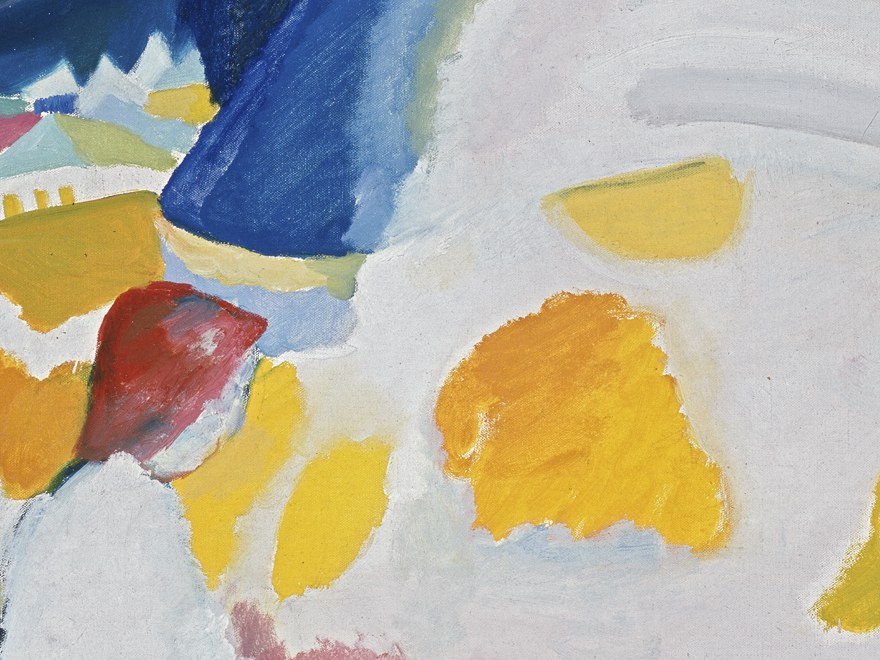
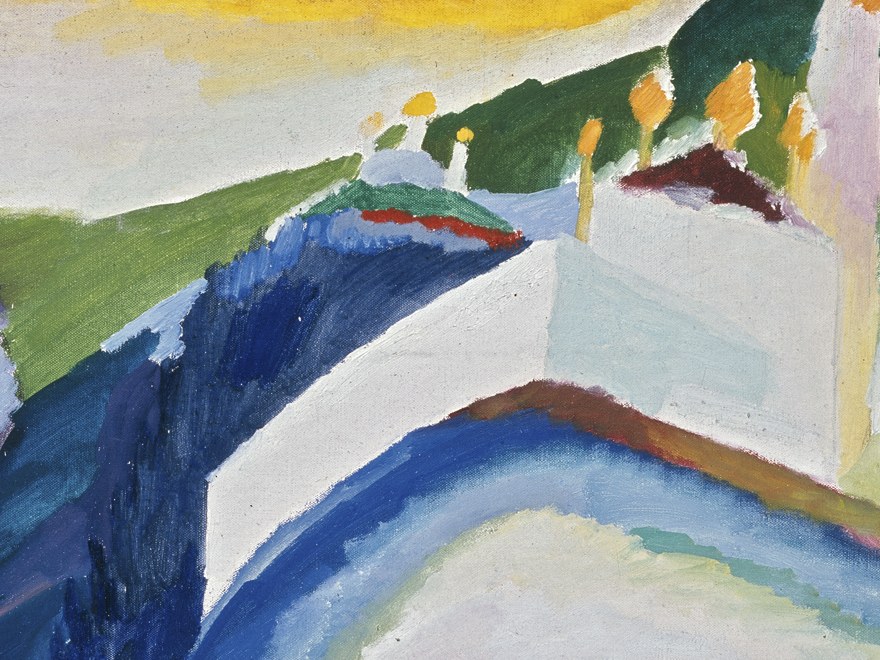
Blue mountain
A deep blue slope curves behind the animal and steadies the composition.
Small figures
Tiny forms at the right edge alter the apparent scale of the cow.
Reproduction from the linked collection record, CC0 1.0. View image source and terms.
Watch: Wassily Kandinsky
Five museum videos about Kandinsky’s art, sources of inspiration and the relationship between colour and music.
Vasily Kandinsky: Around the Circle
Curator Megan Fontanella introduces Kandinsky and the Guggenheim collection.
Watch on YouTubeAt a Glance
- Artist and date:Wassily Kandinsky, 1910.
- Owner's title:Die Kuh; English The Cow.
- Medium and dimensions:Oil on canvas, 95.5 × 105 cm.
- Collection:Lenbachhaus, Munich, GMS 58; Gabriele Münter Stiftung gift, 1957.
- Signature:
KANDINSKY 1910at lower left, according to the museum. - Image:Existing page image retained. The owner record labels its own downloadable reproduction CC0 1.0.
Where this work sits in Kandinsky’s career
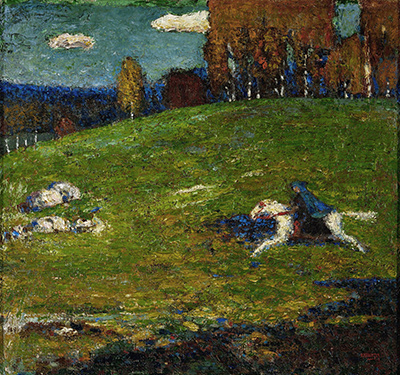
The Blue Rider
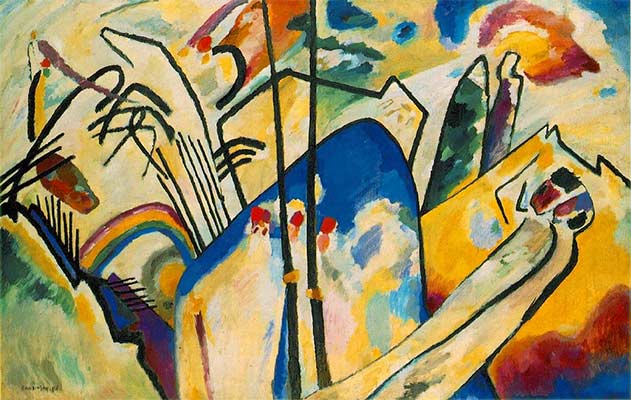
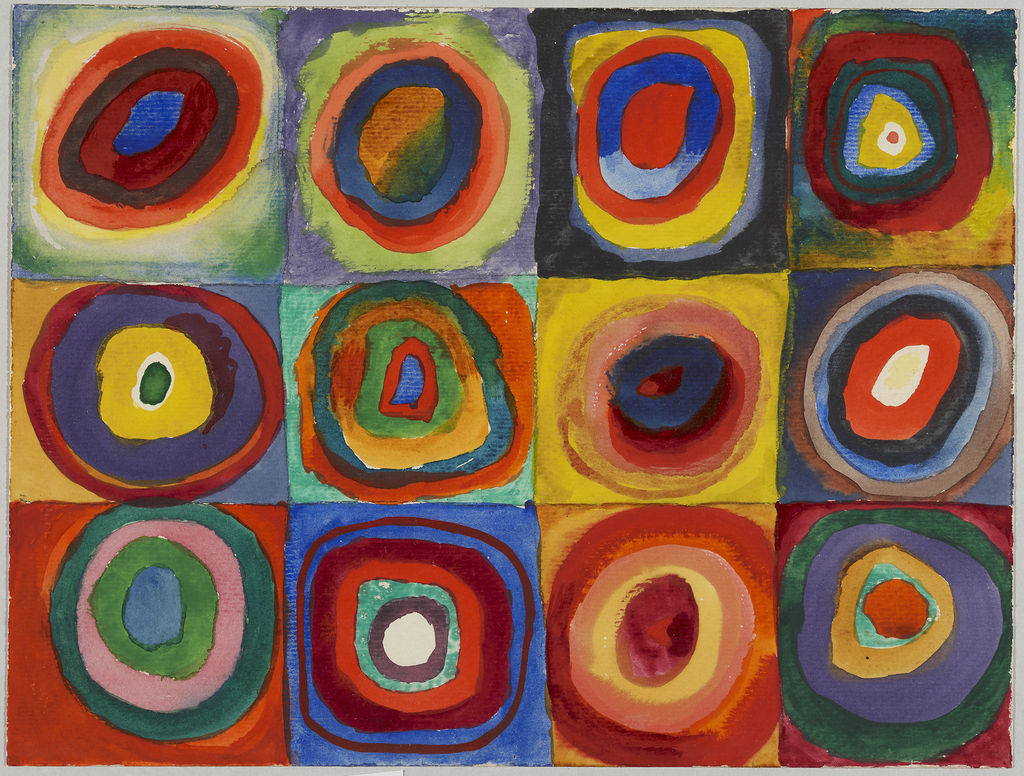
1903The Cow
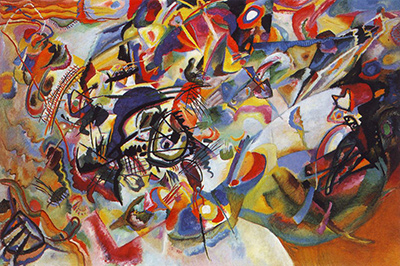
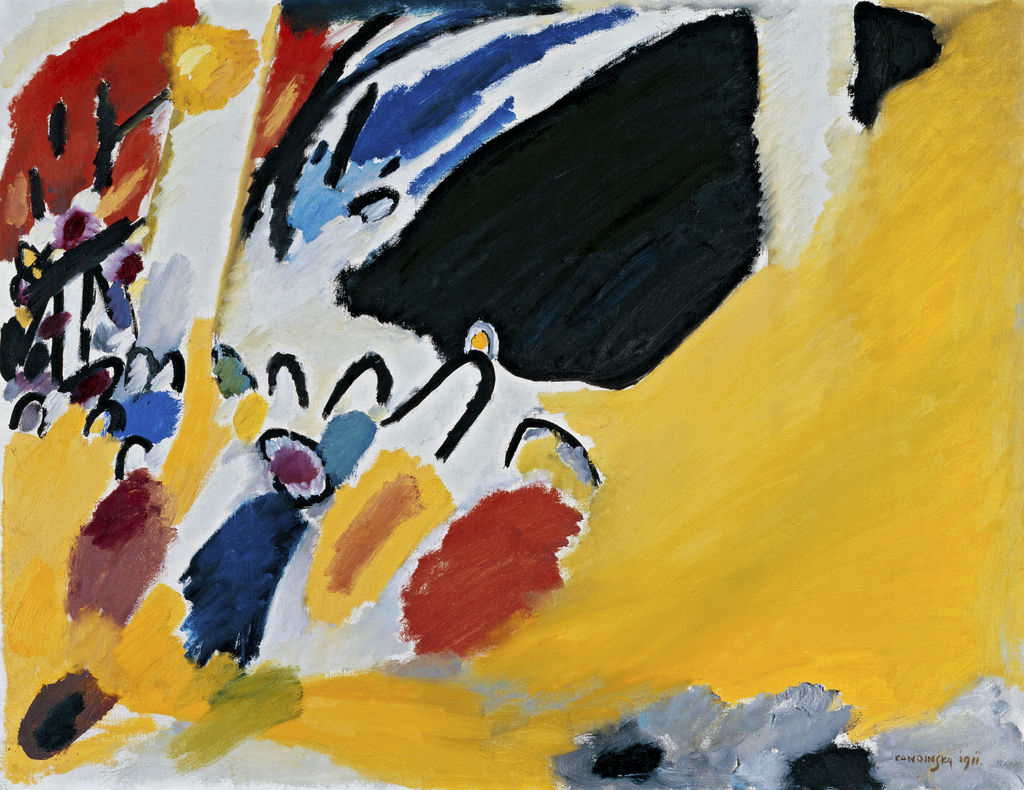
1910Composition VII
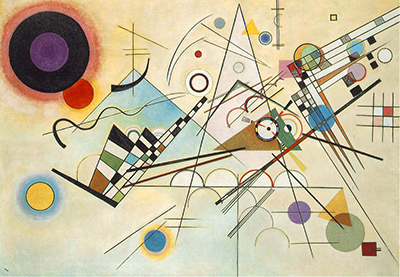
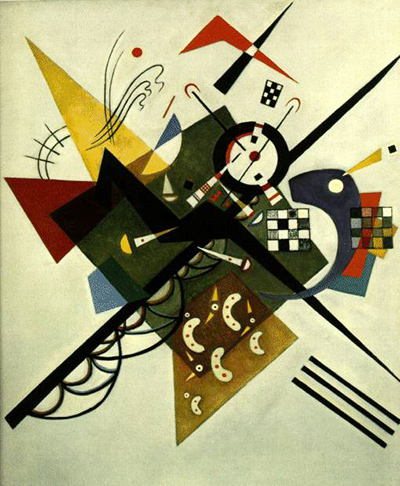
1913Composition VIII
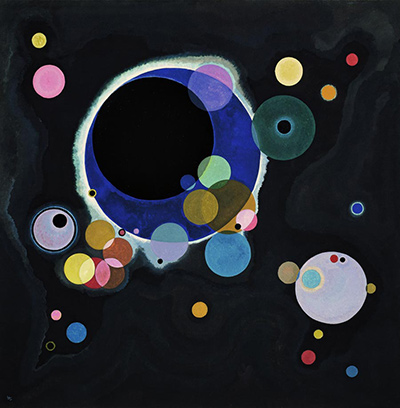
1923Several Circles
1926Sky Blue
1940Contents
- Annotated details
- A rural subject that resists quick recognition
- The cow and mountain echo one another
- Bavarian setting and Russian-looking domes
- Colour breaks up the visible world
- Comparison with Murnau with Church I
- Object, signature and later custody
- Why the painting belongs in the story
- Frequently asked questions
- References
A rural subject that resists quick recognition
The Lenbachhaus describes a powerful white-yellow cow turned to the right and a young farmer milking it. In a small reproduction, the animal can initially look like a broad pale mass rather than a neatly outlined body. Its back rises under the mountain and its head enters a busy right-hand area of trees and buildings. The farmer's figure appears small beside the animal. Kandinsky has not removed the subject; he has made its edges difficult to keep separate from nearby shapes. [1].
The picture is a useful reminder that legibility has degrees. We can identify a cow once a museum title or a careful look directs us to it, yet still struggle to locate every limb and boundary. Yellow within the animal continues into the neighbouring ground. White passes between its body and the landscape beyond. Dark blue and green bands interrupt that continuity, so the subject emerges and recedes as attention shifts. These effects are observations about the picture, not evidence that Kandinsky intended a visual puzzle with one correct hidden outline. [1].
The rural activity is ordinary, but the picture's scale and colour keep it from functioning as an anecdotal farm illustration. At 95.5 × 105 cm, the canvas is substantial. The cow occupies a large fraction of it, while the human figure is relatively small and absorbed into colour. Rather than presenting the farmer as the clear protagonist of a story, the arrangement invites comparison among broad shapes. The title supplies the subject; the painting makes us work through how it is built. [1].
The cow and mountain echo one another
A striking white peak stands behind the animal. The museum observes that its contour seems to extend or trace the cow's back. This near-rhyme of forms is central to the picture: body and mountain can momentarily seem part of one rising shape. A band of blue around the mountain's pointed form helps mark it out while maintaining the strong colour relationship with the foreground. The landscape does not merely sit behind the subject; it participates in the subject's appearance. [1].
Such a visual rhyme differs from saying the cow literally is a mountain. Both remain recognisable when the eye sorts their clues. Kandinsky can make two unlike things share a silhouette or colour without eliminating their separate identities. This is why the picture is better discussed through relationships than through a single story about what each form represents. The owner essay reads this as an analogy of structures and a loosening of material boundaries. That interpretation is supported by the cow's merging with colour around it. [1].
The mountain motif also recurs in Kandinsky's work around these years. In this canvas it is neither an incidental background decoration nor a fully mapped alpine peak. Its pointed geometry helps organise the large central form. The owner notes that such a conical basic shape appears in numerous variations through 1913. That broad observation does not mean every later mountain has the same specific meaning as this one. It points to a form Kandinsky found repeatedly useful. [1].
Bavarian setting and Russian-looking domes
At the peak's edge the Lenbachhaus identifies a white wall, perhaps recalling the town wall at Murnau. Beyond it are domed towers that the museum describes as unmistakably Orthodox in character. A painting made during Kandinsky's Bavarian period can thus combine suggestions from his immediate environment with imagery associated with Russia. The source does not provide enough to turn the whole scene into a specific view of either place. It is safer to say that distinct architectural associations are brought into one invented landscape. [1].
The domes are small compared with the cow and mountain. Their scale and distance do not work like a measured panorama. They add a second, culturally charged rhythm of rounded and pointed forms. The wall below them repeats pale areas of the animal and mountain. Colour and contour link foreground, terrain and buildings across what would otherwise be different subjects. The viewer may first see a cow, then notice architecture, then return to the cow with a changed sense of its shape. [1].
The Lenbachhaus connects this mixture to Kandinsky's later recollection that Bavarian churches and chapels could resonate for him alongside sacred architecture from his homeland. That is an artist's retrospective comparison, reported by the museum. It does not prove that one painted dome reproduces an identifiable building from Moscow or Murnau. The strongest evidence remains the actual arrangement on the canvas: a Bavarian-associated mountain and wall set beside Russian-looking towers. [1].
Colour breaks up the visible world
In The Cow, colour is not held neatly inside each object. The broad white and yellow passages flow across cow, mountain and nearby ground. Blue outlines and dark green areas give some boundaries force but let others slip. The result has energy without requiring the subject to disappear. One can see why the owner describes an intentional estrangement of the motif. The familiar rural scene becomes difficult to grasp because its colour structure no longer follows each object's normal edge. [1].
The picture also has a strong opposition between the pale central sweep and darker angular bands near the upper edges. Orange and red accents catch attention in smaller areas. Those colours change the apparent weight of the cow: it can look monumental against the dark, then almost blend into the bright field that surrounds it. A viewer can move between these impressions without deciding that one cancels the other. The painting's subject and its abstract organisation of colour remain active together. [1].
The owner essay is careful about meaning. It argues that Kandinsky is more concerned here with analogous structures and loosening material form than with hiding a deeper message. That is a useful counterweight to interpretations that assign the cow a fixed religious or spiritual role simply because the painting also includes domes. The buildings are worth discussing, but the source does not establish a complete symbolic code. The observable work of colour and shape offers a firmer starting point. [1].
Comparison with Murnau with Church I
The Lenbachhaus compares The Cow to Murnau with Church I, also dated 1910. The latter is a separate oil on cardboard measuring 64.7 × 50.2 cm, inventory GMS 59. Its owner essay describes a recognisable white church tower and buildings that are close to dissolving in a lively field of colour. Both pictures test how far visible motifs can be loosened. The comparison is supported by the museum, but the paintings should not be treated as two photographs of the same scene. [1]; [2].
The differences matter. Murnau with Church I is a vertical town view on cardboard; The Cow is a wider canvas with an animal and farmer in the foreground. In the former, the owner's account focuses on the view's movement toward freer landscape painting. In the latter, similar dissolving forms create an interplay of animal, mountain and imagined architecture. Formal resemblance therefore does not make one picture a preparatory study for the other. Their materials, dimensions and subjects keep their separate identities clear. [1]; [2].
This comparison also places The Cow within Kandinsky's Munich and Murnau years without making it a literal record of one location. Murnau supplied subjects and forms, while Kandinsky's memories and pictorial decisions could alter them. To say that the painter was moving toward abstraction is a broad historical description; it should not erase the visible cow, farmer and domes in this particular 1910 work. [1].
Object, signature and later custody
The Lenbachhaus records the title Die Kuh, the 1910 date, oil on canvas medium and dimensions of 95.5 × 105 cm. It notes the inscription KANDINSKY 1910 at lower left. These facts anchor the painting when image files or English titles vary. They also show that the work is a full canvas, not the smaller 1910 cardboard study used for comparison. A useful article should separate exact catalogue facts from the visual interpretation of what the canvas is doing. [1].
The owner traces the painting to Gabriele Münter in Murnau from 1926 to 1957, obtained by transfer from Kandinsky. She gave it to the Lenbachhaus in 1957. The record does not establish every earlier movement, so there is no reason to supply a made-up chain of owners before 1926. The accession GMS 58 and the 1957 gift locate the surviving object in the public collection. [1].
The museum currently marks the painting as not on display. That status can change, so ownership is the useful lasting information; a visitor should consult the live record before planning to see it in person. The current page retains its small existing image. The Lenbachhaus labels its own downloadable reproduction CC0 1.0, making a larger clearly licensed image possible if an easy upgrade is later useful. The article and the future guide do not depend on that upgrade to establish the object's identity or the argument. [1].
Why the painting belongs in the story
The Cow sits between a named animal and a nearly independent arrangement of colour. It invites the eye to recover a cow and farmer, then questions how firmly their forms can be separated from a mountain, wall and domes. This is a specific experiment within Kandinsky's 1910 work, not a simple before-and-after marker in which representation vanishes. Its unusual mixture of rural action and architectural memory makes the canvas more than an example of a general stylistic label. [1].
The owner record helps keep that reading grounded. We know the medium, dimensions, signature, date and later custody. We can see the visible colour and shape relationships. The suggested Murnau wall and Russian-looking towers remain the museum's careful interpretation, not certainties about specific buildings. Holding those kinds of evidence apart lets the painting stay complex: a cow is truly there, yet its body is also part of a larger visual movement. [1].
Kandinsky artworks directory
Frequently Asked Questions
The Lenbachhaus dates the oil to 1910 and records a KANDINSKY 1910 signature at lower left. [1].
It belongs to the Lenbachhaus in Munich, inventory GMS 58, through Gabriele Münter's 1957 gift. The current display status should be checked with the museum. [1].
Yes. The owner identifies a large white-yellow cow facing right while a young farmer milks it. Shared colours and dissolving contours make the animal harder to distinguish from its setting. [1].
The museum says the white wall may recall Murnau, while the domed towers evoke Orthodox Russian architecture. It does not identify a precise, consistent topographical view. [1].
No. Both are Lenbachhaus paintings dated 1910, but The Cow is an oil on canvas, 95.5 × 105 cm, GMS 58. Murnau with Church I is oil on cardboard, 64.7 × 50.2 cm, GMS 59. [1]; [2].
The Lenbachhaus labels the image on its object record CC0 1.0. That provides a clearly usable source for this painting; the guide should document the exact record and image file it uses. [1].
Discussion
What do you notice first in The Cow? Share a close observation or a question about the evidence for this work.
Comments are for comparing what we see and what the cited sources establish.
Reader Insights
Where do you first find the cow against the pale mountain?
How do the mountain and animal repeat or disrupt each other’s contours?
What changes when the domed buildings are read as an imagined addition rather than a mapped location?
Join the Conversation
Add your observation below and tell us which part of the artwork led you to it.
References
- Lenbachhaus, Die Kuh. Owner facts, German curatorial essay, provenance, CC0 image label. View source.
- Lenbachhaus, Murnau mit Kirche I. Separate 1910 painting used for the documented comparison. View source.