 by Tom Gurney
Tom Gurney BSc (Hons) is an art history expert with over 20 years experience
Published on June 19, 2020 / Updated on October 14, 2023
Email: tomgurney1@gmail.com / Phone: +44 7429 011000
Composition IV by Wassily Kandinsky: Introduction
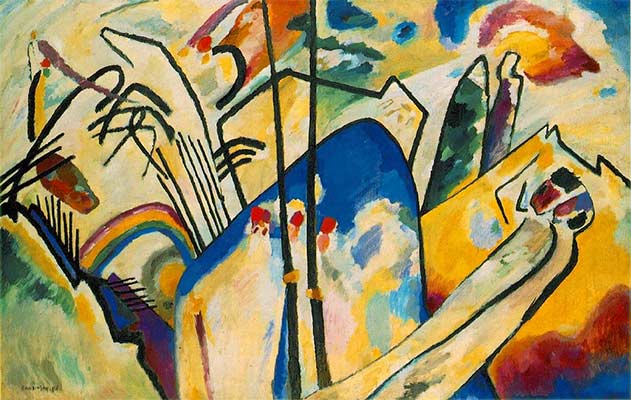
Composition IV is a large horizontal painting completed by Wassily Kandinsky in 1911. Broad areas of blue, yellow, white and red meet black lines that seem to cut, frame and pull the colour across the canvas. Some shapes suggest mountains, riders, upright figures or lances. Others refuse a single stable name. The painting belongs to a moment when Kandinsky was making recognisable subjects less immediately legible while testing how line and colour could organise an image. The Kunstsammlung Nordrhein-Westfalen in Düsseldorf owns the canvas, records it as oil and tempera on canvas, and measures the painted surface at 159.5 × 250.5 cm. Its inventory number is 1013. [1].
The fourth of Kandinsky's numbered Compositions is often called abstract. That is useful if it describes how difficult the picture is to read as one continuous scene. It becomes misleading if it means there are no figures or narrative suggestions at all. Preparatory drawings and later museum scholarship identify riders, Cossacks, a couple and battle-like movement among the forms. The finished painting lets those motifs coexist with large autonomous passages of colour and line. Its interest lies in that tension, not in a clean choice between depiction and pure design. [2]; [5].
Watch: Wassily Kandinsky
Five museum videos about Kandinsky’s art, sources of inspiration and the relationship between colour and music.
Vasily Kandinsky: Around the Circle
Curator Megan Fontanella introduces Kandinsky and the Guggenheim collection.
Watch on YouTubeAt a Glance
- Artist:Wassily Kandinsky.
- Title:Composition IV (Komposition IV).
- Date:1911, also dated in the signature and a reverse inscription.
- Medium:oil and tempera on canvas.
- Painted surface:159.5 × 250.5 cm; the owner lists larger, separate frame dimensions.
- Collection:Kunstsammlung Nordrhein-Westfalen, Düsseldorf, inventory 1013; acquired in 1965.
- Useful comparison:distinct 1911 studies held by the Centre Pompidou and Lenbachhaus.
Where this work sits in Kandinsky’s career
The Blue Rider
1903Composition VII
1913Composition VIII
1923Several Circles
1926Sky Blue
1940Contents
- First look: a canvas in motion
- What can we recognise?
- The divided field
- Colour without a fixed key
- Why the studies matter
- Battle and embrace
- A place in the numbered Compositions
- Before and after the riders
- Making and keeping the painting
- Looking closely without over-decoding
- What the scale changes
- Why Composition IV matters
- Frequently asked questions
- References
First look: a canvas in motion
The middle of the picture is marked by long, nearly vertical black strokes. They divide the view, yet they are not a solid wall: colour and other marks run across or around them. On the left, sweeping black curves and groups of shorter strokes rise through a light field. A rainbow-like sequence of coloured arcs sits lower down. On the right, a strong slanting pale form and a broad yellow area create another kind of energy. Blue and white masses occupy much of the centre. The surface is busy without being filled evenly.
At first sight, the black drawing may seem to float over the coloured areas. Follow one line, though, and it may stop, change direction or disappear into a colour patch. That interruption makes the eye repeatedly choose a new route. The left side can feel like a tangle of rapid signs, while the right opens around larger, clearer shapes. Neither half is entirely calm. A pale diagonal on the right has the force of an arrow, and the dark line near the centre keeps the two sides in contact.
The width of the canvas makes a one-glance reading difficult. A viewer can take in its colour balance from a distance, then move across local incidents: a curved black cluster, a pointed shape, a blue block, a bright red accent. In a reproduction the eye may sweep these quickly. The original scale asks for more bodily looking. It is about two and a half metres wide. The existing local image supports this broad analysis, though exact texture and surface condition need direct study or a conservation image.
What can we recognise?
One appeal of Composition IV is the moment when an apparent abstract mark begins to look like something in a landscape. The peaked forms can suggest hills or mountains. Thin dark diagonals can resemble spears. A grouping of dark and pale shapes may bring a mounted figure into view. These are possibilities guided by research, not a request to label every stroke. If each visible part were reduced to a single noun, much of the painting's shifting effect would be lost.
Museum evidence makes some identifications firmer. MoMA's account of its 1995 Kandinsky: Compositions exhibition says that horsemen remain in Composition IV, but are reduced and partly veiled as pictographic signs. Angela Lampe, writing for the Centre Pompidou about a related study, describes two riders at upper left, three Cossacks whose lances divide the field, and an embracing couple at the right. The study offers a route into the painting's imagery; it does not require the final canvas to be read as a detailed historical illustration. [2]; [5].
The difference between a motif and an exact scene matters. A rider can suggest movement or conflict without identifying a particular battle. A couple can lend the right side a contrasting sense of closeness without giving the viewer names or a plot. A form may be enough like a mountain to help orient the eye, while still functioning as an area of colour. Kandinsky did not have to erase recognisable things for the painting to make line and colour unusually independent.
The divided field
The group of central verticals is among the most decisive features. It creates a seam that may be read as lances, a compositional boundary or both. The black strokes are narrow beside the wide coloured passages, yet they command attention because they contrast so strongly with the light ground. They do not divide the painting into equal, enclosed panels. Curves and colour rhythms cross the seam, and the eye keeps moving between sides.
The left is often described as more agitated. That effect has visible causes: short parallel strokes, arcing lines, sudden dark knots and less open space between marks. The right has broad planes of yellow, white and blue, although the diagonal and pointed forms prevent it from becoming merely peaceful. This is a formal distinction rather than a diagnosis of what an imagined character feels. One can point to the density of line and the scale of colour patches; assigning a precise emotion to each patch would need an attributable interpretation.
The Centre Pompidou's essay reports Kandinsky's 1913 explanation of the picture through contrasts: mass against line, blurred passages against exact marks, sharp battle movement against light, cool colours. That account helps explain why apparently opposed visual conditions are placed together. It also reminds us that the artist wrote about the work after making it. His account is valuable evidence for intention, but looking at the canvas should still test how those contrasts actually appear. [5].
Colour without a fixed key
Blue occupies an emphatic area near the centre, with smaller blue passages elsewhere. Yellow opens at the right and appears in surrounding light. Reds and oranges mark smaller points, while white or pale paint creates breathing room between darker forms. The colours are not merely local colours describing objects. They alter balance and pace. A large blue block can hold the eye even when the viewer has not decided what, if anything, it depicts.
It would be easy to assign each hue a single symbolic meaning and treat the painting as a code to be solved. Kandinsky wrote extensively about colour, and his theory can inform a reading. But a general statement about blue in his writing is not proof that one precise blue patch here has one exclusive message. The more secure starting point is relational: where a colour is placed, how much space it takes, and what sort of line or neighbouring hue it meets.
The arcs at lower left show this clearly. Their bands of colour form a compact, recognisable sequence, yet they also redirect the eye into the surrounding black strokes. A small concentrated passage can hold its own against a wide, pale area. On the right, yellow is expansive but interrupted by pale and dark shapes. These contrasts keep the painting from becoming a set of isolated colour swatches. Colour changes what the line does, and line changes how colour is read.
Why the studies matter
A preparatory study is a separate artwork, not a transparent key to every final decision. The Centre Pompidou has a small charcoal sketch for Composition IV, dated 1911, and MoMA's 1995 exhibition catalogue reproduces at least two other works on paper connected to the composition: a drawing and a study using pencil, charcoal and watercolour. The Lenbachhaus holds a further design in watercolour, ink and line etching. The differences in scale and material alone warn against treating any one sheet as a miniature version of the finished canvas. [4]; [3]; [6].
The studies are valuable because some relationships can be easier to trace before colour and scale complicate them. A lance may connect a cluster of figures; a curved hill can set a spatial route. When the finished painting changes a line or widens a colour field, the viewer can see Kandinsky making a compositional choice rather than simply losing interest in the subject. The sequence is evidence of work and revision, not evidence that the final painting is incomplete without a diagram.
Angela Lampe describes a gridded study closely related to the final canvas. Her discussion identifies riders, three Cossacks and an embracing couple, and reports that Kandinsky gave the study another title, Schlacht or Battle. That study helps establish why battle imagery is associated with the painting. Yet a painting with a broader formal title can hold more than a battle narrative. The title Composition IV invites a viewer to consider how competing elements are arranged, while the study shows some of the representational material from which that arrangement developed. [5].
The Lenbachhaus sheet is especially useful as a securely identified comparison. Its museum record dates it to 1911, gives its medium as watercolour, ink and line etching, and measures it at only 19 × 26.3 cm. It bears inventory number GMS 460. Those object details keep it distinct from the Düsseldorf painting. The study's explicitly CC0 image could be used as an additional illustration with correct attribution, but its licence says nothing about the image rights for a photograph of the main canvas. [6].
Battle and embrace
The suggestion of conflict is supported by the related study and the artist's own later account. Three lance-like verticals can be read as a structural and narrative hinge. On one side, dense marks and rider motifs imply action; on the other, a pair of forms can suggest an embrace. It is possible to read the painting through opposing states of tension and union. The question is how far that reading can be taken before it turns tentative shapes into certain characters.
In the final canvas, the putative figures are not separated by clear outlines from every neighbouring colour field. Black lines may describe a body in one passage and drive the overall rhythm in the next. A viewer can move between an account of what is depicted and an account of how the painted marks behave. That movement is more faithful to the work than a diagram that points to a horse, a couple and a sun as though all were equally unmistakable.
The title Battle belongs in this discussion as a documented alternate name for a preparatory study, according to the Pompidou essay. It should not silently replace the owning museum's title for the final painting. A study can disclose an early idea or one strand of imagery without fixing the finished picture's entire meaning. The Düsseldorf record calls the canvas Komposition IV. Keeping that title visible allows the viewer to ask how a possible battle is made into a composition. [1]; [5].
A place in the numbered Compositions
Kandinsky reserved the title Composition for a small group of major paintings. MoMA's 1995 exhibition brought together the seven surviving numbered canvases and related studies. The first three were lost during the Second World War; the series eventually reached ten. Composition IV is therefore a surviving early member of a deliberately limited sequence, not merely the fourth painting Kandinsky happened to make in 1911. [2].
The sequence should not be treated as a row of identical experiments. Some works retain conspicuous narrative motifs; others distribute recognisable forms differently or focus on a stronger geometric order. Composition IV has its own distinctive conjunction of lances, rider signs, arcs, blue mass and open colour. Reading it only as a transition to Composition VII would miss the decisions visible on this canvas.
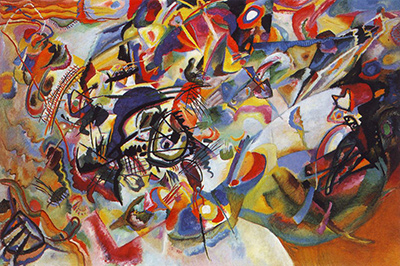
A comparison with the 1913 Composition VII can be illuminating. Both works ask a viewer to navigate dense relations of line and colour. The later canvas, however, is larger and famously intense in its layered activity. Composition IV makes the split between busy linear passages and wider colour zones especially available to a first-time viewer. Comparing them is a way to ask how Kandinsky changed his means, not to declare one a more complete version of the other.
Before and after the riders
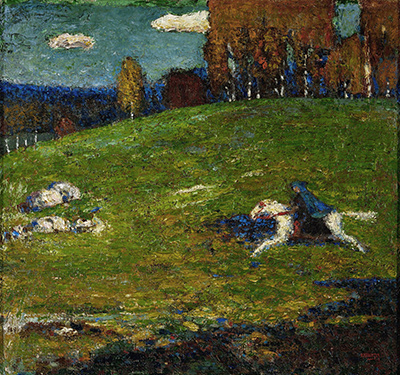
The rider is a recurring subject in Kandinsky's work. His 1903 The Blue Rider still shows a pale horse and blue-clad figure in a legible landscape. In the 1909 Blue Mountain, riders are smaller within a bolder arrangement of colour and simplified forms. MoMA identifies the horsemen in Composition IV as transformed again, approaching pictographic signs. Those comparisons make a sequence visible while leaving room for each picture to have a separate purpose. [2].
The Blue Rider group and its almanac are another part of the 1911–12 context, but the group is not the subject of every Kandinsky painting with a horse. A single named work, a recurring motif and a collaborative initiative have different histories. Composition IV can be discussed beside the group without claiming that a particular rider shape is a formal emblem of membership or that the canvas was made as an illustration for the almanac.
This distinction also resists a simple career story. Kandinsky did not merely remove one recognisable object per year until an abstract image appeared. He could compress, veil or restate subjects while giving line and colour more independence. Here the horsemen do not disappear completely. They become one way into a visual field that can also be read without decoding them. The result is a layered experience rather than a single milestone on a ladder.
Making and keeping the painting
The Düsseldorf collection records a clear provenance: Kandinsky kept the work from 1911 until his death in 1944; it then belonged to Nina Kandinsky until 1965, when the museum acquired it. The acquisition was funded by a donation from Westdeutscher Rundfunk. That record explains why the canvas is now part of the public collection while avoiding a guessed intermediate owner. It also provides the inventory number, inscriptions and catalogue number needed to distinguish the painting from similar titles and later reproductions. [1].
The museum lists the painting as displayed in K20 in its current online record, but exhibition status can change. Anyone planning a visit should consult the collection's current information rather than relying on a timeless assertion on this page. The 1965 acquisition and present collection identity are more durable facts. They also matter for image research: an owning museum record is the right source for object metadata, while a photograph's reuse terms require a separate, clear licence.
The owner calls the work gemeinfrei, or public domain, but its page also credits a named photographer and directs image-rights enquiries to a service address. Those signals do not together offer the simple, clearly reusable image licence required for this project's new sourcing. The existing local image remains in place. A larger image would be welcome only if a plainly compatible public-domain or open licence is established without a permission process. [1].
Looking closely without over-decoding
Begin at the central dark lines. Notice their differing thickness and how the paint around them changes from light to blue, yellow or red. Then look left to the curved black lines and shorter repeated marks. Are they perceived as one moving cluster or many separate signs? Let the eye pass through the coloured arcs below and across to the larger yellow field on the right. This route tests the painting's internal rhythm before any iconographic label is applied.
Next, use the studies as a second pass. The rider and Cossack identifications can focus attention on forms that might otherwise be missed. Return to the final canvas and ask which of those forms remain clear and which are merged into larger shapes. The uncertainty is informative. Kandinsky made the recognisable motif less dominant, but did not necessarily remove it. A study can sharpen the eye without becoming a compulsory answer sheet.
Finally, step back again. The canvas is wide enough for the left and right zones to feel like different kinds of weather or pace, yet the central strokes and recurring colours keep them together. Ask how the painting balances agitation and opening, fine black line and broad colour. These questions can be answered by looking, even if the viewer remains unsure exactly where each rider or figure begins and ends.
What the scale changes
Dimensions can sound like routine catalogue data until the image is imagined at full size. A small study can be held near the eye and taken in almost at once. The Düsseldorf canvas exceeds the span of two outstretched arms. Reading it involves turning the head, shifting attention across zones and perhaps stepping back to recover the whole. That movement changes the role of the central verticals. In a thumbnail they may look like a single dark bar; across the large canvas they become several separate events with colour visible between them.
Scale also affects how quickly a viewer recognises a possible figure. A rider suggested by a handful of marks can be easier to spot in a reproduction that compresses the whole into one field. At the original width, the eye may first register a local rhythm of black lines before the same passage resolves into a body or lance. This is an inference about viewing conditions, not a report of a particular visitor's experience. It explains why looking at the studies and looking at the painting can yield different kinds of clarity.
The museum's canvas measurement is therefore relevant to interpretation. The work's breadth gives the left and right passages their own visual duration, while the narrow central strokes keep them related. The frame is larger, but its measurements should not be substituted for the image size. A reliable catalogue number and exact medium are equally useful: they help keep this oil-and-tempera canvas separate from the much smaller paper studies that can look deceptively similar on a screen. [1]; [6].
Why Composition IV matters
Composition IV shows Kandinsky working with a subject-rich vocabulary and a newly forceful independence of colour and line. The result is neither a conventional battle scene nor a canvas emptied of every object. The preparatory studies document figures and landscape motifs, while the painting asks those motifs to live within a wide, shifting arrangement. MoMA has stressed the veiled horsemen, and the Centre Pompidou has explained the battle and embrace imagery in a related study. The Düsseldorf object record secures the date, medium, size and ownership. Together those sources make room for a careful reading that need not pretend the painting is simpler than it looks. [2]; [5]; [1].
Its great width gives the conflict between marks and masses room to unfold. A thin black line can divide a large zone of colour; a small red note can quicken a pale field; a possible rider can draw attention and then dissolve into a broader rhythm. That is why the work rewards repeated viewing. The first look registers energy and colour. The studies add possible figures. A return to the painting shows how much remains unsettled in productive ways.
Kandinsky artworks directory
Frequently Asked Questions
The owning Kunstsammlung Nordrhein-Westfalen dates it to 1911. Kandinsky's signature and reverse inscription also include that year. [1].
It belongs to the Kunstsammlung Nordrhein-Westfalen in Düsseldorf, inventory 1013. The collection records acquisition in 1965. Check the museum's current display information before travelling to see it. [1].
The museum records oil and tempera on canvas. The painted image measures 159.5 × 250.5 cm; the frame has different, larger dimensions. [1].
The imagery is heavily transformed, but MoMA identifies horsemen reduced to signs. A related study discussed by the Centre Pompidou includes riders, Cossacks and an embracing couple. The final canvas allows those motifs and a largely independent arrangement of colour and line to coexist. [2]; [5].
A Centre Pompidou essay reports that Kandinsky gave a related study the additional title Schlacht (Battle) and describes Cossacks and lances. The owning museum's title for the final canvas remains Komposition IV. [5]; [1].
Discussion
What do you notice first in Composition IV? Share a close observation or a question about the evidence for this work.
Comments are for comparing what we see and what the cited sources establish.
Reader Insights
Which black line most changes the way you move between the left and right halves?
How does a documented study affect your reading of the riders, lances and possible couple?
Which figure remains uncertain when you return from a study to the finished canvas?
Join the Conversation
Add your observation below and tell us which part of the artwork led you to it.
References
- Kunstsammlung Nordrhein-Westfalen, Komposition IV collection record. View source.
- Museum of Modern Art, Kandinsky: Compositions exhibition account, 1995. View source.
- Museum of Modern Art, Kandinsky: Compositions catalogue PDF. View source.
- Centre Pompidou, schematic drawing for Composition IV. View source.
- Centre Pompidou, Angela Lampe's study commentary. View source.
- Lenbachhaus, Entwurf zu “Komposition IV” record. View source.