 by Tom Gurney
Tom Gurney BSc (Hons) is an art history expert with over 20 years experience
Published on June 19, 2020 / Updated on October 14, 2023
Email: tomgurney1@gmail.com / Phone: +44 7429 011000
Kandinsky Drawings and Works on Paper
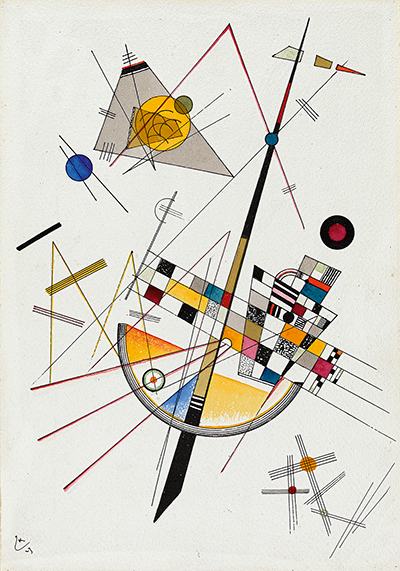
The word “drawings” is a convenient doorway into a far wider part of Wassily Kandinsky’s work. His sheets include spare marks in graphite and ink, dense coloured watercolours, gouache studies, and mixed techniques in which line and colour behave differently. Some helped him develop a painting; others stand as works in their own right. Looking at them makes the large canvases less mysterious without turning every sheet into a key for decoding a finished picture. This guide follows the materials, uses and changing contexts of Kandinsky’s works on paper, then links to individual artwork pages and the wider directory. [1]; [5].
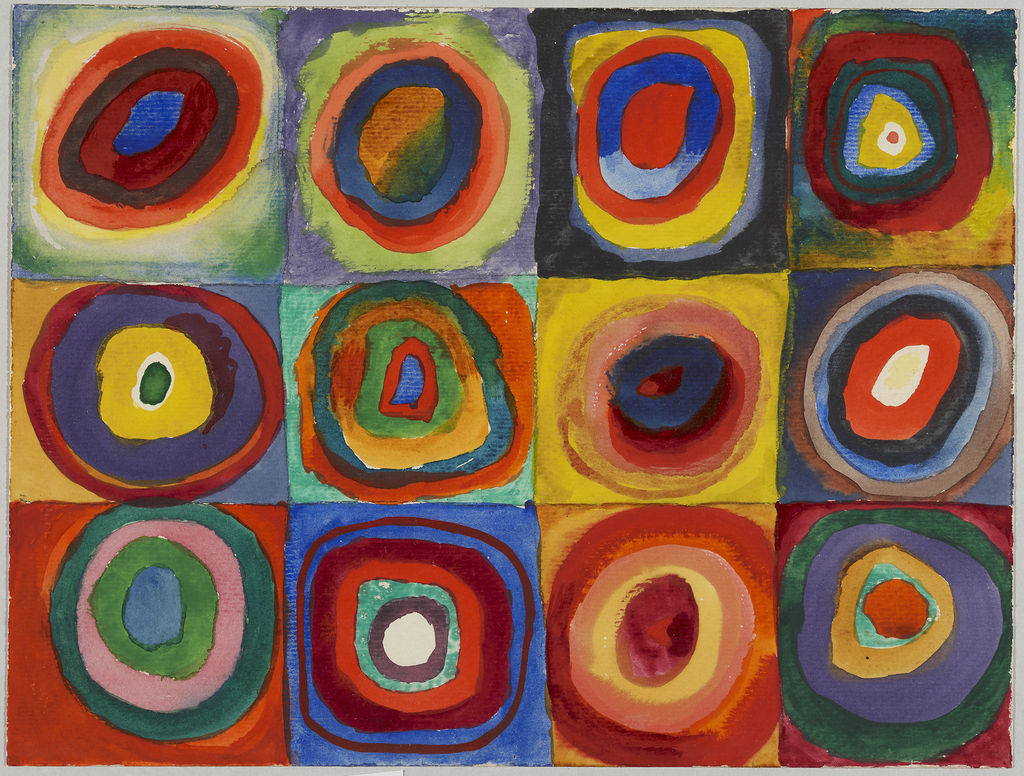
A work on paper is not automatically a quick preliminary sketch. Colour Study: Squares with Concentric Circles gives twelve related colour arrangements a small but carefully organised surface. Untitled (First Abstract Watercolor) is a mixed-media sheet whose date and relation to a larger painting are still debated. Later, Gelb Rosa (Yellow Pink) combines watercolour with pen and ink. These objects ask for attention to paper, layering and scale as much as to the subjects of Kandinsky’s oil paintings.
Watch: Wassily Kandinsky
Five museum videos about Kandinsky’s art, sources of inspiration and the relationship between colour and music.
Vasily Kandinsky: Around the Circle
Curator Megan Fontanella introduces Kandinsky and the Guggenheim collection.
Watch on YouTubeAt a Glance
- Scope:drawings, watercolours, gouache and mixed-media works on paper across Kandinsky’s career.
- Starting works:Colour Study: Squares with Concentric Circles (1913), Untitled catalogued 1913, the 1916 Composition study, and Gelb Rosa (1929).
- Material distinction:transparent watercolour, opaque gouache, ink, graphite and chalk can appear separately or in one sheet.
- Purpose:some sheets are preparatory; others are independent. An owner’s record and the visible object should guide that judgment.
- Directory labels:only source-supported paper identifications receive that label in the wider 91-route artwork directory; a generic label is a research limit, not a statement about the original object.
Contents
- How a sheet can work
- Early studies and independent colour work
- What preparatory studies reveal
- When the study is freer than the painting
- The disputed First Abstract Watercolor
- Moscow: paper as a major working surface
- Bauhaus and later works on paper
- Browse the works and check the records
- Works-on-paper route
- Frequently asked questions
- References
How a sheet can work
Paper offered Kandinsky several kinds of freedom. A graphite or pen line can move rapidly and leave the white support visible. Watercolour can spread in translucent patches; gouache can cover more opaquely. Chalk and dry marks can sit beside wet colour. These are material possibilities rather than a fixed programme: each object’s technique must be checked in its catalogue record. The 1913 Lenbachhaus colour study combines watercolour, gouache and chalk, while the Centre Pompidou’s Untitled combines graphite pencil, India ink and watercolour. [2]; [3].
The white of the page can be part of the design. In a coloured oil canvas, pigment may cover most of the support. In a watercolour, untouched paper can keep separate marks apart or make a colour seem to float. Ink lines may cross patches rather than outline them. Before asking what a shape “means,” notice whether a mark is drawn, brushed, layered or left unpainted around its edge. Such close looking does not require a secret vocabulary of symbols.
Scale also changes the act of looking. The Lenbachhaus colour study measures 23.9 × 31.5 cm; the Centre Pompidou’s Untitled is 49.6 × 64.8 cm. Both are paper works, but one is a compact grid and the other permits a more open spread of lines and colour. A small reproduction can make them look equivalent in size. The owner records restore that difference, even if a screen cannot reproduce their paper texture or paint density.
Early studies and independent colour work
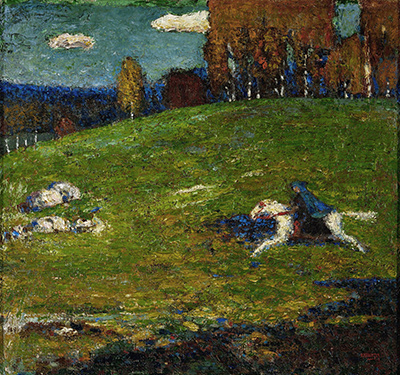
Kandinsky’s move toward abstraction was worked through in many formats. The Munich and Murnau years produced paintings with riders, landscapes and dense colour, as well as sheets that tested how a subject could change when translated into line and colour. A study could isolate a motif, experiment with a spatial arrangement or try a relationship among hues. This does not imply that every early sheet was designed for a particular canvas. That relationship needs a title, inscription, archive or catalogue argument, not a superficial resemblance alone. [1].
The most accessible comparison is Colour Study: Squares with Concentric Circles of 1913. Twelve roughly square cells set rounded bands of colour against different neighbours. The grid makes the trials comparable, while their irregular outlines keep the page visibly handmade. The Lenbachhaus calls it Farbstudie and classifies it as drawing/work on paper, in watercolour, gouache and chalk. It does not identify a single oil painting for which this sheet is a preparatory sketch. The study is therefore useful for watching colour relationships, not for reconstructing an unrecorded final project. [2].
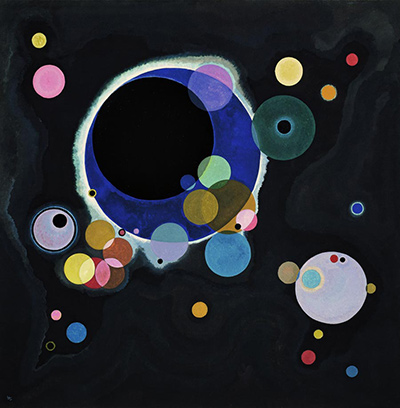
Compare this grid with the painting Several Circles of 1926. Circles recur, but the later dark canvas changes scale, ground and relation among the forms. The paper study does not predict that later work. It reveals how much the effect of a repeated shape depends on its neighbours and support. The comparison also shows why a work on paper deserves its own label: the small mixed-technique sheet is not merely a miniature of the oil painting.
What preparatory studies reveal
Some relationships between sheets and paintings are documented in unusual detail. MoMA’s 1995 exhibition brought the seven surviving numbered Compositions together with thirty-one selected preliminary studies in oil, watercolour, charcoal, ink and pencil. The accompanying catalogue discusses a much larger study process around Composition VII alone, including diagrammatic sheets annotated with colour and movement ideas. These are distinct numbers: thirty-one was the exhibition selection across the series, while the VII dossier describes its own broad preparatory sequence. [5]; [5].
A diagram can reveal that Kandinsky placed and moved forms deliberately. It may also show a motif that receded or disappeared in the completed oil. The final picture is not a simple enlargement of its last study. A viewer can use the paper evidence to ask what changed between versions: Did a dark line move? Was a white opening narrowed? Did a proposed figure become harder to identify? This is a more faithful use of a study than treating it as a legend for a map.
The Guggenheim records at least sixteen drawings, watercolours and oil sketches before Painting with White Border was finished in 1913. The variety of media matters. A line drawing can test direction, a watercolour can test colour, and an oil sketch can approach the physical behaviour of the final paint. Kandinsky’s account of finding the white border belongs to a long process of working and revising, not to a tale of a finished canvas arriving without preparation. [6].
MoMA’s Study for Painting with White Form offers a specific material example: a 1913 sheet of watercolour, opaque watercolour and ink on paper. Its catalogue relation to a painting is part of the title and record. The change between a small study and a larger work is also a change in handling and scale, not simply a question of whether a recognizable house or boat can be found in both. The MoMA record is linked for study; its image carries a separate rights notice and has not been copied into this site.
When the study is freer than the painting
A study need not look less finished or less abstract than the painting to which it relates. The Centre Pompidou’s 1913 Étude pour Kleine Freuden is a watercolour and ink sheet for the painting Small Pleasures. Curator Angela Lampe observes that the sheet is freer and more abstract than the final canvas. Motifs of a hilltop citadel, a rider and a rowing boat remain faintly present. In the oil, their relation is recomposed. This is a useful warning against assuming that a preparatory sheet must be an awkward first step toward a progressively “better” final image.
The source also illustrates why the word “preparatory” should be used carefully. It identifies a relation between two objects, but the paper work still has its own choices, surface and energy. A viewer may prefer the sheet’s spread of marks without concluding that the painting failed, or may find that the painting’s tighter structure clarifies something the study left open. Comparing the objects is an exercise in observing decisions, not ranking media.
The 1916 Composition study on this site calls for another distinction. Its route is a specific work on paper associated with Picture with Two Red Spots, rather than one of Kandinsky’s ten numbered Compositions. The linked article explains the identification and the limits of what can be inferred about a missing or altered final oil. A title containing “Composition” cannot establish a work’s place in that numbered series.
The disputed First Abstract Watercolor
The sheet historically called the First Abstract Watercolor is a particularly clear example of how paper works can carry difficult histories. The Centre Pompidou’s current title is Sans titre (Untitled), and its catalogue date is 1913. The sheet bears a 1910 inscription, which helped support an older claim that it was the first abstract work. The museum discusses a possible connection with Composition VII and leaves open whether the sheet was made unusually early or dated retrospectively. These are different kinds of evidence; the inscription does not automatically settle the date. [3]; [3].
The owner calls its technique graphite pencil, India ink and watercolour on paper. The coloured passages and black lines do not always align as outlines and filled shapes. The white ground remains active between them. Looking at those material relations is more rewarding than repeating a “first” claim whose date is uncertain. A comparison with VII may show related ways of organising the field, but it should not turn every mark on the sheet into a proven key to the later canvas.
It is also misleading to call the sheet an oil painting because it matters in the history of abstraction. Media do not change with a work’s reputation. Its paper support, mixed techniques and cataloguing as a drawing are part of the historical object. The site retains the inherited route name so readers can find the familiar title, while the linked page states the owner’s title and dating plainly.
Moscow: paper as a major working surface
War changed Kandinsky’s life and available working conditions. Returning from Germany to Russia in 1914, he made important watercolours and drawings during the Moscow years, even though a simple painting-only timeline can make that interval seem quiet. The Centre Pompidou’s English monograph states that material conditions encouraged work on paper and discusses Einfach (Simple) of 1916 as a watercolour with a striking separation of line and colour. Its French object essay gives a fuller account of the Moscow sheets and quotes Kandinsky’s 1915 correspondence about the care he was putting into watercolour. [1]; [1].
A watercolour from these years should not be read only as a substitute for an oil he could not make. The paper work has its own line, speed, gaps and transparency. At the same time, Kandinsky could think of these experiments alongside future larger works. The two ideas can coexist: an independent sheet may test an approach that later appears elsewhere. The task is to compare documented objects and avoid inventing a direct sequence whenever they happen to share a curve or colour.
The Moscow period also complicates a neat march from figurative Munich scenes to Bauhaus geometry. The paper works include varying degrees of recognizable subject and abstraction. The 1916 Composition study and Einfach do not look like identical chapters of one style. Seeing that variety helps explain why the later return to Germany involved a shift in setting and teaching role, not the sudden start of Kandinsky’s interest in line.
Bauhaus and later works on paper
At the Bauhaus Kandinsky taught and published about point, line and plane, while continuing to work in more than one medium. The geometric language of some paintings makes it tempting to imagine the paper work as sterile diagrams. Individual sheets resist that reduction. The 1929 Gelb Rosa (Yellow Pink) uses watercolour with pen and black ink on paper laid on board, according to its sale record. Its sprayed or granular colour, curves and delicate linear divisions are materially different from a sharply edged oil canvas. The inherited URL says “yellow rose,” but the recorded German title refers to yellow and pink, not a flower. [8].
The example also shows how evidence is graded. An auction record can establish a medium, date and past provenance, but it does not prove the work’s present owner or every interpretive comparison in its essay. The object page attributes such comparisons and keeps the title correction visible. This drawings guide uses the sheet to show a combination of wet colour and fine line, not to assert a universal Bauhaus style.
The broader lesson is to let a medium’s surface matter. A drawing may carry decisive black marks over washes. A colour study may be organised as a repeatable grid. A watercolour can hold opaque and transparent paint in tension. Kandinsky could use these possibilities during the Blue Rider years, in Moscow and at the Bauhaus without making “drawing” one unchanging category.
Browse the works and check the records
The wider artwork directory below includes all 91 inherited Kandinsky object routes. Its drawing filter is a cautious subset of those routes whose present source packets identify paper media; it is not a catalogue raisonné of Kandinsky’s works on paper. Some routes have generic labels because the exact object identity or medium still needs confirmation. The Paintings guide follows the oils and other painting records, while the Prints guide covers editioned media. These routes help separate material histories that a single “Kandinsky art” list would blur.
For an initial route, compare four source-checked objects. Start with the 1913 colour study: watch a repeated structure change with colour. Turn to Untitled: see how its lines, patches and paper ground hold together without a grid, and remember the disputed date. Move to the 1916 Composition study: ask what the specific project title establishes. Finish with the 1929 Gelb Rosa: see a different balance of delicate line and colour during the Bauhaus years. Each object page points to its evidence and states the limits of identification.
Museum sites can tell you whether a particular sheet is currently on display; ownership alone does not promise a gallery view. When looking online, check dimensions and technique before making close comparisons. A 400-pixel page image may show the broad arrangement while hiding chalk texture, watercolour transparency or revisions. Better images are useful when clearly licensed, but a rights-unclear photograph is not required for an accurate explanation of the documented object.
A route through four works on paper
These four source-checked sheets offer a starting path across colour study, abstraction, the Moscow years and the Bauhaus. The full artwork directory follows; its drawing filter shows a cautious selection, not the artist’s complete paper output.
Kandinsky artworks directory
Frequently Asked Questions
Museums often catalogue them within drawings or works on paper, although the precise technique should still be stated. The Lenbachhaus classifies the 1913 colour study as drawing/work on paper and lists watercolour, gouache and chalk; the Centre Pompidou records Untitled in its drawing domain with graphite, ink and watercolour. [2]; [3].
Yes. MoMA’s Kandinsky: Compositions exhibition showed thirty-one preliminary works across media with the seven surviving canvases, and its catalogue examines the extensive study sequence for Composition VII. The exhibition number is a selection, not a count of every study Kandinsky made.
No. The owning Lenbachhaus identifies it as a 1913 drawing/work on paper in watercolour, gouache and chalk, measuring 23.9 × 31.5 cm. Its “colour study” title does not make it an oil-canvas study for any particular later painting. [2].
The sheet bears a 1910 inscription, but the Centre Pompidou currently catalogues it as 1913 and discusses its possible relation to Composition VII. The exact chronology remains a question. The owner’s date and the older label should both be reported, rather than treating either as an unquestioned fact. [3]; [3].
No. The Centre Pompidou describes substantial drawings and watercolours from 1914–17, including the 1916 watercolour Einfach. Material and political conditions changed the balance of his practice, but the paper works show continued experiment. [1]; [1].
Not necessarily. The Centre Pompidou’s analysis of Étude pour Kleine Freuden finds its 1913 paper work freer and more abstract than the related oil. A documented preparatory relation tells us about a sequence of choices; it does not rank the two objects by quality.
Discussion
Which Kandinsky sheet changes most when you compare it with a related canvas?
Choose a paper work and describe what its lines, colour or white ground contribute.
Reader Insights
Compare the paper surface and marks in two works from different periods.
What does an owner’s medium record tell you about watercolour, ink or chalk in a sheet?
Which study-to-painting relationship needs a more precise object record?
Join the Conversation
Share a close observation about a paper work and the source for its material or date.
References
- Centre Pompidou, Kandinsky English monograph and Einfach essay. View source 1 · View source 2.
- Lenbachhaus, Farbstudie – Quadrate mit konzentrischen Ringen. View source.
- Centre Pompidou, Sans titre object record and dating essay. View source 1 · View source 2.
- Centre Pompidou, Étude pour Kleine Freuden. View source.
- MoMA, Kandinsky: Compositions exhibition and catalogue. View source 1 · View source 2.
- Guggenheim, Toward Abstraction, 1910–14. View source.
- MoMA, Study for Painting with White Form. View source.
- Christie’s, Gelb Rosa lot record. View source.