 by Tom Gurney
Tom Gurney BSc (Hons) is an art history expert with over 20 years experience
Published on June 19, 2020 / Updated on November 4, 2026
Email: tomgurney1@gmail.com / Phone: +44 7429 011000
The Pedlar / Wayfarer by Hieronymus Bosch: Introduction
Hieronymus Bosch's painting now titled The Pedlar by Museum Boijmans Van Beuningen is still widely known in English as The Wayfarer. The two titles matter because they pull the image in slightly different directions. "Pedlar" points to a man with goods on his back, a small trader moving through the world with his basket, tools and baggage. "Wayfarer" widens him into a traveller, a pilgrim of life, a human being passing through danger without knowing exactly what lies ahead.
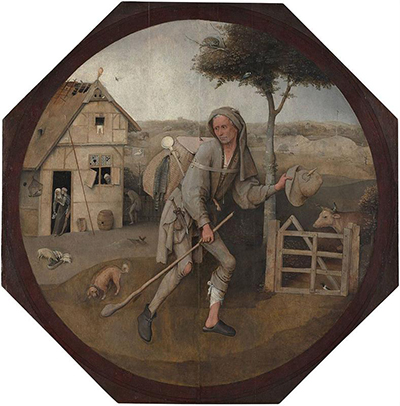
The painting is in Rotterdam, in the collection of Museum Boijmans Van Beuningen. The museum identifies it as a work by Jheronimus Bosch, dated circa 1500, painted in oil on panel, 71 cm high and 70.6 cm wide, with the accession number 1079 (OK) [1]. Its shape is one of the first things viewers notice. The image is presented as a near-round panel, but that form is the result of a complicated history. The painting was assembled from the outside wings of a triptych; the original hinged object was later separated, cut and dispersed [1].
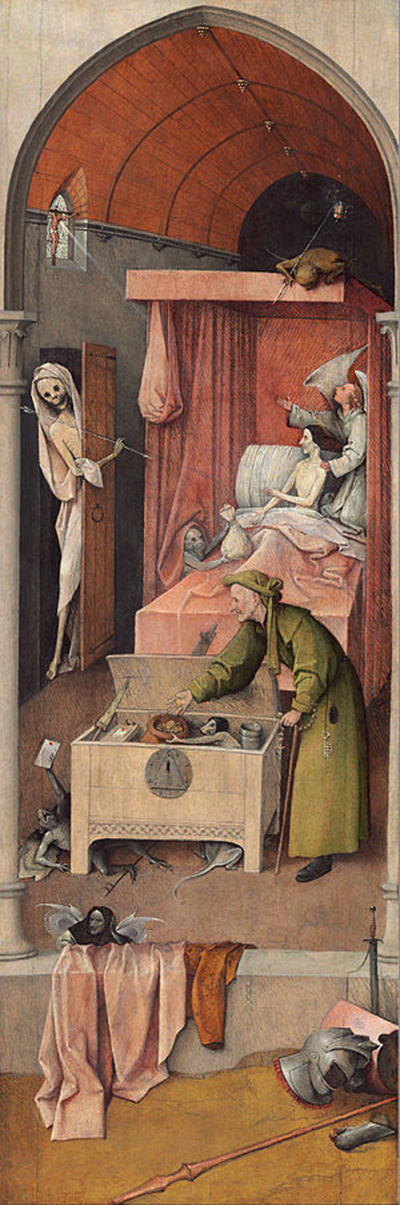
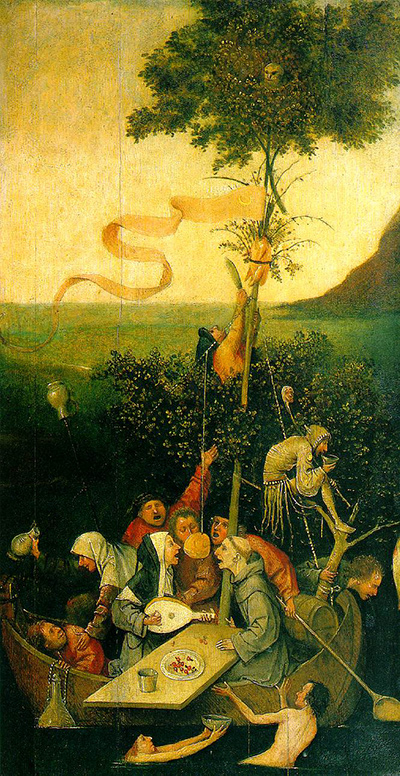
That history makes The Pedlar / Wayfarer one of the most useful works for understanding Bosch's moral imagination. It is not only an image of a shabby traveller in a dangerous landscape. It is also the exterior face of a lost and dismantled triptych whose surviving inner fragments include The Ship of Fools in the Louvre, An Allegory of Intemperance at Yale University Art Gallery, and Death and the Miser in the National Gallery of Art, Washington [1] [2] [3]. The middle panel is unknown. That absence should make interpretation careful, but it does not make the surviving evidence weak.
Within the wider Hieronymus Bosch cluster, this painting belongs beside the paintings overview, Bosch's biography, the guide to Bosch symbolism, the study of workshop and attribution, The Haywain Triptych, The Ship of Fools and Death and the Miser. It is a compact image, but it opens onto some of Bosch's largest questions: how human beings move through life, what they carry, what they look back toward, and what they choose to leave or enter.
Contents
- At a Glance
- What Bosch Shows
- Pedlar, Wayfarer or Pilgrim?
- A Dangerous Landscape
- The Roundel and the Broken Triptych
- The Wayfarer Triptych Network
- Folly, Appetite and Avarice
- The Burden on the Traveller's Back
- Bosch's Moral Journey
- Relation to The Haywain
At a Glance
- ArtistHieronymus Bosch, also known as Jheronimus Bosch
- Current museum titleThe Pedlar
- Common English titleThe Wayfarer
- Datecirca 1500, according to Museum Boijmans Van Beuningen
- MediumOil on panel
- Dimensions71 x 70.6 cm
- CollectionMuseum Boijmans Van Beuningen, Rotterdam
- Accession number1079 (OK)
- Acquired1931, with support from the Rembrandt Association and private donors
- FormatExterior wings of a dismantled triptych, later joined and shaped into a near-round image
- Related surviving fragmentsThe Ship of Fools in the Louvre, An Allegory of Intemperance at Yale, and Death and the Miser in Washington
- Main themesThe journey of life, temptation, moral choice, poverty, worldly baggage and the dangers of the road
Compare these works across Bosch’s career
These date ranges are estimates, not a documented year-by-year sequence. These works provide context for the article; none is highlighted as the object discussed here.
Saint Jerome at Prayer
Circa 1485–1495 [4]Crucifixion with a Donor
Circa 1490–1500 (BRCP) [4]Hermit Saints Triptych
Circa 1495–1505 [4]Saint Liberata Triptych
Circa 1495–1505 [4]The Hearing Forest and the Seeing Field
Circa 1500–1505 (Berlin exhibition) [5]The Haywain Triptych
1510–1516 (BRCP) [4]What Bosch Shows
The central figure is an old or weathered traveller, seen in a landscape just as he turns his head back. He wears mismatched shoes, carries a basket or pack on his back, grips a walking stick and moves along a narrow road. His clothing is worn, his posture bent, and his body seems caught between forward motion and backward attention. Bosch gives him no grand destination. He is simply on the way.
The road is not peaceful. A dog threatens him from one side. Behind him stands a shabby building associated with tavern life, sexual temptation, disorder and poverty. Figures appear in and around it. A couple is visible near the doorway. A man urinates against the wall. Pigs feed nearby. The building looks unstable, patched and morally suspect, less a home than a place of appetite and exposure.
Bosch fills the traveller's belongings with worldly specificity. A jug, ladle, purse, dagger, basket, straps and other small items hang from him or surround him in the museum's object tagging [1]. These details do not need to be forced into a rigid code. They work first as signs of a life carried on the body. The man is burdened by things, habits, trade, hunger, need and memory.
The traveller's backward glance is one of the painting's great ambiguities. Is he leaving the tavern behind? Is he tempted to return? Is he wary of the dog? Is he looking back over a life already compromised? Bosch does not settle the question by adding an inscription. Instead, he makes the figure hover between movement and hesitation.
That hesitation is central to the painting's power. The man has not clearly chosen ruin, but neither is he safely delivered. He is a traveller in the moral sense: someone whose life remains in motion and whose path passes through danger. The image is therefore not simply a genre scene of a poor itinerant worker. It is a moral image in the form of a road.
Pedlar, Wayfarer or Pilgrim?
Museum Boijmans Van Beuningen currently uses the title The Pedlar and notes that the painting is also known as The Wayfarer [1]. Both titles are useful, but neither exhausts the image.
"Pedlar" keeps attention on the social type. The man carries goods. He may sell small wares, travel between towns, and live by movement rather than by settled property. That reading helps explain some of the practical objects attached to him. Even details that look symbolic may also belong to his trade. Boijmans gives the example of the skinned cat: it might carry moral associations, but pedlars also sold cat skins, so the image should not be reduced too quickly to one symbolic meaning [1].
"Wayfarer" shifts attention from trade to journey. It makes the figure less a profession than an image of human passage. Boijmans describes him as a vagabond or pedlar who symbolises man on the path through life: a kind of Everyman or homo viator, weighed down by earthly baggage and moving along a road full of temptations [1]. In that sense he is close to a pilgrim, though not a serene devotional pilgrim with a clear shrine ahead. He is a morally exposed traveller.
The older title The Prodigal Son has also been associated with the image in the history of interpretation. It is not hard to see why: a shabby man near a disreputable house, pigs, hunger and a sense of return or departure all recall the biblical parable. Yet the current museum title avoids making that identification too narrow. Bosch may be drawing on the emotional and moral atmosphere of the prodigal story without illustrating it in a literal way.
The safest reading holds these possibilities together. The figure is a pedlar because Bosch gives him the equipment and bodily reality of a travelling seller. He is a wayfarer because the road turns him into an emblem of life. He is pilgrim-like because his journey has spiritual stakes. He is Everyman because the question posed by his path is not only his own.
A Dangerous Landscape
Bosch's landscape is small, but it is full of moral weather. The road bends through a place where ordinary life and vice are difficult to separate. The tavern or broken house is not shown as a spectacular infernal site. Its danger lies in its familiarity. Human beings drink, desire, quarrel, urinate, linger and neglect themselves. The traveller passes near these things because they are part of the world he must cross.
The dog at the traveller's heels gives the road immediate threat. It is not a monster. It is an everyday animal made aggressive by context. Bosch often makes moral danger feel practical before it becomes theological: a dog bites, a bridge must be crossed, a pack weighs down the shoulders, a road narrows, a door invites, a glance turns back.
The building behind the traveller matters for the same reason. It is not simply a symbolic "house of sin" pasted into the background. Its broken surfaces, signs of appetite and exposed figures create an environment of disorder. The traveller is defined partly by what he leaves behind and partly by what remains near enough to call him back.
Boijmans' public commentary wisely cautions that symbolic readings of individual details can be uncertain [1]. That caution is especially important with Bosch. Birds, pigs, cats, shoes, baskets, purses and tavern signs may carry associations from proverb, moral literature, urban life and late medieval visual culture, but they do not always translate into one fixed meaning. The painting's force comes from the whole situation: a burdened traveller passing through a compromised world.
The landscape therefore reads like a test. The man is not judged by one emblem but by orientation. Does he keep moving? Does he turn back? Does he notice danger? Does he know what kind of place he is leaving? The viewer cannot answer fully, which is why the painting remains alive.
The Roundel and the Broken Triptych
The near-round format is beautiful, but it is not the original format in a simple sense. Boijmans states that The Pedlar was assembled from the outside wings of a triptych [1]. The wings were separated from the rest of the structure, their outer faces brought together, and the resulting image shaped around the central figure.
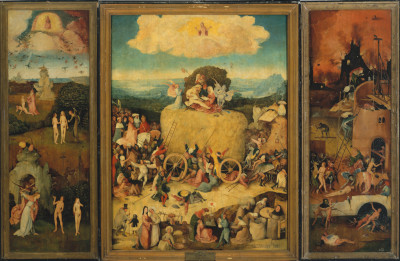
This matters because a triptych is an object of opening and closing. Its exterior is not merely a cover. It prepares, conceals, frames and sometimes transforms the interior. When closed, the viewer encounters one kind of image; when opened, another. Bosch used that structure with exceptional imagination. In The Haywain Triptych, the closed exterior also shows a wayfarer or pilgrim-like figure moving through a dangerous world, while the opened triptych reveals humanity chasing perishable goods toward Hell [6].
The Rotterdam painting and the Prado Haywain exterior are not the same image, but their resemblance is too important to ignore. Boijmans notes that the Rotterdam figure looks very similar to the exterior of The Haywain Triptych, which is why scholars have seen a related iconography [1]. The comparison clarifies Bosch's interest in life's journey. He repeatedly returns to a solitary traveller as an image of humanity under moral pressure.
The difference is also revealing. The Haywain exterior belongs to an intact triptych whose interior is known. The Rotterdam Pedlar / Wayfarer survives from a dismantled triptych whose central panel is missing. The image now feels self-contained because of its round shape, but its original meaning was likely tied to the opening of wings and the revelation of interior scenes.
That brokenness changes the modern act of looking. We encounter a traveller who once concealed, or framed, a larger moral programme. The road he walks is therefore both literal within the image and structural within the object. He was the face of a triptych before it opened onto sin, appetite and death.
The Wayfarer Triptych Network
Museum Boijmans Van Beuningen identifies the surviving inner fragments of the dismantled triptych as The Ship of Fools in the Louvre, An Allegory of Gluttony and Lust or Intemperance at Yale University Art Gallery, and Death and the Miser in the National Gallery of Art, Washington [1]. Closer to Bosch, the Bosch Research and Conservation Project presentation, also lists the complex as the Wayfarer Triptych and separates its exterior, left interior fragments, right interior wing and lost central panel [7].
The Louvre's record for The Ship of Fools supports the same larger context. It describes the Paris panel as a fragment from the inner face of the left wing of a triptych, cut at the edges and bottom, with the Yale fragment fitting below it and Death and the Miser forming the right wing [2]. Yale likewise identifies An Allegory of Intemperance as a fragment that formed the left wing with the Louvre painting [3].
This network gives the traveller a stronger moral setting. Closed, the triptych presented the wayfarer moving through life. Opened, the known fragments exposed forms of misdirected appetite. The Louvre panel shows a boat of fools, drinkers, clerical figures and revellers without proper direction. Yale's fragment continues the theme of intemperance. The Washington panel shows a miser at the moment of death, tempted by money while an angel directs him toward the crucifix [2] [3] [8].
The missing centre remains the great uncertainty. Boijmans says the middle panel is unknown, while noting that some scholars have proposed subjects such as a Marriage at Cana; the museum also records curator Friso Lammertse's caution about that interpretation [1]. The Louvre similarly treats the central panel as lost or not yet identified [2].
That uncertainty should not be filled too eagerly. It is tempting to reconstruct a perfect programme in which each surviving fragment supplies a tidy place in a scheme of the deadly sins. But Bosch's surviving works often resist that neatness, and the physical loss is real. A responsible reading says that the surviving fragments point strongly toward a moral triptych about life's journey, folly, intemperance, avarice, death and judgment, while the full original programme cannot be recovered with certainty.
Folly, Appetite and Avarice
The relation between the Rotterdam exterior and the surviving interior fragments creates a powerful moral sequence. The wayfarer is a figure on the road. The inner fragments show what threatens travellers on that road: appetite without governance, pleasure without direction, wealth without repentance.
In The Ship of Fools, a whole social group drifts together. Food, drink, song and folly replace navigation. The painting is funny and alarming because no one seems to notice the absence of direction. In the Yale fragment below, intemperance becomes even more bodily. Together, the left wing seems concerned with excess, indulgence and loss of self-command [2] [3].
On the right wing, Death and the Miser narrows the problem to a single soul. The National Gallery of Art describes a dying man faced with Death, demons, an angel and a crucifix; the scene draws on the late medieval Ars Moriendi, or Art of Dying, tradition [8]. The miser's choice is brutally concrete. A demon offers money. An angel points toward Christ. Death enters.
Seen with those fragments in mind, the wayfarer outside becomes more than a wanderer. He is the human being before the final account, still travelling, still carrying, still exposed. The triptych's closed face asks how life is travelled; the interior fragments show what happens when life is governed by appetite and possession.
This is also where the painting connects with The Haywain Triptych. In the Prado work, all classes chase hay, an image of perishable worldly goods, while the closed exterior shows a traveller on the road [6]. In the Wayfarer complex, the surviving interior fragments do not show a hay wagon, but they explore the same moral territory. Bosch returns to the human journey again and again because movement makes choice visible.
The Burden on the Traveller's Back
The traveller's pack is one of the painting's most important forms. It makes his life portable, but it also makes him heavy. He carries what he owns, what he sells, what he needs and perhaps what he cannot let go. Bosch makes worldly life visible as weight.
The basket and attached objects should be read with patience. A pedlar's equipment belongs naturally to his trade, but it can also become moral baggage. The painting does not force viewers to choose between literal and symbolic readings. Bosch's art often works precisely because an object can remain practical while gathering moral pressure. A purse is a purse; it can also point to dependence on money. A stick is a tool; it can also mark defence, frailty and travel. A mismatched shoe is a comic observation; it can also suggest instability.
The man's body shows the cost of the burden. He bends forward. His shoulders are loaded. His head turns back, creating a torsion between the direction of his feet and the direction of his attention. Bosch gives the figure an awkward dignity. He is shabby, not heroic, but he is not a simple object of ridicule. He is vulnerable and morally serious.
This ambiguity is one reason the image is more humane than many summaries of Bosch allow. The traveller may be compromised, but he is not a monster. He is threatened by the world and implicated in it. He has baggage, but he is still moving. He has looked back, but he has not necessarily returned.
The painting therefore resists both sentimental and punitive readings. It does not say that poverty makes him virtuous, nor that his poverty proves guilt. It asks what a person carries through life and how those burdens shape the path. That question remains more unsettling than any single symbol.
Bosch's Moral Journey
Bosch's great moral images rarely behave like simple warnings with a single lesson attached. They are environments in which viewers learn how to look. The Pedlar / Wayfarer is especially subtle because it contains no demons, flames or spectacular punishments on its surface. Its danger is quieter. A road, a dog, a tavern, a pack, a glance and a troubled landscape are enough.
The painting's moral journey begins with uncertainty. The traveller's next step matters, but Bosch does not show the end of the road. This differs from Death and the Miser, where the end has arrived, and from The Ship of Fools, where the whole company is already adrift. The wayfarer is between states. That "between" condition is the human condition.
The image also makes temptation spatial. Sin is not only inside the self. It is placed along the road, behind doors, in social spaces, in memories, in threats, in habits of looking. The traveller's path is moral because the landscape is moral. He must pass through a world that offers both danger and instruction.
Yet Bosch avoids turning the traveller into an abstract diagram. The man has a face, body, clothes, objects and fatigue. He belongs to the world he signifies. That is one of Bosch's strengths as a painter: his allegories do not float above ordinary life. They are built from taverns, dogs, shoes, baskets, knives, jugs, bridges, coins, food, boats and beds.
This is why The Pedlar / Wayfarer remains a key image for Bosch's symbolism. Its meaning emerges through the relationships among details rather than through isolated labels. The dog matters because of the road. The road matters because of the traveller. The pack matters because of the body. The tavern matters because of the backward glance. The roundel matters because it was once part of a triptych. Bosch's symbolism is not a dictionary. It is a moral arrangement.
Relation to The Haywain
The comparison with The Haywain Triptych is unavoidable and illuminating. The Prado's closed Haywain shows a ragged pedlar or wayfarer moving through danger. He carries a basket, defends himself against a dog, leaves behind scenes of violence and sensual distraction, and continues over a road whose destination is uncertain [6]. Boijmans explicitly notes the resemblance between that exterior and the Rotterdam painting [1].
The two images are not duplicates. The Haywain exterior belongs to a larger intact moral panorama. When its wings open, the viewer sees the fall of angels and humanity, the world chasing hay, and Hell under construction. The Rotterdam painting belonged to a different triptych, now damaged and dispersed. Its known interior fragments are narrower and more fragmentary: folly, intemperance and avarice, with the central subject lost.
Even so, both works use the traveller to frame human life. Bosch begins not with a saint enthroned or a donor kneeling, but with a vulnerable person on a road. That choice matters. The traveller is not safe simply because he is moving. Movement must become right direction, and right direction depends on resisting the distractions around him.
In the Haywain, the exterior traveller prepares the viewer for a crowd that fails this test. Humanity follows the hay. In the Wayfarer complex, the exterior traveller prepares the viewer for scenes of appetite and final reckoning. Humanity drifts, consumes, hoards and dies. The two triptychs are different works, but they speak in the same moral grammar.
The comparison also shows Bosch's range within repetition. He returns to a wayfarer motif not because he lacks invention, but because the motif is capacious. A lone traveller can stand for poverty, trade, pilgrimage, exile, age, temptation, memory and the uncertain road of life. Bosch can make that figure carry a whole theology without making him cease to be a man with sore feet and a heavy pack.
Why The Pedlar / Wayfarer Still Matters
The painting endures because it is both specific and universal. Bosch gives us a pedlar with mismatched shoes, a basket, a stick and a dangerous road. He also gives us a picture of human life as passage through temptation. The figure is particular enough to be memorable and open enough to become Everyman.
Its fragmentary history adds another layer of poignancy. The triptych to which it belonged has been broken apart. The surviving fragments are divided among Rotterdam, Paris, New Haven and Washington. The centre is gone. Modern viewers meet the traveller as a survivor from a larger moral architecture. That broken state suits the image strangely well. A man on an uncertain road now carries the memory of an uncertain object.
The painting also corrects a shallow view of Bosch as only a maker of nightmares. There are no hell machines here, no sprawling monsters, no infernal orchestra. Instead there is a human figure in transit. Bosch's imagination is just as piercing when it is quiet. He can make a road, a house and a backward glance as morally charged as a demon.
For readers approaching Bosch through The Garden of Earthly Delights or The Haywain Triptych, The Pedlar / Wayfarer offers a more intimate doorway. It asks what the great triptychs ask, but in a lower voice. What is life for? What does a person carry? Which dangers are recognised, and which are mistaken for ordinary company? When the road bends, does the traveller keep moving or turn back?
Bosch does not answer by simplifying the image. The traveller remains suspended between past and future, trade and pilgrimage, guilt and endurance, satire and sympathy. That suspension is the painting's enduring strength. It shows a human being still on the road, and it leaves the viewer there with him.
Artworks and related attributions
Browse paintings, drawings and related attributions. Records group triptychs, fragments and two-sided sheets where appropriate. Dates follow the cited museum records or catalogue headings and are generally estimates. Rows marked “2016 catalogue” report that publication’s attribution and collection information; these are dated opinions, rather than a claim that every work is an accepted autograph Bosch.
| Name | Date | Medium, attribution and collection |
|---|---|---|
| A Crossbowman | Second half of the sixteenth century | Oil on oak panel · Copy after Hieronymus Bosch · Museo Nacional del Prado, Madrid · P002695 Source 1. Source 2. |
| A Woman Spinning and an Old Woman | Museum estimates: about 1480–1490 for the women and 1500–1505 for the reverse; the precise chronology is disputed | Pen and brown and grey ink on the front; pen and brown ink on the reverse · Hieronymus Bosch · Museum Boijmans Van Beuningen, Rotterdam · N 190 recto and verso (PK) Source 1. Source 2. |
| Adoration of the Child in Cologne | Second half of the sixteenth century | Oil on oak panel · Imitator of Hieronymus Bosch, in the city collection record · Wallraf-Richartz-Museum & Fondation Corboud, Cologne · WRM 0474 Source 1. Source 2. |
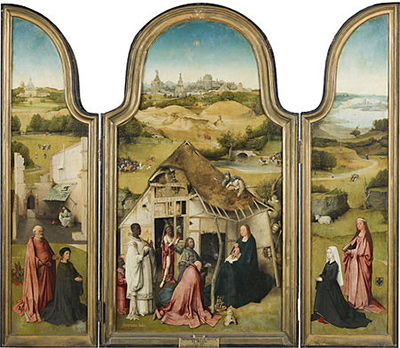
| Adoration of the Magi in Philadelphia | Early sixteenth century in the museum record; around 1495–1520 in the BRCP catalogue | Oil on oak panel · Hieronymus Bosch in the museum record; workshop of Bosch in the 2016 BRCP catalogue · Philadelphia Museum of Art, John G. Johnson Collection, 1917 · 1321; museum object 103592 Source 1. Source 2. |
| Adoration of the Magi — New York | c.1470–1480 | 2016 catalogue: Bosch; oil on oak · Metropolitan Museum 13.26 2016 catalogue. |
| Adoration of the Magi — Prado triptych | c.1494 | Oil on oak; grisaille exterior · Bosch · Prado P002048 Object source. |
| Adoration of the Magi — three associated fragments | c.1515–1535 | 2016 catalogue: Follower of Bosch · Two Shepherds / Retinue in Philadelphia; associated Adoration in private collection in 2016 2016 catalogue. |
| Ascent of the Blessed — Venice | c.1505–1515 | Oil on panel · Bosch · Gallerie dell’Accademia; Visions of the Hereafter Object source. |
| Battle of the Birds and Mammals | Not specified in catalogue heading | 2016 catalogue: Bosch; pen and brown ink · Berlin KdZ 14715 2016 catalogue. |
| Beggars and Musicians | Around 1530–1540 | Ink and wash on paper · Unknown follower of Hieronymus Bosch · Albertina, Vienna · 7798 Source 1. Source 2. |
| Christ Carrying the Cross Drawing | Around 1470 in the museum catalogue | Black chalk or charcoal, pen and brush in brown ink, white corrections · Anonymous, workshop of Rogier van der Weyden · Museum Boijmans Van Beuningen, Rotterdam · N 81 recto and verso (PK) Source 1. Source 2. |
| Christ Carrying the Cross in Vienna | Around 1490–1510 in the current KHM record and BRCP catalogue | Oil on oak, painted on both sides · Hieronymus Bosch; possible workshop involvement in the Passion side discussed by the BRCP · Kunsthistorisches Museum, Vienna · Gemäldegalerie, GG 6429 Source 1. Source 2. |
| Christ Carrying the Cross — El Escorial | c.1495–1505 | 2016 catalogue: Bosch; oil on oak · Patrimonio Nacional 10014739 2016 catalogue. |
| Christ Carrying the Cross — Ghent | c.1510–1516 (museum) | Oil on panel · Bosch in museum listing; authorship disputed · MSK Ghent 1902-H Object source. |
| Christ Mocked — London | c.1510 | Oil on wood · Bosch · National Gallery NG4744 Object source. |
| Concert in the Egg, After Hieronymus Bosch | Around 1561; third quarter of the sixteenth century | Oil on canvas · Anonymous, after Hieronymus Bosch · Palais des Beaux-Arts, Lille · P 816 Source 1. Source 2. |
| Conjurer / Comical Concert — Louvre drawing | Not specified in catalogue heading | 2016 catalogue: Bosch (recto), follower (concert verso) · Pen and brown ink · Louvre INV 19197 2016 catalogue. |
| Conjurer / Cross-bearing and beggars — Liège sheet | Not specified in catalogue heading | 2016 catalogue: Bosch (verso), follower (recto) · Pen and brown ink · Album d’Arenberg 534 2016 catalogue. |
| Crowning with Thorns — El Escorial | c.1530–1540 | 2016 catalogue: Follower of Bosch; oil on oak · Patrimonio Nacional 10014743 2016 catalogue. |
| Crucifixion with a Donor | Circa 1495–1505; Circa 1490–1500 | Oil on oak panel · Hieronymus Bosch · Royal Museums of Fine Arts of Belgium, Brussels · 6639 Source 1. Source 2. |
| Death and the Miser Drawing | Not securely established; probably made after the painting | Pen and brush, dark ink and white highlights on prepared paper · Workshop of Hieronymus Bosch in the BRCP catalogue; alternatives recorded by the Louvre · Musée du Louvre, Department of Prints and Drawings, Paris · RF 6947, Recto Source 1. Source 2. |
| Death and the Miser — Washington | c.1485/1490 (NGA) | Oil on panel · Bosch · National Gallery of Art 1952.5.33 Object source. |
| Ecce Homo Triptych — Boston | c.1495–1500; wings c.1500/1503 | 2016 catalogue: Workshop of Bosch; oil on oak · Museum of Fine Arts Boston; several production phases 2016 catalogue. |
| Ecce Homo — Frankfurt | c.1490 | Mixed technique on oak · Bosch · Städel 1577 Object source. |
| Fall of the Damned — Venice | c.1505–1515 | 2016 catalogue: Bosch; oil on panel · Visions of the Hereafter · Venice 2016 catalogue. |
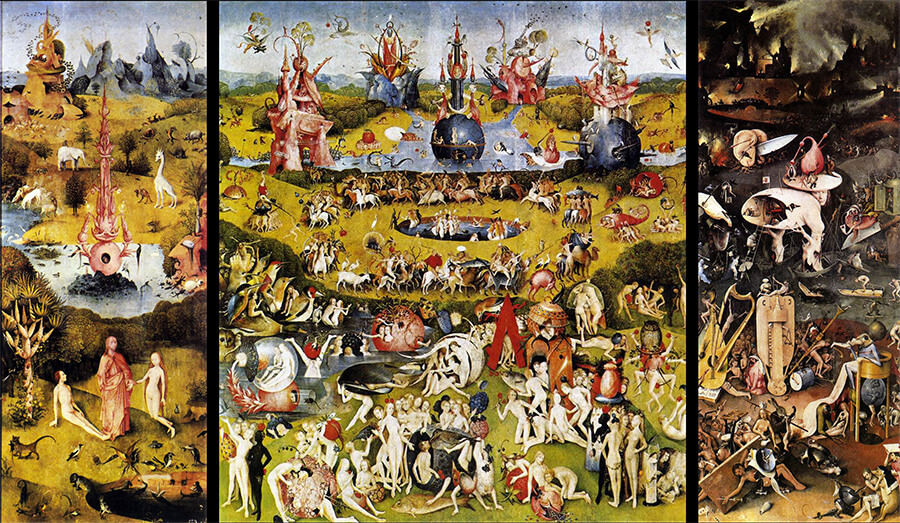
| Garden of Earthly Delights | 1490–1500 (Prado) | Oil on oak; grisaille exterior · Bosch · Prado; triptych Object source. |
| Gluttony and Lust / Allegory of Intemperance — Yale fragment | c.1500–1510 (group dating) | 2016 catalogue: Bosch; oil on oak · Yale 1959.15.22; fragment associated with Ship of Fools 2016 catalogue. |
| Group of Ten Spectators, a Follower of Bosch | Around 1510–1540 in the current museum record | Pen and two brown inks on paper, with a brown framing line · Follower of Hieronymus Bosch in the Morgan record; Bosch in the BRCP catalogue · Morgan Library & Museum, New York · I, 112 Source 1. Source 2. |
| Head of an Old Woman | About 1500 | Oil on panel · Attributed to Jacob Cornelisz. van Oostsanen · Museum Boijmans Van Beuningen, Rotterdam · 2439 (OK) Source 1. Source 2. |
| Hell and the Flood — Rotterdam panels | Around 1515 in the museum records; around 1510–1520 in the BRCP catalogue | Oil on oak panels · Jheronimus Bosch in the museum records; workshop of Bosch in the BRCP catalogue · Museum Boijmans Van Beuningen, Rotterdam Source 1. Source 2. |
| Hermit Saints Triptych | Circa 1495–1505 | Oil on oak panels · Hieronymus Bosch · Gallerie dell’Accademia, Venice · 2044 Source 1. Source 2. |
| Infernal Landscape | Not specified in catalogue heading | 2016 catalogue: Bosch; pen and brown ink, red accent · Private collection in 2016 2016 catalogue. |
| Infernal Scene with Anvil / Monster Studies | Not specified in catalogue heading | 2016 catalogue: Bosch; attribution debated in entry · Pen and brown ink · Berlin KdZ 548 2016 catalogue. |
| Infernal Scene with Tree-Man / Standing Man | Not specified in catalogue heading | 2016 catalogue: Workshop of Bosch; pen and brown ink · Dresden C 1875; historical reverse title includes a proposed prophet 2016 catalogue. |
| Job Triptych — Bruges | c.1510–1520 | 2016 catalogue: Workshop of Bosch; oil on oak · Groeningemuseum / Hoeke loan in 2016 2016 catalogue. |
| Last Judgement — Bruges triptych | c.1495–1505 | 2016 catalogue: Bosch; oil on oak · Groeningemuseum 2016 catalogue. |
| Last Judgement — Munich fragment | c.1530–1540 | 2016 catalogue: Follower of Bosch; oil on oak · Alte Pinakothek 5752 2016 catalogue. |
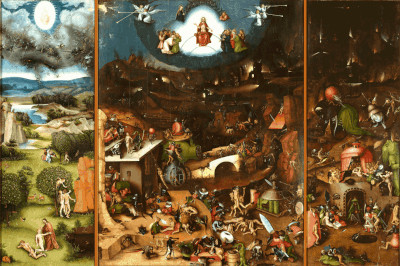
| Last Judgement — Vienna triptych | c.1500–1505 (BRCP 2016) | Oil on oak · Bosch and workshop (BRCP 2016) · Academy of Fine Arts Vienna 2016 catalogue. |
| Man in a Basket and Comic Figures | Around 1500–1515 in the museum record | Pen and brown ink on paper; the reverse is catalogued as iron-gall ink · Hieronymus Bosch in the current Albertina record; attribution has been debated · Albertina, Vienna · 7797 recto and verso Source 1. Source 2. |
| Man Seen from Behind | About 1550–1569; About 1565–1570 | Traces of black chalk, pen and brush in light brown ink · Anonymous, circle of Pieter Bruegel the Elder · Museum Boijmans Van Beuningen, Rotterdam Source 1. Source 2. |
| Mary and John at the Foot of the Cross | About 1440 | Brush in grey and black · Unknown, possibly Netherlandish · Kupferstich-Kabinett, Staatliche Kunstsammlungen Dresden · C 815 Source 1. Source 2. |
| Model Sheet with ‘Witches’ | Disputed; proposals depend on the attribution | Pen and brown ink; the BRCP also records underlying black chalk · Hieronymus Bosch; follower attributions also recorded · Musée du Louvre, Département des Arts graphiques, Paris · INV 19721 recto Source 1. Source 2. |
| Peasant and Three Bust-Length Figures | 1401–1500 | Brown pen over a black preliminary drawing · Attributed to the Master of the Drapery Studies; Bosch circle also recorded · Kupferstichkabinett, Staatliche Museen zu Berlin · KdZ 777 Source 1. Source 2. |
| River to Hell — Venice | c.1505–1515 | 2016 catalogue: Bosch; oil on panel · Visions of the Hereafter · Venice 2016 catalogue. |
| Saint Anthony and a Concert in an Egg | Around 1510–1525 in the museum’s 2016–17 exhibition texts | Pen in light and dark brown inks · Workshop of Hieronymus Bosch; underlying monsters: Bosch (BRCP), possibly Bosch (exhibition text) · Kupferstichkabinett, Staatliche Museen zu Berlin · KdZ 711 recto and verso Source 1. Source 2. |
| Saint Christopher Carrying the Christ Child | c.1500; 1490–1505 in restoration material | Oil on panel · Bosch · Boijmans St 26 Object source. |
| Saint James and Hermogenes | About 1551–1575 in the KIK-IRPA catalogue | Oil on wood, painted on both sides · Anonymous follower of Hieronymus Bosch · Musée des Beaux-Arts, Valenciennes · P.46.1.44; older number 176 Source 1. Source 2. |
| Saint Jerome at Prayer | Circa 1485–1495 | Oil on oak panel · Hieronymus Bosch · Museum of Fine Arts, Ghent · 1908-H Source 1. Source 2. |
| Saint John on Patmos / Passion Scenes | c.1495–1505; estimates vary | Oil on oak · Bosch · Gemäldegalerie Berlin 1647A Object source. |
| Saint John the Baptist in Meditation | Late 15th century; c.1485–1510 (Prado exhibition) | Oil on panel · Bosch · Lázaro Galdiano 8155 Object source. |
| Saint Liberata Triptych | Circa 1495–1505 | Oil on oak panels · Hieronymus Bosch · Gallerie dell’Accademia, Venice · 2045 Source 1. Source 2. |
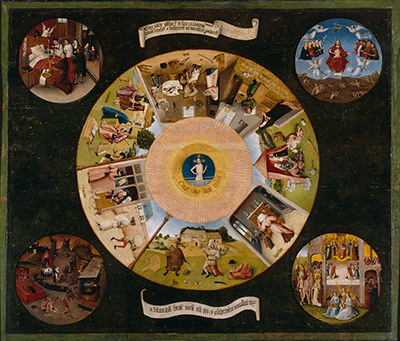
| Seven Deadly Sins and the Four Last Things | 1505–1510 (Prado) | Oil on poplar · Bosch (Prado); workshop/follower disputed · Prado Object source. |
| Ship of Fools — Louvre painting | 1475–1500 (record); c.1505–1515 (exhibition) | Oil on oak · Bosch · Louvre RF 2218; fragment Object source. |
| Ship of Fools — Louvre workshop drawing | Not specified in catalogue heading | 2016 catalogue: Workshop of Bosch · Pen, brush, grey-brown ink and white highlights on prepared paper · Louvre RF 3714 2016 catalogue. |
| Studies of Monsters | About 1530–1550, according to the current Ashmolean record | Pen and brown ink on laid paper, both faces · Anonymous follower of Hieronymus Bosch · Ashmolean Museum, University of Oxford · WA1863.155 Source 1. Source 2. |
| Studies of Saint Anthony and Monsters | No execution date specified in the current Louvre records | Pen and brown ink on paper · Bosch listed; reverse questioned by Louvre; BRCP accepts both faces · Musée du Louvre, Département des Arts graphiques, Paris · INV 20871 recto and verso Source 1. Source 2. |
| Temptation of Saint Anthony — Kansas City fragment | c.1500–1510 | 2016 catalogue: Bosch; oil on oak · Nelson-Atkins 35–22 2016 catalogue. |
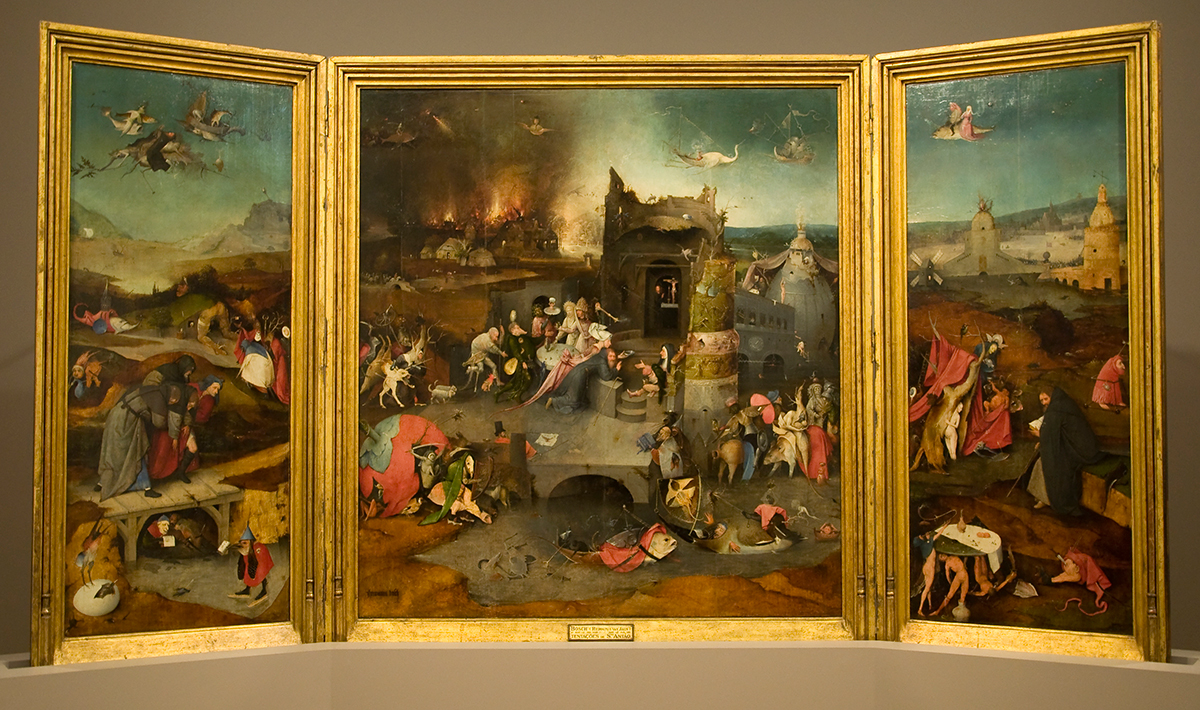
| Temptation of Saint Anthony — Lisbon triptych | c.1500 | Oil on oak · Bosch · Museu Nacional de Arte Antiga 1498 Pint Museum. |
| Temptation of Saint Anthony — Prado panel | c.1530–1540 | 2016 catalogue: Follower of Bosch (2016 opinion); oil on oak · Prado P002049 2016 catalogue. |
| Terrestrial Paradise | Approximately 1505–1515 | Oil on oak panel · Hieronymus Bosch · Gallerie dell'Accademia, Venice Source 1. Source 2. |
| The Burning Ship Drawing | 1500–1520 | Pen and iron gall ink on paper · Attributed to Hieronymus Bosch · Academy of Fine Arts Vienna, Graphic Collection · HZ-2554; numbered 2554 in the BRCP catalogue Source 1. Source 2. |
| The Comical Barber Scene | About 1550–1580, according to the British Museum | Pen and brown ink, grey and brown wash, over black chalk · Anonymous follower, after Hieronymus Bosch · British Museum, Department of Prints and Drawings, London · 1854,0628.46 Source 1. Source 2. |
| The Conjuror, After Hieronymus Bosch | Probably after 1525; around 1530–1540 in the BRCP technical report | Oil on oak panel · Anonymous follower of Hieronymus Bosch · Musée Ducastel-Vera, Saint-Germain-en-Laye · 872.1.87 Source 1. Source 2. |
| The Cure of Folly / Extraction of the Stone of Madness | 1501–1505 (Prado) | Oil on oak · Bosch (Prado); workshop/follower disputed · Prado P002056 Object source. |
| The Entombment Drawing | About 1505–1515, current museum record | Brush and black and grey ink, with grey wash, over black chalk · Workshop of Hieronymus Bosch; drawn by the Master of the Prado Haywain Triptych; Hieronymus Bosch, argued by the BRCP in 2016 · British Museum, Department of Prints and Drawings, London · 1952,0405.9 Source 1. Source 2. |
| The Gathering of the Birds | Not specified in catalogue heading | 2016 catalogue: Bosch; pen and brown ink · Berlin KdZ 13136 2016 catalogue. |
| The Haywain — Prado triptych | 1510–1516 (BRCP 2016) | Oil on oak · Bosch (BRCP 2016) · Prado; separate Escorial version exists 2016 catalogue. |
| The Hearing Forest and the Seeing Field | Circa 1500–1505 | Pen and brown ink on paper · Hieronymus Bosch; reverse: Bosch and workshop · Kupferstichkabinett, Staatliche Museen zu Berlin · KdZ 549, front and reverse Source 1. Source 2. |
| The Owl’s Nest — Rotterdam | Not specified in catalogue heading | 2016 catalogue: Bosch; pen and brown ink · Boijmans N 175 2016 catalogue. |
| The Passion Triptych in Valencia | Workshop of Bosch, about 1510–1520; Follower of Bosch; centre about 1530–1540, wings about 1540–1550 | Oil and gold on oak panels · Workshop of Bosch, about 1510–1520; Follower of Bosch; centre about 1530–1540, wings about 1540–1550 · Museu de Belles Arts de València Source 1. Source 2. |
| The Pedlar / Wayfarer — Rotterdam | c.1500 (museum) | Oil on panel · Bosch · Boijmans 1079 (OK); rejoined exterior Object source. |
| The Tree-Man — Vienna drawing | c.1505 | Pen and brown ink · Bosch · Albertina, Vienna Object source. |
| The Wedding at Cana, After Hieronymus Bosch | Approximately 1560 in the current museum record | Oil on panel, 93 cm high × 72 cm wide · Anonymous, after Hieronymus Bosch · Museum Boijmans Van Beuningen, Rotterdam, St 25 Source 1. Source 2. |
| Two Fantastical Creatures — Berlin KdZ 550 | Around 1505–1515 in the museum’s 2016 exhibition text | Pen in brown ink on reddish prepared laid paper · Hieronymus Bosch · Kupferstichkabinett, Staatliche Museen zu Berlin · KdZ 550, recto and verso Source 1. Source 2. |
| Two Figures Wearing Mitres | About 1480 | Oil on panel · Anonymous (Boijmans); Bosch circle (RKD) · Museum Boijmans Van Beuningen, Rotterdam · 1177 (OK) Source 1. Source 2. |
| Two Men and the Temptation of Eve | About 1505–1515 in the Prado’s 2016 exhibition guide | Pen and grey-brown ink on paper · Hieronymus Bosch in the 2016 catalogues discussed here · Private collection, as recorded in 2016 Source 1. Source 2. |
| Two Men Fighting | Not specified in the current Louvre record | Pen and brown ink · In the manner of Hieronymus Bosch · Musée du Louvre, Département des Arts graphiques, Paris · INV 20660 recto; formerly NIII 8896 and MA 8400 Source 1. Source 2. |
| Two Men — Berlin KdZ 5210 | Not specified in catalogue heading | 2016 catalogue: Bosch questioned · Pen, brush, ink, chalk and white highlights · Berlin KdZ 5210; historical title Two Oriental Men 2016 catalogue. |
| Two Monsters — Berlin KdZ 547 | Approximately 1500–1510 in Berlin's 2016 exhibition catalogue; an estimated range | Pen and brown ink on paper · Hieronymus Bosch · Kupferstichkabinett, Staatliche Museen zu Berlin · KdZ 547, drawn on both sides Source 1. Source 2. |
Frequently Asked Questions
Museum Boijmans Van Beuningen currently titles the painting The Pedlar, while confirming that it is also known as The Wayfarer [1]. "Pedlar" stresses the travelling seller; "Wayfarer" stresses the broader journey of life.
The painting is in the collection of Museum Boijmans Van Beuningen in Rotterdam. The museum records it as oil on panel, circa 1500, accession number 1079 (OK) [1].
Yes. Boijmans states that the painting was assembled from the outside wings of a triptych. The surviving inner fragments are connected with The Ship of Fools in the Louvre, An Allegory of Intemperance at Yale, and Death and the Miser in Washington [1].
The central panel is unknown. Boijmans records that some scholars have proposed specific subjects, including a Marriage at Cana, but also notes museum caution about that identification [1]. The safest conclusion is that the surviving fragments point to a moral programme, while the lost centre cannot be named with certainty.
Boijmans describes the figure as a vagabond or pedlar who symbolises man on the path through life, a kind of Everyman or homo viator weighed down by earthly baggage and surrounded by temptations [1]. The painting keeps that symbolism tied to a concrete figure with real objects, fatigue and danger.
Discussion
Follow the traveller’s route and glance, keeping the different titles in view.
Reader Insights
How does the traveller’s backward glance affect his apparent direction?
Compare the burden on his back with the objects along the road.
How do the titles Pedlar and Wayfarer change your first impression?
Join the Conversation
Share a detail, comparison or question about The Wayfarer below.
References
- Museum Boijmans Van Beuningen, The Pedlar, Jheronimus Bosch: View source
- Musee du Louvre, La Nef des fous, RF 2218: View source
- Yale University Art Gallery, An Allegory of Intemperance, Hieronymus Bosch: View source
- BRCP Catalogue Raisonné (2016), object dates in catalogues 1, 2, 8, 15 and 20; catalogue 20 object metadata only for the Haywain comparison. View source
- Staatliche Museen zu Berlin, 2016 exhibition wall texts, p. 3: approximate date of KdZ 549. View source
- Museo Nacional del Prado, The Haywain Triptych, Hieronymus Bosch: View source
- Closer to Bosch, Bosch Research and Conservation Project high-resolution corpus and technical research presentation: View source
- National Gallery of Art, Washington, Death and the Miser: View source
- Matthijs Ilsink, Jos Koldeweij, Ron Spronk, Luuk Hoogstede, Robert G. Erdmann, Rik Klein Gotink, Hanneke Nap and Daan Veldhuizen, Hieronymus Bosch, Painter and Draughtsman: Catalogue Raisonne, Yale University Press, 2016: View source