 by Tom Gurney
Tom Gurney BSc (Hons) is an art history expert with over 20 years experience
Published on June 19, 2020 / Updated on November 4, 2026
Email: tomgurney1@gmail.com / Phone: +44 7429 011000
Christ Carrying the Cross by Hieronymus Bosch: Introduction
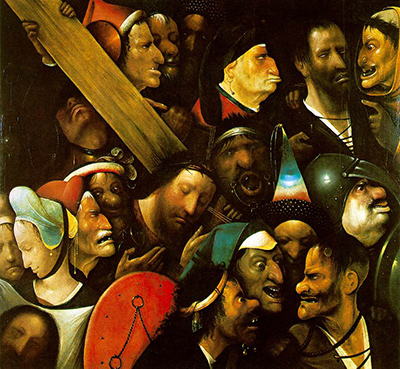
Christ Carrying the Cross in the Museum of Fine Arts Ghent is one of the most intense Passion images associated with Hieronymus Bosch. Instead of showing the long road to Calvary as an outdoor procession, the painting presses the event into a packed square of heads. Christ is hemmed in by tormentors, soldiers, the two thieves, Simon of Cyrene and Veronica, while the cross cuts across the picture like a heavy diagonal beam. The result is not a spacious narrative scene but a close encounter with faces, cruelty, devotion and moral pressure.
The museum records the work as Christ Carrying the Cross, by Jheronimus Bosch, circa 1510 to circa 1516, oil on panel, measuring 76.7 x 83.5 x 9 cm, inventory number 1902-H. It is in the collection of the Museum of Fine Arts Ghent and is recorded as on display; the same record marks the image as public domain and provides linked data and IIIF access. [1] The Flemish Art Collection gives the same object number, medium, date range, collection and public-domain image status. [2]
The authorship is more complicated than those object facts alone suggest. MSK and the Flemish Art Collection present the artist/maker as Jheronimus Bosch, yet the museum text also states that the attribution to Bosch remains disputed. [1] [2] That is the right way to approach the painting: neither stripping it of its force because of scholarly caution, nor treating the name "Bosch" as if it settled every question. The work belongs at the centre of any serious discussion of Boschian Passion imagery, but its label needs careful reading.
Contents
- Object Basics
- Attribution Note
- The Subject: Christ on the Road to Calvary
- A Painting Made of Heads
- Christ's Face
- The Grotesque and the Human
- Relation to Christ Mocked and Other Passion Images
- Devotion, Brotherhood and Moral Looking
- Why the Attribution Debate Matters
- How to Look at Christ Carrying the Cross
Object Basics
The painting is a relatively small panel, but it feels larger than its dimensions because almost every inch is occupied by a face, hand, helmet, cloth or section of the cross. The format is close to square. There is no distant landscape, no architectural stage, and no ordinary horizon to orient the viewer. The route to Calvary has been turned into a crush of figures pushed directly against the surface.
Compare these works across Bosch’s career
These date ranges are estimates, not a documented year-by-year sequence. These works provide context for the article; none is highlighted as the object discussed here.
Saint Jerome at Prayer
Circa 1485–1495 [3]Crucifixion with a Donor
Circa 1490–1500 (BRCP) [3]Hermit Saints Triptych
Circa 1495–1505 [3]Saint Liberata Triptych
Circa 1495–1505 [3]The Hearing Forest and the Seeing Field
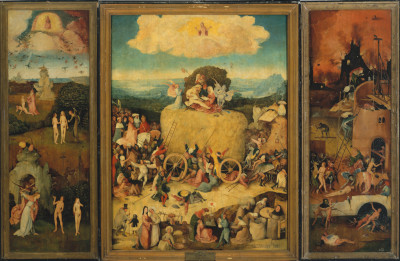
Circa 1500–1505 (Berlin exhibition) [4]The Haywain Triptych
1510–1516 (BRCP) [3]MSK's object record places the work around 1510 to 1516, the final years of Bosch's life if the traditional attribution and date are accepted. [1] The Flemish Art Collection similarly describes it as a late work associated with Bosch. [2] That late dating matters because the painting has often been read beside other concentrated Passion subjects from Bosch's orbit, especially Christ Mocked, also known as The Crowning with Thorns, in the National Gallery, London, and Ecce Homo in the Stadel Museum, Frankfurt. Those works also focus on Christ under public humiliation, surrounded by hostile or complicit humanity.
In ordinary Passion cycles, the Carrying of the Cross may appear as one episode among many: Christ is condemned, mocked, led out, nailed to the cross, crucified and mourned. Here, the episode is isolated and intensified. The panel does not ask the viewer to follow a sequence. It asks the viewer to stand inside a moment.
Attribution Note
MSK Gent and the Flemish Art Collection currently list the artist/maker as Jheronimus Bosch, while also acknowledging that the attribution to Bosch is disputed. [1] [2] The Bosch Research and Conservation Project has made such questions especially important because its research brought together technical imaging, conservation study, comparative analysis and new catalogue work across Bosch's paintings, drawings, workshop and followers. [5] [6] Closer to Bosch gives public digital corpus context for works by Bosch, his workshop and followers, including Christ Carrying the Cross among the object entries. [7] For readers, the safest wording is therefore: the Ghent painting is a major Bosch-associated Passion work, presented by its holding museum under Bosch's name, but with authorship still debated.
This caution does not weaken the painting. It clarifies what kind of evidence is being discussed. Bosch's art was copied, adapted and imitated soon after his death; his inventions became a visual language that other painters could use. A disputed attribution may mean that the work is by Bosch, partly connected with his workshop, after one of his inventions, or by a later artist working in a Boschian mode. Those distinctions matter because they affect how the painting is compared with Bosch's secure works, how its technique is understood, and how its date sits in relation to Bosch's death in 1516.
For the wider problem of Bosch, workshop, follower and after-Bosch labels, see the workshop and attribution guide. The Ghent painting is a useful test case because its current museum presentation and its stated uncertainty have to be held together.
The important point is not to force a yes-or-no answer too quickly. The painting's meaning, structure and power remain available to close looking. What changes is the claim made about the hand behind it.
The Subject: Christ on the Road to Calvary
The subject is the Carrying of the Cross, the moment after Christ has been condemned and before the Crucifixion. In the Gospel of John, Christ bears the cross and goes out to the place of execution; in the Synoptic Gospels, Simon of Cyrene is compelled to carry it. Late medieval art often combines these traditions, showing Christ with the cross while Simon assists. MSK's Iconclass tags identify the subject as Christ bearing the cross, alone or with help, and also record Simon of Cyrene, Veronica's veil, the crown of thorns, the two criminals and the moral contrast between good and bad behaviour. [1]
The painting includes more than the central figure of Christ. Simon of Cyrene appears at the upper left, pressed into the diagonal made by the cross. The so-called bad thief is at the lower right, while the penitent thief appears at the upper right. Veronica is at the lower left, holding the sudarium, the cloth bearing the imprint of Christ's face. [1] [2] These figures turn the painting into a compressed Passion meditation. It includes suffering, assistance, mockery, repentance and sacred image-making within a single crowded field.
Veronica's veil is especially important. It creates a second image of Christ inside the painting. The living Christ is near the centre, eyes closed or lowered, surrounded by noise. The face on the veil appears at the lower left, calmer and more frontal. The painting therefore stages a devotional contrast between the assaulted body and the holy image. The viewer sees Christ in the crush of violence and also sees the face preserved as an object of contemplation.
The thieves add another moral contrast. Their inclusion reminds the viewer that the road to Calvary leads toward the three crosses. The penitent thief and the bad thief are not simply supporting characters; they point toward judgment, mercy and refusal. In a Boschian context, that opposition matters. Bosch's art repeatedly returns to choices between salvation and folly, humility and pride, inward conversion and outward corruption. The Ghent painting compresses that moral field into human faces.
A Painting Made of Heads
The most startling feature of Christ Carrying the Cross is the crowd. The figures do not merely surround Christ; they almost replace space itself. MSK describes Christ's head as encircled by a dynamic group of grotesque "tronies", or faces, and notes that the picture abandons a normal sense of space. [1] The Flemish Art Collection's art-in-focus text similarly stresses that the picture plane is filled with heads and lacks ordinary spatial depth. [8]
That crowding is not accidental confusion. The museum text describes a rigid composition built on diagonals: one follows the beam of the cross from Simon of Cyrene at the upper left toward the bad thief at the lower right; the other links Veronica's veil at the lower left with the penitent thief at the upper right. Christ's head stands at the intersection. [1] [2] The painting may feel chaotic, but its chaos has been organised.
The effect is theatrical and devotional at once. The grotesque heads crowd forward like masks, each with a different expression of anger, stupidity, calculation, fanaticism or mockery. The viewer is not given a neutral place from which to watch. The faces come too close. The panel feels like a moral press, as though sin has become a crowd and that crowd has narrowed around Christ.
This is why the painting is often remembered as one of the most hallucinatory works connected with Bosch. MSK uses that language while acknowledging the disputed attribution. [1] The point is not that the image is dreamlike in a vague way. It is hallucinatory because ordinary religious narrative has been transformed into an overwhelming study of human expression. The road, the landscape and the public event disappear. What remains is proximity.
Christ's Face
At the centre of the painting, Christ's face is quiet. That quietness is not passive. It is the deepest pressure in the picture. Around him the other faces twist, grimace, leer, stare sideways or bare their teeth. Christ's features are softly modelled; his eyes are lowered or closed; his mouth is still. MSK contrasts this serenity with the grotesque heads around him and describes him as the suffering Christ, abandoned by all, who will triumph over evil. [1]
The contrast is the picture's devotional engine. The painting does not make Christ dominant through size or gesture. He is not shown standing above the crowd, raising a hand in blessing or commanding attention through movement. He is made dominant through stillness. The surrounding figures create noise; Christ absorbs it. The more the other faces deform themselves through hatred or foolishness, the more his calm becomes visible.
Veronica's veil doubles that calm. The imprint of Christ's face at the lower left is not merely a narrative detail. It offers a second centre of contemplation. The viewer's eye moves between the living face and the image on cloth: one assaulted, one preserved. In that movement, the painting asks what kind of looking is taking place. The tormentors look at Christ in order to mock, accuse or control him. Veronica's image asks the viewer to look with devotion.
This distinction is central to late medieval Passion art. Such images were not only illustrations of biblical history. They were aids to meditation. A viewer might imagine the suffering of Christ, measure human cruelty against divine patience, and consider his or her own position among the crowd. Bosch's broader world is filled with spectators who fail to see clearly. In the Ghent painting, seeing becomes the moral test.
The Grotesque and the Human
The faces around Christ have often been called grotesque, caricatural or masklike. MSK connects them with masks used in Passion plays and with the tradition of exaggerated facial types. [1] The Flemish Art Collection calls them both caricatured and lifelike, a useful tension because the painting works by keeping the crowd recognisably human even as it pushes expression toward distortion. [8]
That tension is one reason caution around authorship matters. Bosch's secure works often combine minute observation with invention, but it does not follow that every grotesque head is Bosch's own. By the sixteenth century, Boschian distortion could itself become a style. Later painters and followers could imitate the demons, fools, masks and grimacing types that viewers associated with Bosch. The Ghent painting's intensity is undeniable; the question is how closely its handling, underdrawing, structure and expressive language belong to Bosch's own practice.
The faces also need careful historical reading. Modern viewers may be tempted to treat them as pure fantasy or psychological portraiture. The painting is more specific than that. It belongs to a Passion tradition in which Christ's tormentors are often marked as morally ugly, socially alien, foolish, cruel or spiritually blind. Some details may also connect with late medieval theatrical culture, devotional performance and the visual language of moral opposition. That does not make the imagery comfortable. It asks the reader to recognise how sacred art could turn hostility, prejudice, satire and devotion into a single visual system.
In this painting, evil is not represented by monsters. It is represented by human faces.
Relation to Christ Mocked and Other Passion Images
The closest comparison within Bosch's Passion imagery is Christ Mocked (The Crowning with Thorns) in the National Gallery, London. The National Gallery dates that painting to about 1510 and identifies it as the only known painting of Christ mocked that can be attributed to Bosch. [9] Like the Ghent panel, it brings the viewer very close to Christ and his tormentors. It also compresses several moments of humiliation into a half-length devotional image rather than spreading the story across a larger narrative setting.
The London painting, however, differs sharply in mood. The National Gallery describes Christ staring calmly out from the centre while four tormentors close in around him. Technical study shows that Bosch toned down some of the violence from the underdrawing, making the final expressions more ambiguous. [9] That ambiguity is crucial. In London, the tormentors can seem cruel, anxious, intent or uncertain. In Ghent, the crowd is more extreme. The faces press harder into caricature. The world around Christ seems less psychologically ambiguous and more brutally divided.
This difference is part of the attribution discussion. If Christ Carrying the Cross is compared with the London Christ Mocked, the comparison can support both fascination and doubt. Both paintings concentrate Passion suffering into close faces. Both make Christ's calm the still point within aggression. Yet their handling of space, expression and moral contrast is not identical. A careful reader does not need to choose between admiration and caution. The paintings can be read together precisely because their similarities and differences are meaningful.
Ecce Homo in Frankfurt adds another Passion comparison. The Stadel Museum identifies that work as by Hieronymus Bosch, circa 1490, and records that donor figures once appeared in the lower corners before later damage and overpainting altered the image. An X-ray examination in 1983 revealed that a donor family had been painted in the foreground and then covered. [10] That history shows how Passion imagery could be tied to prayer, patronage and later alteration. A scene of Christ before the people was not just a dramatic episode; it was also a place where donors placed themselves in relation to suffering and salvation.
Seen beside London and Frankfurt, the Ghent painting looks like the most claustrophobic of the group. Ecce Homo sets Christ before a city crowd and donor prayer. Christ Mocked narrows the humiliation to a small group around Christ's body. Christ Carrying the Cross pushes the pressure even further, until nearly everything becomes face, beam, cloth and moral confrontation.
Devotion, Brotherhood and Moral Looking
MSK connects the painting's representation with the ideas of lay brotherhoods and notes that Bosch himself belonged to such a confraternity. [1] Prado's Bosch biography gives the documentary basis for Bosch's membership in the Brotherhood of Our Lady in 's-Hertogenbosch: he was admitted as an ordinary member in 1486/87 and became a sworn member the following year. [11]
That context does not explain the painting in a simple one-to-one way, especially while authorship is debated. It does, however, help explain why Passion imagery mattered in Bosch's world. Lay devotion encouraged meditation on Christ's suffering, moral self-examination, prayer and the imitation of Christ. A painting like Christ Carrying the Cross turns those practices into looking. The viewer is brought close to Christ, but also uncomfortably close to the faces that persecute him.
This is not a gentle devotional image. It does not offer a tranquil landscape or a distant sacred history. It asks whether the viewer can distinguish serenity from noise, compassion from spectacle, and sacred attention from hostile looking. Veronica becomes a model of right response: she preserves Christ's face. The tormentors become warnings: they look without seeing.
That moral structure fits Bosch's wider art. The paintings associated with him repeatedly oppose wisdom and folly, discipline and appetite, salvation and damnation. The style and technique of those works often depends on extreme density: the viewer must sort a crowded image, discover hidden relationships, and recognise that the surface is not the whole meaning. In Christ Carrying the Cross, that density is no longer spread across a landscape or triptych. It is concentrated in a ring of heads.
Why the Attribution Debate Matters
Attribution matters because Bosch's name is powerful. Once a painting is called Bosch, viewers may read every grotesque face as direct evidence of his imagination. If the work is instead by a follower, workshop artist or later Boschian painter, it still matters, but it tells a different story: the story of Bosch's influence, the spread of his inventions, and the demand for images that felt morally and visually Boschian.
The BRCP's work is central here because it treats the Bosch corpus as a material and comparative problem. The project set out to examine Bosch's paintings and drawings with standardised methods, including macrophotography, infrared work, infrared reflectography and close conservation study, and to bring the results together in books and digital access for scholars and the public. [5] Yale University Press describes the resulting catalogue raisonne as the product of six years of research into Bosch's iconography, technique, conservation history and life. [6]
For the Ghent painting, the public record therefore needs two truths at once. First, MSK and the Flemish Art Collection identify the maker as Jheronimus Bosch and preserve the work as a key painting in the Bosch field. [1] [2] Second, the attribution is not settled, and responsible discussion needs to say so clearly. [1] This is not a museum quarrel to be dramatised. It is an ordinary consequence of serious research into a small, famous and heavily imitated body of work.
The painting itself almost teaches that lesson. It is about looking rightly under pressure. The crowd offers too many faces, too much expression, too much certainty of accusation. Christ and Veronica offer another kind of image: quiet, difficult, inward, demanding patience. A careful attribution does something similar. It slows down the rush to claim. It lets the painting remain powerful without making the evidence say more than it can.
How to Look at Christ Carrying the Cross
Begin with the diagonals. Follow the cross from the upper left toward the lower right, then follow the opposing diagonal from Veronica's veil toward the upper right. Notice how Christ's face sits where those lines meet. The composition is not random crowding; it is a structure of pressure.
Then look at the pairs. Christ and Veronica are the calmest faces. The two thieves point toward the Crucifixion and the moral division to come. Simon of Cyrene introduces the theme of burden-bearing. The tormentors create a counter-image of human corruption. These contrasts make the painting readable even when the surface feels overwhelming.
Look also at the absence of landscape. Bosch's most famous works, such as The Garden of Earthly Delights and The Haywain Triptych, unfold across worlds. This painting removes the world. No road opens ahead. No city recedes behind. The viewer is trapped with the crowd. That confinement is the painting's power.
Finally, keep the attribution in view without letting it consume the experience. The painting is a major Passion image in Bosch's orbit, held by MSK Gent and presented in current museum records under Bosch's name, but with disputed authorship acknowledged. It rewards close looking whether one approaches it as Bosch, Bosch-associated, or part of the wider Boschian visual tradition. Its real subject is not only Christ's journey to Calvary. It is the human face under moral strain.
Artworks and related attributions
Browse paintings, drawings and related attributions. Records group triptychs, fragments and two-sided sheets where appropriate. Dates follow the cited museum records or catalogue headings and are generally estimates. Rows marked “2016 catalogue” report that publication’s attribution and collection information; these are dated opinions, rather than a claim that every work is an accepted autograph Bosch.
| Name | Date | Medium, attribution and collection |
|---|---|---|
| A Crossbowman | Second half of the sixteenth century | Oil on oak panel · Copy after Hieronymus Bosch · Museo Nacional del Prado, Madrid · P002695 Source 1. Source 2. |
| A Woman Spinning and an Old Woman | Museum estimates: about 1480–1490 for the women and 1500–1505 for the reverse; the precise chronology is disputed | Pen and brown and grey ink on the front; pen and brown ink on the reverse · Hieronymus Bosch · Museum Boijmans Van Beuningen, Rotterdam · N 190 recto and verso (PK) Source 1. Source 2. |
| Adoration of the Child in Cologne | Second half of the sixteenth century | Oil on oak panel · Imitator of Hieronymus Bosch, in the city collection record · Wallraf-Richartz-Museum & Fondation Corboud, Cologne · WRM 0474 Source 1. Source 2. |
| Adoration of the Magi in Philadelphia | Early sixteenth century in the museum record; around 1495–1520 in the BRCP catalogue | Oil on oak panel · Hieronymus Bosch in the museum record; workshop of Bosch in the 2016 BRCP catalogue · Philadelphia Museum of Art, John G. Johnson Collection, 1917 · 1321; museum object 103592 Source 1. Source 2. |
| Adoration of the Magi — New York | c.1470–1480 | 2016 catalogue: Bosch; oil on oak · Metropolitan Museum 13.26 2016 catalogue. |
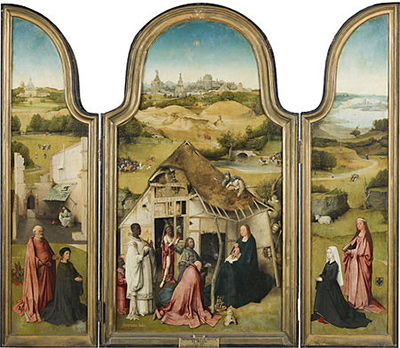
| Adoration of the Magi — Prado triptych | c.1494 | Oil on oak; grisaille exterior · Bosch · Prado P002048 Object source. |
| Adoration of the Magi — three associated fragments | c.1515–1535 | 2016 catalogue: Follower of Bosch · Two Shepherds / Retinue in Philadelphia; associated Adoration in private collection in 2016 2016 catalogue. |
| Ascent of the Blessed — Venice | c.1505–1515 | Oil on panel · Bosch · Gallerie dell’Accademia; Visions of the Hereafter Object source. |
| Battle of the Birds and Mammals | Not specified in catalogue heading | 2016 catalogue: Bosch; pen and brown ink · Berlin KdZ 14715 2016 catalogue. |
| Beggars and Musicians | Around 1530–1540 | Ink and wash on paper · Unknown follower of Hieronymus Bosch · Albertina, Vienna · 7798 Source 1. Source 2. |
| Christ Carrying the Cross Drawing | Around 1470 in the museum catalogue | Black chalk or charcoal, pen and brush in brown ink, white corrections · Anonymous, workshop of Rogier van der Weyden · Museum Boijmans Van Beuningen, Rotterdam · N 81 recto and verso (PK) Source 1. Source 2. |
| Christ Carrying the Cross in Vienna | Around 1490–1510 in the current KHM record and BRCP catalogue | Oil on oak, painted on both sides · Hieronymus Bosch; possible workshop involvement in the Passion side discussed by the BRCP · Kunsthistorisches Museum, Vienna · Gemäldegalerie, GG 6429 Source 1. Source 2. |
| Christ Carrying the Cross — El Escorial | c.1495–1505 | 2016 catalogue: Bosch; oil on oak · Patrimonio Nacional 10014739 2016 catalogue. |
| Christ Carrying the Cross — Ghent | c.1510–1516 (museum) | Oil on panel · Bosch in museum listing; authorship disputed · MSK Ghent 1902-H Object source. |
| Christ Mocked — London | c.1510 | Oil on wood · Bosch · National Gallery NG4744 Object source. |
| Concert in the Egg, After Hieronymus Bosch | Around 1561; third quarter of the sixteenth century | Oil on canvas · Anonymous, after Hieronymus Bosch · Palais des Beaux-Arts, Lille · P 816 Source 1. Source 2. |
| Conjurer / Comical Concert — Louvre drawing | Not specified in catalogue heading | 2016 catalogue: Bosch (recto), follower (concert verso) · Pen and brown ink · Louvre INV 19197 2016 catalogue. |
| Conjurer / Cross-bearing and beggars — Liège sheet | Not specified in catalogue heading | 2016 catalogue: Bosch (verso), follower (recto) · Pen and brown ink · Album d’Arenberg 534 2016 catalogue. |
| Crowning with Thorns — El Escorial | c.1530–1540 | 2016 catalogue: Follower of Bosch; oil on oak · Patrimonio Nacional 10014743 2016 catalogue. |
| Crucifixion with a Donor | Circa 1495–1505; Circa 1490–1500 | Oil on oak panel · Hieronymus Bosch · Royal Museums of Fine Arts of Belgium, Brussels · 6639 Source 1. Source 2. |
| Death and the Miser Drawing | Not securely established; probably made after the painting | Pen and brush, dark ink and white highlights on prepared paper · Workshop of Hieronymus Bosch in the BRCP catalogue; alternatives recorded by the Louvre · Musée du Louvre, Department of Prints and Drawings, Paris · RF 6947, Recto Source 1. Source 2. |
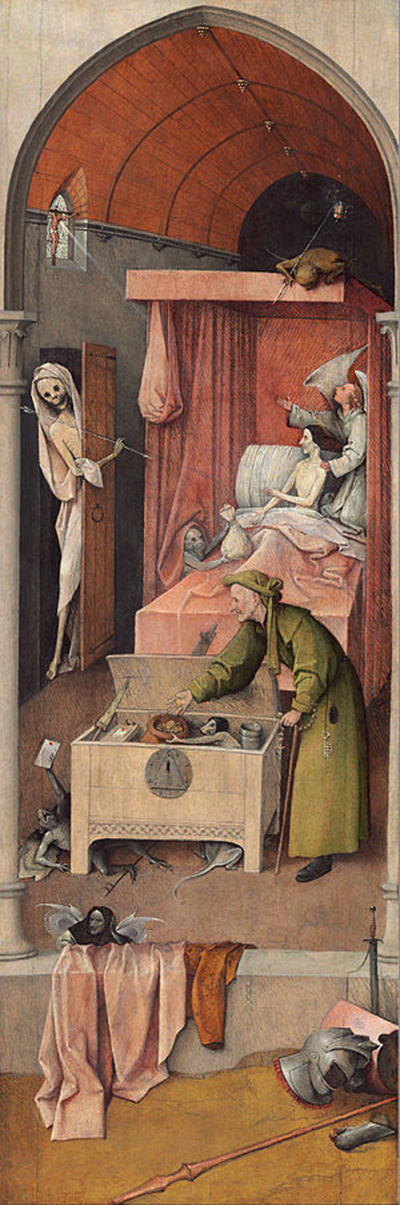
| Death and the Miser — Washington | c.1485/1490 (NGA) | Oil on panel · Bosch · National Gallery of Art 1952.5.33 Object source. |
| Ecce Homo Triptych — Boston | c.1495–1500; wings c.1500/1503 | 2016 catalogue: Workshop of Bosch; oil on oak · Museum of Fine Arts Boston; several production phases 2016 catalogue. |
| Ecce Homo — Frankfurt | c.1490 | Mixed technique on oak · Bosch · Städel 1577 Object source. |
| Fall of the Damned — Venice | c.1505–1515 | 2016 catalogue: Bosch; oil on panel · Visions of the Hereafter · Venice 2016 catalogue. |
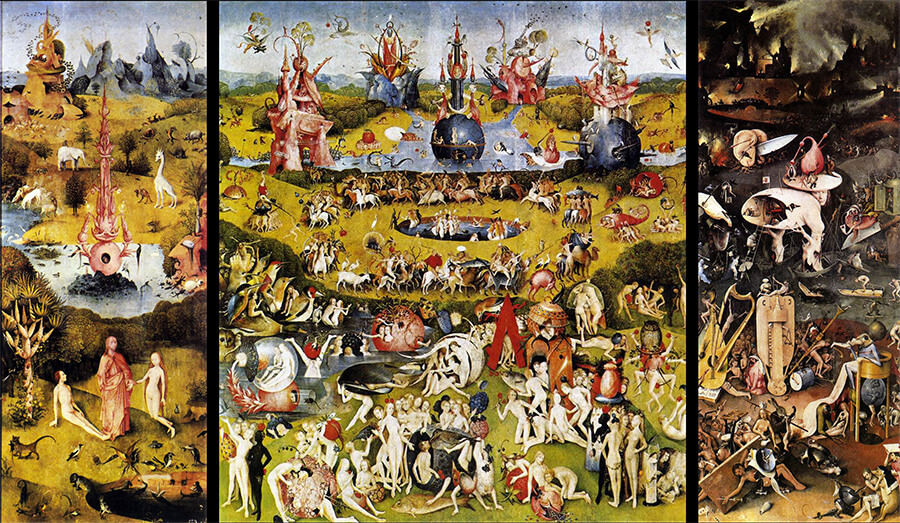
| Garden of Earthly Delights | 1490–1500 (Prado) | Oil on oak; grisaille exterior · Bosch · Prado; triptych Object source. |
| Gluttony and Lust / Allegory of Intemperance — Yale fragment | c.1500–1510 (group dating) | 2016 catalogue: Bosch; oil on oak · Yale 1959.15.22; fragment associated with Ship of Fools 2016 catalogue. |
| Group of Ten Spectators, a Follower of Bosch | Around 1510–1540 in the current museum record | Pen and two brown inks on paper, with a brown framing line · Follower of Hieronymus Bosch in the Morgan record; Bosch in the BRCP catalogue · Morgan Library & Museum, New York · I, 112 Source 1. Source 2. |
| Head of an Old Woman | About 1500 | Oil on panel · Attributed to Jacob Cornelisz. van Oostsanen · Museum Boijmans Van Beuningen, Rotterdam · 2439 (OK) Source 1. Source 2. |
| Hell and the Flood — Rotterdam panels | Around 1515 in the museum records; around 1510–1520 in the BRCP catalogue | Oil on oak panels · Jheronimus Bosch in the museum records; workshop of Bosch in the BRCP catalogue · Museum Boijmans Van Beuningen, Rotterdam Source 1. Source 2. |
| Hermit Saints Triptych | Circa 1495–1505 | Oil on oak panels · Hieronymus Bosch · Gallerie dell’Accademia, Venice · 2044 Source 1. Source 2. |
| Infernal Landscape | Not specified in catalogue heading | 2016 catalogue: Bosch; pen and brown ink, red accent · Private collection in 2016 2016 catalogue. |
| Infernal Scene with Anvil / Monster Studies | Not specified in catalogue heading | 2016 catalogue: Bosch; attribution debated in entry · Pen and brown ink · Berlin KdZ 548 2016 catalogue. |
| Infernal Scene with Tree-Man / Standing Man | Not specified in catalogue heading | 2016 catalogue: Workshop of Bosch; pen and brown ink · Dresden C 1875; historical reverse title includes a proposed prophet 2016 catalogue. |
| Job Triptych — Bruges | c.1510–1520 | 2016 catalogue: Workshop of Bosch; oil on oak · Groeningemuseum / Hoeke loan in 2016 2016 catalogue. |
| Last Judgement — Bruges triptych | c.1495–1505 | 2016 catalogue: Bosch; oil on oak · Groeningemuseum 2016 catalogue. |
| Last Judgement — Munich fragment | c.1530–1540 | 2016 catalogue: Follower of Bosch; oil on oak · Alte Pinakothek 5752 2016 catalogue. |
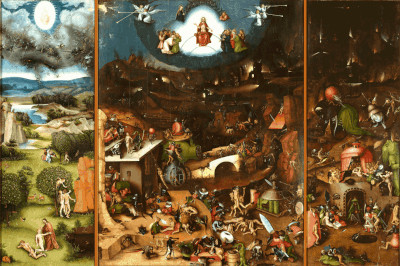
| Last Judgement — Vienna triptych | c.1500–1505 (BRCP 2016) | Oil on oak · Bosch and workshop (BRCP 2016) · Academy of Fine Arts Vienna 2016 catalogue. |
| Man in a Basket and Comic Figures | Around 1500–1515 in the museum record | Pen and brown ink on paper; the reverse is catalogued as iron-gall ink · Hieronymus Bosch in the current Albertina record; attribution has been debated · Albertina, Vienna · 7797 recto and verso Source 1. Source 2. |
| Man Seen from Behind | About 1550–1569; About 1565–1570 | Traces of black chalk, pen and brush in light brown ink · Anonymous, circle of Pieter Bruegel the Elder · Museum Boijmans Van Beuningen, Rotterdam Source 1. Source 2. |
| Mary and John at the Foot of the Cross | About 1440 | Brush in grey and black · Unknown, possibly Netherlandish · Kupferstich-Kabinett, Staatliche Kunstsammlungen Dresden · C 815 Source 1. Source 2. |
| Model Sheet with ‘Witches’ | Disputed; proposals depend on the attribution | Pen and brown ink; the BRCP also records underlying black chalk · Hieronymus Bosch; follower attributions also recorded · Musée du Louvre, Département des Arts graphiques, Paris · INV 19721 recto Source 1. Source 2. |
| Peasant and Three Bust-Length Figures | 1401–1500 | Brown pen over a black preliminary drawing · Attributed to the Master of the Drapery Studies; Bosch circle also recorded · Kupferstichkabinett, Staatliche Museen zu Berlin · KdZ 777 Source 1. Source 2. |
| River to Hell — Venice | c.1505–1515 | 2016 catalogue: Bosch; oil on panel · Visions of the Hereafter · Venice 2016 catalogue. |
| Saint Anthony and a Concert in an Egg | Around 1510–1525 in the museum’s 2016–17 exhibition texts | Pen in light and dark brown inks · Workshop of Hieronymus Bosch; underlying monsters: Bosch (BRCP), possibly Bosch (exhibition text) · Kupferstichkabinett, Staatliche Museen zu Berlin · KdZ 711 recto and verso Source 1. Source 2. |
| Saint Christopher Carrying the Christ Child | c.1500; 1490–1505 in restoration material | Oil on panel · Bosch · Boijmans St 26 Object source. |
| Saint James and Hermogenes | About 1551–1575 in the KIK-IRPA catalogue | Oil on wood, painted on both sides · Anonymous follower of Hieronymus Bosch · Musée des Beaux-Arts, Valenciennes · P.46.1.44; older number 176 Source 1. Source 2. |
| Saint Jerome at Prayer | Circa 1485–1495 | Oil on oak panel · Hieronymus Bosch · Museum of Fine Arts, Ghent · 1908-H Source 1. Source 2. |
| Saint John on Patmos / Passion Scenes | c.1495–1505; estimates vary | Oil on oak · Bosch · Gemäldegalerie Berlin 1647A Object source. |
| Saint John the Baptist in Meditation | Late 15th century; c.1485–1510 (Prado exhibition) | Oil on panel · Bosch · Lázaro Galdiano 8155 Object source. |
| Saint Liberata Triptych | Circa 1495–1505 | Oil on oak panels · Hieronymus Bosch · Gallerie dell’Accademia, Venice · 2045 Source 1. Source 2. |
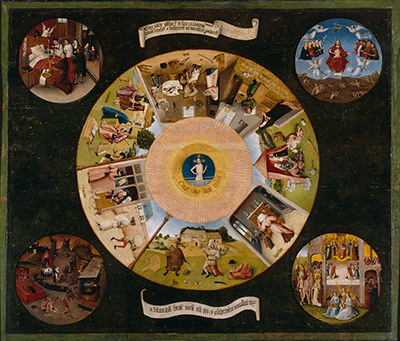
| Seven Deadly Sins and the Four Last Things | 1505–1510 (Prado) | Oil on poplar · Bosch (Prado); workshop/follower disputed · Prado Object source. |
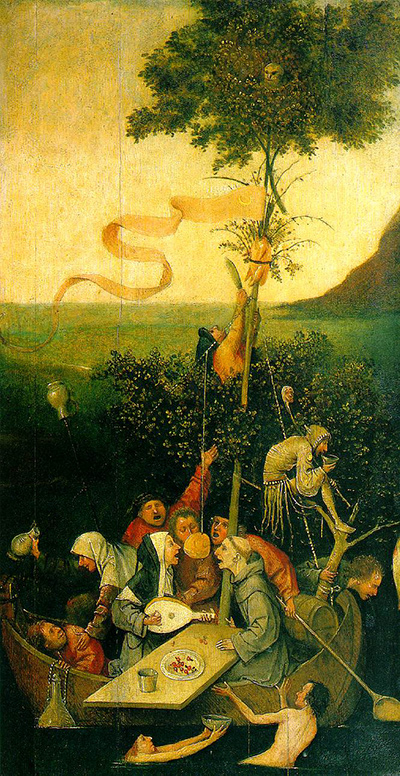
| Ship of Fools — Louvre painting | 1475–1500 (record); c.1505–1515 (exhibition) | Oil on oak · Bosch · Louvre RF 2218; fragment Object source. |
| Ship of Fools — Louvre workshop drawing | Not specified in catalogue heading | 2016 catalogue: Workshop of Bosch · Pen, brush, grey-brown ink and white highlights on prepared paper · Louvre RF 3714 2016 catalogue. |
| Studies of Monsters | About 1530–1550, according to the current Ashmolean record | Pen and brown ink on laid paper, both faces · Anonymous follower of Hieronymus Bosch · Ashmolean Museum, University of Oxford · WA1863.155 Source 1. Source 2. |
| Studies of Saint Anthony and Monsters | No execution date specified in the current Louvre records | Pen and brown ink on paper · Bosch listed; reverse questioned by Louvre; BRCP accepts both faces · Musée du Louvre, Département des Arts graphiques, Paris · INV 20871 recto and verso Source 1. Source 2. |
| Temptation of Saint Anthony — Kansas City fragment | c.1500–1510 | 2016 catalogue: Bosch; oil on oak · Nelson-Atkins 35–22 2016 catalogue. |
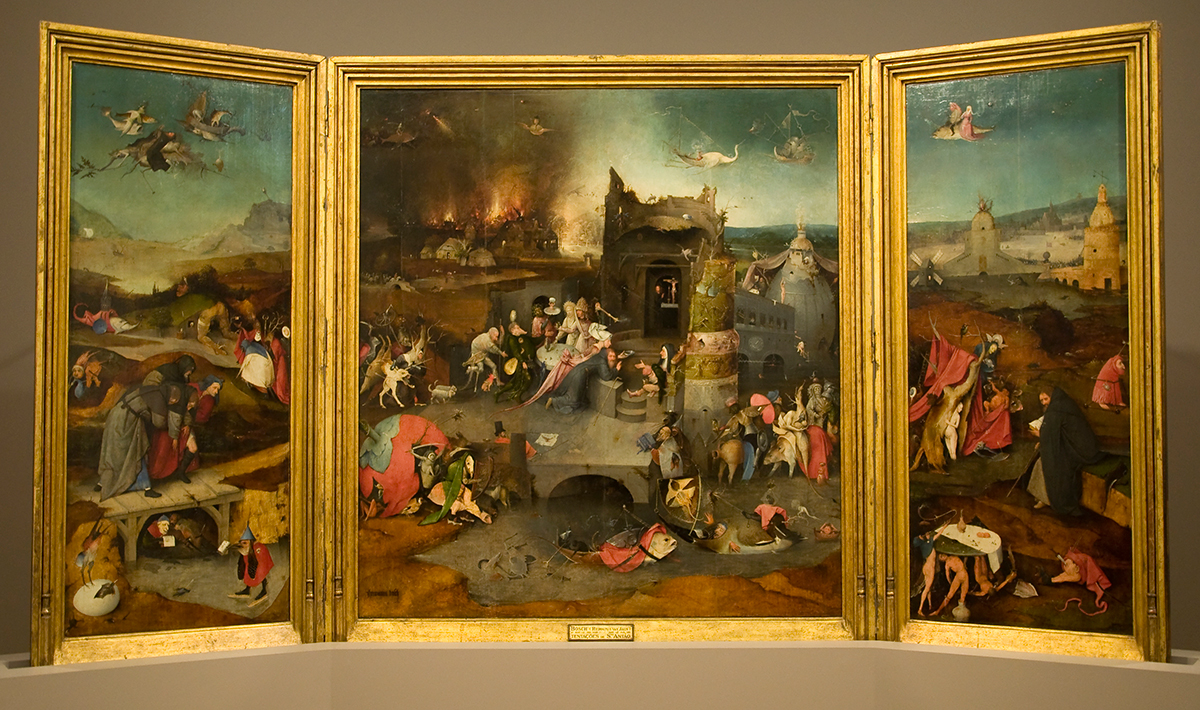
| Temptation of Saint Anthony — Lisbon triptych | c.1500 | Oil on oak · Bosch · Museu Nacional de Arte Antiga 1498 Pint Museum. |
| Temptation of Saint Anthony — Prado panel | c.1530–1540 | 2016 catalogue: Follower of Bosch (2016 opinion); oil on oak · Prado P002049 2016 catalogue. |
| Terrestrial Paradise | Approximately 1505–1515 | Oil on oak panel · Hieronymus Bosch · Gallerie dell'Accademia, Venice Source 1. Source 2. |
| The Burning Ship Drawing | 1500–1520 | Pen and iron gall ink on paper · Attributed to Hieronymus Bosch · Academy of Fine Arts Vienna, Graphic Collection · HZ-2554; numbered 2554 in the BRCP catalogue Source 1. Source 2. |
| The Comical Barber Scene | About 1550–1580, according to the British Museum | Pen and brown ink, grey and brown wash, over black chalk · Anonymous follower, after Hieronymus Bosch · British Museum, Department of Prints and Drawings, London · 1854,0628.46 Source 1. Source 2. |
| The Conjuror, After Hieronymus Bosch | Probably after 1525; around 1530–1540 in the BRCP technical report | Oil on oak panel · Anonymous follower of Hieronymus Bosch · Musée Ducastel-Vera, Saint-Germain-en-Laye · 872.1.87 Source 1. Source 2. |
| The Cure of Folly / Extraction of the Stone of Madness | 1501–1505 (Prado) | Oil on oak · Bosch (Prado); workshop/follower disputed · Prado P002056 Object source. |
| The Entombment Drawing | About 1505–1515, current museum record | Brush and black and grey ink, with grey wash, over black chalk · Workshop of Hieronymus Bosch; drawn by the Master of the Prado Haywain Triptych; Hieronymus Bosch, argued by the BRCP in 2016 · British Museum, Department of Prints and Drawings, London · 1952,0405.9 Source 1. Source 2. |
| The Gathering of the Birds | Not specified in catalogue heading | 2016 catalogue: Bosch; pen and brown ink · Berlin KdZ 13136 2016 catalogue. |
| The Haywain — Prado triptych | 1510–1516 (BRCP 2016) | Oil on oak · Bosch (BRCP 2016) · Prado; separate Escorial version exists 2016 catalogue. |
| The Hearing Forest and the Seeing Field | Circa 1500–1505 | Pen and brown ink on paper · Hieronymus Bosch; reverse: Bosch and workshop · Kupferstichkabinett, Staatliche Museen zu Berlin · KdZ 549, front and reverse Source 1. Source 2. |
| The Owl’s Nest — Rotterdam | Not specified in catalogue heading | 2016 catalogue: Bosch; pen and brown ink · Boijmans N 175 2016 catalogue. |
| The Passion Triptych in Valencia | Workshop of Bosch, about 1510–1520; Follower of Bosch; centre about 1530–1540, wings about 1540–1550 | Oil and gold on oak panels · Workshop of Bosch, about 1510–1520; Follower of Bosch; centre about 1530–1540, wings about 1540–1550 · Museu de Belles Arts de València Source 1. Source 2. |
| The Pedlar / Wayfarer — Rotterdam | c.1500 (museum) | Oil on panel · Bosch · Boijmans 1079 (OK); rejoined exterior Object source. |
| The Tree-Man — Vienna drawing | c.1505 | Pen and brown ink · Bosch · Albertina, Vienna Object source. |
| The Wedding at Cana, After Hieronymus Bosch | Approximately 1560 in the current museum record | Oil on panel, 93 cm high × 72 cm wide · Anonymous, after Hieronymus Bosch · Museum Boijmans Van Beuningen, Rotterdam, St 25 Source 1. Source 2. |
| Two Fantastical Creatures — Berlin KdZ 550 | Around 1505–1515 in the museum’s 2016 exhibition text | Pen in brown ink on reddish prepared laid paper · Hieronymus Bosch · Kupferstichkabinett, Staatliche Museen zu Berlin · KdZ 550, recto and verso Source 1. Source 2. |
| Two Figures Wearing Mitres | About 1480 | Oil on panel · Anonymous (Boijmans); Bosch circle (RKD) · Museum Boijmans Van Beuningen, Rotterdam · 1177 (OK) Source 1. Source 2. |
| Two Men and the Temptation of Eve | About 1505–1515 in the Prado’s 2016 exhibition guide | Pen and grey-brown ink on paper · Hieronymus Bosch in the 2016 catalogues discussed here · Private collection, as recorded in 2016 Source 1. Source 2. |
| Two Men Fighting | Not specified in the current Louvre record | Pen and brown ink · In the manner of Hieronymus Bosch · Musée du Louvre, Département des Arts graphiques, Paris · INV 20660 recto; formerly NIII 8896 and MA 8400 Source 1. Source 2. |
| Two Men — Berlin KdZ 5210 | Not specified in catalogue heading | 2016 catalogue: Bosch questioned · Pen, brush, ink, chalk and white highlights · Berlin KdZ 5210; historical title Two Oriental Men 2016 catalogue. |
| Two Monsters — Berlin KdZ 547 | Approximately 1500–1510 in Berlin's 2016 exhibition catalogue; an estimated range | Pen and brown ink on paper · Hieronymus Bosch · Kupferstichkabinett, Staatliche Museen zu Berlin · KdZ 547, drawn on both sides Source 1. Source 2. |
Frequently Asked Questions
This is the painting in the Museum of Fine Arts Ghent, inventory 1902-H. Its closely crowded heads distinguish it from the separate Vienna and El Escorial paintings.[1]
The museum lists Bosch while also acknowledging that the attribution remains disputed. The artist heading should therefore be read with the museum’s qualification.[1]
The museum records approximately 1510–1516. This is a catalogue date range, not a precise execution year.[1]
The museum records 76.7 × 83.5 cm for the painted panel’s height and width. The format brings the heads and Christ’s burden close to the viewer.[1]
Discussion
Compare Christ’s lowered face with the surrounding heads and gestures.
Reader Insights
How does the crowd leave space around Christ’s face?
Compare the directions of the surrounding eyes and mouths.
What changes in your reading when the attribution debate is kept open?
Join the Conversation
Share a detail, comparison or question about Christ Carrying the Cross below.
References
- Museum of Fine Arts Ghent, Christ Carrying the Cross: View source
- The Flemish Art Collection, Christ Carrying the Cross: View source
- BRCP Catalogue Raisonné (2016), object dates in catalogues 1, 2, 8, 15 and 20; catalogue 20 object metadata only for the Haywain comparison. View source
- Staatliche Museen zu Berlin, 2016 exhibition wall texts, p. 3: approximate date of KdZ 549. View source
- Bosch500, Bosch Research and Conservation Project (in Dutch): View source
- Yale University Press, Hieronymus Bosch, Painter and Draughtsman: Catalogue Raisonne: View source
- Closer to Bosch: View source
- The Flemish Art Collection, "Jheronimus Bosch, Bearing of the Cross, MSK Gent": View source
- The National Gallery, London, Christ Mocked (The Crowning with Thorns): View source
- Stadel Museum, Ecce Homo: View source
- Museo Nacional del Prado, Hieronymus Bosch artist biography: View source