 by Tom Gurney
Tom Gurney BSc (Hons) is an art history expert with over 20 years experience
Published on June 19, 2020 / Updated on November 4, 2026
Email: tomgurney1@gmail.com / Phone: +44 7429 011000
Christ Mocked (The Crowning with Thorns) by Hieronymus Bosch: Introduction
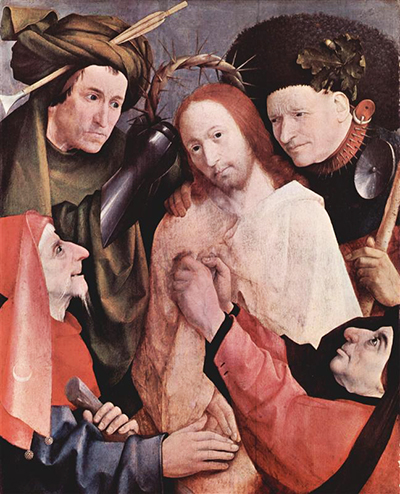
Hieronymus Bosch's Christ Mocked (The Crowning with Thorns) is one of the most concentrated Passion images in early Netherlandish painting. It is not a vast moral theatre like The Garden of Earthly Delights, nor a panelled journey through sin and punishment like The Haywain Triptych or The Last Judgement Triptych. It is a small, upright, half-length confrontation: Christ in the centre, four tormentors around him, a crown of thorns suspended at the instant before it is pressed down.
The painting belongs to the National Gallery, London, where it is catalogued as Christ Mocked (The Crowning with Thorns), about 1510, oil on wood, 73.8 by 59 cm, inventory number NG4744. The Gallery identifies the support as Baltic or Polish oak and records the work as bought in 1934. [1] Lorne Campbell's National Gallery catalogue entry gives the medium more precisely as oil on oak panel and treats the painting as a major Bosch autograph work, while also tracing its complicated attribution history and its relationship to later versions and pastiches. [2]
The familiar URL title, "crowned with thorns", points to one part of the episode. The National Gallery's title is more exact. Bosch has fused the Crowning with Thorns with the Mocking of Christ: the moment after Christ's condemnation, when humiliation, mock kingship, bodily assault and devotional witness all converge. [1] The painting is therefore not simply an illustration of torture. It is an image of derision staged with terrible stillness.
For a reader approaching Hieronymus Bosch through monsters and Hell scenes, this London painting may initially look restrained. That restraint is exactly what gives it force. Bosch compresses narrative, symbol, facial expression and technical experiment into a narrow space, then makes the viewer stand where there is almost no room left to stand.
Contents
- At a Glance
- The Subject: Mockery, Crown, and Condemnation
- Title and Naming
- A Small Painting Built Like a Trap
- Christ at the Centre
- The Four Tormentors
- Devotional Confrontation
- Underdrawing and Revision
- The Unfinished Saint Christopher Beneath
- Paint, Colour, and Surface
At a Glance
- ArtistHieronymus Bosch
- TitleChrist Mocked (The Crowning with Thorns)
- Dateabout 1510
- Mediumoil on wood, identified by the National Gallery as Baltic or Polish oak
- Dimensions73.8 x 59 cm
- CollectionNational Gallery, London
- Inventory numberNG4744
- SubjectChrist mocked and crowned with thorns before the Crucifixion
- Key technical finding infrared and X-radiographic evidence reveal an abandoned Saint Christopher composition beneath the painting and substantial changes between underdrawing and paint
Compare these works across Bosch’s career
These date ranges are estimates, not a documented year-by-year sequence. These works provide context for the article; none is highlighted as the object discussed here.
Saint Jerome at Prayer
Circa 1485–1495 [3]Crucifixion with a Donor
Circa 1490–1500 (BRCP) [3]Hermit Saints Triptych
Circa 1495–1505 [3]Saint Liberata Triptych
Circa 1495–1505 [3]The Hearing Forest and the Seeing Field
Circa 1500–1505 (Berlin exhibition) [4]The Haywain Triptych
1510–1516 (BRCP) [3]The Subject: Mockery, Crown, and Condemnation
The painting draws on the Passion narratives in the Gospels, especially the mock coronation of Christ by soldiers and the insults and blows described around his trials. The National Gallery notes that Bosch brings together the humiliation before Jewish authorities and the later Roman mockery after Christ's trial before Pontius Pilate. [1] Campbell's catalogue entry makes the same point in more technical iconographic terms: Bosch has not isolated one biblical verse, but has gathered several Gospel accounts into a single half-length invention. [2]
That compression matters. In a sequential Passion cycle, the viewer might move from arrest to trial to mockery to Crucifixion. Here Bosch offers no interval. Christ has already been dressed for mock kingship. The crown is ready. Hands enter from every side. The men around him are close enough to touch his hair, robe, shoulder and fingers. Their actions imply the episodes before and after this moment: derision, spitting, stripping, striking and the walk toward execution.
The composition does not show a public crowd. It gives us five heads and a few brutal props. The absence of a broad setting intensifies the devotional function of the image. There is no landscape to escape into, no architecture to measure, no distant bystander to soften the scene. Christ's face becomes the fixed centre of a tightly staged assault.
This makes the work very different from Bosch's wider triptychs. In the paintings that made his reputation, Bosch often builds moral meaning through accumulation: people, animals, objects, hybrid creatures, punishments and comic cruelties gather across large fields. In the London Christ Mocked, the field collapses inward. Bosch's invention lies in making a near-iconic close-up carry the weight of a Passion narrative.
Title and Naming
The painting is often described under variants such as Crowning with Thorns, Christ Crowned with Thorns or Christ Mocked. The National Gallery's title, Christ Mocked (The Crowning with Thorns), is helpful because it preserves both the devotional subject and the exact action being prepared. [1]
"The Crowning with Thorns" names the imminent physical act. "Christ Mocked" names the broader humiliation. In Bosch's image, the tormentors do not merely place a painful crown on Christ's head; they perform a parody of kingship. The white robe, the exposed hands, the mock homage of the lower figures and the soldiers' equipment all contribute to a scene of false ceremony.
The title also protects the painting from being read too narrowly as a single dramatic beat. The crown is not yet fully placed. The red-clad man at lower right appears to lift or tug Christ's robe. The figure at lower left touches Christ's fingers while holding a staff. The man in green raises the crown in an iron gauntlet. The upper-right figure places a hand on Christ's shoulder while holding another staff. The mockery is not one gesture but an orchestrated pressure from all four sides.
A Small Painting Built Like a Trap
The National Gallery emphasizes the unusual upright format of the work and the difficulty of imagining this subject as a half-length composition. [1] Campbell connects that half-length ambition with Netherlandish narrative precedents by Rogier van der Weyden and Hugo van der Goes, while arguing that Bosch transformed the format into something highly individual. [2]
The structure is severe. Christ sits at the centre but seems physically smaller than the surrounding men because their hats, shoulders and heads press outward toward the edges. Campbell observes that all five faces are on the same scale; the tormentors feel larger because of their breadth and elaborate headgear. [2] The effect is not natural space but moral compression.
The figures occupy three shallow planes. The two upper men stand farthest back, Christ is placed in front of them, and the two lower figures occupy the foreground. Yet Bosch deliberately complicates that order. The gauntlet that holds the crown appears close to Christ's hair, while the crown itself sits behind his head. The upper-right figure's hand rests on Christ's shoulder, but the paint evidence shows that this hand was introduced over other painted forms rather than reserved from the beginning. [2]
The result is a space that is both lucid and uneasy. The viewer can understand who surrounds Christ, but not settle comfortably into a measured room. The figures seem to lock together like pieces in a device. Their staves, sleeves, hands, crown, hats and shoulders create a pattern of diagonals and enclosing curves.
Campbell's close analysis shows how deliberate this design is. Christ's right eye lies on the central vertical axis, and the painting's geometry is organised around triangles, diagonals and repeated angles. [2] Those observations might sound dry until one looks again at the picture. The geometry does not cool the scene; it tightens it. Bosch gives violence a formal order, making the impending cruelty feel controlled rather than chaotic.
Christ at the Centre
Christ's gaze is the painting's moral hinge. The National Gallery describes him as calm, set against the brutality of the men around him. [1] That calm should not be inflated into a detailed psychological portrait. Bosch does not give us access to an inner monologue. He gives us a face that looks outward while every other face is turned inward.
The direction of looking is crucial. All four tormentors focus on Christ, but Christ looks past them toward the viewer. This creates a devotional confrontation. The spectator is not merely watching men mock Christ; the spectator is seen from within the mocked Christ's stillness.
His robe is white, and Campbell's technical account is especially important here. The robe was not once red or purple and then faded. The National Gallery's analysis found no trace of vanished red pigments in it. [1] Campbell argues that the white robe may connect with the Latin Vulgate wording of Luke 23:11 and also gives Christ tonal prominence against the coloured tormentors. [2]
In other Passion images, white can signal innocence, exposure or vulnerability. In Bosch's panel it does all three without becoming sentimental. Christ's pale garment is surrounded by greens, reds, purplish blues, black headgear, metal and wood. His body is visually exposed, but the painting gives him compositional authority. His face remains the fixed point around which everything else moves.
The crown itself deepens the paradox. It is an instrument of torture and the emblem of mock kingship, yet the National Gallery notes that it forms a halo-like shape. [1] Campbell observes that the thorns do not intrude aggressively across Christ's face; they remain tangent to his hair and contour. [2] Bosch turns the object of humiliation into a shape that almost sanctifies the head it is meant to wound.
The Four Tormentors
Bosch's four tormentors are not generic villains. Each is individually designed through costume, colour, gesture and attribute. The danger of overreading them is real, but the painting plainly asks for slow looking.
The upper-left man wears green and holds the crown in an iron gauntlet. The gauntlet is practical and cruelly ironic: it protects his hand from the thorns he is about to press onto Christ. His headgear includes a crossbow bolt. Campbell identifies this as a hunting arrow with a chisel-like tip, a type meant to disable an animal rather than kill it instantly. [2] The detail turns the Passion scene into an image of pursuit and helplessness.
The upper-right man wears a dark hat with oak leaves and an acorn, a spiked collar and a blue cape. The National Gallery interprets the collar as suggesting savagery and connects it with late medieval characterisations of Christ's tormentors through the language of dogs. [1] Campbell's catalogue is careful with the oak leaves, describing them as possibly associated with pagan ritual rather than assigning a single fixed meaning. [2] The tone of the figure is therefore not reducible to one symbol. He is both archaic and theatrical, courtly and menacing.
The lower-left man wears a red hood marked with a star, crescent and other pale signs. Campbell relates the star and crescent to the Orient, possibly the eastern Mediterranean or Palestine, while leaving the cross-like emblem unexplained. [2] His mouth hangs open. In the underdrawing, he raised a hand to his mouth, probably indicating spitting or shouting; in the painted version the gesture has been softened. [2]
The lower-right man, in red, appears to lift Christ's robe and expose his hands. Campbell notes his prominent buttonholes, rich costume and probable identification through facial type and clothing. [2] Modern readers should approach this kind of late medieval and early Netherlandish visual coding carefully. Bosch's painting belongs to a Christian Passion tradition that often assigned blame through hostile stereotypes. A responsible reading can describe those codes without endorsing them.
Together the four figures turn the scene into a map of threat: military force, ritual derision, mock homage, physical stripping, animal imagery, exoticising costume and the tense performance of accusation. The painting's seriousness lies partly in the fact that Bosch does not make them simply grotesque. Their faces are unsettling because they remain human.
Devotional Confrontation
The London painting belongs to a devotional culture in which close images of Christ's suffering invited meditation, self-examination and affective response. Bosch's biography is documentary rather than intimate, but his membership in the religious life of 's-Hertogenbosch and his repeated treatment of sin, temptation and judgement make this devotional context essential.
Unlike the panoramic inventions of Bosch's larger works, Christ Mocked offers a frontal encounter. The viewer is placed before Christ at the instant when mockery is about to become bodily injury. The tormentors form a frame, but Christ's face interrupts their frame by looking outward. This outward gaze prevents the viewer from remaining neutral.
The painting also resists a simple contrast between serene victim and monstrous enemies. The National Gallery notes that Bosch's revisions make the men's expressions open to different interpretations. [1] Campbell similarly leaves space for the observer to decide whether they are cruel or anxious. [2] That ambiguity is important. Bosch does not need to solve each face into a single emotion. He composes a moral pressure in which action, costume and gaze matter more than psychological certainty.
The crown of thorns is central to that pressure. It is too large to fit easily around Christ's head, and Campbell's microscopic description distinguishes different thorn forms and pigments, including a thorn embedded in Christ's scalp. [2] The crown is both object and sign: pain, false kingship, halo, enclosure.
In this sense, the painting is closely related to Bosch's wider moral art without needing demons or Hell. The subject is not infernal punishment but human cruelty enacted around divine patience. It belongs beside Ecce Homo and Christ Carrying the Cross as part of Bosch's Passion imagery, but it is more compressed and more formally balanced than the crowded Ghent picture traditionally associated with his name.
Underdrawing and Revision
The technical evidence is one of the reasons this painting rewards serious attention. Infrared reflectography and X-radiography reveal not only ordinary underdrawing but two superimposed designs: an abandoned Saint Christopher beneath and the later Christ Mocked drawn over it. [2]
The Christ Mocked underdrawing differs substantially from the final painted image. In the first design, Christ's hair fell more fully across his shoulders, his shoulders were narrower, and he wore a mantle fastened at the neck. His hands were lower, crossed nearer the lower edge. The upper-right tormentor originally grasped Christ's shoulder with one hand, while the staff he held had spikes that were not carried into the paint. The lower-right man clutched the edge of Christ's mantle more violently, as if to tear it off. The lower-left man raised a hand toward his mouth, probably to signal spitting or shouting. [2]
These changes are not trivial adjustments. They transform the emotional pitch of the work. The underdrawn scene was more aggressively physical. The finished painting remains threatening, but the violence is held at the threshold. The crown hovers. The robe is lifted. Hands touch, grasp and prepare. Bosch shifts from overt brutality to suspended menace.
The National Gallery draws attention to this toning down of violence and to the greater ambiguity produced by the changes. [1] That is a useful way to understand the painting's power. Bosch does not remove cruelty; he disciplines it through design. By restraining the most explicit gestures, he makes the scene harder to dismiss as mere spectacle.
This kind of revision also connects the painting to Bosch's broader style and technique. His works often reveal invention not as a single fixed plan but as a process of adjustment from drawing to paint. In Christ Mocked, the technical record shows a painter thinking through how much violence the image should show, and how much it should make the viewer anticipate.
The Unfinished Saint Christopher Beneath
One of the most remarkable facts about the painting is hidden below the surface. The first composition on the panel showed Saint Christopher carrying the Christ Child, who raises his hand in blessing. A light blue sky was already painted in the upper part of that earlier image. Bosch then abandoned the Saint Christopher and reused the panel for Christ Mocked. [2]
The National Gallery notes that this unfinished Saint Christopher is probably also by Bosch, although it differs in style and technique from the final painting above it. [1] Campbell gives a more detailed explanation: the underdrawn Saint Christopher is rapid and vigorous, while the later Christ Mocked underdrawing was applied over it without an intermediary layer. [2]
This discovery changes how the panel is understood. It is not simply a support with a finished Passion image on one side. It contains an abandoned devotional subject beneath another devotional subject. Saint Christopher carrying the Christ Child and Christ mocked by his tormentors are very different images, yet both turn on the relation between human contact and divine presence.
There is no need to romanticise the reuse. Panels were valuable, and unfinished works could be repurposed. But the technical evidence gives the painting an unusually dense history of making. The blue of the earlier sky even survives in small exposures and, according to Campbell, was incorporated in places into later effects such as highlights on green. [2]
The hidden Saint Christopher also reminds us that Bosch's surviving oeuvre is only a fraction of his activity. The visible painting belongs to the public canon; the buried painting belongs to the workshop reality of abandoned starts, reused materials and decisions changed midstream. For questions of workshop and attribution, such evidence is not incidental. It shows why technical research has become central to Bosch studies.
Paint, Colour, and Surface
Campbell's technical notes reveal a painting made with economy and precision. The medium is linseed oil. The flesh paint is often thin, while other passages are thicker and more tactile. Red and green glazes were blotted with textiles. In the armour and hat of the upper-right figure, wet paint was dragged or feathered with dry brushes. The catchlights in the eyes are built from small, careful strokes. [2]
The surface has changed over time. Red lake glazes have faded, some copper green glazes have turned brownish, and increasing transparency in thin paint layers allows underdrawing and pentimenti to appear more clearly, especially in Christ's robe. [2] These changes do not make the painting illegible, but they shape what modern viewers see. Some passages are more transparent than Bosch's first viewers would have known; some colour relationships have cooled or darkened.
The white robe is especially important. Its pale surface separates Christ from the surrounding reds, greens, blues and blacks. It also gives the technical evidence a visible stage: the thinness of the paint in light areas helps reveal the drawing below. The robe is therefore both a devotional sign and a material record.
Bosch's colour structure is controlled. Green in the upper-left figure is echoed by oak leaves in the upper-right hat. Reds and pinks dominate the lower zone. Blues appear in sleeve and cape. The crown ties the top of the composition together through grey-green, pink and red notes. [2] This is not the uncontrolled fantasy sometimes associated with Bosch. It is invention governed by colour, geometry and surface intelligence.
Attribution, Versions, and Bosch's Range
The current National Gallery attribution is to Hieronymus Bosch. [1] That status is important because Campbell notes that this is the only Crowning with Thorns now known that can be attributed to Bosch. [2] The claim does not mean that no other Boschian Crowning images exist. It means that the London painting occupies a special position among versions, copies and later compositions.
Its attribution history was not always straightforward. The painting was shown in 1882 as by "Holbein(?)" and sold in 1892 under a broader Early Flemish School label. Conway later treated it as an imitation of the Escorial Crowning with Thorns. Friedlander, in 1934 and 1937, recognised it as an original by Bosch, and that attribution was accepted by most later writers. [2]
Later technical and comparative work changed the relationship between London and Escorial. Campbell records that Klein and Verougstraete with Van Schoute demonstrated that the Escorial painting, once admired as Bosch, was instead a post-1516 imitation or pastiche based on the National Gallery work. Other versions in Antwerp, Bern, Philadelphia and elsewhere likewise depend on the London painting and the Escorial composition. [2]
That reversal is a useful lesson in Bosch attribution. The work that once looked derivative became the anchor; the more expansive or emphatic versions became afterimages. Bosch's authorship is not identified simply by weirdness, crowded grotesquerie or the quantity of invention. It is also visible in restraint, design, revision and the handling of paint.
Campbell strengthens the attribution by comparing Christ in the London painting with God the Father in the left wing of The Garden of Earthly Delights, noting similarities in flesh painting and in the quality of design and colour. [2] The broader Bosch Research and Conservation Project catalogue and technical volumes provide the modern comparative frame for this kind of attribution work across Bosch, workshop, follower and after-Bosch material. [5] [6] That comparison helps place Christ Mocked within Bosch's late style without making it dependent on a single motif.
The painting therefore expands the reader's idea of Bosch. He is not only the painter of demons, punishments and strange hybrid bodies. He is also a painter capable of a disciplined half-length Passion image in which the drama is carried by facial direction, hands, costume, geometry and the nearly unbearable pause before action.
Provenance and Collection History
The known modern provenance begins with the picture in the collection of Charles Magniac, exhibited at the Royal Academy in 1882. A contemporary review suggested it may have been bought in Spain and perhaps brought there from the Netherlands by Spanish or Portuguese patrons. The Magniac collection was sold at Christie's in July 1892, where the picture was bought by Robert Thompson Crawshay. By 1933 it belonged to the Galleria Sangiorgi in Rome and was exported to Switzerland during the winter of 1933-34. [2]
In 1934 the painting was inspected in Lucerne by Kenneth Clark and Max Friedlander before being sent to London for the National Gallery Trustees. The Gallery bought it that year from Galleria Sangiorgi. [2] The National Gallery object record gives the acquisition credit simply as "Bought, 1934." [1]
Campbell also records that the painting is included among works with incomplete provenance for the years 1933-45. [1] That note should remain visible in any responsible account of the object. It does not undo the painting's art-historical importance, but it marks a gap in the documentary record during a period when provenance questions carry special weight.
The possible Iberian thread in the painting's history has attracted attention because sixteenth-century records mention a Bosch Crowning with Thorns owned by Damiao de Gois and donated in 1560 to the parish church of Our Lady of Varzea at Alenquer, north of Lisbon. Campbell treats any identification with the National Gallery painting as tempting but uncertain, and adds that even if the London painting were that object, the association would not securely date it. [2]
Relation to Bosch's Other Passion Images
Bosch's Passion imagery is a more varied field than the London painting alone suggests. Ecce Homo presents Christ before the crowd; Christ Carrying the Cross belongs to a dense tradition of hostile faces and disputed attribution; Christ Mocked isolates a threshold moment before the Crucifixion. Each work asks different questions about spectatorship, guilt and devotional presence.
The London painting is especially valuable because it avoids the easy shorthand of "Bosch equals grotesque." There are no demons here, no infernal architecture, no comic instruments of punishment. The threat is made from ordinary bodies, clothes, tools and hands. Even the most symbolic details, such as the hunting arrow, spiked collar and crown, remain materially plausible objects.
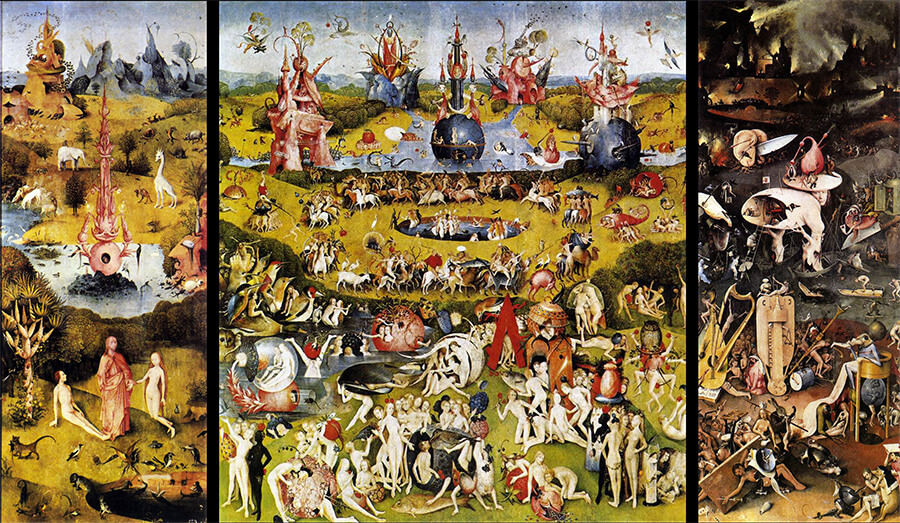
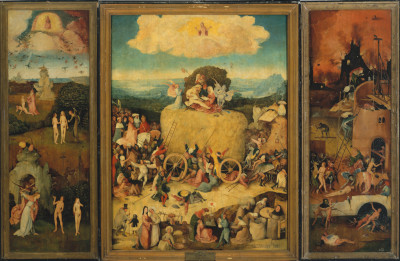
This restraint also connects the work to the larger Bosch cluster. In The Garden of Earthly Delights, Bosch turns desire and punishment into a vast visual system. In The Haywain Triptych, worldly folly moves toward Hell. In Christ Mocked, the moral crisis is concentrated into the viewer's encounter with one calm face surrounded by four urgent ones.
That makes the painting an essential bridge between Bosch's visionary reputation and his technical discipline. It shows that his art of moral confrontation could work at monumental scale or within a half-length panel scarcely more than half a metre wide.
Why the Painting Matters
Christ Mocked (The Crowning with Thorns) matters because it is small enough to seem immediate and complex enough to sustain prolonged looking. Its power comes from compression: Gospel episodes, devotional address, visual stereotypes, costume detail, material surface, underdrawing and hidden reuse all occupy one tight image.
It also matters for Bosch attribution. The National Gallery painting is not a marginal curiosity in a field of more dramatic Boschian Passion images. It is the secure point from which several later or derivative Crowning compositions have been reassessed. [2] Its importance lies partly in what it teaches about Bosch's range: disciplined, restrained, technically alert, and capable of making ambiguity more troubling than spectacle.
Above all, the painting matters as an image of looking. Four men look at Christ. Christ looks outward. The viewer looks back. Bosch makes that triangle of sight carry the painting's theological and human tension. The image does not ask us to decode every badge, leaf or gesture into a single answer. It asks us to remain in front of Christ's stillness while the machinery of mockery closes around him.
Artworks and related attributions
Browse paintings, drawings and related attributions. Records group triptychs, fragments and two-sided sheets where appropriate. Dates follow the cited museum records or catalogue headings and are generally estimates. Rows marked “2016 catalogue” report that publication’s attribution and collection information; these are dated opinions, rather than a claim that every work is an accepted autograph Bosch.
| Name | Date | Medium, attribution and collection |
|---|---|---|
| A Crossbowman | Second half of the sixteenth century | Oil on oak panel · Copy after Hieronymus Bosch · Museo Nacional del Prado, Madrid · P002695 Source 1. Source 2. |
| A Woman Spinning and an Old Woman | Museum estimates: about 1480–1490 for the women and 1500–1505 for the reverse; the precise chronology is disputed | Pen and brown and grey ink on the front; pen and brown ink on the reverse · Hieronymus Bosch · Museum Boijmans Van Beuningen, Rotterdam · N 190 recto and verso (PK) Source 1. Source 2. |
| Adoration of the Child in Cologne | Second half of the sixteenth century | Oil on oak panel · Imitator of Hieronymus Bosch, in the city collection record · Wallraf-Richartz-Museum & Fondation Corboud, Cologne · WRM 0474 Source 1. Source 2. |
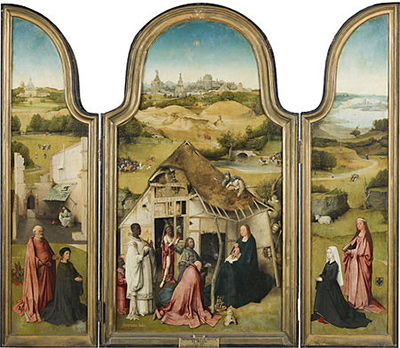
| Adoration of the Magi in Philadelphia | Early sixteenth century in the museum record; around 1495–1520 in the BRCP catalogue | Oil on oak panel · Hieronymus Bosch in the museum record; workshop of Bosch in the 2016 BRCP catalogue · Philadelphia Museum of Art, John G. Johnson Collection, 1917 · 1321; museum object 103592 Source 1. Source 2. |
| Adoration of the Magi — New York | c.1470–1480 | 2016 catalogue: Bosch; oil on oak · Metropolitan Museum 13.26 2016 catalogue. |
| Adoration of the Magi — Prado triptych | c.1494 | Oil on oak; grisaille exterior · Bosch · Prado P002048 Object source. |
| Adoration of the Magi — three associated fragments | c.1515–1535 | 2016 catalogue: Follower of Bosch · Two Shepherds / Retinue in Philadelphia; associated Adoration in private collection in 2016 2016 catalogue. |
| Ascent of the Blessed — Venice | c.1505–1515 | Oil on panel · Bosch · Gallerie dell’Accademia; Visions of the Hereafter Object source. |
| Battle of the Birds and Mammals | Not specified in catalogue heading | 2016 catalogue: Bosch; pen and brown ink · Berlin KdZ 14715 2016 catalogue. |
| Beggars and Musicians | Around 1530–1540 | Ink and wash on paper · Unknown follower of Hieronymus Bosch · Albertina, Vienna · 7798 Source 1. Source 2. |
| Christ Carrying the Cross Drawing | Around 1470 in the museum catalogue | Black chalk or charcoal, pen and brush in brown ink, white corrections · Anonymous, workshop of Rogier van der Weyden · Museum Boijmans Van Beuningen, Rotterdam · N 81 recto and verso (PK) Source 1. Source 2. |
| Christ Carrying the Cross in Vienna | Around 1490–1510 in the current KHM record and BRCP catalogue | Oil on oak, painted on both sides · Hieronymus Bosch; possible workshop involvement in the Passion side discussed by the BRCP · Kunsthistorisches Museum, Vienna · Gemäldegalerie, GG 6429 Source 1. Source 2. |
| Christ Carrying the Cross — El Escorial | c.1495–1505 | 2016 catalogue: Bosch; oil on oak · Patrimonio Nacional 10014739 2016 catalogue. |
| Christ Carrying the Cross — Ghent | c.1510–1516 (museum) | Oil on panel · Bosch in museum listing; authorship disputed · MSK Ghent 1902-H Object source. |
| Christ Mocked — London | c.1510 | Oil on wood · Bosch · National Gallery NG4744 Object source. |
| Concert in the Egg, After Hieronymus Bosch | Around 1561; third quarter of the sixteenth century | Oil on canvas · Anonymous, after Hieronymus Bosch · Palais des Beaux-Arts, Lille · P 816 Source 1. Source 2. |
| Conjurer / Comical Concert — Louvre drawing | Not specified in catalogue heading | 2016 catalogue: Bosch (recto), follower (concert verso) · Pen and brown ink · Louvre INV 19197 2016 catalogue. |
| Conjurer / Cross-bearing and beggars — Liège sheet | Not specified in catalogue heading | 2016 catalogue: Bosch (verso), follower (recto) · Pen and brown ink · Album d’Arenberg 534 2016 catalogue. |
| Crowning with Thorns — El Escorial | c.1530–1540 | 2016 catalogue: Follower of Bosch; oil on oak · Patrimonio Nacional 10014743 2016 catalogue. |
| Crucifixion with a Donor | Circa 1495–1505; Circa 1490–1500 | Oil on oak panel · Hieronymus Bosch · Royal Museums of Fine Arts of Belgium, Brussels · 6639 Source 1. Source 2. |
| Death and the Miser Drawing | Not securely established; probably made after the painting | Pen and brush, dark ink and white highlights on prepared paper · Workshop of Hieronymus Bosch in the BRCP catalogue; alternatives recorded by the Louvre · Musée du Louvre, Department of Prints and Drawings, Paris · RF 6947, Recto Source 1. Source 2. |
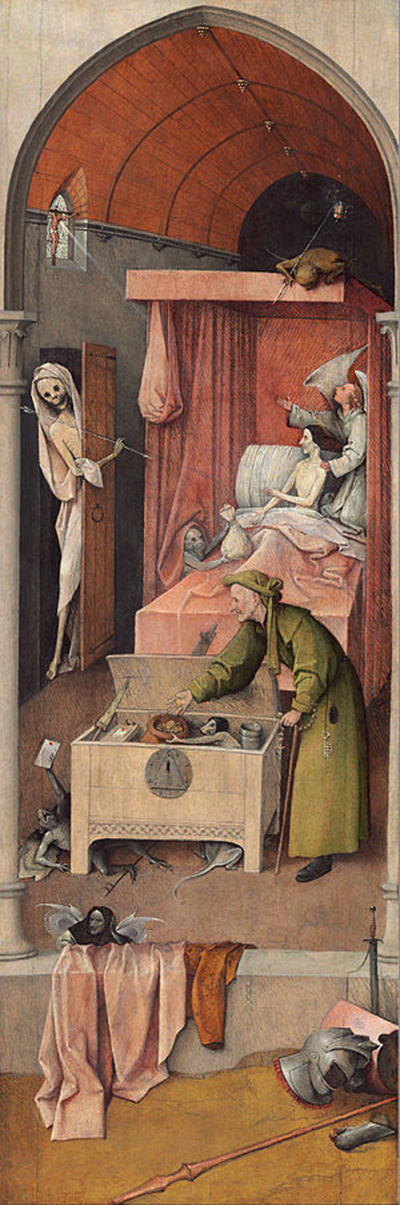
| Death and the Miser — Washington | c.1485/1490 (NGA) | Oil on panel · Bosch · National Gallery of Art 1952.5.33 Object source. |
| Ecce Homo Triptych — Boston | c.1495–1500; wings c.1500/1503 | 2016 catalogue: Workshop of Bosch; oil on oak · Museum of Fine Arts Boston; several production phases 2016 catalogue. |
| Ecce Homo — Frankfurt | c.1490 | Mixed technique on oak · Bosch · Städel 1577 Object source. |
| Fall of the Damned — Venice | c.1505–1515 | 2016 catalogue: Bosch; oil on panel · Visions of the Hereafter · Venice 2016 catalogue. |
| Garden of Earthly Delights | 1490–1500 (Prado) | Oil on oak; grisaille exterior · Bosch · Prado; triptych Object source. |
| Gluttony and Lust / Allegory of Intemperance — Yale fragment | c.1500–1510 (group dating) | 2016 catalogue: Bosch; oil on oak · Yale 1959.15.22; fragment associated with Ship of Fools 2016 catalogue. |
| Group of Ten Spectators, a Follower of Bosch | Around 1510–1540 in the current museum record | Pen and two brown inks on paper, with a brown framing line · Follower of Hieronymus Bosch in the Morgan record; Bosch in the BRCP catalogue · Morgan Library & Museum, New York · I, 112 Source 1. Source 2. |
| Head of an Old Woman | About 1500 | Oil on panel · Attributed to Jacob Cornelisz. van Oostsanen · Museum Boijmans Van Beuningen, Rotterdam · 2439 (OK) Source 1. Source 2. |
| Hell and the Flood — Rotterdam panels | Around 1515 in the museum records; around 1510–1520 in the BRCP catalogue | Oil on oak panels · Jheronimus Bosch in the museum records; workshop of Bosch in the BRCP catalogue · Museum Boijmans Van Beuningen, Rotterdam Source 1. Source 2. |
| Hermit Saints Triptych | Circa 1495–1505 | Oil on oak panels · Hieronymus Bosch · Gallerie dell’Accademia, Venice · 2044 Source 1. Source 2. |
| Infernal Landscape | Not specified in catalogue heading | 2016 catalogue: Bosch; pen and brown ink, red accent · Private collection in 2016 2016 catalogue. |
| Infernal Scene with Anvil / Monster Studies | Not specified in catalogue heading | 2016 catalogue: Bosch; attribution debated in entry · Pen and brown ink · Berlin KdZ 548 2016 catalogue. |
| Infernal Scene with Tree-Man / Standing Man | Not specified in catalogue heading | 2016 catalogue: Workshop of Bosch; pen and brown ink · Dresden C 1875; historical reverse title includes a proposed prophet 2016 catalogue. |
| Job Triptych — Bruges | c.1510–1520 | 2016 catalogue: Workshop of Bosch; oil on oak · Groeningemuseum / Hoeke loan in 2016 2016 catalogue. |
| Last Judgement — Bruges triptych | c.1495–1505 | 2016 catalogue: Bosch; oil on oak · Groeningemuseum 2016 catalogue. |
| Last Judgement — Munich fragment | c.1530–1540 | 2016 catalogue: Follower of Bosch; oil on oak · Alte Pinakothek 5752 2016 catalogue. |
| Last Judgement — Vienna triptych | c.1500–1505 (BRCP 2016) | Oil on oak · Bosch and workshop (BRCP 2016) · Academy of Fine Arts Vienna 2016 catalogue. |
| Man in a Basket and Comic Figures | Around 1500–1515 in the museum record | Pen and brown ink on paper; the reverse is catalogued as iron-gall ink · Hieronymus Bosch in the current Albertina record; attribution has been debated · Albertina, Vienna · 7797 recto and verso Source 1. Source 2. |
| Man Seen from Behind | About 1550–1569; About 1565–1570 | Traces of black chalk, pen and brush in light brown ink · Anonymous, circle of Pieter Bruegel the Elder · Museum Boijmans Van Beuningen, Rotterdam Source 1. Source 2. |
| Mary and John at the Foot of the Cross | About 1440 | Brush in grey and black · Unknown, possibly Netherlandish · Kupferstich-Kabinett, Staatliche Kunstsammlungen Dresden · C 815 Source 1. Source 2. |
| Model Sheet with ‘Witches’ | Disputed; proposals depend on the attribution | Pen and brown ink; the BRCP also records underlying black chalk · Hieronymus Bosch; follower attributions also recorded · Musée du Louvre, Département des Arts graphiques, Paris · INV 19721 recto Source 1. Source 2. |
| Peasant and Three Bust-Length Figures | 1401–1500 | Brown pen over a black preliminary drawing · Attributed to the Master of the Drapery Studies; Bosch circle also recorded · Kupferstichkabinett, Staatliche Museen zu Berlin · KdZ 777 Source 1. Source 2. |
| River to Hell — Venice | c.1505–1515 | 2016 catalogue: Bosch; oil on panel · Visions of the Hereafter · Venice 2016 catalogue. |
| Saint Anthony and a Concert in an Egg | Around 1510–1525 in the museum’s 2016–17 exhibition texts | Pen in light and dark brown inks · Workshop of Hieronymus Bosch; underlying monsters: Bosch (BRCP), possibly Bosch (exhibition text) · Kupferstichkabinett, Staatliche Museen zu Berlin · KdZ 711 recto and verso Source 1. Source 2. |
| Saint Christopher Carrying the Christ Child | c.1500; 1490–1505 in restoration material | Oil on panel · Bosch · Boijmans St 26 Object source. |
| Saint James and Hermogenes | About 1551–1575 in the KIK-IRPA catalogue | Oil on wood, painted on both sides · Anonymous follower of Hieronymus Bosch · Musée des Beaux-Arts, Valenciennes · P.46.1.44; older number 176 Source 1. Source 2. |
| Saint Jerome at Prayer | Circa 1485–1495 | Oil on oak panel · Hieronymus Bosch · Museum of Fine Arts, Ghent · 1908-H Source 1. Source 2. |
| Saint John on Patmos / Passion Scenes | c.1495–1505; estimates vary | Oil on oak · Bosch · Gemäldegalerie Berlin 1647A Object source. |
| Saint John the Baptist in Meditation | Late 15th century; c.1485–1510 (Prado exhibition) | Oil on panel · Bosch · Lázaro Galdiano 8155 Object source. |
| Saint Liberata Triptych | Circa 1495–1505 | Oil on oak panels · Hieronymus Bosch · Gallerie dell’Accademia, Venice · 2045 Source 1. Source 2. |
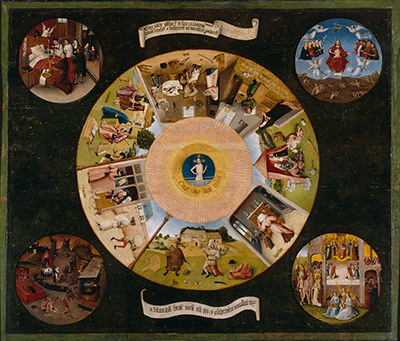
| Seven Deadly Sins and the Four Last Things | 1505–1510 (Prado) | Oil on poplar · Bosch (Prado); workshop/follower disputed · Prado Object source. |
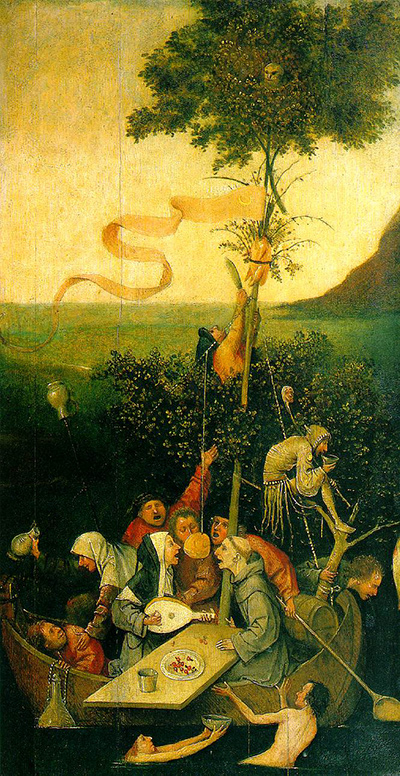
| Ship of Fools — Louvre painting | 1475–1500 (record); c.1505–1515 (exhibition) | Oil on oak · Bosch · Louvre RF 2218; fragment Object source. |
| Ship of Fools — Louvre workshop drawing | Not specified in catalogue heading | 2016 catalogue: Workshop of Bosch · Pen, brush, grey-brown ink and white highlights on prepared paper · Louvre RF 3714 2016 catalogue. |
| Studies of Monsters | About 1530–1550, according to the current Ashmolean record | Pen and brown ink on laid paper, both faces · Anonymous follower of Hieronymus Bosch · Ashmolean Museum, University of Oxford · WA1863.155 Source 1. Source 2. |
| Studies of Saint Anthony and Monsters | No execution date specified in the current Louvre records | Pen and brown ink on paper · Bosch listed; reverse questioned by Louvre; BRCP accepts both faces · Musée du Louvre, Département des Arts graphiques, Paris · INV 20871 recto and verso Source 1. Source 2. |
| Temptation of Saint Anthony — Kansas City fragment | c.1500–1510 | 2016 catalogue: Bosch; oil on oak · Nelson-Atkins 35–22 2016 catalogue. |
| Temptation of Saint Anthony — Lisbon triptych | c.1500 | Oil on oak · Bosch · Museu Nacional de Arte Antiga 1498 Pint Museum. |
| Temptation of Saint Anthony — Prado panel | c.1530–1540 | 2016 catalogue: Follower of Bosch (2016 opinion); oil on oak · Prado P002049 2016 catalogue. |
| Terrestrial Paradise | Approximately 1505–1515 | Oil on oak panel · Hieronymus Bosch · Gallerie dell'Accademia, Venice Source 1. Source 2. |
| The Burning Ship Drawing | 1500–1520 | Pen and iron gall ink on paper · Attributed to Hieronymus Bosch · Academy of Fine Arts Vienna, Graphic Collection · HZ-2554; numbered 2554 in the BRCP catalogue Source 1. Source 2. |
| The Comical Barber Scene | About 1550–1580, according to the British Museum | Pen and brown ink, grey and brown wash, over black chalk · Anonymous follower, after Hieronymus Bosch · British Museum, Department of Prints and Drawings, London · 1854,0628.46 Source 1. Source 2. |
| The Conjuror, After Hieronymus Bosch | Probably after 1525; around 1530–1540 in the BRCP technical report | Oil on oak panel · Anonymous follower of Hieronymus Bosch · Musée Ducastel-Vera, Saint-Germain-en-Laye · 872.1.87 Source 1. Source 2. |
| The Cure of Folly / Extraction of the Stone of Madness | 1501–1505 (Prado) | Oil on oak · Bosch (Prado); workshop/follower disputed · Prado P002056 Object source. |
| The Entombment Drawing | About 1505–1515, current museum record | Brush and black and grey ink, with grey wash, over black chalk · Workshop of Hieronymus Bosch; drawn by the Master of the Prado Haywain Triptych; Hieronymus Bosch, argued by the BRCP in 2016 · British Museum, Department of Prints and Drawings, London · 1952,0405.9 Source 1. Source 2. |
| The Gathering of the Birds | Not specified in catalogue heading | 2016 catalogue: Bosch; pen and brown ink · Berlin KdZ 13136 2016 catalogue. |
| The Haywain — Prado triptych | 1510–1516 (BRCP 2016) | Oil on oak · Bosch (BRCP 2016) · Prado; separate Escorial version exists 2016 catalogue. |
| The Hearing Forest and the Seeing Field | Circa 1500–1505 | Pen and brown ink on paper · Hieronymus Bosch; reverse: Bosch and workshop · Kupferstichkabinett, Staatliche Museen zu Berlin · KdZ 549, front and reverse Source 1. Source 2. |
| The Owl’s Nest — Rotterdam | Not specified in catalogue heading | 2016 catalogue: Bosch; pen and brown ink · Boijmans N 175 2016 catalogue. |
| The Passion Triptych in Valencia | Workshop of Bosch, about 1510–1520; Follower of Bosch; centre about 1530–1540, wings about 1540–1550 | Oil and gold on oak panels · Workshop of Bosch, about 1510–1520; Follower of Bosch; centre about 1530–1540, wings about 1540–1550 · Museu de Belles Arts de València Source 1. Source 2. |
| The Pedlar / Wayfarer — Rotterdam | c.1500 (museum) | Oil on panel · Bosch · Boijmans 1079 (OK); rejoined exterior Object source. |
| The Tree-Man — Vienna drawing | c.1505 | Pen and brown ink · Bosch · Albertina, Vienna Object source. |
| The Wedding at Cana, After Hieronymus Bosch | Approximately 1560 in the current museum record | Oil on panel, 93 cm high × 72 cm wide · Anonymous, after Hieronymus Bosch · Museum Boijmans Van Beuningen, Rotterdam, St 25 Source 1. Source 2. |
| Two Fantastical Creatures — Berlin KdZ 550 | Around 1505–1515 in the museum’s 2016 exhibition text | Pen in brown ink on reddish prepared laid paper · Hieronymus Bosch · Kupferstichkabinett, Staatliche Museen zu Berlin · KdZ 550, recto and verso Source 1. Source 2. |
| Two Figures Wearing Mitres | About 1480 | Oil on panel · Anonymous (Boijmans); Bosch circle (RKD) · Museum Boijmans Van Beuningen, Rotterdam · 1177 (OK) Source 1. Source 2. |
| Two Men and the Temptation of Eve | About 1505–1515 in the Prado’s 2016 exhibition guide | Pen and grey-brown ink on paper · Hieronymus Bosch in the 2016 catalogues discussed here · Private collection, as recorded in 2016 Source 1. Source 2. |
| Two Men Fighting | Not specified in the current Louvre record | Pen and brown ink · In the manner of Hieronymus Bosch · Musée du Louvre, Département des Arts graphiques, Paris · INV 20660 recto; formerly NIII 8896 and MA 8400 Source 1. Source 2. |
| Two Men — Berlin KdZ 5210 | Not specified in catalogue heading | 2016 catalogue: Bosch questioned · Pen, brush, ink, chalk and white highlights · Berlin KdZ 5210; historical title Two Oriental Men 2016 catalogue. |
| Two Monsters — Berlin KdZ 547 | Approximately 1500–1510 in Berlin's 2016 exhibition catalogue; an estimated range | Pen and brown ink on paper · Hieronymus Bosch · Kupferstichkabinett, Staatliche Museen zu Berlin · KdZ 547, drawn on both sides Source 1. Source 2. |
Frequently Asked Questions
The title refers to the Passion episode in which Christ is mocked as "King of the Jews" and crowned with thorns. The National Gallery title combines the broader humiliation, "Christ Mocked", with the specific action, "The Crowning with Thorns". [1]
Technical examination revealed an unfinished Saint Christopher composition beneath the visible image. It showed Saint Christopher carrying the Christ Child. Bosch abandoned that design and reused the panel for Christ Mocked. [2]
Campbell notes that the robe has always been white, not a faded red or purple. He connects the choice partly with the Vulgate wording of Luke 23:11 and partly with the way white sets Christ apart from the coloured tormentors. [2]
The painting is in the National Gallery, London. The Gallery records it as NG4744, bought in 1934, and catalogues it as about 1510. [1]
Discussion
Look at the compressed space, pale garment and gestures around Christ.
Reader Insights
Which hand or object first directs your attention towards Christ?
How does his pale garment separate him from the surrounding figures?
What changes when you know that an earlier Saint Christopher lies beneath the paint?
Join the Conversation
Share a detail, comparison or question about Christ Mocked (The Crowning with Thorns) below.
References
- National Gallery, London, "Hieronymus Bosch, Christ Mocked (The Crowning with Thorns), NG4744," object record, accessed July 2026 View source
- Lorne Campbell, "NG 4744, Christ Mocked (The Crowning with Thorns)," in The Sixteenth Century Netherlandish Paintings with French Paintings before 1600, National Gallery, 2014; online version 3, 2025 View source
- BRCP Catalogue Raisonné (2016), object dates in catalogues 1, 2, 8, 15 and 20; catalogue 20 object metadata only for the Haywain comparison. View source
- Staatliche Museen zu Berlin, 2016 exhibition wall texts, p. 3: approximate date of KdZ 549. View source
- Matthijs Ilsink, Jos Koldeweij, Ron Spronk, Luuk Hoogstede, Robert G. Erdmann, Rik Klein Gotink, Hanneke Nap and Daan Veldhuizen, Hieronymus Bosch, Painter and Draughtsman: Catalogue Raisonne, Brussels and New Haven, 2016.
- Luuk Hoogstede, Ron Spronk, Robert G. Erdmann, Rik Klein Gotink, Matthijs Ilsink, Jos Koldeweij, Hanneke Nap and Daan Veldhuizen, Hieronymus Bosch, Painter and Draughtsman: Technical Studies, Brussels and New Haven, 2016.