by Tom Gurney
Tom Gurney BSc (Hons) is an art history expert with over 20 years experience
Published on June 19, 2020 / Updated on November 4, 2026
Email: tomgurney1@gmail.com / Phone: +44 7429 011000
Terrestrial Paradise: Introduction
Angels attend naked men and women among green slopes and dense trees. Some figures sit quietly, while others raise their faces and hands towards a destination beyond the painting. Above them, a fountain stands on a hill against blue water and a distant horizon. Bosch's Terrestrial Paradise, also called The Garden of Eden, makes a landscape into a place of expectation: these souls have reached a blessed setting, but their movement towards heaven is not yet complete. [1][3]
The painting belongs to the four Visions of the Hereafter in the Gallerie dell'Accademia, Venice. Its companions are the Ascent of the Blessed, the Fall of the Damned and a scene usually called Hell or The River to Hell. They bring the salvation and punishment of humanity into four narrow fields. Within that larger contrast, Terrestrial Paradise deserves attention for its particular kind of reassurance: guidance rather than triumph, a landscape still occupied by animals, and faces turned towards something the panel itself does not show. [1][3]
At a Glance
- ArtistHieronymus Bosch. [1][3]
- CollectionGallerie dell'Accademia, Venice. [1]
- EnsembleOne of the four Visions of the Hereafter. [1][3]
- DateApproximately 1505–1515. [1][3]
- MediumOil on oak panel. [3][4]
- Dimensions88.5 × 39.8 cm in the BRCP examination. [4]
Compare these works across Bosch’s career
These date ranges are estimates, not a documented year-by-year sequence. These works provide context for the article; none is highlighted as the object discussed here.
Saint Jerome at Prayer
Circa 1485–1495 [2]Crucifixion with a Donor
Circa 1490–1500 (BRCP) [2]Hermit Saints Triptych
Circa 1495–1505 [2]Saint Liberata Triptych
Circa 1495–1505 [2]The Hearing Forest and the Seeing Field
Circa 1500–1505 (Berlin exhibition) [5]The Haywain Triptych
1510–1516 (BRCP) [2]Contents
- Introduction
- Annotated Details
- Terrestrial Paradise: Introduction
- Angels and the Souls They Guide
- A Landscape Built Upwards
- Paradise Before the Final Ascent
- An Uneasy Animal Detail
- Painting Light Over a Dark Preparation
- Changes Around the Fountain and Figures
- Four Panels, an Unknown Original Arrangement
- Dating the Painting and its Venetian History
Annotated Details from Terrestrial Paradise
The narrow panel moves from groups of souls and angels towards the fountain above. These larger views make its changes of scale easier to follow.
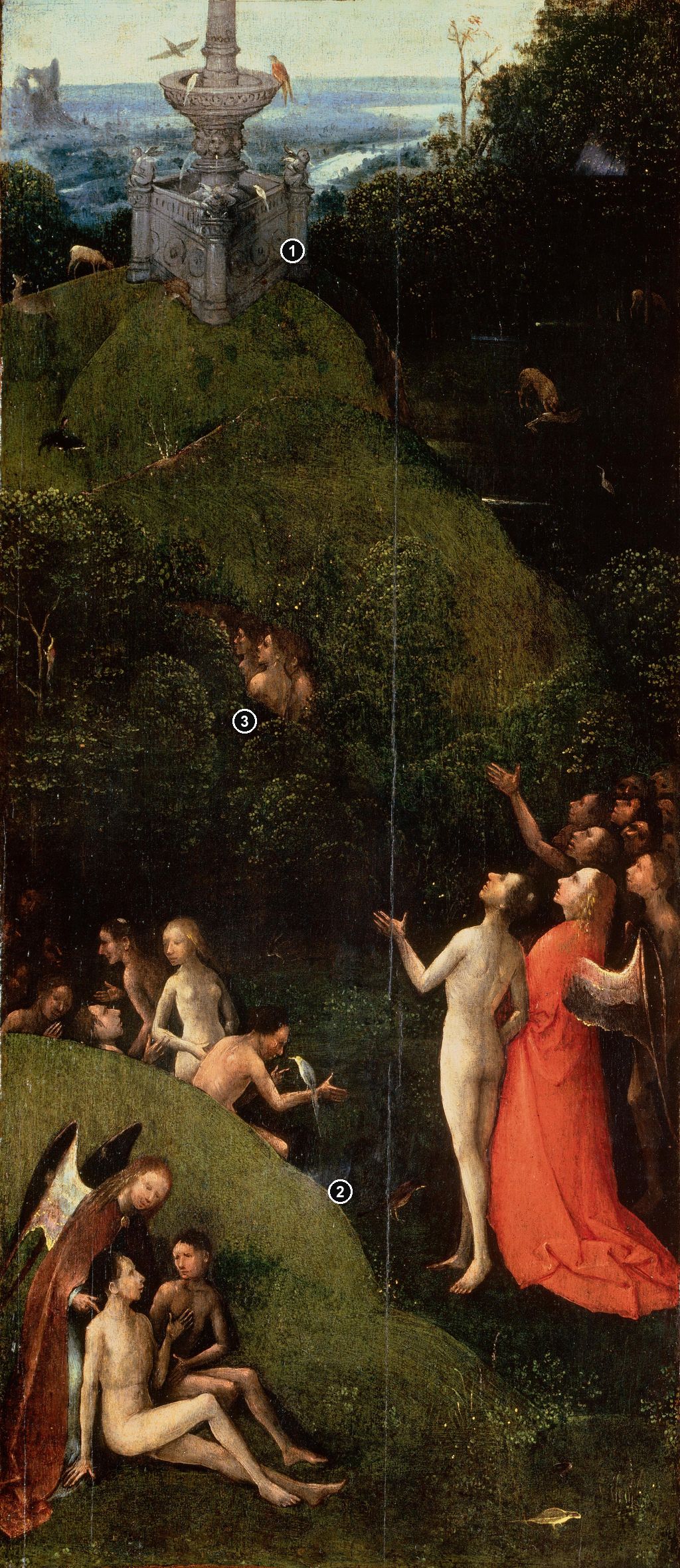
Details from TERRESTRIAL PARADISE
Explore the fountain, the surrounding creatures and the figures below.
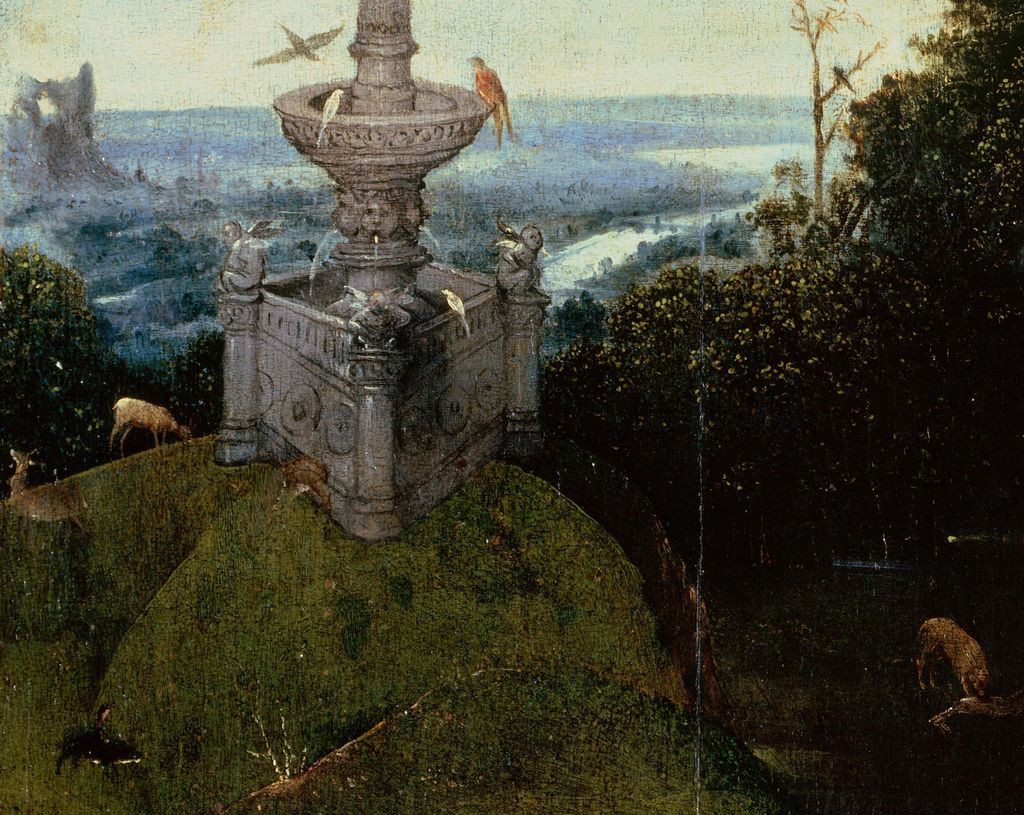
The fountain and distant country
The fountain rises above the wooded slope. The distant hills and water continue behind its pale structure.
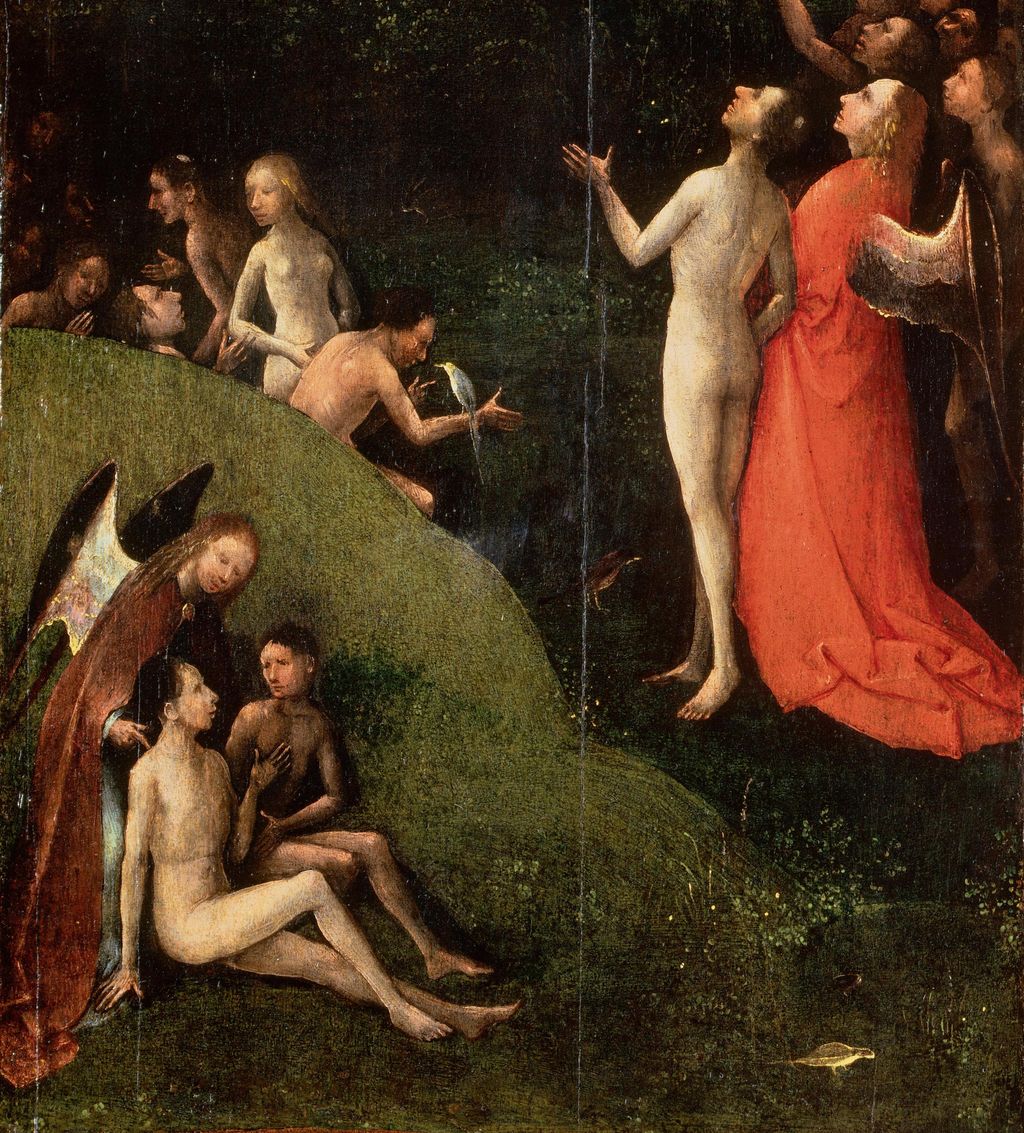
Angels and souls
Angels in coloured robes accompany the unclothed souls. Their gestures connect separate groups across the lower part of the panel.
Creatures on the slope
Small creatures occupy the grass beneath the fountain. Their scale separates this middle distance from the larger figures in the foreground.
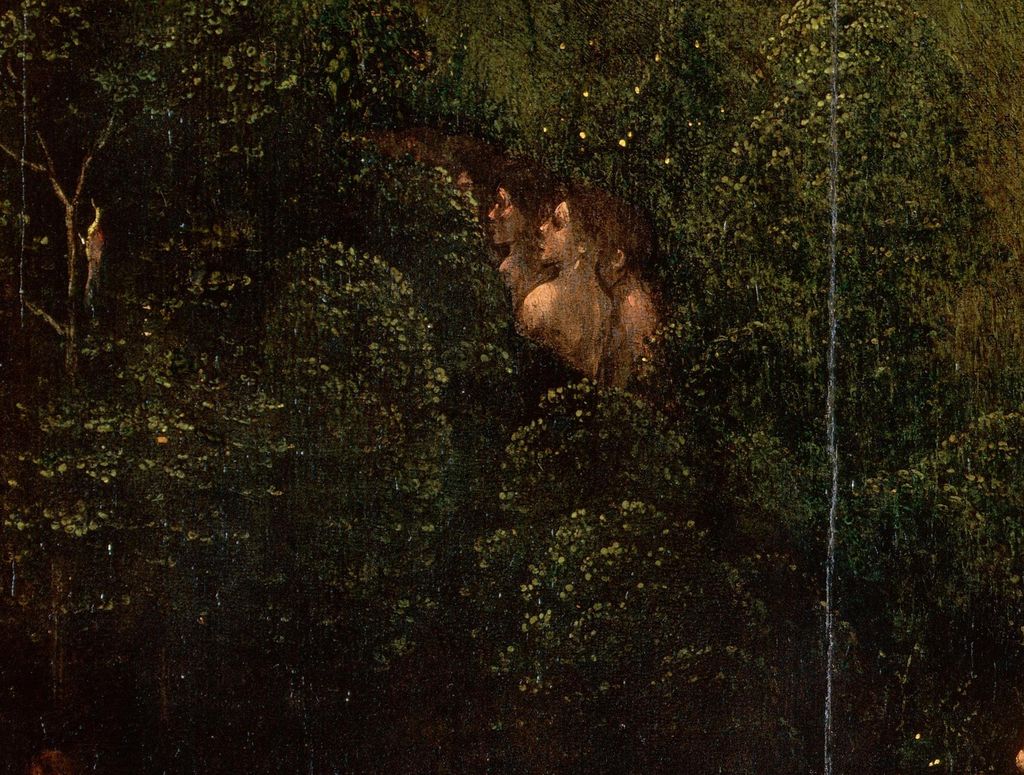
Image and detail crops: Wikimedia Commons source file (public domain reproduction).
Angels and the Souls They Guide
The foreground begins with an intimate group at the lower left. An angel bends towards two seated figures, bringing its head close to theirs. Its wings distinguish it from the unclothed people, but its posture is attentive rather than commanding. The human bodies occupy a small patch of ground enclosed by the rising bank. Bosch makes their immediate relationship readable before the eye travels farther into the landscape. [3][4]
At the right, a standing woman looks upwards beside an angel in a brilliant red robe. Her raised hand and tilted head direct attention beyond the upper edge. Other figures behind her repeat the upward movement, making it more than an isolated gesture. The robe descends in a large, flowing shape, contrasting with the narrow human bodies and the dark foliage. It is both a vivid colour accent and a means of holding this group together. [3][4]
Between these foreground groups, further figures emerge from the greenery. Their partial concealment gives the wooded middle distance an inhabited depth. There is no broad procession crossing an open road. Instead, small encounters appear at successive distances, so that guidance seems to take place throughout the setting. The angels' work is expressed through proximity, touch and attention, rather than through a single dramatic intervention. [3]
A Landscape Built Upwards
The tall format encourages an upward reading, but Bosch does not arrange the land as a straightforward staircase. A bank rises across the lower foreground, trees interrupt the middle, and the fountain hill occupies the upper section. These overlapping forms delay the eye. One can follow the figures' gestures directly upwards or wander through the darker gaps between the slopes and foliage. The landscape offers both a destination and places where looking must slow down. [3][4]
Near the top, the grey fountain gives the scene an architectural focus. Its base appears firmly placed on the rounded hill, while the bowl and central shaft project towards the sky. Birds gather around it. Behind this comparatively solid structure, water and land lose definition in the blue distance. The fountain is therefore neither a close foreground object nor an inaccessible apparition: Bosch places it within the landscape while letting it stand against an expansive horizon. [3][4]
The quiet colour of that horizon contrasts with the strong red robe below. Their separation helps extend the painting beyond its actual dimensions. The foreground bodies, trees and fountain occupy different distances, while the strip of blue suggests a world continuing behind them. Yet the figures looking up do not simply direct us towards the fountain. Their destination belongs to the larger subject of salvation and to the relationship between this panel and its companion images. [3]
Paradise Before the Final Ascent
The title Terrestrial Paradise can cause confusion if it is taken to mean another picture of Adam and Eve at the beginning of Genesis. Here the subject is a gathering of souls accompanied by angels. There is no central scene in which God presents Eve to Adam, as in the Paradise wing of The Garden of Earthly Delights. The shared imagery of a garden and fountain serves a different narrative setting. [1][3]
One scholarly interpretation explains such a place as the final stage of purification before heaven. In a conference abstract, E. De Bruyn relates Boschian earthly paradises without Adam and Eve to medieval accounts of a blessed waiting place. That proposal helps explain why the souls can be safely accompanied by angels yet still look towards a further destination. It is an interpretation of the imagery, rather than a recovered title or a documented instruction from the painting's original patron. [6]
The companion Ascent of the Blessed supplies a strikingly different visual experience. There, angels and souls rise through darkness towards a tunnel of light. In Terrestrial Paradise, the body still has ground beneath it, trees around it and nearby companions. Comparing the two panels makes their difference productive: a sheltered landscape and an ascent into light can express successive possibilities without requiring us to reconstruct an exact route through a lost ensemble. [3]
An Uneasy Animal Detail
The setting is not entirely free from disturbance. In the wooded background, a lion attacks a deer. The BRCP catalogue compares this detail with predatory animals in other Bosch paintings, including the Paradise imagery of the Vienna Last Judgement and The Garden of Earthly Delights. The repetition places the Venetian landscape within Bosch's wider practice of combining rich natural settings with animal violence. [3]
The detail complicates the picture without supplying a complete explanation for it. It may trouble an expectation that paradise must exclude every form of predation, but the painting does not identify a particular soul with the lion or its prey. Nor does it show the foreground angels failing in their task. Its force lies partly in the contrast between their careful attention to human figures and the more distant activity of the animals. The viewer must hold those observations together rather than replace the entire scene with a single ominous symbol. [3]
Painting Light Over a Dark Preparation
Conservation research gives a material explanation for the panel's unusual contrasts. All four Visions were painted over a black preparation applied above the pale ground. Light passages consequently needed sufficient body to cover that darkness, while thinner dark colours could allow it to contribute to the final effect. The technical study distinguishes this black layer from the underlying ground; it is not simply a description of the painting's present dark appearance. [4]
In Terrestrial Paradise, the sky was built with white and then blue paint, while the foliage developed through green layers and lighter dots. The foreground figures were painted directly over the black preparation, whereas some more distant figures were laid over green. These different starting points help explain why seemingly similar bodies can behave differently within the landscape. Small strokes and highlights give faces and limbs definition without smoothing every passage into an even surface. [4]
The technical examination did not reveal a conventional underdrawing. That absence is a limit of observation, not proof that Bosch began without planning. A dark preparation can obstruct the detection of marks beneath it, and lighter painted indications may have helped establish parts of the design. The report considers several such possibilities while distinguishing them from securely observed layers. [4]
Changes Around the Fountain and Figures
The fountain landscape was revised during painting. The technical study describes an adjustment to the hill, making its left side less steep, with the lower fountain painted across part of the slope. The catalogue also warns that losses and later retouching around this area affect how clearly the forms can now be read. A difficult contour is therefore not automatically a deliberate puzzle left by Bosch. [3][4]
The human groups likewise preserve changes. The shoulder of the red-robed angel was reduced, while a neighbouring figure's arm was shifted and a leg moved backwards. These are small alterations, but they show Bosch refining the relationships between bodies and clothing. A gesture that now appears effortless could have required adjustment as the surrounding figure or robe developed. The final composition grew through painting rather than being mechanically transferred in every detail from an unchanging design. [4]
Ageing has added further changes that the artist did not intend. Greens have darkened, and paint containing lead white has become more transparent, allowing more of the dark preparation to affect the figures. Wear, old varnish and retouching also alter the balance of colour and light. The technical report largely records examination in 2011, before the treatment of the backs begun in 2015; its condition observations belong to that documented stage of the object's history. [4]
Four Panels, an Unknown Original Arrangement
The four pictures are materially connected. Some of their oak boards came from the same trees, and their dimensions, technique and themes reinforce their relationship. They retain evidence of original side edges and frames, although the tops and bottoms were cut down. Such findings establish that the panels belonged together more firmly than they establish the shape of the complete object to which they belonged. [3][4]
One proposal sees them as parts of a larger composition associated with the Last Judgement. The BRCP catalogue also considers shutters for a niche or another object, perhaps arranged above one another. Their painted backs are important to that discussion: instead of additional figures, they carry red and green stone imitations. The authors compare the practical demands of different kinds of folding ensembles, but no surviving central component settles the matter. [1][3]
The history of those backs also needs qualification. The museum summary suggests a later workshop adaptation, while the BRCP technical report describes the stone imitations as presumably original. Their recovery has made the construction and use of the panels more interesting, without producing universal agreement about every stage. What can safely be said is that these were decorated, movable members of a larger object; a modern row of four paintings should not be mistaken for a proven reconstruction of their first display. [1][3][4]
Dating the Painting and its Venetian History
The museum and BRCP catalogue place the paintings around 1505–1515. Tree-ring evidence allows an earlier starting point for the ensemble's wood, with painting possible from about 1484 and statistically more likely after 1486 under the assumptions used in the study. Those are limits derived from timber, missing outer rings and time for preparation. They do not mean Bosch painted Terrestrial Paradise in 1484. The later estimate also considers relationships with his other works. [1][3][4]
The paintings' association with Cardinal Domenico Grimani gives them a prominent place in the history of northern art in Venice. Marcantonio Michiel recorded Bosch works with infernal and dreamlike subjects in Grimani's collection in 1521. The BRCP catalogue discusses the possibility that these descriptions refer to the surviving panels, while acknowledging problems in their wording and number. That identification is a historical argument, not a precise record naming Terrestrial Paradise as it is titled today. [3]
Later Venetian descriptions provide firmer evidence of the panels' presence in the Doge's Palace. The BRCP catalogue traces references through seventeenth- and eighteenth-century guides, including descriptions that attributed the unusual images to Herri met de Bles rather than Bosch. The panels subsequently moved between Venetian collections. Unlike the two Bosch triptychs sent to Vienna in the nineteenth century, the Visions remained in Venice. Their changing attributions and locations belong to their reception history, not to evidence that Bosch painted them in Italy. [1][3]
The 2017 Bosch and Venice exhibition also proposed that northern commissions were adapted for Italian collectors, possibly Grimani. This distinguishes the circumstances in which a painting was conceived from the setting in which it was later appreciated. The original patron and exact function remain unknown. In Venice, however, these images could invite both devotional reflection and the cultivated discussion of extraordinary northern painting. [7]
Looking at the Panel as Part of a Whole
Terrestrial Paradise gives the viewer several scales of attention: a hand reaching upwards, an angel bending to seated souls, a fountain overlooking a landscape, and a wooded distance containing less reassuring life. Its promise is expressed through guidance and expectation. The absence of the final heavenly destination from this particular scene gives the upward gestures their purpose. [3]
The painting's relationship with the other Visions expands that promise without erasing its own character. It shares their narrow supports and dark preparation, but offers green terrain in place of the ascent's darkness or the infernal panels' violence. Reading it closely therefore means attending to a distinct image while preserving the uncertainty of the larger object. The surviving panel is specific and substantial; the complete arrangement that once gave it a physical setting remains unknown. [3][4]

Artworks and related attributions
Browse paintings, drawings and related attributions. Records group triptychs, fragments and two-sided sheets where appropriate. Dates follow the cited museum records or catalogue headings and are generally estimates. Rows marked “2016 catalogue” report that publication’s attribution and collection information; these are dated opinions, rather than a claim that every work is an accepted autograph Bosch.
| Name | Date | Medium, attribution and collection |
|---|---|---|
| A Crossbowman | Second half of the sixteenth century | Oil on oak panel · Copy after Hieronymus Bosch · Museo Nacional del Prado, Madrid · P002695 Source 1. Source 2. |
| A Woman Spinning and an Old Woman | Museum estimates: about 1480–1490 for the women and 1500–1505 for the reverse; the precise chronology is disputed | Pen and brown and grey ink on the front; pen and brown ink on the reverse · Hieronymus Bosch · Museum Boijmans Van Beuningen, Rotterdam · N 190 recto and verso (PK) Source 1. Source 2. |
| Adoration of the Child in Cologne | Second half of the sixteenth century | Oil on oak panel · Imitator of Hieronymus Bosch, in the city collection record · Wallraf-Richartz-Museum & Fondation Corboud, Cologne · WRM 0474 Source 1. Source 2. |
| Adoration of the Magi in Philadelphia | Early sixteenth century in the museum record; around 1495–1520 in the BRCP catalogue | Oil on oak panel · Hieronymus Bosch in the museum record; workshop of Bosch in the 2016 BRCP catalogue · Philadelphia Museum of Art, John G. Johnson Collection, 1917 · 1321; museum object 103592 Source 1. Source 2. |
| Adoration of the Magi — New York | c.1470–1480 | 2016 catalogue: Bosch; oil on oak · Metropolitan Museum 13.26 2016 catalogue. |
| Adoration of the Magi — Prado triptych | c.1494 | Oil on oak; grisaille exterior · Bosch · Prado P002048 Object source. |
| Adoration of the Magi — three associated fragments | c.1515–1535 | 2016 catalogue: Follower of Bosch · Two Shepherds / Retinue in Philadelphia; associated Adoration in private collection in 2016 2016 catalogue. |
| Ascent of the Blessed — Venice | c.1505–1515 | Oil on panel · Bosch · Gallerie dell’Accademia; Visions of the Hereafter Object source. |
| Battle of the Birds and Mammals | Not specified in catalogue heading | 2016 catalogue: Bosch; pen and brown ink · Berlin KdZ 14715 2016 catalogue. |
| Beggars and Musicians | Around 1530–1540 | Ink and wash on paper · Unknown follower of Hieronymus Bosch · Albertina, Vienna · 7798 Source 1. Source 2. |
| Christ Carrying the Cross Drawing | Around 1470 in the museum catalogue | Black chalk or charcoal, pen and brush in brown ink, white corrections · Anonymous, workshop of Rogier van der Weyden · Museum Boijmans Van Beuningen, Rotterdam · N 81 recto and verso (PK) Source 1. Source 2. |
| Christ Carrying the Cross in Vienna | Around 1490–1510 in the current KHM record and BRCP catalogue | Oil on oak, painted on both sides · Hieronymus Bosch; possible workshop involvement in the Passion side discussed by the BRCP · Kunsthistorisches Museum, Vienna · Gemäldegalerie, GG 6429 Source 1. Source 2. |
| Christ Carrying the Cross — El Escorial | c.1495–1505 | 2016 catalogue: Bosch; oil on oak · Patrimonio Nacional 10014739 2016 catalogue. |
| Christ Carrying the Cross — Ghent | c.1510–1516 (museum) | Oil on panel · Bosch in museum listing; authorship disputed · MSK Ghent 1902-H Object source. |
| Christ Mocked — London | c.1510 | Oil on wood · Bosch · National Gallery NG4744 Object source. |
| Concert in the Egg, After Hieronymus Bosch | Around 1561; third quarter of the sixteenth century | Oil on canvas · Anonymous, after Hieronymus Bosch · Palais des Beaux-Arts, Lille · P 816 Source 1. Source 2. |
| Conjurer / Comical Concert — Louvre drawing | Not specified in catalogue heading | 2016 catalogue: Bosch (recto), follower (concert verso) · Pen and brown ink · Louvre INV 19197 2016 catalogue. |
| Conjurer / Cross-bearing and beggars — Liège sheet | Not specified in catalogue heading | 2016 catalogue: Bosch (verso), follower (recto) · Pen and brown ink · Album d’Arenberg 534 2016 catalogue. |
| Crowning with Thorns — El Escorial | c.1530–1540 | 2016 catalogue: Follower of Bosch; oil on oak · Patrimonio Nacional 10014743 2016 catalogue. |
| Crucifixion with a Donor | Circa 1495–1505; Circa 1490–1500 | Oil on oak panel · Hieronymus Bosch · Royal Museums of Fine Arts of Belgium, Brussels · 6639 Source 1. Source 2. |
| Death and the Miser Drawing | Not securely established; probably made after the painting | Pen and brush, dark ink and white highlights on prepared paper · Workshop of Hieronymus Bosch in the BRCP catalogue; alternatives recorded by the Louvre · Musée du Louvre, Department of Prints and Drawings, Paris · RF 6947, Recto Source 1. Source 2. |
| Death and the Miser — Washington | c.1485/1490 (NGA) | Oil on panel · Bosch · National Gallery of Art 1952.5.33 Object source. |
| Ecce Homo Triptych — Boston | c.1495–1500; wings c.1500/1503 | 2016 catalogue: Workshop of Bosch; oil on oak · Museum of Fine Arts Boston; several production phases 2016 catalogue. |
| Ecce Homo — Frankfurt | c.1490 | Mixed technique on oak · Bosch · Städel 1577 Object source. |
| Fall of the Damned — Venice | c.1505–1515 | 2016 catalogue: Bosch; oil on panel · Visions of the Hereafter · Venice 2016 catalogue. |
| Garden of Earthly Delights | 1490–1500 (Prado) | Oil on oak; grisaille exterior · Bosch · Prado; triptych Object source. |
| Gluttony and Lust / Allegory of Intemperance — Yale fragment | c.1500–1510 (group dating) | 2016 catalogue: Bosch; oil on oak · Yale 1959.15.22; fragment associated with Ship of Fools 2016 catalogue. |
| Group of Ten Spectators, a Follower of Bosch | Around 1510–1540 in the current museum record | Pen and two brown inks on paper, with a brown framing line · Follower of Hieronymus Bosch in the Morgan record; Bosch in the BRCP catalogue · Morgan Library & Museum, New York · I, 112 Source 1. Source 2. |
| Head of an Old Woman | About 1500 | Oil on panel · Attributed to Jacob Cornelisz. van Oostsanen · Museum Boijmans Van Beuningen, Rotterdam · 2439 (OK) Source 1. Source 2. |
| Hell and the Flood — Rotterdam panels | Around 1515 in the museum records; around 1510–1520 in the BRCP catalogue | Oil on oak panels · Jheronimus Bosch in the museum records; workshop of Bosch in the BRCP catalogue · Museum Boijmans Van Beuningen, Rotterdam Source 1. Source 2. |
| Hermit Saints Triptych | Circa 1495–1505 | Oil on oak panels · Hieronymus Bosch · Gallerie dell’Accademia, Venice · 2044 Source 1. Source 2. |
| Infernal Landscape | Not specified in catalogue heading | 2016 catalogue: Bosch; pen and brown ink, red accent · Private collection in 2016 2016 catalogue. |
| Infernal Scene with Anvil / Monster Studies | Not specified in catalogue heading | 2016 catalogue: Bosch; attribution debated in entry · Pen and brown ink · Berlin KdZ 548 2016 catalogue. |
| Infernal Scene with Tree-Man / Standing Man | Not specified in catalogue heading | 2016 catalogue: Workshop of Bosch; pen and brown ink · Dresden C 1875; historical reverse title includes a proposed prophet 2016 catalogue. |
| Job Triptych — Bruges | c.1510–1520 | 2016 catalogue: Workshop of Bosch; oil on oak · Groeningemuseum / Hoeke loan in 2016 2016 catalogue. |
| Last Judgement — Bruges triptych | c.1495–1505 | 2016 catalogue: Bosch; oil on oak · Groeningemuseum 2016 catalogue. |
| Last Judgement — Munich fragment | c.1530–1540 | 2016 catalogue: Follower of Bosch; oil on oak · Alte Pinakothek 5752 2016 catalogue. |
| Last Judgement — Vienna triptych | c.1500–1505 (BRCP 2016) | Oil on oak · Bosch and workshop (BRCP 2016) · Academy of Fine Arts Vienna 2016 catalogue. |
| Man in a Basket and Comic Figures | Around 1500–1515 in the museum record | Pen and brown ink on paper; the reverse is catalogued as iron-gall ink · Hieronymus Bosch in the current Albertina record; attribution has been debated · Albertina, Vienna · 7797 recto and verso Source 1. Source 2. |
| Man Seen from Behind | About 1550–1569; About 1565–1570 | Traces of black chalk, pen and brush in light brown ink · Anonymous, circle of Pieter Bruegel the Elder · Museum Boijmans Van Beuningen, Rotterdam Source 1. Source 2. |
| Mary and John at the Foot of the Cross | About 1440 | Brush in grey and black · Unknown, possibly Netherlandish · Kupferstich-Kabinett, Staatliche Kunstsammlungen Dresden · C 815 Source 1. Source 2. |
| Model Sheet with ‘Witches’ | Disputed; proposals depend on the attribution | Pen and brown ink; the BRCP also records underlying black chalk · Hieronymus Bosch; follower attributions also recorded · Musée du Louvre, Département des Arts graphiques, Paris · INV 19721 recto Source 1. Source 2. |
| Peasant and Three Bust-Length Figures | 1401–1500 | Brown pen over a black preliminary drawing · Attributed to the Master of the Drapery Studies; Bosch circle also recorded · Kupferstichkabinett, Staatliche Museen zu Berlin · KdZ 777 Source 1. Source 2. |
| River to Hell — Venice | c.1505–1515 | 2016 catalogue: Bosch; oil on panel · Visions of the Hereafter · Venice 2016 catalogue. |
| Saint Anthony and a Concert in an Egg | Around 1510–1525 in the museum’s 2016–17 exhibition texts | Pen in light and dark brown inks · Workshop of Hieronymus Bosch; underlying monsters: Bosch (BRCP), possibly Bosch (exhibition text) · Kupferstichkabinett, Staatliche Museen zu Berlin · KdZ 711 recto and verso Source 1. Source 2. |
| Saint Christopher Carrying the Christ Child | c.1500; 1490–1505 in restoration material | Oil on panel · Bosch · Boijmans St 26 Object source. |
| Saint James and Hermogenes | About 1551–1575 in the KIK-IRPA catalogue | Oil on wood, painted on both sides · Anonymous follower of Hieronymus Bosch · Musée des Beaux-Arts, Valenciennes · P.46.1.44; older number 176 Source 1. Source 2. |
| Saint Jerome at Prayer | Circa 1485–1495 | Oil on oak panel · Hieronymus Bosch · Museum of Fine Arts, Ghent · 1908-H Source 1. Source 2. |
| Saint John on Patmos / Passion Scenes | c.1495–1505; estimates vary | Oil on oak · Bosch · Gemäldegalerie Berlin 1647A Object source. |
| Saint John the Baptist in Meditation | Late 15th century; c.1485–1510 (Prado exhibition) | Oil on panel · Bosch · Lázaro Galdiano 8155 Object source. |
| Saint Liberata Triptych | Circa 1495–1505 | Oil on oak panels · Hieronymus Bosch · Gallerie dell’Accademia, Venice · 2045 Source 1. Source 2. |
| Seven Deadly Sins and the Four Last Things | 1505–1510 (Prado) | Oil on poplar · Bosch (Prado); workshop/follower disputed · Prado Object source. |
| Ship of Fools — Louvre painting | 1475–1500 (record); c.1505–1515 (exhibition) | Oil on oak · Bosch · Louvre RF 2218; fragment Object source. |
| Ship of Fools — Louvre workshop drawing | Not specified in catalogue heading | 2016 catalogue: Workshop of Bosch · Pen, brush, grey-brown ink and white highlights on prepared paper · Louvre RF 3714 2016 catalogue. |
| Studies of Monsters | About 1530–1550, according to the current Ashmolean record | Pen and brown ink on laid paper, both faces · Anonymous follower of Hieronymus Bosch · Ashmolean Museum, University of Oxford · WA1863.155 Source 1. Source 2. |
| Studies of Saint Anthony and Monsters | No execution date specified in the current Louvre records | Pen and brown ink on paper · Bosch listed; reverse questioned by Louvre; BRCP accepts both faces · Musée du Louvre, Département des Arts graphiques, Paris · INV 20871 recto and verso Source 1. Source 2. |
| Temptation of Saint Anthony — Kansas City fragment | c.1500–1510 | 2016 catalogue: Bosch; oil on oak · Nelson-Atkins 35–22 2016 catalogue. |
| Temptation of Saint Anthony — Lisbon triptych | c.1500 | Oil on oak · Bosch · Museu Nacional de Arte Antiga 1498 Pint Museum. |
| Temptation of Saint Anthony — Prado panel | c.1530–1540 | 2016 catalogue: Follower of Bosch (2016 opinion); oil on oak · Prado P002049 2016 catalogue. |
| Terrestrial Paradise | Approximately 1505–1515 | Oil on oak panel · Hieronymus Bosch · Gallerie dell'Accademia, Venice Source 1. Source 2. |
| The Burning Ship Drawing | 1500–1520 | Pen and iron gall ink on paper · Attributed to Hieronymus Bosch · Academy of Fine Arts Vienna, Graphic Collection · HZ-2554; numbered 2554 in the BRCP catalogue Source 1. Source 2. |
| The Comical Barber Scene | About 1550–1580, according to the British Museum | Pen and brown ink, grey and brown wash, over black chalk · Anonymous follower, after Hieronymus Bosch · British Museum, Department of Prints and Drawings, London · 1854,0628.46 Source 1. Source 2. |
| The Conjuror, After Hieronymus Bosch | Probably after 1525; around 1530–1540 in the BRCP technical report | Oil on oak panel · Anonymous follower of Hieronymus Bosch · Musée Ducastel-Vera, Saint-Germain-en-Laye · 872.1.87 Source 1. Source 2. |
| The Cure of Folly / Extraction of the Stone of Madness | 1501–1505 (Prado) | Oil on oak · Bosch (Prado); workshop/follower disputed · Prado P002056 Object source. |
| The Entombment Drawing | About 1505–1515, current museum record | Brush and black and grey ink, with grey wash, over black chalk · Workshop of Hieronymus Bosch; drawn by the Master of the Prado Haywain Triptych; Hieronymus Bosch, argued by the BRCP in 2016 · British Museum, Department of Prints and Drawings, London · 1952,0405.9 Source 1. Source 2. |
| The Gathering of the Birds | Not specified in catalogue heading | 2016 catalogue: Bosch; pen and brown ink · Berlin KdZ 13136 2016 catalogue. |
| The Haywain — Prado triptych | 1510–1516 (BRCP 2016) | Oil on oak · Bosch (BRCP 2016) · Prado; separate Escorial version exists 2016 catalogue. |
| The Hearing Forest and the Seeing Field | Circa 1500–1505 | Pen and brown ink on paper · Hieronymus Bosch; reverse: Bosch and workshop · Kupferstichkabinett, Staatliche Museen zu Berlin · KdZ 549, front and reverse Source 1. Source 2. |
| The Owl’s Nest — Rotterdam | Not specified in catalogue heading | 2016 catalogue: Bosch; pen and brown ink · Boijmans N 175 2016 catalogue. |
| The Passion Triptych in Valencia | Workshop of Bosch, about 1510–1520; Follower of Bosch; centre about 1530–1540, wings about 1540–1550 | Oil and gold on oak panels · Workshop of Bosch, about 1510–1520; Follower of Bosch; centre about 1530–1540, wings about 1540–1550 · Museu de Belles Arts de València Source 1. Source 2. |
| The Pedlar / Wayfarer — Rotterdam | c.1500 (museum) | Oil on panel · Bosch · Boijmans 1079 (OK); rejoined exterior Object source. |
| The Tree-Man — Vienna drawing | c.1505 | Pen and brown ink · Bosch · Albertina, Vienna Object source. |
| The Wedding at Cana, After Hieronymus Bosch | Approximately 1560 in the current museum record | Oil on panel, 93 cm high × 72 cm wide · Anonymous, after Hieronymus Bosch · Museum Boijmans Van Beuningen, Rotterdam, St 25 Source 1. Source 2. |
| Two Fantastical Creatures — Berlin KdZ 550 | Around 1505–1515 in the museum’s 2016 exhibition text | Pen in brown ink on reddish prepared laid paper · Hieronymus Bosch · Kupferstichkabinett, Staatliche Museen zu Berlin · KdZ 550, recto and verso Source 1. Source 2. |
| Two Figures Wearing Mitres | About 1480 | Oil on panel · Anonymous (Boijmans); Bosch circle (RKD) · Museum Boijmans Van Beuningen, Rotterdam · 1177 (OK) Source 1. Source 2. |
| Two Men and the Temptation of Eve | About 1505–1515 in the Prado’s 2016 exhibition guide | Pen and grey-brown ink on paper · Hieronymus Bosch in the 2016 catalogues discussed here · Private collection, as recorded in 2016 Source 1. Source 2. |
| Two Men Fighting | Not specified in the current Louvre record | Pen and brown ink · In the manner of Hieronymus Bosch · Musée du Louvre, Département des Arts graphiques, Paris · INV 20660 recto; formerly NIII 8896 and MA 8400 Source 1. Source 2. |
| Two Men — Berlin KdZ 5210 | Not specified in catalogue heading | 2016 catalogue: Bosch questioned · Pen, brush, ink, chalk and white highlights · Berlin KdZ 5210; historical title Two Oriental Men 2016 catalogue. |
| Two Monsters — Berlin KdZ 547 | Approximately 1500–1510 in Berlin's 2016 exhibition catalogue; an estimated range | Pen and brown ink on paper · Hieronymus Bosch · Kupferstichkabinett, Staatliche Museen zu Berlin · KdZ 547, drawn on both sides Source 1. Source 2. |
Frequently Asked Questions
It belongs to the Gallerie dell’Accademia in Venice as one of the four Visions of the Hereafter.[1]
The BRCP technical examination records 88.5 × 39.8 cm. The tall oak panel lets the eye move from intimate foreground groups towards the fountain and distant water.[4]
Discussion
Look from the small encounters among the trees towards the fountain and the destination beyond the panel.
Reader Insights
Follow the red-robed angel and the woman beside it. Where does their upward attention lead you?
How do the trees and banks slow your movement towards the fountain?
Compare this wooded setting with the open ascent in its companion panel. What changes in the sense of reassurance?
Join the Conversation
Share a detail, comparison or question about Terrestrial Paradise: the Venice Panel below.
References
- Gallerie dell'Accademia di Venezia, Visioni dell'Aldilà, current collection record. View source.
- BRCP Catalogue Raisonné (2016), object dates in catalogues 1, 2, 8, 15 and 20; catalogue 20 object metadata only for the Haywain comparison. View source
- Matthijs Ilsink and colleagues, Hieronymus Bosch, Painter and Draughtsman: Catalogue Raisonné (2016), catalogue 18, pp. 308–315. View source.
- Bosch Research and Conservation Project, Visions of the Hereafter, technical study, catalogue 18, research reports 32–39, pp. 252–263. View source.
- Staatliche Museen zu Berlin, 2016 exhibition wall texts, p. 3: approximate date of KdZ 549. View source
- E. De Bruyn, “Earthly Paradise as the final phase of Purgatory in Boschian Last Judgment triptychs,” conference abstract, Jheronimus Bosch Art Center. View source.
- Fondazione Musei Civici di Venezia, Jheronimus Bosch e Venezia, exhibition itinerary (2017). View source.
- Splash image, Angels accompany souls through the landscape of Terrestrial Paradise, one of Bosch’s four Visions of the Hereafter in Venice. View source. View source.