by Tom Gurney
Tom Gurney BSc (Hons) is an art history expert with over 20 years experience
Published on June 19, 2020 / Updated on November 4, 2026
Email: tomgurney1@gmail.com / Phone: +44 7429 011000
Hieronymus Bosch Paintings: Introduction
Hieronymus Bosch's paintings are among the most vivid and difficult works of the Northern Renaissance. They are also fewer, stranger, and less securely defined than their modern fame can make them seem. The name "Bosch" now gathers together a small core of paintings generally accepted as his, works associated with his workshop, later followers and copies, and several objects whose attribution remains disputed. A useful introduction to Bosch's painted corpus has to hold all of those categories in view.
Bosch worked in and around 's-Hertogenbosch, a thriving Brabant city where his family belonged to a multi-generation painters' workshop. Documentary evidence is comparatively thin, but BoschDoc and local heritage records connect him to the Van Aken family, the painters' trade, the market-place house known as De Kleine Winst, and the Brotherhood of Our Lady. That local setting matters because his paintings are not isolated fantasies. They belong to a world of urban devotion, religious confraternities, courtly collecting, moral instruction, panel painting, and workshop practice.
The paintings are best approached through the main artist overview, the document-led biography, and the individual works that anchor the corpus: The Garden of Earthly Delights, The Haywain Triptych, The Last Judgement, The Temptation of Saint Anthony, The Seven Deadly Sins and the Four Last Things, Death and the Miser, Ship of Fools, The Adoration of the Magi, and Christ Mocked (The Crowning with Thorns). Together they show Bosch as a painter of religious drama, moral peril, comic folly, social satire, and technical invention.
Contents
- A Small Corpus with a Large Shadow
- Selected Hieronymus Bosch Paintings
- Panel Painting and the Triptych Imagination
- Major Paintings and Their Roles
- Devotion, Sin, Folly, and Fear
- Technique and Looking Closely
- Workshop, Followers, and Disputed Works
- How to Read Bosch's Paintings
A Small Corpus with a Large Shadow
Bosch's painted corpus is not a neat catalogue of dozens of unquestioned masterpieces. It is a historical problem. Museums, technical researchers, and catalogue authors have had to separate paintings by Bosch from paintings by his workshop, images by followers, copies after lost or famous compositions, and works once attributed to Bosch that no longer carry the same confidence. The Bosch Research and Conservation Project, presented through BRCP publications and the Closer to Bosch platform, is central to that modern reassessment because it combines art-historical study with technical examination, including visible light, infrared, infrared reflectography, and X-radiography where available.
This is why cautious wording matters. A painting may be a Bosch masterpiece in one museum record, a disputed object in another scholarly discussion, or a later follower's work in a current research catalogue. The difference is not pedantry. It changes how the work is read. A panel painted by Bosch's own hand carries different evidence from a work made in his workshop, and both differ from a sixteenth-century image made after Bosch's inventions had become famous.
The uncertainty is especially important because Bosch's visual language was widely imitated. Demons, hybrid bodies, fools, hollow trees, broken instruments, taverns, false surgeons, temptations, and hellscapes became part of a Boschian repertory. Later artists could make convincing "Bosch-like" images without being Bosch. A responsible account therefore distinguishes Bosch, workshop, follower, after Bosch, and disputed attribution rather than treating every legacy title as settled.
Selected Hieronymus Bosch Paintings


Panel Painting and the Triptych Imagination
Bosch painted primarily on panel, often oak, using oil paint and carefully worked underdrawing. His most ambitious surviving works are triptychs: hinged multi-panel paintings that could be seen closed and then opened. The triptych format gave Bosch a structure for time, revelation, and moral sequence. A closed exterior might present a restrained grisaille scene, while the opened interior could unfold into a blazing theatre of paradise, earthly folly, temptation, judgement, or damnation.
In The Garden of Earthly Delights, the Prado identifies the exterior wings with the Third Day of Creation, painted in grisaille. Opened, the triptych moves from Eden to the crowded central world of sensual and moral ambiguity, then to Hell. The result is not a simple story with a single settled moral key. It is a painted argument about creation, desire, disorder, punishment, and the difficulty of interpretation.
The Haywain Triptych uses a related triptych logic but makes the moral structure more explicit. The Prado dates its version to 1512-1515 and describes the interior as a meditation on sin, beginning with rebel angels, Adam and Eve, and the expulsion from Eden, then moving through the haywain procession toward infernal consequence. The hay wagon becomes a worldly prize pursued by popes, rulers, peasants, musicians, lovers, and cheats. Bosch's genius is to make the procession both ridiculous and terrifying.
The Last Judgement in Vienna again depends on the open triptych as a moral architecture. The Academy of Fine Arts Vienna dates the work broadly to c. 1490-1505 and presents it as one of Bosch's densest large-scale paintings, with Fall, Judgement, torment, and grisaille exterior imagery. Its crowded surface does not merely illustrate punishment. It turns the entire painted field into a test of looking: the eye is tempted to wander, laugh, recoil, and then ask why the image is so fascinating.
Major Paintings and Their Roles
The Garden remains Bosch's most famous painting, but the corpus is not a one-work phenomenon. The Prado's Adoration of the Magi shows Bosch handling a traditional devotional subject with donor portraits, reverse imagery, and technical complexity. The Prado record identifies the donors as Peeter Scheyfve and Agneese de Gramme, accompanied by Saint Peter and Saint Agnes, and notes underdrawing and compositional changes beneath the paint surface. This triptych reminds readers that Bosch was not only a painter of monsters. He was also a painter of altarpieces, patrons, saints, and sacred narrative.
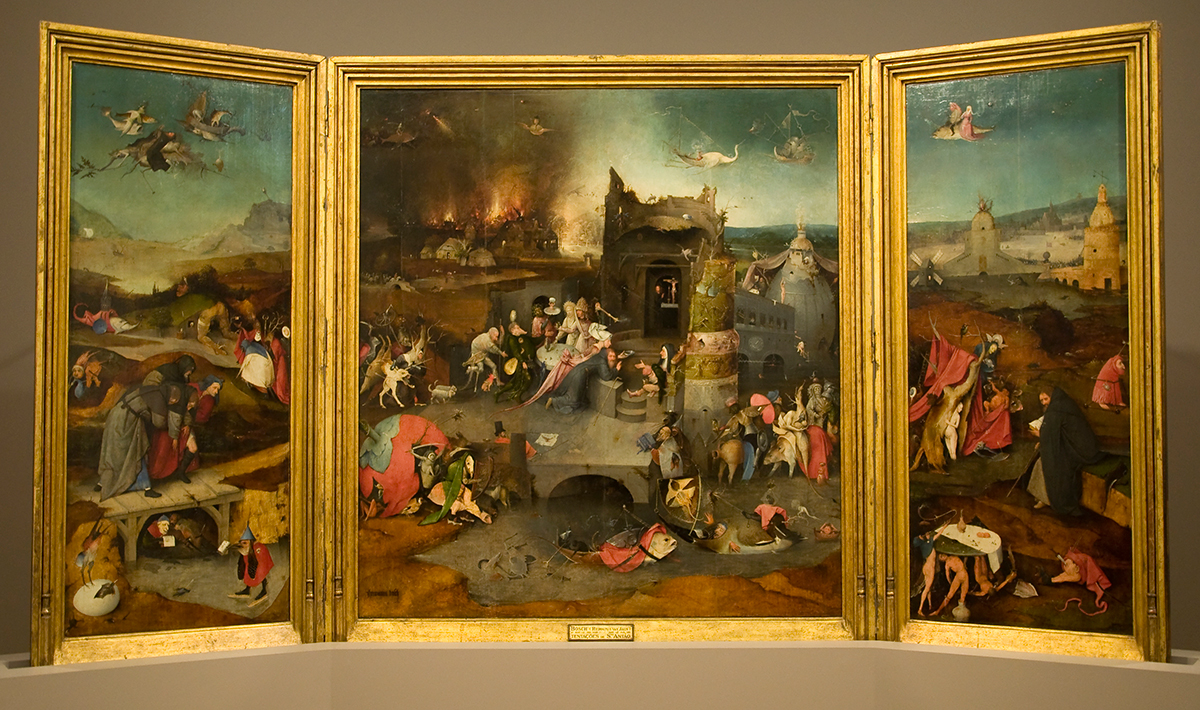
The Temptation of Saint Anthony in Lisbon is another major anchor. The MNAA/Google Arts route identifies the triptych as signed by Bosch and held by the Museu Nacional de Arte Antiga, while related museum and print records show how the Saint Anthony composition generated versions, copies, and after-Bosch images. The subject was ideal for Bosch: a holy figure remains still while visions of appetite, fear, violence, false devotion, and grotesque invention swirl around him. The open triptych can be read as temptation made visible.
Death and the Miser in the National Gallery of Art, Washington, is smaller than the triptychs but central to Bosch's moral imagination. The NGA identifies it as a work by Bosch, c. 1485/1490, and makes its object media freely available in the public domain. The painting stages a deathbed choice: a miser turns between worldly wealth and spiritual reckoning. Its narrow room, hovering death, angelic prompt, and demonic pressure condense Bosch's moral universe into a single chamber.
Ship of Fools at the Louvre gives the comic side of Bosch's moral satire. The Louvre records the work as La Nef des fous, dates it broadly to 1475/1500, and connects its modern title with its rediscovery in 1914 and with Sebastian Brant's 1494 Ship of Fools tradition. Restoration material from the Louvre and C2RMF has also clarified iconographic details after the removal of old varnish and repaints. The painting is fragmentary in the larger sense too: it belongs to a network of surviving panels and lost parts often discussed with The Pedlar or Wayfarer, Death and the Miser, and scenes of gluttony and lust.
Christ Mocked (The Crowning with Thorns) in the National Gallery, London, shows a different register: compressed, confrontational, and psychologically taut. The National Gallery dates it about 1510 and notes that it is the only painting of Christ mocked now known that can be attributed to Bosch. Lorne Campbell's catalogue entry and the Gallery's technical notes point to underdrawing changes and an unfinished Saint Christopher beneath the painting. Here Bosch reduces spectacle and pushes the viewer close to Christ's face, surrounded by tormentors whose expressions become a moral field.
Devotion, Sin, Folly, and Fear
Bosch's painted subjects often combine devotion with moral exposure. Saints are tested, pilgrims stray, fools feast, sinners grasp at worldly reward, and bodies become comic or monstrous signs of inward disorder. These are not private nightmares detached from Christian culture. They are painted meditations on temptation, salvation, judgement, and the instability of human desire.
The Seven Deadly Sins and the Four Last Things makes that moral framework explicit, while also demonstrating the need for attribution caution. The Prado attributes the table to Bosch and dates it 1505-1510, discussing both its iconography and the scholarly arguments around authenticity. BRCP/Closer and related scholarship have complicated the picture, so public discussion should not treat the attribution as uncontested. The work remains important because its circular design turns sin into an all-seeing moral diagram, but the authorship question belongs in the reader's understanding of it.
Other works make sin less diagrammatic and more theatrical. The Haywain presents humanity chasing a load of hay as if it were the prize of life. Ship of Fools gathers singers, drinkers, and religious figures into a drifting comedy of appetite. Death and the Miser reduces moral choice to a last, pressured moment. The Cure of Folly, known through the Prado as The Extraction of the Stone of Madness, satirizes false healing and fraudulent wisdom, but it also sits among Bosch's attribution-sensitive works and requires careful alignment between Prado and BRCP evidence.
Bosch's hell imagery is famous because it is visually inexhaustible, but it is most powerful when seen as part of this moral system rather than as mere fantasy. In the Garden, Last Judgement, Haywain, and the afterlife-related works in Venice, hell is not only a place of punishment. It is the end point of choices, habits, temptations, and forms of blindness that Bosch has already shown in the world.
Technique and Looking Closely
Modern technical study has changed the way Bosch's paintings are understood. Infrared reflectography, X-radiography, dendrochronology, paint sampling, conservation treatment, and high-resolution imaging reveal revisions, underdrawing, workshop habits, later repainting, and sometimes hidden or abandoned compositions. These methods do not replace interpretation, but they discipline it.
The Prado's technical material for The Haywain and Garden helps explain how Bosch planned and revised large, complex panels. The National Gallery's study of Christ Mocked shows underdrawing that was more brutal before the final painting was moderated, as well as the unfinished Saint Christopher beneath the surface. Boijmans' restoration work on Saint Christopher documents ultraviolet photography, raking light, XRF, infrared, X-rays, paint samples, structural issues, varnish, and unstable paint. The Stadel's Ecce Homo record offers another strong object route, with a public-domain image designation and institutional object data.
Technical evidence also helps with attribution. Underdrawing style, panel construction, support type, paint handling, and changes during execution can all bear on whether a work belongs to Bosch, his workshop, a follower, or a copyist. This is why Style and Technique belongs beside Workshop and Attribution: Bosch's style is not just a matter of strange imagery, but of how an image was made.
Workshop, Followers, and Disputed Works
Bosch's fame spread quickly, and his inventions were copied, adapted, and transformed. Some surviving paintings are best understood as workshop products, follower works, or later images after Bosch. Others remain debated because museum records, older scholarship, and BRCP research do not always align.
The distinction is especially visible around works such as The Seven Deadly Sins, The Cure of Folly, Christ Carrying the Cross, Concert in the Egg, and the many images attached to Boschian devils, musicians, witches, fools, and grotesque heads. The MSK/Vlaamse Kunstcollectie route for Christ Carrying the Cross, for example, preserves the work's power while also acknowledging debated authorship in the current public record. Concert in the Egg is a different kind of case: current routes identify it as follower of or after Bosch rather than by Bosch, making it useful for reception and imitation but risky as a straightforward Bosch artwork.
The after-Bosch print tradition adds another layer. Bosch is not known through secure autograph prints in the way that Durer is, but his inventions circulated through printmakers, copyists, publishers, and later artists. Records at the Met, NGA, Rijksmuseum, and British Museum show how Boschian subjects and styles moved through prints after Bosch and related visual culture. This print culture helps explain why the Boschian imagination became so widely available, and why later viewers often encounter "Bosch" as a style before they encounter the smaller accepted group of paintings.
How to Read Bosch's Paintings
Bosch rewards close looking, but he resists simple decoding. A bird, fruit, musical instrument, broken vessel, funnel, knife, owl, hollow tree, or hybrid creature may carry moral or cultural associations, but not every detail has a single fixed meaning. The better question is often how details behave together. Are they tempting the viewer into curiosity? Mocking human appetite? Turning a sacred scene into a test of attention? Linking bodily comedy to spiritual danger?
The most reliable readings usually begin with object facts, current attribution, format, subject, patronage, technical evidence, and comparison with related works. The Garden is clearer when seen beside Haywain and Last Judgement. Ship of Fools is richer when connected to The Pedlar/Wayfarer and Death and the Miser. The Adoration of the Magi gains depth through its donor portraits and reverse imagery. Christ Mocked becomes more intense when its technical history is considered.
Bosch's paintings survive as objects, arguments, and questions. They belong to oak panels, workshop practice, devotional use, courtly ownership, technical study, and centuries of imitation. Their strangeness is real, but it is not shapeless. It grows from a disciplined painterly intelligence: one that could turn moral theology into crowds, temptation into theatre, and the act of looking into a test of the soul.
Browse more works and related attributions
This selection includes works attributed to Bosch, workshop productions, later copies and works formerly associated with him. Follow each article for the collection, object identity and attribution evidence.


Artworks and related attributions
Browse paintings, drawings and related attributions. Records group triptychs, fragments and two-sided sheets where appropriate. Dates follow the cited museum records or catalogue headings and are generally estimates. Rows marked “2016 catalogue” report that publication’s attribution and collection information; these are dated opinions, rather than a claim that every work is an accepted autograph Bosch.
| Name | Date | Medium, attribution and collection |
|---|---|---|
| A Crossbowman | Second half of the sixteenth century | Oil on oak panel · Copy after Hieronymus Bosch · Museo Nacional del Prado, Madrid · P002695 Source 1. Source 2. |
| A Woman Spinning and an Old Woman | Museum estimates: about 1480–1490 for the women and 1500–1505 for the reverse; the precise chronology is disputed | Pen and brown and grey ink on the front; pen and brown ink on the reverse · Hieronymus Bosch · Museum Boijmans Van Beuningen, Rotterdam · N 190 recto and verso (PK) Source 1. Source 2. |
| Adoration of the Child in Cologne | Second half of the sixteenth century | Oil on oak panel · Imitator of Hieronymus Bosch, in the city collection record · Wallraf-Richartz-Museum & Fondation Corboud, Cologne · WRM 0474 Source 1. Source 2. |
| Adoration of the Magi in Philadelphia | Early sixteenth century in the museum record; around 1495–1520 in the BRCP catalogue | Oil on oak panel · Hieronymus Bosch in the museum record; workshop of Bosch in the 2016 BRCP catalogue · Philadelphia Museum of Art, John G. Johnson Collection, 1917 · 1321; museum object 103592 Source 1. Source 2. |
| Adoration of the Magi — New York | c.1470–1480 | 2016 catalogue: Bosch; oil on oak · Metropolitan Museum 13.26 2016 catalogue. |
| Adoration of the Magi — Prado triptych | c.1494 | Oil on oak; grisaille exterior · Bosch · Prado P002048 Object source. |
| Adoration of the Magi — three associated fragments | c.1515–1535 | 2016 catalogue: Follower of Bosch · Two Shepherds / Retinue in Philadelphia; associated Adoration in private collection in 2016 2016 catalogue. |
| Ascent of the Blessed — Venice | c.1505–1515 | Oil on panel · Bosch · Gallerie dell’Accademia; Visions of the Hereafter Object source. |
| Battle of the Birds and Mammals | Not specified in catalogue heading | 2016 catalogue: Bosch; pen and brown ink · Berlin KdZ 14715 2016 catalogue. |
| Beggars and Musicians | Around 1530–1540 | Ink and wash on paper · Unknown follower of Hieronymus Bosch · Albertina, Vienna · 7798 Source 1. Source 2. |
| Christ Carrying the Cross Drawing | Around 1470 in the museum catalogue | Black chalk or charcoal, pen and brush in brown ink, white corrections · Anonymous, workshop of Rogier van der Weyden · Museum Boijmans Van Beuningen, Rotterdam · N 81 recto and verso (PK) Source 1. Source 2. |
| Christ Carrying the Cross in Vienna | Around 1490–1510 in the current KHM record and BRCP catalogue | Oil on oak, painted on both sides · Hieronymus Bosch; possible workshop involvement in the Passion side discussed by the BRCP · Kunsthistorisches Museum, Vienna · Gemäldegalerie, GG 6429 Source 1. Source 2. |
| Christ Carrying the Cross — El Escorial | c.1495–1505 | 2016 catalogue: Bosch; oil on oak · Patrimonio Nacional 10014739 2016 catalogue. |
| Christ Carrying the Cross — Ghent | c.1510–1516 (museum) | Oil on panel · Bosch in museum listing; authorship disputed · MSK Ghent 1902-H Object source. |
| Christ Mocked — London | c.1510 | Oil on wood · Bosch · National Gallery NG4744 Object source. |
| Concert in the Egg, After Hieronymus Bosch | Around 1561; third quarter of the sixteenth century | Oil on canvas · Anonymous, after Hieronymus Bosch · Palais des Beaux-Arts, Lille · P 816 Source 1. Source 2. |
| Conjurer / Comical Concert — Louvre drawing | Not specified in catalogue heading | 2016 catalogue: Bosch (recto), follower (concert verso) · Pen and brown ink · Louvre INV 19197 2016 catalogue. |
| Conjurer / Cross-bearing and beggars — Liège sheet | Not specified in catalogue heading | 2016 catalogue: Bosch (verso), follower (recto) · Pen and brown ink · Album d’Arenberg 534 2016 catalogue. |
| Crowning with Thorns — El Escorial | c.1530–1540 | 2016 catalogue: Follower of Bosch; oil on oak · Patrimonio Nacional 10014743 2016 catalogue. |
| Crucifixion with a Donor | Circa 1495–1505; Circa 1490–1500 | Oil on oak panel · Hieronymus Bosch · Royal Museums of Fine Arts of Belgium, Brussels · 6639 Source 1. Source 2. |
| Death and the Miser Drawing | Not securely established; probably made after the painting | Pen and brush, dark ink and white highlights on prepared paper · Workshop of Hieronymus Bosch in the BRCP catalogue; alternatives recorded by the Louvre · Musée du Louvre, Department of Prints and Drawings, Paris · RF 6947, Recto Source 1. Source 2. |
| Death and the Miser — Washington | c.1485/1490 (NGA) | Oil on panel · Bosch · National Gallery of Art 1952.5.33 Object source. |
| Ecce Homo Triptych — Boston | c.1495–1500; wings c.1500/1503 | 2016 catalogue: Workshop of Bosch; oil on oak · Museum of Fine Arts Boston; several production phases 2016 catalogue. |
| Ecce Homo — Frankfurt | c.1490 | Mixed technique on oak · Bosch · Städel 1577 Object source. |
| Fall of the Damned — Venice | c.1505–1515 | 2016 catalogue: Bosch; oil on panel · Visions of the Hereafter · Venice 2016 catalogue. |
| Garden of Earthly Delights | 1490–1500 (Prado) | Oil on oak; grisaille exterior · Bosch · Prado; triptych Object source. |
| Gluttony and Lust / Allegory of Intemperance — Yale fragment | c.1500–1510 (group dating) | 2016 catalogue: Bosch; oil on oak · Yale 1959.15.22; fragment associated with Ship of Fools 2016 catalogue. |
| Group of Ten Spectators, a Follower of Bosch | Around 1510–1540 in the current museum record | Pen and two brown inks on paper, with a brown framing line · Follower of Hieronymus Bosch in the Morgan record; Bosch in the BRCP catalogue · Morgan Library & Museum, New York · I, 112 Source 1. Source 2. |
| Head of an Old Woman | About 1500 | Oil on panel · Attributed to Jacob Cornelisz. van Oostsanen · Museum Boijmans Van Beuningen, Rotterdam · 2439 (OK) Source 1. Source 2. |
| Hell and the Flood — Rotterdam panels | Around 1515 in the museum records; around 1510–1520 in the BRCP catalogue | Oil on oak panels · Jheronimus Bosch in the museum records; workshop of Bosch in the BRCP catalogue · Museum Boijmans Van Beuningen, Rotterdam Source 1. Source 2. |
| Hermit Saints Triptych | Circa 1495–1505 | Oil on oak panels · Hieronymus Bosch · Gallerie dell’Accademia, Venice · 2044 Source 1. Source 2. |
| Infernal Landscape | Not specified in catalogue heading | 2016 catalogue: Bosch; pen and brown ink, red accent · Private collection in 2016 2016 catalogue. |
| Infernal Scene with Anvil / Monster Studies | Not specified in catalogue heading | 2016 catalogue: Bosch; attribution debated in entry · Pen and brown ink · Berlin KdZ 548 2016 catalogue. |
| Infernal Scene with Tree-Man / Standing Man | Not specified in catalogue heading | 2016 catalogue: Workshop of Bosch; pen and brown ink · Dresden C 1875; historical reverse title includes a proposed prophet 2016 catalogue. |
| Job Triptych — Bruges | c.1510–1520 | 2016 catalogue: Workshop of Bosch; oil on oak · Groeningemuseum / Hoeke loan in 2016 2016 catalogue. |
| Last Judgement — Bruges triptych | c.1495–1505 | 2016 catalogue: Bosch; oil on oak · Groeningemuseum 2016 catalogue. |
| Last Judgement — Munich fragment | c.1530–1540 | 2016 catalogue: Follower of Bosch; oil on oak · Alte Pinakothek 5752 2016 catalogue. |
| Last Judgement — Vienna triptych | c.1500–1505 (BRCP 2016) | Oil on oak · Bosch and workshop (BRCP 2016) · Academy of Fine Arts Vienna 2016 catalogue. |
| Man in a Basket and Comic Figures | Around 1500–1515 in the museum record | Pen and brown ink on paper; the reverse is catalogued as iron-gall ink · Hieronymus Bosch in the current Albertina record; attribution has been debated · Albertina, Vienna · 7797 recto and verso Source 1. Source 2. |
| Man Seen from Behind | About 1550–1569; About 1565–1570 | Traces of black chalk, pen and brush in light brown ink · Anonymous, circle of Pieter Bruegel the Elder · Museum Boijmans Van Beuningen, Rotterdam Source 1. Source 2. |
| Mary and John at the Foot of the Cross | About 1440 | Brush in grey and black · Unknown, possibly Netherlandish · Kupferstich-Kabinett, Staatliche Kunstsammlungen Dresden · C 815 Source 1. Source 2. |
| Model Sheet with ‘Witches’ | Disputed; proposals depend on the attribution | Pen and brown ink; the BRCP also records underlying black chalk · Hieronymus Bosch; follower attributions also recorded · Musée du Louvre, Département des Arts graphiques, Paris · INV 19721 recto Source 1. Source 2. |
| Peasant and Three Bust-Length Figures | 1401–1500 | Brown pen over a black preliminary drawing · Attributed to the Master of the Drapery Studies; Bosch circle also recorded · Kupferstichkabinett, Staatliche Museen zu Berlin · KdZ 777 Source 1. Source 2. |
| River to Hell — Venice | c.1505–1515 | 2016 catalogue: Bosch; oil on panel · Visions of the Hereafter · Venice 2016 catalogue. |
| Saint Anthony and a Concert in an Egg | Around 1510–1525 in the museum’s 2016–17 exhibition texts | Pen in light and dark brown inks · Workshop of Hieronymus Bosch; underlying monsters: Bosch (BRCP), possibly Bosch (exhibition text) · Kupferstichkabinett, Staatliche Museen zu Berlin · KdZ 711 recto and verso Source 1. Source 2. |
| Saint Christopher Carrying the Christ Child | c.1500; 1490–1505 in restoration material | Oil on panel · Bosch · Boijmans St 26 Object source. |
| Saint James and Hermogenes | About 1551–1575 in the KIK-IRPA catalogue | Oil on wood, painted on both sides · Anonymous follower of Hieronymus Bosch · Musée des Beaux-Arts, Valenciennes · P.46.1.44; older number 176 Source 1. Source 2. |
| Saint Jerome at Prayer | Circa 1485–1495 | Oil on oak panel · Hieronymus Bosch · Museum of Fine Arts, Ghent · 1908-H Source 1. Source 2. |
| Saint John on Patmos / Passion Scenes | c.1495–1505; estimates vary | Oil on oak · Bosch · Gemäldegalerie Berlin 1647A Object source. |
| Saint John the Baptist in Meditation | Late 15th century; c.1485–1510 (Prado exhibition) | Oil on panel · Bosch · Lázaro Galdiano 8155 Object source. |
| Saint Liberata Triptych | Circa 1495–1505 | Oil on oak panels · Hieronymus Bosch · Gallerie dell’Accademia, Venice · 2045 Source 1. Source 2. |
| Seven Deadly Sins and the Four Last Things | 1505–1510 (Prado) | Oil on poplar · Bosch (Prado); workshop/follower disputed · Prado Object source. |
| Ship of Fools — Louvre painting | 1475–1500 (record); c.1505–1515 (exhibition) | Oil on oak · Bosch · Louvre RF 2218; fragment Object source. |
| Ship of Fools — Louvre workshop drawing | Not specified in catalogue heading | 2016 catalogue: Workshop of Bosch · Pen, brush, grey-brown ink and white highlights on prepared paper · Louvre RF 3714 2016 catalogue. |
| Studies of Monsters | About 1530–1550, according to the current Ashmolean record | Pen and brown ink on laid paper, both faces · Anonymous follower of Hieronymus Bosch · Ashmolean Museum, University of Oxford · WA1863.155 Source 1. Source 2. |
| Studies of Saint Anthony and Monsters | No execution date specified in the current Louvre records | Pen and brown ink on paper · Bosch listed; reverse questioned by Louvre; BRCP accepts both faces · Musée du Louvre, Département des Arts graphiques, Paris · INV 20871 recto and verso Source 1. Source 2. |
| Temptation of Saint Anthony — Kansas City fragment | c.1500–1510 | 2016 catalogue: Bosch; oil on oak · Nelson-Atkins 35–22 2016 catalogue. |
| Temptation of Saint Anthony — Lisbon triptych | c.1500 | Oil on oak · Bosch · Museu Nacional de Arte Antiga 1498 Pint Museum. |
| Temptation of Saint Anthony — Prado panel | c.1530–1540 | 2016 catalogue: Follower of Bosch (2016 opinion); oil on oak · Prado P002049 2016 catalogue. |
| Terrestrial Paradise | Approximately 1505–1515 | Oil on oak panel · Hieronymus Bosch · Gallerie dell'Accademia, Venice Source 1. Source 2. |
| The Burning Ship Drawing | 1500–1520 | Pen and iron gall ink on paper · Attributed to Hieronymus Bosch · Academy of Fine Arts Vienna, Graphic Collection · HZ-2554; numbered 2554 in the BRCP catalogue Source 1. Source 2. |
| The Comical Barber Scene | About 1550–1580, according to the British Museum | Pen and brown ink, grey and brown wash, over black chalk · Anonymous follower, after Hieronymus Bosch · British Museum, Department of Prints and Drawings, London · 1854,0628.46 Source 1. Source 2. |
| The Conjuror, After Hieronymus Bosch | Probably after 1525; around 1530–1540 in the BRCP technical report | Oil on oak panel · Anonymous follower of Hieronymus Bosch · Musée Ducastel-Vera, Saint-Germain-en-Laye · 872.1.87 Source 1. Source 2. |
| The Cure of Folly / Extraction of the Stone of Madness | 1501–1505 (Prado) | Oil on oak · Bosch (Prado); workshop/follower disputed · Prado P002056 Object source. |
| The Entombment Drawing | About 1505–1515, current museum record | Brush and black and grey ink, with grey wash, over black chalk · Workshop of Hieronymus Bosch; drawn by the Master of the Prado Haywain Triptych; Hieronymus Bosch, argued by the BRCP in 2016 · British Museum, Department of Prints and Drawings, London · 1952,0405.9 Source 1. Source 2. |
| The Gathering of the Birds | Not specified in catalogue heading | 2016 catalogue: Bosch; pen and brown ink · Berlin KdZ 13136 2016 catalogue. |
| The Haywain — Prado triptych | 1510–1516 (BRCP 2016) | Oil on oak · Bosch (BRCP 2016) · Prado; separate Escorial version exists 2016 catalogue. |
| The Hearing Forest and the Seeing Field | Circa 1500–1505 | Pen and brown ink on paper · Hieronymus Bosch; reverse: Bosch and workshop · Kupferstichkabinett, Staatliche Museen zu Berlin · KdZ 549, front and reverse Source 1. Source 2. |
| The Owl’s Nest — Rotterdam | Not specified in catalogue heading | 2016 catalogue: Bosch; pen and brown ink · Boijmans N 175 2016 catalogue. |
| The Passion Triptych in Valencia | Workshop of Bosch, about 1510–1520; Follower of Bosch; centre about 1530–1540, wings about 1540–1550 | Oil and gold on oak panels · Workshop of Bosch, about 1510–1520; Follower of Bosch; centre about 1530–1540, wings about 1540–1550 · Museu de Belles Arts de València Source 1. Source 2. |
| The Pedlar / Wayfarer — Rotterdam | c.1500 (museum) | Oil on panel · Bosch · Boijmans 1079 (OK); rejoined exterior Object source. |
| The Tree-Man — Vienna drawing | c.1505 | Pen and brown ink · Bosch · Albertina, Vienna Object source. |
| The Wedding at Cana, After Hieronymus Bosch | Approximately 1560 in the current museum record | Oil on panel, 93 cm high × 72 cm wide · Anonymous, after Hieronymus Bosch · Museum Boijmans Van Beuningen, Rotterdam, St 25 Source 1. Source 2. |
| Two Fantastical Creatures — Berlin KdZ 550 | Around 1505–1515 in the museum’s 2016 exhibition text | Pen in brown ink on reddish prepared laid paper · Hieronymus Bosch · Kupferstichkabinett, Staatliche Museen zu Berlin · KdZ 550, recto and verso Source 1. Source 2. |
| Two Figures Wearing Mitres | About 1480 | Oil on panel · Anonymous (Boijmans); Bosch circle (RKD) · Museum Boijmans Van Beuningen, Rotterdam · 1177 (OK) Source 1. Source 2. |
| Two Men and the Temptation of Eve | About 1505–1515 in the Prado’s 2016 exhibition guide | Pen and grey-brown ink on paper · Hieronymus Bosch in the 2016 catalogues discussed here · Private collection, as recorded in 2016 Source 1. Source 2. |
| Two Men Fighting | Not specified in the current Louvre record | Pen and brown ink · In the manner of Hieronymus Bosch · Musée du Louvre, Département des Arts graphiques, Paris · INV 20660 recto; formerly NIII 8896 and MA 8400 Source 1. Source 2. |
| Two Men — Berlin KdZ 5210 | Not specified in catalogue heading | 2016 catalogue: Bosch questioned · Pen, brush, ink, chalk and white highlights · Berlin KdZ 5210; historical title Two Oriental Men 2016 catalogue. |
| Two Monsters — Berlin KdZ 547 | Approximately 1500–1510 in Berlin's 2016 exhibition catalogue; an estimated range | Pen and brown ink on paper · Hieronymus Bosch · Kupferstichkabinett, Staatliche Museen zu Berlin · KdZ 547, drawn on both sides Source 1. Source 2. |
Discussion
Look again at the images and ideas explored in Hieronymus Bosch Paintings. These editorial prompts invite your observations.
Reader Insights
Which detail or passage most changes how you understand this subject?
Which comparison with another work by Bosch helps you see it differently?
Which interpretation is best supported by the sources, and which remains uncertain?
Join the Conversation
Share a detail, comparison or question about Hieronymus Bosch Paintings below.
References
- Bosch Research and Conservation Project, project and publication information: View source
- Closer to Bosch, Bosch Research and Conservation Project interactive research platform: View source
- BoschDoc / Huygens ING / KNAW: View source
- Erfgoed 's-Hertogenbosch, De Kleine Winst / Van Aken workshop: View source
- Museo Nacional del Prado, The Garden of Earthly Delights Triptych: View source
- Museo Nacional del Prado, The Haywain Triptych: View source
- Museo Nacional del Prado, Triptych of the Adoration of the Magi: View source
- Museo Nacional del Prado, Table of the Seven Deadly Sins: View source
- Museo Nacional del Prado, The Extraction of the Stone of Madness: View source
- Museo Nacional del Prado, Controversies Regarding Hieronymus Bosch: View source
- Academy of Fine Arts Vienna, The Last Judgement Triptych: View source
- National Gallery of Art, Washington, Death and the Miser: View source
- Louvre Collections, La Nef des fous: View source
- Louvre, restoration note on La Nef des fous: View source
- National Gallery, London, Christ Mocked (The Crowning with Thorns): View source
- National Gallery, London, Lorne Campbell catalogue entry on Christ Mocked: View source
- Museum Boijmans Van Beuningen, The Pedlar: View source
- Museum Boijmans Van Beuningen, Jheronimus Bosch in the Restoration Studio: View source
- Stadel Museum, Ecce Homo: View source
- Museum of Fine Arts Ghent, Christ Carrying the Cross: View source
- Flemish Art Collection, Christ Carrying the Cross: View source
- Google Arts & Culture / MNAA, Tentacoes de Santo Antao: View source
- Clowes Collection, Temptation of St. Anthony after Bosch: View source
- Metropolitan Museum of Art, The Temptation of St. Anthony after Bosch: View source
- British Museum, after-Bosch print records including Shrove Tuesday or the Fool's Kitchen: View source