 by Tom Gurney
Tom Gurney BSc (Hons) is an art history expert with over 20 years experience
Published on June 19, 2020 / Updated on November 4, 2026
Email: tomgurney1@gmail.com / Phone: +44 7429 011000
Ascent of the Blessed and Bosch's Visions of the Hereafter: Introduction
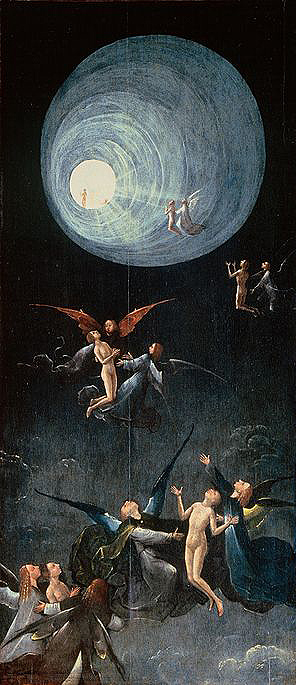
Hieronymus Bosch's Ascent of the Blessed is one of the strangest images of salvation in Northern Renaissance painting. Instead of a crowded heaven with thrones, choirs, jewels and formal ranks of saints, Bosch gives the viewer a vertical field of cloud, darkness and guided movement. Naked souls, small and fragile, are lifted by angels toward a circular passage of light. At the far end of that tunnel, the forms almost dissolve into brightness.
The panel belongs to the group usually called Visions of the Hereafter or the four afterlife panels in Venice. They are now associated with the Gallerie dell'Accademia in Venice and are recorded as coming from the collection of Cardinal Domenico Grimani. The museum dates the group to about 1505-1515 and presents it as oil on panel by Bosch, while noting that scholars have not agreed on the panels' original arrangement or function. They may once have belonged to a more complex composition, perhaps connected with the Last Judgment, and may have served as side panels rather than as an independent set from the start. [1]
That uncertainty matters. The Venice panels invite dramatic storytelling, but their surviving condition asks for restraint. They are not a complete, safely reconstructable machine of salvation and damnation. They are fragments, or at least survivors from a larger visual idea whose full setting has been lost. What can be said with confidence is already powerful: Bosch arranged an afterlife sequence in which paradise, ascent, fall and hell become almost physical experiences. The viewer is not simply told that souls are saved or damned. The viewer watches them rise, drop, drift, cling, disappear and enter light.
Contents
- The Venice Afterlife Panels
- What Happens in Ascent of the Blessed
- Paradise Before Ascent
- Descent and Hell
- A Last Judgment Without the Whole Machine
- Attribution and Date Caution
- Why the Tunnel Matters
- Bosch's Afterlife Imagination
- How to Look at Ascent of the Blessed
Compare these works across Bosch’s career
These date ranges are estimates, not a documented year-by-year sequence. These works provide context for the article; none is highlighted as the object discussed here.
Saint Jerome at Prayer
Circa 1485–1495 [2]Crucifixion with a Donor
Circa 1490–1500 (BRCP) [2]Hermit Saints Triptych
Circa 1495–1505 [2]Saint Liberata Triptych
Circa 1495–1505 [2]The Hearing Forest and the Seeing Field
Circa 1500–1505 (Berlin exhibition) [3]The Haywain Triptych
1510–1516 (BRCP) [2]The Venice Afterlife Panels
The four works are commonly identified as The Garden of Eden or Terrestrial Paradise, The Ascent of the Blessed, The Fall of the Damned and The River to Hell or Hell. The Bosch Research and Conservation Project's catalogue tradition records the group as BRCP Cat. 18.1-18.4, with the panels painted in oil on oak and dated around 1505-1515. [4] The dimensions differ slightly from panel to panel, but each is tall and narrow, a format that suits the sensation of passage. These are not broad narrative landscapes like The Garden of Earthly Delights or panoramic triptychs like The Last Judgement. They feel more like doors, shafts, cliffs or thresholds.
The Gallerie dell'Accademia describes the group as moving through four "stages" from Heaven to Hell. At one end stands a lush garden inhabited by the elect, naked because they are imagined as free from sin. At the other is a sulphurous infernal swamp where demons torment sinners. Between those poles are two passages: one upward, with blessed souls led by angels toward a tunnel of light, and one downward, with souls falling toward hell. [1]
This is why the Ascent panel works best when it is not isolated from the group. Seen alone, it can look almost gentle: clouds, angels, bodies relieved of earthly weight, and a radiant destination. Seen with the others, it becomes one half of a terrible balance. Bosch places heavenly movement against infernal movement. The saved are guided; the damned are seized. The blessed travel toward form-dissolving light; the damned descend into darkness, smoke, water and monstrous force.
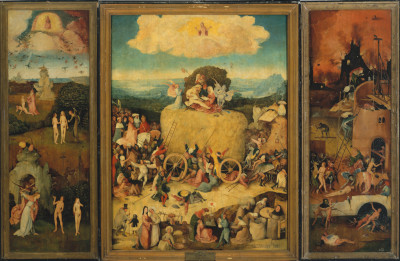
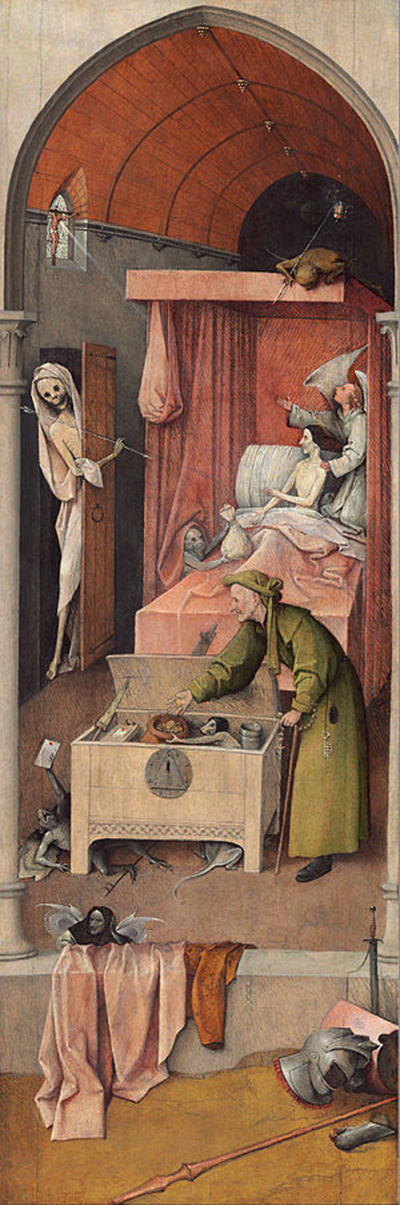
That paired logic also connects the Venice group to the wider architecture of Bosch's paintings. Again and again, Bosch imagines moral life as a path, a crossing or a perilous journey. In The Haywain Triptych, humanity follows a wagon of worldly desire toward judgment. In Death and the Miser, a soul is pressed between last-minute mercy and worldly attachment. In The Last Judgement, creation, sin and punishment unfold across an immense triptych. The Venice panels are more compressed, but they belong to the same moral universe.
What Happens in Ascent of the Blessed
In Ascent of the Blessed, Bosch removes almost everything that might anchor the scene to earthly space. There is no architecture, no city, no landscape horizon and no saintly court. The bodies rise through a zone of vapour. Angels accompany the souls in pairs or small groups, supporting them as they travel upward through the picture. Near the top, a circular tunnel opens into a brilliant glow. Within that passage, the figures become smaller and less distinct, as if the final stage of salvation cannot be described by ordinary bodily presence.
The image is quiet by Bosch's standards, but not simple. Bosch is famous for teeming inventions: hybrid beasts, tool-like demons, edible architecture, musical instruments turned into torture devices, birds and vessels given unsettling roles. Here he suppresses most of that machinery. The drama depends on direction, scale and light. The viewer's eye moves with the souls, from lower cloud to higher cloud, from visible flesh to bright aperture.
That restraint makes the panel unusually affecting. Bosch's hells often feel overloaded because damnation multiplies sensation. Pain, noise, heat, cold, fear, crowding and grotesque invention seem to arrive all at once. Salvation, in this panel, is a thinning-out. It is not empty, but it is simplified. The saved are not triumphant heroes. They are carried. Their bodies remain vulnerable, and their ascent depends on angelic guidance.
The tunnel of light is the panel's unforgettable invention. It is both spatial and symbolic: an opening through which the blessed move, a destination that cannot be fully seen, and a visual answer to the smoky or watery depths of Bosch's infernal scenes. Modern discussions have sometimes noticed its resemblance to later descriptions of passage into light, but the safer historical context is medieval Christian eschatology: stories of visionary journeys through hell, purgatory and heaven, devotional images of judgment, and Netherlandish traditions of angelic escort. Grzegorz Kubies's study of the panel places it in relation to eschatological literature, Netherlandish and Flemish painting, and modern near-death-experience comparisons while still stressing the old problem that the panels' original function is unknown. [5]
Paradise Before Ascent
The Garden of Eden or Terrestrial Paradise panel supplies the gentler counterpart to the Ascent. The Gallerie describes Heaven as a lush garden inhabited by sinless human beings, and the Bosch Project summary likewise treats two of the panels as devoted to the saved. [1][4] This paradise is not the same as the left wing of The Garden of Earthly Delights, though the comparison is revealing. Bosch often imagines paradise as beautiful but strange: trees, water, animals, mineral forms and human bodies coexist in an atmosphere that is never merely decorative.
In the Venice group, paradise is not the final visual climax. It is one stage in a sequence. The garden belongs to the blessed, but Ascent of the Blessed turns salvation into motion beyond the garden. The souls are not simply placed in a beautiful enclosure; they are led toward a brightness beyond the panel's ordinary space. The distinction is important because it keeps Bosch's afterlife from becoming a simple map. Paradise, purgatorial passage, heavenly ascent, fall and hell are visual states, not surveyed territories.
The Gallerie also notes possible literary contexts, including the twelfth-century Vision of Tnugdalus and Dante's Divine Comedy. The point is not that Bosch illustrated either text directly. The safer claim is that such visionary literature formed part of the imaginative world in which journeys through the afterlife could be pictured as sequences of terror, instruction, purification and final encounter. The Gallerie adds a suggestive local detail: Dante was translated into Dutch in 1484 in Bosch's hometown of s-Hertogenbosch. [1] That does not prove Bosch read Dante, but it shows how afterlife narrative could circulate through the linguistic and devotional environment of his world.
Descent and Hell
The darker half of the Venice group belongs to Bosch's infernal imagination. In The Fall of the Damned, souls plunge downward rather than rise. In The River to Hell or Hell, the damned enter a swamp-like world of demons and punishment. The Bosch Project summary stresses the recurring importance of heaven and hell in Bosch's oeuvre and describes the damned panels as scenes in which demons drag souls toward the inferno amid smoke and fire. [4]
These panels also sharpen the meaning of Ascent of the Blessed. Bosch does not imagine the afterlife as a neutral continuation of earthly experience. It is a division of destinies. Bodies are still bodies, but they are subject to opposite forces. The blessed are held, accompanied and directed. The damned are pulled, pushed and overwhelmed. In one panel, the soul moves through a tunnel toward radiance; in another, it drops through a rocky darkness or is drawn into infernal water.
This contrast explains why the Venice group belongs beside Bosch's Hell imagery rather than apart from it. Bosch's hells are not merely horror scenes. They complete the moral pressure of his art. His demons and punishments are grotesque because they externalize disordered desire, spiritual blindness and the consequences of sin. In the Venice panels, that terrifying invention is set against one of Bosch's clearest images of hope. Salvation exists, but it is narrow, guided and almost weightless; damnation is crowded, smoky and physically coercive.
The relationship to The Last Judgement is especially strong, though it should not be overstated. The Gallerie records the scholarly view that the panels may have formed part of a larger composition, possibly on the theme of the Last Judgment. [1] Reutersward's 1991 article also addressed the four afterlife panels in Venice and proposed an order in which fall, purgatory, earthly paradise and ascension would offer hope at the moment of death. [6] Such proposals are valuable because they show how scholars have tried to make sense of the surviving panels, but they remain reconstructions. The surviving works do not force a single arrangement.
A Last Judgment Without the Whole Machine
Bosch's great triptychs often depend on opening and unfolding. Closed wings, outer grisaille, inner panels, side wings and central fields work together. The viewer encounters time, narrative and revelation through the physical format of the object. The Venice panels are harder to read because that physical logic is partly missing. If they once belonged to a larger Last Judgment structure, the centre and original frame of meaning have not survived in a form that lets us rebuild the whole with certainty.
Even so, the panels preserve a strong Last Judgment atmosphere. They are concerned with ultimate sorting: the separation of souls, the direction of their movement, the presence or absence of angelic aid, and the geography of punishment and beatitude. They do not show Christ as judge in the surviving scenes. They do not show the full resurrection of the dead, the weighing of souls, or the broad celestial court familiar from many Last Judgment images. Instead, they concentrate on what happens after judgment has already taken effect.
That concentration gives the group its peculiar force. The viewer does not stand before the courtroom. The viewer stands inside the consequence. Bosch shows the afterlife not as doctrine diagrammed from above, but as passage experienced from within: a body carried into light, a body thrown into depth, a body entering a garden, a body caught in hell's waters.
This is one reason the panels feel so different from the full moral panoramas of Bosch's style and technique elsewhere. In larger works, Bosch often builds meaning through density: tiny episodes, odd objects, visual rhymes and crowded surfaces. In Ascent of the Blessed, meaning comes from an almost architectural reduction. The tunnel is the composition's great form. The angels and souls enact its promise.
Attribution and Date Caution
The Gallerie dell'Accademia presents the Venice group under Bosch's name and dates it to about 1505-1515. [1] The Bosch Project/Bossche Encyclopedie summary also records the group as Jheronimus Bosch, oil on oak, with BRCP catalogue references. [4] At the same time, Bosch's surviving corpus is an area where careful wording matters. Works associated with him can involve questions of autograph authorship, workshop and attribution, later additions, copy traditions and changing scholarly opinion.
For the Venice panels, the most prominent caution is not a simple rejection of Bosch's authorship, but uncertainty about original configuration, order and function. The Gallerie notes that the back of the panels was decorated in imitation of marble, apparently in a summary way and probably added later by someone from the painter's workshop to suit a new decorative setting. [1] That detail is small but revealing. It suggests that the panels had a life after their first conception, and that their later display history affected how they were seen.
The date range also deserves care. Older popular references sometimes place Ascent of the Blessed around 1500-1504 or simply around 1500. The museum and BRCP-linked planning evidence used here supports the broader range around 1505-1515. That places the group in Bosch's later career, close to the period of major works in which his afterlife imagery, moral satire and visionary invention had reached exceptional concentration.
These cautions do not weaken the article's encounter with the painting. They make it more interesting. Bosch is not an artist who becomes clearer when every uncertainty is flattened. The surviving evidence is part of the experience: the Venice panels are authoritative enough to be central to Bosch's afterlife imagery, but fragmentary enough to keep their original use hauntingly open.
Why the Tunnel Matters
The tunnel in Ascent of the Blessed is one of Bosch's most memorable visual ideas because it turns theology into optics. The blessed do not merely face a gold background or stand beneath a heavenly court. They move through a passage where darkness, cloud and light form a sequence. The eye understands salvation as transition before the mind supplies doctrine.
The round opening also reverses Bosch's hellish holes, mouths, caverns and pits. In many Boschian scenes, openings are dangerous: they swallow, conceal, trap or expose. Here the opening receives the blessed. It does not devour them; it draws them toward radiance. The painting's emotional power comes from that reversal. Bosch uses a form that could have been frightening and makes it the architecture of hope.
Yet the hope is not sentimental. The blessed souls are naked and small. They do not stride upward under their own power. Angels carry them. Their bodies are still recognizably human, still in need, still dependent on grace. Bosch's symbolism often resists one-to-one decoding, and this panel is no exception. The tunnel should not be reduced to a single modern phrase or psychological metaphor. It is better understood as a visual threshold where medieval ideas of heaven, purgation, angelic escort and visionary journey converge.
That is also why Ascent of the Blessed has lasted so strongly in the modern imagination. Viewers who know little about Bosch's theological world can still follow the picture's basic movement. The body rises. The angel guides. The darkness opens. The light waits.
Bosch's Afterlife Imagination
Bosch's art is often remembered for hell, but the Venice panels remind us that his afterlife imagination includes salvation. The infernal scenes are more crowded, more sensational and more instantly recognizable as Boschian. They supply demons, punishments, smoke and helpless descent. Ascent of the Blessed offers the rarer counterweight: a Bosch image in which the fantastic is almost purified into movement and light.
This does not make the panel detached from his darker work. It depends on that darkness. Without the damned panels, the ascent might feel like a private mystical vision. With them, it becomes part of a moral drama in which human destiny divides. Without Bosch's broader hell imagery, the tunnel might seem serene in a general way. Against the swamp, cliff and demons of the Venice group, its brightness becomes urgent.
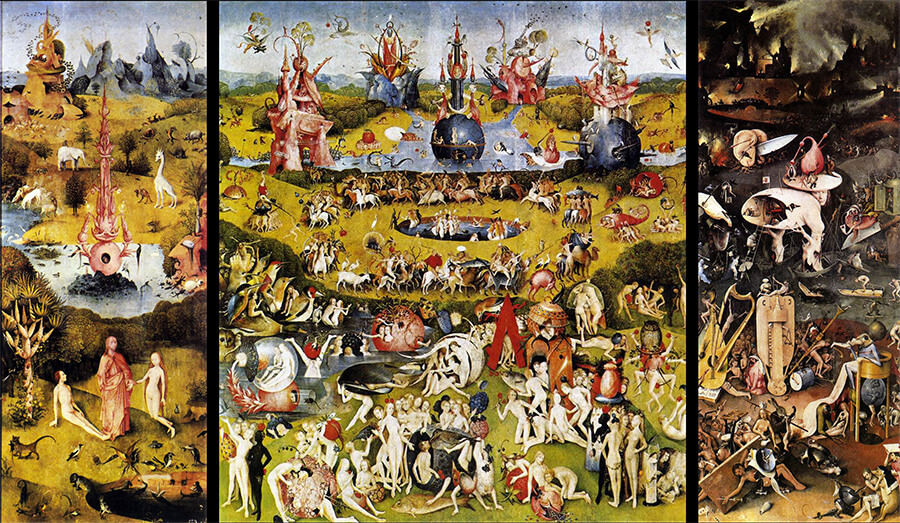
The same structure runs through many of Bosch's great moral paintings. In The Garden of Earthly Delights, paradise, pleasure and hell are held in disturbing relation. In The Haywain Triptych, worldly desire moves toward judgment. In The Last Judgement, the blessed and damned occupy radically different conditions after the end of time. The Venice panels compress that world into four narrow visions. They are small beside Bosch's great triptychs, but they are not minor in imagination.
How to Look at Ascent of the Blessed
Begin with the lower figures and follow the diagonals upward. Notice how little earthly weight remains. Bosch does not give the blessed elaborate gestures of triumph. Their bodies are passive, almost stunned, as angels support them through the cloudy space. Then look at the tunnel itself. Its circular form pulls the eye into depth, but the light at the end resists ordinary description. It is a destination and a disappearance.
Then set the panel mentally beside the others. The garden of the elect gives one image of blessedness; the ascent gives another. The fall and river to hell make the opposite motion visible. The set is not a tidy map, but it is a coherent meditation on direction. Bosch asks the viewer to feel the difference between being lifted and being dragged, between being guided and being thrown, between entering light and sinking into darkness.
Finally, return to the uncertainty. The panels may once have belonged to a larger structure. Their order has been debated. Their backs were altered. Their first setting is not securely recoverable. This unresolved history is not a distraction from the paintings' meaning. It is part of their afterlife as objects. Like the souls they show, the panels have travelled through time, collection, display and interpretation, carrying with them a vision that remains both clear and unfinished.
Ascent of the Blessed is therefore more than a single heavenly panel. It is Bosch's most concentrated image of passage into light, and one of the essential works for understanding how his art thinks about death, judgment, fear and hope.
Artworks and related attributions
Browse paintings, drawings and related attributions. Records group triptychs, fragments and two-sided sheets where appropriate. Dates follow the cited museum records or catalogue headings and are generally estimates. Rows marked “2016 catalogue” report that publication’s attribution and collection information; these are dated opinions, rather than a claim that every work is an accepted autograph Bosch.
| Name | Date | Medium, attribution and collection |
|---|---|---|
| A Crossbowman | Second half of the sixteenth century | Oil on oak panel · Copy after Hieronymus Bosch · Museo Nacional del Prado, Madrid · P002695 Source 1. Source 2. |
| A Woman Spinning and an Old Woman | Museum estimates: about 1480–1490 for the women and 1500–1505 for the reverse; the precise chronology is disputed | Pen and brown and grey ink on the front; pen and brown ink on the reverse · Hieronymus Bosch · Museum Boijmans Van Beuningen, Rotterdam · N 190 recto and verso (PK) Source 1. Source 2. |
| Adoration of the Child in Cologne | Second half of the sixteenth century | Oil on oak panel · Imitator of Hieronymus Bosch, in the city collection record · Wallraf-Richartz-Museum & Fondation Corboud, Cologne · WRM 0474 Source 1. Source 2. |
| Adoration of the Magi in Philadelphia | Early sixteenth century in the museum record; around 1495–1520 in the BRCP catalogue | Oil on oak panel · Hieronymus Bosch in the museum record; workshop of Bosch in the 2016 BRCP catalogue · Philadelphia Museum of Art, John G. Johnson Collection, 1917 · 1321; museum object 103592 Source 1. Source 2. |
| Adoration of the Magi — New York | c.1470–1480 | 2016 catalogue: Bosch; oil on oak · Metropolitan Museum 13.26 2016 catalogue. |
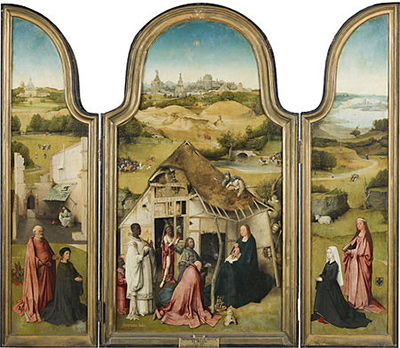
| Adoration of the Magi — Prado triptych | c.1494 | Oil on oak; grisaille exterior · Bosch · Prado P002048 Object source. |
| Adoration of the Magi — three associated fragments | c.1515–1535 | 2016 catalogue: Follower of Bosch · Two Shepherds / Retinue in Philadelphia; associated Adoration in private collection in 2016 2016 catalogue. |
| Ascent of the Blessed — Venice | c.1505–1515 | Oil on panel · Bosch · Gallerie dell’Accademia; Visions of the Hereafter Object source. |
| Battle of the Birds and Mammals | Not specified in catalogue heading | 2016 catalogue: Bosch; pen and brown ink · Berlin KdZ 14715 2016 catalogue. |
| Beggars and Musicians | Around 1530–1540 | Ink and wash on paper · Unknown follower of Hieronymus Bosch · Albertina, Vienna · 7798 Source 1. Source 2. |
| Christ Carrying the Cross Drawing | Around 1470 in the museum catalogue | Black chalk or charcoal, pen and brush in brown ink, white corrections · Anonymous, workshop of Rogier van der Weyden · Museum Boijmans Van Beuningen, Rotterdam · N 81 recto and verso (PK) Source 1. Source 2. |
| Christ Carrying the Cross in Vienna | Around 1490–1510 in the current KHM record and BRCP catalogue | Oil on oak, painted on both sides · Hieronymus Bosch; possible workshop involvement in the Passion side discussed by the BRCP · Kunsthistorisches Museum, Vienna · Gemäldegalerie, GG 6429 Source 1. Source 2. |
| Christ Carrying the Cross — El Escorial | c.1495–1505 | 2016 catalogue: Bosch; oil on oak · Patrimonio Nacional 10014739 2016 catalogue. |
| Christ Carrying the Cross — Ghent | c.1510–1516 (museum) | Oil on panel · Bosch in museum listing; authorship disputed · MSK Ghent 1902-H Object source. |
| Christ Mocked — London | c.1510 | Oil on wood · Bosch · National Gallery NG4744 Object source. |
| Concert in the Egg, After Hieronymus Bosch | Around 1561; third quarter of the sixteenth century | Oil on canvas · Anonymous, after Hieronymus Bosch · Palais des Beaux-Arts, Lille · P 816 Source 1. Source 2. |
| Conjurer / Comical Concert — Louvre drawing | Not specified in catalogue heading | 2016 catalogue: Bosch (recto), follower (concert verso) · Pen and brown ink · Louvre INV 19197 2016 catalogue. |
| Conjurer / Cross-bearing and beggars — Liège sheet | Not specified in catalogue heading | 2016 catalogue: Bosch (verso), follower (recto) · Pen and brown ink · Album d’Arenberg 534 2016 catalogue. |
| Crowning with Thorns — El Escorial | c.1530–1540 | 2016 catalogue: Follower of Bosch; oil on oak · Patrimonio Nacional 10014743 2016 catalogue. |
| Crucifixion with a Donor | Circa 1495–1505; Circa 1490–1500 | Oil on oak panel · Hieronymus Bosch · Royal Museums of Fine Arts of Belgium, Brussels · 6639 Source 1. Source 2. |
| Death and the Miser Drawing | Not securely established; probably made after the painting | Pen and brush, dark ink and white highlights on prepared paper · Workshop of Hieronymus Bosch in the BRCP catalogue; alternatives recorded by the Louvre · Musée du Louvre, Department of Prints and Drawings, Paris · RF 6947, Recto Source 1. Source 2. |
| Death and the Miser — Washington | c.1485/1490 (NGA) | Oil on panel · Bosch · National Gallery of Art 1952.5.33 Object source. |
| Ecce Homo Triptych — Boston | c.1495–1500; wings c.1500/1503 | 2016 catalogue: Workshop of Bosch; oil on oak · Museum of Fine Arts Boston; several production phases 2016 catalogue. |
| Ecce Homo — Frankfurt | c.1490 | Mixed technique on oak · Bosch · Städel 1577 Object source. |
| Fall of the Damned — Venice | c.1505–1515 | 2016 catalogue: Bosch; oil on panel · Visions of the Hereafter · Venice 2016 catalogue. |
| Garden of Earthly Delights | 1490–1500 (Prado) | Oil on oak; grisaille exterior · Bosch · Prado; triptych Object source. |
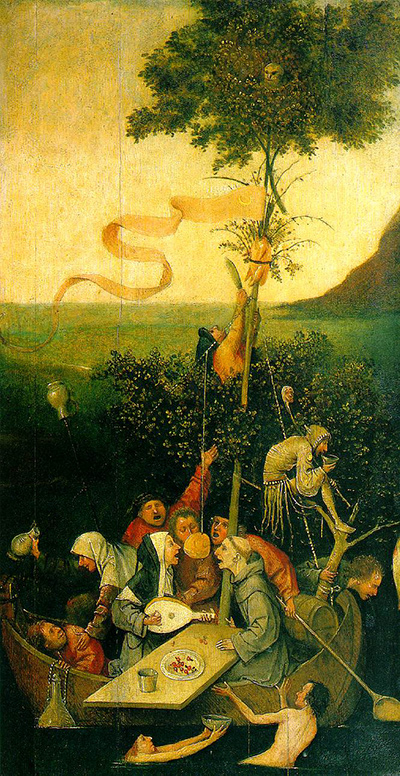
| Gluttony and Lust / Allegory of Intemperance — Yale fragment | c.1500–1510 (group dating) | 2016 catalogue: Bosch; oil on oak · Yale 1959.15.22; fragment associated with Ship of Fools 2016 catalogue. |
| Group of Ten Spectators, a Follower of Bosch | Around 1510–1540 in the current museum record | Pen and two brown inks on paper, with a brown framing line · Follower of Hieronymus Bosch in the Morgan record; Bosch in the BRCP catalogue · Morgan Library & Museum, New York · I, 112 Source 1. Source 2. |
| Head of an Old Woman | About 1500 | Oil on panel · Attributed to Jacob Cornelisz. van Oostsanen · Museum Boijmans Van Beuningen, Rotterdam · 2439 (OK) Source 1. Source 2. |
| Hell and the Flood — Rotterdam panels | Around 1515 in the museum records; around 1510–1520 in the BRCP catalogue | Oil on oak panels · Jheronimus Bosch in the museum records; workshop of Bosch in the BRCP catalogue · Museum Boijmans Van Beuningen, Rotterdam Source 1. Source 2. |
| Hermit Saints Triptych | Circa 1495–1505 | Oil on oak panels · Hieronymus Bosch · Gallerie dell’Accademia, Venice · 2044 Source 1. Source 2. |
| Infernal Landscape | Not specified in catalogue heading | 2016 catalogue: Bosch; pen and brown ink, red accent · Private collection in 2016 2016 catalogue. |
| Infernal Scene with Anvil / Monster Studies | Not specified in catalogue heading | 2016 catalogue: Bosch; attribution debated in entry · Pen and brown ink · Berlin KdZ 548 2016 catalogue. |
| Infernal Scene with Tree-Man / Standing Man | Not specified in catalogue heading | 2016 catalogue: Workshop of Bosch; pen and brown ink · Dresden C 1875; historical reverse title includes a proposed prophet 2016 catalogue. |
| Job Triptych — Bruges | c.1510–1520 | 2016 catalogue: Workshop of Bosch; oil on oak · Groeningemuseum / Hoeke loan in 2016 2016 catalogue. |
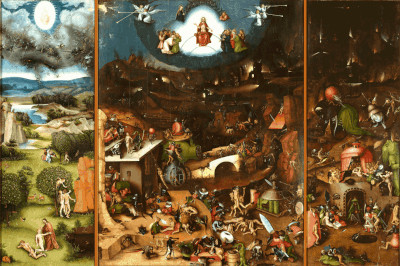
| Last Judgement — Bruges triptych | c.1495–1505 | 2016 catalogue: Bosch; oil on oak · Groeningemuseum 2016 catalogue. |
| Last Judgement — Munich fragment | c.1530–1540 | 2016 catalogue: Follower of Bosch; oil on oak · Alte Pinakothek 5752 2016 catalogue. |
| Last Judgement — Vienna triptych | c.1500–1505 (BRCP 2016) | Oil on oak · Bosch and workshop (BRCP 2016) · Academy of Fine Arts Vienna 2016 catalogue. |
| Man in a Basket and Comic Figures | Around 1500–1515 in the museum record | Pen and brown ink on paper; the reverse is catalogued as iron-gall ink · Hieronymus Bosch in the current Albertina record; attribution has been debated · Albertina, Vienna · 7797 recto and verso Source 1. Source 2. |
| Man Seen from Behind | About 1550–1569; About 1565–1570 | Traces of black chalk, pen and brush in light brown ink · Anonymous, circle of Pieter Bruegel the Elder · Museum Boijmans Van Beuningen, Rotterdam Source 1. Source 2. |
| Mary and John at the Foot of the Cross | About 1440 | Brush in grey and black · Unknown, possibly Netherlandish · Kupferstich-Kabinett, Staatliche Kunstsammlungen Dresden · C 815 Source 1. Source 2. |
| Model Sheet with ‘Witches’ | Disputed; proposals depend on the attribution | Pen and brown ink; the BRCP also records underlying black chalk · Hieronymus Bosch; follower attributions also recorded · Musée du Louvre, Département des Arts graphiques, Paris · INV 19721 recto Source 1. Source 2. |
| Peasant and Three Bust-Length Figures | 1401–1500 | Brown pen over a black preliminary drawing · Attributed to the Master of the Drapery Studies; Bosch circle also recorded · Kupferstichkabinett, Staatliche Museen zu Berlin · KdZ 777 Source 1. Source 2. |
| River to Hell — Venice | c.1505–1515 | 2016 catalogue: Bosch; oil on panel · Visions of the Hereafter · Venice 2016 catalogue. |
| Saint Anthony and a Concert in an Egg | Around 1510–1525 in the museum’s 2016–17 exhibition texts | Pen in light and dark brown inks · Workshop of Hieronymus Bosch; underlying monsters: Bosch (BRCP), possibly Bosch (exhibition text) · Kupferstichkabinett, Staatliche Museen zu Berlin · KdZ 711 recto and verso Source 1. Source 2. |
| Saint Christopher Carrying the Christ Child | c.1500; 1490–1505 in restoration material | Oil on panel · Bosch · Boijmans St 26 Object source. |
| Saint James and Hermogenes | About 1551–1575 in the KIK-IRPA catalogue | Oil on wood, painted on both sides · Anonymous follower of Hieronymus Bosch · Musée des Beaux-Arts, Valenciennes · P.46.1.44; older number 176 Source 1. Source 2. |
| Saint Jerome at Prayer | Circa 1485–1495 | Oil on oak panel · Hieronymus Bosch · Museum of Fine Arts, Ghent · 1908-H Source 1. Source 2. |
| Saint John on Patmos / Passion Scenes | c.1495–1505; estimates vary | Oil on oak · Bosch · Gemäldegalerie Berlin 1647A Object source. |
| Saint John the Baptist in Meditation | Late 15th century; c.1485–1510 (Prado exhibition) | Oil on panel · Bosch · Lázaro Galdiano 8155 Object source. |
| Saint Liberata Triptych | Circa 1495–1505 | Oil on oak panels · Hieronymus Bosch · Gallerie dell’Accademia, Venice · 2045 Source 1. Source 2. |
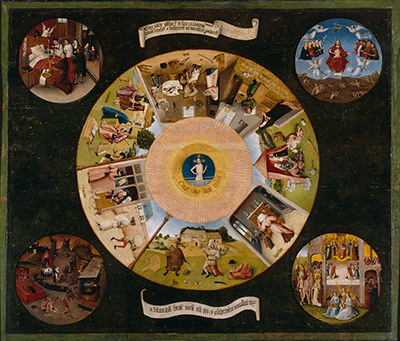
| Seven Deadly Sins and the Four Last Things | 1505–1510 (Prado) | Oil on poplar · Bosch (Prado); workshop/follower disputed · Prado Object source. |
| Ship of Fools — Louvre painting | 1475–1500 (record); c.1505–1515 (exhibition) | Oil on oak · Bosch · Louvre RF 2218; fragment Object source. |
| Ship of Fools — Louvre workshop drawing | Not specified in catalogue heading | 2016 catalogue: Workshop of Bosch · Pen, brush, grey-brown ink and white highlights on prepared paper · Louvre RF 3714 2016 catalogue. |
| Studies of Monsters | About 1530–1550, according to the current Ashmolean record | Pen and brown ink on laid paper, both faces · Anonymous follower of Hieronymus Bosch · Ashmolean Museum, University of Oxford · WA1863.155 Source 1. Source 2. |
| Studies of Saint Anthony and Monsters | No execution date specified in the current Louvre records | Pen and brown ink on paper · Bosch listed; reverse questioned by Louvre; BRCP accepts both faces · Musée du Louvre, Département des Arts graphiques, Paris · INV 20871 recto and verso Source 1. Source 2. |
| Temptation of Saint Anthony — Kansas City fragment | c.1500–1510 | 2016 catalogue: Bosch; oil on oak · Nelson-Atkins 35–22 2016 catalogue. |
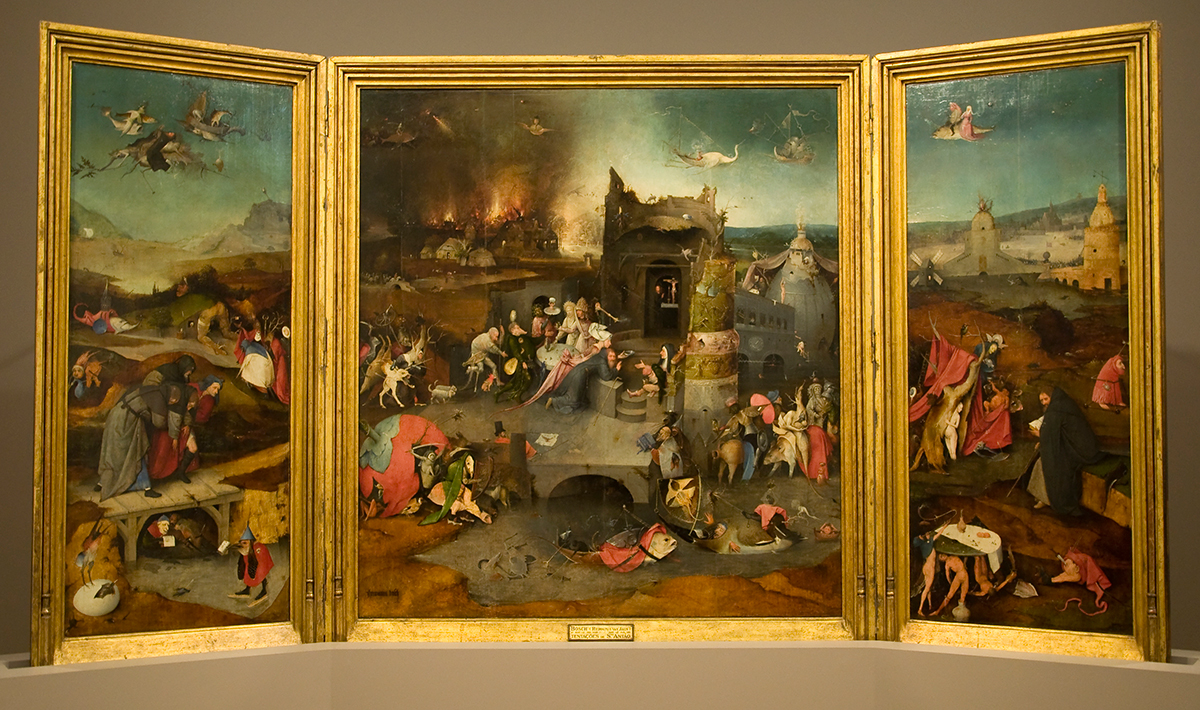
| Temptation of Saint Anthony — Lisbon triptych | c.1500 | Oil on oak · Bosch · Museu Nacional de Arte Antiga 1498 Pint Museum. |
| Temptation of Saint Anthony — Prado panel | c.1530–1540 | 2016 catalogue: Follower of Bosch (2016 opinion); oil on oak · Prado P002049 2016 catalogue. |
| Terrestrial Paradise | Approximately 1505–1515 | Oil on oak panel · Hieronymus Bosch · Gallerie dell'Accademia, Venice Source 1. Source 2. |
| The Burning Ship Drawing | 1500–1520 | Pen and iron gall ink on paper · Attributed to Hieronymus Bosch · Academy of Fine Arts Vienna, Graphic Collection · HZ-2554; numbered 2554 in the BRCP catalogue Source 1. Source 2. |
| The Comical Barber Scene | About 1550–1580, according to the British Museum | Pen and brown ink, grey and brown wash, over black chalk · Anonymous follower, after Hieronymus Bosch · British Museum, Department of Prints and Drawings, London · 1854,0628.46 Source 1. Source 2. |
| The Conjuror, After Hieronymus Bosch | Probably after 1525; around 1530–1540 in the BRCP technical report | Oil on oak panel · Anonymous follower of Hieronymus Bosch · Musée Ducastel-Vera, Saint-Germain-en-Laye · 872.1.87 Source 1. Source 2. |
| The Cure of Folly / Extraction of the Stone of Madness | 1501–1505 (Prado) | Oil on oak · Bosch (Prado); workshop/follower disputed · Prado P002056 Object source. |
| The Entombment Drawing | About 1505–1515, current museum record | Brush and black and grey ink, with grey wash, over black chalk · Workshop of Hieronymus Bosch; drawn by the Master of the Prado Haywain Triptych; Hieronymus Bosch, argued by the BRCP in 2016 · British Museum, Department of Prints and Drawings, London · 1952,0405.9 Source 1. Source 2. |
| The Gathering of the Birds | Not specified in catalogue heading | 2016 catalogue: Bosch; pen and brown ink · Berlin KdZ 13136 2016 catalogue. |
| The Haywain — Prado triptych | 1510–1516 (BRCP 2016) | Oil on oak · Bosch (BRCP 2016) · Prado; separate Escorial version exists 2016 catalogue. |
| The Hearing Forest and the Seeing Field | Circa 1500–1505 | Pen and brown ink on paper · Hieronymus Bosch; reverse: Bosch and workshop · Kupferstichkabinett, Staatliche Museen zu Berlin · KdZ 549, front and reverse Source 1. Source 2. |
| The Owl’s Nest — Rotterdam | Not specified in catalogue heading | 2016 catalogue: Bosch; pen and brown ink · Boijmans N 175 2016 catalogue. |
| The Passion Triptych in Valencia | Workshop of Bosch, about 1510–1520; Follower of Bosch; centre about 1530–1540, wings about 1540–1550 | Oil and gold on oak panels · Workshop of Bosch, about 1510–1520; Follower of Bosch; centre about 1530–1540, wings about 1540–1550 · Museu de Belles Arts de València Source 1. Source 2. |
| The Pedlar / Wayfarer — Rotterdam | c.1500 (museum) | Oil on panel · Bosch · Boijmans 1079 (OK); rejoined exterior Object source. |
| The Tree-Man — Vienna drawing | c.1505 | Pen and brown ink · Bosch · Albertina, Vienna Object source. |
| The Wedding at Cana, After Hieronymus Bosch | Approximately 1560 in the current museum record | Oil on panel, 93 cm high × 72 cm wide · Anonymous, after Hieronymus Bosch · Museum Boijmans Van Beuningen, Rotterdam, St 25 Source 1. Source 2. |
| Two Fantastical Creatures — Berlin KdZ 550 | Around 1505–1515 in the museum’s 2016 exhibition text | Pen in brown ink on reddish prepared laid paper · Hieronymus Bosch · Kupferstichkabinett, Staatliche Museen zu Berlin · KdZ 550, recto and verso Source 1. Source 2. |
| Two Figures Wearing Mitres | About 1480 | Oil on panel · Anonymous (Boijmans); Bosch circle (RKD) · Museum Boijmans Van Beuningen, Rotterdam · 1177 (OK) Source 1. Source 2. |
| Two Men and the Temptation of Eve | About 1505–1515 in the Prado’s 2016 exhibition guide | Pen and grey-brown ink on paper · Hieronymus Bosch in the 2016 catalogues discussed here · Private collection, as recorded in 2016 Source 1. Source 2. |
| Two Men Fighting | Not specified in the current Louvre record | Pen and brown ink · In the manner of Hieronymus Bosch · Musée du Louvre, Département des Arts graphiques, Paris · INV 20660 recto; formerly NIII 8896 and MA 8400 Source 1. Source 2. |
| Two Men — Berlin KdZ 5210 | Not specified in catalogue heading | 2016 catalogue: Bosch questioned · Pen, brush, ink, chalk and white highlights · Berlin KdZ 5210; historical title Two Oriental Men 2016 catalogue. |
| Two Monsters — Berlin KdZ 547 | Approximately 1500–1510 in Berlin's 2016 exhibition catalogue; an estimated range | Pen and brown ink on paper · Hieronymus Bosch · Kupferstichkabinett, Staatliche Museen zu Berlin · KdZ 547, drawn on both sides Source 1. Source 2. |
Frequently Asked Questions
It belongs to the four Visions of the Hereafter in the Gallerie dell’Accademia, Venice.[1]
The museum dates the group approximately 1505–1515. That is an estimated range for the paintings, rather than an exact year.[1]
The panels’ original arrangement and function remain uncertain. A connection with a larger Last Judgment composition is a proposal rather than a securely reconstructed whole.[1]
Angels guide small human souls towards a circular passage of light. Their gestures and the narrowing bright destination organise the movement through darkness.[1]
Discussion
Follow the guided bodies towards the light and compare the companion panels.
Reader Insights
How does the tunnel direct your eye towards the light?
Compare the angels’ gestures with the bodies they guide.
What changes when the ascent is seen alongside the other Venetian afterlife panels?
Join the Conversation
Share a detail, comparison or question about Ascent of the Blessed below.
References
- Gallerie dell'Accademia di Venezia, "Visions of the Hereafter" / "Quattro visioni dell'Aldila," collection record, View source and View source
- BRCP Catalogue Raisonné (2016), object dates in catalogues 1, 2, 8, 15 and 20; catalogue 20 object metadata only for the Haywain comparison. View source
- Staatliche Museen zu Berlin, 2016 exhibition wall texts, p. 3: approximate date of KdZ 549. View source
- Bossche Encyclopedie / Bosch Project summary, "Visioenen van het hiernamaals / Visions of the Hereafter," recording BRCP Cat. 18.1-18.4 and oil-on-oak panel data View source
- Grzegorz Kubies, "Fantasy or a Transcendent Experience? Study of the Painting Ascent into Heaven by Jheronimus Bosch from the Palazzo Ducale in Venice," Roczniki Humanistyczne 66, no. 4 (2018), DOI: View source
- Patrik Reutersward, "Hieronymus Bosch's Four Afterlife Panels in Venice," Artibus et Historiae 12, no. 24 (1991): 29-35; bibliographic record: View source
- Bosch Research and Conservation Project / Closer to Bosch, "Visions of the Hereafter" object and detail resource View source