by Tom Gurney
Tom Gurney BSc (Hons) is an art history expert with over 20 years experience
Published on June 19, 2020 / Updated on November 4, 2026
Email: tomgurney1@gmail.com / Phone: +44 7429 011000
Triptych of the Adoration of the Magi: Introduction
Hieronymus Bosch's Triptych of the Adoration of the Magi is one of the best paintings through which to see Bosch beyond monsters. Dated by the Museo Nacional del Prado to about 1494, painted in grisaille and oil on oak panel, and now displayed in Room 056A in Madrid, it is a devotional triptych about arrival, recognition and redemption [1]. Its subject is traditional: the Virgin Mary presents the Christ Child to the Magi, who have travelled to worship him. Its handling is unmistakably Bosch: a holy scene is surrounded by donors, saints, strange watchers, biblical prefigurations, distant armies, signs of sin and a painted exterior that turns the closed object into a meditation on the Mass and the Passion.
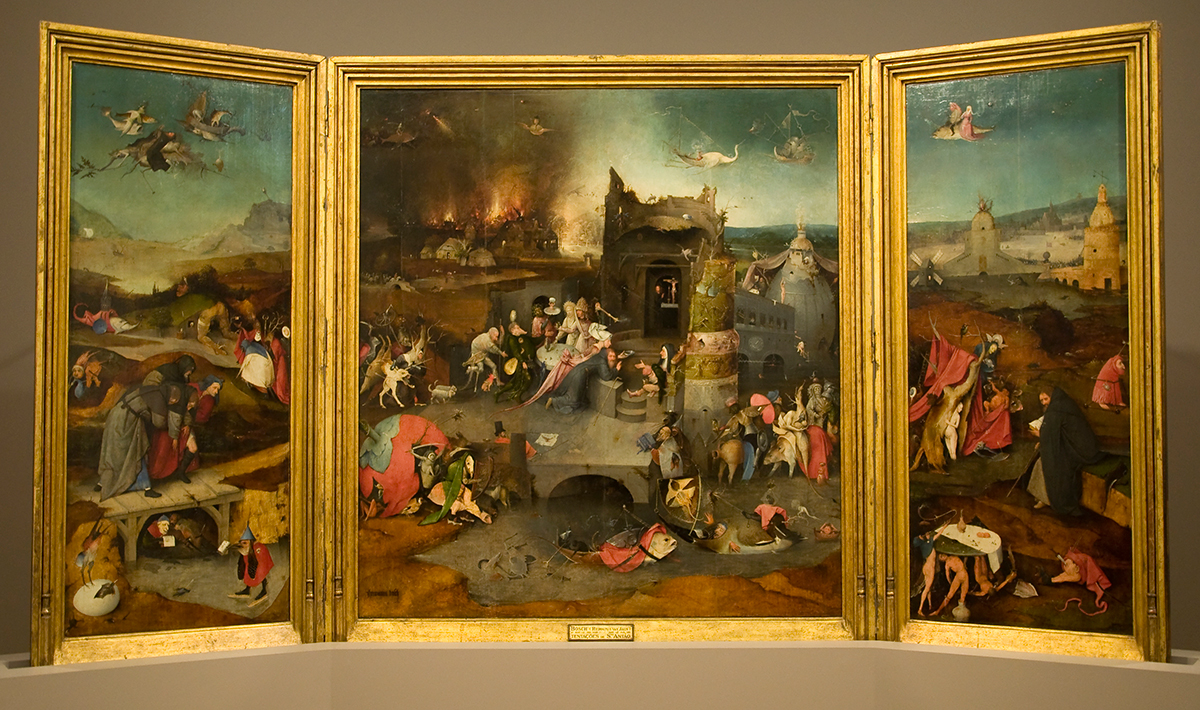
The painting belongs beside Bosch's larger moral triptychs, including The Garden of Earthly Delights and The Haywain Triptych, but its emotional temperature is different. The Garden overwhelms the viewer with creation, desire and consequence. The Haywain turns worldly appetite into a public procession. The Adoration of the Magi is quieter and more liturgical. Bosch still fills the picture with unsettling details, but here his invention works around a central act of worship. The strange elements do not cancel the devotion. They sharpen it.
This makes the triptych especially useful for understanding Bosch as a religious painter. The main Hieronymus Bosch overview introduces his career, and the Bosch paintings hub explains the broader corpus. This article focuses on one object: a signed, donor-filled, technically studied Prado triptych in which Bosch takes a familiar Nativity subject and turns it into a dense image of salvation offered to the whole world.
Contents
- Annotated Details
- At a Glance
- The Subject: Worship At The Threshold
- Peeter Scheyfve, Agneese De Gramme And Their Saints
- The Central Panel: A Traditional Scene Made Uneasy
- The Gifts And The Theology Of Detail
- The Closed Triptych: Mass Of Saint Gregory And The Passion
- Technical Evidence And Underdrawing
- Bosch And The Traditional Adoration
At a Glance
- ArtistHieronymus Bosch, also known as Jheronimus Bosch
- TitleTriptych of the Adoration of the Magi
- Dateca. 1494
- MediumGrisaille and oil on oak panel
- Dimensions147.4 x 168.6 cm
- CollectionMuseo Nacional del Prado, Madrid
- InventoryP002048
- DisplayRoom 056A, Prado
- FormatTriptych with painted exterior wings
- PatronsPeeter Scheyfve and Agneese de Gramme of Antwerp
- Patron saintsSaint Peter and Saint Agnes
- Main themeThe Adoration of the Magi as a sign of universal redemption
- Related Bosch pagesbiography, paintings, style and technique and workshop and attribution
Compare these works across Bosch’s career
These date ranges are estimates, not a documented year-by-year sequence. These works provide context for the article; none is highlighted as the object discussed here.
Saint Jerome at Prayer
Circa 1485–1495 [2]Crucifixion with a Donor
Circa 1490–1500 (BRCP) [2]Hermit Saints Triptych
Circa 1495–1505 [2]Saint Liberata Triptych
Circa 1495–1505 [2]The Hearing Forest and the Seeing Field
Circa 1500–1505 (Berlin exhibition) [3]The Haywain Triptych
1510–1516 (BRCP) [2]Annotated Details from Adoration of the Magi
The numbered details move across the donor wings and into the central Epiphany, before looking upward to the fragile shelter and outward to Bosch's animated landscape.
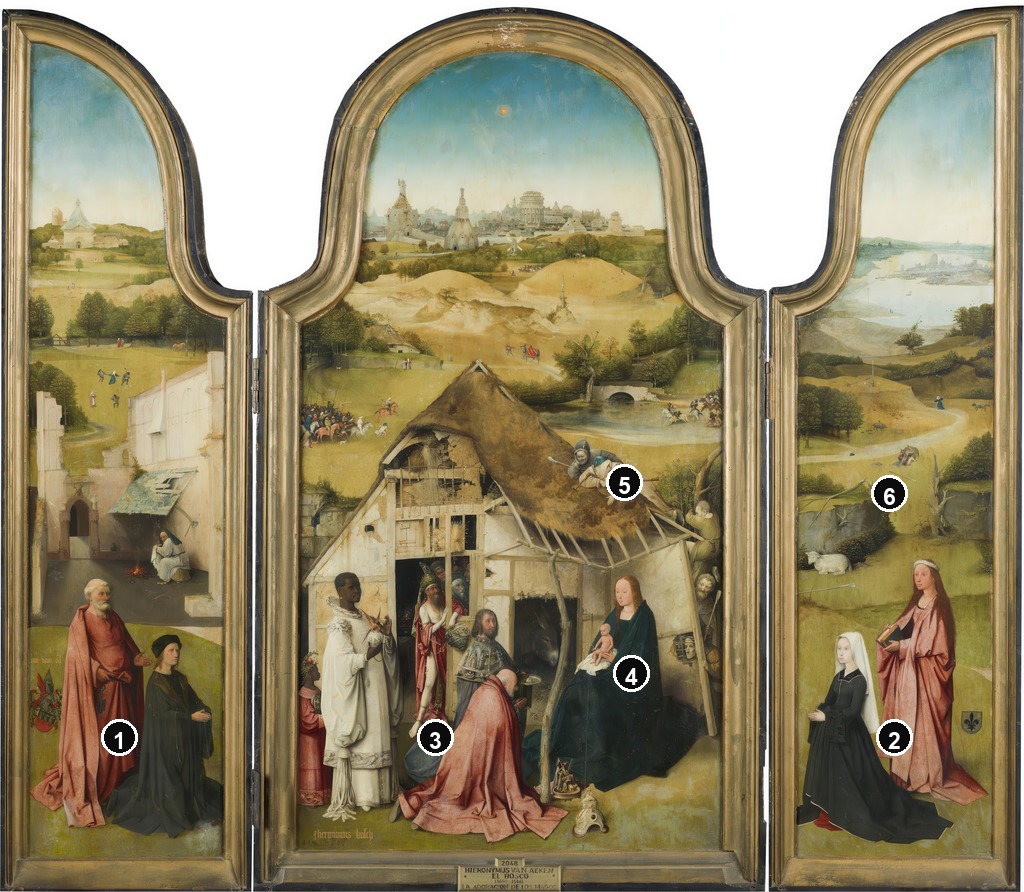
Details from ADORATION OF THE MAGI
Close looking reveals how Bosch links the donors' devotion to the central ceremony while surrounding it with unstable architecture and distant unease.
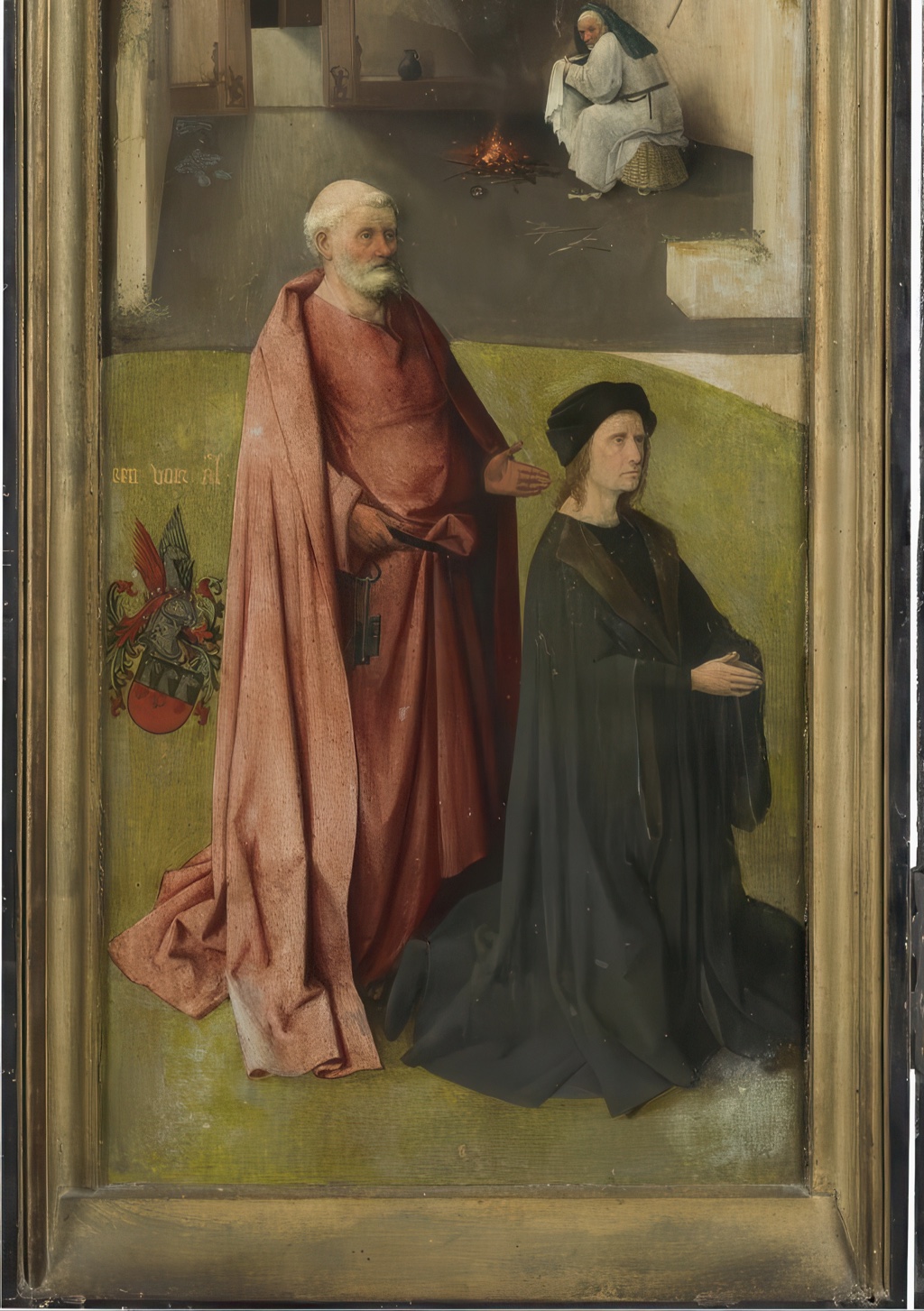
The donor and Saint Peter
On the left wing, Saint Peter presents the kneeling donor; the apostle's key and the donor's shield make the devotional portrait legible at a glance.
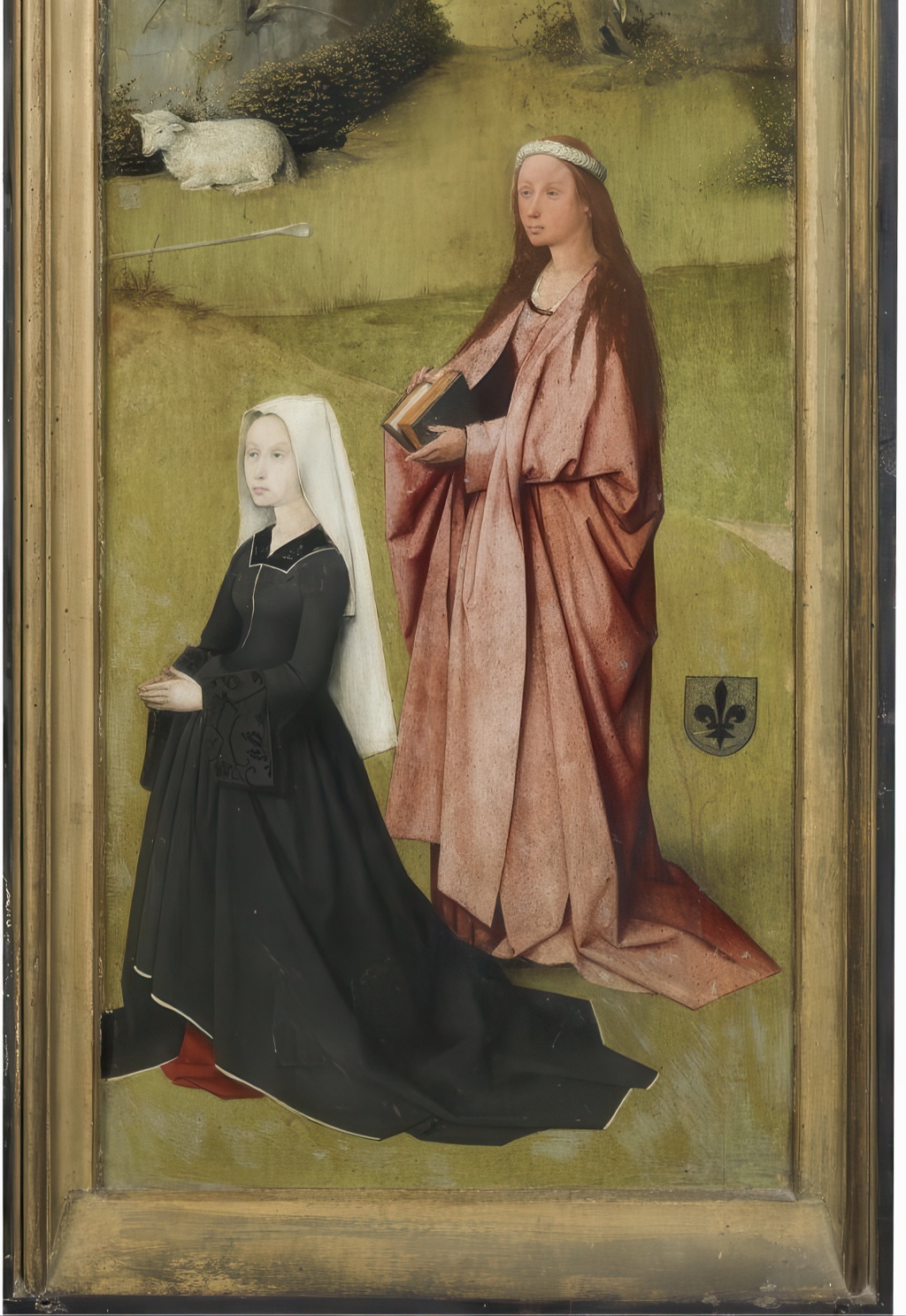
The donor and Saint Agnes
The right wing mirrors the donor portrait with a kneeling woman presented by Saint Agnes, who holds her book while a small shield appears below.
The Magi and their gifts
The three richly dressed Magi converge before the stable, with vessels, textiles and varied poses directing attention toward the infant.
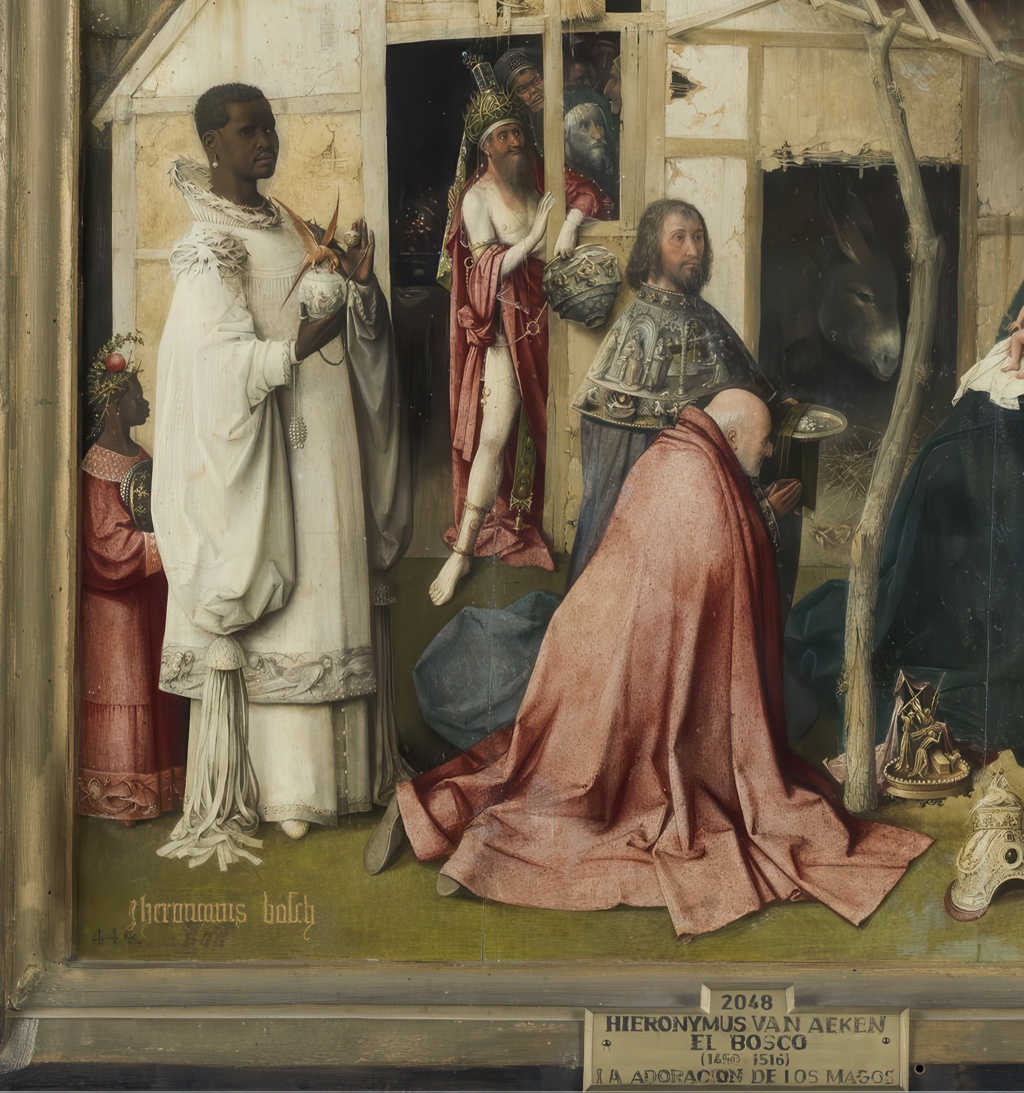
The Virgin, Child and doorway onlookers
The Virgin and Child sit against the damaged wall while an arresting pale figure and shadowed companions peer from the stable doorway.
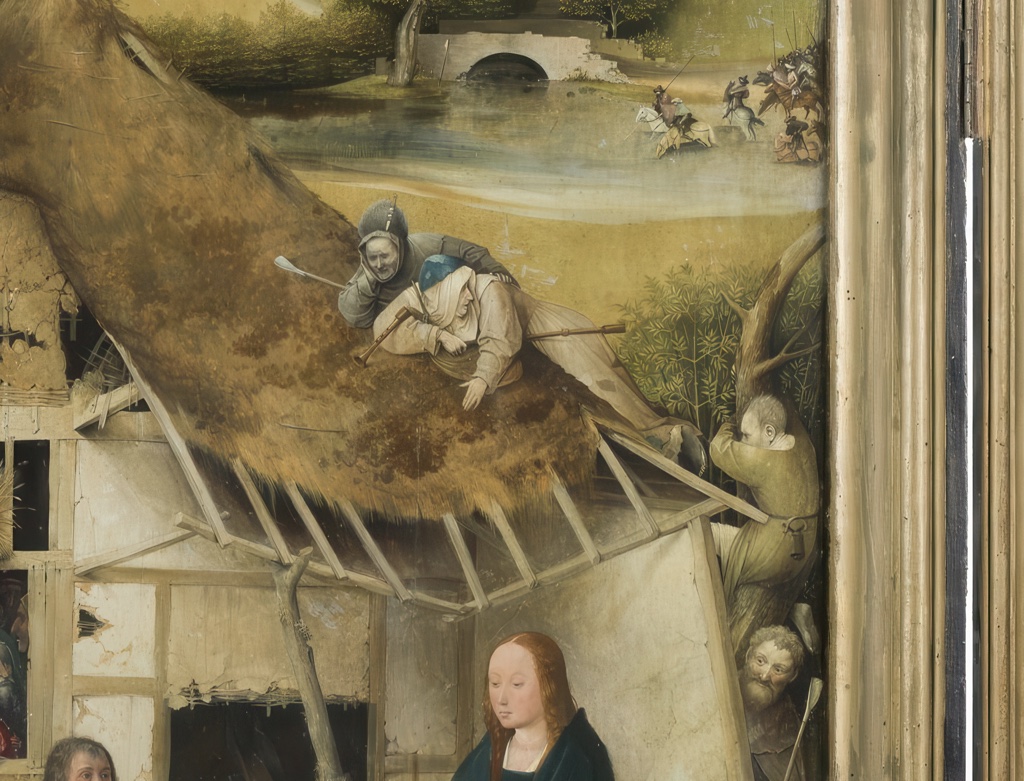
The roof, riders and hidden faces
A crouching figure occupies the patched roof as riders pass in the distance and two faces emerge from the broken structure at the right.
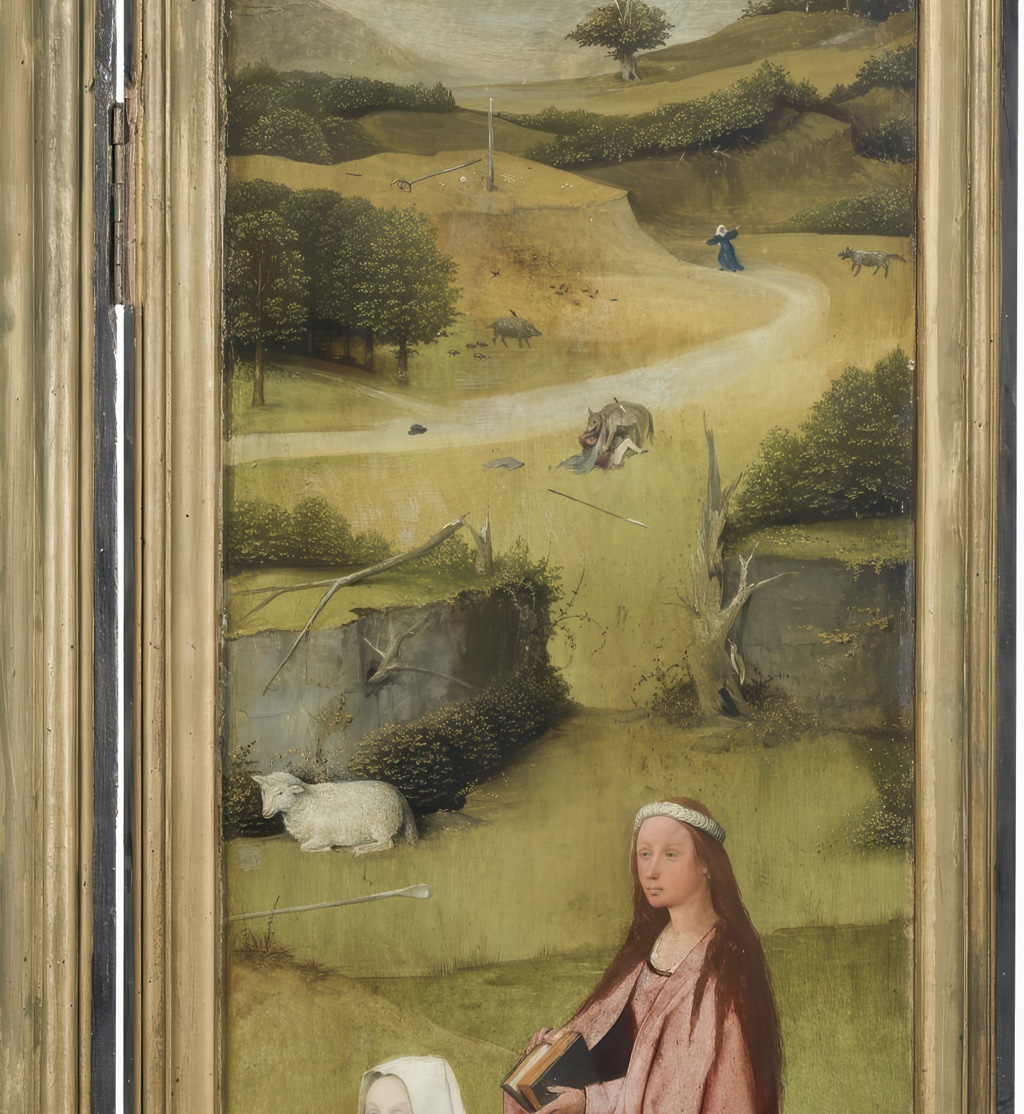
Violence in the right-hand landscape
Tiny figures and animals animate the right-hand distance, including the violent encounter singled out in the page text amid roads, fields and water.
The Subject: Worship At The Threshold
The Adoration of the Magi was one of the great subjects of late medieval and early Renaissance Christian art. It allowed painters to show the first recognition of Christ by Gentile rulers: the Magi come from afar, kneel before the Child, and offer gifts that point beyond infancy to kingship, sacrifice, death and resurrection. In Bosch's Prado triptych, the event is not treated as a courtly pageant alone. It is an encounter between divine humility and a world already marked by danger.
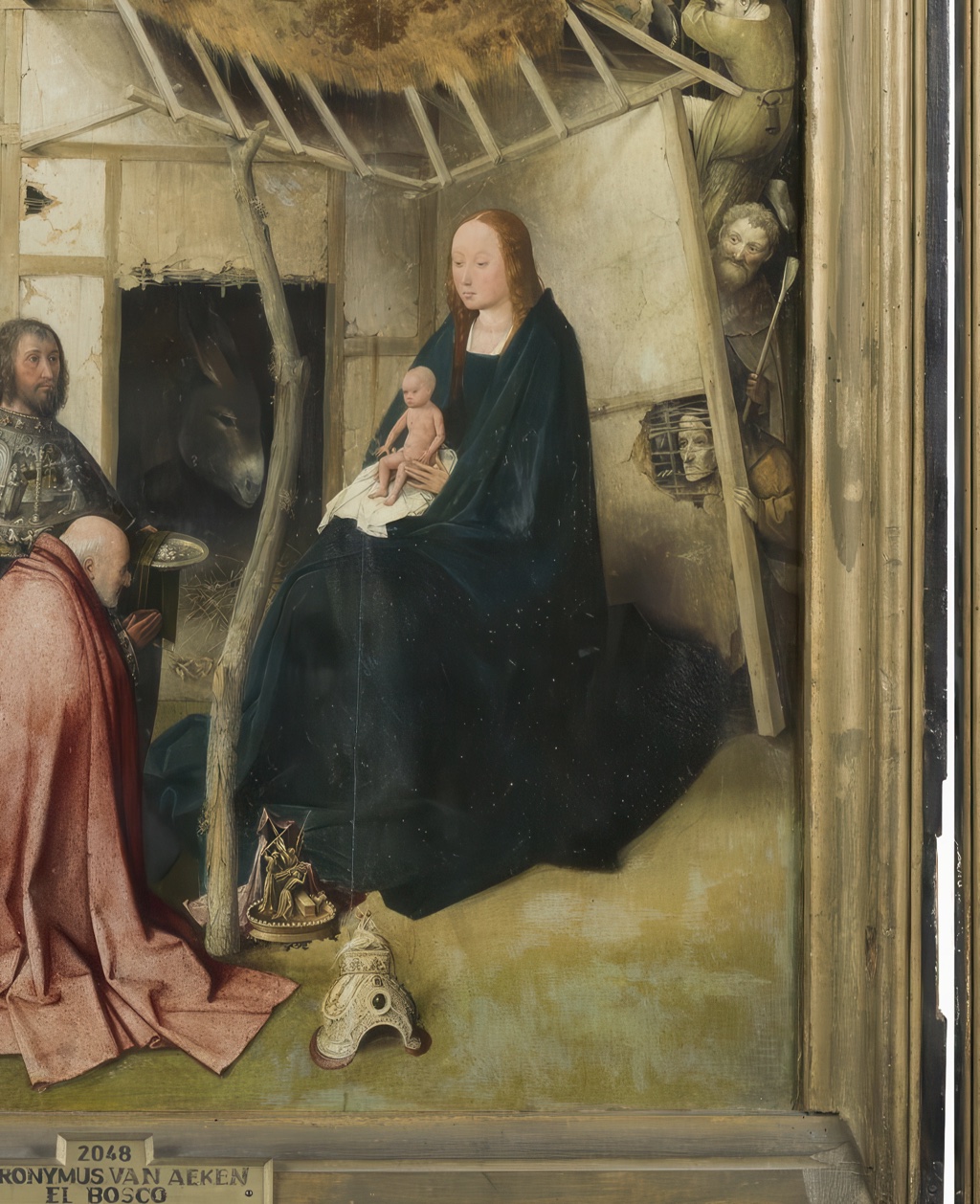
At the centre, Mary sits with Jesus on her lap. The Prado notes that her pose recalls works by Jan van Eyck, a comparison that helps place Bosch inside the Netherlandish tradition rather than outside it [1]. Mary is not an eccentric Boschian invention. She is calm, frontal and devotional. The Christ Child receives the attention that the painting's more restless details threaten to scatter.
The Magi approach with gifts and elaborate clothing. Their wealth matters, but Bosch does not let luxury become mere display. The gifts and garments carry small Old Testament scenes associated with the Biblia pauperum, a medieval tradition that linked episodes from the Hebrew Bible with events in the life of Christ [1]. The first Magus's gift is decorated with the Sacrifice of Isaac, read as a prefiguration of Christ's sacrifice. The second Magus's metal cloak includes the Queen of Sheba presenting gifts to Solomon and the offering of Manoah and his wife after the announcement of Samson's birth. The third Magus's vessel includes Abner before David, while the phoenix on the vessel evokes resurrection [1].
These details make the Adoration more than a charming Christmas scene. The Child in Mary's lap is already surrounded by signs of Passion, sacrifice and resurrection. Bosch's minute painting of the gifts becomes theology in metal, pearl, vessel and ornament. The Magi bring costly objects, but those objects teach the viewer how to read the Child: not only as newborn, but as redeemer.
Peeter Scheyfve, Agneese De Gramme And Their Saints
The triptych was commissioned, according to the Prado, by Peeter Scheyfve and Agneese de Gramme of Antwerp around 1494 [1]. Their presence changes the work from a general sacred image into a particular act of devotion. Bosch places the donors in the wings, kneeling under the protection of their patron saints. On the left wing, Peeter Scheyfve appears with Saint Peter. On the right, Agneese de Gramme appears with Saint Agnes [1].
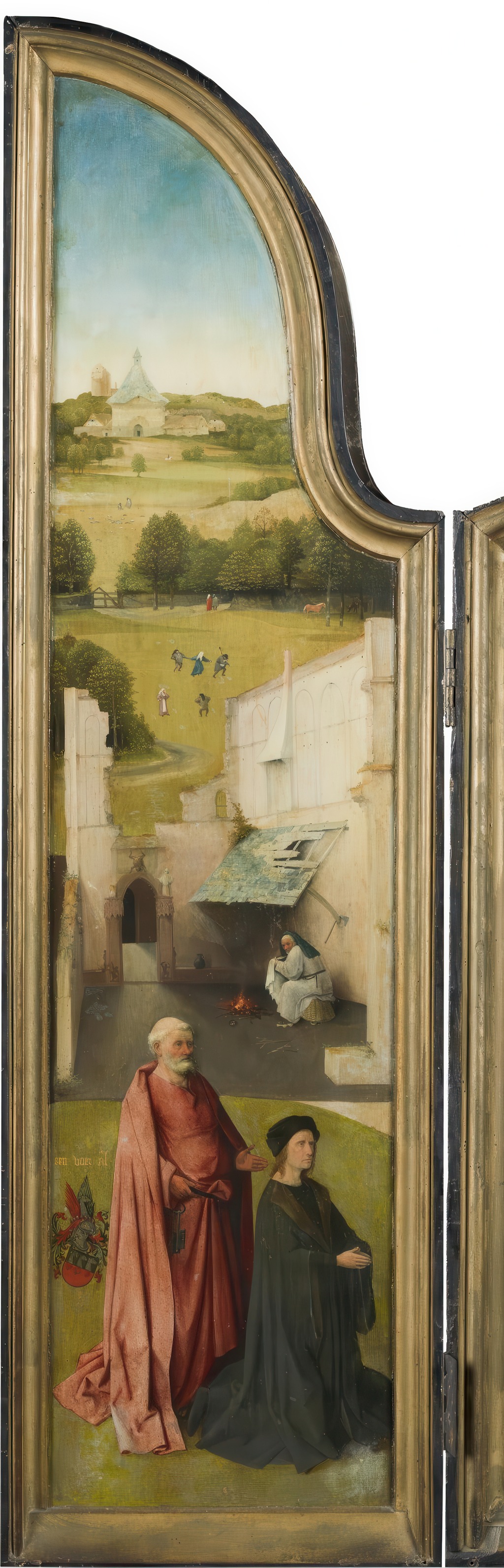
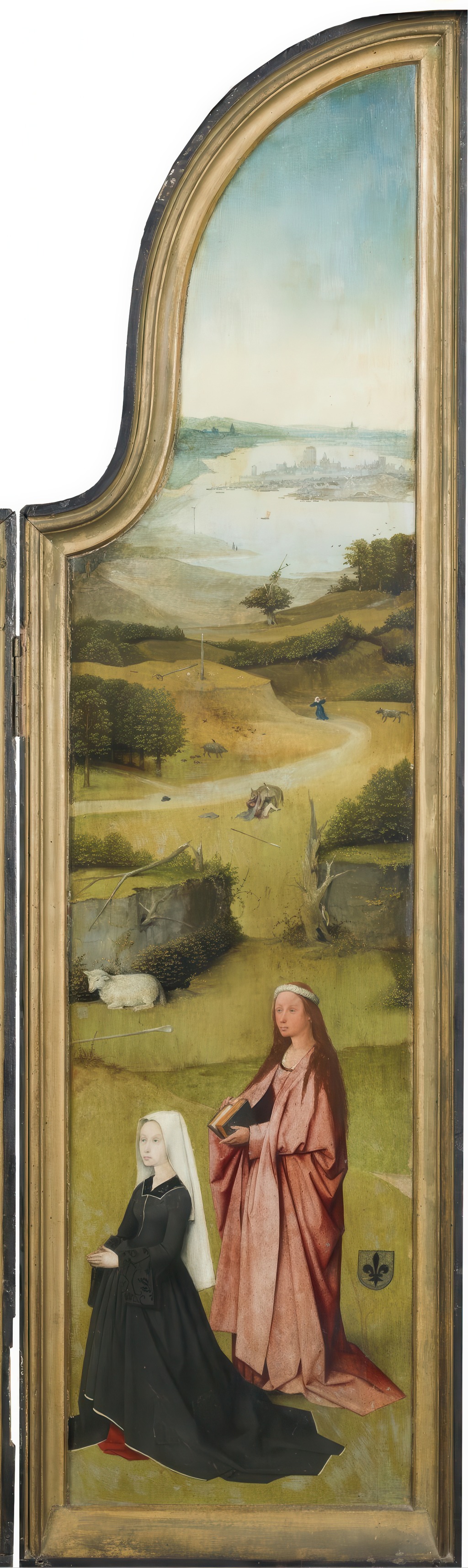
This arrangement belongs to a long tradition of Netherlandish donor imagery. Patrons could be shown near sacred figures not because they were part of the biblical event, but because the painting made prayer visible. The donors kneel before the holy scene, commended by saints whose names or devotional associations mattered to them. The effect is intimate and public at once: private piety is displayed in a costly, skilfully made object.
Peeter Scheyfve's motto appears in the work. The Prado gives the motto as Een voert al, translated as "One for all" [1]. The phrase adds a heraldic and personal note without turning the painting into a portrait panel. Bosch lets the donors' identities be known, but the triptych's emphasis remains devotional. The saints stand between the donors and the central mystery; the donors themselves receive, rather than command, the scene.
The reverse of the triptych expands this family presence. The Prado identifies two further donor figures on the closed wings: a young man, Jan Scheyfve, described as the patrons' son, and an older man probably identifiable as Peeter's father Claus Scheyfve, who died before 1495 [1]. The family therefore appears not only when the triptych is open, but also when it is closed. Prayer, lineage and memorial presence are built into the object's two states.
That family context should be kept specific. Bosch's biography is sparse in surviving documents, and the painting does not give us Bosch's private thoughts about patrons. What it does show is a wealthy Antwerp burgher family commissioning a sophisticated devotional triptych from a painter whose visual imagination could serve both piety and prestige.
The Central Panel: A Traditional Scene Made Uneasy
The central panel is built around recognition. Mary and the Child occupy the devotional focus, while the Magi approach in rich clothing. The setting, however, is not polished palace architecture. The stable resembles a Brabantian hut, and Bosch fills its edges with figures and signs that complicate the scene [1].
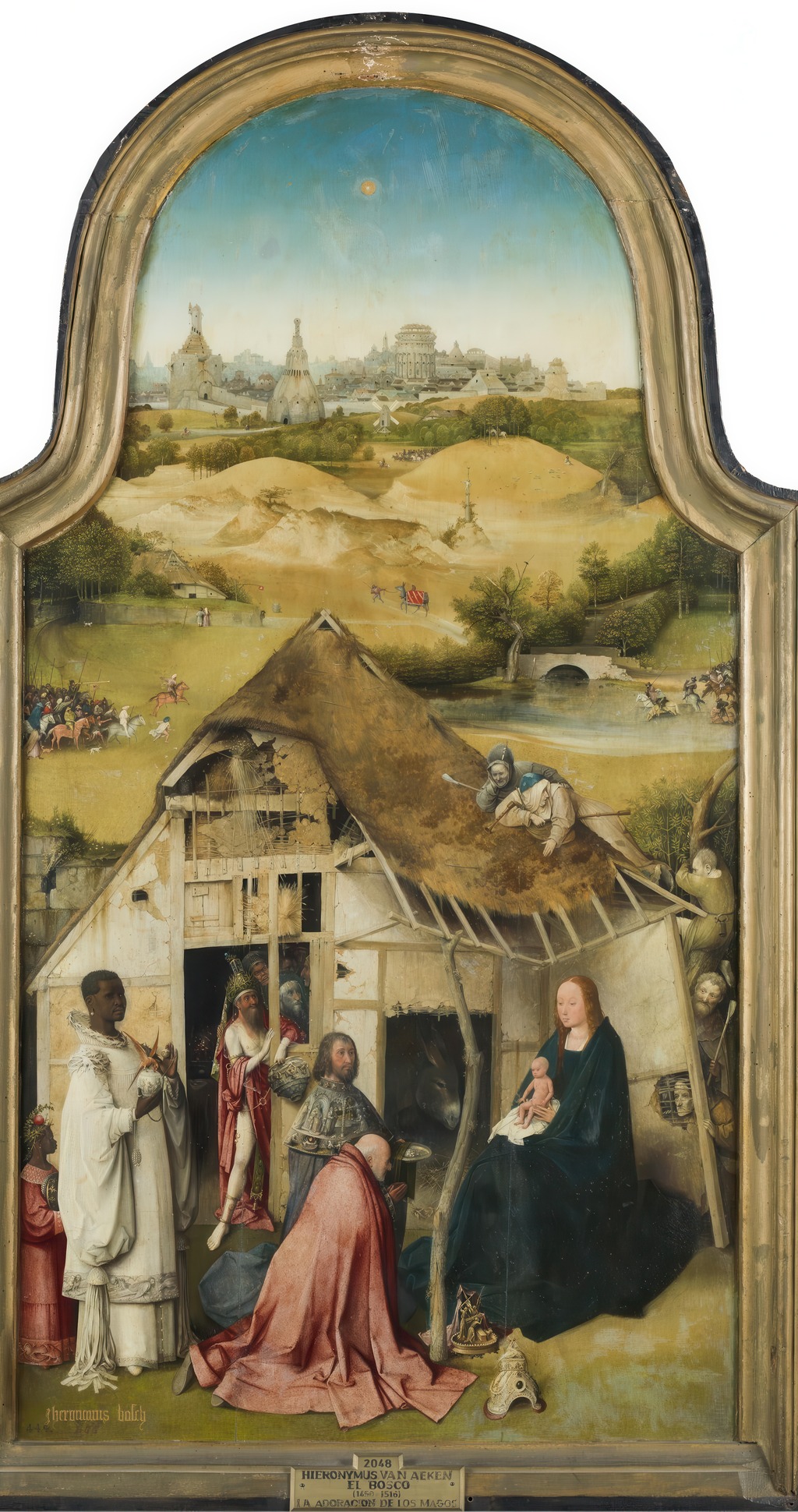
The most troubling figure stands at the entrance to the stable. Prado commentary identifies him as the Antichrist [1]. He is partly exposed, oddly clothed, and surrounded by a group whose distorted features sharpen the sense of spiritual threat. Above him, in the hayloft, an owl watches a dead mouse. Bosch often uses animals and small details to charge a scene morally, but caution is needed: a detail should not be turned into a fixed code by itself. Here the Prado's interpretation matters because it places the owl, prey and strange figure within the triptych's broader salvation theme [1].
The six shepherds on the far right complete the Adoration scene, but they do not dissolve its tension. Bosch sets worship beside watchers who may not fully recognise what is before them. In this, the triptych differs from a purely harmonious Adoration. The Christ Child is present; recognition has begun; yet the world around the Child contains blindness, menace and misunderstanding.
In the background, Bosch opens the scene outward. The Prado identifies a house with a swan flag and a dovecote as a brothel, with a man leading a horse ridden by a monkey toward it, an allusion to lust [1]. Farther away, mounted groups move across the landscape, and the Prado relates the soldiers in oriental headgear to Herod's search for the Child [1]. Bethlehem appears in the distance, but Bosch gives it an imaginative architecture that mixes the biblical East with Netherlandish touches such as a windmill.
The result is not sensationalism. It is devotional pressure. Bosch does not isolate the Nativity from sin, lust, violence or political threat. He paints salvation entering a world that needs it. The holy centre is small and steady; the surrounding world is busy, compromised and watchful.
The Gifts And The Theology Of Detail
Bosch's love of detail is often discussed through devils and hybrid creatures, but the Adoration shows that the same precision could serve the most orthodox devotional subject. The Magi's robes, vessels and gifts are marvels of surface. The Prado stresses Bosch's skill in rendering costly materials and extremely fine highlights, with brushstrokes so delicate that they can appear almost drawn [1].
The first gift, placed at the Virgin's feet beside a sumptuous helmet, is a table ornament of gold and pearls. Its Sacrifice of Isaac scene points toward Christ's future sacrifice, and the Prado notes that its support on toads reinforces the association with sin [1]. The object is beautiful, but its meaning is not simply beautiful. It joins luxury to sacrifice and fallen nature.
The second Magus's metal cloak works in a similar way. Its biblical scenes are not decorative embroidery without purpose. The Queen of Sheba before Solomon offers a model of royal gift-giving, while Manoah and his wife offering after the announcement of Samson's birth creates another prefigurative link to the birth of Christ [1]. Bosch embeds sacred history into the very clothing of worship.
The third Magus's vessel adds another layer. Abner kneels before David, a scene associated with the joining of Israel's tribes, and the phoenix above the vessel evokes resurrection [1]. The third Magus's white cloak also carries thistle leaves along the shoulders and neck, read by the Prado in relation to the Passion and redemption [1]. Even a garment border can participate in the theology of the triptych.
This is one reason the painting is a strong introduction to Bosch's style and technique. His originality is not only the invention of strange figures. It is the ability to make tiny painted surfaces carry large theological relations. In the Adoration, craftsmanship becomes exegesis.
The Closed Triptych: Mass Of Saint Gregory And The Passion
When the wings are closed, the triptych changes subject. The exterior shows the Mass of Saint Gregory in semi-grisaille, with donor figures on the reverse [1]. Grisaille and semi-grisaille exteriors often give Netherlandish triptychs a quieter, sculptural or liturgical character. Here the closed state is not merely protective. It interprets the open state.
The Prado links the closed exterior to the advent of salvation and to the Eucharistic meaning of the Adoration itself [1]. At the Mass of Saint Gregory, Christ appears as the Man of Sorrows, rising from the sarcophagus. Bosch surrounds this miracle with Passion scenes arranged in tiers like an altarpiece: the Agony in the Garden, Christ's Arrest, Christ before Pilate, the Flagellation, the Crowning with Thorns, the Way to Calvary and the Crucifixion [1].
This exterior is unusually rich. The Crucifixion is painted partly on the frame, and the Prado notes additional details including the Good Thief, the Bad Thief, Judas hanging from a tree while demons carry away his soul, and nine angels around Christ as the Man of Sorrows [1]. Bosch therefore turns the closed triptych into a compressed Passion meditation. The viewer who sees the work closed encounters the sacrificial meaning of Christ before seeing the Magi adore the infant Christ inside.
That connection changes how the open Adoration should be read. The Child is not only adored as a newborn king. He is the same Christ whose Passion and sacramental presence are contemplated on the exterior. The wheat stored above the Antichrist in the hut also carries Eucharistic resonance in Prado's reading [1]. Bosch joins Nativity, Passion, Mass and redemption into one hinged object.
Technical Evidence And Underdrawing
The Adoration of the Magi is also important because technical study helps answer questions about how Bosch planned and revised the work. The Prado records underdrawing executed with brush and liquid medium. It describes long, thin, light strokes for the main composition, shorter strokes in areas of modelling and detail, and changes to the contours and positions of some elements during painting [1].
This kind of evidence matters for Bosch because his works often look fantastically spontaneous. Technical study shows a more disciplined process: forms are sketched, adjusted, strengthened and finished through paint. The folds of the draperies were drawn with long strokes in a less intense colour, and shadows or creases could then be accentuated in the painted stage [1]. The visible richness depends on a hidden structure of drawing.
The curtains in the exterior Mass of Saint Gregory are especially revealing. Prado commentary states that Bosch added the curtains during the final stage of execution, painting them over already completed figures. It also notes that technical studies show the donors and the work were painted at the same time, countering the idea that the patrons were later additions [1]. This is a good example of why conservation evidence is not merely technical background. It can change the historical reading of the object.
The Bosch Research and Conservation Project and Closer to Bosch are central to this wider technical turn in Bosch studies. BRCP describes its work as a project to improve knowledge of Bosch's paintings and drawings, his workshop and his followers, using photographic documentation in visible light and infrared, infrared reflectography, and digitised X-radiographs where available [4]. Closer to Bosch presents high-resolution and technical research for Bosch, workshop and follower material [5]. For a signed and securely attributed Prado triptych, this research context reinforces the point that Bosch's authorship is studied through matter as well as style.
Technical evidence also protects the painting from a simplistic reading of Bosch as pure fantasy. The Adoration is carefully made, altered and finished. Its devotional argument depends on the physical intelligence of the object: open and closed panels, painted frame, underdrawing, overpainted curtains, donor integration, grisaille effects and minute highlights.
Bosch And The Traditional Adoration
The Prado's 2016 Bosch exhibition placed the Adoration of the Magi Triptych within a section on the childhood and ministry of Christ. The exhibition material stressed that the figure of Christ is the principal focus in these works and connected that focus with devotional currents associated with the imitation of Christ [6]. It also noted that the Adoration was the subject most represented by Bosch, a subject through which he expressed the universality of redemption [6].
That point is important because Bosch is often approached through his most extreme imagery first. The Adoration shows that he could remain close to a traditional subject while reformulating it in his own way. The Magi still worship. Mary still presents the Child. Donors still kneel with patron saints. The triptych still works as a devotional object. But Bosch adds symbolic pressure in the background, in the hut, in the gifts, in the reverse imagery and in the uneasy relation between recognition and blindness.
The Metropolitan Museum of Art's earlier Adoration of the Magi, dated about 1475, gives useful context for Bosch's repeated engagement with the theme, though it is a separate object rather than a substitute for the Prado triptych. The Met describes its scene as tranquil and characteristic of Bosch's work before the more famous Hell imagery, with a stagelike setting and differentiated Magi representing varied origins [7]. The contrast helps show how the Prado triptych deepens the subject into a larger theological structure.
Bosch's later fame as a painter of devils can make the Adoration seem less immediately Boschian than the Garden or Haywain. In fact, it reveals the same mind under different conditions. He still thinks through thresholds, hidden threat, moral contrast, social status, exquisite detail and the danger of seeing without understanding. The difference is that here the centre is not human appetite or final judgement. The centre is Christ received in humility.
That is why the triptych matters. It shows Bosch's imagination serving devotion rather than escaping it. The painting's strangeness does not pull the viewer away from the Adoration; it makes the Adoration more urgent. The world around the Child is full of signs that redemption is needed. The kneeling Magi, the donors, the saints, the Mass of Saint Gregory and the Passion scenes all answer that need in different ways. Bosch's gift is to make those answers visible in one object that opens and closes, conceals and reveals, dazzles and warns.
Artworks and related attributions
Browse paintings, drawings and related attributions. Records group triptychs, fragments and two-sided sheets where appropriate. Dates follow the cited museum records or catalogue headings and are generally estimates. Rows marked “2016 catalogue” report that publication’s attribution and collection information; these are dated opinions, rather than a claim that every work is an accepted autograph Bosch.
| Name | Date | Medium, attribution and collection |
|---|---|---|
| A Crossbowman | Second half of the sixteenth century | Oil on oak panel · Copy after Hieronymus Bosch · Museo Nacional del Prado, Madrid · P002695 Source 1. Source 2. |
| A Woman Spinning and an Old Woman | Museum estimates: about 1480–1490 for the women and 1500–1505 for the reverse; the precise chronology is disputed | Pen and brown and grey ink on the front; pen and brown ink on the reverse · Hieronymus Bosch · Museum Boijmans Van Beuningen, Rotterdam · N 190 recto and verso (PK) Source 1. Source 2. |
| Adoration of the Child in Cologne | Second half of the sixteenth century | Oil on oak panel · Imitator of Hieronymus Bosch, in the city collection record · Wallraf-Richartz-Museum & Fondation Corboud, Cologne · WRM 0474 Source 1. Source 2. |
| Adoration of the Magi in Philadelphia | Early sixteenth century in the museum record; around 1495–1520 in the BRCP catalogue | Oil on oak panel · Hieronymus Bosch in the museum record; workshop of Bosch in the 2016 BRCP catalogue · Philadelphia Museum of Art, John G. Johnson Collection, 1917 · 1321; museum object 103592 Source 1. Source 2. |
| Adoration of the Magi — New York | c.1470–1480 | 2016 catalogue: Bosch; oil on oak · Metropolitan Museum 13.26 2016 catalogue. |
| Adoration of the Magi — Prado triptych | c.1494 | Oil on oak; grisaille exterior · Bosch · Prado P002048 Object source. |
| Adoration of the Magi — three associated fragments | c.1515–1535 | 2016 catalogue: Follower of Bosch · Two Shepherds / Retinue in Philadelphia; associated Adoration in private collection in 2016 2016 catalogue. |
| Ascent of the Blessed — Venice | c.1505–1515 | Oil on panel · Bosch · Gallerie dell’Accademia; Visions of the Hereafter Object source. |
| Battle of the Birds and Mammals | Not specified in catalogue heading | 2016 catalogue: Bosch; pen and brown ink · Berlin KdZ 14715 2016 catalogue. |
| Beggars and Musicians | Around 1530–1540 | Ink and wash on paper · Unknown follower of Hieronymus Bosch · Albertina, Vienna · 7798 Source 1. Source 2. |
| Christ Carrying the Cross Drawing | Around 1470 in the museum catalogue | Black chalk or charcoal, pen and brush in brown ink, white corrections · Anonymous, workshop of Rogier van der Weyden · Museum Boijmans Van Beuningen, Rotterdam · N 81 recto and verso (PK) Source 1. Source 2. |
| Christ Carrying the Cross in Vienna | Around 1490–1510 in the current KHM record and BRCP catalogue | Oil on oak, painted on both sides · Hieronymus Bosch; possible workshop involvement in the Passion side discussed by the BRCP · Kunsthistorisches Museum, Vienna · Gemäldegalerie, GG 6429 Source 1. Source 2. |
| Christ Carrying the Cross — El Escorial | c.1495–1505 | 2016 catalogue: Bosch; oil on oak · Patrimonio Nacional 10014739 2016 catalogue. |
| Christ Carrying the Cross — Ghent | c.1510–1516 (museum) | Oil on panel · Bosch in museum listing; authorship disputed · MSK Ghent 1902-H Object source. |
| Christ Mocked — London | c.1510 | Oil on wood · Bosch · National Gallery NG4744 Object source. |
| Concert in the Egg, After Hieronymus Bosch | Around 1561; third quarter of the sixteenth century | Oil on canvas · Anonymous, after Hieronymus Bosch · Palais des Beaux-Arts, Lille · P 816 Source 1. Source 2. |
| Conjurer / Comical Concert — Louvre drawing | Not specified in catalogue heading | 2016 catalogue: Bosch (recto), follower (concert verso) · Pen and brown ink · Louvre INV 19197 2016 catalogue. |
| Conjurer / Cross-bearing and beggars — Liège sheet | Not specified in catalogue heading | 2016 catalogue: Bosch (verso), follower (recto) · Pen and brown ink · Album d’Arenberg 534 2016 catalogue. |
| Crowning with Thorns — El Escorial | c.1530–1540 | 2016 catalogue: Follower of Bosch; oil on oak · Patrimonio Nacional 10014743 2016 catalogue. |
| Crucifixion with a Donor | Circa 1495–1505; Circa 1490–1500 | Oil on oak panel · Hieronymus Bosch · Royal Museums of Fine Arts of Belgium, Brussels · 6639 Source 1. Source 2. |
| Death and the Miser Drawing | Not securely established; probably made after the painting | Pen and brush, dark ink and white highlights on prepared paper · Workshop of Hieronymus Bosch in the BRCP catalogue; alternatives recorded by the Louvre · Musée du Louvre, Department of Prints and Drawings, Paris · RF 6947, Recto Source 1. Source 2. |
| Death and the Miser — Washington | c.1485/1490 (NGA) | Oil on panel · Bosch · National Gallery of Art 1952.5.33 Object source. |
| Ecce Homo Triptych — Boston | c.1495–1500; wings c.1500/1503 | 2016 catalogue: Workshop of Bosch; oil on oak · Museum of Fine Arts Boston; several production phases 2016 catalogue. |
| Ecce Homo — Frankfurt | c.1490 | Mixed technique on oak · Bosch · Städel 1577 Object source. |
| Fall of the Damned — Venice | c.1505–1515 | 2016 catalogue: Bosch; oil on panel · Visions of the Hereafter · Venice 2016 catalogue. |
| Garden of Earthly Delights | 1490–1500 (Prado) | Oil on oak; grisaille exterior · Bosch · Prado; triptych Object source. |
| Gluttony and Lust / Allegory of Intemperance — Yale fragment | c.1500–1510 (group dating) | 2016 catalogue: Bosch; oil on oak · Yale 1959.15.22; fragment associated with Ship of Fools 2016 catalogue. |
| Group of Ten Spectators, a Follower of Bosch | Around 1510–1540 in the current museum record | Pen and two brown inks on paper, with a brown framing line · Follower of Hieronymus Bosch in the Morgan record; Bosch in the BRCP catalogue · Morgan Library & Museum, New York · I, 112 Source 1. Source 2. |
| Head of an Old Woman | About 1500 | Oil on panel · Attributed to Jacob Cornelisz. van Oostsanen · Museum Boijmans Van Beuningen, Rotterdam · 2439 (OK) Source 1. Source 2. |
| Hell and the Flood — Rotterdam panels | Around 1515 in the museum records; around 1510–1520 in the BRCP catalogue | Oil on oak panels · Jheronimus Bosch in the museum records; workshop of Bosch in the BRCP catalogue · Museum Boijmans Van Beuningen, Rotterdam Source 1. Source 2. |
| Hermit Saints Triptych | Circa 1495–1505 | Oil on oak panels · Hieronymus Bosch · Gallerie dell’Accademia, Venice · 2044 Source 1. Source 2. |
| Infernal Landscape | Not specified in catalogue heading | 2016 catalogue: Bosch; pen and brown ink, red accent · Private collection in 2016 2016 catalogue. |
| Infernal Scene with Anvil / Monster Studies | Not specified in catalogue heading | 2016 catalogue: Bosch; attribution debated in entry · Pen and brown ink · Berlin KdZ 548 2016 catalogue. |
| Infernal Scene with Tree-Man / Standing Man | Not specified in catalogue heading | 2016 catalogue: Workshop of Bosch; pen and brown ink · Dresden C 1875; historical reverse title includes a proposed prophet 2016 catalogue. |
| Job Triptych — Bruges | c.1510–1520 | 2016 catalogue: Workshop of Bosch; oil on oak · Groeningemuseum / Hoeke loan in 2016 2016 catalogue. |
| Last Judgement — Bruges triptych | c.1495–1505 | 2016 catalogue: Bosch; oil on oak · Groeningemuseum 2016 catalogue. |
| Last Judgement — Munich fragment | c.1530–1540 | 2016 catalogue: Follower of Bosch; oil on oak · Alte Pinakothek 5752 2016 catalogue. |
| Last Judgement — Vienna triptych | c.1500–1505 (BRCP 2016) | Oil on oak · Bosch and workshop (BRCP 2016) · Academy of Fine Arts Vienna 2016 catalogue. |
| Man in a Basket and Comic Figures | Around 1500–1515 in the museum record | Pen and brown ink on paper; the reverse is catalogued as iron-gall ink · Hieronymus Bosch in the current Albertina record; attribution has been debated · Albertina, Vienna · 7797 recto and verso Source 1. Source 2. |
| Man Seen from Behind | About 1550–1569; About 1565–1570 | Traces of black chalk, pen and brush in light brown ink · Anonymous, circle of Pieter Bruegel the Elder · Museum Boijmans Van Beuningen, Rotterdam Source 1. Source 2. |
| Mary and John at the Foot of the Cross | About 1440 | Brush in grey and black · Unknown, possibly Netherlandish · Kupferstich-Kabinett, Staatliche Kunstsammlungen Dresden · C 815 Source 1. Source 2. |
| Model Sheet with ‘Witches’ | Disputed; proposals depend on the attribution | Pen and brown ink; the BRCP also records underlying black chalk · Hieronymus Bosch; follower attributions also recorded · Musée du Louvre, Département des Arts graphiques, Paris · INV 19721 recto Source 1. Source 2. |
| Peasant and Three Bust-Length Figures | 1401–1500 | Brown pen over a black preliminary drawing · Attributed to the Master of the Drapery Studies; Bosch circle also recorded · Kupferstichkabinett, Staatliche Museen zu Berlin · KdZ 777 Source 1. Source 2. |
| River to Hell — Venice | c.1505–1515 | 2016 catalogue: Bosch; oil on panel · Visions of the Hereafter · Venice 2016 catalogue. |
| Saint Anthony and a Concert in an Egg | Around 1510–1525 in the museum’s 2016–17 exhibition texts | Pen in light and dark brown inks · Workshop of Hieronymus Bosch; underlying monsters: Bosch (BRCP), possibly Bosch (exhibition text) · Kupferstichkabinett, Staatliche Museen zu Berlin · KdZ 711 recto and verso Source 1. Source 2. |
| Saint Christopher Carrying the Christ Child | c.1500; 1490–1505 in restoration material | Oil on panel · Bosch · Boijmans St 26 Object source. |
| Saint James and Hermogenes | About 1551–1575 in the KIK-IRPA catalogue | Oil on wood, painted on both sides · Anonymous follower of Hieronymus Bosch · Musée des Beaux-Arts, Valenciennes · P.46.1.44; older number 176 Source 1. Source 2. |
| Saint Jerome at Prayer | Circa 1485–1495 | Oil on oak panel · Hieronymus Bosch · Museum of Fine Arts, Ghent · 1908-H Source 1. Source 2. |
| Saint John on Patmos / Passion Scenes | c.1495–1505; estimates vary | Oil on oak · Bosch · Gemäldegalerie Berlin 1647A Object source. |
| Saint John the Baptist in Meditation | Late 15th century; c.1485–1510 (Prado exhibition) | Oil on panel · Bosch · Lázaro Galdiano 8155 Object source. |
| Saint Liberata Triptych | Circa 1495–1505 | Oil on oak panels · Hieronymus Bosch · Gallerie dell’Accademia, Venice · 2045 Source 1. Source 2. |
| Seven Deadly Sins and the Four Last Things | 1505–1510 (Prado) | Oil on poplar · Bosch (Prado); workshop/follower disputed · Prado Object source. |
| Ship of Fools — Louvre painting | 1475–1500 (record); c.1505–1515 (exhibition) | Oil on oak · Bosch · Louvre RF 2218; fragment Object source. |
| Ship of Fools — Louvre workshop drawing | Not specified in catalogue heading | 2016 catalogue: Workshop of Bosch · Pen, brush, grey-brown ink and white highlights on prepared paper · Louvre RF 3714 2016 catalogue. |
| Studies of Monsters | About 1530–1550, according to the current Ashmolean record | Pen and brown ink on laid paper, both faces · Anonymous follower of Hieronymus Bosch · Ashmolean Museum, University of Oxford · WA1863.155 Source 1. Source 2. |
| Studies of Saint Anthony and Monsters | No execution date specified in the current Louvre records | Pen and brown ink on paper · Bosch listed; reverse questioned by Louvre; BRCP accepts both faces · Musée du Louvre, Département des Arts graphiques, Paris · INV 20871 recto and verso Source 1. Source 2. |
| Temptation of Saint Anthony — Kansas City fragment | c.1500–1510 | 2016 catalogue: Bosch; oil on oak · Nelson-Atkins 35–22 2016 catalogue. |
| Temptation of Saint Anthony — Lisbon triptych | c.1500 | Oil on oak · Bosch · Museu Nacional de Arte Antiga 1498 Pint Museum. |
| Temptation of Saint Anthony — Prado panel | c.1530–1540 | 2016 catalogue: Follower of Bosch (2016 opinion); oil on oak · Prado P002049 2016 catalogue. |
| Terrestrial Paradise | Approximately 1505–1515 | Oil on oak panel · Hieronymus Bosch · Gallerie dell'Accademia, Venice Source 1. Source 2. |
| The Burning Ship Drawing | 1500–1520 | Pen and iron gall ink on paper · Attributed to Hieronymus Bosch · Academy of Fine Arts Vienna, Graphic Collection · HZ-2554; numbered 2554 in the BRCP catalogue Source 1. Source 2. |
| The Comical Barber Scene | About 1550–1580, according to the British Museum | Pen and brown ink, grey and brown wash, over black chalk · Anonymous follower, after Hieronymus Bosch · British Museum, Department of Prints and Drawings, London · 1854,0628.46 Source 1. Source 2. |
| The Conjuror, After Hieronymus Bosch | Probably after 1525; around 1530–1540 in the BRCP technical report | Oil on oak panel · Anonymous follower of Hieronymus Bosch · Musée Ducastel-Vera, Saint-Germain-en-Laye · 872.1.87 Source 1. Source 2. |
| The Cure of Folly / Extraction of the Stone of Madness | 1501–1505 (Prado) | Oil on oak · Bosch (Prado); workshop/follower disputed · Prado P002056 Object source. |
| The Entombment Drawing | About 1505–1515, current museum record | Brush and black and grey ink, with grey wash, over black chalk · Workshop of Hieronymus Bosch; drawn by the Master of the Prado Haywain Triptych; Hieronymus Bosch, argued by the BRCP in 2016 · British Museum, Department of Prints and Drawings, London · 1952,0405.9 Source 1. Source 2. |
| The Gathering of the Birds | Not specified in catalogue heading | 2016 catalogue: Bosch; pen and brown ink · Berlin KdZ 13136 2016 catalogue. |
| The Haywain — Prado triptych | 1510–1516 (BRCP 2016) | Oil on oak · Bosch (BRCP 2016) · Prado; separate Escorial version exists 2016 catalogue. |
| The Hearing Forest and the Seeing Field | Circa 1500–1505 | Pen and brown ink on paper · Hieronymus Bosch; reverse: Bosch and workshop · Kupferstichkabinett, Staatliche Museen zu Berlin · KdZ 549, front and reverse Source 1. Source 2. |
| The Owl’s Nest — Rotterdam | Not specified in catalogue heading | 2016 catalogue: Bosch; pen and brown ink · Boijmans N 175 2016 catalogue. |
| The Passion Triptych in Valencia | Workshop of Bosch, about 1510–1520; Follower of Bosch; centre about 1530–1540, wings about 1540–1550 | Oil and gold on oak panels · Workshop of Bosch, about 1510–1520; Follower of Bosch; centre about 1530–1540, wings about 1540–1550 · Museu de Belles Arts de València Source 1. Source 2. |
| The Pedlar / Wayfarer — Rotterdam | c.1500 (museum) | Oil on panel · Bosch · Boijmans 1079 (OK); rejoined exterior Object source. |
| The Tree-Man — Vienna drawing | c.1505 | Pen and brown ink · Bosch · Albertina, Vienna Object source. |
| The Wedding at Cana, After Hieronymus Bosch | Approximately 1560 in the current museum record | Oil on panel, 93 cm high × 72 cm wide · Anonymous, after Hieronymus Bosch · Museum Boijmans Van Beuningen, Rotterdam, St 25 Source 1. Source 2. |
| Two Fantastical Creatures — Berlin KdZ 550 | Around 1505–1515 in the museum’s 2016 exhibition text | Pen in brown ink on reddish prepared laid paper · Hieronymus Bosch · Kupferstichkabinett, Staatliche Museen zu Berlin · KdZ 550, recto and verso Source 1. Source 2. |
| Two Figures Wearing Mitres | About 1480 | Oil on panel · Anonymous (Boijmans); Bosch circle (RKD) · Museum Boijmans Van Beuningen, Rotterdam · 1177 (OK) Source 1. Source 2. |
| Two Men and the Temptation of Eve | About 1505–1515 in the Prado’s 2016 exhibition guide | Pen and grey-brown ink on paper · Hieronymus Bosch in the 2016 catalogues discussed here · Private collection, as recorded in 2016 Source 1. Source 2. |
| Two Men Fighting | Not specified in the current Louvre record | Pen and brown ink · In the manner of Hieronymus Bosch · Musée du Louvre, Département des Arts graphiques, Paris · INV 20660 recto; formerly NIII 8896 and MA 8400 Source 1. Source 2. |
| Two Men — Berlin KdZ 5210 | Not specified in catalogue heading | 2016 catalogue: Bosch questioned · Pen, brush, ink, chalk and white highlights · Berlin KdZ 5210; historical title Two Oriental Men 2016 catalogue. |
| Two Monsters — Berlin KdZ 547 | Approximately 1500–1510 in Berlin's 2016 exhibition catalogue; an estimated range | Pen and brown ink on paper · Hieronymus Bosch · Kupferstichkabinett, Staatliche Museen zu Berlin · KdZ 547, drawn on both sides Source 1. Source 2. |
Frequently Asked Questions
The triptych is in the Museo Nacional del Prado in Madrid, inventory P002048. The Prado displays it in Room 056A with its Bosch holdings [1].
The Prado records that Peeter Scheyfve and Agneese de Gramme of Antwerp commissioned the work from Bosch around 1494. They appear with Saint Peter and Saint Agnes, and additional family donor figures appear on the reverse [1].
The closed triptych shows the Mass of Saint Gregory in semi-grisaille, with donor figures. Bosch includes Passion scenes around Christ as the Man of Sorrows, joining the Adoration inside to the Eucharist and Christ's sacrifice [1].
No. The Adoration is the central subject, but Bosch connects it to redemption, the Passion, the Mass, Old Testament prefigurations and the universality of salvation. The Magi's gifts and garments are decorated with biblical scenes that help build this meaning [1].
The Prado records brush underdrawing in liquid medium, changes to contours and positions, finely painted highlights and curtains added over completed figures. These details show Bosch planning, revising and refining the image beneath and within the painted surface [1].
Discussion
Compare the gifts, donors and watchers with the painted exterior.
Reader Insights
How do the donors and their saints frame the central act of worship?
Which detail first makes the stable feel less secure?
How does the closed exterior change your reading of the open triptych?
Join the Conversation
Share a detail, comparison or question about Adoration of the Magi below.
References
- Museo Nacional del Prado, Triptych of the Adoration of the Magi, Hieronymus Bosch, ca. 1494: View source
- BRCP Catalogue Raisonné (2016), object dates in catalogues 1, 2, 8, 15 and 20; catalogue 20 object metadata only for the Haywain comparison. View source
- Staatliche Museen zu Berlin, 2016 exhibition wall texts, p. 3: approximate date of KdZ 549. View source
- Bosch Research and Conservation Project, project description and publications: View source
- Closer to Bosch, Bosch Research and Conservation Project high-resolution and technical research presentation: View source
- Museo Nacional del Prado, Bosch. The 5th Centenary Exhibition, section on The Childhood and Ministry of Christ: View source
- The Metropolitan Museum of Art, The Adoration of the Magi, Hieronymus Bosch, ca. 1475: View source
- Matthijs Ilsink, Jos Koldeweij, Ron Spronk, Luuk Hoogstede, Robert G. Erdmann, Rik Klein Gotink, Hanneke Nap and Daan Veldhuizen, Hieronymus Bosch, Painter and Draughtsman: Catalogue Raisonne, Yale University Press, 2016: View source