by Tom Gurney
Tom Gurney BSc (Hons) is an art history expert with over 20 years experience
Published on June 19, 2020 / Updated on November 4, 2026
Email: tomgurney1@gmail.com / Phone: +44 7429 011000
The Garden of Earthly Delights: Introduction
Hieronymus Bosch's The Garden of Earthly Delights is one of the most famous paintings in the Museo Nacional del Prado and one of the most difficult works in European art to describe responsibly. It is familiar enough to appear almost everywhere in modern visual culture: a triptych full of nude bodies, giant fruit, glassy architecture, birds, fountains, demons, knives, musical instruments and torments. Yet the painting remains resistant to simple explanation. Its power comes not from one hidden message waiting to be decoded, but from the way Bosch makes moral, devotional and visual uncertainty feel immediate. [1]
The work belongs at the centre of any serious introduction to Hieronymus Bosch. It gathers many of the concerns that recur across his paintings: temptation, sin, fragile pleasure, false security, punishment, visionary invention and the problem of looking at the world without being seduced by it. It also shows why Bosch needs careful writing. His imagery is strange, but it is not a free invitation to invent meanings. The best interpretations begin with the object itself, the triptych format, the Prado's current object record, the Bosch Research and Conservation Project, early provenance evidence and the long scholarly debate around Bosch's visual language. [1] [2] [3]
Contents
- Annotated Details
- At a Glance
- What Is The Garden of Earthly Delights?
- Bosch, The Prado, And The Painting's Place In His Work
- The Exterior: Creation In Grisaille
- Opening The Triptych
- The Left Panel: Paradise And The Beginning Of Human History
- The Centre Panel: Earthly Delight, False Paradise And Human Desire
- The Right Panel: Hell And The Collapse Of Delight
- Moral And Devotional Interpretation
At a Glance
- ArtistHieronymus Bosch, born Jheronimus van Aken, c. 1450-1516
- TitleThe Garden of Earthly Delights Triptych
- Date1490-1500 in the Prado's current record
- MediumGrisaille and oil on oak panel
- FormatTriptych with two movable wings and a painted exterior
- DimensionsPrado records the centre panel as 185.8 cm high by 172.5 cm wide, with each wing 185.8 cm high by 76.5 cm wide
- CollectionMuseo Nacional del Prado, Madrid, Room 056A
- Ownership statusOn permanent loan from Patrimonio Nacional, belonging to the Monastery of San Lorenzo de El Escorial
- Core source anchorsPrado object record and 2016 exhibition research; Bosch Research and Conservation Project; Closer to Bosch; BoschDoc
Compare these works across Bosch’s career
These date ranges are estimates, not a documented year-by-year sequence. These works provide context for the article; none is highlighted as the object discussed here.
Saint Jerome at Prayer
Circa 1485–1495 [4]Crucifixion with a Donor
Circa 1490–1500 (BRCP) [4]Hermit Saints Triptych
Circa 1495–1505 [4]Saint Liberata Triptych
Circa 1495–1505 [4]The Hearing Forest and the Seeing Field
Circa 1500–1505 (Berlin exhibition) [5]The Haywain Triptych
1510–1516 (BRCP) [4]Annotated Details from The Garden of Earthly Delights
The numbered details move across the open triptych from the strange landscape of Eden through the teeming central garden to the dark musical punishments of Hell.
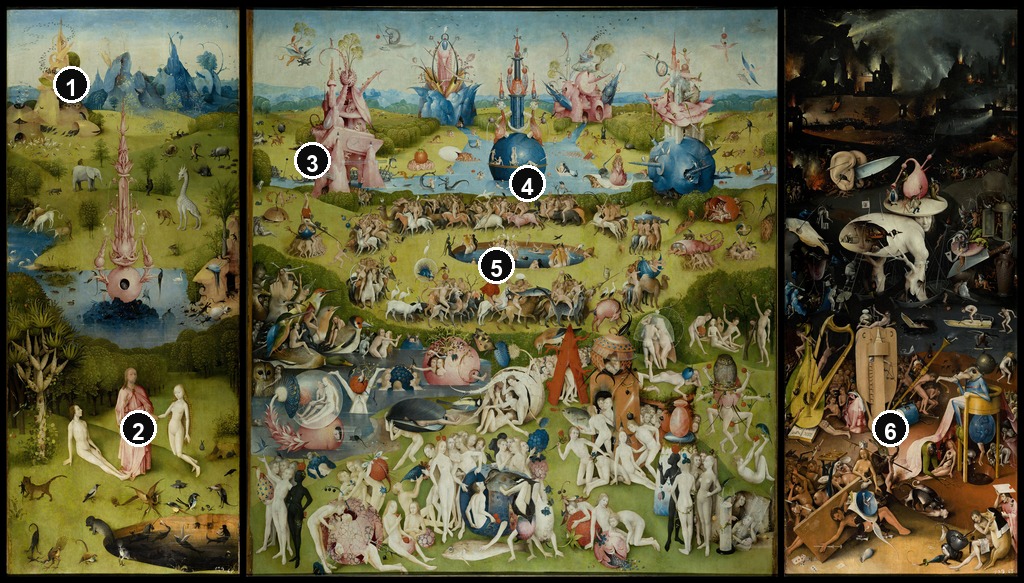
Details from THE GARDEN OF EARTHLY DELIGHTS
Close looking reveals Bosch’s abrupt shifts of scale, improbable structures, crowded bodies and unsettling transformations from paradise to punishment.
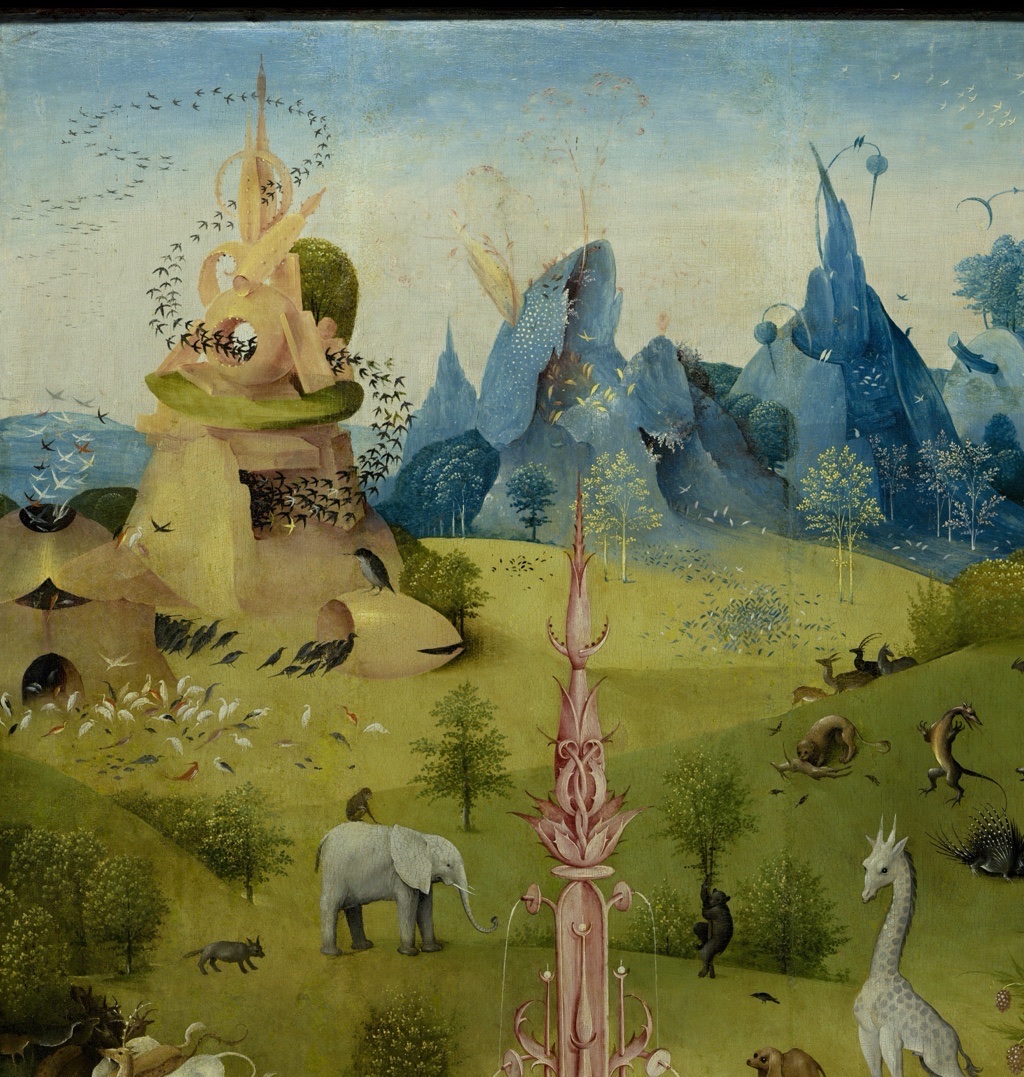
Eden fountain and creatures
A pale organic fountain rises above the left panel while birds, animals and dark openings disturb the calm geometry of the landscape.
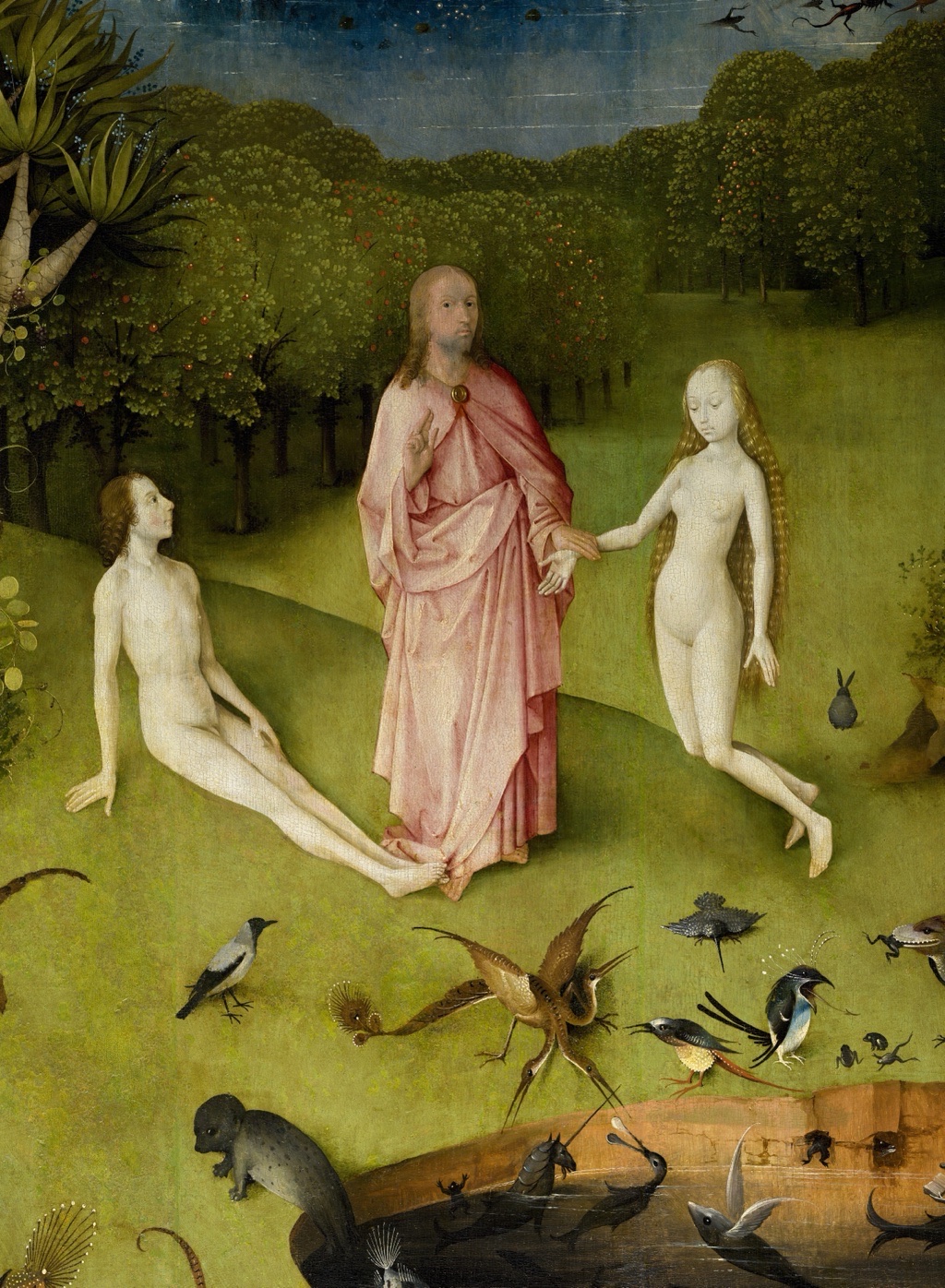
God presents Eve to Adam
The three figures form a quiet triangle at the foot of the left panel, surrounded by a landscape already busy with unfamiliar creatures.
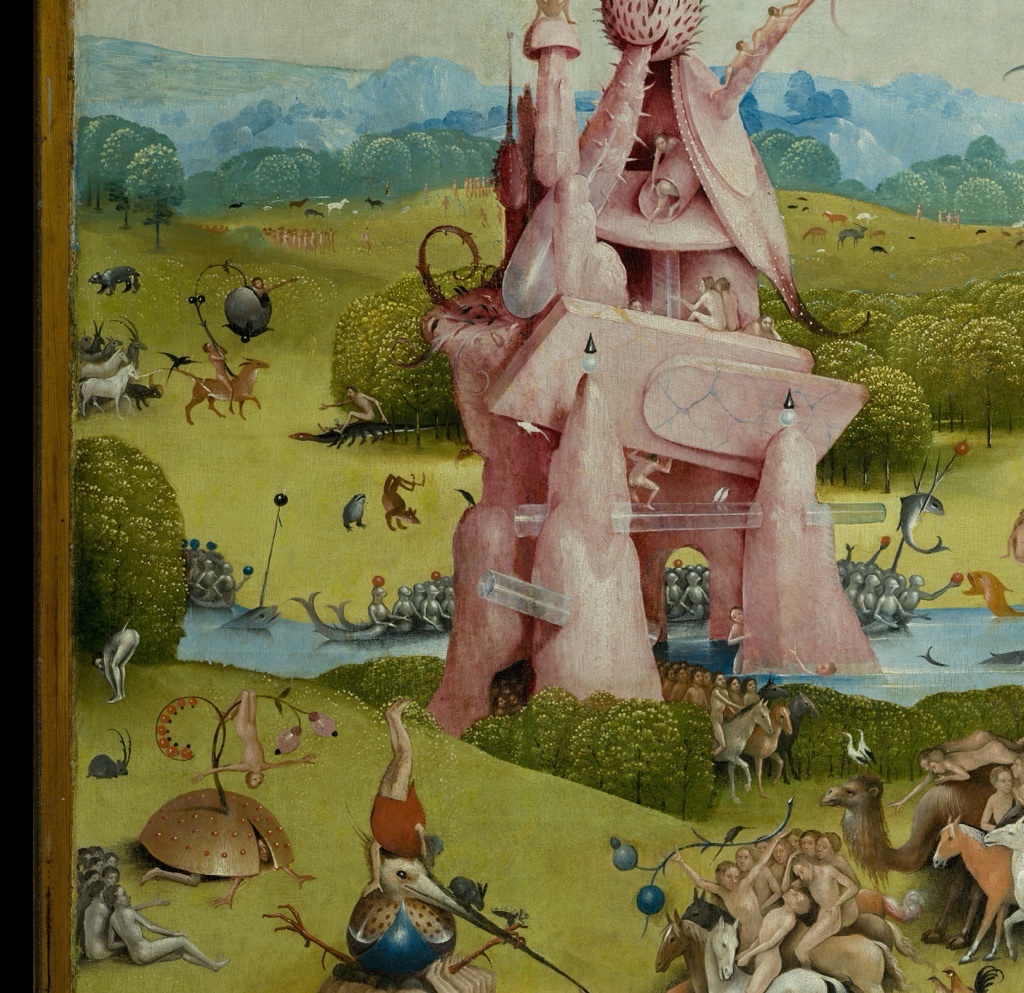
Pink fountain and oversized fruit
A fragile pink structure opens like a shell above enlarged fruit and tiny figures, making ordinary scale feel suddenly unreliable.
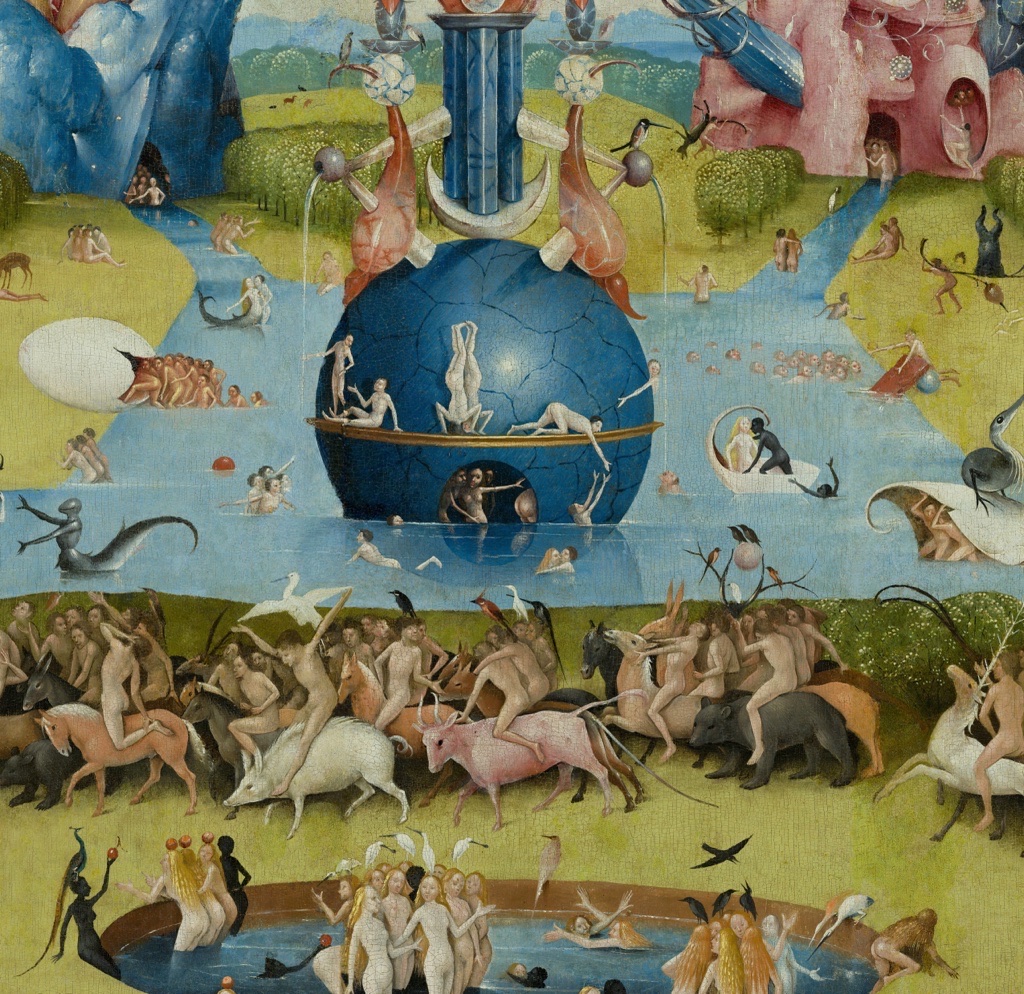
Blue globe and bathers
A dark blue sphere sits in the water like an impossible vessel, pierced by openings and surrounded by figures whose bodies repeat its curves.
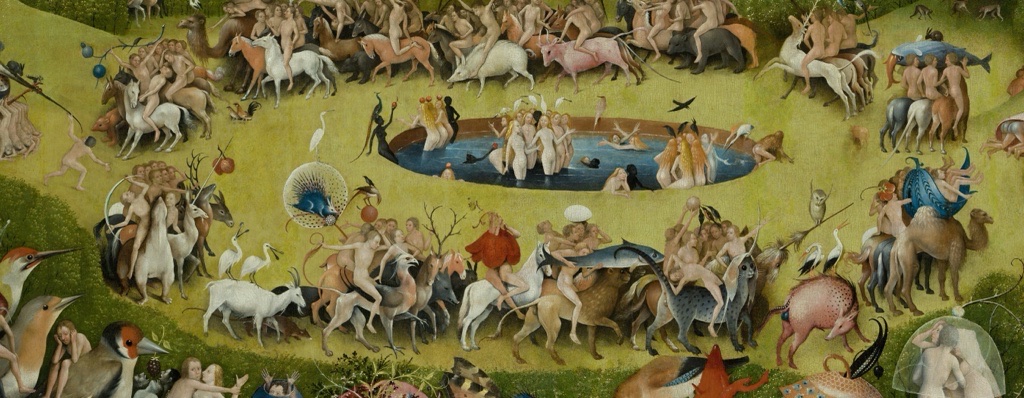
Riders circle the pool
A dense ring of riders turns around the central water, binding people, horses and other animals into a continuous revolving band.
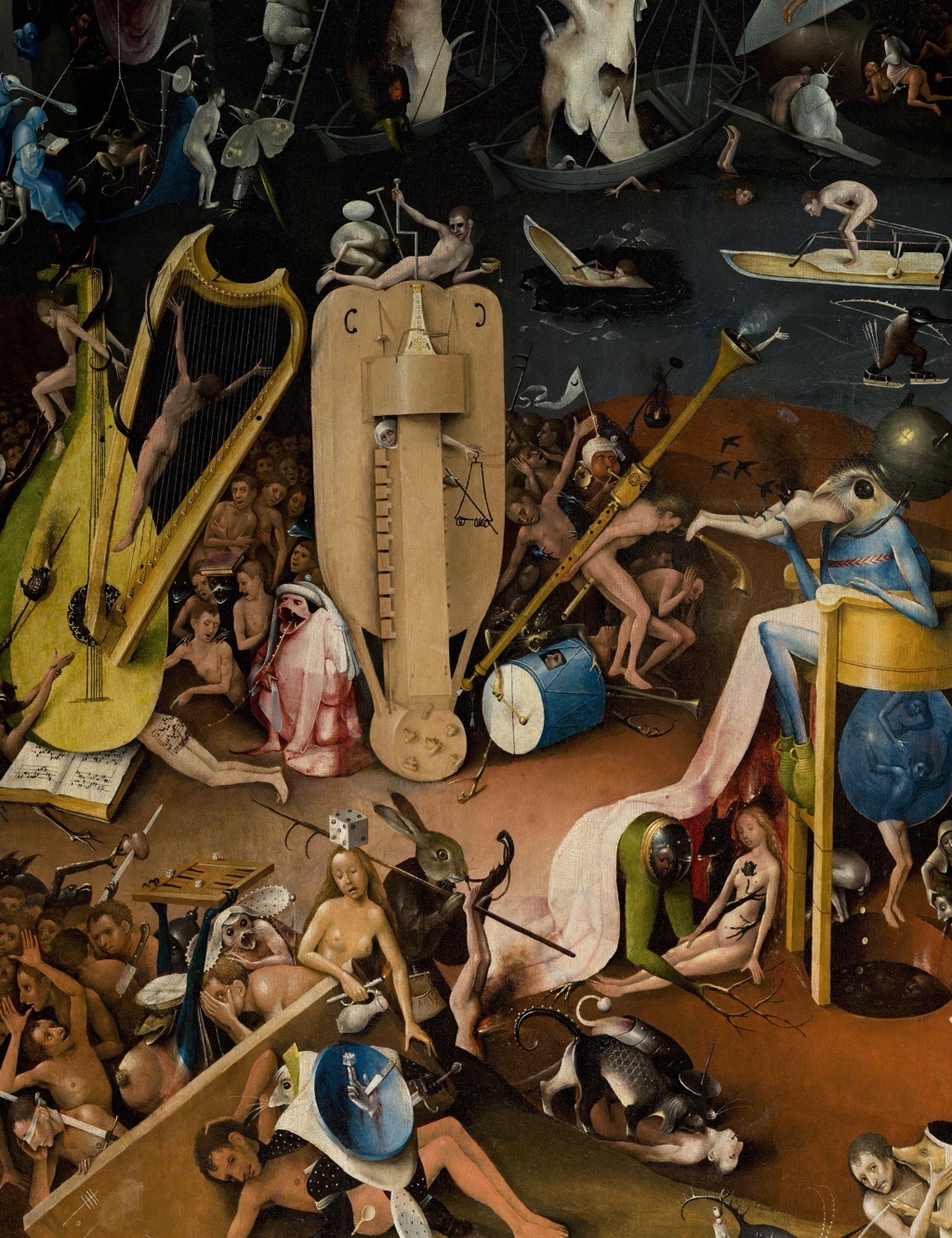
Hell’s musical instruments
Enlarged instruments crowd the dark panel, turning harp, lute, drum and hurdy-gurdy into a stage of confinement and bodily punishment.
What Is The Garden of Earthly Delights?
The Garden of Earthly Delights is a painted triptych: three connected panels, with a larger centre and two narrower wings that could close over it. When closed, the triptych becomes a single grey-toned image of the world at creation. When opened, it reveals three coloured interior scenes: Paradise at left, an immense central landscape of earthly delight, and Hell at right. The shift from grey exterior to saturated interior is essential. Bosch does not simply place three pictures side by side. He makes the act of opening the wings part of the meaning. [1]
The triptych format would have been familiar from Christian altarpieces, but Bosch uses it in a way that is not straightforwardly liturgical. The centre panel does not present a conventional holy scene. It does not show the Crucifixion, the Virgin, saints, or an orderly heavenly hierarchy. Instead it offers a dazzling world in which naked men and women move among birds, fruit, pools, shells, transparent vessels and impossible structures. That unexpected centre is the reason the painting continues to provoke interpretation. It takes a format associated with sacred order and fills it with a vision that seems at once beautiful, comic, unstable and morally dangerous. [1] [6]
The Prado describes the triptych as Bosch's most complex and enigmatic creation. Its modern title is not necessarily its original title, and its first known setting was not a church altar but an aristocratic palace. The earliest key testimony places it in the Nassau palace at Coudenberg in Brussels in 1517, where Antonio de Beatis, secretary to Cardinal Luigi of Aragon, recorded seeing a remarkable painting. Prado research connects the work to Engelbert II of Nassau and the sophisticated courtly world of the Burgundian Netherlands. [1] [3]
The painting's basic movement is clear enough to follow. The exterior begins before human history, with the created world shown in grisaille. The interior begins with Adam, Eve and God in Paradise. It expands into a vast central scene of human pleasure. It ends in Hell. But almost everything within that movement is disputed or layered. Does the central panel show sinful humanity before punishment? A false paradise? A world that might have existed if Adam and Eve had never fallen? A courtly moral warning in deliberately pleasurable form? A meditation on desire, creation and human failure? Different scholars have answered these questions in different ways. A responsible reading does not flatten that debate into a symbol list. [1] [6]
Bosch's achievement lies in making the viewer want to look closely while also making close looking morally uncomfortable. The painting is packed with particulars: an owl hidden in a fountain, a giraffe in Eden, strawberries carried like offerings, fish used as mounts, birds feeding fruit to humans, knives and ears in Hell, a hollow tree-bodied figure staring outward. Each detail asks for attention. Yet Bosch's larger structure warns that attention itself may become a form of appetite. To look at The Garden of Earthly Delights is to enter a painting about looking, wanting, interpreting and being judged. [1]
Bosch, The Prado, And The Painting's Place In His Work
Bosch worked in 's-Hertogenbosch, in the Duchy of Brabant, and came from the Van Aken family of painters. His surviving biography is fragmentary, but BoschDoc and local sources make clear that he belonged to a documented urban, devotional and workshop world rather than to a fantasy of isolated genius. He was connected with the Brotherhood of Our Lady, and his art emerged from a late medieval culture in which religious instruction, moral satire, courtly display and visual invention could overlap. For a fuller life context, see the Bosch biography. [3]
The Prado is central to Bosch studies because it holds several of his most important works or works historically associated with him, including The Garden of Earthly Delights, The Haywain Triptych, The Adoration of the Magi and the disputed Table of the Seven Deadly Sins. The Garden is now displayed in Room 056A, where it functions as one of the museum's great magnets. The Prado's object record, exhibition material and technical research are therefore essential anchors for any public account of the painting. [1]
The Garden also needs to be read alongside Bosch's other triptychs. In The Haywain Triptych, Bosch presents humanity chasing a cart of hay, a moral image of worldly greed and folly, between scenes of sin's origin and infernal consequence. In The Last Judgement, now in Vienna, he builds an immense vision of sin, judgment and punishment. In The Temptations of Saint Anthony, the saint is surrounded by demonic invention, false ritual and spiritual testing. The Garden is more ambiguous than any simple comparison allows, but those works help establish Bosch's repeated concern with the destiny of human beings under moral pressure. [1]
The Bosch Research and Conservation Project, presented through BRCP publications and the Closer to Bosch digital platform, has helped change how Bosch is studied. It emphasizes object-level examination: visible light, macrophotography, infrared imaging, X-radiography where available, underdrawing, conservation history and careful distinctions between Bosch, workshop, followers and later copies. That evidence matters because Bosch's name became a brand after his death. Many later works imitate his monsters and hellscapes. The Garden is not a doubtful follower picture, but the wider problem of Boschian copies explains why workshop and attribution are so important in this artist's cluster. [2] [7]
The Exterior: Creation In Grisaille
When the triptych is closed, the viewer sees an extraordinary monochrome image of the created world. Bosch paints a transparent globe or cosmic sphere, with land and water under a dark sky. God appears in the upper left, small but decisive, with inscriptions drawn from the Psalms: he spoke, and it was made; he commanded, and it was created. The Prado identifies the exterior as the Third Day of Creation, before the making of the sun, moon, animals and human beings. [1]
The exterior is painted in grisaille, a grey-toned technique that can resemble stone, sculpture or uncoloured vision. That restraint changes the emotional temperature of the work. The closed triptych is quiet, remote and cosmic. It does not yet contain the fever of the interior. It presents a world under divine command, still empty of human desire. There are no crowds, no fruit processions, no infernal punishments, no bodies exposing themselves to delight or ruin. The exterior is the world before the human drama begins. [1]
This exterior scene also frames the whole triptych as a meditation on creation. Bosch does not begin with the Fall of Adam and Eve, nor with the Crucifixion, nor with the Last Judgment. He begins with the making of the world itself. The question that follows is therefore not only "What sins are shown?" but "What happens to creation when humanity enters it?" The interior panels answer that question in a form that remains disturbing because it is so visually pleasurable. [1] [6]
The monochrome surface matters for interpretation. Grisaille can suggest distance, discipline and an image before colour. When the wings open, the viewer moves from a restrained vision of the created world into a coloured world of bodies and consequences. The triptych does not merely illustrate time; it stages a transition from divine command to human action. That transition is central to Bosch's moral imagination. [1]
The exterior also resists the easy idea that the painting is simply a carnival of fantasy. Before Bosch gives us monsters, fruit and desire, he gives us theology. The globe is fragile, luminous and enclosed. The creator is present but not theatrically dominant. The world has been called into being, but the sun has not yet been set in the sky and humanity has not yet entered the story. The triptych's first image is therefore not chaos but order, an order that the interior will test almost to breaking point. [1]
Opening The Triptych
Once opened, the triptych reads from left to right with a broad narrative force: Paradise, earthly delight, Hell. This sequence resembles other moral triptychs by Bosch, but the Garden complicates the pattern because the central panel is not a normal scene of vice. It is too bright, too beautiful and too seductive to be dismissed as a simple sermon illustration. It seems to offer pleasure before it reveals the price of pleasure. [1] [6]
The three interior panels are linked by landscape, water, bodies, animals and architecture. The left panel contains God, Adam and Eve in a richly imagined Paradise. The central panel enlarges that Eden-like world into a crowded field of naked humanity. The right panel darkens the world into Hell, where objects of pleasure and culture become instruments of pain. Fruits, birds, instruments, vessels and bodies recur across the triptych in altered states. Bosch makes forms migrate from delight to punishment. [1]
The open triptych's power depends on scale and density. The viewer can stand back and see a moral arc. Up close, the arc dissolves into hundreds of incidents. The central panel especially resists a single focal point. The eye circles around pools, processions, trees, birds, human groups and strange architectural forms. The right panel has its own terrible attractions: a burning city, frozen water, musical tortures, beasts in action and the so-called tree-man. This structure makes Bosch's painting a prolonged experience rather than a quick moral diagram. [1] [7]
That prolonged looking is part of the work's seriousness. Bosch does not ask the viewer to identify one emblem and move on. He builds a world whose surface invites exploration and whose logic remains unstable. The painting is not obscure because Bosch lacked discipline. It is obscure because disciplined invention was one of his strongest tools. [2] [6]
The Left Panel: Paradise And The Beginning Of Human History
The left panel is often described as Paradise or Eden. God stands between Adam and Eve, bringing the first woman to the first man. Adam reclines on the ground, newly awake and astonished. Eve kneels or is presented beside him, while God, shown with the appearance of Christ, joins them at the centre of the composition. This is not yet the expulsion from Eden. Bosch chooses the moment of introduction, union and human beginning. [1]
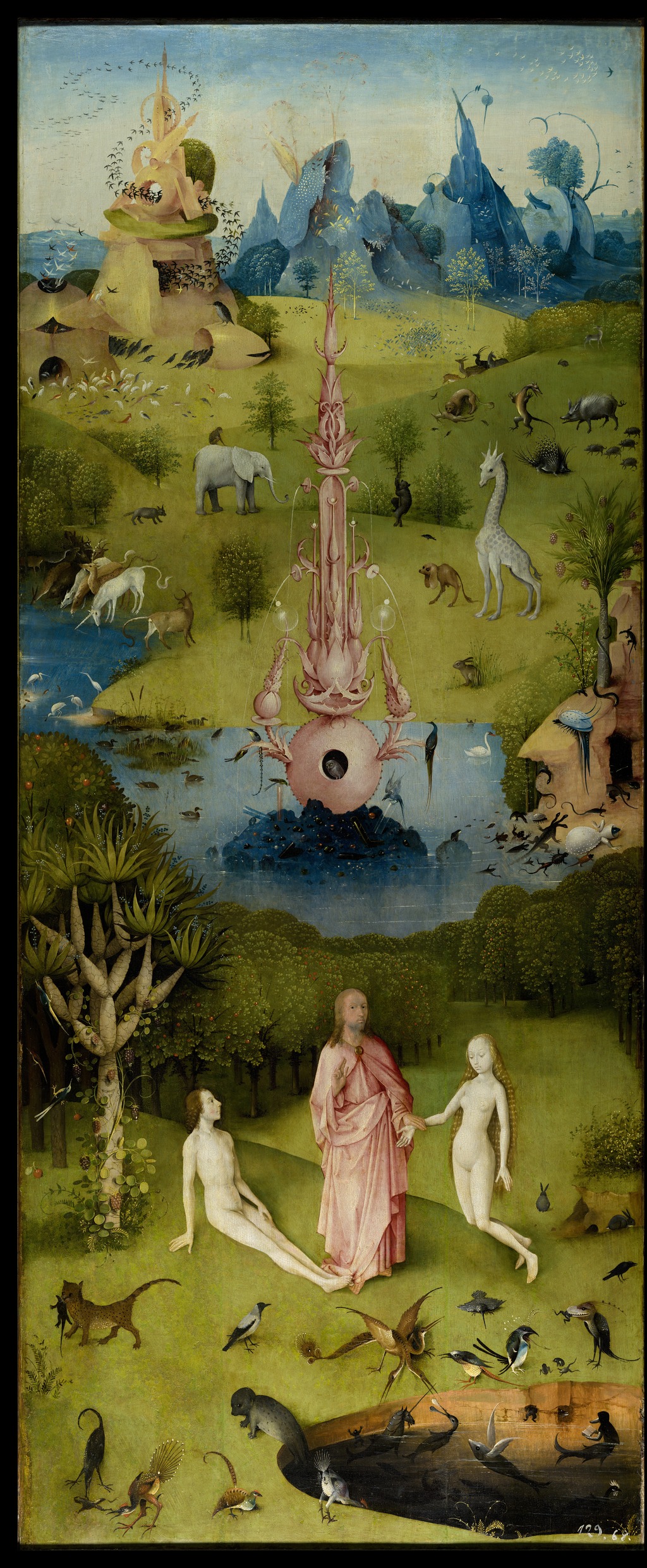
The scene is beautiful but not simple. Around the central group, animals move through a fantastical landscape. Some are recognizable, including exotic animals that would have signalled wonder in Bosch's northern European world. Others are stranger, hybrid or ominous. A tall pink fountain rises from the water behind the figures, delicate and uncanny, with an owl-like creature placed within its structure. Pools, rocks, birds and plants fill the panel with life. [1]
Paradise here is not an empty stage. Bosch imagines creation as abundance, but also as a place already containing signs of tension. Animals pursue one another. Hybrid shapes appear among natural forms. The fountain is at once beautiful and unsettling. This does not mean Bosch paints Eden as already fallen in a literal chronological sense. Rather, he paints Paradise in a way that foreshadows the vulnerability of the world into which humanity is introduced. [1] [6]
The relation between Adam, Eve and God is crucial. Adam looks toward Eve with a mixture of wonder and awakening. God touches Eve and presents her, binding the first human couple within divine order. Yet the viewer knows what comes next in Christian tradition: temptation, the Fall and exile from Eden. Bosch does not need to paint the serpent at the centre of the panel for the story's future to be felt. The very act of presentation carries dramatic irony. [1]
Technical study deepens this scene. Prado exhibition material notes that infrared reflectography revealed changes in the underdrawing, including shifts in the placement and conception of Adam, Eve and God. God was first imagined differently and then given the Christ-like appearance seen in the completed painting. Such evidence matters because it shows Bosch thinking through the meaning of the scene while working, rather than simply filling in a fixed cartoon. [8]
The left panel also establishes the triptych's language of forms. Water, bodies, animals, fruit-like shapes and strange mineral or organic structures will return in the centre panel. Bosch's world is not divided into neat symbolic compartments. Eden's forms are transformed, multiplied and unsettled as the triptych moves outward. A viewer who studies the left panel carefully sees that the central panel grows from Paradise rather than appearing as an unrelated fantasy.
The figure of God is one reason the left panel remains morally anchored. Without him, the scene might seem like a dream of nature. With him, it becomes a theological scene of human origin. The central question is not whether Bosch admired nature's abundance. He clearly did. The question is what human beings do with abundance when desire enters the world. [1] [6]
The Centre Panel: Earthly Delight, False Paradise And Human Desire
The central panel gives the triptych its modern title and its greatest interpretive difficulty. Hundreds of nude figures fill a wide landscape of pools, lawns, fruit, birds, shells, vessels and delicate structures. They gather in groups, ride animals, carry enormous berries, enter transparent globes, embrace, play, balance, hide, peer, bathe and process around water. The scene is so bright and intricate that it first appears festive. Only gradually does its unease become clear. [1]
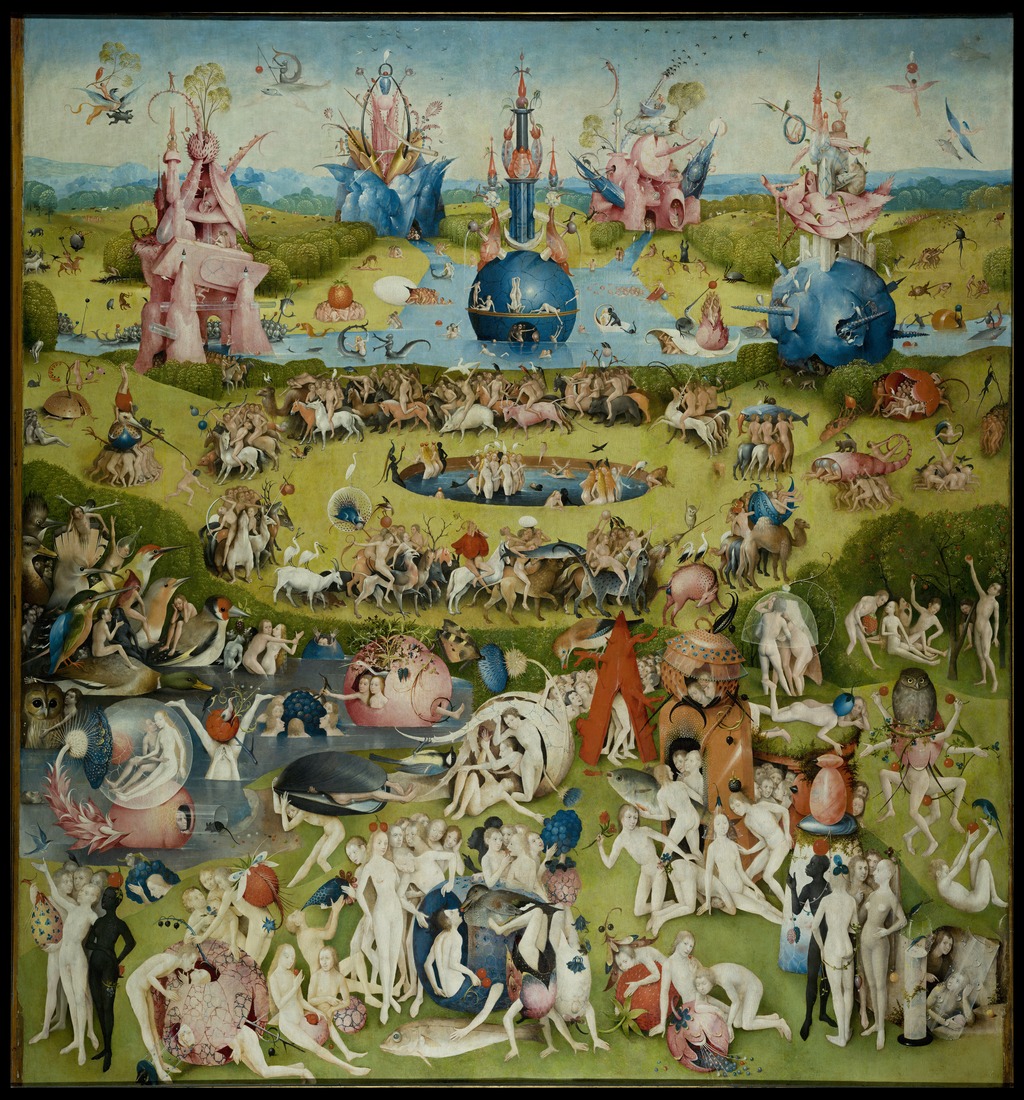
The Prado's interpretation connects the central panel with false paradise and lust. The triptych draws attention to sins and their consequences, but Bosch's method is not blunt. He does not show one easily named act repeated across the panel. Instead he creates a field of desire, appetite and sensory absorption. Bodies are exposed but rarely individualized. People seem young, pale and interchangeable. Many appear absorbed in collective behaviour rather than personal decision. [1]
Fruit is everywhere. Giant strawberries, berries, cherries and other forms are carried, entered, exchanged or consumed. In late medieval moral culture, fruit could suggest sweetness, transience and temptation, but Bosch's fruit should not be reduced to one dictionary entry. It functions visually as well as symbolically. It is soft, bright, perishable and sensuous. It invites touch and taste. In the Garden, such objects become part of a world where pleasure is abundant but unstable. [1] [6]
Birds and animals also take on strange roles. Humans ride birds, gather around them, or appear to be fed by them. Some birds are rendered with enough specificity to reward natural observation; others belong to Bosch's imaginative transformations. The result is a world in which the hierarchy between human beings and animals has become unstable. In Eden, animals surrounded the first couple. In the centre panel, humans seem to have joined a larger circuit of appetite, movement and display.
Water structures the whole scene. Pools gather groups of figures. In the middle distance, riders circle around a pool of women. In the background, fountains and blue or pink architectural fantasies rise from water like fragile machines. Water may suggest fertility, cleansing, reflection or instability, depending on context. Bosch keeps those possibilities open. His landscape looks fertile, but it is not peaceful. Its pleasures seem circular, repetitive and without a clear end. [1]
The circular procession around the pool is one of the panel's most discussed motifs. Men ride animals around a central group of women, producing a visual rhythm of attraction and pursuit. The motif has often been read in relation to desire, fertility, sexual circulation or courtly ritual. Yet it also resists exact reduction. It is not a single allegorical emblem but a moving system, a visual machine for showing bodies drawn into repeated patterns. [6]
Transparent globes, shells and vessels appear throughout the panel. Some figures enter them or are enclosed by them. These forms are beautiful but fragile. They suggest pleasure as enclosure, self-containment and illusion. The glassy objects look precious, but they also look breakable. Bosch's visual intelligence lies in that double effect. The viewer is drawn to their delicacy while sensing that such pleasure cannot last. [1]
The central panel contains little overt violence compared with Hell, but it is not innocent. Many figures seem passive, entranced or absorbed in ritualized pleasure. They do not look toward God, toward judgment, or even much toward the viewer. They are caught within the world of the panel. That inward absorption is one reason the scene can be read morally without needing Bosch to paint obvious punishment in the same space. [1] [6]
Some scholars have proposed that the central panel imagines humanity in a hypothetical world before the Fall, or a paradise of natural innocence. Others read it as a deliberately seductive vision of lust and worldly folly whose consequence appears at right. The Prado's interpretation weighs strongly toward the moral reading, while still acknowledging the painting's exceptional complexity. The most careful approach is to recognize that the panel's beauty is part of the warning. Bosch makes delight look delightful. [1] [6]
That point is important. If the central panel were visually ugly, it would be easier to interpret but much less profound. Bosch instead paints temptation as abundance, variety and fascination. The viewer's pleasure in the painted surface becomes analogous to the figures' immersion in the world of delight. We do not merely observe the central panel; we feel the pull of it. [1]
The central panel also connects the Garden to Bosch's symbolism without becoming a simple glossary of symbols. Owls, fruit, shells, birds and instruments may carry associations in late medieval visual culture, but Bosch's meanings are built through relationships, not isolated labels. A strawberry in one context, a bird in another, and a shell elsewhere do not always mean the same thing. Responsible interpretation follows composition, sequence, repetition and source-supported context. [6]
The Right Panel: Hell And The Collapse Of Delight
The right panel turns the triptych into a vision of consequence. The scene is dark, crowded and violent. A burning city glows in the background. Figures are pierced, crushed, swallowed, frozen, dragged, read, written upon, bound and tormented. Objects associated with pleasure, culture and ordinary life become instruments of punishment. This is the part of the painting that most directly connects the Garden with Bosch's wider imagery of Hell and judgment. [1]
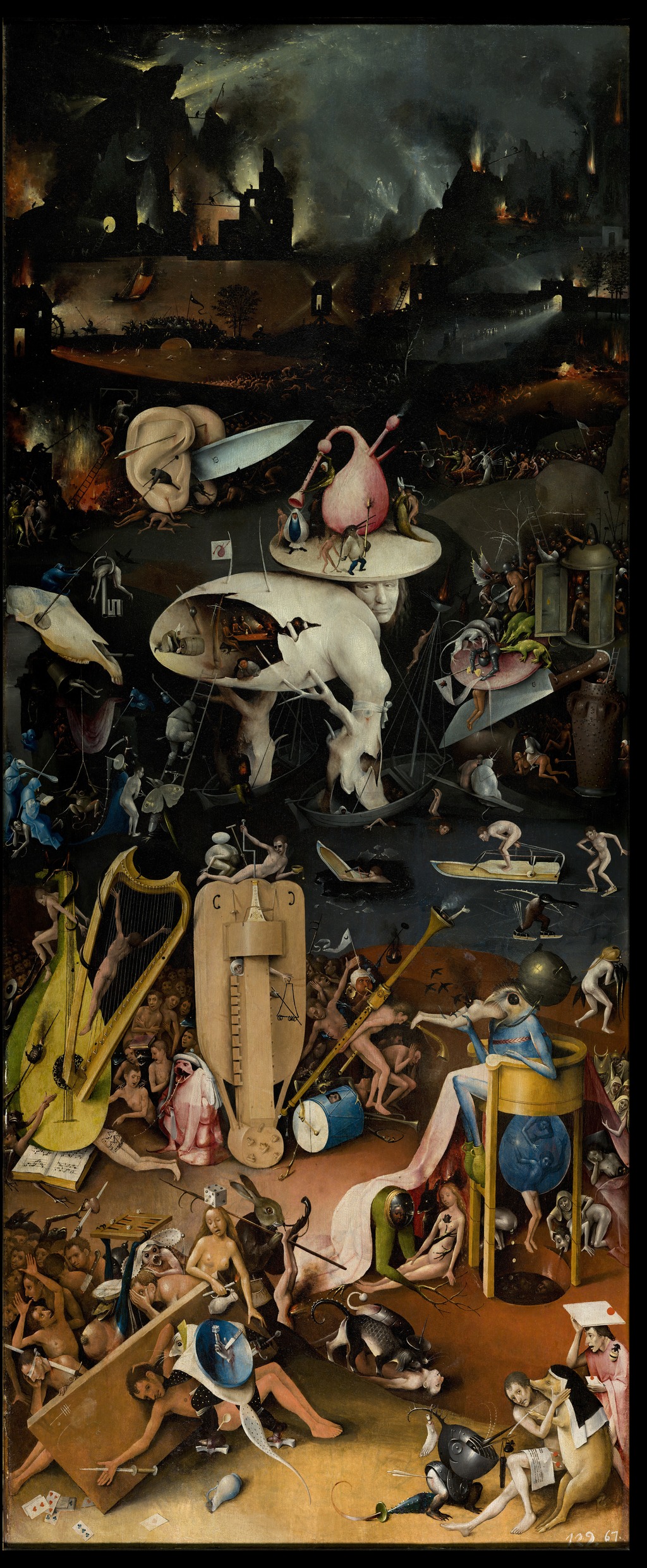
Hell is not only fire. Bosch includes darkness, ice, machinery, tavern disorder, monstrous bodies and impossible architecture. The panel's variety is part of its terror. Punishment is not a single furnace but an entire world in which creation has been inverted. The crowded delights of the central panel become crowded torments. The viewer's eye again moves from episode to episode, but now curiosity is mixed with horror. [1]
One of the most famous figures is the so-called tree-man: a hollow, egg-like body supported by tree trunks or broken limbs, wearing a disk or platform on his head and turning a pale face toward the viewer. Around and within him, tavern-like scenes, figures and objects create a disturbing fusion of human body, architecture and landscape. The figure has often been treated as a self-portrait or a psychological clue, but such claims require caution. What can be said securely is that Bosch uses the tree-man as a visual centre of infernal instability. [1]
Musical instruments dominate another section of Hell. A lute, harp, hurdy-gurdy or similar instruments appear not as sources of harmony but as devices of torment. Bodies are pinned, stretched or crushed against them. Music, which could be associated with order, pleasure or worship, is transformed into punishment. This inversion fits the panel's broader logic: the things that delight the senses become the means by which the senses are punished. [1]
The ears pierced by a knife are among Bosch's most unforgettable inventions. Their scale and strangeness make them feel less like a standard medieval emblem than an act of visual imagination pushed to an extreme. Yet the motif is not random. Throughout the right panel, body parts, tools and senses are dislocated from proper order. Hearing, seeing, tasting, touching and playing all become exposed to judgment.
Elsewhere in the panel, figures are devoured, excreted, forced into strange ceremonies, or punished through objects connected with gambling, drinking, lust or violence. Bosch's Hell is theatrical, but it is not merely comic. Its grotesque humour sharpens the moral point. Viewers may laugh or marvel, then realize that the jokes are part of a scene of damnation. [1] [6]
The transition from the central panel to Hell is crucial. Bosch does not paint a neat legal ledger in which one central act receives one matching punishment. He paints a transformation of world into anti-world. Brightness becomes darkness. Circular play becomes compulsion. Musical pleasure becomes pain. Fruit and bodily delight give way to consumption and dismemberment. Architecture no longer shelters; it traps. The moral movement is broad rather than mechanical. [1]
This is why The Garden of Earthly Delights should not be read as a puzzle with every monster assigned a single sin. Bosch's Hell works through atmosphere, inversion, repetition and accumulation. The viewer understands that something has gone catastrophically wrong, even when individual details remain unresolved. That unresolved quality is not a failure of interpretation. It is part of the painting's design. [6]
Moral And Devotional Interpretation
The Garden's broad moral structure is hard to deny: creation, human delight and Hell form a sequence that warns about the fate of humanity. Prado material explicitly places the work within discussions of sin, false paradise and consequence. Yet the painting is more than an illustrated sermon. Its complexity lies in how Bosch makes moral danger visually beautiful before making it terrifying. [1]
In late medieval devotional culture, images could teach, warn, move and discipline the viewer. Bosch's triptych belongs to that world, even if its original palace setting and central imagery make it unusual. It asks viewers to contemplate creation, human desire and damnation. The closed wings present the world under God. The opened interior presents what human beings do within that world and what may follow. [3] [1]
The painting also belongs to a culture of moral satire. Bosch often exposes folly by exaggerating it into memorable form. In The Haywain Triptych, the pursuit of worldly goods becomes a vast procession around a hay cart. In the Garden, the pursuit of pleasure becomes an entire landscape. Bosch's moral imagination is visual before it is verbal. He thinks through bodies, objects, animals and transformations. [1]
Devotional interpretation should not make the painting dull. Bosch's seriousness includes play, comedy and surprise. His demons and hybrid forms are often absurd as well as frightening. His central panel is formally beautiful, not accidentally attractive. The work's moral force depends on that tension. Viewers are not simply told that delight is dangerous; they are made to experience delight as attraction. [6]
The triptych's likely aristocratic context matters here. A work associated with the Nassau palace would have been seen by educated, courtly viewers capable of recognizing visual wit, theological allusion, luxury, display and moral warning. The painting may have functioned as a prestige object, a conversation piece and a spiritual provocation at once. These categories do not cancel one another. Courtly art could delight and admonish in the same breath. [1] [3]
The lack of a single surviving statement by Bosch about the work is also important. Bosch left no explanatory text telling us what each figure means. That absence should produce humility. Some elements can be interpreted with confidence because they fit the triptych's sequence, contemporary moral culture, biblical themes or documented reception. Other elements remain uncertain. A good reading distinguishes between those levels rather than presenting all claims with equal certainty. [3] [6]
Ambiguity Is Not A Weakness
The Garden's ambiguity is sometimes treated as a problem to be solved. It is better understood as one of the painting's central strengths. Bosch creates an image that invites interpretation while exposing the limits of interpretation. The viewer wants to know what the fruit means, why the figures behave as they do, whether the central landscape is before or after the Fall, and how each detail connects to the whole. The painting gives evidence, but not a full key. [1] [6]
This ambiguity does not mean that any interpretation is valid. The object has a date range, material structure, provenance, format and visual sequence. It belongs to Bosch's corpus and to the religious and courtly culture of the Netherlands around 1500. The exterior is Creation; the left panel is Paradise; the right panel is Hell. These anchors matter. Within them, there is room for debate about the central panel's exact status and about the meaning of many details. [1]
Sensational interpretations often detach Bosch from his world and turn the Garden into a conspiracy diagram, a dream journal, a coded heresy map or a proto-modern fantasy. Such readings may be entertaining, but they usually flatten the evidence. Bosch was inventive enough without needing to be made into a secret modern. His strangeness is more compelling when placed within late medieval theology, moral satire, courtly display, workshop practice and technical evidence. [3] [2]
The painting's modern fame has also encouraged anachronism. Because the central panel looks dreamlike, it is often compared with Surrealism. That comparison can be useful when discussing later reception, but it should not be used as an explanation of Bosch's own purpose. Bosch was not a twentieth-century Surrealist before Surrealism. He was a late medieval and early Netherlandish painter whose visual imagination later spoke powerfully to modern viewers. [6]
Ambiguity also protects the painting from becoming a checklist. A symbol list may tell a reader that fruit means lust, owls mean evil, shells mean sexuality and instruments mean sensual pleasure. Sometimes such associations are useful. But Bosch's details operate in a field of visual relationships. The same object can shift in meaning according to placement, scale and narrative context. The Garden rewards close looking because it refuses to make meaning mechanical. [6]
How To Look Closely Without Over-Decoding
The Garden rewards a slow route through the panels. Begin with the format before the details. The closed wings establish creation in grey. The open interior moves from Paradise to delight to Hell. That sequence gives the viewer a moral grammar before any single owl, berry, instrument or monster is interpreted. Without that grammar, the details become detached curiosities. With it, they become part of a painting about human beings inside a created world. [1]
Next, follow repeated forms. Bosch often makes a shape or object change meaning as it moves across the triptych. Water in Eden suggests created abundance; water in the centre becomes a social and erotic environment; water or ice in Hell becomes part of punishment and desolation. Birds begin as creatures within Paradise, then become oversized companions, mounts or feeders in the centre. Instruments can appear as signs of culture and pleasure, then become devices of torment. Such repetitions are more reliable than isolated guesses because they arise from the painting's own structure. [1]
Scale is another clue. Bosch enlarges small things and miniaturizes human beings. Fruit becomes architecture or cargo. Birds become mounts. Ears become monumental objects. The body becomes a building in the tree-man. These changes of scale unsettle the viewer's confidence in ordinary categories. Human beings are no longer masters of the world; they are absorbed into systems of appetite, display and punishment.
Look also for direction and attention. In the left panel, God, Adam and Eve form a clear devotional centre. In the central panel, attention disperses. Many figures look at one another, at fruit, at animals or at nothing in particular. In Hell, attention becomes coercive: bodies are forced into punishments, read by demons, pierced by instruments or trapped in humiliating arrangements. Bosch turns looking from wonder into distraction and then into judgment. [1] [6]
Finally, separate observation from conclusion. It is secure to say that the exterior represents Creation, that the left panel shows God presenting Eve to Adam, that the right panel shows Hell, and that the provenance connects the work with the Nassau court and later Spanish royal collecting. It is more interpretive to say exactly what every berry, bird or vessel means. Strong writing about Bosch moves between those levels without confusing them. The painting becomes richer, not poorer, when uncertainty is named honestly. [1] [3] [6]
Technique, Underdrawing And Revision
The Garden is painted in grisaille and oil on oak panel. Its technique is inseparable from its meaning. Bosch's crisp figures, translucent forms, delicate architecture and monstrous inventions require both imagination and control. The triptych may look like an eruption of fantasy, but technical study shows a painter making deliberate changes as he worked. [1] [2]
The Prado's 2016 Bosch exhibition placed particular emphasis on technical examination. Infrared reflectography and X-radiography allowed researchers and visitors to see aspects of the work not visible to the naked eye, including underdrawing and changes beneath the painted surface. The Prado notes that these images reveal Bosch's creative process and the adjustments he made between underdrawing and final paint. [8]
In the left panel, technical study indicates changes to the grouping of Adam, Eve and God. In the central panel, Prado material notes alterations to figures, landscape forms and the false fountain of the Four Rivers. In Hell, Bosch removed or changed large forms and fantastical beasts. Such revisions matter because they make the Garden less like a fully predetermined diagram and more like a painting developed through active invention. [8]
The underdrawing, according to Prado exhibition material, was executed freehand in brush over a white ground. This is important for Bosch's style and technique. His precision does not mean stiffness. The technical evidence points to an artist who could work with speed, adjustment and invention while maintaining a highly organized pictorial world. [8] [2]
The BRCP and Closer to Bosch platform are especially valuable because they encourage this object-based approach. They bring attention to macrophotography, infrared macrophotography and infrared reflectography, as well as the broader technical and catalogue study of Bosch, his workshop and followers. For the Garden, that means the painting is not only a field of symbols; it is a made object, planned and revised on oak panels by a working painter. [2] [7]
Dendrochronology and stylistic comparison also affect dating. The Prado places the work in 1490-1500 and explains that earlier and later dates have been debated. The painting's relation to the Prado's Adoration of the Magi and to a creation image in Hartmann Schedel's World Chronicle, published in Nuremberg in 1493, are part of the Prado's argument for a 1490s date. This dating matters because it supports the association with Engelbert II of Nassau rather than older theories centered on Henry III. [1]
Technique therefore helps interpretation in two ways. It gives evidence for how Bosch worked, and it constrains speculation. The Garden's meaning is not hidden only in iconography; it is also visible in revisions, format, material, scale, colour and the relation between exterior and interior. [8] [2]
Provenance: From Nassau Palace To The Prado
The Garden's provenance is unusually important because it shapes how the painting is understood. The key early document is Antonio de Beatis's account of 1517, which places a remarkable painting at the Nassau palace of Coudenberg in Brussels. Prado research associates the triptych with Engelbert II of Nassau, who died in 1504, rather than treating it primarily as a later commission for Henry III of Nassau. [1]
The Prado's current provenance traces the work from Engelbert II to Henry III of Nassau, then to Rene de Chalon and William I of Orange. In 1568, during the conflicts of the Low Countries under Spanish rule, the triptych was expropriated in Brussels by Fernando Alvarez de Toledo, Duke of Alba. It then passed to Fernando de Toledo, the Duke's illegitimate son. Philip II purchased it at Fernando de Toledo's posthumous sale in 1591. [1]
Philip II sent the work to the Monastery of San Lorenzo de El Escorial in 1593. This Spanish royal and monastic context deeply affected the painting's later history. The Garden was moved to the Museo del Prado in 1933 from El Escorial and remains on permanent loan from Patrimonio Nacional, belonging to the Monastery of San Lorenzo de El Escorial. [1]
This history helps explain why the Prado is not simply a display location. The museum is the main modern public home of a work whose Spanish royal afterlife is part of its identity. Philip II's collecting of Bosch helped preserve major works and shaped Bosch's later reputation. Spanish reception is therefore not a side note; it is part of the painting's survival and interpretation. [1] [3]
The Nassau origin also helps correct a common simplification. Older accounts often associated the Garden with Henry III of Nassau and courtly marriage culture. Prado research now points toward Engelbert II as the likely patron, based on the revised dating and the 1517 evidence. That does not eliminate every question about original function, but it shifts the emphasis toward a late fifteenth-century courtly setting. [1]
The painting's early palace context makes its combination of pleasure and warning especially fascinating. It was probably not made for a parish altar. It was a sophisticated object for elite viewers, capable of provoking wonder, conversation, moral reflection and perhaps unease. The central panel's sensual brilliance would have been part of its effect. [1] [6]
Relation To The Haywain, Last Judgement And Saint Anthony
The Garden becomes clearer when set beside Bosch's other major triptychs, but it should not be reduced to them. The Haywain offers one of the closest structural comparisons. Its exterior and interior build a moral sequence around sin, worldly pursuit and judgment. Humanity chases the hay cart, ignoring spiritual danger. The Garden also moves from creation and Paradise toward Hell, but its central scene is less explicitly satirical and more visually seductive. [1]
The Last Judgement offers another comparison. It makes the consequences of sin almost overwhelming, with dense punishments and apocalyptic scope. The Garden's right panel belongs to the same broad universe of infernal imagination, but the Garden gives unusual weight to the world before Hell. Its centre panel makes the viewer linger in the condition that judgment condemns.
The Temptations of Saint Anthony provides a third comparison. There, the saint is tested by demonic spectacle, false rituals and grotesque invention. In the Garden, there is no isolated saint resisting temptation. The central panel shows humanity collectively absorbed in delight. The difference is profound. Saint Anthony resists; the Garden's figures seem immersed.
These comparisons show why Bosch's Hell imagery should be read across works rather than in isolation. Instruments, monsters, hybrid bodies, burning landscapes and grotesque punishments are part of a broader visual language. The Hell support context helps connect the Garden to Bosch's visions of afterlife, punishment and judgment without pretending that each infernal detail has an identical meaning in every work.
They also show why Bosch's symbolism and style and technique deserve separate attention. The Garden is both iconographically rich and technically sophisticated. Its meaning emerges from moral structure, visual invention, material execution and viewer response. [1] [2]
Reception And Modern Fame
The Garden was famous early. Antonio de Beatis's 1517 notice already suggests that the work was remarkable enough to record. Its later Spanish royal history, copies and continued visibility helped make it one of Bosch's defining works. By the modern period, it had become an emblem of Bosch himself: the painting most likely to stand for his imagination in textbooks, exhibitions and popular culture. [1] [3]
The Prado's 2016 Bosch exhibition reinforced that status. The Garden was displayed with technical images, including infrared reflectography and X-radiography, and with contextual works connected to Engelbert II of Nassau, including a portrait of the patron and related manuscript material. This context encouraged viewers to see the Garden not only as a spectacular image, but as a courtly, technical, devotional and historical object. [9]
Modern viewers often approach the Garden through its strangeness. That is understandable. Few paintings before or after Bosch contain such an intense concentration of visual invention. But the most interesting modern reception does not require pretending Bosch was outside history. The painting's later influence, from Boschian copies to modern fascination with dream imagery, belongs to a larger story of reception and influence. [2] [6]
Comparisons with Surrealism can help explain why twentieth-century viewers found Bosch newly compelling, but they should remain comparisons, not origins. Bosch's imagery may feel dreamlike to modern eyes, yet his triptych belongs to late medieval Christian moral culture, courtly collecting and early Netherlandish painting. Its modern afterlife is powerful because the work is both historically specific and visually inexhaustible. [6]
Why Responsible Interpretation Matters
Responsible interpretation matters because the Garden is too good to be simplified. Its weirdness is not a license for careless decoding. Bosch's triptych has object facts, technical evidence, provenance, a place in his corpus and a deep scholarly record. Ignoring those anchors makes the painting less strange, not more, because it replaces Bosch's difficult invention with modern fantasy. [1] [2] [3]
At the same time, responsible interpretation should not drain the painting of wonder. Bosch's details remain startling even when placed in context. The owl in the fountain, the fruit processions, the glass vessels, the tree-man and the musical torments do not become ordinary once they are studied. They become sharper. Evidence gives the strangeness weight.
The Garden asks viewers to balance attention and caution. Look closely, because Bosch built a world in details. Be cautious, because not every detail yields a secure meaning. Follow the triptych's structure, because creation, Paradise, delight and Hell frame the work. Allow ambiguity, because the central panel's power depends on it. [1] [6]
This is why the painting remains inexhaustible. It is not only a famous image of naked figures and monsters. It is a disciplined meditation on creation, desire and consequence, painted with such brilliance that the viewer experiences the danger of delight while trying to understand it. Bosch makes moral thought visual. He makes looking a test. [1]
Artworks and related attributions
Browse paintings, drawings and related attributions. Records group triptychs, fragments and two-sided sheets where appropriate. Dates follow the cited museum records or catalogue headings and are generally estimates. Rows marked “2016 catalogue” report that publication’s attribution and collection information; these are dated opinions, rather than a claim that every work is an accepted autograph Bosch.
| Name | Date | Medium, attribution and collection |
|---|---|---|
| A Crossbowman | Second half of the sixteenth century | Oil on oak panel · Copy after Hieronymus Bosch · Museo Nacional del Prado, Madrid · P002695 Source 1. Source 2. |
| A Woman Spinning and an Old Woman | Museum estimates: about 1480–1490 for the women and 1500–1505 for the reverse; the precise chronology is disputed | Pen and brown and grey ink on the front; pen and brown ink on the reverse · Hieronymus Bosch · Museum Boijmans Van Beuningen, Rotterdam · N 190 recto and verso (PK) Source 1. Source 2. |
| Adoration of the Child in Cologne | Second half of the sixteenth century | Oil on oak panel · Imitator of Hieronymus Bosch, in the city collection record · Wallraf-Richartz-Museum & Fondation Corboud, Cologne · WRM 0474 Source 1. Source 2. |
| Adoration of the Magi in Philadelphia | Early sixteenth century in the museum record; around 1495–1520 in the BRCP catalogue | Oil on oak panel · Hieronymus Bosch in the museum record; workshop of Bosch in the 2016 BRCP catalogue · Philadelphia Museum of Art, John G. Johnson Collection, 1917 · 1321; museum object 103592 Source 1. Source 2. |
| Adoration of the Magi — New York | c.1470–1480 | 2016 catalogue: Bosch; oil on oak · Metropolitan Museum 13.26 2016 catalogue. |
| Adoration of the Magi — Prado triptych | c.1494 | Oil on oak; grisaille exterior · Bosch · Prado P002048 Object source. |
| Adoration of the Magi — three associated fragments | c.1515–1535 | 2016 catalogue: Follower of Bosch · Two Shepherds / Retinue in Philadelphia; associated Adoration in private collection in 2016 2016 catalogue. |
| Ascent of the Blessed — Venice | c.1505–1515 | Oil on panel · Bosch · Gallerie dell’Accademia; Visions of the Hereafter Object source. |
| Battle of the Birds and Mammals | Not specified in catalogue heading | 2016 catalogue: Bosch; pen and brown ink · Berlin KdZ 14715 2016 catalogue. |
| Beggars and Musicians | Around 1530–1540 | Ink and wash on paper · Unknown follower of Hieronymus Bosch · Albertina, Vienna · 7798 Source 1. Source 2. |
| Christ Carrying the Cross Drawing | Around 1470 in the museum catalogue | Black chalk or charcoal, pen and brush in brown ink, white corrections · Anonymous, workshop of Rogier van der Weyden · Museum Boijmans Van Beuningen, Rotterdam · N 81 recto and verso (PK) Source 1. Source 2. |
| Christ Carrying the Cross in Vienna | Around 1490–1510 in the current KHM record and BRCP catalogue | Oil on oak, painted on both sides · Hieronymus Bosch; possible workshop involvement in the Passion side discussed by the BRCP · Kunsthistorisches Museum, Vienna · Gemäldegalerie, GG 6429 Source 1. Source 2. |
| Christ Carrying the Cross — El Escorial | c.1495–1505 | 2016 catalogue: Bosch; oil on oak · Patrimonio Nacional 10014739 2016 catalogue. |
| Christ Carrying the Cross — Ghent | c.1510–1516 (museum) | Oil on panel · Bosch in museum listing; authorship disputed · MSK Ghent 1902-H Object source. |
| Christ Mocked — London | c.1510 | Oil on wood · Bosch · National Gallery NG4744 Object source. |
| Concert in the Egg, After Hieronymus Bosch | Around 1561; third quarter of the sixteenth century | Oil on canvas · Anonymous, after Hieronymus Bosch · Palais des Beaux-Arts, Lille · P 816 Source 1. Source 2. |
| Conjurer / Comical Concert — Louvre drawing | Not specified in catalogue heading | 2016 catalogue: Bosch (recto), follower (concert verso) · Pen and brown ink · Louvre INV 19197 2016 catalogue. |
| Conjurer / Cross-bearing and beggars — Liège sheet | Not specified in catalogue heading | 2016 catalogue: Bosch (verso), follower (recto) · Pen and brown ink · Album d’Arenberg 534 2016 catalogue. |
| Crowning with Thorns — El Escorial | c.1530–1540 | 2016 catalogue: Follower of Bosch; oil on oak · Patrimonio Nacional 10014743 2016 catalogue. |
| Crucifixion with a Donor | Circa 1495–1505; Circa 1490–1500 | Oil on oak panel · Hieronymus Bosch · Royal Museums of Fine Arts of Belgium, Brussels · 6639 Source 1. Source 2. |
| Death and the Miser Drawing | Not securely established; probably made after the painting | Pen and brush, dark ink and white highlights on prepared paper · Workshop of Hieronymus Bosch in the BRCP catalogue; alternatives recorded by the Louvre · Musée du Louvre, Department of Prints and Drawings, Paris · RF 6947, Recto Source 1. Source 2. |
| Death and the Miser — Washington | c.1485/1490 (NGA) | Oil on panel · Bosch · National Gallery of Art 1952.5.33 Object source. |
| Ecce Homo Triptych — Boston | c.1495–1500; wings c.1500/1503 | 2016 catalogue: Workshop of Bosch; oil on oak · Museum of Fine Arts Boston; several production phases 2016 catalogue. |
| Ecce Homo — Frankfurt | c.1490 | Mixed technique on oak · Bosch · Städel 1577 Object source. |
| Fall of the Damned — Venice | c.1505–1515 | 2016 catalogue: Bosch; oil on panel · Visions of the Hereafter · Venice 2016 catalogue. |
| Garden of Earthly Delights | 1490–1500 (Prado) | Oil on oak; grisaille exterior · Bosch · Prado; triptych Object source. |
| Gluttony and Lust / Allegory of Intemperance — Yale fragment | c.1500–1510 (group dating) | 2016 catalogue: Bosch; oil on oak · Yale 1959.15.22; fragment associated with Ship of Fools 2016 catalogue. |
| Group of Ten Spectators, a Follower of Bosch | Around 1510–1540 in the current museum record | Pen and two brown inks on paper, with a brown framing line · Follower of Hieronymus Bosch in the Morgan record; Bosch in the BRCP catalogue · Morgan Library & Museum, New York · I, 112 Source 1. Source 2. |
| Head of an Old Woman | About 1500 | Oil on panel · Attributed to Jacob Cornelisz. van Oostsanen · Museum Boijmans Van Beuningen, Rotterdam · 2439 (OK) Source 1. Source 2. |
| Hell and the Flood — Rotterdam panels | Around 1515 in the museum records; around 1510–1520 in the BRCP catalogue | Oil on oak panels · Jheronimus Bosch in the museum records; workshop of Bosch in the BRCP catalogue · Museum Boijmans Van Beuningen, Rotterdam Source 1. Source 2. |
| Hermit Saints Triptych | Circa 1495–1505 | Oil on oak panels · Hieronymus Bosch · Gallerie dell’Accademia, Venice · 2044 Source 1. Source 2. |
| Infernal Landscape | Not specified in catalogue heading | 2016 catalogue: Bosch; pen and brown ink, red accent · Private collection in 2016 2016 catalogue. |
| Infernal Scene with Anvil / Monster Studies | Not specified in catalogue heading | 2016 catalogue: Bosch; attribution debated in entry · Pen and brown ink · Berlin KdZ 548 2016 catalogue. |
| Infernal Scene with Tree-Man / Standing Man | Not specified in catalogue heading | 2016 catalogue: Workshop of Bosch; pen and brown ink · Dresden C 1875; historical reverse title includes a proposed prophet 2016 catalogue. |
| Job Triptych — Bruges | c.1510–1520 | 2016 catalogue: Workshop of Bosch; oil on oak · Groeningemuseum / Hoeke loan in 2016 2016 catalogue. |
| Last Judgement — Bruges triptych | c.1495–1505 | 2016 catalogue: Bosch; oil on oak · Groeningemuseum 2016 catalogue. |
| Last Judgement — Munich fragment | c.1530–1540 | 2016 catalogue: Follower of Bosch; oil on oak · Alte Pinakothek 5752 2016 catalogue. |
| Last Judgement — Vienna triptych | c.1500–1505 (BRCP 2016) | Oil on oak · Bosch and workshop (BRCP 2016) · Academy of Fine Arts Vienna 2016 catalogue. |
| Man in a Basket and Comic Figures | Around 1500–1515 in the museum record | Pen and brown ink on paper; the reverse is catalogued as iron-gall ink · Hieronymus Bosch in the current Albertina record; attribution has been debated · Albertina, Vienna · 7797 recto and verso Source 1. Source 2. |
| Man Seen from Behind | About 1550–1569; About 1565–1570 | Traces of black chalk, pen and brush in light brown ink · Anonymous, circle of Pieter Bruegel the Elder · Museum Boijmans Van Beuningen, Rotterdam Source 1. Source 2. |
| Mary and John at the Foot of the Cross | About 1440 | Brush in grey and black · Unknown, possibly Netherlandish · Kupferstich-Kabinett, Staatliche Kunstsammlungen Dresden · C 815 Source 1. Source 2. |
| Model Sheet with ‘Witches’ | Disputed; proposals depend on the attribution | Pen and brown ink; the BRCP also records underlying black chalk · Hieronymus Bosch; follower attributions also recorded · Musée du Louvre, Département des Arts graphiques, Paris · INV 19721 recto Source 1. Source 2. |
| Peasant and Three Bust-Length Figures | 1401–1500 | Brown pen over a black preliminary drawing · Attributed to the Master of the Drapery Studies; Bosch circle also recorded · Kupferstichkabinett, Staatliche Museen zu Berlin · KdZ 777 Source 1. Source 2. |
| River to Hell — Venice | c.1505–1515 | 2016 catalogue: Bosch; oil on panel · Visions of the Hereafter · Venice 2016 catalogue. |
| Saint Anthony and a Concert in an Egg | Around 1510–1525 in the museum’s 2016–17 exhibition texts | Pen in light and dark brown inks · Workshop of Hieronymus Bosch; underlying monsters: Bosch (BRCP), possibly Bosch (exhibition text) · Kupferstichkabinett, Staatliche Museen zu Berlin · KdZ 711 recto and verso Source 1. Source 2. |
| Saint Christopher Carrying the Christ Child | c.1500; 1490–1505 in restoration material | Oil on panel · Bosch · Boijmans St 26 Object source. |
| Saint James and Hermogenes | About 1551–1575 in the KIK-IRPA catalogue | Oil on wood, painted on both sides · Anonymous follower of Hieronymus Bosch · Musée des Beaux-Arts, Valenciennes · P.46.1.44; older number 176 Source 1. Source 2. |
| Saint Jerome at Prayer | Circa 1485–1495 | Oil on oak panel · Hieronymus Bosch · Museum of Fine Arts, Ghent · 1908-H Source 1. Source 2. |
| Saint John on Patmos / Passion Scenes | c.1495–1505; estimates vary | Oil on oak · Bosch · Gemäldegalerie Berlin 1647A Object source. |
| Saint John the Baptist in Meditation | Late 15th century; c.1485–1510 (Prado exhibition) | Oil on panel · Bosch · Lázaro Galdiano 8155 Object source. |
| Saint Liberata Triptych | Circa 1495–1505 | Oil on oak panels · Hieronymus Bosch · Gallerie dell’Accademia, Venice · 2045 Source 1. Source 2. |
| Seven Deadly Sins and the Four Last Things | 1505–1510 (Prado) | Oil on poplar · Bosch (Prado); workshop/follower disputed · Prado Object source. |
| Ship of Fools — Louvre painting | 1475–1500 (record); c.1505–1515 (exhibition) | Oil on oak · Bosch · Louvre RF 2218; fragment Object source. |
| Ship of Fools — Louvre workshop drawing | Not specified in catalogue heading | 2016 catalogue: Workshop of Bosch · Pen, brush, grey-brown ink and white highlights on prepared paper · Louvre RF 3714 2016 catalogue. |
| Studies of Monsters | About 1530–1550, according to the current Ashmolean record | Pen and brown ink on laid paper, both faces · Anonymous follower of Hieronymus Bosch · Ashmolean Museum, University of Oxford · WA1863.155 Source 1. Source 2. |
| Studies of Saint Anthony and Monsters | No execution date specified in the current Louvre records | Pen and brown ink on paper · Bosch listed; reverse questioned by Louvre; BRCP accepts both faces · Musée du Louvre, Département des Arts graphiques, Paris · INV 20871 recto and verso Source 1. Source 2. |
| Temptation of Saint Anthony — Kansas City fragment | c.1500–1510 | 2016 catalogue: Bosch; oil on oak · Nelson-Atkins 35–22 2016 catalogue. |
| Temptation of Saint Anthony — Lisbon triptych | c.1500 | Oil on oak · Bosch · Museu Nacional de Arte Antiga 1498 Pint Museum. |
| Temptation of Saint Anthony — Prado panel | c.1530–1540 | 2016 catalogue: Follower of Bosch (2016 opinion); oil on oak · Prado P002049 2016 catalogue. |
| Terrestrial Paradise | Approximately 1505–1515 | Oil on oak panel · Hieronymus Bosch · Gallerie dell'Accademia, Venice Source 1. Source 2. |
| The Burning Ship Drawing | 1500–1520 | Pen and iron gall ink on paper · Attributed to Hieronymus Bosch · Academy of Fine Arts Vienna, Graphic Collection · HZ-2554; numbered 2554 in the BRCP catalogue Source 1. Source 2. |
| The Comical Barber Scene | About 1550–1580, according to the British Museum | Pen and brown ink, grey and brown wash, over black chalk · Anonymous follower, after Hieronymus Bosch · British Museum, Department of Prints and Drawings, London · 1854,0628.46 Source 1. Source 2. |
| The Conjuror, After Hieronymus Bosch | Probably after 1525; around 1530–1540 in the BRCP technical report | Oil on oak panel · Anonymous follower of Hieronymus Bosch · Musée Ducastel-Vera, Saint-Germain-en-Laye · 872.1.87 Source 1. Source 2. |
| The Cure of Folly / Extraction of the Stone of Madness | 1501–1505 (Prado) | Oil on oak · Bosch (Prado); workshop/follower disputed · Prado P002056 Object source. |
| The Entombment Drawing | About 1505–1515, current museum record | Brush and black and grey ink, with grey wash, over black chalk · Workshop of Hieronymus Bosch; drawn by the Master of the Prado Haywain Triptych; Hieronymus Bosch, argued by the BRCP in 2016 · British Museum, Department of Prints and Drawings, London · 1952,0405.9 Source 1. Source 2. |
| The Gathering of the Birds | Not specified in catalogue heading | 2016 catalogue: Bosch; pen and brown ink · Berlin KdZ 13136 2016 catalogue. |
| The Haywain — Prado triptych | 1510–1516 (BRCP 2016) | Oil on oak · Bosch (BRCP 2016) · Prado; separate Escorial version exists 2016 catalogue. |
| The Hearing Forest and the Seeing Field | Circa 1500–1505 | Pen and brown ink on paper · Hieronymus Bosch; reverse: Bosch and workshop · Kupferstichkabinett, Staatliche Museen zu Berlin · KdZ 549, front and reverse Source 1. Source 2. |
| The Owl’s Nest — Rotterdam | Not specified in catalogue heading | 2016 catalogue: Bosch; pen and brown ink · Boijmans N 175 2016 catalogue. |
| The Passion Triptych in Valencia | Workshop of Bosch, about 1510–1520; Follower of Bosch; centre about 1530–1540, wings about 1540–1550 | Oil and gold on oak panels · Workshop of Bosch, about 1510–1520; Follower of Bosch; centre about 1530–1540, wings about 1540–1550 · Museu de Belles Arts de València Source 1. Source 2. |
| The Pedlar / Wayfarer — Rotterdam | c.1500 (museum) | Oil on panel · Bosch · Boijmans 1079 (OK); rejoined exterior Object source. |
| The Tree-Man — Vienna drawing | c.1505 | Pen and brown ink · Bosch · Albertina, Vienna Object source. |
| The Wedding at Cana, After Hieronymus Bosch | Approximately 1560 in the current museum record | Oil on panel, 93 cm high × 72 cm wide · Anonymous, after Hieronymus Bosch · Museum Boijmans Van Beuningen, Rotterdam, St 25 Source 1. Source 2. |
| Two Fantastical Creatures — Berlin KdZ 550 | Around 1505–1515 in the museum’s 2016 exhibition text | Pen in brown ink on reddish prepared laid paper · Hieronymus Bosch · Kupferstichkabinett, Staatliche Museen zu Berlin · KdZ 550, recto and verso Source 1. Source 2. |
| Two Figures Wearing Mitres | About 1480 | Oil on panel · Anonymous (Boijmans); Bosch circle (RKD) · Museum Boijmans Van Beuningen, Rotterdam · 1177 (OK) Source 1. Source 2. |
| Two Men and the Temptation of Eve | About 1505–1515 in the Prado’s 2016 exhibition guide | Pen and grey-brown ink on paper · Hieronymus Bosch in the 2016 catalogues discussed here · Private collection, as recorded in 2016 Source 1. Source 2. |
| Two Men Fighting | Not specified in the current Louvre record | Pen and brown ink · In the manner of Hieronymus Bosch · Musée du Louvre, Département des Arts graphiques, Paris · INV 20660 recto; formerly NIII 8896 and MA 8400 Source 1. Source 2. |
| Two Men — Berlin KdZ 5210 | Not specified in catalogue heading | 2016 catalogue: Bosch questioned · Pen, brush, ink, chalk and white highlights · Berlin KdZ 5210; historical title Two Oriental Men 2016 catalogue. |
| Two Monsters — Berlin KdZ 547 | Approximately 1500–1510 in Berlin's 2016 exhibition catalogue; an estimated range | Pen and brown ink on paper · Hieronymus Bosch · Kupferstichkabinett, Staatliche Museen zu Berlin · KdZ 547, drawn on both sides Source 1. Source 2. |
Frequently Asked Questions
The broad structure points toward a moral and devotional reading: creation, Paradise, earthly delight and Hell. The Prado connects the triptych with sin, false paradise and consequence. The exact meaning of the central panel remains debated, and many details resist secure decoding. The safest answer is that Bosch created a courtly, Christian moral vision in which human desire is made visually seductive before its consequences are shown. [1] [6]
Many scholars and the Prado's interpretation connect the centre panel with lust, false paradise and humanity's moral failure. Other readings have proposed a more hypothetical or ambiguous vision of human life. The panel's place between Eden and Hell strongly supports a warning function, but Bosch's brilliance lies in making that warning appear pleasurable, abundant and difficult to reduce to one sentence. [1] [6]
The exterior is painted in grisaille, a grey-toned technique. It shows the world on the Third Day of Creation, before the creation of heavenly bodies, animals and human beings. The restrained exterior contrasts with the intensely coloured interior and frames the whole triptych as a movement from divine creation into human history and judgment. [1]
The Prado associates the triptych with Engelbert II of Nassau. Antonio de Beatis's 1517 account places the work in the Nassau palace at Coudenberg in Brussels. Earlier theories often emphasized Henry III of Nassau, but Prado dating and provenance research support Engelbert II as the likely patron. [1]
It uses the triptych format familiar from altarpieces, but its likely early setting was an aristocratic palace rather than a church altar. Its centre panel also differs sharply from conventional altarpiece imagery. It is better described as a triptych with moral and devotional meaning made for an elite courtly context. [1] [6]
No. Bosch's imagery later appealed to modern viewers, including people interested in dreamlike and irrational imagery, but he was a late medieval Netherlandish painter working within Christian, courtly and moral traditions. Calling him a proto-Surrealist may be a useful shorthand for reception, but it is not an explanation of his historical purpose. [6]
The triptych is in the Museo Nacional del Prado in Madrid, Room 056A. It is on permanent loan from Patrimonio Nacional and belongs to the Monastery of San Lorenzo de El Escorial. [1]
Discussion
Compare the panels and the closed exterior without treating every detail as a fixed code.
Reader Insights
How does opening the triptych change the scale of its world?
Which repeated form links the centre with the right wing for you?
Where does a close detail most resist a single symbolic explanation?
Join the Conversation
Share a detail, comparison or question about The Garden of Earthly Delights below.
References
- Museo Nacional del Prado, The Garden of Earthly Delights Triptych, Hieronymus Bosch, object record: View source
- Bosch Research and Conservation Project, project description and publications: View source
- Huygens Institute / KNAW, BoschDoc online database: View source
- BRCP Catalogue Raisonné (2016), object dates in catalogues 1, 2, 8, 15 and 20; catalogue 20 object metadata only for the Haywain comparison. View source
- Staatliche Museen zu Berlin, 2016 exhibition wall texts, p. 3: approximate date of KdZ 549. View source
- Recognised Bosch scholarship used for interpretation context includes Pilar Silva Maroto, Reindert Falkenburg, Paul Vandenbroeck, Eric de Bruyn, Larry Silver, Hans Belting and the Bosch Research and Conservation Project catalogue tradition.
- Closer to Bosch, Bosch Research and Conservation Project digital platform: View source
- Museo Nacional del Prado, technical and restoration resources for The Garden of Earthly Delights: View source
- Museo Nacional del Prado, Bosch. The 5th Centenary Exhibition: View source
- Matthijs Ilsink, Jos Koldeweij, Ron Spronk, Luuk Hoogstede, Robert G. Erdmann, Rik Klein Gotink, Hanneke Nap and Daan Veldhuizen, Hieronymus Bosch, Painter and Draughtsman: Catalogue Raisonne, Mercatorfonds/Yale University Press, 2016: View source