 by Tom Gurney
Tom Gurney BSc (Hons) is an art history expert with over 20 years experience
Published on June 19, 2020 / Updated on November 4, 2026
Email: tomgurney1@gmail.com / Phone: +44 7429 011000
The Cure of Folly by Hieronymus Bosch: Introduction
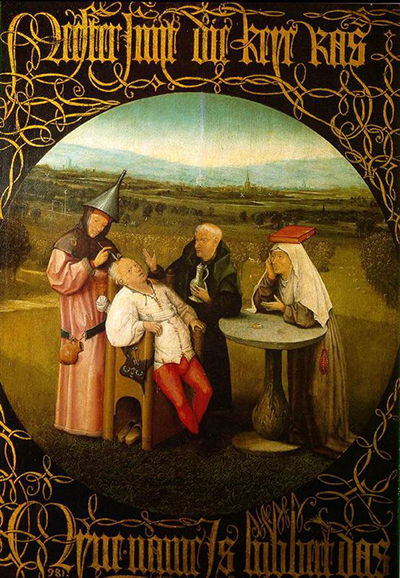
Hieronymus Bosch's The Cure of Folly, also known as The Extraction of the Stone of Madness, is one of the Prado's sharpest small paintings: a fake operation, a duped patient, a surgeon with a funnel on his head, a monk, a woman balancing a book, and a flower being removed from a skull as though foolishness could be weeded out by hand. It is comic, but not light. Bosch turns a popular joke about madness into a miniature theatre of deception, desire, bad medicine and moral blindness. [1]
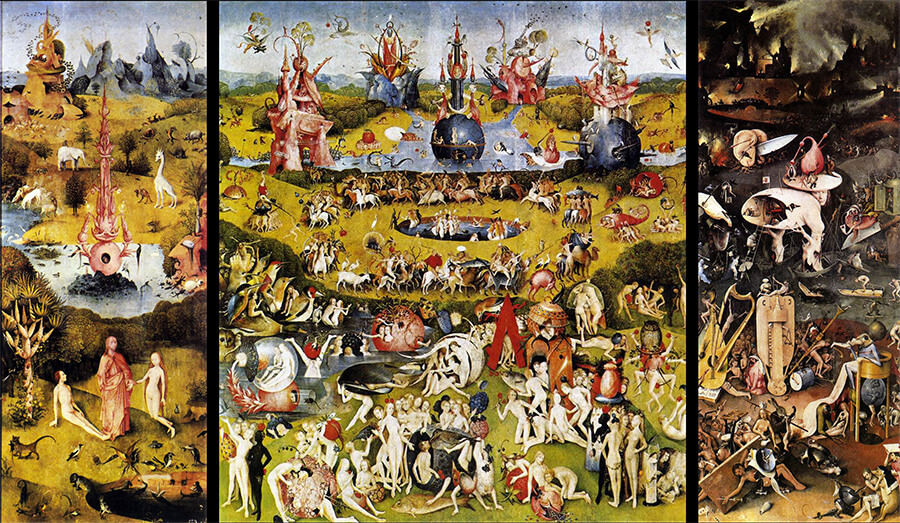
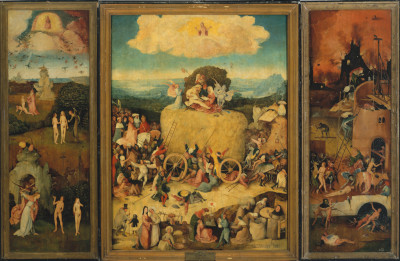
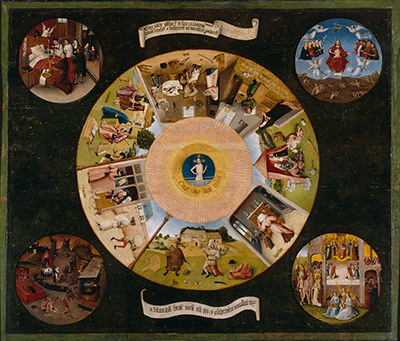
The painting belongs beside Bosch's larger moral works, including The Garden of Earthly Delights, The Haywain Triptych and The Seven Deadly Sins and the Four Last Things. It shares their interest in folly, sin and self-deception, but it compresses those themes into a few figures gathered around a chair. The monsters have disappeared. The surgery is monstrous enough.
The Prado currently attributes the work to Bosch and dates it to 1501-1505. It identifies the medium as oil on Baltic oak planks, gives the dimensions as 48.5 x 34.5 cm, and records the inventory number P002056. The painting is shown in Room 056A with other Bosch works. Its provenance begins with Philip of Burgundy, Bishop of Utrecht, at Duurstede Castle before 1524, followed by a sale in Utrecht in 1527, later Spanish royal ownership, and entry into the Prado in 1839. [1]
Attribution needs to be stated carefully. The Prado presents The Extraction of the Stone of Madness as a work by Hieronymus Bosch and gives an extended technical and iconographic argument for that view. The Bosch Research and Conservation Project and Closer to Bosch place the work inside the wider problem of Bosch, workshop and disputed paintings, and Prado commentary on Bosch controversies identifies this painting, along with The Seven Deadly Sins and the Four Last Things, as one of the difficult cases raised by BRCP-era debate. The safest reading is therefore twofold: the Prado's current label matters, and so does the modern attribution discussion around it. [1] [2] [3]
Contents
- At a Glance
- A Small Painting With a Large Joke
- The Inscription and Lubbert Das
- False Surgery and Moral Medicine
- The Funnel, the Book and the Flower
- Philip of Burgundy and the Shape of the Commission
- Technical Evidence and the Smooth Surface
- Attribution Caution
- Why the Painting Still Feels Modern
- Cure of Folly in Bosch's Moral World
At a Glance
- DetailCurrent information
- Common titlesThe Cure of Folly; The Extraction of the Stone of Madness
- Current Prado attributionHieronymus Bosch
- Date1501-1505
- MediumOil on Baltic oak planks
- Dimensions48.5 x 34.5 cm
- CollectionMuseo Nacional del Prado, Madrid
- InventoryP002056
- SubjectA fraudulent extraction of the supposed "stone" of madness
- Key themesFolly, false surgery, deception, lust, language play and attribution debate
- Related pagesHieronymus Bosch, Bosch paintings, symbolism, prints and reception and workshop and attribution
Compare these works across Bosch’s career
These date ranges are estimates, not a documented year-by-year sequence. These works provide context for the article; none is highlighted as the object discussed here.
Saint Jerome at Prayer
Circa 1485–1495 [4]Crucifixion with a Donor
Circa 1490–1500 (BRCP) [4]Hermit Saints Triptych
Circa 1495–1505 [4]Saint Liberata Triptych
Circa 1495–1505 [4]The Hearing Forest and the Seeing Field
Circa 1500–1505 (Berlin exhibition) [5]The Haywain Triptych
1510–1516 (BRCP) [4]A Small Painting With a Large Joke
The first trick of The Cure of Folly is that it seems easy to understand. A man has something wrong in his head. A surgeon cuts into him. A witness, a cleric and a female figure attend the scene. The patient is bound to a chair, his clogs removed, his body fixed in place. This is not a noble medical consultation. It is a country operation staged in the open air, with two distant cities receding behind the little drama. [1]
But Bosch makes the joke unstable. The supposed surgeon is not a trustworthy healer. The inverted funnel on his head marks him as a fraud, an emblem of foolishness rather than learning. The patient has not been cured of anything. From his head comes not a stone but a waterlily-like flower, matched by another on the table. The procedure is therefore both literal and absurd: a popular expression has been acted out as if language itself could be opened with a knife. [1]
This is Bosch at his most economical. In larger paintings, he fills the field with crowds, animals, demons, machines and punishments. Here, everything turns on a small circle of figures and a handful of objects. The painting belongs to the same moral world as the Bosch symbolism explored elsewhere in the cluster, but its symbolic work is not a dictionary exercise. The funnel, flower, book, bag, dagger, monk and patient gain force from the situation. They are props in a scam.
The tone is wonderfully sour. The patient asks for help, but the help itself is foolish. The surgeon claims knowledge, but wears the sign of ignorance. The operation promises clarity, but reveals appetite, greed and theatrical fraud. If Bosch is laughing, it is the kind of laughter that leaves the room colder.
The Inscription and Lubbert Das
The surrounding inscription is one of the painting's essential features. The Prado gives the upper text as "Meester snijt die key ras", commonly understood as the patient's plea for the master to cut out the stone quickly. The lower text reads "Myne name Is lubbert das", "My name is Lubbert Das." [1]
The name is not neutral. Prado commentary explains that "Lubbert" could function as a name or nickname for a fat, lazy and stupid person, while "das", badger, carried associations of nocturnal laziness. The wordplay becomes still sharper because "lubben" can mean to castrate. That opens the painting to a sexual and moral reading: the flower removed from the man's head may be linked not only with money or credulity but with lust. [1]
This is why the inscription matters as more than a caption. Bosch is not simply labelling the joke. He is making words and image misbehave together. The viewer reads of a stone, sees a flower, recognizes an operation, and then has to ask what has really been extracted. Folly? Money? Desire? Dignity? The painting keeps all of those possibilities in play.
The image is also set within a decorative field of gold interlace against black, a format the Prado connects with manuscript illumination and heraldic display. That elegant frame makes the vulgarity of the scene more pointed. The setting looks ceremonious; the content is ridiculous. Bosch turns a peasant farce into something almost official, as though stupidity has received its own coat of arms. [1]
False Surgery and Moral Medicine
The "stone of madness" belonged to a wider comic and moral tradition in northern Europe. The idea was that foolishness, stupidity or insanity could be imagined as a stone lodged in the head. To "extract" it was to perform a visual joke on false healing and human gullibility. Rijksmuseum commentary on a related painting notes that the theme appears repeatedly in Netherlandish painting and literature in the sixteenth and seventeenth centuries, and refers directly to the Madrid composition and its Lubbert Das inscription. [6]
Bosch's version is not a medical illustration in the modern sense. It does not document a respectable clinical procedure. It stages the idea of cure as fraud. The patient wants an external solution to an internal problem. The operator supplies a theatrical answer. The monk and woman make the scene social: folly is not private, and deception is not carried out alone.
This is one reason the painting should not be treated as a simple mockery of mental illness. Its subject is not modern psychiatric suffering. It is a late medieval and early Renaissance moral joke about foolishness, credulity and the fantasy that a corrupt or disordered inner life can be repaired by a trick. Bosch's satire is aimed at the system of mutual deception: the dupe who wants a miraculous cure, the charlatan who profits from him, and the observers whose presence gives the absurdity a public stage.
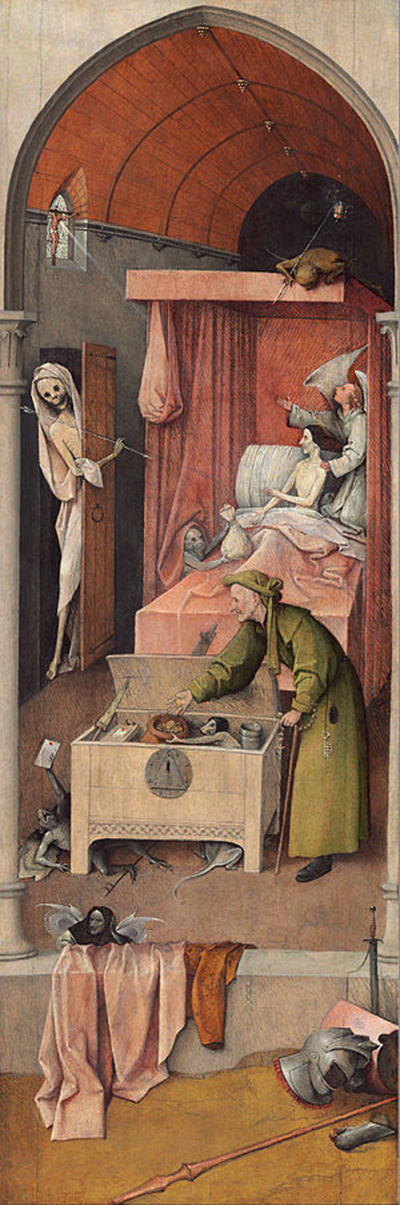
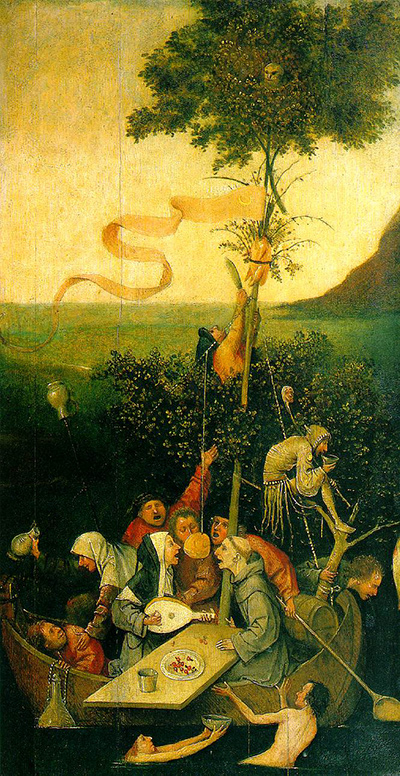
The surgical instruments and the open head make the joke bodily. Bosch often uses the body as the place where moral disorder becomes visible. In The Haywain, bodies clamber after hay; in Ship of Fools, bodies eat, drink and reach; in Death and the Miser, the body hesitates between worldly possessions and spiritual danger. In The Cure of Folly, the head itself becomes a marketplace for false expertise.
The Funnel, the Book and the Flower
The funnel hat is one of the picture's best jokes. It reverses the expected hierarchy of knowledge. A surgeon should be learned, controlled and precise. This one wears an object associated with absurdity and deception. The tool used to pour or direct substances becomes a hat for a mind that cannot direct itself. [1]
The woman with the book balanced on her head deepens the satire. A book usually signals learning, devotion or textual authority. Placed on the head rather than read, it becomes ridiculous: knowledge has become posture. The painting does not attack learning itself; Bosch was too clever an image-maker for that. It attacks empty signs of wisdom, the kind of knowledge displayed without being understood.
The flower is more ambiguous. The Prado identifies the extracted object as a type of waterlily, with another flower lying on the table as if from a prior operation. One reading links it to payment: the surgeon is removing value from the trusting patient. Another, associated by the Prado with Arias Bonel and related sexual interpretation, sees the flower as an allusion to lust and even castration. [1]
Bosch does not force a single answer. The flower is funny because it is the wrong thing. It is not a stone, not a cure, not medical proof. It is a symbolic object dressed as evidence. That is precisely how false expertise works in the scene: it produces a visible result, and the visible result is nonsense.
The bag hanging from the chair and pierced by a dagger adds to the erotic and financial pressure. Bags in Bosch's moral language can carry meanings around possession, appetite and bodily desire, but here the exact reading depends on the whole scene. The patient is tied down, his head opened, his money or sexuality implicated, his name made into a joke. He is not simply foolish; he is made legible as foolish by everyone around him.
Philip of Burgundy and the Shape of the Commission
The Prado links the painting with Philip of Burgundy, Bishop of Utrecht, who owned it at Duurstede Castle before 1524. Philip's status matters because the painting's format is unusually refined for such a coarse subject. The Prado argues that Philip, a member of the Order of the Golden Fleece from 1501, may have shaped the commission, and that the interlaced ornament and smooth surface refer to ceremonial and heraldic visual culture. [1]
That argument affects the dating. Dendrochronology indicates that the Baltic oak panel could have been painted from 1488 onward. The Prado, however, favours 1501-1505 on stylistic grounds and because of Philip's entry into the Order of the Golden Fleece in 1501. The date is therefore not a mere label. It comes from a combination of wood evidence, patronage context, style and interpretation. [1]
The patronage angle also makes the painting less rustic than it first appears. The subject is a peasant being cheated in a landscape, but the object itself may have been made for an elite viewer with a taste for learned visual games. Folly is shown low in the social order, yet the painting's wit belongs to a courtly and clerical world that could enjoy the joke from above.
That tension is uncomfortable and important. Bosch's satire often crosses social levels. Foolishness appears among peasants, monks, merchants, nobles and rulers. Here the seated patient carries the insult most directly, but the painting also asks what kind of culture delights in seeing folly framed, ornamented and collected.
Technical Evidence and the Smooth Surface
Prado technical commentary gives unusually specific evidence for how the painting was made. It identifies Baltic oak, a chalk ground with animal-glue binder, and two phases of underdrawing: first a dry, slightly greasy material, then a liquid medium used to reinforce outlines, folds and modelling strokes. The Prado argues that the unusual smoothness of the surface and the controlled underdrawing relate to the commission's heraldic or ceremonial character. [1]
This technical evidence matters because it is part of the attribution argument. Bosch is often associated with searching underdrawing, changes during execution and inventive adjustment. The Prado notes numerous adjustments in the two phases of underdrawing and differences between drawing and paint, though fewer than in some other Bosch works. It also compares the painting of the distant landscape with other works by Bosch, including the background of the central panel of The Haywain Triptych. [1]
The evidence does not make the attribution debate disappear. It explains why the Prado continues to defend the painting as Bosch. Closer to Bosch and BRCP materials, meanwhile, remind readers that Bosch studies now depend on comparing objects across categories: autograph works, workshop productions, followers and disputed pictures. This painting is most interesting when read inside that field of evidence rather than outside it. [3]
For readers, the practical lesson is simple: do not let the small scale or comic subject make the painting seem minor. It is a technical object, a social satire, a verbal puzzle and an attribution case all at once.
Attribution Caution
The Prado currently labels The Extraction of the Stone of Madness as a painting by Hieronymus Bosch and provides detailed technical and historical reasons for that attribution. At the same time, Bosch scholarship has treated the work as contested, and Prado's own discussion of Bosch controversies names it as one of the difficult cases raised in the debate around the Bosch Research and Conservation Project. Readers should therefore understand the title "by Bosch" here as the Prado's current attribution, not as a universally uncomplicated fact. The painting remains central to Bosch's world of folly and satire, but its authorship should be discussed with the same care given to other disputed Bosch objects. [1] [2] [3]
That caution is not a retreat from interpretation. It is what makes interpretation honest. If the painting is by Bosch, it is a brilliant small demonstration of his ability to turn a proverb into a visual trap. If elements of the attribution remain debated, the picture still helps reveal how Boschian satire worked, how his name attached to images of folly, and how modern technical research changes the way museums describe old paintings.
For more on these categories, see Bosch workshop and attribution. The labels matter because they tell us what kind of evidence a painting can carry. An autograph work can speak directly to Bosch's practice. A workshop or follower work may speak more to transmission, copying and reception. A disputed painting asks readers to hold meaning and authorship apart without pretending that either is irrelevant.
Why the Painting Still Feels Modern
Part of the painting's force is that its satire is still legible. False cures have not vanished. Nor have theatrical experts, public gullibility, vanity learning, profitable nonsense or the wish to remove moral difficulty by a quick operation. Bosch's world is late medieval and early Renaissance, but the joke lands because the social mechanism remains familiar.
Yet the painting should not be flattened into a modern cartoon. Its comedy belongs to a culture of proverbs, religious morality, courtly display, medical parody and vernacular wordplay. The patient is not simply "mad" in a modern clinical sense. He is a figure of folly: someone caught between stupidity, appetite, laziness, credulity and spiritual disorder. That makes the painting harsher, but also more precise.
The rural setting helps. The small promontory, plain and distant towns create a world large enough to make the event feel public. The operation is absurd, but it is not isolated. Society continues in the background. Cities stand at a distance while folly performs itself in the foreground. Bosch often uses this spatial intelligence: small actions reveal large moral conditions.
The circular scene also behaves like a mirror, as the Prado suggests. Viewers look at Lubbert Das and are invited to laugh, but the mirror structure makes the laughter risky. The fool is not only the man in the chair. It may be the patient, the surgeon, the witnesses, the collector, the viewer and anyone who mistakes a performance of wisdom for wisdom itself.
Cure of Folly in Bosch's Moral World
The painting's closest Boschian relatives are not only medical satires. It belongs with scenes of misplaced trust and misdirected desire. In Ship of Fools, a group drifts through appetite and foolish sociability. In Death and the Miser, a dying man hesitates between salvation and worldly goods. In The Haywain Triptych, humanity chases a wagon of hay toward destruction. In The Cure of Folly, the moral disaster is smaller but exquisitely focused: a man pays to have folly removed while participating in the very folly that exposes him.
That is Bosch's cruel elegance. The cure proves the sickness. The patient's hope proves his gullibility. The surgeon's success proves his fraud. The flower extracted from the head proves that the promised stone was a trick all along.
The painting also belongs with Bosch's reception through prints and Boschian visual culture. The stone-extraction theme circulated beyond this panel, and later Netherlandish images adapted the subject. Rijksmuseum commentary on a related version makes clear that the Madrid composition became part of a wider tradition of images about removing rocks, stones or folly from the head. [6]
That wider circulation is one reason attribution questions matter so much. Bosch's inventions were memorable enough to be copied, transformed and reattached to new objects. A strong Boschian idea could outlive Bosch's hand. The stone operation, with its blend of popular saying, social mockery and moral theatre, was exactly the sort of image that could travel.
How to Look at The Cure of Folly
Start with the circle. Bosch has placed the scene within a round field, framed by ornamental inscription. That format makes the image feel like an emblem or mirror rather than a casual anecdote.
Then look at the heads. The patient's head is opened; the surgeon's head is crowned by a funnel; the woman's head supports a book; the monk's head turns into witness and accomplice. Knowledge, folly and authority all gather around the body part that should govern reason.
Next, follow the hands. The surgeon cuts. The patient sits bound. The observers do little. The flower comes out, but nothing is healed. Bosch's action is deliberately wrong: it has the form of treatment and the substance of exploitation.
Finally, read the inscription back into the scene. The patient gives his name and asks for the stone to be cut out quickly. The painting answers by showing that the request itself is part of the foolishness. Lubbert Das wants a cure from someone whose own costume announces folly. That is Bosch's satire in miniature: the problem is not hidden inside the skull; it is visible in the whole arrangement of trust, performance and desire.
Why Current Labels Matter
Current labels matter because Bosch is not only an artist; he is also a problem of evidence. His name attracts paintings, drawings, copies and later inventions with unusual force. A small work such as The Cure of Folly can be famous enough to feel familiar, yet still demand care about authorship.
The Prado's label gives the painting a direct place in Bosch's corpus. The BRCP and Closer to Bosch context reminds readers that modern Bosch study also requires comparison, technical evidence and openness to revised categories. The most useful public account should not force a false simplicity. It should let the object be funny, uncomfortable and evidentially complex at the same time.
That complexity makes the painting better, not worse. The Cure of Folly is a joke about bad diagnosis that has itself become a test of diagnosis. What is the object? Who made it? What does the inscription say? Is the operation a cure, a theft, a sexual joke, a moral emblem or all of those at once? Bosch, or the Boschian world around him, gives the same answer in every direction: look again before you believe the expert with the funnel.
Artworks and related attributions
Browse paintings, drawings and related attributions. Records group triptychs, fragments and two-sided sheets where appropriate. Dates follow the cited museum records or catalogue headings and are generally estimates. Rows marked “2016 catalogue” report that publication’s attribution and collection information; these are dated opinions, rather than a claim that every work is an accepted autograph Bosch.
| Name | Date | Medium, attribution and collection |
|---|---|---|
| A Crossbowman | Second half of the sixteenth century | Oil on oak panel · Copy after Hieronymus Bosch · Museo Nacional del Prado, Madrid · P002695 Source 1. Source 2. |
| A Woman Spinning and an Old Woman | Museum estimates: about 1480–1490 for the women and 1500–1505 for the reverse; the precise chronology is disputed | Pen and brown and grey ink on the front; pen and brown ink on the reverse · Hieronymus Bosch · Museum Boijmans Van Beuningen, Rotterdam · N 190 recto and verso (PK) Source 1. Source 2. |
| Adoration of the Child in Cologne | Second half of the sixteenth century | Oil on oak panel · Imitator of Hieronymus Bosch, in the city collection record · Wallraf-Richartz-Museum & Fondation Corboud, Cologne · WRM 0474 Source 1. Source 2. |
| Adoration of the Magi in Philadelphia | Early sixteenth century in the museum record; around 1495–1520 in the BRCP catalogue | Oil on oak panel · Hieronymus Bosch in the museum record; workshop of Bosch in the 2016 BRCP catalogue · Philadelphia Museum of Art, John G. Johnson Collection, 1917 · 1321; museum object 103592 Source 1. Source 2. |
| Adoration of the Magi — New York | c.1470–1480 | 2016 catalogue: Bosch; oil on oak · Metropolitan Museum 13.26 2016 catalogue. |
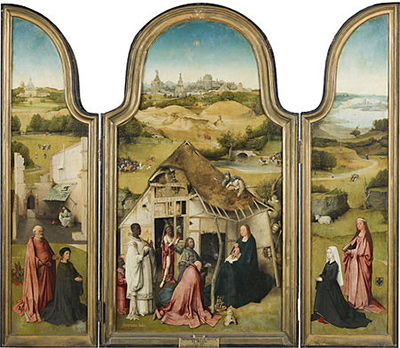
| Adoration of the Magi — Prado triptych | c.1494 | Oil on oak; grisaille exterior · Bosch · Prado P002048 Object source. |
| Adoration of the Magi — three associated fragments | c.1515–1535 | 2016 catalogue: Follower of Bosch · Two Shepherds / Retinue in Philadelphia; associated Adoration in private collection in 2016 2016 catalogue. |
| Ascent of the Blessed — Venice | c.1505–1515 | Oil on panel · Bosch · Gallerie dell’Accademia; Visions of the Hereafter Object source. |
| Battle of the Birds and Mammals | Not specified in catalogue heading | 2016 catalogue: Bosch; pen and brown ink · Berlin KdZ 14715 2016 catalogue. |
| Beggars and Musicians | Around 1530–1540 | Ink and wash on paper · Unknown follower of Hieronymus Bosch · Albertina, Vienna · 7798 Source 1. Source 2. |
| Christ Carrying the Cross Drawing | Around 1470 in the museum catalogue | Black chalk or charcoal, pen and brush in brown ink, white corrections · Anonymous, workshop of Rogier van der Weyden · Museum Boijmans Van Beuningen, Rotterdam · N 81 recto and verso (PK) Source 1. Source 2. |
| Christ Carrying the Cross in Vienna | Around 1490–1510 in the current KHM record and BRCP catalogue | Oil on oak, painted on both sides · Hieronymus Bosch; possible workshop involvement in the Passion side discussed by the BRCP · Kunsthistorisches Museum, Vienna · Gemäldegalerie, GG 6429 Source 1. Source 2. |
| Christ Carrying the Cross — El Escorial | c.1495–1505 | 2016 catalogue: Bosch; oil on oak · Patrimonio Nacional 10014739 2016 catalogue. |
| Christ Carrying the Cross — Ghent | c.1510–1516 (museum) | Oil on panel · Bosch in museum listing; authorship disputed · MSK Ghent 1902-H Object source. |
| Christ Mocked — London | c.1510 | Oil on wood · Bosch · National Gallery NG4744 Object source. |
| Concert in the Egg, After Hieronymus Bosch | Around 1561; third quarter of the sixteenth century | Oil on canvas · Anonymous, after Hieronymus Bosch · Palais des Beaux-Arts, Lille · P 816 Source 1. Source 2. |
| Conjurer / Comical Concert — Louvre drawing | Not specified in catalogue heading | 2016 catalogue: Bosch (recto), follower (concert verso) · Pen and brown ink · Louvre INV 19197 2016 catalogue. |
| Conjurer / Cross-bearing and beggars — Liège sheet | Not specified in catalogue heading | 2016 catalogue: Bosch (verso), follower (recto) · Pen and brown ink · Album d’Arenberg 534 2016 catalogue. |
| Crowning with Thorns — El Escorial | c.1530–1540 | 2016 catalogue: Follower of Bosch; oil on oak · Patrimonio Nacional 10014743 2016 catalogue. |
| Crucifixion with a Donor | Circa 1495–1505; Circa 1490–1500 | Oil on oak panel · Hieronymus Bosch · Royal Museums of Fine Arts of Belgium, Brussels · 6639 Source 1. Source 2. |
| Death and the Miser Drawing | Not securely established; probably made after the painting | Pen and brush, dark ink and white highlights on prepared paper · Workshop of Hieronymus Bosch in the BRCP catalogue; alternatives recorded by the Louvre · Musée du Louvre, Department of Prints and Drawings, Paris · RF 6947, Recto Source 1. Source 2. |
| Death and the Miser — Washington | c.1485/1490 (NGA) | Oil on panel · Bosch · National Gallery of Art 1952.5.33 Object source. |
| Ecce Homo Triptych — Boston | c.1495–1500; wings c.1500/1503 | 2016 catalogue: Workshop of Bosch; oil on oak · Museum of Fine Arts Boston; several production phases 2016 catalogue. |
| Ecce Homo — Frankfurt | c.1490 | Mixed technique on oak · Bosch · Städel 1577 Object source. |
| Fall of the Damned — Venice | c.1505–1515 | 2016 catalogue: Bosch; oil on panel · Visions of the Hereafter · Venice 2016 catalogue. |
| Garden of Earthly Delights | 1490–1500 (Prado) | Oil on oak; grisaille exterior · Bosch · Prado; triptych Object source. |
| Gluttony and Lust / Allegory of Intemperance — Yale fragment | c.1500–1510 (group dating) | 2016 catalogue: Bosch; oil on oak · Yale 1959.15.22; fragment associated with Ship of Fools 2016 catalogue. |
| Group of Ten Spectators, a Follower of Bosch | Around 1510–1540 in the current museum record | Pen and two brown inks on paper, with a brown framing line · Follower of Hieronymus Bosch in the Morgan record; Bosch in the BRCP catalogue · Morgan Library & Museum, New York · I, 112 Source 1. Source 2. |
| Head of an Old Woman | About 1500 | Oil on panel · Attributed to Jacob Cornelisz. van Oostsanen · Museum Boijmans Van Beuningen, Rotterdam · 2439 (OK) Source 1. Source 2. |
| Hell and the Flood — Rotterdam panels | Around 1515 in the museum records; around 1510–1520 in the BRCP catalogue | Oil on oak panels · Jheronimus Bosch in the museum records; workshop of Bosch in the BRCP catalogue · Museum Boijmans Van Beuningen, Rotterdam Source 1. Source 2. |
| Hermit Saints Triptych | Circa 1495–1505 | Oil on oak panels · Hieronymus Bosch · Gallerie dell’Accademia, Venice · 2044 Source 1. Source 2. |
| Infernal Landscape | Not specified in catalogue heading | 2016 catalogue: Bosch; pen and brown ink, red accent · Private collection in 2016 2016 catalogue. |
| Infernal Scene with Anvil / Monster Studies | Not specified in catalogue heading | 2016 catalogue: Bosch; attribution debated in entry · Pen and brown ink · Berlin KdZ 548 2016 catalogue. |
| Infernal Scene with Tree-Man / Standing Man | Not specified in catalogue heading | 2016 catalogue: Workshop of Bosch; pen and brown ink · Dresden C 1875; historical reverse title includes a proposed prophet 2016 catalogue. |
| Job Triptych — Bruges | c.1510–1520 | 2016 catalogue: Workshop of Bosch; oil on oak · Groeningemuseum / Hoeke loan in 2016 2016 catalogue. |
| Last Judgement — Bruges triptych | c.1495–1505 | 2016 catalogue: Bosch; oil on oak · Groeningemuseum 2016 catalogue. |
| Last Judgement — Munich fragment | c.1530–1540 | 2016 catalogue: Follower of Bosch; oil on oak · Alte Pinakothek 5752 2016 catalogue. |
| Last Judgement — Vienna triptych | c.1500–1505 (BRCP 2016) | Oil on oak · Bosch and workshop (BRCP 2016) · Academy of Fine Arts Vienna 2016 catalogue. |
| Man in a Basket and Comic Figures | Around 1500–1515 in the museum record | Pen and brown ink on paper; the reverse is catalogued as iron-gall ink · Hieronymus Bosch in the current Albertina record; attribution has been debated · Albertina, Vienna · 7797 recto and verso Source 1. Source 2. |
| Man Seen from Behind | About 1550–1569; About 1565–1570 | Traces of black chalk, pen and brush in light brown ink · Anonymous, circle of Pieter Bruegel the Elder · Museum Boijmans Van Beuningen, Rotterdam Source 1. Source 2. |
| Mary and John at the Foot of the Cross | About 1440 | Brush in grey and black · Unknown, possibly Netherlandish · Kupferstich-Kabinett, Staatliche Kunstsammlungen Dresden · C 815 Source 1. Source 2. |
| Model Sheet with ‘Witches’ | Disputed; proposals depend on the attribution | Pen and brown ink; the BRCP also records underlying black chalk · Hieronymus Bosch; follower attributions also recorded · Musée du Louvre, Département des Arts graphiques, Paris · INV 19721 recto Source 1. Source 2. |
| Peasant and Three Bust-Length Figures | 1401–1500 | Brown pen over a black preliminary drawing · Attributed to the Master of the Drapery Studies; Bosch circle also recorded · Kupferstichkabinett, Staatliche Museen zu Berlin · KdZ 777 Source 1. Source 2. |
| River to Hell — Venice | c.1505–1515 | 2016 catalogue: Bosch; oil on panel · Visions of the Hereafter · Venice 2016 catalogue. |
| Saint Anthony and a Concert in an Egg | Around 1510–1525 in the museum’s 2016–17 exhibition texts | Pen in light and dark brown inks · Workshop of Hieronymus Bosch; underlying monsters: Bosch (BRCP), possibly Bosch (exhibition text) · Kupferstichkabinett, Staatliche Museen zu Berlin · KdZ 711 recto and verso Source 1. Source 2. |
| Saint Christopher Carrying the Christ Child | c.1500; 1490–1505 in restoration material | Oil on panel · Bosch · Boijmans St 26 Object source. |
| Saint James and Hermogenes | About 1551–1575 in the KIK-IRPA catalogue | Oil on wood, painted on both sides · Anonymous follower of Hieronymus Bosch · Musée des Beaux-Arts, Valenciennes · P.46.1.44; older number 176 Source 1. Source 2. |
| Saint Jerome at Prayer | Circa 1485–1495 | Oil on oak panel · Hieronymus Bosch · Museum of Fine Arts, Ghent · 1908-H Source 1. Source 2. |
| Saint John on Patmos / Passion Scenes | c.1495–1505; estimates vary | Oil on oak · Bosch · Gemäldegalerie Berlin 1647A Object source. |
| Saint John the Baptist in Meditation | Late 15th century; c.1485–1510 (Prado exhibition) | Oil on panel · Bosch · Lázaro Galdiano 8155 Object source. |
| Saint Liberata Triptych | Circa 1495–1505 | Oil on oak panels · Hieronymus Bosch · Gallerie dell’Accademia, Venice · 2045 Source 1. Source 2. |
| Seven Deadly Sins and the Four Last Things | 1505–1510 (Prado) | Oil on poplar · Bosch (Prado); workshop/follower disputed · Prado Object source. |
| Ship of Fools — Louvre painting | 1475–1500 (record); c.1505–1515 (exhibition) | Oil on oak · Bosch · Louvre RF 2218; fragment Object source. |
| Ship of Fools — Louvre workshop drawing | Not specified in catalogue heading | 2016 catalogue: Workshop of Bosch · Pen, brush, grey-brown ink and white highlights on prepared paper · Louvre RF 3714 2016 catalogue. |
| Studies of Monsters | About 1530–1550, according to the current Ashmolean record | Pen and brown ink on laid paper, both faces · Anonymous follower of Hieronymus Bosch · Ashmolean Museum, University of Oxford · WA1863.155 Source 1. Source 2. |
| Studies of Saint Anthony and Monsters | No execution date specified in the current Louvre records | Pen and brown ink on paper · Bosch listed; reverse questioned by Louvre; BRCP accepts both faces · Musée du Louvre, Département des Arts graphiques, Paris · INV 20871 recto and verso Source 1. Source 2. |
| Temptation of Saint Anthony — Kansas City fragment | c.1500–1510 | 2016 catalogue: Bosch; oil on oak · Nelson-Atkins 35–22 2016 catalogue. |
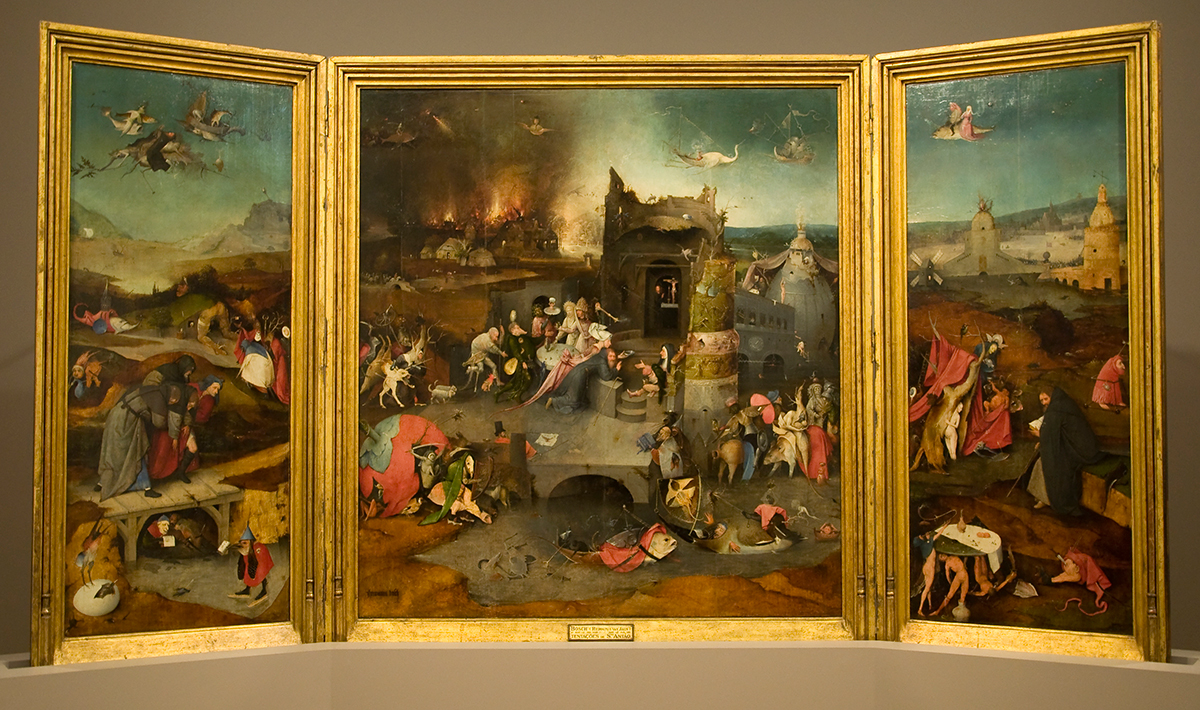
| Temptation of Saint Anthony — Lisbon triptych | c.1500 | Oil on oak · Bosch · Museu Nacional de Arte Antiga 1498 Pint Museum. |
| Temptation of Saint Anthony — Prado panel | c.1530–1540 | 2016 catalogue: Follower of Bosch (2016 opinion); oil on oak · Prado P002049 2016 catalogue. |
| Terrestrial Paradise | Approximately 1505–1515 | Oil on oak panel · Hieronymus Bosch · Gallerie dell'Accademia, Venice Source 1. Source 2. |
| The Burning Ship Drawing | 1500–1520 | Pen and iron gall ink on paper · Attributed to Hieronymus Bosch · Academy of Fine Arts Vienna, Graphic Collection · HZ-2554; numbered 2554 in the BRCP catalogue Source 1. Source 2. |
| The Comical Barber Scene | About 1550–1580, according to the British Museum | Pen and brown ink, grey and brown wash, over black chalk · Anonymous follower, after Hieronymus Bosch · British Museum, Department of Prints and Drawings, London · 1854,0628.46 Source 1. Source 2. |
| The Conjuror, After Hieronymus Bosch | Probably after 1525; around 1530–1540 in the BRCP technical report | Oil on oak panel · Anonymous follower of Hieronymus Bosch · Musée Ducastel-Vera, Saint-Germain-en-Laye · 872.1.87 Source 1. Source 2. |
| The Cure of Folly / Extraction of the Stone of Madness | 1501–1505 (Prado) | Oil on oak · Bosch (Prado); workshop/follower disputed · Prado P002056 Object source. |
| The Entombment Drawing | About 1505–1515, current museum record | Brush and black and grey ink, with grey wash, over black chalk · Workshop of Hieronymus Bosch; drawn by the Master of the Prado Haywain Triptych; Hieronymus Bosch, argued by the BRCP in 2016 · British Museum, Department of Prints and Drawings, London · 1952,0405.9 Source 1. Source 2. |
| The Gathering of the Birds | Not specified in catalogue heading | 2016 catalogue: Bosch; pen and brown ink · Berlin KdZ 13136 2016 catalogue. |
| The Haywain — Prado triptych | 1510–1516 (BRCP 2016) | Oil on oak · Bosch (BRCP 2016) · Prado; separate Escorial version exists 2016 catalogue. |
| The Hearing Forest and the Seeing Field | Circa 1500–1505 | Pen and brown ink on paper · Hieronymus Bosch; reverse: Bosch and workshop · Kupferstichkabinett, Staatliche Museen zu Berlin · KdZ 549, front and reverse Source 1. Source 2. |
| The Owl’s Nest — Rotterdam | Not specified in catalogue heading | 2016 catalogue: Bosch; pen and brown ink · Boijmans N 175 2016 catalogue. |
| The Passion Triptych in Valencia | Workshop of Bosch, about 1510–1520; Follower of Bosch; centre about 1530–1540, wings about 1540–1550 | Oil and gold on oak panels · Workshop of Bosch, about 1510–1520; Follower of Bosch; centre about 1530–1540, wings about 1540–1550 · Museu de Belles Arts de València Source 1. Source 2. |
| The Pedlar / Wayfarer — Rotterdam | c.1500 (museum) | Oil on panel · Bosch · Boijmans 1079 (OK); rejoined exterior Object source. |
| The Tree-Man — Vienna drawing | c.1505 | Pen and brown ink · Bosch · Albertina, Vienna Object source. |
| The Wedding at Cana, After Hieronymus Bosch | Approximately 1560 in the current museum record | Oil on panel, 93 cm high × 72 cm wide · Anonymous, after Hieronymus Bosch · Museum Boijmans Van Beuningen, Rotterdam, St 25 Source 1. Source 2. |
| Two Fantastical Creatures — Berlin KdZ 550 | Around 1505–1515 in the museum’s 2016 exhibition text | Pen in brown ink on reddish prepared laid paper · Hieronymus Bosch · Kupferstichkabinett, Staatliche Museen zu Berlin · KdZ 550, recto and verso Source 1. Source 2. |
| Two Figures Wearing Mitres | About 1480 | Oil on panel · Anonymous (Boijmans); Bosch circle (RKD) · Museum Boijmans Van Beuningen, Rotterdam · 1177 (OK) Source 1. Source 2. |
| Two Men and the Temptation of Eve | About 1505–1515 in the Prado’s 2016 exhibition guide | Pen and grey-brown ink on paper · Hieronymus Bosch in the 2016 catalogues discussed here · Private collection, as recorded in 2016 Source 1. Source 2. |
| Two Men Fighting | Not specified in the current Louvre record | Pen and brown ink · In the manner of Hieronymus Bosch · Musée du Louvre, Département des Arts graphiques, Paris · INV 20660 recto; formerly NIII 8896 and MA 8400 Source 1. Source 2. |
| Two Men — Berlin KdZ 5210 | Not specified in catalogue heading | 2016 catalogue: Bosch questioned · Pen, brush, ink, chalk and white highlights · Berlin KdZ 5210; historical title Two Oriental Men 2016 catalogue. |
| Two Monsters — Berlin KdZ 547 | Approximately 1500–1510 in Berlin's 2016 exhibition catalogue; an estimated range | Pen and brown ink on paper · Hieronymus Bosch · Kupferstichkabinett, Staatliche Museen zu Berlin · KdZ 547, drawn on both sides Source 1. Source 2. |
Frequently Asked Questions
It is also called The Extraction of the Stone of Madness. The supposed operation turns a claim to cure foolishness into a scene of deception.[1]
It belongs to the Museo Nacional del Prado in Madrid, inventory P002056.[1]
The Prado records 1501–1505 and oil on Baltic oak planks, measuring 48.5 × 34.5 cm.[1]
The painter shows a flower where a supposed stone would be expected. The impossible operation and the figures’ equipment contribute to the painting’s satire.[1]
Discussion
Compare the operation’s gestures with its inscription and impossible equipment.
Reader Insights
How do the funnel and book make ordinary objects seem absurd?
What does the flower change about the apparent operation?
How does the inscription affect your reading of the seated patient?
Join the Conversation
Share a detail, comparison or question about The Cure of Folly below.
References
- Museo Nacional del Prado, The Extraction of the Stone of Madness: View source
- Museo Nacional del Prado, "Controversies Regarding Hieronymus Bosch": View source
- Closer to Bosch, Bosch Research and Conservation Project object platform: View source
- BRCP Catalogue Raisonné (2016), object dates in catalogues 1, 2, 8, 15 and 20; catalogue 20 object metadata only for the Haywain comparison. View source
- Staatliche Museen zu Berlin, 2016 exhibition wall texts, p. 3: approximate date of KdZ 549. View source
- Rijksmuseum, Removing the Rocks in the Head: View source
- Bosch Research and Conservation Project, project information (in Dutch): View source
- Yale University Press, Hieronymus Bosch, Painter and Draughtsman: Catalogue Raisonne: View source