by Tom Gurney
Tom Gurney BSc (Hons) is an art history expert with over 20 years experience
Published on June 19, 2020 / Updated on November 4, 2026
Email: tomgurney1@gmail.com / Phone: +44 7429 011000
A choir crowds around an open music book inside an enormous broken egg. Its singers lean forward with the concentration of an important performance, while a thief takes advantage of their distraction. In Concert in the Egg, collective enthusiasm and private misconduct occupy the same small space. The spectacle is funny before it becomes unsettling: the vessel holding these people together is already full of holes.
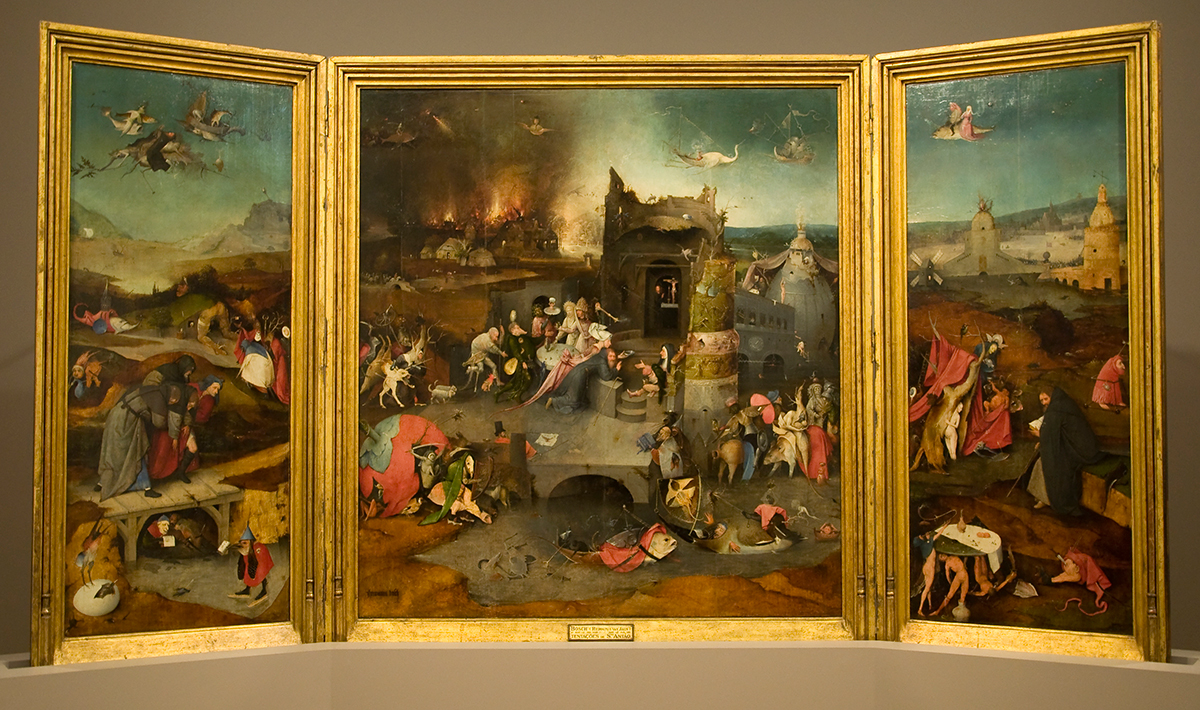
The painting belongs to the Palais des Beaux-Arts in Lille. Although often reproduced under Hieronymus Bosch’s name, it is catalogued as an anonymous work after him, made around 1561, several decades after his death in 1516. That distinction changes how we look at it. This is evidence of Bosch’s continuing influence and the adaptation of his inventions, rather than a securely surviving canvas painted by the master himself.[1]
At a Glance
- TitleConcert in the Egg; Le Concert dans l’œuf
- ArtistAnonymous, after Hieronymus Bosch
- DateAround 1561; third quarter of the sixteenth century
- MediumOil on canvas
- Dimensions108.5 × 126.5 cm
- CollectionPalais des Beaux-Arts, Lille
- InventoryP 816
- Related drawingBerlin, Kupferstichkabinett, KdZ 711 verso; a separate work with a complex attribution
Compare these works across Bosch’s career
These date ranges are estimates, not a documented year-by-year sequence. These works provide context for the article; none is highlighted as the object discussed here.
Saint Jerome at Prayer
Circa 1485–1495 [2]Crucifixion with a Donor
Circa 1490–1500 (BRCP) [2]Hermit Saints Triptych
Circa 1495–1505 [2]Saint Liberata Triptych
Circa 1495–1505 [2]The Hearing Forest and the Seeing Field
Circa 1500–1505 (Berlin exhibition) [3]The Haywain Triptych
1510–1516 (BRCP) [2]Contents
Annotated Details from Concert in the Egg, After Bosch
The Lille painting combines an improbable group of singers with quieter activity around the shell. These details follow the score, the clustered heads and the theft among the singers.
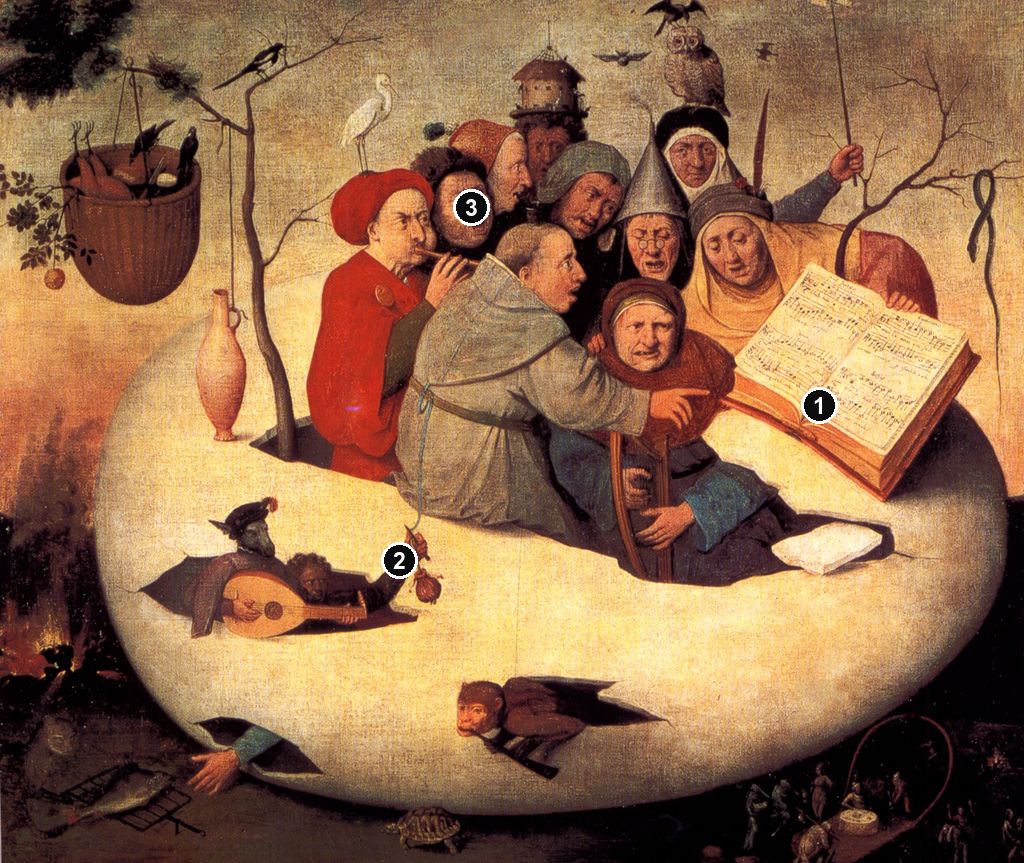
Details from CONCERT IN THE EGG, AFTER BOSCH
A later painter after Bosch created this scene; the comparisons and attribution are discussed in the article.
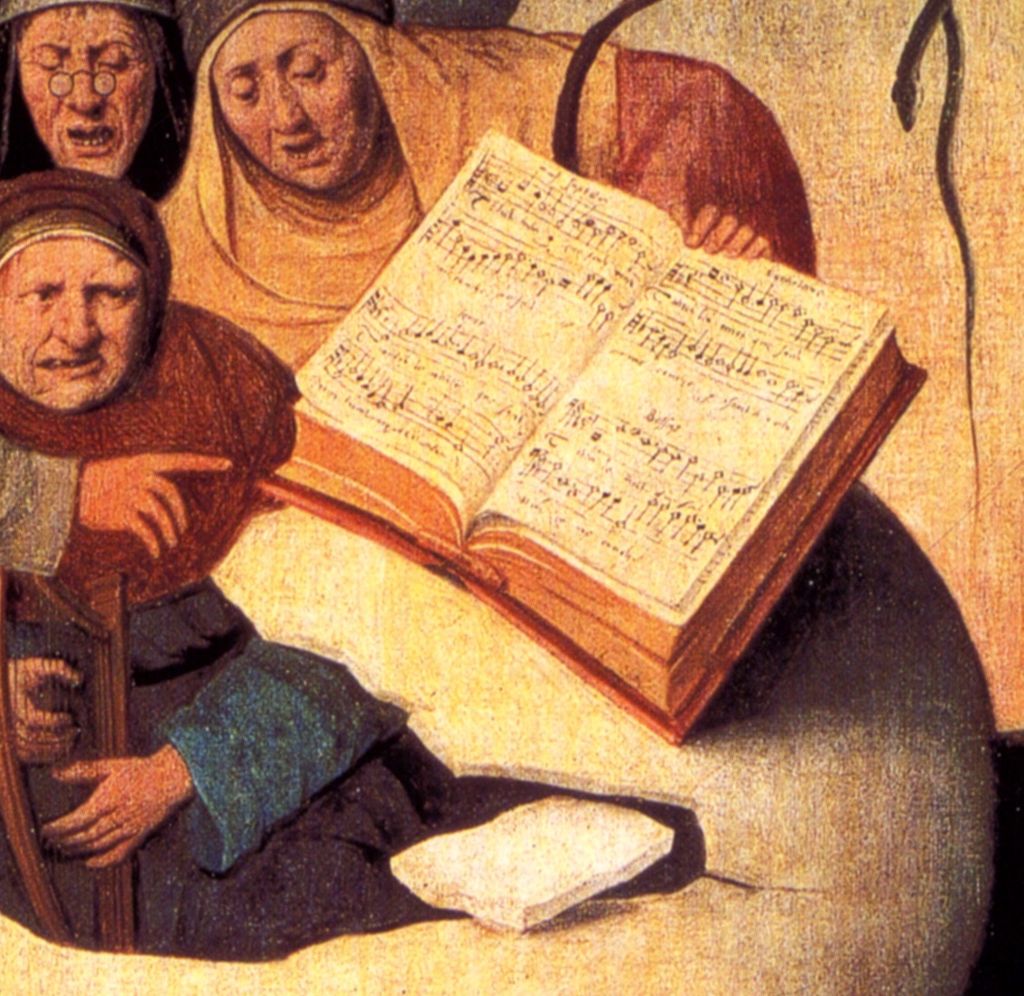
The open music book
The large book faces the singers. Its ruled pages turn an ordinary object into a conspicuous part of this unlikely gathering.
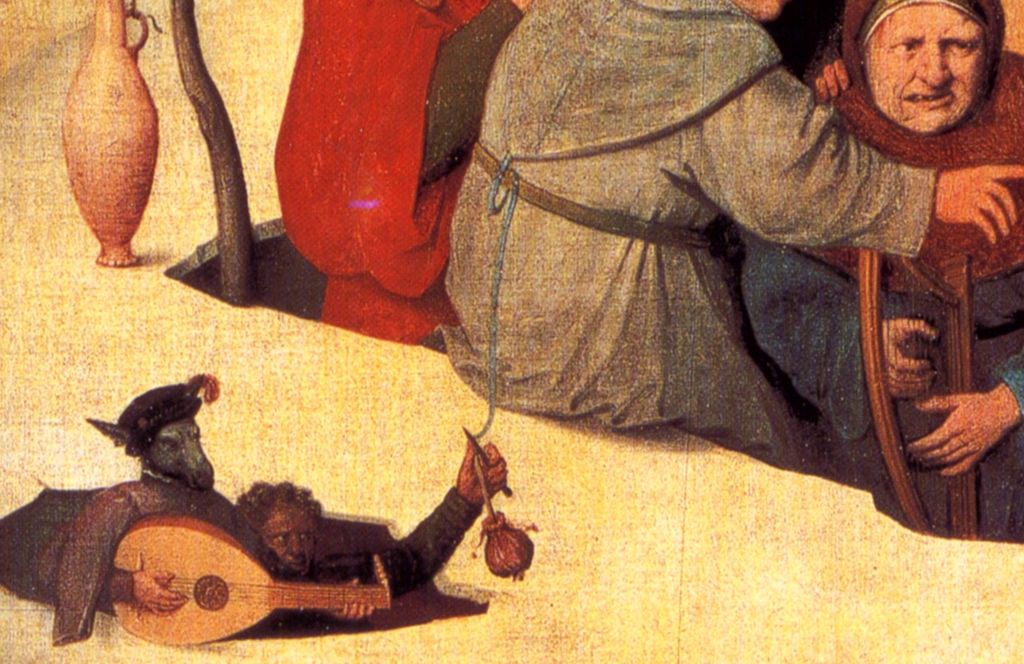
The purse cutter
A small figure reaches towards the purse at the grey-clad singer’s waist. The theft takes place within the group whose attention is directed towards the music.
Heads above the shell
Faces crowd together above the egg. Headgear, birds and the broken branches interrupt the outline of the group.
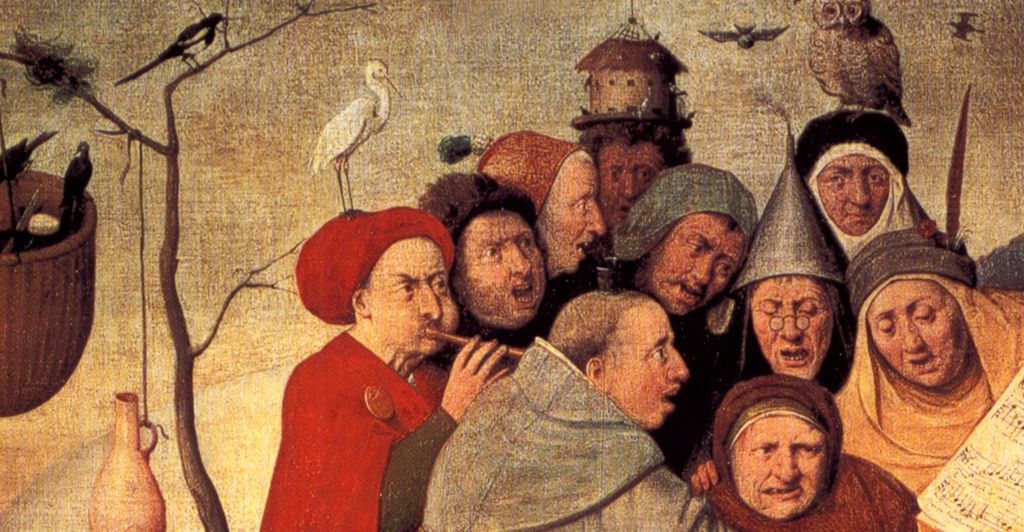
Image and detail crops: Wikimedia Commons source file (public domain reproduction).
Looking at the Singers
The white shell dominates the composition. It has the rounded volume of a familiar household object but the scale of a building or boat. Above its broken upper edge, heads gather in a compact mass, each turned slightly differently towards the book. Their closeness creates the impression of shared purpose. There is almost no room between one participant and the next, so that the singers become a single, uneven human cluster.
The figure in grey, seen largely from behind, gives this cluster its strongest forward movement. His arm leads towards the open pages, and the angle of his head directs our attention in the same direction. A red-clad participant forms a contrasting block on the left. Across the group, changes of headgear, facial expression and posture prevent the chorus from becoming a row of interchangeable faces. We can follow the action immediately, even before identifying any of its stranger details.
The music book supplies an apparently sensible explanation for the gathering. It rests at a readable angle, large enough to command the group’s attention. Yet its prominence also makes the musicians’ enclosure seem more absurd. The painter gives the performance an organising centre while refusing to give it a plausible venue. That tension between recognisable behaviour and impossible surroundings is the image’s strongest initial joke.
A Music Book in the Wrong Setting
Lille’s teaching sheet identifies the music as a secular song by Crecquillon and interprets the scene as a parody of communal religious reading. The grey habit and the concentration on a shared volume help explain that comparison: a familiar arrangement associated with devotion has been redirected towards worldly entertainment. The museum’s account therefore gives the book a more specific function than merely indicating that some singing is taking place.[4]
The composition itself makes the contrast legible. Faces look towards the pages with conspicuous seriousness, while their surroundings undermine the dignity of the occasion. The elevated book suggests order; the shell, improvised headgear and intrusive animals suggest a world that refuses to remain orderly. The scene does not need us to hear the tune to convey that mismatch. Its silence leaves the viewer to imagine a performance whose physical circumstances are already comically unsuitable.
Music is also a useful way of depicting absorption. To sing together, the participants must attend to a common rhythm and shared information. Here, that cooperation narrows their awareness. The book draws eyes inwards while other activity unfolds beside and beneath them. We see more than the performers do, and the distance between their concentration and our wider view becomes central to the satire.
The Theft Beside the Performance
A small figure reaches towards the purse at the grey-clad singer’s waist. The museum describes the action as purse cutting.[4] It is easy to overlook initially because the larger heads and pale shell demand attention first. Once noticed, however, it changes the scene. The concert is no longer simply an eccentric entertainment. Someone’s pleasure creates an opportunity for someone else’s gain.
The arrangement gives the viewer a double role. We can enjoy the absurd gathering, but we can also recognise a danger that its participants miss. The singer who appears most involved in directing attention towards the book is particularly exposed to what happens behind his back. The theft turns a general impression of foolishness into a specific failure of awareness. It is a small, intelligible action within a picture otherwise crowded with marvels.
The moral force of the episode comes from this relationship between actions. A purse, a reaching hand and a distracted owner can communicate without a catalogue of hidden emblems. Nor does the dark appearance of the thief’s face justify assigning the figure an ethnicity or turning complexion into a moral explanation. What establishes the wrongdoing is the depicted act. The painting’s visual argument depends on conduct and opportunity.
A Shell That Cannot Keep the World Out
The shell seems to separate the choir from its surroundings, but its openings repeatedly interrupt that separation. A stringed instrument and an animal-headed performer appear at one breach. Lower down, another small creature emerges into view. Elsewhere, an arm reaches out towards a fish. Each opening introduces a different action, so the surface becomes something more complicated than a smooth container.
These interruptions encourage a second circuit around the picture. After following the singers’ gaze to the book, we can trace the shell’s curve and discover the smaller incidents. The broad white area provides breathing space between them. Against that pale surface, a dark head, an instrument or an extended arm becomes unusually conspicuous. The shell both unifies the composition and supplies a succession of little stages.
Its scale is deliberately unstable. The singers fit inside it as though it were a public room, while objects outside it recall a much smaller world. The result resists a single, measurable setting. Rather than patiently constructing a place we might enter, the painter joins recognisable things at incompatible sizes. The egg remains unmistakably an egg even while performing the work of architecture.
Foolishness, Fragility and Alchemy
An egg can suggest enclosure, potential life or breakability, but the picture does not label one of those meanings as its exclusive subject. The cracks are already visible. Whatever symbolic associations we bring to the object, the gathering occupies a container that offers uncertain protection. Its apparent unity is compromised by the same openings that make its inhabitants’ activities visible.
The Berlin museums’ discussion of the related drawing proposes that a fragile shell enclosing cheerful singers can evoke the instability of earthly pleasure. It also connects the egg motif with proverbial foolishness.[5] That interpretation suits the contrast between a confident performance and an unreliable enclosure. It remains an interpretation, however, rather than a statement preserved from the painter explaining every detail of the Lille canvas.
Lille’s teaching material also offers an alchemical reading, treating the egg as a vessel associated with transformation and linking several animals and objects to that tradition.[4] This is one route through the picture’s imagery. It should not become a rigid decoding system in which every bird, instrument or household object has a single permanent meaning. The visual relationships remain important: the strange headgear crowds the singers, the theft exploits their attention, and the shell allows disorder to enter their apparent community.
The Related Drawing in Berlin
A drawing in Berlin’s Kupferstichkabinett shows another concert inside an egg. It occupies the reverse of a sheet whose other face depicts the Temptation of Saint Anthony, and carries the inventory number KdZ 711. The 2016 Bosch Research and Conservation Project catalogue separates the hands involved: it assigns the concert to the workshop, while attributing two monster-head sketches on the same side to Bosch himself.[6]
That distinction matters because the sheet is sometimes described too simply as Bosch’s preparatory drawing for the painting. The catalogue instead argues that the concert was probably a free workshop variation on an invention by Bosch. It observes that part of the concert overlaps an earlier monster sketch, establishing a sequence within the sheet. A drawing that contains work attributed to Bosch need not have been drawn entirely by him, and a related composition need not be an exact design for a particular surviving canvas.[6]
The Berlin image also looks different. Its singers occupy a smaller cluster near the top of a largely empty oval shell. Open mouths and raised arms make their performance animated, but the surrounding paper leaves the enclosure conspicuously exposed. Lille’s painter develops a denser, more colourful spectacle, including distinct activities around the shell’s openings and setting the white mass against a darker environment. The shared central conceit is clear; a direct, complete transfer from one object to the other is not established.
After Bosch: What the Attribution Means
The French national collections record describes the Lille painting as a copy after a lost original and records its purchase in 1890 from Morhange.[1] A lost prototype can help account for related compositions surviving in different forms, but its disappearance limits what can be checked. We cannot place the Lille canvas beside that original and measure exactly what was retained, altered or invented by the later painter.
The Berlin evidence makes that limitation productive. It suggests a subject that could circulate through drawing and workshop variation rather than remaining fixed in a single authoritative version. The 2016 catalogue’s note places the Lille painting most probably in the third quarter of the sixteenth century, broadly consistent with the national record’s date around 1561.[6] Those dates concern the surviving painting; they do not date every idea incorporated into it.
The phrase “after Bosch” therefore deserves to remain visible whenever this work is discussed. It identifies a relationship to an influential artist without assigning the physical canvas to his hand. It also leaves room to appreciate the later painter’s choices: the commanding white shell, the crowded faces, the emphatic book and the carefully placed opportunities for distraction all contribute to the particular experience of this version.
The most rewarding way to finish looking is to return to the concert’s apparent unity. At first, everyone seems gathered around the same task. Then the separate interests emerge: performing, watching, stealing, reaching and playing through the shell. The group occupies one fragile vessel without sharing one field of attention. That difference between being together and seeing together gives Concert in the Egg its enduring bite.
Artworks and related attributions
Browse paintings, drawings and related attributions. Records group triptychs, fragments and two-sided sheets where appropriate. Dates follow the cited museum records or catalogue headings and are generally estimates. Rows marked “2016 catalogue” report that publication’s attribution and collection information; these are dated opinions, rather than a claim that every work is an accepted autograph Bosch.
| Name | Date | Medium, attribution and collection |
|---|---|---|
| A Crossbowman | Second half of the sixteenth century | Oil on oak panel · Copy after Hieronymus Bosch · Museo Nacional del Prado, Madrid · P002695 Source 1. Source 2. |
| A Woman Spinning and an Old Woman | Museum estimates: about 1480–1490 for the women and 1500–1505 for the reverse; the precise chronology is disputed | Pen and brown and grey ink on the front; pen and brown ink on the reverse · Hieronymus Bosch · Museum Boijmans Van Beuningen, Rotterdam · N 190 recto and verso (PK) Source 1. Source 2. |
| Adoration of the Child in Cologne | Second half of the sixteenth century | Oil on oak panel · Imitator of Hieronymus Bosch, in the city collection record · Wallraf-Richartz-Museum & Fondation Corboud, Cologne · WRM 0474 Source 1. Source 2. |
| Adoration of the Magi in Philadelphia | Early sixteenth century in the museum record; around 1495–1520 in the BRCP catalogue | Oil on oak panel · Hieronymus Bosch in the museum record; workshop of Bosch in the 2016 BRCP catalogue · Philadelphia Museum of Art, John G. Johnson Collection, 1917 · 1321; museum object 103592 Source 1. Source 2. |
| Adoration of the Magi — New York | c.1470–1480 | 2016 catalogue: Bosch; oil on oak · Metropolitan Museum 13.26 2016 catalogue. |
| Adoration of the Magi — Prado triptych | c.1494 | Oil on oak; grisaille exterior · Bosch · Prado P002048 Object source. |
| Adoration of the Magi — three associated fragments | c.1515–1535 | 2016 catalogue: Follower of Bosch · Two Shepherds / Retinue in Philadelphia; associated Adoration in private collection in 2016 2016 catalogue. |
| Ascent of the Blessed — Venice | c.1505–1515 | Oil on panel · Bosch · Gallerie dell’Accademia; Visions of the Hereafter Object source. |
| Battle of the Birds and Mammals | Not specified in catalogue heading | 2016 catalogue: Bosch; pen and brown ink · Berlin KdZ 14715 2016 catalogue. |
| Beggars and Musicians | Around 1530–1540 | Ink and wash on paper · Unknown follower of Hieronymus Bosch · Albertina, Vienna · 7798 Source 1. Source 2. |
| Christ Carrying the Cross Drawing | Around 1470 in the museum catalogue | Black chalk or charcoal, pen and brush in brown ink, white corrections · Anonymous, workshop of Rogier van der Weyden · Museum Boijmans Van Beuningen, Rotterdam · N 81 recto and verso (PK) Source 1. Source 2. |
| Christ Carrying the Cross in Vienna | Around 1490–1510 in the current KHM record and BRCP catalogue | Oil on oak, painted on both sides · Hieronymus Bosch; possible workshop involvement in the Passion side discussed by the BRCP · Kunsthistorisches Museum, Vienna · Gemäldegalerie, GG 6429 Source 1. Source 2. |
| Christ Carrying the Cross — El Escorial | c.1495–1505 | 2016 catalogue: Bosch; oil on oak · Patrimonio Nacional 10014739 2016 catalogue. |
| Christ Carrying the Cross — Ghent | c.1510–1516 (museum) | Oil on panel · Bosch in museum listing; authorship disputed · MSK Ghent 1902-H Object source. |
| Christ Mocked — London | c.1510 | Oil on wood · Bosch · National Gallery NG4744 Object source. |
| Concert in the Egg, After Hieronymus Bosch | Around 1561; third quarter of the sixteenth century | Oil on canvas · Anonymous, after Hieronymus Bosch · Palais des Beaux-Arts, Lille · P 816 Source 1. Source 2. |
| Conjurer / Comical Concert — Louvre drawing | Not specified in catalogue heading | 2016 catalogue: Bosch (recto), follower (concert verso) · Pen and brown ink · Louvre INV 19197 2016 catalogue. |
| Conjurer / Cross-bearing and beggars — Liège sheet | Not specified in catalogue heading | 2016 catalogue: Bosch (verso), follower (recto) · Pen and brown ink · Album d’Arenberg 534 2016 catalogue. |
| Crowning with Thorns — El Escorial | c.1530–1540 | 2016 catalogue: Follower of Bosch; oil on oak · Patrimonio Nacional 10014743 2016 catalogue. |
| Crucifixion with a Donor | Circa 1495–1505; Circa 1490–1500 | Oil on oak panel · Hieronymus Bosch · Royal Museums of Fine Arts of Belgium, Brussels · 6639 Source 1. Source 2. |
| Death and the Miser Drawing | Not securely established; probably made after the painting | Pen and brush, dark ink and white highlights on prepared paper · Workshop of Hieronymus Bosch in the BRCP catalogue; alternatives recorded by the Louvre · Musée du Louvre, Department of Prints and Drawings, Paris · RF 6947, Recto Source 1. Source 2. |
| Death and the Miser — Washington | c.1485/1490 (NGA) | Oil on panel · Bosch · National Gallery of Art 1952.5.33 Object source. |
| Ecce Homo Triptych — Boston | c.1495–1500; wings c.1500/1503 | 2016 catalogue: Workshop of Bosch; oil on oak · Museum of Fine Arts Boston; several production phases 2016 catalogue. |
| Ecce Homo — Frankfurt | c.1490 | Mixed technique on oak · Bosch · Städel 1577 Object source. |
| Fall of the Damned — Venice | c.1505–1515 | 2016 catalogue: Bosch; oil on panel · Visions of the Hereafter · Venice 2016 catalogue. |
| Garden of Earthly Delights | 1490–1500 (Prado) | Oil on oak; grisaille exterior · Bosch · Prado; triptych Object source. |
| Gluttony and Lust / Allegory of Intemperance — Yale fragment | c.1500–1510 (group dating) | 2016 catalogue: Bosch; oil on oak · Yale 1959.15.22; fragment associated with Ship of Fools 2016 catalogue. |
| Group of Ten Spectators, a Follower of Bosch | Around 1510–1540 in the current museum record | Pen and two brown inks on paper, with a brown framing line · Follower of Hieronymus Bosch in the Morgan record; Bosch in the BRCP catalogue · Morgan Library & Museum, New York · I, 112 Source 1. Source 2. |
| Head of an Old Woman | About 1500 | Oil on panel · Attributed to Jacob Cornelisz. van Oostsanen · Museum Boijmans Van Beuningen, Rotterdam · 2439 (OK) Source 1. Source 2. |
| Hell and the Flood — Rotterdam panels | Around 1515 in the museum records; around 1510–1520 in the BRCP catalogue | Oil on oak panels · Jheronimus Bosch in the museum records; workshop of Bosch in the BRCP catalogue · Museum Boijmans Van Beuningen, Rotterdam Source 1. Source 2. |
| Hermit Saints Triptych | Circa 1495–1505 | Oil on oak panels · Hieronymus Bosch · Gallerie dell’Accademia, Venice · 2044 Source 1. Source 2. |
| Infernal Landscape | Not specified in catalogue heading | 2016 catalogue: Bosch; pen and brown ink, red accent · Private collection in 2016 2016 catalogue. |
| Infernal Scene with Anvil / Monster Studies | Not specified in catalogue heading | 2016 catalogue: Bosch; attribution debated in entry · Pen and brown ink · Berlin KdZ 548 2016 catalogue. |
| Infernal Scene with Tree-Man / Standing Man | Not specified in catalogue heading | 2016 catalogue: Workshop of Bosch; pen and brown ink · Dresden C 1875; historical reverse title includes a proposed prophet 2016 catalogue. |
| Job Triptych — Bruges | c.1510–1520 | 2016 catalogue: Workshop of Bosch; oil on oak · Groeningemuseum / Hoeke loan in 2016 2016 catalogue. |
| Last Judgement — Bruges triptych | c.1495–1505 | 2016 catalogue: Bosch; oil on oak · Groeningemuseum 2016 catalogue. |
| Last Judgement — Munich fragment | c.1530–1540 | 2016 catalogue: Follower of Bosch; oil on oak · Alte Pinakothek 5752 2016 catalogue. |
| Last Judgement — Vienna triptych | c.1500–1505 (BRCP 2016) | Oil on oak · Bosch and workshop (BRCP 2016) · Academy of Fine Arts Vienna 2016 catalogue. |
| Man in a Basket and Comic Figures | Around 1500–1515 in the museum record | Pen and brown ink on paper; the reverse is catalogued as iron-gall ink · Hieronymus Bosch in the current Albertina record; attribution has been debated · Albertina, Vienna · 7797 recto and verso Source 1. Source 2. |
| Man Seen from Behind | About 1550–1569; About 1565–1570 | Traces of black chalk, pen and brush in light brown ink · Anonymous, circle of Pieter Bruegel the Elder · Museum Boijmans Van Beuningen, Rotterdam Source 1. Source 2. |
| Mary and John at the Foot of the Cross | About 1440 | Brush in grey and black · Unknown, possibly Netherlandish · Kupferstich-Kabinett, Staatliche Kunstsammlungen Dresden · C 815 Source 1. Source 2. |
| Model Sheet with ‘Witches’ | Disputed; proposals depend on the attribution | Pen and brown ink; the BRCP also records underlying black chalk · Hieronymus Bosch; follower attributions also recorded · Musée du Louvre, Département des Arts graphiques, Paris · INV 19721 recto Source 1. Source 2. |
| Peasant and Three Bust-Length Figures | 1401–1500 | Brown pen over a black preliminary drawing · Attributed to the Master of the Drapery Studies; Bosch circle also recorded · Kupferstichkabinett, Staatliche Museen zu Berlin · KdZ 777 Source 1. Source 2. |
| River to Hell — Venice | c.1505–1515 | 2016 catalogue: Bosch; oil on panel · Visions of the Hereafter · Venice 2016 catalogue. |
| Saint Anthony and a Concert in an Egg | Around 1510–1525 in the museum’s 2016–17 exhibition texts | Pen in light and dark brown inks · Workshop of Hieronymus Bosch; underlying monsters: Bosch (BRCP), possibly Bosch (exhibition text) · Kupferstichkabinett, Staatliche Museen zu Berlin · KdZ 711 recto and verso Source 1. Source 2. |
| Saint Christopher Carrying the Christ Child | c.1500; 1490–1505 in restoration material | Oil on panel · Bosch · Boijmans St 26 Object source. |
| Saint James and Hermogenes | About 1551–1575 in the KIK-IRPA catalogue | Oil on wood, painted on both sides · Anonymous follower of Hieronymus Bosch · Musée des Beaux-Arts, Valenciennes · P.46.1.44; older number 176 Source 1. Source 2. |
| Saint Jerome at Prayer | Circa 1485–1495 | Oil on oak panel · Hieronymus Bosch · Museum of Fine Arts, Ghent · 1908-H Source 1. Source 2. |
| Saint John on Patmos / Passion Scenes | c.1495–1505; estimates vary | Oil on oak · Bosch · Gemäldegalerie Berlin 1647A Object source. |
| Saint John the Baptist in Meditation | Late 15th century; c.1485–1510 (Prado exhibition) | Oil on panel · Bosch · Lázaro Galdiano 8155 Object source. |
| Saint Liberata Triptych | Circa 1495–1505 | Oil on oak panels · Hieronymus Bosch · Gallerie dell’Accademia, Venice · 2045 Source 1. Source 2. |
| Seven Deadly Sins and the Four Last Things | 1505–1510 (Prado) | Oil on poplar · Bosch (Prado); workshop/follower disputed · Prado Object source. |
| Ship of Fools — Louvre painting | 1475–1500 (record); c.1505–1515 (exhibition) | Oil on oak · Bosch · Louvre RF 2218; fragment Object source. |
| Ship of Fools — Louvre workshop drawing | Not specified in catalogue heading | 2016 catalogue: Workshop of Bosch · Pen, brush, grey-brown ink and white highlights on prepared paper · Louvre RF 3714 2016 catalogue. |
| Studies of Monsters | About 1530–1550, according to the current Ashmolean record | Pen and brown ink on laid paper, both faces · Anonymous follower of Hieronymus Bosch · Ashmolean Museum, University of Oxford · WA1863.155 Source 1. Source 2. |
| Studies of Saint Anthony and Monsters | No execution date specified in the current Louvre records | Pen and brown ink on paper · Bosch listed; reverse questioned by Louvre; BRCP accepts both faces · Musée du Louvre, Département des Arts graphiques, Paris · INV 20871 recto and verso Source 1. Source 2. |
| Temptation of Saint Anthony — Kansas City fragment | c.1500–1510 | 2016 catalogue: Bosch; oil on oak · Nelson-Atkins 35–22 2016 catalogue. |
| Temptation of Saint Anthony — Lisbon triptych | c.1500 | Oil on oak · Bosch · Museu Nacional de Arte Antiga 1498 Pint Museum. |
| Temptation of Saint Anthony — Prado panel | c.1530–1540 | 2016 catalogue: Follower of Bosch (2016 opinion); oil on oak · Prado P002049 2016 catalogue. |
| Terrestrial Paradise | Approximately 1505–1515 | Oil on oak panel · Hieronymus Bosch · Gallerie dell'Accademia, Venice Source 1. Source 2. |
| The Burning Ship Drawing | 1500–1520 | Pen and iron gall ink on paper · Attributed to Hieronymus Bosch · Academy of Fine Arts Vienna, Graphic Collection · HZ-2554; numbered 2554 in the BRCP catalogue Source 1. Source 2. |
| The Comical Barber Scene | About 1550–1580, according to the British Museum | Pen and brown ink, grey and brown wash, over black chalk · Anonymous follower, after Hieronymus Bosch · British Museum, Department of Prints and Drawings, London · 1854,0628.46 Source 1. Source 2. |
| The Conjuror, After Hieronymus Bosch | Probably after 1525; around 1530–1540 in the BRCP technical report | Oil on oak panel · Anonymous follower of Hieronymus Bosch · Musée Ducastel-Vera, Saint-Germain-en-Laye · 872.1.87 Source 1. Source 2. |
| The Cure of Folly / Extraction of the Stone of Madness | 1501–1505 (Prado) | Oil on oak · Bosch (Prado); workshop/follower disputed · Prado P002056 Object source. |
| The Entombment Drawing | About 1505–1515, current museum record | Brush and black and grey ink, with grey wash, over black chalk · Workshop of Hieronymus Bosch; drawn by the Master of the Prado Haywain Triptych; Hieronymus Bosch, argued by the BRCP in 2016 · British Museum, Department of Prints and Drawings, London · 1952,0405.9 Source 1. Source 2. |
| The Gathering of the Birds | Not specified in catalogue heading | 2016 catalogue: Bosch; pen and brown ink · Berlin KdZ 13136 2016 catalogue. |
| The Haywain — Prado triptych | 1510–1516 (BRCP 2016) | Oil on oak · Bosch (BRCP 2016) · Prado; separate Escorial version exists 2016 catalogue. |
| The Hearing Forest and the Seeing Field | Circa 1500–1505 | Pen and brown ink on paper · Hieronymus Bosch; reverse: Bosch and workshop · Kupferstichkabinett, Staatliche Museen zu Berlin · KdZ 549, front and reverse Source 1. Source 2. |
| The Owl’s Nest — Rotterdam | Not specified in catalogue heading | 2016 catalogue: Bosch; pen and brown ink · Boijmans N 175 2016 catalogue. |
| The Passion Triptych in Valencia | Workshop of Bosch, about 1510–1520; Follower of Bosch; centre about 1530–1540, wings about 1540–1550 | Oil and gold on oak panels · Workshop of Bosch, about 1510–1520; Follower of Bosch; centre about 1530–1540, wings about 1540–1550 · Museu de Belles Arts de València Source 1. Source 2. |
| The Pedlar / Wayfarer — Rotterdam | c.1500 (museum) | Oil on panel · Bosch · Boijmans 1079 (OK); rejoined exterior Object source. |
| The Tree-Man — Vienna drawing | c.1505 | Pen and brown ink · Bosch · Albertina, Vienna Object source. |
| The Wedding at Cana, After Hieronymus Bosch | Approximately 1560 in the current museum record | Oil on panel, 93 cm high × 72 cm wide · Anonymous, after Hieronymus Bosch · Museum Boijmans Van Beuningen, Rotterdam, St 25 Source 1. Source 2. |
| Two Fantastical Creatures — Berlin KdZ 550 | Around 1505–1515 in the museum’s 2016 exhibition text | Pen in brown ink on reddish prepared laid paper · Hieronymus Bosch · Kupferstichkabinett, Staatliche Museen zu Berlin · KdZ 550, recto and verso Source 1. Source 2. |
| Two Figures Wearing Mitres | About 1480 | Oil on panel · Anonymous (Boijmans); Bosch circle (RKD) · Museum Boijmans Van Beuningen, Rotterdam · 1177 (OK) Source 1. Source 2. |
| Two Men and the Temptation of Eve | About 1505–1515 in the Prado’s 2016 exhibition guide | Pen and grey-brown ink on paper · Hieronymus Bosch in the 2016 catalogues discussed here · Private collection, as recorded in 2016 Source 1. Source 2. |
| Two Men Fighting | Not specified in the current Louvre record | Pen and brown ink · In the manner of Hieronymus Bosch · Musée du Louvre, Département des Arts graphiques, Paris · INV 20660 recto; formerly NIII 8896 and MA 8400 Source 1. Source 2. |
| Two Men — Berlin KdZ 5210 | Not specified in catalogue heading | 2016 catalogue: Bosch questioned · Pen, brush, ink, chalk and white highlights · Berlin KdZ 5210; historical title Two Oriental Men 2016 catalogue. |
| Two Monsters — Berlin KdZ 547 | Approximately 1500–1510 in Berlin's 2016 exhibition catalogue; an estimated range | Pen and brown ink on paper · Hieronymus Bosch · Kupferstichkabinett, Staatliche Museen zu Berlin · KdZ 547, drawn on both sides Source 1. Source 2. |
Frequently Asked Questions
The Lille canvas is catalogued as an anonymous work after Bosch, around 1561. It demonstrates the later adaptation of his imagery rather than a secure autograph painting.[1]
It belongs to the Palais des Beaux-Arts in Lille, inventory P 816. The official object record gives oil on canvas, 108.5 × 126.5 cm.[1]
A small figure cuts a purse while the singers concentrate on their shared music book. The theft turns their absorption into an opportunity for someone else.[4]
Discussion
Look beyond the choir’s common focus to the theft and the unstable shell surrounding it.
Reader Insights
When did you first notice the purse cutting, and how did it change the performance?
How does the serious concentration on the book compare with the absurd shell?
Which gap or opening in the egg most disrupts its apparent role as a secure enclosure?
Join the Conversation
Share a detail, comparison or question about Concert in the Egg, After Hieronymus Bosch below.
References
- French Ministry of Culture, Joconde record 000PE016597, complete object record: Lille P816, anonymous after Bosch, date, materials, dimensions and acquisition. View source.
- BRCP Catalogue Raisonné (2016), object dates in catalogues 1, 2, 8, 15 and 20; catalogue 20 object metadata only for the Haywain comparison. View source
- Staatliche Museen zu Berlin, 2016 exhibition wall texts, p. 3: approximate date of KdZ 549. View source
- Palais des Beaux-Arts de Lille, Concert dans l’œuf teaching sheet, complete document; artwork discussion and proposed interpretations. Its erroneous dimensions are not used here. View source.
- Staatliche Museen zu Berlin, Bosch exhibition worklist and wall texts, p4, complete Concert in an Egg entry. View source.
- Bosch Research and Conservation Project, Catalogue Raisonné, catalogue43, pp522–525: complete entry for Berlin KdZ711 recto/verso, plates, technical observations and note on the Lille painting. View source.
- Splash image, Anonymous artist after Hieronymus Bosch, Concert in the Egg, around 1561, Palais des Beaux-Arts, Lille, P 816. View source.