 by Tom Gurney
Tom Gurney BSc (Hons) is an art history expert with over 20 years experience
Published on June 19, 2020 / Updated on November 4, 2026
Email: tomgurney1@gmail.com / Phone: +44 7429 011000
Saint Christopher Carrying the Christ Child: Introduction
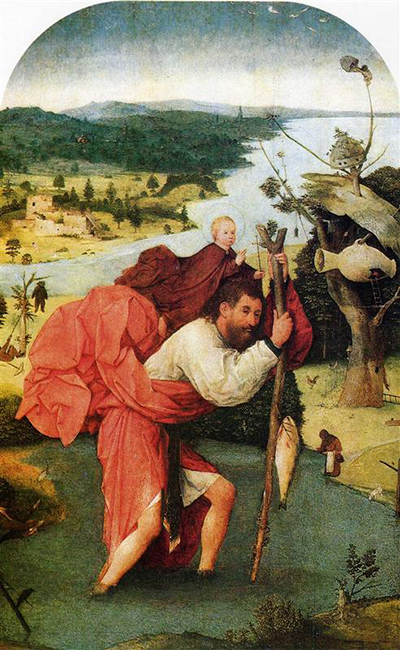
Hieronymus Bosch's Saint Christopher Carrying the Christ Child looks at first like one of the most familiar saintly legends in late medieval art. A giant carries a child through water. The child turns out to be Christ. The saint becomes the protector of travellers. Yet Bosch does not leave the story as a simple devotional image. He sets the crossing inside an expansive, unstable landscape where hermits, strange creatures, improvised dwellings, small hazards and difficult details turn the scene into a meditation on travel, conversion and spiritual burden.
The painting is in Museum Boijmans Van Beuningen, Rotterdam. The museum records it as Saint Christopher Carrying the Christ Child, painted by Jheronimus Bosch in circa 1500, in oil on panel, with the accession number St 26. Its dimensions are 113 cm high by 71.5 cm wide, and it belongs to the Old Masters department as a loan from Stichting Museum Boijmans Van Beuningen, formerly the Koenigs collection [1]. Boijmans also notes that the work is associated with an extensive restoration history and with the major Bosch anniversary exhibitions of 2016 and later years [1] [2].
This is not one of Bosch's enormous triptychs, like The Garden of Earthly Delights or The Haywain Triptych. It is a single devotional panel. That smaller format changes the temperature of the picture. Instead of staging all humanity between Paradise and Hell, Bosch concentrates on a single act of carrying. The saint's body, the river, the child, the staff, the fish, the hermit's dwelling and the peculiar landscape details all circle one question: what does it mean to bear Christ through a dangerous world?
The answer is not simple. Bosch's saints are rarely placed in calm, empty settings. Saint John the Baptist and Saint John on Patmos also occupy landscapes filled with pressure, signs and visual disturbance. In Saint Christopher, that pressure is especially appropriate, because the subject is a traveller's saint. The image belongs beside Bosch's wider concern with roads, crossings, burdens and choices, from The Wayfarer to the moral journeys mapped across his major paintings.
Contents
- At a Glance
- What Bosch Shows
- The Legend of Christopher
- A Saint for Travellers and Pilgrims
- The Christ Child and the Weight of the World
- The Landscape Around the Crossing
- Fish, Dragon and Uncertain Details
- Bosch's Technique in a Devotional Panel
- Restoration and the Bosch 500 Moment
- Attribution and the Bosch Corpus
At a Glance
- ArtistJheronimus Bosch, also known as Hieronymus Bosch
- TitleSaint Christopher Carrying the Christ Child
- Datecirca 1500 according to Museum Boijmans Van Beuningen; the restoration material gives the broader range 1490-1505
- MediumOil on panel
- Dimensions113 cm high by 71.5 cm wide
- CollectionMuseum Boijmans Van Beuningen, Rotterdam
- Accession numberSt 26
- Credit lineLoan Stichting Museum Boijmans Van Beuningen, former Koenigs collection, 1940
- SubjectThe giant Reprobus, later Saint Christopher, carrying the Christ Child across a river
- Key themesConversion, pilgrimage, travel, devotional protection, spiritual burden, strange landscape detail and technical conservation evidence
Compare these works across Bosch’s career
These date ranges are estimates, not a documented year-by-year sequence. These works provide context for the article; none is highlighted as the object discussed here.
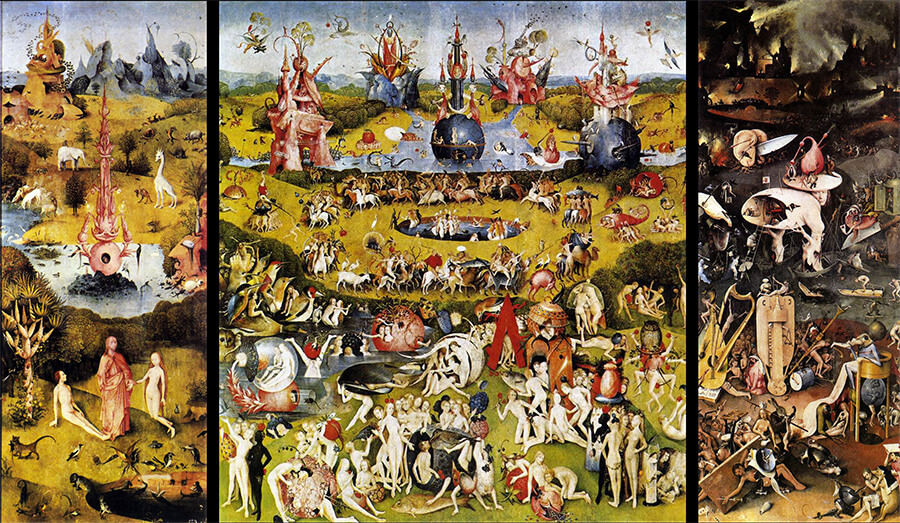
Saint Jerome at Prayer
Circa 1485–1495 [3]Crucifixion with a Donor
Circa 1490–1500 (BRCP) [3]Hermit Saints Triptych
Circa 1495–1505 [3]Saint Liberata Triptych
Circa 1495–1505 [3]The Hearing Forest and the Seeing Field
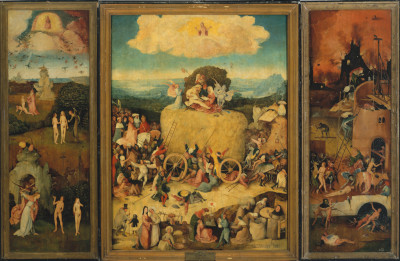
Circa 1500–1505 (Berlin exhibition) [4]The Haywain Triptych
1510–1516 (BRCP) [3]What Bosch Shows
The centre of the painting is the crossing. Christopher, still recognisable as the giant Reprobus of the legend, wades through water with the Christ Child on his shoulders. Boijmans summarises the story clearly: Reprobus sought to serve the most powerful master in the world, passed from king to devil, learned that the devil feared the Christian cross, and was directed by a hermit to serve Christ by carrying travellers across a dangerous river [2].
The decisive moment comes when the traveller he carries is not an ordinary child. The child becomes unbearably heavy because he is Christ, bearing the sins of the world. The giant then receives the name Christopher, meaning "Christ bearer", and becomes the patron saint of travellers [1] [2].
Bosch paints that legend as a physical test. The saint's body is large, active and bent to the task. The river is not a decorative strip at his feet but the space of ordeal. The child may be small, but his theological weight exceeds the giant's natural strength. The imbalance between visible size and invisible burden is the heart of the image.
That imbalance also explains why the painting should not be reduced to a sentimental scene of protection. Christopher protects travellers because he has first been overwhelmed by the one he carries. He is strong, but not self-sufficient. His conversion begins when worldly measures of power fail. King, devil, giant strength and physical service all lead to the recognition that Christ is the true master.
Bosch's composition makes that recognition take place inside a world still crowded with danger. The saint is not removed from temptation or disorder. He moves through it. The landscape contains signs of habitation, isolation, oddity and threat. Boijmans calls attention to the "extraordinary scenes" dotted across the extensive landscape and notes that, as often in Bosch, strange creatures and remarkable situations populate the world around the main subject [1] [2].
The Legend of Christopher
The legend of Saint Christopher was one of the most popular stories of medieval devotional culture. Its appeal is easy to understand. It turns sainthood into service, strength into humility and travel into a spiritual metaphor. Christopher does not become holy by withdrawing from the road. He becomes holy by carrying others across it.
Boijmans' account preserves the basic narrative: the giant first wants to serve the greatest power, then learns through disappointment and instruction that Christ is greater than king or devil. A hermit directs him toward a practical vocation. Because Christopher is huge and strong, he can serve by ferrying people across a dangerous river [2].
That detail matters. The hermit does not tell Christopher to become a theologian or a preacher. He gives him a task suited to his body. Bosch's picture therefore makes conversion visible through labour. The saint's large limbs, staff and leaning posture are not incidental. They show faith enacted as work.
The Christ Child's heaviness is the paradox at the centre of the story. A child should be light. This child is impossibly heavy because he carries what human beings cannot carry: the sins of the world. Christopher's body almost becomes an image of Christian doctrine. The saint bears Christ, and Christ bears the world.
The name Christopher, "Christ bearer", turns the event into identity. The image is therefore about naming as well as action. Reprobus becomes Christopher because he has discovered whom he truly serves. Bosch gives that transformation a landscape, a body and a river.
The theme links naturally to Bosch's broader interest in the human path through life. In The Wayfarer, the traveller moves along a road full of temptations and uncertain signs. In Saint Christopher, the traveller-saint enters water rather than walking a road, but the moral structure is related. Both images ask how a person moves through danger while carrying a burden.
A Saint for Travellers and Pilgrims
Saint Christopher's popularity was closely tied to travel, danger and protection. The very act of looking at or carrying an image of Christopher was widely associated with safety on the road. The Bosch Research and Conservation Project catalogue places Bosch's painting within that wider devotional culture, including the late medieval belief in the saint's protective power and the display of Christopher images in churches and public places where travellers could see them [5] [6].
This context helps explain the painting's immediate force. A viewer did not need to solve every landscape detail before understanding the saint's role. Christopher stands for protection at a threshold: river, road, journey, danger, night, death, sin. His giant body gives reassurance, but the Christ Child gives the reassurance its source.
The painting also touches the culture of pilgrimage. A pilgrim is a traveller with spiritual purpose, and Bosch often makes travel morally charged. The road is never just geography. It is a way of life. In Bosch's biography, the artist's documented world in 's-Hertogenbosch belongs to a late medieval urban culture of confraternities, churches, workshops and devotional practice. Christopher's river crossing fits that world: faith is practiced in movement, labour, risk and attention.
That is why the painting belongs beside Bosch's road imagery rather than only beside saint pictures. The Hieronymus Bosch overview and the symbolism guide both return to the idea that Bosch's figures often stand between choices. Christopher's choice has already turned toward Christ, but the landscape still tests him. He is not in Heaven. He is in the middle of the crossing.
The Christ Child and the Weight of the World
The Christ Child in this painting is small, but he controls the meaning of the scene. Boijmans explains that the child becomes as heavy as lead because he is Jesus, who bears the sins of the world [2]. The saint's strain is therefore a sign of revelation. The stronger Christopher appears, the more astonishing the child's burden becomes.
In visual terms, Bosch uses scale against expectation. A giant should dominate a child. Here the small figure on the giant's shoulders is the true centre of power. The panel becomes a lesson in inverted hierarchy: the child outweighs the giant, Christ exceeds worldly force, and service proves greater than mastery.
The Christ Child's gesture and attributes matter because they identify him as more than a passenger. Later summaries of the Bosch Research and Conservation Project's catalogue entry identify the child by signs such as his nimbus, blessing gesture and staff, while placing the image within the traditional Christopher legend [5] [6]. The child is not merely carried across the river; he reveals the saint's vocation.
This revelation also gives the panel its devotional charge. A viewer standing before the painting sees an image of burden, but also of nearness. Christ is not distant. He is physically present, resting on the saint's shoulders. Christopher's whole body becomes the place where faith is tested and confirmed.
The subject could easily have become static: a saint, a child, a river, a standard attribute. Bosch instead makes the scene feel unstable and active. The staff, water, landscape details and saint's movement keep the image in transition. The crossing is still happening. Conversion is not illustrated as a completed fact but as a moment under pressure.
The Landscape Around the Crossing
One reason Bosch's Saint Christopher is so compelling is that the landscape refuses to behave like a neutral backdrop. Boijmans describes it as extensive and filled with extraordinary scenes [1]. The saint's story may be legible, but the world around him remains strange.
This is typical Bosch territory. His landscapes often mix wide distance with tiny incidents. The viewer's eye moves from the main figure to small buildings, animals, vessels, figures and hybrid forms. The effect is not merely decorative. The landscape becomes a field of moral and imaginative pressure.
In Saint Christopher, the strangeness suits the subject. A traveller's world is full of hazards. The saint moves through water, but the surrounding environment suggests other forms of danger: isolation, temptation, odd habitation, unstable borders between human and animal life, and the presence of creatures or objects that seem to belong partly to ordinary experience and partly to Bosch's invented moral universe.
The hermit's presence is important here. In the legend, the hermit instructs Christopher in the Christian faith and gives him his vocation. A hermit's dwelling in the landscape therefore anchors the scene in devotional teaching. At the same time, Bosch's handling of such dwellings often makes them visually odd: small, improvised, almost swallowed by the landscape. Sacred instruction does not abolish the world's strangeness; it gives the saint a way to move through it.
The landscape also helps establish scale. Tiny figures, buildings and details make Christopher feel immense. The saint is not just large because the legend says so. Bosch makes his size legible by placing him against a world of smallness. This makes the burden of the Christ Child more paradoxical. Even a giant among small things bends under the weight of the smallest holy figure in the painting.
Fish, Dragon and Uncertain Details
The painting includes details that invite interpretation, but Bosch rewards caution. Boijmans' Dutch collection Q&A is useful because it preserves both iconographic suggestions and uncertainty. When asked about the small dragon in the painting, the museum answered that its meaning is not completely certain, while offering Satan as a possible explanation because Christopher served the devil before turning to Christ [7].
That is the right tone for Bosch. The dragon may fit the story of Christopher's former service to the devil, but the detail should not be treated as if Bosch had supplied a caption. The power of the painting lies partly in the way small creatures and signs hover between narrative reference, moral symbol and imaginative invention.
The fish attached to Christopher's staff has a stronger Christological reading in Boijmans' Q&A. The museum notes that most current readers connect the fish with Christ, especially because it appears wounded and bleeding, which makes a link to Christ's crucifixion and redemption plausible [7]. This interpretation works because fish symbolism has deep Christian resonance and because the painted detail belongs to a panel centred on Christ's saving burden.
Even here, caution remains useful. The fish is not a separate puzzle to be solved in isolation. It hangs from the saint's staff as he carries Christ. It belongs to a cluster of ideas: crossing, burden, sacrifice, salvation, travel and protection. Bosch's best details usually work this way. They do not simply stand for one word; they intensify the action of the whole image.
This approach also protects the painting from the weakest form of Bosch interpretation, where every monster or object becomes a dictionary entry. The Bosch symbolism guide is most helpful when it asks what a creature or object is doing, not only what it "means". In Saint Christopher, the important actions are carrying, crossing, instructing, weighing down, guiding, threatening and redeeming.
Bosch's Technique in a Devotional Panel
The painting is especially valuable for understanding Bosch's style and technique because it has been examined and restored in an unusually visible way. Boijmans' restoration material records a detailed sequence of study and treatment. Preliminary examination included paint samples, ultraviolet photography and raking light. Conservators used a computer to record their work and study XRF images, infrared images, X-rays and paint samples [2].
These methods help move Bosch away from the myth of pure fantasy. The painting is an object: oil, panel, ground, paint, varnish, cracks, old repairs, structural stress and later conservation decisions. The strange landscape and saintly legend are inseparable from this material history.
Boijmans explains that the preliminary examination revealed several problems. The reinforcing cradle, or parquet, on the back of the panel was fixed when it should have been able to move; the wood was rotten in places; the varnish had yellowed; and some paint was loose [2]. These are not glamorous details, but they change how the painting can be seen and preserved.
The restoration also helps explain why old paintings may not simply look as their makers intended. Yellowed varnish can darken and flatten colour. Old retouching can obscure damaged or worn passages. A fixed cradle can restrict the movement of a wooden panel, contributing to cracks or undulation. Loose paint threatens the surface itself.
The conservation work addressed both paint and support. Boijmans records the removal of yellowed varnish and old retouching, the consolidation of loose paint, filling and retouching of losses, and the addition of a new varnish layer. For the support, the panel was identified as four oak planks; the fixed cradle was carefully loosened without damaging the paint layers, old wax and dirt were removed, insect holes were filled, and edges were made flush, glued and filled [2].
This evidence makes Saint Christopher a particularly good bridge between devotional reading and technical study. The saint's act of carrying is also mirrored by the painting's own support: four oak planks, a cradle, cracks, joins, varnish, paint and restoration labour. The image is about bearing a burden; the object has borne five centuries of physical strain.
Restoration and the Bosch 500 Moment
The restoration had a public setting. Boijmans states that the painting and other Bosch works from the collection were requested as loans for the 2016 Jheronimus Bosch 500 exhibition in 's-Hertogenbosch, but that Saint Christopher was too fragile to travel before treatment [2]. The public restoration ran from April 2015 into early 2016, allowing visitors to see conservation work usually hidden behind museum walls [2].
That context matters because 2016 was not only a commemorative year. It was a turning point in public Bosch research. The Bosch Research and Conservation Project, the Closer to Bosch platform and major exhibitions brought together technical imaging, conservation, attribution debate and high-resolution study. Closer to Bosch presents Saint Christopher as CAT7 within its Bosch corpus and offers the work in relation to visible and technical image types such as macrophotography, infrared macrophotography, infrared reflectography and X-radiography where available [6].
The restoration of Saint Christopher therefore belongs to a wider renewal of Bosch studies. It was not only a museum maintenance project. It was part of a broader effort to understand Bosch's paintings as physical objects with histories of making, damage, care and interpretation.
Boijmans' restoration page also stresses reversibility: modern restoration materials should be removable in the future without damaging the painting [2]. That principle is crucial for old master conservation. It recognises that every treatment belongs to a chain of care rather than to a final, permanent solution.
For readers, the result is a richer sense of what looking means. To look at Bosch is not only to identify monsters or decode symbols. It is also to understand panels, paint layers, varnish, X-rays, underlayers, wood movement and the responsibilities of conservation.
Attribution and the Bosch Corpus
Boijmans presents the painting as by Jheronimus Bosch [1]. Closer to Bosch likewise lists Saint Christopher among the paintings associated with Bosch and identifies it as CAT7 [6]. The painting also has an important signature tradition: the Dutch Boijmans record notes a signature at lower left, reading Jheronimus Bosch [7].
At the same time, Bosch attribution always benefits from careful language. His fame generated workshop production, copies, imitations and later Boschian works. Boijmans itself is unusually alert to this problem. Its Bosch artist material explains that only around twenty-five panels are generally accepted as authentic worldwide, and that some paintings once bought as Bosch are now understood differently after technical research, including dendrochronology [8].
For Saint Christopher, the available museum and BRCP/Closer framing supports the painting's place among Bosch's accepted works. The caution is not that the object should be treated as doubtful, but that Bosch studies as a field has learned to test appearance against evidence. Signature, panel support, underdrawing, technical examination, provenance, style and comparison all matter.
This is especially useful because the panel shows both familiar saintly iconography and distinctly Boschian invention. The core subject could have been painted by many late medieval artists. The landscape details, strange creatures, scale play and restless expansion of the scene belong much more closely to Bosch's imagination. The painting is traditional and idiosyncratic at once.
That combination makes Saint Christopher an important counterweight to Bosch's infernal fame. He is often remembered for devils, punishments and grotesques, but here those energies are placed inside a saint's legend. The strangeness does not replace devotion. It sharpens it.
Place in Bosch's Work
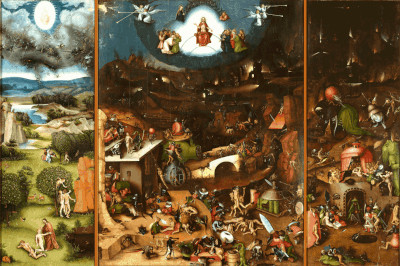
Saint Christopher occupies a revealing position in Bosch's art. It is not as encyclopedic as The Garden of Earthly Delights, not as socially panoramic as The Haywain Triptych, not as concentratedly confrontational as Christ Mocked, and not as infernal as The Last Judgement. Its power lies in the meeting of a popular saint, a traveller's devotional image and Bosch's restless landscape imagination.
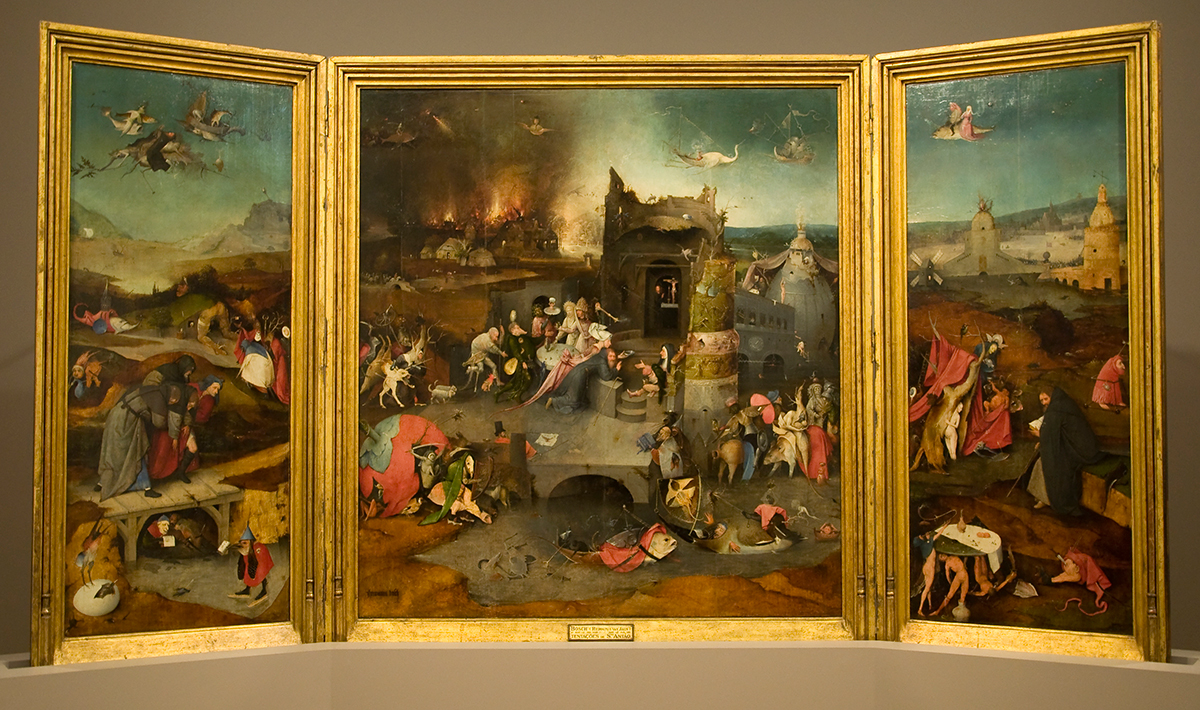
The painting also belongs to a group of Bosch works in which solitary or semi-solitary holy figures resist or move through a troubled world. Saint John the Baptist withdraws into meditation. Saint John on Patmos receives revelation. Saint Anthony is tested by demons. Saint Christopher moves, bears and serves.
Christopher's activity makes him especially close to the wayfarer figure. Both are travellers in morally charged spaces, but their burdens differ. The wayfarer carries the baggage of earthly life. Christopher carries Christ. The difference is the difference between wandering through temptation and serving through faith.
This makes the panel unusually hopeful for Bosch. The landscape is strange and dangerous, but the saint is not adrift. He has been given a task, and the task reveals Christ. The child is heavy, but the burden gives the giant his name and purpose.
The painting's continued interest also rests on its technical survival. Because Boijmans documented the restoration process in detail, Saint Christopher lets viewers connect Bosch's imagery to the material life of the object. The river crossing survives through a different kind of crossing: from oak tree to panel, from paint to varnish, from damage to restoration, from late medieval devotion to modern conservation.
Why Saint Christopher Still Matters
The painting matters because it shows Bosch's imagination working through protection rather than damnation. The famous Bosch world of strange creatures and uncertain details is still present, but it is organised around a saintly act. The result is an image of danger crossed, not only danger suffered.
It also matters because the subject speaks to Bosch's deeper moral geography. His art often asks where human beings are going, what they carry, who guides them and what forces threaten the journey. In Saint Christopher, those questions become literal. A giant enters the river with a child on his shoulders. The child grows impossibly heavy. The saint learns that the true power in the world is not the king, the devil or physical strength, but Christ.
The painting is devotional without being simple. It gives travellers a protector, but it also reminds them that protection is not magic detached from conversion. Christopher protects because he serves. He serves because he has recognised the true master. He recognises Christ because the burden becomes impossible by ordinary standards.
Bosch's strange landscape keeps that revelation from becoming tame. The world remains full of odd creatures, uncertain signs and fragile dwellings. The saint does not escape that world; he crosses through it. That is why the panel still feels alive. It is a picture of faith under weight, movement through danger and the difficult grace of carrying what cannot be carried by strength alone.
Artworks and related attributions
Browse paintings, drawings and related attributions. Records group triptychs, fragments and two-sided sheets where appropriate. Dates follow the cited museum records or catalogue headings and are generally estimates. Rows marked “2016 catalogue” report that publication’s attribution and collection information; these are dated opinions, rather than a claim that every work is an accepted autograph Bosch.
| Name | Date | Medium, attribution and collection |
|---|---|---|
| A Crossbowman | Second half of the sixteenth century | Oil on oak panel · Copy after Hieronymus Bosch · Museo Nacional del Prado, Madrid · P002695 Source 1. Source 2. |
| A Woman Spinning and an Old Woman | Museum estimates: about 1480–1490 for the women and 1500–1505 for the reverse; the precise chronology is disputed | Pen and brown and grey ink on the front; pen and brown ink on the reverse · Hieronymus Bosch · Museum Boijmans Van Beuningen, Rotterdam · N 190 recto and verso (PK) Source 1. Source 2. |
| Adoration of the Child in Cologne | Second half of the sixteenth century | Oil on oak panel · Imitator of Hieronymus Bosch, in the city collection record · Wallraf-Richartz-Museum & Fondation Corboud, Cologne · WRM 0474 Source 1. Source 2. |
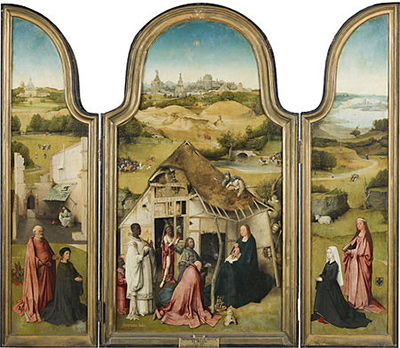
| Adoration of the Magi in Philadelphia | Early sixteenth century in the museum record; around 1495–1520 in the BRCP catalogue | Oil on oak panel · Hieronymus Bosch in the museum record; workshop of Bosch in the 2016 BRCP catalogue · Philadelphia Museum of Art, John G. Johnson Collection, 1917 · 1321; museum object 103592 Source 1. Source 2. |
| Adoration of the Magi — New York | c.1470–1480 | 2016 catalogue: Bosch; oil on oak · Metropolitan Museum 13.26 2016 catalogue. |
| Adoration of the Magi — Prado triptych | c.1494 | Oil on oak; grisaille exterior · Bosch · Prado P002048 Object source. |
| Adoration of the Magi — three associated fragments | c.1515–1535 | 2016 catalogue: Follower of Bosch · Two Shepherds / Retinue in Philadelphia; associated Adoration in private collection in 2016 2016 catalogue. |
| Ascent of the Blessed — Venice | c.1505–1515 | Oil on panel · Bosch · Gallerie dell’Accademia; Visions of the Hereafter Object source. |
| Battle of the Birds and Mammals | Not specified in catalogue heading | 2016 catalogue: Bosch; pen and brown ink · Berlin KdZ 14715 2016 catalogue. |
| Beggars and Musicians | Around 1530–1540 | Ink and wash on paper · Unknown follower of Hieronymus Bosch · Albertina, Vienna · 7798 Source 1. Source 2. |
| Christ Carrying the Cross Drawing | Around 1470 in the museum catalogue | Black chalk or charcoal, pen and brush in brown ink, white corrections · Anonymous, workshop of Rogier van der Weyden · Museum Boijmans Van Beuningen, Rotterdam · N 81 recto and verso (PK) Source 1. Source 2. |
| Christ Carrying the Cross in Vienna | Around 1490–1510 in the current KHM record and BRCP catalogue | Oil on oak, painted on both sides · Hieronymus Bosch; possible workshop involvement in the Passion side discussed by the BRCP · Kunsthistorisches Museum, Vienna · Gemäldegalerie, GG 6429 Source 1. Source 2. |
| Christ Carrying the Cross — El Escorial | c.1495–1505 | 2016 catalogue: Bosch; oil on oak · Patrimonio Nacional 10014739 2016 catalogue. |
| Christ Carrying the Cross — Ghent | c.1510–1516 (museum) | Oil on panel · Bosch in museum listing; authorship disputed · MSK Ghent 1902-H Object source. |
| Christ Mocked — London | c.1510 | Oil on wood · Bosch · National Gallery NG4744 Object source. |
| Concert in the Egg, After Hieronymus Bosch | Around 1561; third quarter of the sixteenth century | Oil on canvas · Anonymous, after Hieronymus Bosch · Palais des Beaux-Arts, Lille · P 816 Source 1. Source 2. |
| Conjurer / Comical Concert — Louvre drawing | Not specified in catalogue heading | 2016 catalogue: Bosch (recto), follower (concert verso) · Pen and brown ink · Louvre INV 19197 2016 catalogue. |
| Conjurer / Cross-bearing and beggars — Liège sheet | Not specified in catalogue heading | 2016 catalogue: Bosch (verso), follower (recto) · Pen and brown ink · Album d’Arenberg 534 2016 catalogue. |
| Crowning with Thorns — El Escorial | c.1530–1540 | 2016 catalogue: Follower of Bosch; oil on oak · Patrimonio Nacional 10014743 2016 catalogue. |
| Crucifixion with a Donor | Circa 1495–1505; Circa 1490–1500 | Oil on oak panel · Hieronymus Bosch · Royal Museums of Fine Arts of Belgium, Brussels · 6639 Source 1. Source 2. |
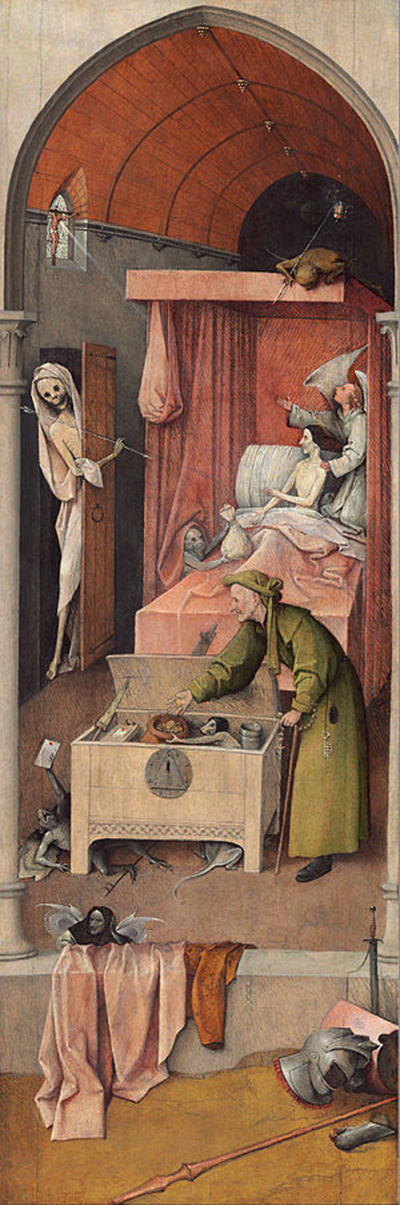
| Death and the Miser Drawing | Not securely established; probably made after the painting | Pen and brush, dark ink and white highlights on prepared paper · Workshop of Hieronymus Bosch in the BRCP catalogue; alternatives recorded by the Louvre · Musée du Louvre, Department of Prints and Drawings, Paris · RF 6947, Recto Source 1. Source 2. |
| Death and the Miser — Washington | c.1485/1490 (NGA) | Oil on panel · Bosch · National Gallery of Art 1952.5.33 Object source. |
| Ecce Homo Triptych — Boston | c.1495–1500; wings c.1500/1503 | 2016 catalogue: Workshop of Bosch; oil on oak · Museum of Fine Arts Boston; several production phases 2016 catalogue. |
| Ecce Homo — Frankfurt | c.1490 | Mixed technique on oak · Bosch · Städel 1577 Object source. |
| Fall of the Damned — Venice | c.1505–1515 | 2016 catalogue: Bosch; oil on panel · Visions of the Hereafter · Venice 2016 catalogue. |
| Garden of Earthly Delights | 1490–1500 (Prado) | Oil on oak; grisaille exterior · Bosch · Prado; triptych Object source. |
| Gluttony and Lust / Allegory of Intemperance — Yale fragment | c.1500–1510 (group dating) | 2016 catalogue: Bosch; oil on oak · Yale 1959.15.22; fragment associated with Ship of Fools 2016 catalogue. |
| Group of Ten Spectators, a Follower of Bosch | Around 1510–1540 in the current museum record | Pen and two brown inks on paper, with a brown framing line · Follower of Hieronymus Bosch in the Morgan record; Bosch in the BRCP catalogue · Morgan Library & Museum, New York · I, 112 Source 1. Source 2. |
| Head of an Old Woman | About 1500 | Oil on panel · Attributed to Jacob Cornelisz. van Oostsanen · Museum Boijmans Van Beuningen, Rotterdam · 2439 (OK) Source 1. Source 2. |
| Hell and the Flood — Rotterdam panels | Around 1515 in the museum records; around 1510–1520 in the BRCP catalogue | Oil on oak panels · Jheronimus Bosch in the museum records; workshop of Bosch in the BRCP catalogue · Museum Boijmans Van Beuningen, Rotterdam Source 1. Source 2. |
| Hermit Saints Triptych | Circa 1495–1505 | Oil on oak panels · Hieronymus Bosch · Gallerie dell’Accademia, Venice · 2044 Source 1. Source 2. |
| Infernal Landscape | Not specified in catalogue heading | 2016 catalogue: Bosch; pen and brown ink, red accent · Private collection in 2016 2016 catalogue. |
| Infernal Scene with Anvil / Monster Studies | Not specified in catalogue heading | 2016 catalogue: Bosch; attribution debated in entry · Pen and brown ink · Berlin KdZ 548 2016 catalogue. |
| Infernal Scene with Tree-Man / Standing Man | Not specified in catalogue heading | 2016 catalogue: Workshop of Bosch; pen and brown ink · Dresden C 1875; historical reverse title includes a proposed prophet 2016 catalogue. |
| Job Triptych — Bruges | c.1510–1520 | 2016 catalogue: Workshop of Bosch; oil on oak · Groeningemuseum / Hoeke loan in 2016 2016 catalogue. |
| Last Judgement — Bruges triptych | c.1495–1505 | 2016 catalogue: Bosch; oil on oak · Groeningemuseum 2016 catalogue. |
| Last Judgement — Munich fragment | c.1530–1540 | 2016 catalogue: Follower of Bosch; oil on oak · Alte Pinakothek 5752 2016 catalogue. |
| Last Judgement — Vienna triptych | c.1500–1505 (BRCP 2016) | Oil on oak · Bosch and workshop (BRCP 2016) · Academy of Fine Arts Vienna 2016 catalogue. |
| Man in a Basket and Comic Figures | Around 1500–1515 in the museum record | Pen and brown ink on paper; the reverse is catalogued as iron-gall ink · Hieronymus Bosch in the current Albertina record; attribution has been debated · Albertina, Vienna · 7797 recto and verso Source 1. Source 2. |
| Man Seen from Behind | About 1550–1569; About 1565–1570 | Traces of black chalk, pen and brush in light brown ink · Anonymous, circle of Pieter Bruegel the Elder · Museum Boijmans Van Beuningen, Rotterdam Source 1. Source 2. |
| Mary and John at the Foot of the Cross | About 1440 | Brush in grey and black · Unknown, possibly Netherlandish · Kupferstich-Kabinett, Staatliche Kunstsammlungen Dresden · C 815 Source 1. Source 2. |
| Model Sheet with ‘Witches’ | Disputed; proposals depend on the attribution | Pen and brown ink; the BRCP also records underlying black chalk · Hieronymus Bosch; follower attributions also recorded · Musée du Louvre, Département des Arts graphiques, Paris · INV 19721 recto Source 1. Source 2. |
| Peasant and Three Bust-Length Figures | 1401–1500 | Brown pen over a black preliminary drawing · Attributed to the Master of the Drapery Studies; Bosch circle also recorded · Kupferstichkabinett, Staatliche Museen zu Berlin · KdZ 777 Source 1. Source 2. |
| River to Hell — Venice | c.1505–1515 | 2016 catalogue: Bosch; oil on panel · Visions of the Hereafter · Venice 2016 catalogue. |
| Saint Anthony and a Concert in an Egg | Around 1510–1525 in the museum’s 2016–17 exhibition texts | Pen in light and dark brown inks · Workshop of Hieronymus Bosch; underlying monsters: Bosch (BRCP), possibly Bosch (exhibition text) · Kupferstichkabinett, Staatliche Museen zu Berlin · KdZ 711 recto and verso Source 1. Source 2. |
| Saint Christopher Carrying the Christ Child | c.1500; 1490–1505 in restoration material | Oil on panel · Bosch · Boijmans St 26 Object source. |
| Saint James and Hermogenes | About 1551–1575 in the KIK-IRPA catalogue | Oil on wood, painted on both sides · Anonymous follower of Hieronymus Bosch · Musée des Beaux-Arts, Valenciennes · P.46.1.44; older number 176 Source 1. Source 2. |
| Saint Jerome at Prayer | Circa 1485–1495 | Oil on oak panel · Hieronymus Bosch · Museum of Fine Arts, Ghent · 1908-H Source 1. Source 2. |
| Saint John on Patmos / Passion Scenes | c.1495–1505; estimates vary | Oil on oak · Bosch · Gemäldegalerie Berlin 1647A Object source. |
| Saint John the Baptist in Meditation | Late 15th century; c.1485–1510 (Prado exhibition) | Oil on panel · Bosch · Lázaro Galdiano 8155 Object source. |
| Saint Liberata Triptych | Circa 1495–1505 | Oil on oak panels · Hieronymus Bosch · Gallerie dell’Accademia, Venice · 2045 Source 1. Source 2. |
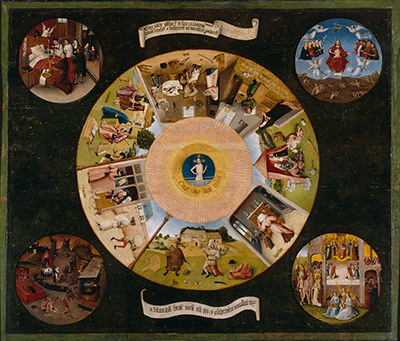
| Seven Deadly Sins and the Four Last Things | 1505–1510 (Prado) | Oil on poplar · Bosch (Prado); workshop/follower disputed · Prado Object source. |
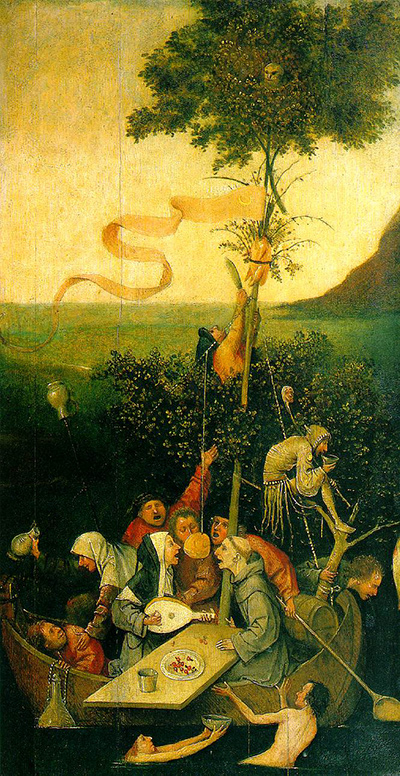
| Ship of Fools — Louvre painting | 1475–1500 (record); c.1505–1515 (exhibition) | Oil on oak · Bosch · Louvre RF 2218; fragment Object source. |
| Ship of Fools — Louvre workshop drawing | Not specified in catalogue heading | 2016 catalogue: Workshop of Bosch · Pen, brush, grey-brown ink and white highlights on prepared paper · Louvre RF 3714 2016 catalogue. |
| Studies of Monsters | About 1530–1550, according to the current Ashmolean record | Pen and brown ink on laid paper, both faces · Anonymous follower of Hieronymus Bosch · Ashmolean Museum, University of Oxford · WA1863.155 Source 1. Source 2. |
| Studies of Saint Anthony and Monsters | No execution date specified in the current Louvre records | Pen and brown ink on paper · Bosch listed; reverse questioned by Louvre; BRCP accepts both faces · Musée du Louvre, Département des Arts graphiques, Paris · INV 20871 recto and verso Source 1. Source 2. |
| Temptation of Saint Anthony — Kansas City fragment | c.1500–1510 | 2016 catalogue: Bosch; oil on oak · Nelson-Atkins 35–22 2016 catalogue. |
| Temptation of Saint Anthony — Lisbon triptych | c.1500 | Oil on oak · Bosch · Museu Nacional de Arte Antiga 1498 Pint Museum. |
| Temptation of Saint Anthony — Prado panel | c.1530–1540 | 2016 catalogue: Follower of Bosch (2016 opinion); oil on oak · Prado P002049 2016 catalogue. |
| Terrestrial Paradise | Approximately 1505–1515 | Oil on oak panel · Hieronymus Bosch · Gallerie dell'Accademia, Venice Source 1. Source 2. |
| The Burning Ship Drawing | 1500–1520 | Pen and iron gall ink on paper · Attributed to Hieronymus Bosch · Academy of Fine Arts Vienna, Graphic Collection · HZ-2554; numbered 2554 in the BRCP catalogue Source 1. Source 2. |
| The Comical Barber Scene | About 1550–1580, according to the British Museum | Pen and brown ink, grey and brown wash, over black chalk · Anonymous follower, after Hieronymus Bosch · British Museum, Department of Prints and Drawings, London · 1854,0628.46 Source 1. Source 2. |
| The Conjuror, After Hieronymus Bosch | Probably after 1525; around 1530–1540 in the BRCP technical report | Oil on oak panel · Anonymous follower of Hieronymus Bosch · Musée Ducastel-Vera, Saint-Germain-en-Laye · 872.1.87 Source 1. Source 2. |
| The Cure of Folly / Extraction of the Stone of Madness | 1501–1505 (Prado) | Oil on oak · Bosch (Prado); workshop/follower disputed · Prado P002056 Object source. |
| The Entombment Drawing | About 1505–1515, current museum record | Brush and black and grey ink, with grey wash, over black chalk · Workshop of Hieronymus Bosch; drawn by the Master of the Prado Haywain Triptych; Hieronymus Bosch, argued by the BRCP in 2016 · British Museum, Department of Prints and Drawings, London · 1952,0405.9 Source 1. Source 2. |
| The Gathering of the Birds | Not specified in catalogue heading | 2016 catalogue: Bosch; pen and brown ink · Berlin KdZ 13136 2016 catalogue. |
| The Haywain — Prado triptych | 1510–1516 (BRCP 2016) | Oil on oak · Bosch (BRCP 2016) · Prado; separate Escorial version exists 2016 catalogue. |
| The Hearing Forest and the Seeing Field | Circa 1500–1505 | Pen and brown ink on paper · Hieronymus Bosch; reverse: Bosch and workshop · Kupferstichkabinett, Staatliche Museen zu Berlin · KdZ 549, front and reverse Source 1. Source 2. |
| The Owl’s Nest — Rotterdam | Not specified in catalogue heading | 2016 catalogue: Bosch; pen and brown ink · Boijmans N 175 2016 catalogue. |
| The Passion Triptych in Valencia | Workshop of Bosch, about 1510–1520; Follower of Bosch; centre about 1530–1540, wings about 1540–1550 | Oil and gold on oak panels · Workshop of Bosch, about 1510–1520; Follower of Bosch; centre about 1530–1540, wings about 1540–1550 · Museu de Belles Arts de València Source 1. Source 2. |
| The Pedlar / Wayfarer — Rotterdam | c.1500 (museum) | Oil on panel · Bosch · Boijmans 1079 (OK); rejoined exterior Object source. |
| The Tree-Man — Vienna drawing | c.1505 | Pen and brown ink · Bosch · Albertina, Vienna Object source. |
| The Wedding at Cana, After Hieronymus Bosch | Approximately 1560 in the current museum record | Oil on panel, 93 cm high × 72 cm wide · Anonymous, after Hieronymus Bosch · Museum Boijmans Van Beuningen, Rotterdam, St 25 Source 1. Source 2. |
| Two Fantastical Creatures — Berlin KdZ 550 | Around 1505–1515 in the museum’s 2016 exhibition text | Pen in brown ink on reddish prepared laid paper · Hieronymus Bosch · Kupferstichkabinett, Staatliche Museen zu Berlin · KdZ 550, recto and verso Source 1. Source 2. |
| Two Figures Wearing Mitres | About 1480 | Oil on panel · Anonymous (Boijmans); Bosch circle (RKD) · Museum Boijmans Van Beuningen, Rotterdam · 1177 (OK) Source 1. Source 2. |
| Two Men and the Temptation of Eve | About 1505–1515 in the Prado’s 2016 exhibition guide | Pen and grey-brown ink on paper · Hieronymus Bosch in the 2016 catalogues discussed here · Private collection, as recorded in 2016 Source 1. Source 2. |
| Two Men Fighting | Not specified in the current Louvre record | Pen and brown ink · In the manner of Hieronymus Bosch · Musée du Louvre, Département des Arts graphiques, Paris · INV 20660 recto; formerly NIII 8896 and MA 8400 Source 1. Source 2. |
| Two Men — Berlin KdZ 5210 | Not specified in catalogue heading | 2016 catalogue: Bosch questioned · Pen, brush, ink, chalk and white highlights · Berlin KdZ 5210; historical title Two Oriental Men 2016 catalogue. |
| Two Monsters — Berlin KdZ 547 | Approximately 1500–1510 in Berlin's 2016 exhibition catalogue; an estimated range | Pen and brown ink on paper · Hieronymus Bosch · Kupferstichkabinett, Staatliche Museen zu Berlin · KdZ 547, drawn on both sides Source 1. Source 2. |
Frequently Asked Questions
The painting is in Museum Boijmans Van Beuningen, Rotterdam. The museum records it as an Old Masters work, accession number St 26, on loan from Stichting Museum Boijmans Van Beuningen, formerly the Koenigs collection [1].
Museum Boijmans Van Beuningen dates the painting to circa 1500. The museum's restoration material uses the broader range 1490-1505 [1] [2].
The giant Reprobus carries a child across a river. During the crossing the child becomes unbearably heavy and is revealed as Christ, who bears the sins of the world. Reprobus then becomes Christopher, the "Christ bearer", and the patron saint of travellers [2].
Saint Christopher was widely venerated as a protector of travellers. The Bosch Research and Conservation Project catalogue places the painting within the late medieval culture in which images of Christopher were displayed where travellers could see them and were believed to offer protection [5] [6].
The restoration material records structural and surface problems including a fixed cradle on the back of the panel, rotten wood in places, yellowed varnish and loose paint. The treatment involved technical examination, varnish and old retouching removal, support work on the four oak planks, consolidation, filling, retouching and a new varnish layer [2].
Boijmans presents the work as by Jheronimus Bosch, and Closer to Bosch lists it as Saint Christopher CAT7 within the Bosch corpus [1] [6]. Because Bosch's name was copied and imitated early, attribution language across the cluster remains evidence-led, but the museum and BRCP/Closer framing support this painting's accepted status.
Discussion
Compare the weight of the child with the landscape around the crossing.
Reader Insights
How does the child’s small size compare with Christopher’s apparent effort?
Follow the river crossing into the surrounding landscape.
Which distant detail most changes the apparent calm of the saint’s journey?
Join the Conversation
Share a detail, comparison or question about Saint Christopher below.
References
- Museum Boijmans Van Beuningen, Saint Christopher Carrying the Christ Child, Jheronimus Bosch: View source
- Museum Boijmans Van Beuningen, "Jheronimus Bosch in the Restauration Studio": View source
- BRCP Catalogue Raisonné (2016), object dates in catalogues 1, 2, 8, 15 and 20; catalogue 20 object metadata only for the Haywain comparison. View source
- Staatliche Museen zu Berlin, 2016 exhibition wall texts, p. 3: approximate date of KdZ 549. View source
- Matthijs Ilsink, Jos Koldeweij, Ron Spronk, Luuk Hoogstede, Robert G. Erdmann, Rik Klein Gotink, Hanneke Nap and Daan Veldhuizen, Hieronymus Bosch, Painter and Draughtsman: Catalogue Raisonne, Yale University Press, 2016: View source
- Closer to Bosch, Bosch Research and Conservation Project platform: View source
- Museum Boijmans Van Beuningen, De heilige Christoffel draagt het Christuskind, Dutch collection record and public Q&A: View source
- Museum Boijmans Van Beuningen, "Jheronimus Bosch": View source