by Tom Gurney
Tom Gurney BSc (Hons) is an art history expert with over 20 years experience
Published on June 19, 2020 / Updated on November 4, 2026
Email: tomgurney1@gmail.com / Phone: +44 7429 011000
The Ship of Fools by Hieronymus Bosch: Introduction
Hieronymus Bosch's Ship of Fools is a small painting with a large moral wake. Now in the Louvre as La Nef des fous, it shows a crowded, unstable boat carrying singers, drinkers, a fool, a monk, a nun and other figures who seem far more interested in appetite than direction. No one steers. No one looks toward a safe shore. Food hangs above open mouths, a jug cools in the water, music replaces prayer, and the mast itself behaves less like a nautical tool than a comic emblem of disorder.
The painting is often introduced through its famous title, but that title is only the beginning. The Louvre's collection record identifies the work as La Nef des fous, with the alternate title Satire de noceurs debauches, or a satire of dissolute revellers. It records the object as oil on oak, 58 by 33 cm, inventory RF 2218, in the Department of Paintings [1]. The same record dates it broadly to the fourth quarter of the fifteenth century, 1475-1500, while the Louvre's 2024-2025 Figures du Fou exhibition label used the range around 1505-1515 [1] [2]. The safest wording is therefore late Bosch, around the turn of the sixteenth century, with museum records not fully identical on date.
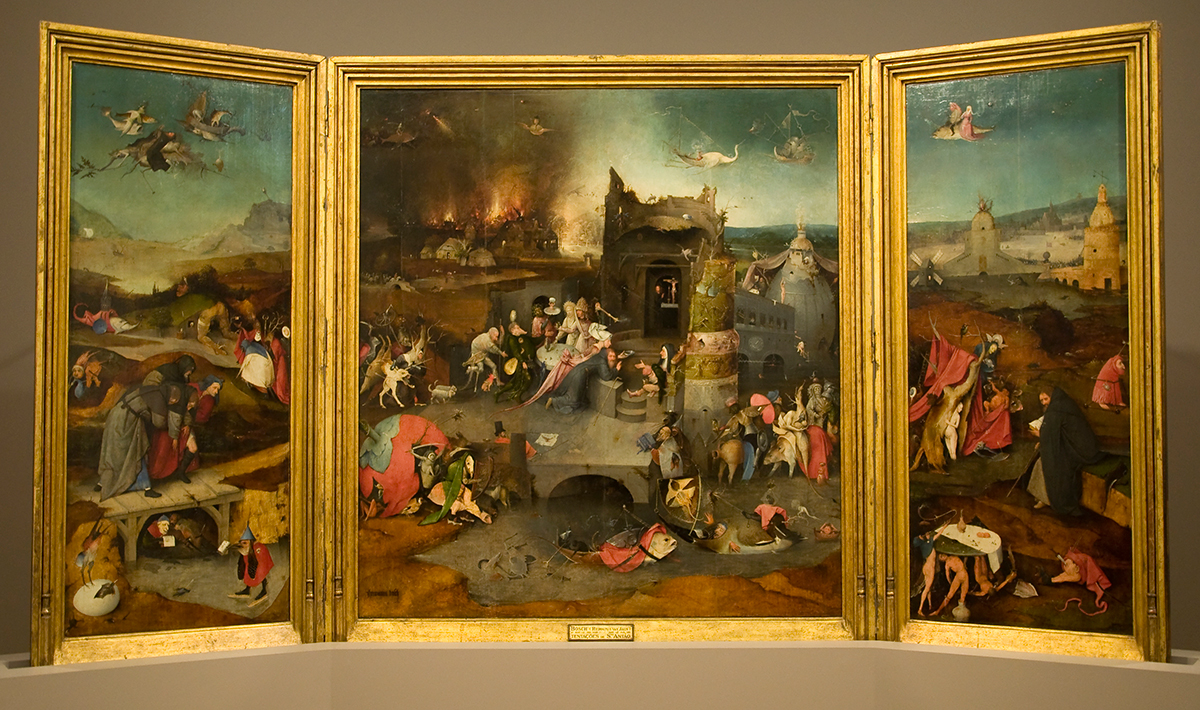
What makes the work especially important is its double identity. It is a brilliant image of folly, gluttony and clerical satire, but it is also a fragment from a dismantled triptych. The Louvre describes it as the upper fragment of the inner face of a left wing; the lower fragment, now at Yale University Art Gallery, continues the theme of intemperance, while the right wing is represented by Death and the Miser in Washington [1]. The closed exterior of the wings is connected with the Rotterdam work known as The Pedlar or Wayfarer [1] [3].
This study belongs within the wider Hieronymus Bosch cluster, especially the paintings overview and the guide to Bosch's prints and reception, where the spread of Boschian imagery through books, copies and later graphic culture becomes part of the story.
That larger structure changes how the boat should be read. Ship of Fools is not merely a freestanding joke about ridiculous people at sea. It belongs to Bosch's wider moral world, alongside The Haywain Triptych, The Garden of Earthly Delights, Death and the Miser, and the solitary wayfarer who moves through a landscape of temptation. Bosch is asking about the course of a human life: whether it is guided, distracted, consumed, redeemed or lost.
Contents
- Annotated Details
- At a Glance
- What Bosch Shows
- A Boat Without Direction
- Sebastian Brant and the Ship of Fools Tradition
- Folly, Gluttony and Clerical Satire
- A Fragment of a Dismantled Triptych
- What Restoration Revealed
- The Missing Centre and the Limits of Reconstruction
- The Ship of Fools and Bosch's Wider Moral World
At a Glance
- ArtistHieronymus Bosch, also known as Jheronimus Bosch
- TitleLa Nef des fous, commonly The Ship of Fools
- Alternate titleSatire de noceurs debauches
- DateLouvre collection record: 1475-1500; Louvre exhibition label: around 1505-1515
- MediumOil on oak
- Dimensions58 x 33 cm
- CollectionMusee du Louvre, Department of Paintings, Paris
- InventoryRF 2218
- FormatFragment from the inner left wing of a dismantled triptych
- Related fragments and panelsYale's lower fragment often associated with gluttony, drunkenness or lust; Death and the Miser in Washington; The Pedlar / Wayfarer in Rotterdam
- Main themesFolly, gluttony, drunkenness, clerical satire, moral blindness and the danger of a life without spiritual direction
Compare these works across Bosch’s career
These date ranges are estimates, not a documented year-by-year sequence. These works provide context for the article; none is highlighted as the object discussed here.
Saint Jerome at Prayer
Circa 1485–1495 [4]Crucifixion with a Donor
Circa 1490–1500 (BRCP) [4]Hermit Saints Triptych
Circa 1495–1505 [4]Saint Liberata Triptych
Circa 1495–1505 [4]The Hearing Forest and the Seeing Field
Circa 1500–1505 (Berlin exhibition) [5]The Haywain Triptych
1510–1516 (BRCP) [4]Annotated Details from Ship of Fools
The numbered details move from the ominous mast and improvised feast to the revelers packed into the boat and the swimmers struggling beside it.
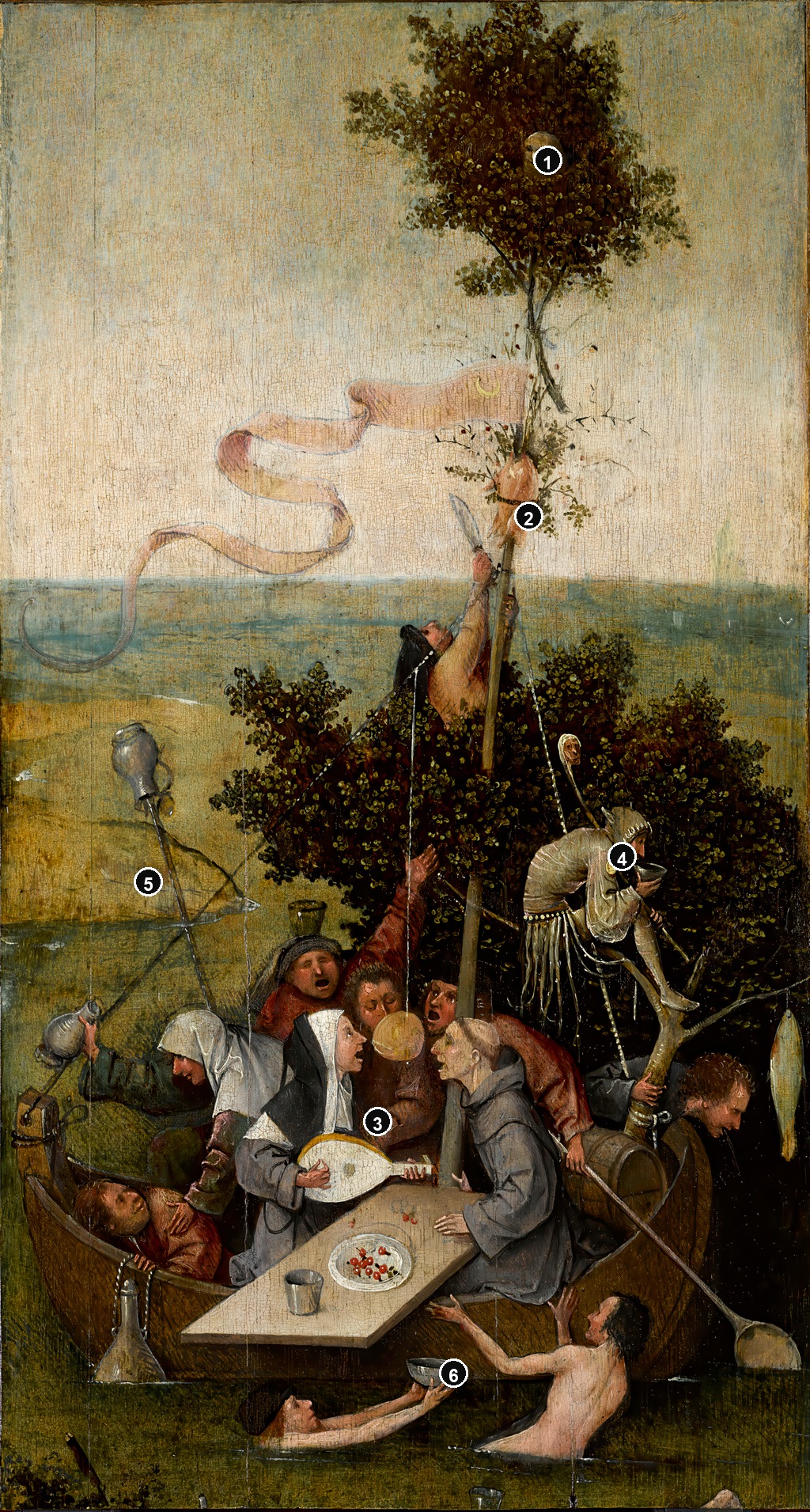
Details from SHIP OF FOOLS
Close looking reveals how Bosch joins appetite, music, improvised navigation and indifference to danger within one precariously crowded boat.
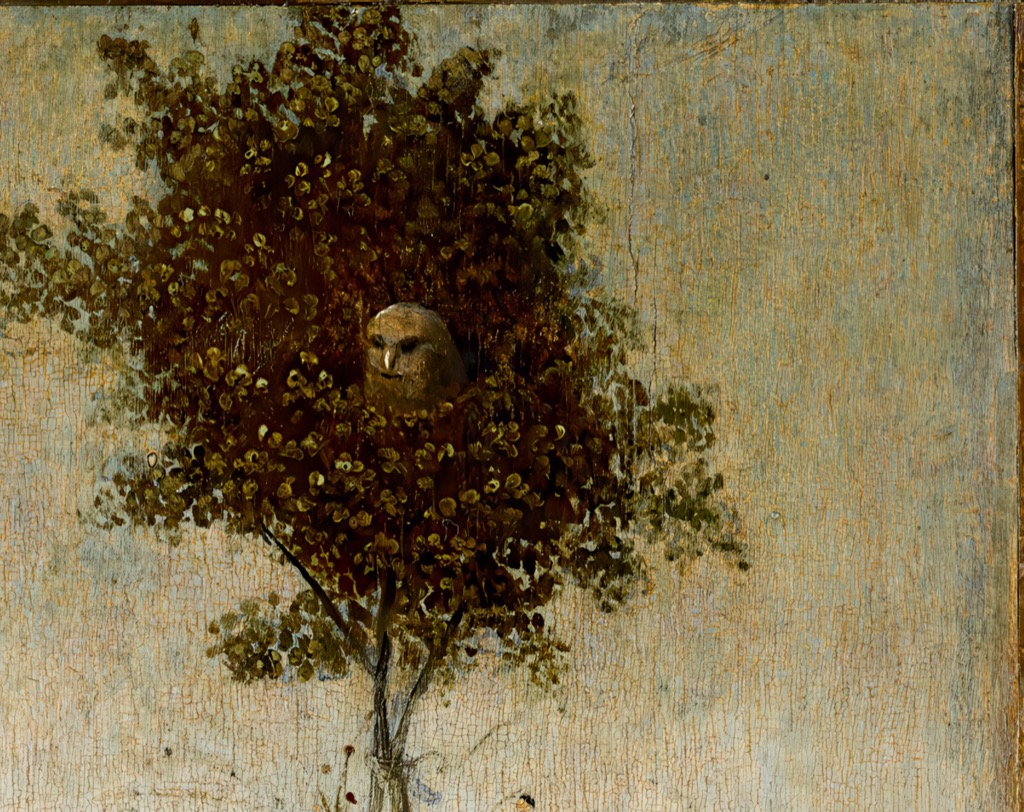
The owl in the mast
An owl peers from the dense foliage at the top of the living mast, its pale face adding an ominous stillness above the noisy boat.
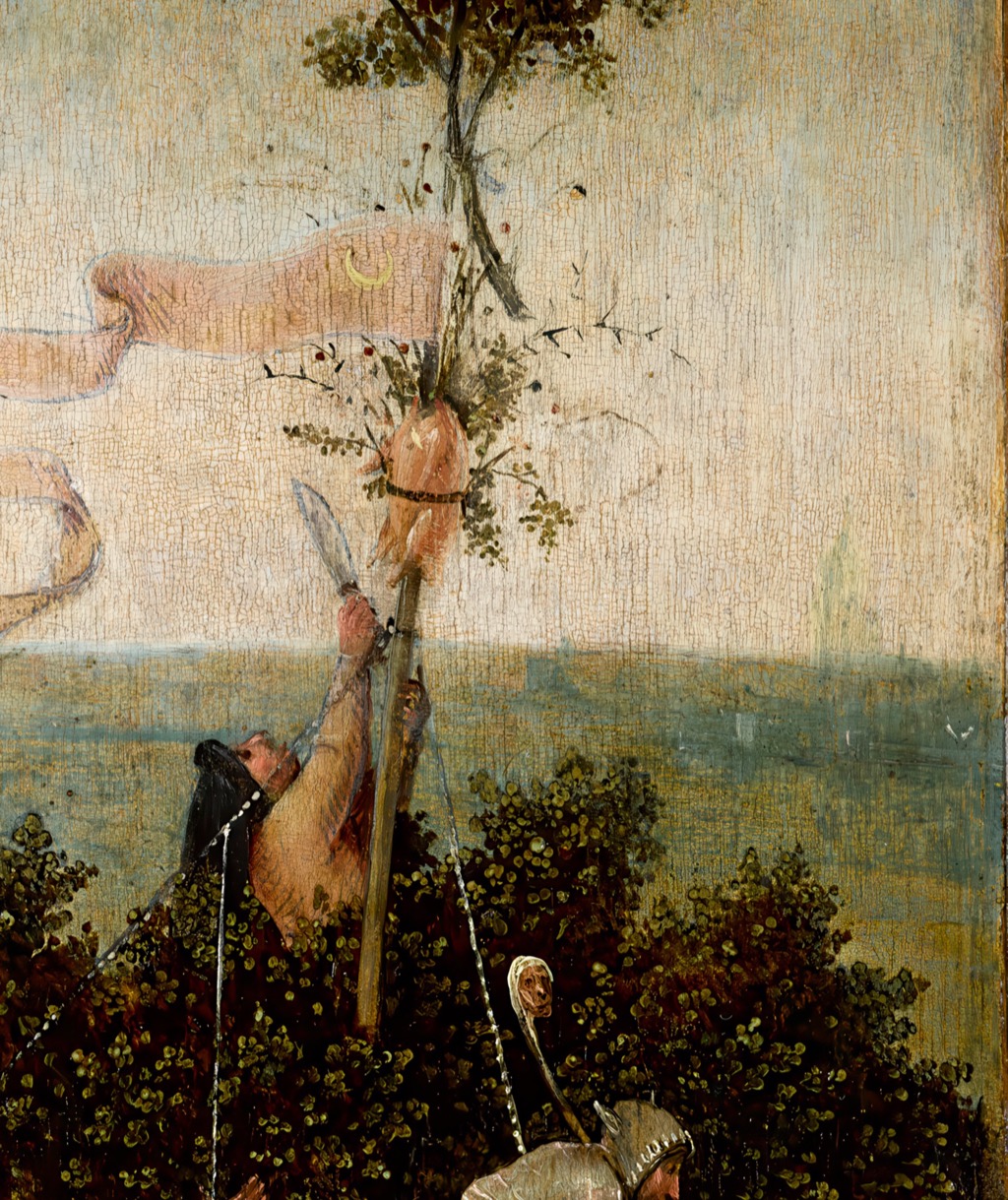
The climber and roasted bird
A man climbs the mast with a knife raised toward the food fastened above him, extending the passengers' appetite into the rigging.
The nun, friar and lute
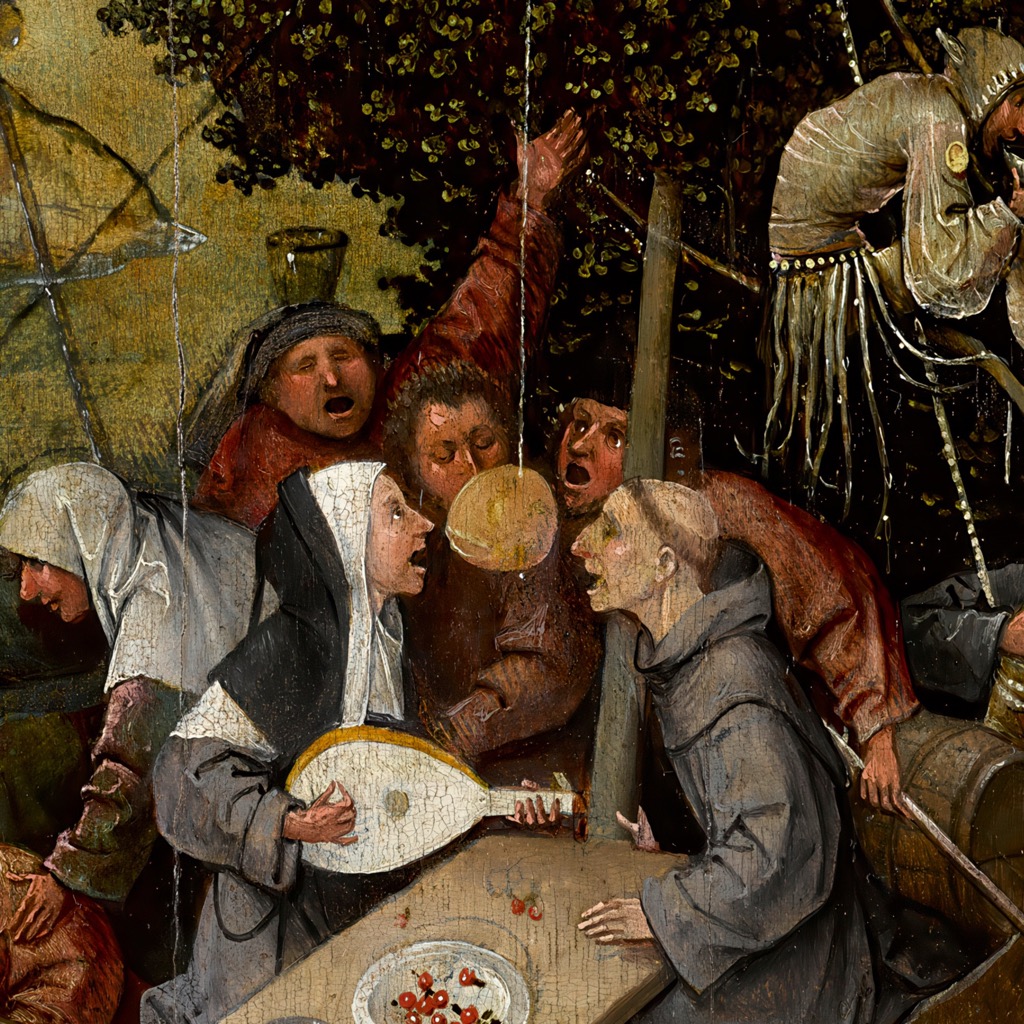
The nun and friar sing around a lute while food rests on the table, placing music, appetite and religious dress at the centre of the revelry.
The fool and the sick reveler
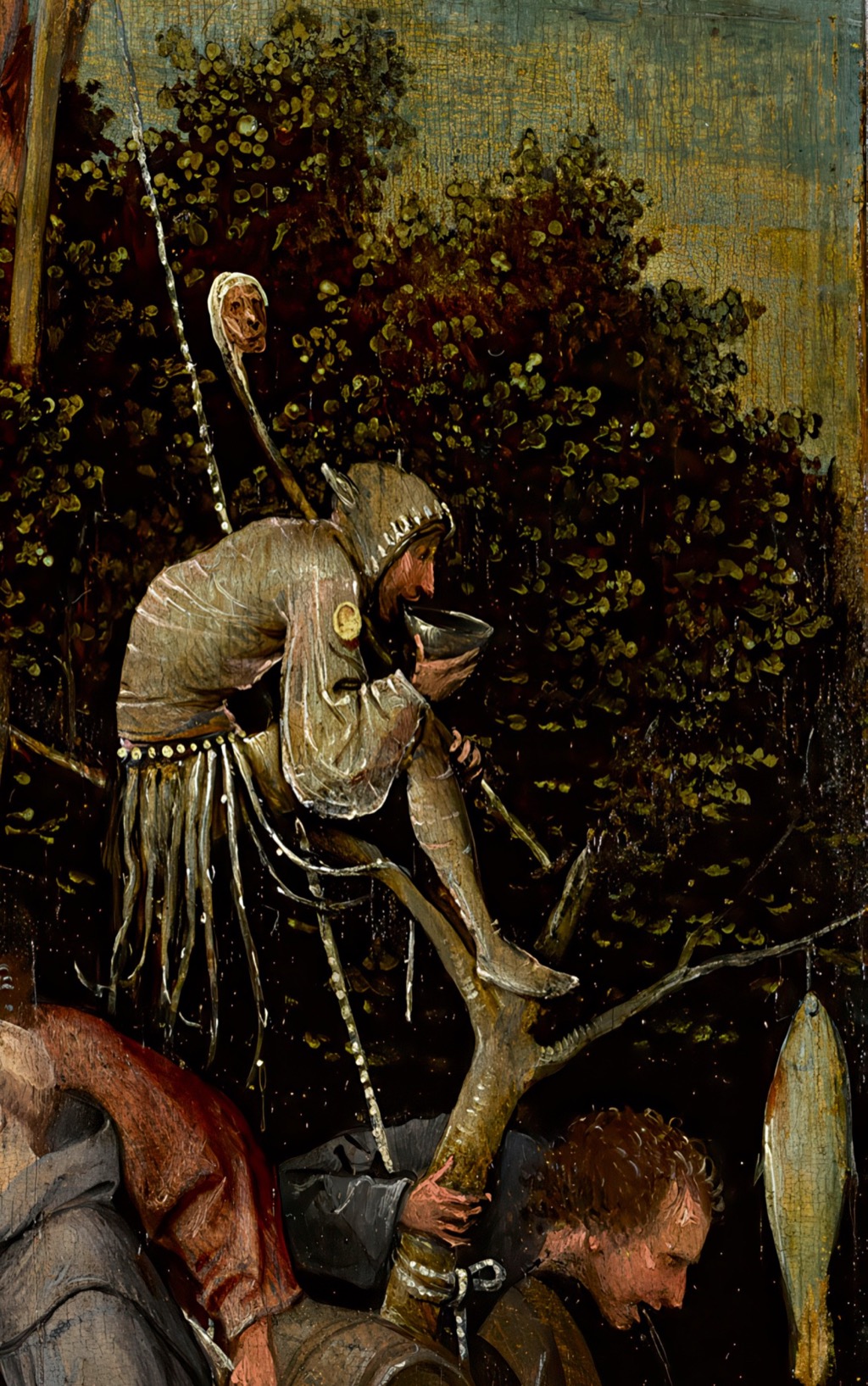
The fool drinks from his perch while another passenger bends over the gunwale, a compact pairing of excess and its physical consequence.
The flagon dragged through the water
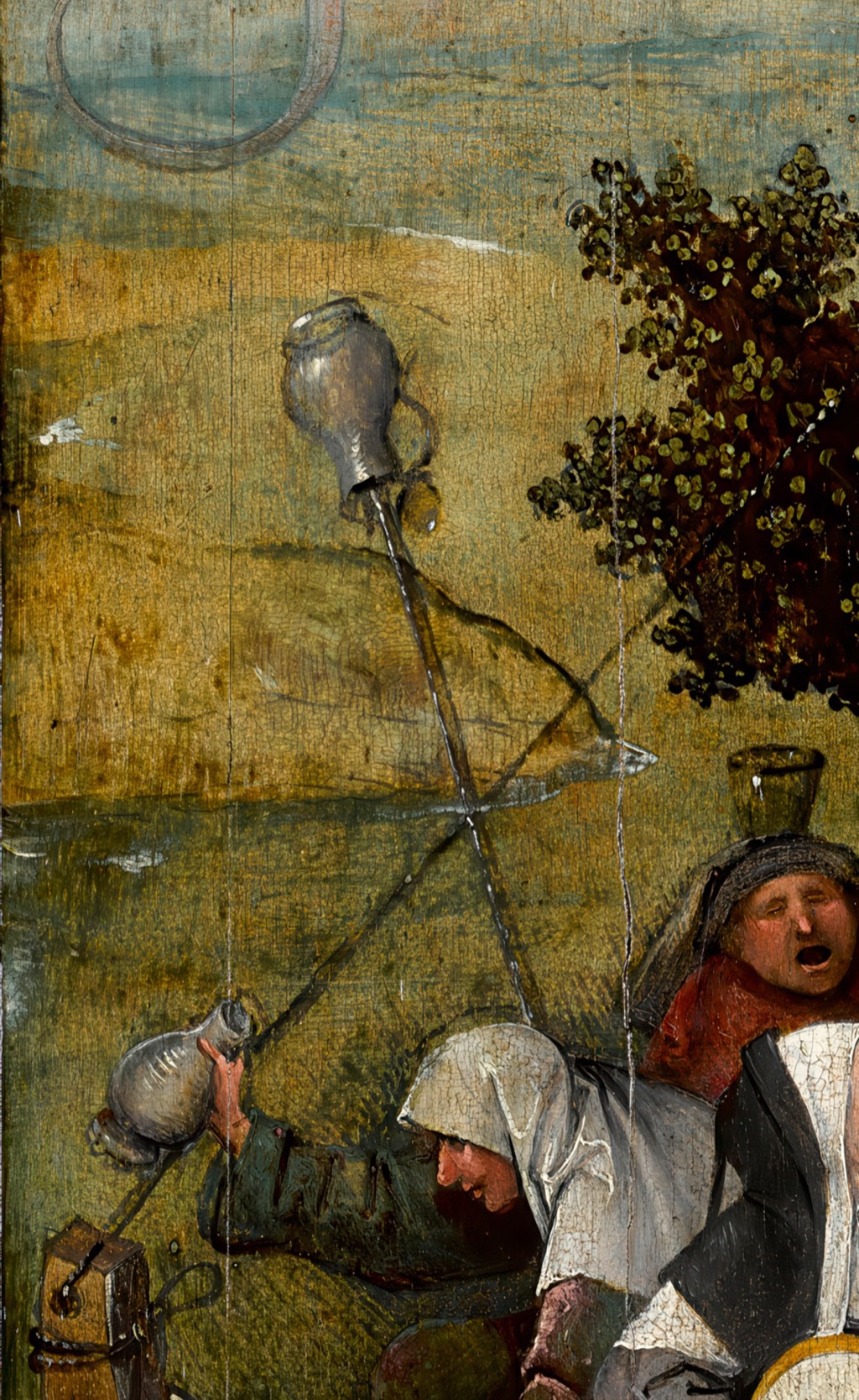
At the left edge, a passenger reaches toward a vessel trailing in the water as an improvised oar and other objects emphasize the boat's disorder.
The swimmers left behind
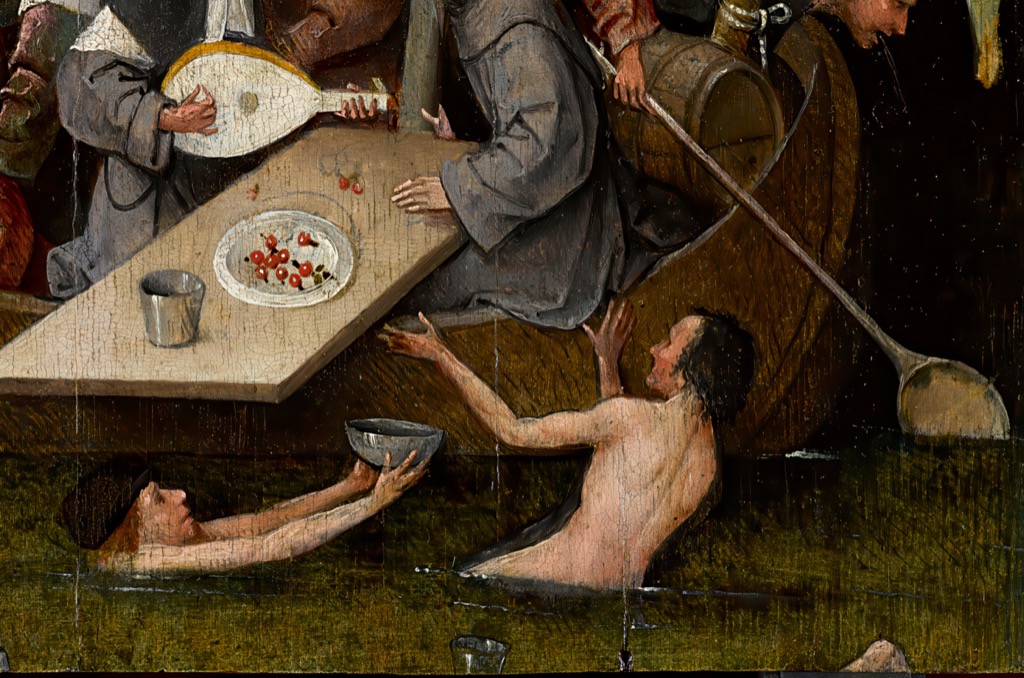
Two figures struggle in the water beside the crowded boat, reaching up toward passengers who remain absorbed in eating, drinking and song.
What Bosch Shows
The scene is cramped and comic before it is frightening. A group of figures crowd into a shallow boat. A nun and a monk sit near the centre, facing one another across a small table or makeshift meal. Their mouths open toward a hanging morsel, as if the simplest appetite has become a game. Other figures sing, drink and reach. A man sprawls partly over the side. A fool, identifiable by costume and marotte, sits in the vessel as both participant and emblem. The group is busy, noisy and socially mixed, yet almost nobody behaves as if the boat itself matters.
Bosch's vessel is not an heroic ship of pilgrimage or discovery. It has the look of something improvised, overloaded and absurdly unfit for purpose. The mast rises through the composition with foliage at its top, closer to a maypole or tavern sign than to a working mast. The boat drifts rather than travels. It creates a moral space where human beings have gathered without governance, direction or self-knowledge.
The food and drink are not incidental still-life details. They give the satire its bodily force. The figures' actions revolve around consumption: eating, drinking, singing, reaching, touching, leaning and competing for pleasures that are immediate but unstable. In Bosch's art, appetite is rarely only appetite. It can become a sign of misplaced love, failed discipline and spiritual inattention. For more on this broader pattern, see Bosch symbolism and iconography.
The monk and nun sharpen the image. Bosch is not simply mocking peasants or tavern drinkers. He places religious figures inside the disorder, joining the same game of mouths, music and food. Late medieval moral satire often criticised clergy who failed to live according to their calling, and Bosch's picture belongs to that tradition without needing to be reduced to a single anti-clerical slogan. The religious clothing matters because it turns common intemperance into a more pointed spiritual failure.
The fool also matters because he is both a person and a diagnosis. He does not merely add comic colour. He declares the moral condition of the whole boat. A company that eats, drinks and sings without steering is foolish even before it is damned. Bosch's satire exposes folly as a shared social state: the fool is not alone because the boat itself has become foolish.
A Boat Without Direction
The simplest way into the painting is to ask who is in control. The answer is nobody. The boat moves, but it does not appear to have a destination. Its passengers are animated by appetite, not navigation. Their little world is full of sound and motion, yet empty of guidance.
That is why the composition is more severe than it first appears. Bosch's comedy is never just comedy. The joke of the overloaded boat points toward a theological danger: a life carried along by pleasure without a saving course. The passengers are not shown committing one dramatic crime. They are shown wasting the very faculty that should distinguish them from beasts and fools: judgment.
The boat motif also makes folly communal. A single glutton can be dismissed as a weak person. A boat full of gluttons becomes a society. Everyone's disorder affects everyone else because all are trapped in the same unstable vessel. This is one reason the subject remained so powerful in late medieval and Renaissance culture. A ship can stand for a city, a Church, a human community or the whole world, depending on context. Bosch keeps that flexibility alive.
The presence of music intensifies the danger. Singing might normally mark celebration, courtship or worship. Here it helps drown out self-knowledge. The voices are open, the bodies are close, and sound joins food and drink as a sign of absorption in the present moment. Music in Bosch can be beautiful, comic or infernal; its meaning depends on setting. In this boat, it belongs to distraction.
The moral geography is therefore compact but complete. Water surrounds the revellers. The vessel lacks clear direction. Food and drink dominate the action. A fool sits within the company. Religious figures participate in the disorder. Bosch has compressed the whole problem of human conduct into a few square feet of oak.
Sebastian Brant and the Ship of Fools Tradition
The title Ship of Fools naturally brings Sebastian Brant's famous book into view. Brant's Narrenschiff, published in Basel in 1494, became one of the most influential works of late medieval moral satire. It presents folly as a voyage: fools sail together because each form of bad judgment, pride, greed or moral confusion places people on the wrong course.
The Louvre's Figures du Fou exhibition note connects Bosch's panel with Brant's tradition. It explains that when the panel was rediscovered in 1914, the title La Nef des fous was assigned because the iconography seemed closely related to Brant's 1494 work. The Louvre also stresses the wider popularity of the fool in print culture, including the familiar costume, donkey ears, bells and fool's staff, and the popularity of the motif of fools travelling by ship [2].
That connection is persuasive, but it should not be overstated. The Louvre collection record itself is careful: the painting can be related to Brant's text, but Brant's book need not have determined Bosch's representation [1]. The restoration press material goes further in cautioning that the panel is not a strict, direct illustration of Brant, even though the analogy is meaningful [6].
This distinction is important. Bosch and Brant belong to the same moral atmosphere, but Bosch's painting does not need to be a scene-by-scene translation of the book. The relationship is one of shared satire, shared imagery and shared anxiety about folly as spiritual failure. Brant helped give the ship of fools a powerful literary and printed form. Bosch gave the idea a concentrated pictorial life, rooted in his own world of triptychs, sin, appetite and judgment.
The date question also makes the relationship nuanced. If one follows the Louvre exhibition range around 1505-1515, the painting comes after Brant's book and after its rapid diffusion. If one follows the broader 1475-1500 range in the collection record, the work still falls close to the first publication and early reception of the motif. Either way, the safest claim is proximity rather than dependency.
Folly, Gluttony and Clerical Satire
The Louvre's alternate title, Satire de noceurs debauches, is useful because it keeps the subject close to the image. Bosch shows dissolute revellers, not an abstract concept. The people in the boat behave like a parody of a festive company. Their pleasure has slipped into absurdity. They do not feast in a stable hall but drift in a vessel that turns enjoyment into danger.
Gluttony is central, but not by itself. The boat company suggests a knot of appetites: food, drink, song, bodily closeness and indiscipline. The lower Yale fragment, associated with the same left wing, strengthens this reading. The Louvre record says the Yale fragment fits exactly beneath the Louvre panel, and restoration research connected details at the bottom of the Louvre painting with forms continuing into the Yale fragment [1] [7]. Together, the two fragments point toward intemperance rather than a polite meal.
The clerical figures make the satire sharper. A monk and nun should represent religious discipline, renunciation and ordered devotion. In the boat, they appear absorbed in the same game as the other revellers. Bosch does not need to add an explanatory inscription. The contrast between habit and behaviour is the argument.
The fool's presence then names what the religious figures and lay revellers have in common. Folly is not lack of intelligence. It is bad orientation. The people in the boat know how to sing, eat and play; they do not know how to live. Their problem is not absence of energy but misdirected energy.
This is one of Bosch's recurring moral devices. In The Haywain Triptych, the crowd follows a wagon of perishable hay toward Hell. In Death and the Miser, a dying man faces a final choice between gold and salvation. In The Pedlar / Wayfarer, a traveller moves through a world of temptation. The Ship of Fools belongs to the same family of images. It shows what life looks like when appetite becomes the captain.
A Fragment of a Dismantled Triptych
The painting's fragmentary state is not a side issue. It is central to the meaning now visible. The Louvre record says the panel has been cut at the right, left and bottom. It identifies the work as the upper fragment of the inner face of the left wing of a triptych whose central panel is lost [1]. The lower part of that left wing is the Yale fragment commonly associated with gluttony, drunkenness or lust. The inner face of the right wing is Death and the Miser in Washington [1].
The exterior adds another layer. According to the Louvre, the outer faces of the wings, painted in grisaille and later cut into an octagonal form after being split in thickness, are connected with the Rotterdam Colporteur, now generally known through titles such as The Pedlar or Wayfarer [1]. Museum Boijmans Van Beuningen's record for The Pedlar also states that technical research shows it originally covered the exterior of the wings of a triptych, and its public Q&A identifies the interior fragments as Ship of Fools, Yale's Allegory of Intemperance, and Death and the Miser, while noting that the centre panel is unknown [3].
This reconstruction is powerful, but it must be handled with care. The surviving pieces do not restore the original triptych completely. The centre panel is lost or unidentified. The exact original programme remains open. Still, the relationships among the fragments are strong enough to change the way Ship of Fools is read. It was not originally an isolated moral scene. It formed part of a hinged object about sin, temptation, human life and death.
The pairing with Death and the Miser is especially revealing. On one side, a boatload of gluttons and fools drifts through pleasure. On the other, a miser lies at the threshold of death, tempted by wealth while salvation remains available. These are not identical sins, but they belong to the same moral universe. One image shows life dissipated in appetite; the other shows the last reckoning of attachment.
The connection with the Wayfarer deepens the contrast. Closed, the triptych seems to have presented a traveller, a figure of human life on the road. Opened, it revealed interior scenes of vice and death. The same human being who journeys through the world must decide how to live within it. Bosch's moral art repeatedly returns to that idea: life is movement, but movement alone does not mean progress.
What Restoration Revealed
The 2014-2015 restoration and research campaign transformed modern understanding of Ship of Fools. The Louvre press release describes a twelve-month treatment at the Centre de recherche et de restauration des musees de France, or C2RMF, led in the paint layer by Agnes Malpel and carried out in consultation with the Bosch Research and Conservation Project [6]. The work involved reducing darkened varnish and removing later overpaint that had altered the painting's appearance and even its iconographic reading [6].
C2RMF's technical account is especially detailed. It states that the small wooden panel, 58 by 32.5 cm in its measurement, had been sawn both in thickness and at its lower part, and that it belonged to a triptych whose other identified elements include the Yale lower fragment, the Rotterdam Vagabond or Wayfarer, and Washington's Death and the Miser [7]. Scientific study included imaging, X-ray fluorescence analysis, XRF mapping and stratigraphic sections from micro-samples [7].
One of the major findings concerned later repainting. C2RMF reports that the work had been covered with darkened surface layers and overpaint that gave it an aged, brown-black appearance and masked parts of the original image [7]. The restoration revealed a lighter, colder landscape, a clearer horizon and details that had been hidden or misunderstood. At the bottom edge of the Louvre fragment, cleaning brought back elements connected with the Yale fragment below: the top of a funnel-shaped head covering, a branch, a floating glass and part of a swimmer's foot [6].
The mast and horizon were also affected by later changes. The Louvre press material explains that extra foliage added around the mast and a brown hill at the right of the horizon were removed after analysis showed them to be later overpaint [6]. C2RMF's account says the overpaint had enlarged the tree-like mast and substantially modified the horizon, including masking traces of a distant city [7].
These discoveries matter because they show how physical history can shape interpretation. A viewer before the restoration saw a darker, more autonomous-looking image. After cleaning, the painting's connection to the Yale fragment and larger triptych became easier to see. Conservation did not solve every art-historical question, but it restored evidence that had been literally covered.
The restoration also brought the underdrawing into sharper discussion. C2RMF reports that infrared reflectography revealed a clear underlying drawing, possibly made in two stages, and showed differences between preparatory drawing and final composition [7]. The fool's form, the foliage, the horizon and other details became part of a renewed technical conversation about Bosch's working method and the relationship between the painting and a related drawing in the Louvre's graphic arts collection [6].
For more on this material side of Bosch, see Bosch style and technique and Bosch workshop and attribution. Ship of Fools is a perfect case study because the painting's modern meaning depends on both iconography and conservation: fools, monks, food and drink on the surface; sawn oak, hidden underdrawing and removed overpaint beneath it.
The Missing Centre and the Limits of Reconstruction
The lost centre panel is the great absence in the story. Several surviving fragments can be placed in meaningful relationship, but the central image that would have governed the full triptych is not known. This absence should make interpretation more careful, not weaker.
The Louvre describes the original central panel as lost [1]. Boijmans says the centre is unknown and adds that it was highly likely to have had a religious theme [3]. That is a useful possibility, but it is not the same as knowing the subject. Any reconstruction of the full work must leave room for uncertainty.
What can be said with more confidence is that the surviving fragments create a moral pattern. The left interior wing, with the Louvre and Yale fragments, concerns gluttony, drunkenness, lust or intemperance. The right interior wing, Death and the Miser, concerns avarice, death and the last decision of the soul. The exterior wayfarer presents human life as a journey through temptation. Together, those elements point toward a triptych about sin and the condition of humanity.
The Louvre restoration press note proposes that the set was devoted to the capital sins, while also noting that the panel had been detached from that context and later understood as a Ship of Fools by analogy with Brant's celebrated satire [6]. That formulation is valuable because it holds two truths together. The title Ship of Fools remains meaningful, but the painting's original subject may have been more specifically gluttony or intemperance within a wider programme of sin.
The result is not a debunking of the famous title. It is a refinement. The painting can still be called The Ship of Fools because that is how it entered modern understanding and how the Louvre presents it. But a fuller reading recognises that the boat of fools may be one part of a larger moral architecture. Bosch's revellers are foolish not only because they resemble Brant's voyagers, but because they enact a deadly form of appetite inside a triptych about human choice.
The Ship of Fools and Bosch's Wider Moral World
Bosch returned again and again to people who move wrongly. The crowd in The Haywain follows hay toward Hell. The wayfarer travels with baggage through a dangerous landscape. The miser hesitates between gold and salvation as Death enters the room. The revellers in Ship of Fools drift without direction. These images do not tell the same story, but they share a moral grammar.
That grammar is one of motion and misdirection. Human beings are always going somewhere: along roads, across bridges, behind wagons, toward death, into boats. The question is whether movement is guided by wisdom. In Ship of Fools, the answer is painfully visible. The boat moves, but nobody governs it.
The work also belongs to Bosch's tradition of making sin look ridiculous before it becomes terrifying. The scene is funny: the open mouths, the crowded vessel, the fool's gear, the absurd mast, the social discomfort of clerics behaving badly. But the laughter catches. The joke is not safely outside the viewer. Folly is communal, attractive and recognisable. The painting asks whether a whole society can be merry and lost at the same time.
This is why the work remains one of Bosch's most accessible moral satires. It does not require the vast infernal architecture of the Garden or the apocalyptic scale of The Last Judgement. It uses a small boat. That smallness makes the warning sharper. A few people, a little food, a song, a drink, a fool, a monk and a nun are enough to make the world go wrong.
The painting also helps explain Bosch's place between late medieval moral culture and early modern visual invention. Brant's printed satire, fool imagery, proverb culture, clerical criticism, devotional triptychs and technical panel painting all meet in one object. Bosch did not invent moral satire, fools or allegorical ships from nothing. His genius was to compress inherited themes into images that feel at once historical and unnervingly alive.
Why the Painting Still Matters
Ship of Fools matters because it teaches viewers how Bosch thinks. He does not simply display vice. He gives vice a structure. A boat without direction becomes an image of life without judgment. Food and drink become signs of appetite that has forgotten discipline. Music becomes noise that covers spiritual danger. Religious costume becomes a measure of hypocrisy. The fool becomes both character and verdict.
The painting also matters because modern research has restored its complexity. The Louvre record, the Figures du Fou exhibition, C2RMF's technical account, the restoration press material, and the related records for The Pedlar and Death and the Miser all show that this is not a simple standalone picture. It is a surviving fragment with a long history of cutting, splitting, repainting, rediscovery, retitling, restoration and interpretation.
That history makes the work more moving. The original triptych is damaged and dispersed. The centre is missing. The Louvre fragment was darkened and altered before restoration. Yet the image still speaks with extraordinary clarity. A boat full of people sings and eats while drifting nowhere. Bosch makes the scene comic enough to invite looking and serious enough to make looking uncomfortable.
In the end, the power of Ship of Fools lies in its refusal to separate folly from ordinary pleasure. The passengers are not spectacular monsters. They are recognisable people in a recognisable social mess. They want food, drink, music, company and amusement. Their danger is not that they enjoy things, but that enjoyment has replaced direction.
Bosch's little boat therefore belongs with the largest questions in his art. What does a person follow? What does a society gather around? What happens when appetite governs the journey? And when the vessel has no rudder, who notices before the water closes in?
Artworks and related attributions
Browse paintings, drawings and related attributions. Records group triptychs, fragments and two-sided sheets where appropriate. Dates follow the cited museum records or catalogue headings and are generally estimates. Rows marked “2016 catalogue” report that publication’s attribution and collection information; these are dated opinions, rather than a claim that every work is an accepted autograph Bosch.
| Name | Date | Medium, attribution and collection |
|---|---|---|
| A Crossbowman | Second half of the sixteenth century | Oil on oak panel · Copy after Hieronymus Bosch · Museo Nacional del Prado, Madrid · P002695 Source 1. Source 2. |
| A Woman Spinning and an Old Woman | Museum estimates: about 1480–1490 for the women and 1500–1505 for the reverse; the precise chronology is disputed | Pen and brown and grey ink on the front; pen and brown ink on the reverse · Hieronymus Bosch · Museum Boijmans Van Beuningen, Rotterdam · N 190 recto and verso (PK) Source 1. Source 2. |
| Adoration of the Child in Cologne | Second half of the sixteenth century | Oil on oak panel · Imitator of Hieronymus Bosch, in the city collection record · Wallraf-Richartz-Museum & Fondation Corboud, Cologne · WRM 0474 Source 1. Source 2. |
| Adoration of the Magi in Philadelphia | Early sixteenth century in the museum record; around 1495–1520 in the BRCP catalogue | Oil on oak panel · Hieronymus Bosch in the museum record; workshop of Bosch in the 2016 BRCP catalogue · Philadelphia Museum of Art, John G. Johnson Collection, 1917 · 1321; museum object 103592 Source 1. Source 2. |
| Adoration of the Magi — New York | c.1470–1480 | 2016 catalogue: Bosch; oil on oak · Metropolitan Museum 13.26 2016 catalogue. |
| Adoration of the Magi — Prado triptych | c.1494 | Oil on oak; grisaille exterior · Bosch · Prado P002048 Object source. |
| Adoration of the Magi — three associated fragments | c.1515–1535 | 2016 catalogue: Follower of Bosch · Two Shepherds / Retinue in Philadelphia; associated Adoration in private collection in 2016 2016 catalogue. |
| Ascent of the Blessed — Venice | c.1505–1515 | Oil on panel · Bosch · Gallerie dell’Accademia; Visions of the Hereafter Object source. |
| Battle of the Birds and Mammals | Not specified in catalogue heading | 2016 catalogue: Bosch; pen and brown ink · Berlin KdZ 14715 2016 catalogue. |
| Beggars and Musicians | Around 1530–1540 | Ink and wash on paper · Unknown follower of Hieronymus Bosch · Albertina, Vienna · 7798 Source 1. Source 2. |
| Christ Carrying the Cross Drawing | Around 1470 in the museum catalogue | Black chalk or charcoal, pen and brush in brown ink, white corrections · Anonymous, workshop of Rogier van der Weyden · Museum Boijmans Van Beuningen, Rotterdam · N 81 recto and verso (PK) Source 1. Source 2. |
| Christ Carrying the Cross in Vienna | Around 1490–1510 in the current KHM record and BRCP catalogue | Oil on oak, painted on both sides · Hieronymus Bosch; possible workshop involvement in the Passion side discussed by the BRCP · Kunsthistorisches Museum, Vienna · Gemäldegalerie, GG 6429 Source 1. Source 2. |
| Christ Carrying the Cross — El Escorial | c.1495–1505 | 2016 catalogue: Bosch; oil on oak · Patrimonio Nacional 10014739 2016 catalogue. |
| Christ Carrying the Cross — Ghent | c.1510–1516 (museum) | Oil on panel · Bosch in museum listing; authorship disputed · MSK Ghent 1902-H Object source. |
| Christ Mocked — London | c.1510 | Oil on wood · Bosch · National Gallery NG4744 Object source. |
| Concert in the Egg, After Hieronymus Bosch | Around 1561; third quarter of the sixteenth century | Oil on canvas · Anonymous, after Hieronymus Bosch · Palais des Beaux-Arts, Lille · P 816 Source 1. Source 2. |
| Conjurer / Comical Concert — Louvre drawing | Not specified in catalogue heading | 2016 catalogue: Bosch (recto), follower (concert verso) · Pen and brown ink · Louvre INV 19197 2016 catalogue. |
| Conjurer / Cross-bearing and beggars — Liège sheet | Not specified in catalogue heading | 2016 catalogue: Bosch (verso), follower (recto) · Pen and brown ink · Album d’Arenberg 534 2016 catalogue. |
| Crowning with Thorns — El Escorial | c.1530–1540 | 2016 catalogue: Follower of Bosch; oil on oak · Patrimonio Nacional 10014743 2016 catalogue. |
| Crucifixion with a Donor | Circa 1495–1505; Circa 1490–1500 | Oil on oak panel · Hieronymus Bosch · Royal Museums of Fine Arts of Belgium, Brussels · 6639 Source 1. Source 2. |
| Death and the Miser Drawing | Not securely established; probably made after the painting | Pen and brush, dark ink and white highlights on prepared paper · Workshop of Hieronymus Bosch in the BRCP catalogue; alternatives recorded by the Louvre · Musée du Louvre, Department of Prints and Drawings, Paris · RF 6947, Recto Source 1. Source 2. |
| Death and the Miser — Washington | c.1485/1490 (NGA) | Oil on panel · Bosch · National Gallery of Art 1952.5.33 Object source. |
| Ecce Homo Triptych — Boston | c.1495–1500; wings c.1500/1503 | 2016 catalogue: Workshop of Bosch; oil on oak · Museum of Fine Arts Boston; several production phases 2016 catalogue. |
| Ecce Homo — Frankfurt | c.1490 | Mixed technique on oak · Bosch · Städel 1577 Object source. |
| Fall of the Damned — Venice | c.1505–1515 | 2016 catalogue: Bosch; oil on panel · Visions of the Hereafter · Venice 2016 catalogue. |
| Garden of Earthly Delights | 1490–1500 (Prado) | Oil on oak; grisaille exterior · Bosch · Prado; triptych Object source. |
| Gluttony and Lust / Allegory of Intemperance — Yale fragment | c.1500–1510 (group dating) | 2016 catalogue: Bosch; oil on oak · Yale 1959.15.22; fragment associated with Ship of Fools 2016 catalogue. |
| Group of Ten Spectators, a Follower of Bosch | Around 1510–1540 in the current museum record | Pen and two brown inks on paper, with a brown framing line · Follower of Hieronymus Bosch in the Morgan record; Bosch in the BRCP catalogue · Morgan Library & Museum, New York · I, 112 Source 1. Source 2. |
| Head of an Old Woman | About 1500 | Oil on panel · Attributed to Jacob Cornelisz. van Oostsanen · Museum Boijmans Van Beuningen, Rotterdam · 2439 (OK) Source 1. Source 2. |
| Hell and the Flood — Rotterdam panels | Around 1515 in the museum records; around 1510–1520 in the BRCP catalogue | Oil on oak panels · Jheronimus Bosch in the museum records; workshop of Bosch in the BRCP catalogue · Museum Boijmans Van Beuningen, Rotterdam Source 1. Source 2. |
| Hermit Saints Triptych | Circa 1495–1505 | Oil on oak panels · Hieronymus Bosch · Gallerie dell’Accademia, Venice · 2044 Source 1. Source 2. |
| Infernal Landscape | Not specified in catalogue heading | 2016 catalogue: Bosch; pen and brown ink, red accent · Private collection in 2016 2016 catalogue. |
| Infernal Scene with Anvil / Monster Studies | Not specified in catalogue heading | 2016 catalogue: Bosch; attribution debated in entry · Pen and brown ink · Berlin KdZ 548 2016 catalogue. |
| Infernal Scene with Tree-Man / Standing Man | Not specified in catalogue heading | 2016 catalogue: Workshop of Bosch; pen and brown ink · Dresden C 1875; historical reverse title includes a proposed prophet 2016 catalogue. |
| Job Triptych — Bruges | c.1510–1520 | 2016 catalogue: Workshop of Bosch; oil on oak · Groeningemuseum / Hoeke loan in 2016 2016 catalogue. |
| Last Judgement — Bruges triptych | c.1495–1505 | 2016 catalogue: Bosch; oil on oak · Groeningemuseum 2016 catalogue. |
| Last Judgement — Munich fragment | c.1530–1540 | 2016 catalogue: Follower of Bosch; oil on oak · Alte Pinakothek 5752 2016 catalogue. |
| Last Judgement — Vienna triptych | c.1500–1505 (BRCP 2016) | Oil on oak · Bosch and workshop (BRCP 2016) · Academy of Fine Arts Vienna 2016 catalogue. |
| Man in a Basket and Comic Figures | Around 1500–1515 in the museum record | Pen and brown ink on paper; the reverse is catalogued as iron-gall ink · Hieronymus Bosch in the current Albertina record; attribution has been debated · Albertina, Vienna · 7797 recto and verso Source 1. Source 2. |
| Man Seen from Behind | About 1550–1569; About 1565–1570 | Traces of black chalk, pen and brush in light brown ink · Anonymous, circle of Pieter Bruegel the Elder · Museum Boijmans Van Beuningen, Rotterdam Source 1. Source 2. |
| Mary and John at the Foot of the Cross | About 1440 | Brush in grey and black · Unknown, possibly Netherlandish · Kupferstich-Kabinett, Staatliche Kunstsammlungen Dresden · C 815 Source 1. Source 2. |
| Model Sheet with ‘Witches’ | Disputed; proposals depend on the attribution | Pen and brown ink; the BRCP also records underlying black chalk · Hieronymus Bosch; follower attributions also recorded · Musée du Louvre, Département des Arts graphiques, Paris · INV 19721 recto Source 1. Source 2. |
| Peasant and Three Bust-Length Figures | 1401–1500 | Brown pen over a black preliminary drawing · Attributed to the Master of the Drapery Studies; Bosch circle also recorded · Kupferstichkabinett, Staatliche Museen zu Berlin · KdZ 777 Source 1. Source 2. |
| River to Hell — Venice | c.1505–1515 | 2016 catalogue: Bosch; oil on panel · Visions of the Hereafter · Venice 2016 catalogue. |
| Saint Anthony and a Concert in an Egg | Around 1510–1525 in the museum’s 2016–17 exhibition texts | Pen in light and dark brown inks · Workshop of Hieronymus Bosch; underlying monsters: Bosch (BRCP), possibly Bosch (exhibition text) · Kupferstichkabinett, Staatliche Museen zu Berlin · KdZ 711 recto and verso Source 1. Source 2. |
| Saint Christopher Carrying the Christ Child | c.1500; 1490–1505 in restoration material | Oil on panel · Bosch · Boijmans St 26 Object source. |
| Saint James and Hermogenes | About 1551–1575 in the KIK-IRPA catalogue | Oil on wood, painted on both sides · Anonymous follower of Hieronymus Bosch · Musée des Beaux-Arts, Valenciennes · P.46.1.44; older number 176 Source 1. Source 2. |
| Saint Jerome at Prayer | Circa 1485–1495 | Oil on oak panel · Hieronymus Bosch · Museum of Fine Arts, Ghent · 1908-H Source 1. Source 2. |
| Saint John on Patmos / Passion Scenes | c.1495–1505; estimates vary | Oil on oak · Bosch · Gemäldegalerie Berlin 1647A Object source. |
| Saint John the Baptist in Meditation | Late 15th century; c.1485–1510 (Prado exhibition) | Oil on panel · Bosch · Lázaro Galdiano 8155 Object source. |
| Saint Liberata Triptych | Circa 1495–1505 | Oil on oak panels · Hieronymus Bosch · Gallerie dell’Accademia, Venice · 2045 Source 1. Source 2. |
| Seven Deadly Sins and the Four Last Things | 1505–1510 (Prado) | Oil on poplar · Bosch (Prado); workshop/follower disputed · Prado Object source. |
| Ship of Fools — Louvre painting | 1475–1500 (record); c.1505–1515 (exhibition) | Oil on oak · Bosch · Louvre RF 2218; fragment Object source. |
| Ship of Fools — Louvre workshop drawing | Not specified in catalogue heading | 2016 catalogue: Workshop of Bosch · Pen, brush, grey-brown ink and white highlights on prepared paper · Louvre RF 3714 2016 catalogue. |
| Studies of Monsters | About 1530–1550, according to the current Ashmolean record | Pen and brown ink on laid paper, both faces · Anonymous follower of Hieronymus Bosch · Ashmolean Museum, University of Oxford · WA1863.155 Source 1. Source 2. |
| Studies of Saint Anthony and Monsters | No execution date specified in the current Louvre records | Pen and brown ink on paper · Bosch listed; reverse questioned by Louvre; BRCP accepts both faces · Musée du Louvre, Département des Arts graphiques, Paris · INV 20871 recto and verso Source 1. Source 2. |
| Temptation of Saint Anthony — Kansas City fragment | c.1500–1510 | 2016 catalogue: Bosch; oil on oak · Nelson-Atkins 35–22 2016 catalogue. |
| Temptation of Saint Anthony — Lisbon triptych | c.1500 | Oil on oak · Bosch · Museu Nacional de Arte Antiga 1498 Pint Museum. |
| Temptation of Saint Anthony — Prado panel | c.1530–1540 | 2016 catalogue: Follower of Bosch (2016 opinion); oil on oak · Prado P002049 2016 catalogue. |
| Terrestrial Paradise | Approximately 1505–1515 | Oil on oak panel · Hieronymus Bosch · Gallerie dell'Accademia, Venice Source 1. Source 2. |
| The Burning Ship Drawing | 1500–1520 | Pen and iron gall ink on paper · Attributed to Hieronymus Bosch · Academy of Fine Arts Vienna, Graphic Collection · HZ-2554; numbered 2554 in the BRCP catalogue Source 1. Source 2. |
| The Comical Barber Scene | About 1550–1580, according to the British Museum | Pen and brown ink, grey and brown wash, over black chalk · Anonymous follower, after Hieronymus Bosch · British Museum, Department of Prints and Drawings, London · 1854,0628.46 Source 1. Source 2. |
| The Conjuror, After Hieronymus Bosch | Probably after 1525; around 1530–1540 in the BRCP technical report | Oil on oak panel · Anonymous follower of Hieronymus Bosch · Musée Ducastel-Vera, Saint-Germain-en-Laye · 872.1.87 Source 1. Source 2. |
| The Cure of Folly / Extraction of the Stone of Madness | 1501–1505 (Prado) | Oil on oak · Bosch (Prado); workshop/follower disputed · Prado P002056 Object source. |
| The Entombment Drawing | About 1505–1515, current museum record | Brush and black and grey ink, with grey wash, over black chalk · Workshop of Hieronymus Bosch; drawn by the Master of the Prado Haywain Triptych; Hieronymus Bosch, argued by the BRCP in 2016 · British Museum, Department of Prints and Drawings, London · 1952,0405.9 Source 1. Source 2. |
| The Gathering of the Birds | Not specified in catalogue heading | 2016 catalogue: Bosch; pen and brown ink · Berlin KdZ 13136 2016 catalogue. |
| The Haywain — Prado triptych | 1510–1516 (BRCP 2016) | Oil on oak · Bosch (BRCP 2016) · Prado; separate Escorial version exists 2016 catalogue. |
| The Hearing Forest and the Seeing Field | Circa 1500–1505 | Pen and brown ink on paper · Hieronymus Bosch; reverse: Bosch and workshop · Kupferstichkabinett, Staatliche Museen zu Berlin · KdZ 549, front and reverse Source 1. Source 2. |
| The Owl’s Nest — Rotterdam | Not specified in catalogue heading | 2016 catalogue: Bosch; pen and brown ink · Boijmans N 175 2016 catalogue. |
| The Passion Triptych in Valencia | Workshop of Bosch, about 1510–1520; Follower of Bosch; centre about 1530–1540, wings about 1540–1550 | Oil and gold on oak panels · Workshop of Bosch, about 1510–1520; Follower of Bosch; centre about 1530–1540, wings about 1540–1550 · Museu de Belles Arts de València Source 1. Source 2. |
| The Pedlar / Wayfarer — Rotterdam | c.1500 (museum) | Oil on panel · Bosch · Boijmans 1079 (OK); rejoined exterior Object source. |
| The Tree-Man — Vienna drawing | c.1505 | Pen and brown ink · Bosch · Albertina, Vienna Object source. |
| The Wedding at Cana, After Hieronymus Bosch | Approximately 1560 in the current museum record | Oil on panel, 93 cm high × 72 cm wide · Anonymous, after Hieronymus Bosch · Museum Boijmans Van Beuningen, Rotterdam, St 25 Source 1. Source 2. |
| Two Fantastical Creatures — Berlin KdZ 550 | Around 1505–1515 in the museum’s 2016 exhibition text | Pen in brown ink on reddish prepared laid paper · Hieronymus Bosch · Kupferstichkabinett, Staatliche Museen zu Berlin · KdZ 550, recto and verso Source 1. Source 2. |
| Two Figures Wearing Mitres | About 1480 | Oil on panel · Anonymous (Boijmans); Bosch circle (RKD) · Museum Boijmans Van Beuningen, Rotterdam · 1177 (OK) Source 1. Source 2. |
| Two Men and the Temptation of Eve | About 1505–1515 in the Prado’s 2016 exhibition guide | Pen and grey-brown ink on paper · Hieronymus Bosch in the 2016 catalogues discussed here · Private collection, as recorded in 2016 Source 1. Source 2. |
| Two Men Fighting | Not specified in the current Louvre record | Pen and brown ink · In the manner of Hieronymus Bosch · Musée du Louvre, Département des Arts graphiques, Paris · INV 20660 recto; formerly NIII 8896 and MA 8400 Source 1. Source 2. |
| Two Men — Berlin KdZ 5210 | Not specified in catalogue heading | 2016 catalogue: Bosch questioned · Pen, brush, ink, chalk and white highlights · Berlin KdZ 5210; historical title Two Oriental Men 2016 catalogue. |
| Two Monsters — Berlin KdZ 547 | Approximately 1500–1510 in Berlin's 2016 exhibition catalogue; an estimated range | Pen and brown ink on paper · Hieronymus Bosch · Kupferstichkabinett, Staatliche Museen zu Berlin · KdZ 547, drawn on both sides Source 1. Source 2. |
Frequently Asked Questions
It belongs to the Musée du Louvre, Paris, inventory RF 2218, under the title La Nef des fous.[1]
The panel is a fragment from a dismantled triptych. Its surviving boundaries should not be treated as an intact original composition.[1]
The Louvre records oil on oak, 58 × 33 cm. The narrow surviving format concentrates the unstable gathering inside the boat.[1]
Discussion
Compare the boat’s unstable gathering with the evidence for a dismantled larger work.
Reader Insights
How do the figures’ gestures make the boat seem directionless?
What does the makeshift mast contribute to the gathering?
How does knowing that the painting is a fragment change your view of its boundaries?
Join the Conversation
Share a detail, comparison or question about Ship of Fools below.
References
- Musee du Louvre, La Nef des fous, RF 2218: View source
- Musee du Louvre, La Nef des fous, Figures du Fou exhibition feature: View source
- Museum Boijmans Van Beuningen, The Pedlar: View source
- BRCP Catalogue Raisonné (2016), object dates in catalogues 1, 2, 8, 15 and 20; catalogue 20 object metadata only for the Haywain comparison. View source
- Staatliche Museen zu Berlin, 2016 exhibition wall texts, p. 3: approximate date of KdZ 549. View source
- Musee du Louvre press release, La Nef des fous de Jerome Bosch restauree, 26 November 2015: View source
- Centre de recherche et de restauration des musees de France, Recherche et Restauration: La Nef des Fous, 1 December 2015: View source
- National Gallery of Art, Washington, Death and the Miser: View source
- Matthijs Ilsink, Jos Koldeweij, Ron Spronk, Luuk Hoogstede, Robert G. Erdmann, Rik Klein Gotink, Hanneke Nap and Daan Veldhuizen, Hieronymus Bosch, Painter and Draughtsman: Catalogue Raisonne, Yale University Press, 2016: View source