by Tom Gurney
Tom Gurney BSc (Hons) is an art history expert with over 20 years experience
Published on June 19, 2020 / Updated on November 4, 2026
Email: tomgurney1@gmail.com / Phone: +44 7429 011000
A woman looks towards the right in a narrow painted panel. Her white headcloth fills much of the left side, while her nose, lips and chin form an emphatic profile against a dark background. Only a small part of her upper body is visible. The picture asks us to attend to one face, its direction and its enclosure in pale cloth.
Museum Boijmans Van Beuningen currently attributes Head of an Old Woman to Jacob Cornelisz. van Oostsanen and dates it to about 1500. Its Dutch catalogue lists Bosch and Pieter Bruegel the Elder as former attributions.[1] The painting's appearance in older Bosch reproductions reflects that history, rather than a securely accepted place in Bosch's present oeuvre.
At a Glance
- TitleHead of an Old Woman
- Current attributionAttributed to Jacob Cornelisz. van Oostsanen
- Museum dateAbout 1500
- Former attributionsHieronymus Bosch; Pieter Bruegel the Elder
- MediumOil on panel
- Dimensions13 × 5 cm
- CollectionMuseum Boijmans Van Beuningen, Rotterdam
- Inventory2439 (OK)
- AcquisitionWith the D. G. van Beuningen collection, 1958
Compare these works across Bosch’s career
These date ranges are estimates, not a documented year-by-year sequence. These works provide context for the article; none is highlighted as the object discussed here.
Saint Jerome at Prayer
Circa 1485–1495 [2]Crucifixion with a Donor
Circa 1490–1500 (BRCP) [2]Hermit Saints Triptych
Circa 1495–1505 [2]Saint Liberata Triptych
Circa 1495–1505 [2]The Hearing Forest and the Seeing Field
Circa 1500–1505 (Berlin exhibition) [3]The Haywain Triptych
1510–1516 (BRCP) [2]Contents
Annotated Details from Head of an Old Woman: Rotterdam Fragment
The narrow panel fragment contains a woman in profile beneath pale folded cloth. Its present attribution to Jacob Cornelisz. van Oostsanen is discussed in the article.
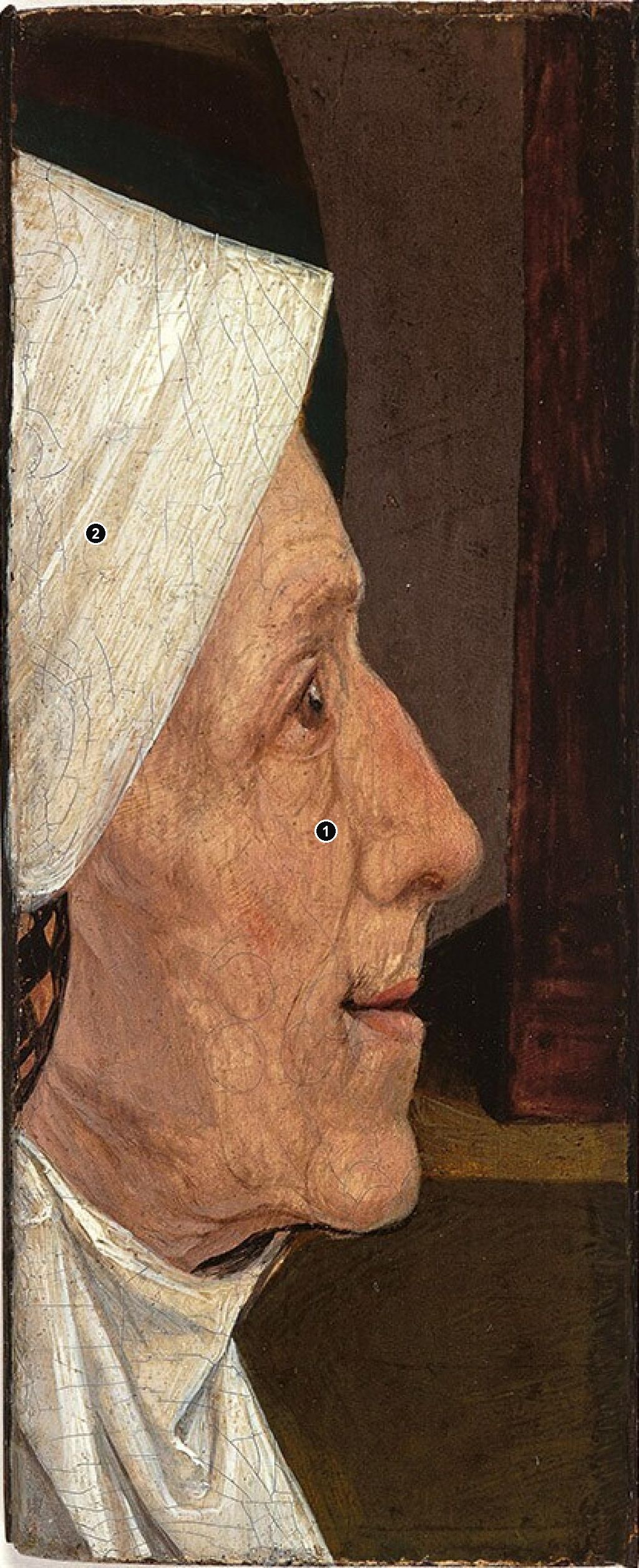
Details from HEAD OF AN OLD WOMAN: ROTTERDAM FRAGMENT
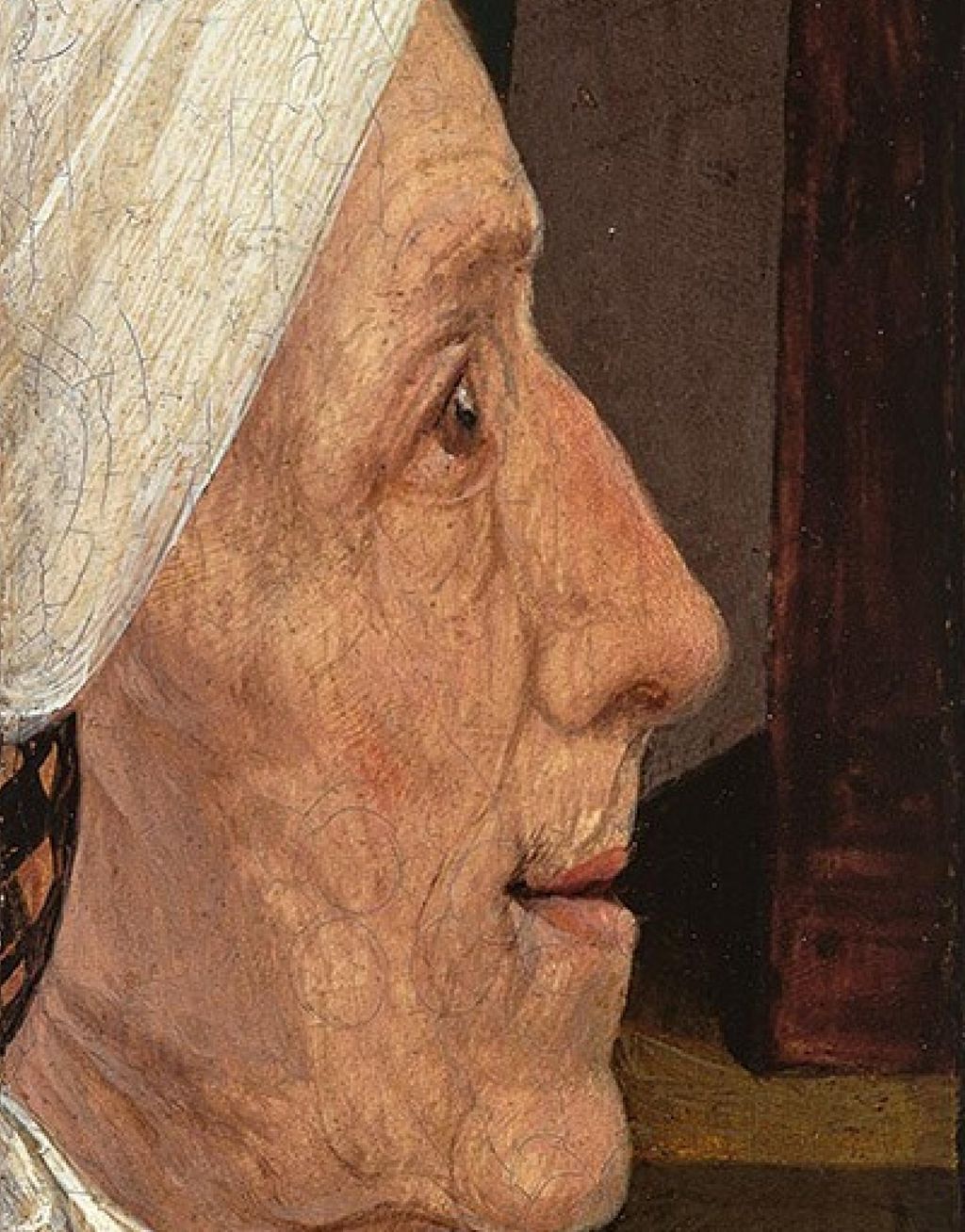
These views bring the face and folds into focus without filling in the lost surrounding composition.
The profile and expression
The forehead, nose and slightly open mouth form one continuous outer profile. Small wrinkles and changes of colour describe the skin beneath the eye and around the mouth.
The pale cloth and collar
Pale cloth descends around the head and neck. Fine marks, folds and the worn paint surface remain visible against the dark background.
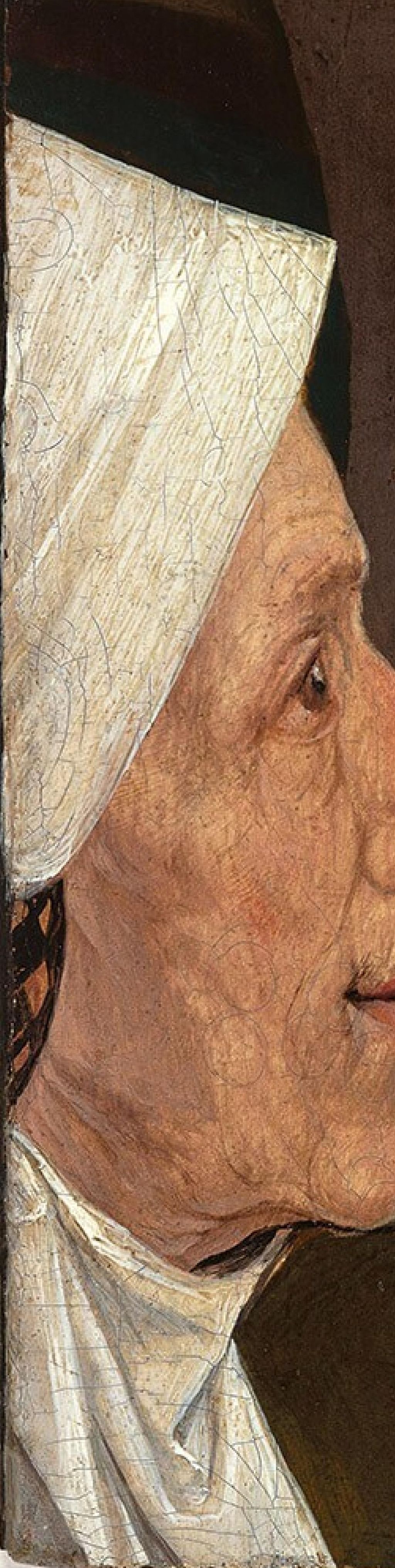
Image and detail crops: Wikimedia Commons source 1 (public domain reproductions).
The Profile and Its Direction
The face is almost entirely seen from the side. A long slope runs from the brow towards the projecting nose, then changes direction at the mouth and chin. Against the darker ground, this outer contour is unusually clear. The figure can be recognised as a human presence before the smaller features have been examined.
The eye interrupts that broad outline with a small dark accent. It sits beneath a reddish-brown brow and looks towards the same side as the face. Its position gives the head an alertness that the relatively quiet mouth does not explain fully. The picture preserves a direction of attention without revealing what holds it.
The lips are slightly parted. A narrow dark line separates them, and a small shadow lies beneath the lower lip. Below, the chin projects again before the outline turns back towards the neck. These successive changes make the profile more varied than one continuous downward curve.
The visible features suggest attention, but a specific emotion is harder to establish. The woman might seem absorbed, questioning or simply watchful. None of those impressions identifies a conversation or event beyond the painted boundaries. The face remains compelling partly because its object of attention is withheld.
Pale Cloth around the Head
The headcloth introduces a different kind of shape. Its outer edge rises diagonally towards the top left, while another edge descends beside the forehead and cheek. The pale material therefore frames the face asymmetrically. More cloth is visible behind the head than in front of it.
Near the temple, the cloth meets the skin along a sharply defined boundary. Farther down, its edge curves back towards the ear and neck. The contrast of warm flesh with cooler pale fabric makes those changes of direction especially legible.
The visible cloth is not an even white field. Thin grey and yellowish passages suggest folds and changes of surface. Some marks are interrupted by the painting's cracked and worn appearance. A close view therefore needs to distinguish the broad arrangement of the headwear from small lines whose origin is less easily judged from a reproduction.
At the lower left, more pale fabric gathers beneath the neck. Several sloping folds converge around a darker opening under the chin. This small passage anchors the head in clothing, even though the shoulders and torso are largely outside the visible image. The face feels attached to a body whose full position is unavailable.
Skin, Shadow and the Visible Surface
The cheek and neck contain subtle shifts between light ochre, pinkish brown and deeper shadow. The eye socket, the crease beside the nose and the underside of the chin provide darker accents. They describe the head through small transitions rather than through a strongly illuminated front and a single broad shadow.
The woman's age is conveyed through the arrangement of the features and folds of skin. The cheek narrows around the mouth, the jaw turns sharply towards the neck, and the brow is marked above the eye. Those visible decisions can be discussed without treating the face as a medical record or identifying a particular condition.
A network of fine cracks crosses both flesh and fabric. Some are long enough to cut across several painted forms. These lines belong to the object's physical history and should not all be read as wrinkles or textile decoration. The distinction matters especially in a small painting, where every visible mark can seem disproportionately significant.
The surface also limits what can be inferred about technique. A dark patch may belong to an original shadow, wear or a later change in the painting's appearance. A photograph alone does not establish the cause of each interruption or the history of its treatment.
A Narrow Field of View
At thirteen centimetres high and five centimetres wide, the panel offers a particularly restricted view.[1] The head nearly fills that space. There is little room for a gesture, a hand or a surrounding group that might explain the woman's role.
The background is correspondingly compressed. Dark vertical passages rise behind the face, and a small horizontal division appears near the lower right. These forms give the setting some structure without establishing a complete room. They make the head feel situated, while leaving the broader location uncertain.
The narrow format can encourage speculation about a larger composition. It does not, by itself, identify one. No surviving companion figure or securely reconstructed narrative is established by the evidence discussed here. Looking closely at the present image need not depend on supplying a missing scene.
From a Bosch Label to an Oostsanen Attribution
The museum's own 2017 annual report listed inventory 2439 as Bosch, with a tentative date of about 1510, among works lent to exhibitions in Tokyo and Osaka.[4] That dated institutional record shows how recently the Bosch name still accompanied this particular panel. It should be read as evidence of the label used then, rather than as the museum's current conclusion.
Daantje Meuwissen's 2019 contribution, A New Attribution for Head of an Old Woman, is cited in the current Dutch catalogue. Her public author summary confirms that she proposes the Amsterdam painter Jacob Cornelisz. van Oostsanen.[1][5] The proposal is an attribution, rather than the discovery of a signature or a document naming the sitter.
The catalogue wording is appropriately qualified: attributed to. It identifies the painter currently proposed for the work while preserving a degree of uncertainty. Treating that wording seriously avoids turning a former confident name into an equally unsupported certainty under a new one.
The English and Dutch museum records are not fully aligned. The English page has the Oostsanen headline but also retains Bosch as an attributed artist in its detailed fields. The Dutch page explicitly marks Bosch as a former attribution.[1][6] That difference helps explain conflicting descriptions of the same inventory number; it does not establish the involvement of two painters.
What the Wood Study Does Not Date
The BRCP's Technical Studies includes Rotterdam inventory 2439 in its dendrochronology appendix, under the title Female Heads. The entry records one board and states that dating was not possible.[7] It therefore supplies no scientific execution year for this panel.
That result should not be confused with an early date, a late date or evidence for either painter. A measurement that does not yield a date cannot settle the authorship question. The museum's approximate date of 1500 remains a catalogue estimate rather than a year independently established by that table.
Collecting and the Surviving Object
The Dutch museum record traces the panel through the Douwes and Jacques Goudstikker dealerships in Amsterdam in 1933, followed by D. G. van Beuningen's acquisition that year. It entered the museum with his collection in 1958.[1] Those transactions concern the surviving small panel, separate from the circumstances in which it was originally painted.
Its collecting history and changing artist names have encouraged different ways of looking at it. Under Bosch's name, a viewer might seek a relation to his crowded narratives; under Oostsanen's, a different group of paintings becomes relevant. The profile itself remains the starting point against which such comparisons must be tested.
The white cloth, dark ground and attentive eye give the little painting a clear visual structure. Its present interest does not require certainty about the woman's identity or an invented account of what she sees. A carefully bounded view of one face survives, alongside a documented history of reconsidering who painted it.
Artworks and related attributions
Browse paintings, drawings and related attributions. Records group triptychs, fragments and two-sided sheets where appropriate. Dates follow the cited museum records or catalogue headings and are generally estimates. Rows marked “2016 catalogue” report that publication’s attribution and collection information; these are dated opinions, rather than a claim that every work is an accepted autograph Bosch.
| Name | Date | Medium, attribution and collection |
|---|---|---|
| A Crossbowman | Second half of the sixteenth century | Oil on oak panel · Copy after Hieronymus Bosch · Museo Nacional del Prado, Madrid · P002695 Source 1. Source 2. |
| A Woman Spinning and an Old Woman | Museum estimates: about 1480–1490 for the women and 1500–1505 for the reverse; the precise chronology is disputed | Pen and brown and grey ink on the front; pen and brown ink on the reverse · Hieronymus Bosch · Museum Boijmans Van Beuningen, Rotterdam · N 190 recto and verso (PK) Source 1. Source 2. |
| Adoration of the Child in Cologne | Second half of the sixteenth century | Oil on oak panel · Imitator of Hieronymus Bosch, in the city collection record · Wallraf-Richartz-Museum & Fondation Corboud, Cologne · WRM 0474 Source 1. Source 2. |
| Adoration of the Magi in Philadelphia | Early sixteenth century in the museum record; around 1495–1520 in the BRCP catalogue | Oil on oak panel · Hieronymus Bosch in the museum record; workshop of Bosch in the 2016 BRCP catalogue · Philadelphia Museum of Art, John G. Johnson Collection, 1917 · 1321; museum object 103592 Source 1. Source 2. |
| Adoration of the Magi — New York | c.1470–1480 | 2016 catalogue: Bosch; oil on oak · Metropolitan Museum 13.26 2016 catalogue. |
| Adoration of the Magi — Prado triptych | c.1494 | Oil on oak; grisaille exterior · Bosch · Prado P002048 Object source. |
| Adoration of the Magi — three associated fragments | c.1515–1535 | 2016 catalogue: Follower of Bosch · Two Shepherds / Retinue in Philadelphia; associated Adoration in private collection in 2016 2016 catalogue. |
| Ascent of the Blessed — Venice | c.1505–1515 | Oil on panel · Bosch · Gallerie dell’Accademia; Visions of the Hereafter Object source. |
| Battle of the Birds and Mammals | Not specified in catalogue heading | 2016 catalogue: Bosch; pen and brown ink · Berlin KdZ 14715 2016 catalogue. |
| Beggars and Musicians | Around 1530–1540 | Ink and wash on paper · Unknown follower of Hieronymus Bosch · Albertina, Vienna · 7798 Source 1. Source 2. |
| Christ Carrying the Cross Drawing | Around 1470 in the museum catalogue | Black chalk or charcoal, pen and brush in brown ink, white corrections · Anonymous, workshop of Rogier van der Weyden · Museum Boijmans Van Beuningen, Rotterdam · N 81 recto and verso (PK) Source 1. Source 2. |
| Christ Carrying the Cross in Vienna | Around 1490–1510 in the current KHM record and BRCP catalogue | Oil on oak, painted on both sides · Hieronymus Bosch; possible workshop involvement in the Passion side discussed by the BRCP · Kunsthistorisches Museum, Vienna · Gemäldegalerie, GG 6429 Source 1. Source 2. |
| Christ Carrying the Cross — El Escorial | c.1495–1505 | 2016 catalogue: Bosch; oil on oak · Patrimonio Nacional 10014739 2016 catalogue. |
| Christ Carrying the Cross — Ghent | c.1510–1516 (museum) | Oil on panel · Bosch in museum listing; authorship disputed · MSK Ghent 1902-H Object source. |
| Christ Mocked — London | c.1510 | Oil on wood · Bosch · National Gallery NG4744 Object source. |
| Concert in the Egg, After Hieronymus Bosch | Around 1561; third quarter of the sixteenth century | Oil on canvas · Anonymous, after Hieronymus Bosch · Palais des Beaux-Arts, Lille · P 816 Source 1. Source 2. |
| Conjurer / Comical Concert — Louvre drawing | Not specified in catalogue heading | 2016 catalogue: Bosch (recto), follower (concert verso) · Pen and brown ink · Louvre INV 19197 2016 catalogue. |
| Conjurer / Cross-bearing and beggars — Liège sheet | Not specified in catalogue heading | 2016 catalogue: Bosch (verso), follower (recto) · Pen and brown ink · Album d’Arenberg 534 2016 catalogue. |
| Crowning with Thorns — El Escorial | c.1530–1540 | 2016 catalogue: Follower of Bosch; oil on oak · Patrimonio Nacional 10014743 2016 catalogue. |
| Crucifixion with a Donor | Circa 1495–1505; Circa 1490–1500 | Oil on oak panel · Hieronymus Bosch · Royal Museums of Fine Arts of Belgium, Brussels · 6639 Source 1. Source 2. |
| Death and the Miser Drawing | Not securely established; probably made after the painting | Pen and brush, dark ink and white highlights on prepared paper · Workshop of Hieronymus Bosch in the BRCP catalogue; alternatives recorded by the Louvre · Musée du Louvre, Department of Prints and Drawings, Paris · RF 6947, Recto Source 1. Source 2. |
| Death and the Miser — Washington | c.1485/1490 (NGA) | Oil on panel · Bosch · National Gallery of Art 1952.5.33 Object source. |
| Ecce Homo Triptych — Boston | c.1495–1500; wings c.1500/1503 | 2016 catalogue: Workshop of Bosch; oil on oak · Museum of Fine Arts Boston; several production phases 2016 catalogue. |
| Ecce Homo — Frankfurt | c.1490 | Mixed technique on oak · Bosch · Städel 1577 Object source. |
| Fall of the Damned — Venice | c.1505–1515 | 2016 catalogue: Bosch; oil on panel · Visions of the Hereafter · Venice 2016 catalogue. |
| Garden of Earthly Delights | 1490–1500 (Prado) | Oil on oak; grisaille exterior · Bosch · Prado; triptych Object source. |
| Gluttony and Lust / Allegory of Intemperance — Yale fragment | c.1500–1510 (group dating) | 2016 catalogue: Bosch; oil on oak · Yale 1959.15.22; fragment associated with Ship of Fools 2016 catalogue. |
| Group of Ten Spectators, a Follower of Bosch | Around 1510–1540 in the current museum record | Pen and two brown inks on paper, with a brown framing line · Follower of Hieronymus Bosch in the Morgan record; Bosch in the BRCP catalogue · Morgan Library & Museum, New York · I, 112 Source 1. Source 2. |
| Head of an Old Woman | About 1500 | Oil on panel · Attributed to Jacob Cornelisz. van Oostsanen · Museum Boijmans Van Beuningen, Rotterdam · 2439 (OK) Source 1. Source 2. |
| Hell and the Flood — Rotterdam panels | Around 1515 in the museum records; around 1510–1520 in the BRCP catalogue | Oil on oak panels · Jheronimus Bosch in the museum records; workshop of Bosch in the BRCP catalogue · Museum Boijmans Van Beuningen, Rotterdam Source 1. Source 2. |
| Hermit Saints Triptych | Circa 1495–1505 | Oil on oak panels · Hieronymus Bosch · Gallerie dell’Accademia, Venice · 2044 Source 1. Source 2. |
| Infernal Landscape | Not specified in catalogue heading | 2016 catalogue: Bosch; pen and brown ink, red accent · Private collection in 2016 2016 catalogue. |
| Infernal Scene with Anvil / Monster Studies | Not specified in catalogue heading | 2016 catalogue: Bosch; attribution debated in entry · Pen and brown ink · Berlin KdZ 548 2016 catalogue. |
| Infernal Scene with Tree-Man / Standing Man | Not specified in catalogue heading | 2016 catalogue: Workshop of Bosch; pen and brown ink · Dresden C 1875; historical reverse title includes a proposed prophet 2016 catalogue. |
| Job Triptych — Bruges | c.1510–1520 | 2016 catalogue: Workshop of Bosch; oil on oak · Groeningemuseum / Hoeke loan in 2016 2016 catalogue. |
| Last Judgement — Bruges triptych | c.1495–1505 | 2016 catalogue: Bosch; oil on oak · Groeningemuseum 2016 catalogue. |
| Last Judgement — Munich fragment | c.1530–1540 | 2016 catalogue: Follower of Bosch; oil on oak · Alte Pinakothek 5752 2016 catalogue. |
| Last Judgement — Vienna triptych | c.1500–1505 (BRCP 2016) | Oil on oak · Bosch and workshop (BRCP 2016) · Academy of Fine Arts Vienna 2016 catalogue. |
| Man in a Basket and Comic Figures | Around 1500–1515 in the museum record | Pen and brown ink on paper; the reverse is catalogued as iron-gall ink · Hieronymus Bosch in the current Albertina record; attribution has been debated · Albertina, Vienna · 7797 recto and verso Source 1. Source 2. |
| Man Seen from Behind | About 1550–1569; About 1565–1570 | Traces of black chalk, pen and brush in light brown ink · Anonymous, circle of Pieter Bruegel the Elder · Museum Boijmans Van Beuningen, Rotterdam Source 1. Source 2. |
| Mary and John at the Foot of the Cross | About 1440 | Brush in grey and black · Unknown, possibly Netherlandish · Kupferstich-Kabinett, Staatliche Kunstsammlungen Dresden · C 815 Source 1. Source 2. |
| Model Sheet with ‘Witches’ | Disputed; proposals depend on the attribution | Pen and brown ink; the BRCP also records underlying black chalk · Hieronymus Bosch; follower attributions also recorded · Musée du Louvre, Département des Arts graphiques, Paris · INV 19721 recto Source 1. Source 2. |
| Peasant and Three Bust-Length Figures | 1401–1500 | Brown pen over a black preliminary drawing · Attributed to the Master of the Drapery Studies; Bosch circle also recorded · Kupferstichkabinett, Staatliche Museen zu Berlin · KdZ 777 Source 1. Source 2. |
| River to Hell — Venice | c.1505–1515 | 2016 catalogue: Bosch; oil on panel · Visions of the Hereafter · Venice 2016 catalogue. |
| Saint Anthony and a Concert in an Egg | Around 1510–1525 in the museum’s 2016–17 exhibition texts | Pen in light and dark brown inks · Workshop of Hieronymus Bosch; underlying monsters: Bosch (BRCP), possibly Bosch (exhibition text) · Kupferstichkabinett, Staatliche Museen zu Berlin · KdZ 711 recto and verso Source 1. Source 2. |
| Saint Christopher Carrying the Christ Child | c.1500; 1490–1505 in restoration material | Oil on panel · Bosch · Boijmans St 26 Object source. |
| Saint James and Hermogenes | About 1551–1575 in the KIK-IRPA catalogue | Oil on wood, painted on both sides · Anonymous follower of Hieronymus Bosch · Musée des Beaux-Arts, Valenciennes · P.46.1.44; older number 176 Source 1. Source 2. |
| Saint Jerome at Prayer | Circa 1485–1495 | Oil on oak panel · Hieronymus Bosch · Museum of Fine Arts, Ghent · 1908-H Source 1. Source 2. |
| Saint John on Patmos / Passion Scenes | c.1495–1505; estimates vary | Oil on oak · Bosch · Gemäldegalerie Berlin 1647A Object source. |
| Saint John the Baptist in Meditation | Late 15th century; c.1485–1510 (Prado exhibition) | Oil on panel · Bosch · Lázaro Galdiano 8155 Object source. |
| Saint Liberata Triptych | Circa 1495–1505 | Oil on oak panels · Hieronymus Bosch · Gallerie dell’Accademia, Venice · 2045 Source 1. Source 2. |
| Seven Deadly Sins and the Four Last Things | 1505–1510 (Prado) | Oil on poplar · Bosch (Prado); workshop/follower disputed · Prado Object source. |
| Ship of Fools — Louvre painting | 1475–1500 (record); c.1505–1515 (exhibition) | Oil on oak · Bosch · Louvre RF 2218; fragment Object source. |
| Ship of Fools — Louvre workshop drawing | Not specified in catalogue heading | 2016 catalogue: Workshop of Bosch · Pen, brush, grey-brown ink and white highlights on prepared paper · Louvre RF 3714 2016 catalogue. |
| Studies of Monsters | About 1530–1550, according to the current Ashmolean record | Pen and brown ink on laid paper, both faces · Anonymous follower of Hieronymus Bosch · Ashmolean Museum, University of Oxford · WA1863.155 Source 1. Source 2. |
| Studies of Saint Anthony and Monsters | No execution date specified in the current Louvre records | Pen and brown ink on paper · Bosch listed; reverse questioned by Louvre; BRCP accepts both faces · Musée du Louvre, Département des Arts graphiques, Paris · INV 20871 recto and verso Source 1. Source 2. |
| Temptation of Saint Anthony — Kansas City fragment | c.1500–1510 | 2016 catalogue: Bosch; oil on oak · Nelson-Atkins 35–22 2016 catalogue. |
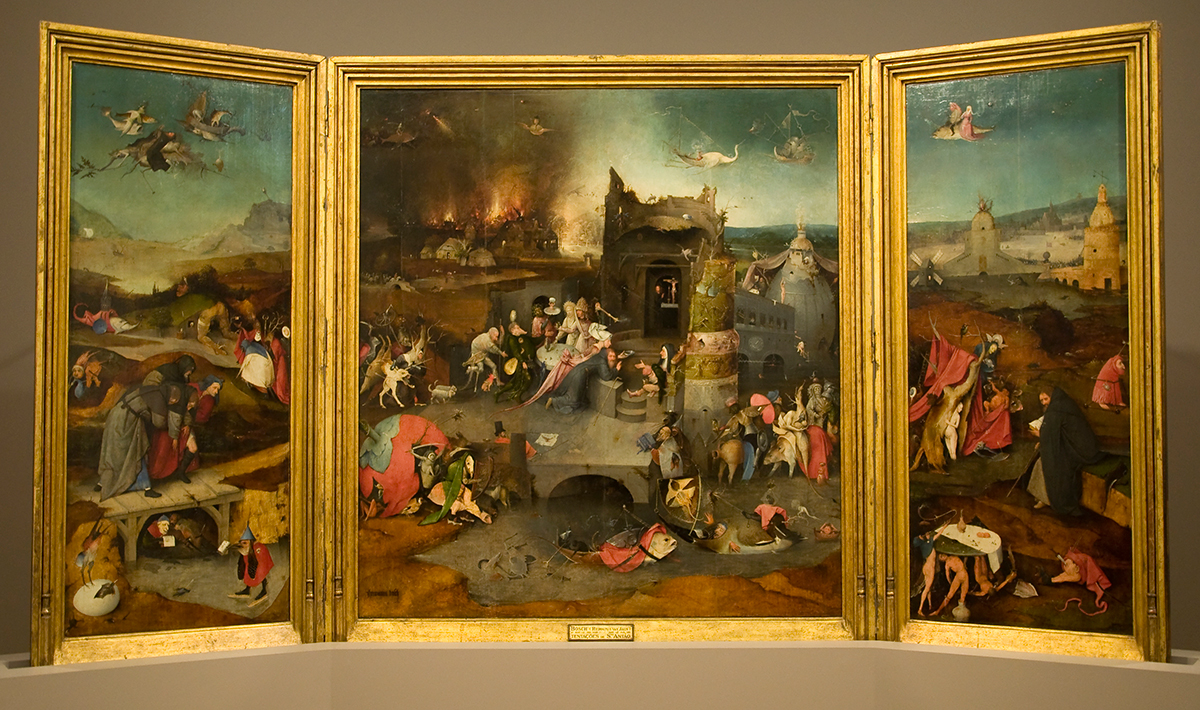
| Temptation of Saint Anthony — Lisbon triptych | c.1500 | Oil on oak · Bosch · Museu Nacional de Arte Antiga 1498 Pint Museum. |
| Temptation of Saint Anthony — Prado panel | c.1530–1540 | 2016 catalogue: Follower of Bosch (2016 opinion); oil on oak · Prado P002049 2016 catalogue. |
| Terrestrial Paradise | Approximately 1505–1515 | Oil on oak panel · Hieronymus Bosch · Gallerie dell'Accademia, Venice Source 1. Source 2. |
| The Burning Ship Drawing | 1500–1520 | Pen and iron gall ink on paper · Attributed to Hieronymus Bosch · Academy of Fine Arts Vienna, Graphic Collection · HZ-2554; numbered 2554 in the BRCP catalogue Source 1. Source 2. |
| The Comical Barber Scene | About 1550–1580, according to the British Museum | Pen and brown ink, grey and brown wash, over black chalk · Anonymous follower, after Hieronymus Bosch · British Museum, Department of Prints and Drawings, London · 1854,0628.46 Source 1. Source 2. |
| The Conjuror, After Hieronymus Bosch | Probably after 1525; around 1530–1540 in the BRCP technical report | Oil on oak panel · Anonymous follower of Hieronymus Bosch · Musée Ducastel-Vera, Saint-Germain-en-Laye · 872.1.87 Source 1. Source 2. |
| The Cure of Folly / Extraction of the Stone of Madness | 1501–1505 (Prado) | Oil on oak · Bosch (Prado); workshop/follower disputed · Prado P002056 Object source. |
| The Entombment Drawing | About 1505–1515, current museum record | Brush and black and grey ink, with grey wash, over black chalk · Workshop of Hieronymus Bosch; drawn by the Master of the Prado Haywain Triptych; Hieronymus Bosch, argued by the BRCP in 2016 · British Museum, Department of Prints and Drawings, London · 1952,0405.9 Source 1. Source 2. |
| The Gathering of the Birds | Not specified in catalogue heading | 2016 catalogue: Bosch; pen and brown ink · Berlin KdZ 13136 2016 catalogue. |
| The Haywain — Prado triptych | 1510–1516 (BRCP 2016) | Oil on oak · Bosch (BRCP 2016) · Prado; separate Escorial version exists 2016 catalogue. |
| The Hearing Forest and the Seeing Field | Circa 1500–1505 | Pen and brown ink on paper · Hieronymus Bosch; reverse: Bosch and workshop · Kupferstichkabinett, Staatliche Museen zu Berlin · KdZ 549, front and reverse Source 1. Source 2. |
| The Owl’s Nest — Rotterdam | Not specified in catalogue heading | 2016 catalogue: Bosch; pen and brown ink · Boijmans N 175 2016 catalogue. |
| The Passion Triptych in Valencia | Workshop of Bosch, about 1510–1520; Follower of Bosch; centre about 1530–1540, wings about 1540–1550 | Oil and gold on oak panels · Workshop of Bosch, about 1510–1520; Follower of Bosch; centre about 1530–1540, wings about 1540–1550 · Museu de Belles Arts de València Source 1. Source 2. |
| The Pedlar / Wayfarer — Rotterdam | c.1500 (museum) | Oil on panel · Bosch · Boijmans 1079 (OK); rejoined exterior Object source. |
| The Tree-Man — Vienna drawing | c.1505 | Pen and brown ink · Bosch · Albertina, Vienna Object source. |
| The Wedding at Cana, After Hieronymus Bosch | Approximately 1560 in the current museum record | Oil on panel, 93 cm high × 72 cm wide · Anonymous, after Hieronymus Bosch · Museum Boijmans Van Beuningen, Rotterdam, St 25 Source 1. Source 2. |
| Two Fantastical Creatures — Berlin KdZ 550 | Around 1505–1515 in the museum’s 2016 exhibition text | Pen in brown ink on reddish prepared laid paper · Hieronymus Bosch · Kupferstichkabinett, Staatliche Museen zu Berlin · KdZ 550, recto and verso Source 1. Source 2. |
| Two Figures Wearing Mitres | About 1480 | Oil on panel · Anonymous (Boijmans); Bosch circle (RKD) · Museum Boijmans Van Beuningen, Rotterdam · 1177 (OK) Source 1. Source 2. |
| Two Men and the Temptation of Eve | About 1505–1515 in the Prado’s 2016 exhibition guide | Pen and grey-brown ink on paper · Hieronymus Bosch in the 2016 catalogues discussed here · Private collection, as recorded in 2016 Source 1. Source 2. |
| Two Men Fighting | Not specified in the current Louvre record | Pen and brown ink · In the manner of Hieronymus Bosch · Musée du Louvre, Département des Arts graphiques, Paris · INV 20660 recto; formerly NIII 8896 and MA 8400 Source 1. Source 2. |
| Two Men — Berlin KdZ 5210 | Not specified in catalogue heading | 2016 catalogue: Bosch questioned · Pen, brush, ink, chalk and white highlights · Berlin KdZ 5210; historical title Two Oriental Men 2016 catalogue. |
| Two Monsters — Berlin KdZ 547 | Approximately 1500–1510 in Berlin's 2016 exhibition catalogue; an estimated range | Pen and brown ink on paper · Hieronymus Bosch · Kupferstichkabinett, Staatliche Museen zu Berlin · KdZ 547, drawn on both sides Source 1. Source 2. |
Frequently Asked Questions
The museum’s Dutch catalogue attributes the panel to Jacob Cornelisz. van Oostsanen, about 1500, and records Bosch and Bruegel as former attributions.[1]
The museum’s 2017 annual report listed inventory 2439 as Bosch, with a tentative date around 1510, for loans to Tokyo and Osaka. That documents the historical label used then.[4]
No. The BRCP technical appendix records one board and states that dating was not possible. It supplies no scientific execution year for this panel.[7]
Discussion
Compare the profile and pale cloth with the documented changes in the painting’s attribution.
Reader Insights
How does the white headcloth sharpen the face’s profile?
Where does the eye direct your attention beyond the narrow panel?
How do the visible cracks complicate the distinction between painted features and the surface’s history?
Join the Conversation
Share a detail, comparison or question about Head of an Old Woman: A Former Bosch Attribution below.
References
- Museum Boijmans Van Beuningen: Head of an Old Woman, 2439 (OK), current Dutch attribution, metadata, provenance and bibliography View source.
- BRCP Catalogue Raisonné (2016), object dates in catalogues 1, 2, 8, 15 and 20; catalogue 20 object metadata only for the Haywain comparison. View source
- Staatliche Museen zu Berlin, 2016 exhibition wall texts, p. 3: approximate date of KdZ 549. View source
- Museum Boijmans Van Beuningen, Annual Report 2017, pp. 142–143: Japanese exhibition loan list, inventory 2439 View source.
- Daantje Meuwissen: public author summary of A New Attribution for Head of an Old Woman View source.
- Museum Boijmans Van Beuningen: Head of an Old Woman, current English record and detailed attribution fields View source.
- Bosch Research and Conservation Project, Technical Studies (2016), Appendix I, p. 457: Rotterdam inventory 2439, available through SRAL View source.
- Splash image, Attributed to Jacob Cornelisz. van Oostsanen, Head of an Old Woman, about 1500, oil on panel, 13 × 5 cm. Museum Boijmans Van Beuningen, 2439 (OK), acquired with the D. G. van Beuningen collection, 1958. View source.