 by Tom Gurney
Tom Gurney BSc (Hons) is an art history expert with over 20 years experience
Published on June 19, 2020 / Updated on November 4, 2026
Email: tomgurney1@gmail.com / Phone: +44 7429 011000
The Temptation of Saint Anthony: Introduction
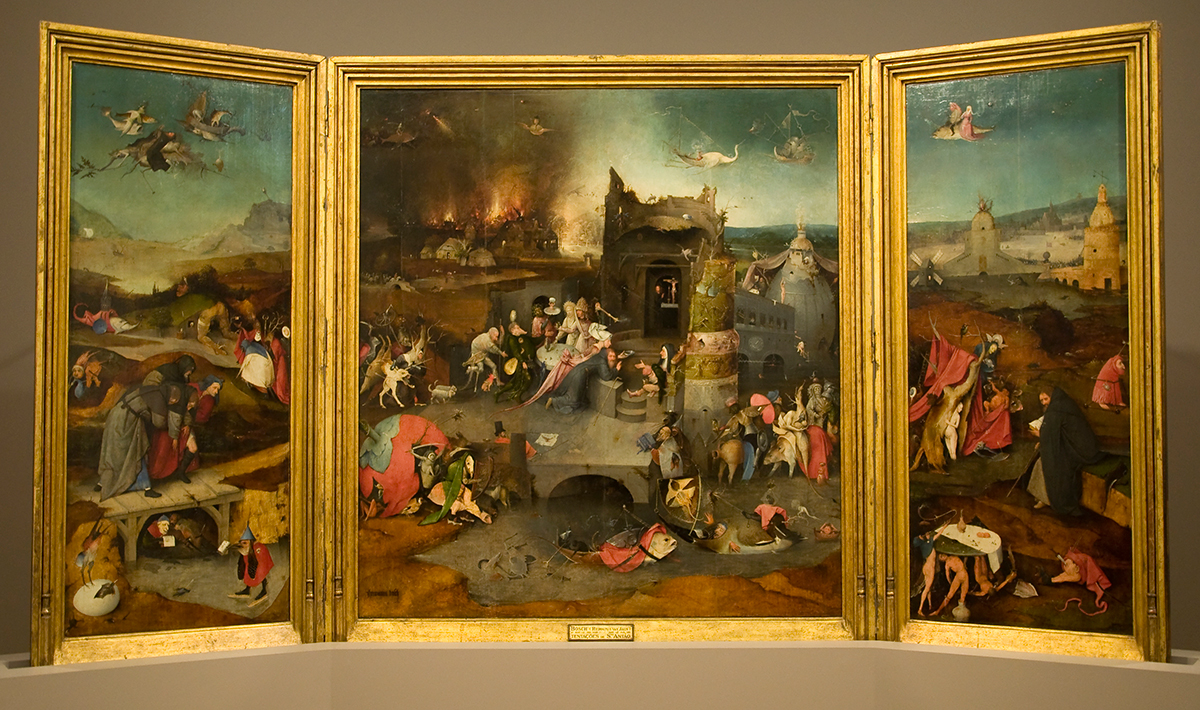
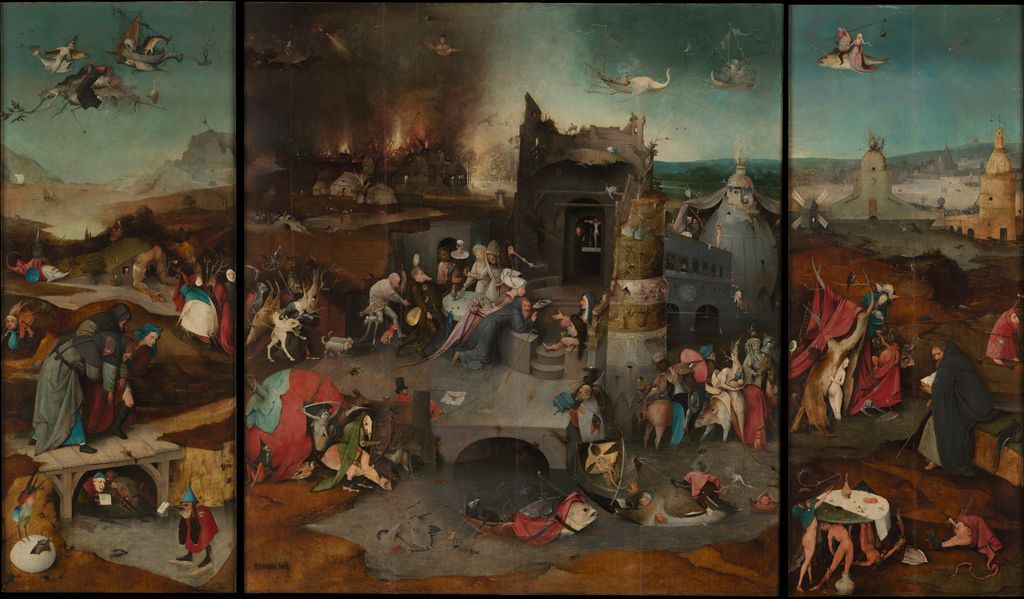
Hieronymus Bosch's The Temptation of Saint Anthony is one of the great survival stories in Northern Renaissance art: not only the survival of a painted triptych, but the survival of a saint's attention under pressure. The work, now in the Museu Nacional de Arte Antiga in Lisbon, is signed by Bosch and is usually dated around 1500. The MNAA records it as oil on oak, with a central panel measuring 131.5 x 119 cm and side panels measuring 131.5 x 53 cm.
The painting belongs beside Bosch's other major triptychs, especially The Garden of Earthly Delights, The Haywain Triptych and The Last Judgement. Yet its emotional centre is different. The Garden unfolds a vast world of creation, desire and punishment; The Haywain turns social appetite into a public procession; The Last Judgement overwhelms the eye with final reckoning. The Lisbon Saint Anthony concentrates all that Boschian pressure around a hermit who remains present, watchful and inwardly anchored while the world around him breaks into demon theatre.
That balance is the key to the painting. It is easy to remember the monsters first: hybrid bodies, fires, flying creatures, ruined architecture, false ceremonies, animal-headed figures and seductive forms. But Bosch does not make Saint Anthony disappear inside spectacle. The demons are loud; the saint is quiet. The painting asks the viewer to look through the noise and find the point of resistance. In the central panel, Anthony turns calmly toward us, raises a blessing hand and echoes the gesture of Christ hidden in the ruined chapel behind him. The visual path from demons to saint to Christ is the triptych's devotional argument.
Contents
- Annotated Details
- At a Glance
- What Bosch Shows
- The Closed Triptych
- The Left Wing: Assault and Rescue
- The Central Panel: The Saint at the Still Point
- The Right Wing: False Beauty and Appetite
- Saint Anthony and Bosch's Devotional Culture
- Demons Without a Symbol Dictionary
- Technique, Surface and Close Looking
At a Glance
- ArtistHieronymus Bosch, also known as Jheronimus Bosch
- TitleThe Temptation of Saint Anthony or The Temptations of Saint Anthony
- Datec. 1500
- MediumOil on oak
- FormatTriptych with painted exterior wings
- CollectionMuseu Nacional de Arte Antiga, Lisbon
- Inventory1498 Pint
- Dimensionscentral panel 131.5 x 119 cm; side panels 131.5 x 53 cm
- Signaturesigned by Bosch on the lower left of the central panel, according to MNAA
- SubjectSaint Anthony Abbot resisting demonic assault and temptation
- Related Bosch pagesHieronymus Bosch, biography, paintings, symbolism, style and technique, workshop and attribution, prints and Hell
Compare these works across Bosch’s career
These date ranges are estimates, not a documented year-by-year sequence. These works provide context for the article; none is highlighted as the object discussed here.
Saint Jerome at Prayer
Circa 1485–1495 [1]Crucifixion with a Donor
Circa 1490–1500 (BRCP) [1]Hermit Saints Triptych
Circa 1495–1505 [1]Saint Liberata Triptych
Circa 1495–1505 [1]The Hearing Forest and the Seeing Field
Circa 1500–1505 (Berlin exhibition) [2]The Haywain Triptych
1510–1516 (BRCP) [1]Annotated Details from The Temptation of Saint Anthony (Lisbon triptych)
These six details belong to the open triptych in Lisbon. They move from the airborne assault and rescue in the left wing to the central gathering and the temptations in the right wing.
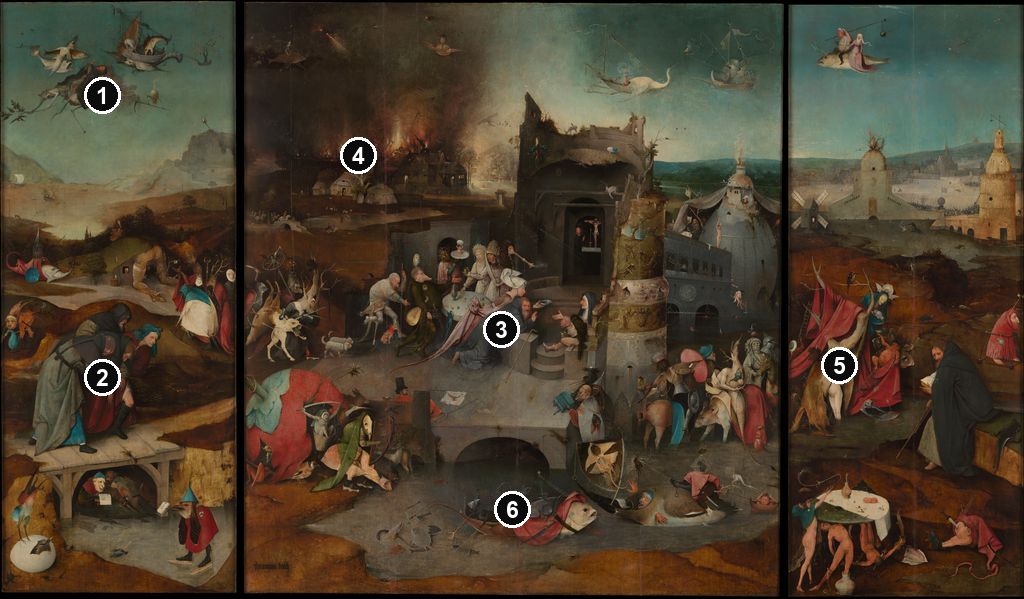
Details from THE TEMPTATION OF SAINT ANTHONY (LISBON TRIPTYCH)
Follow the numbered views across the three panels. Each enlargement is cropped from the same image of the Lisbon triptych.
Anthony carried through the sky
In the left wing, a dark-robed figure is surrounded by flying hybrid creatures high above the landscape. The airborne episode is distinct from the rescue shown below.
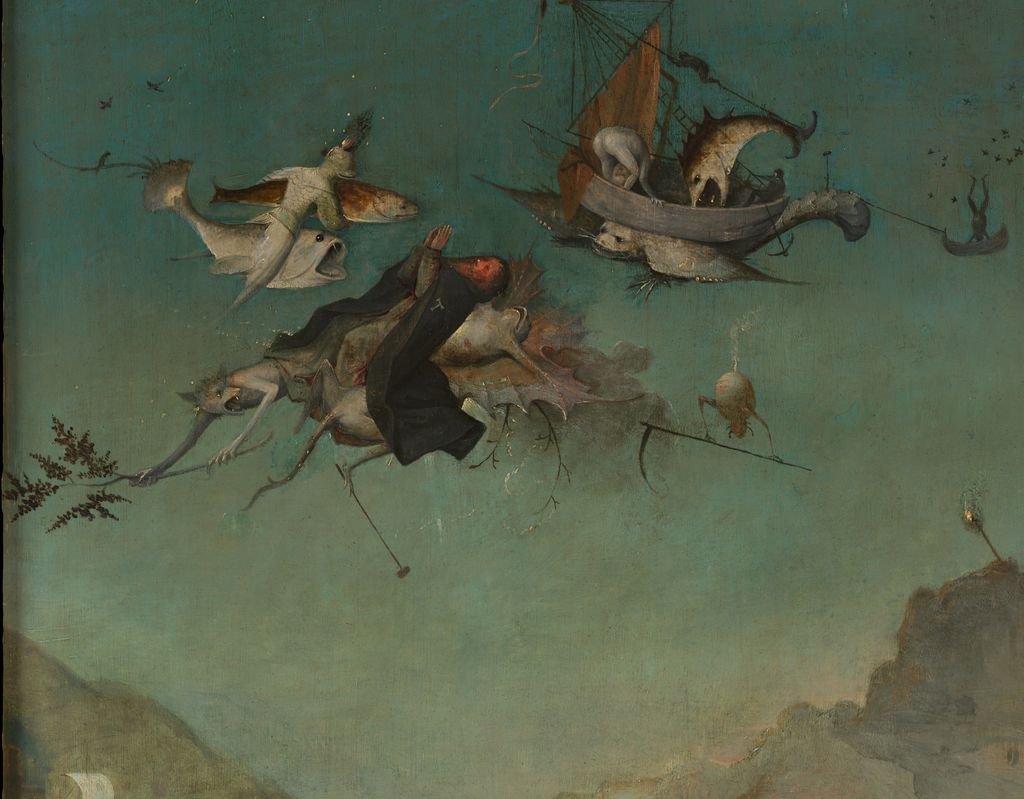
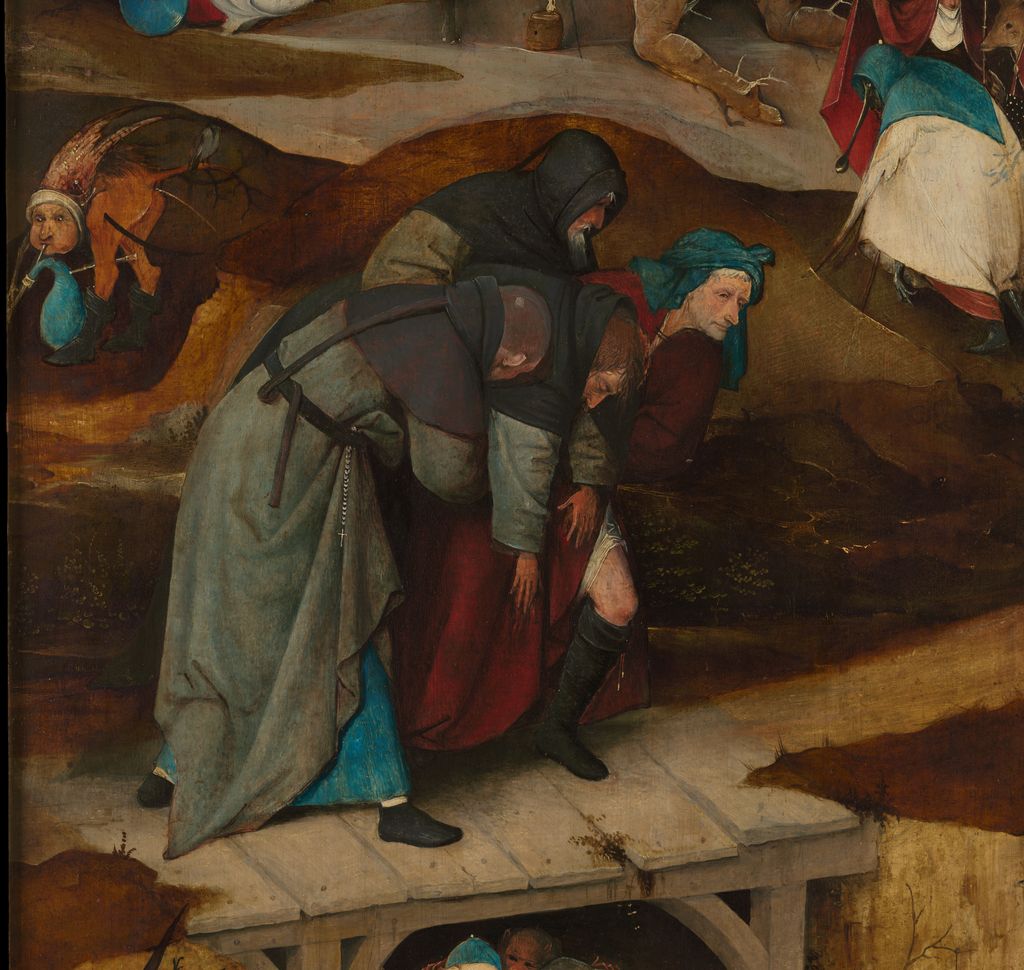
The rescue beside the bridge
Near the bottom of the left wing, figures support the exhausted saint as they cross the bridge. The bowed bodies and linked arms make the rescue readable within the crowded landscape.
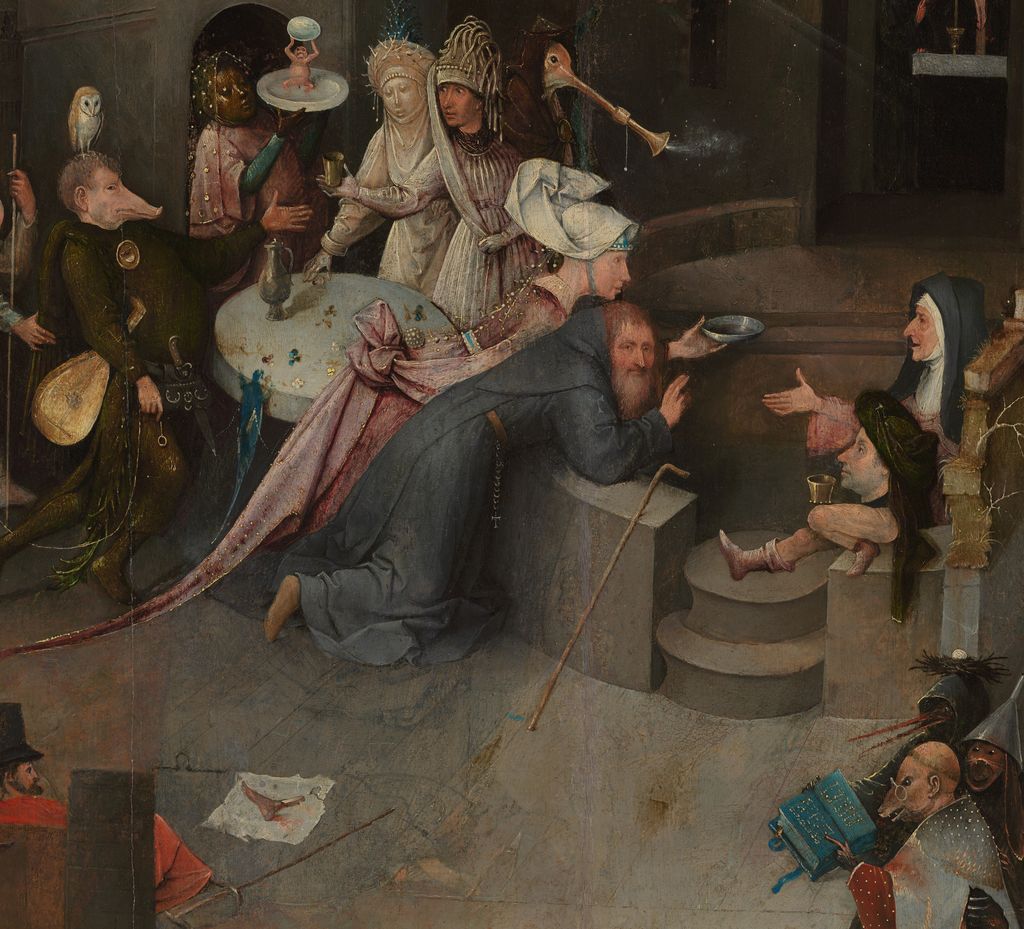
Anthony kneeling at the ruined building
At the centre of the triptych, Anthony kneels beside a low stone platform. His dark habit and turned face remain visible amid the brightly dressed figures and strange objects gathered around him.
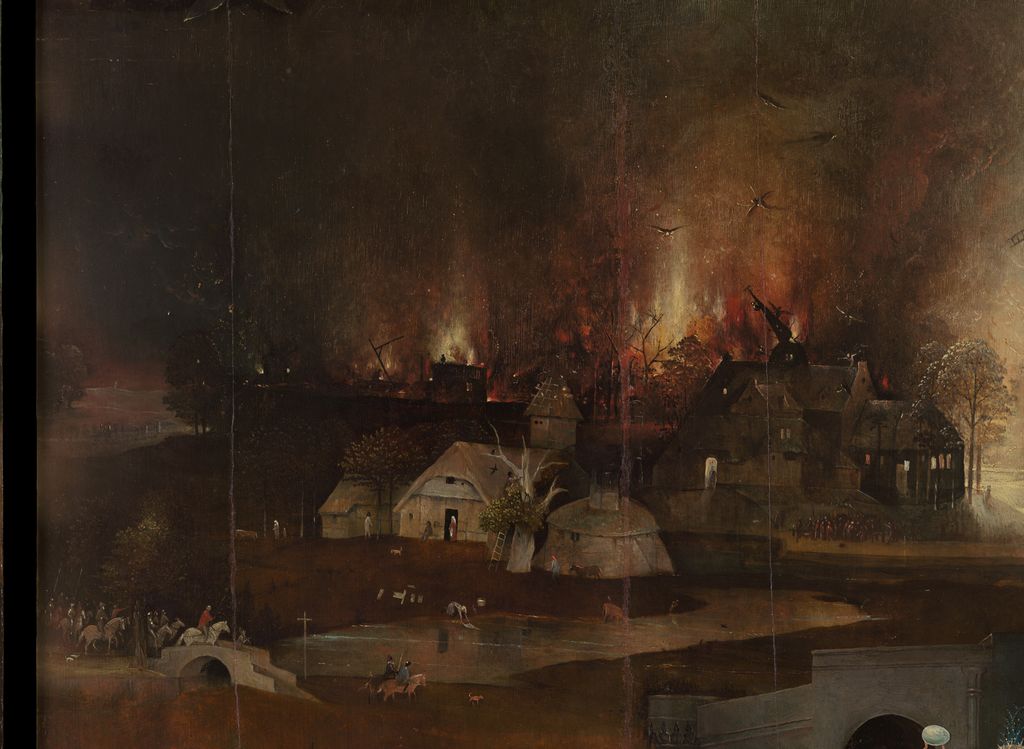
The burning settlement
Flames and smoke rise above the buildings in the upper left of the central panel. The illuminated roofs and dark smoke form a separate disturbance behind the foreground gathering.
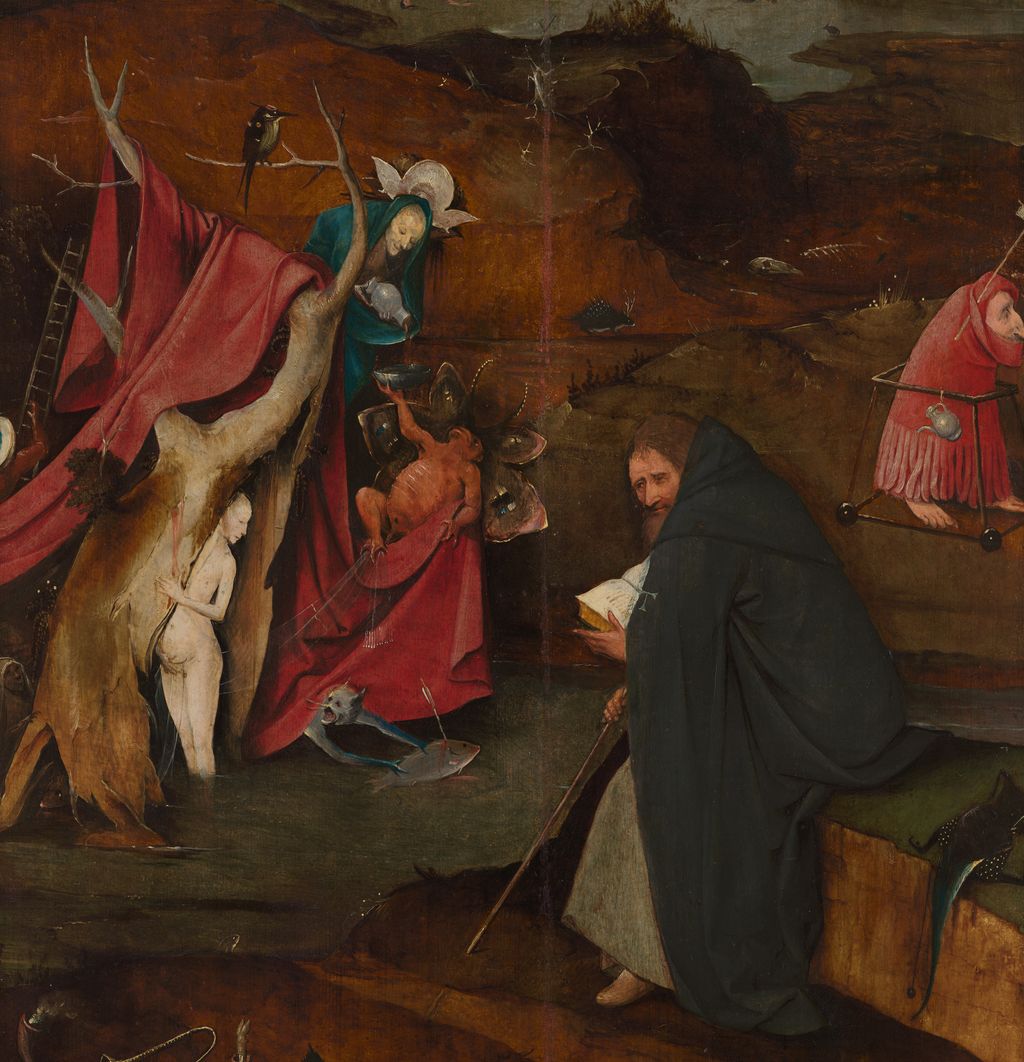
The figure beneath the red canopy
On the right wing, a pale figure stands beneath a red cloth held among the trees. Anthony sits farther to the right, while small creatures and unusual vessels occupy the ground below.
The fish-shaped vessel in the foreground
A large fish-shaped form with a red covering crosses the foreground of the central panel. Nearby boats, figures and fragments interrupt the water around the bridge opening.
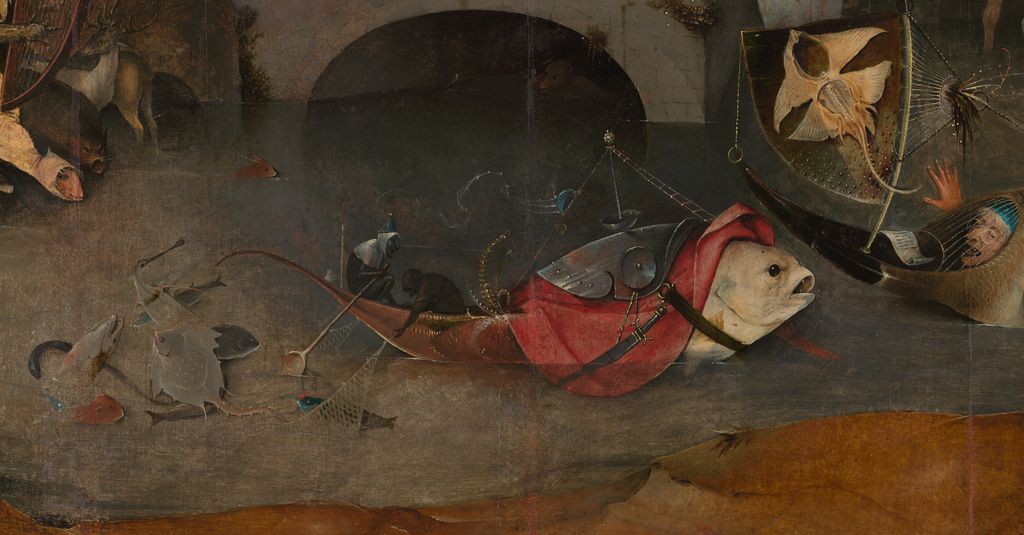
Image source for the triptych and these details: Wikimedia Commons, reproduction sourced from the Bosch Project, marked public domain. Detail crops and numbered overview prepared for this article.
What Bosch Shows
The Lisbon triptych presents episodes from the life and legend of Saint Anthony Abbot, the Egyptian hermit whose desert solitude became a model of Christian ascetic endurance. Anthony was one of the most important early monastic saints. His life, known through Athanasius's Life of Anthony and later medieval retellings such as Jacobus de Voragine's Golden Legend, made him a natural subject for artists interested in spiritual combat. He withdraws from ordinary society, but the wilderness does not become empty. It becomes the place where temptation, fear, illusion and bodily trial reveal themselves.
Bosch's triptych turns that legend into a layered visual experience. The open panels show Anthony under attack, surrounded by demonic and hybrid figures, yet still oriented toward salvation. The left wing presents physical assault and rescue. The central panel gathers the fullest crowd of monsters, parody rituals and broken architecture around the kneeling saint. The right wing turns temptation toward seductive beauty, food, bodily appetite and worldly unease. The subject is not simply "a saint among monsters." It is the moral testing of a person who must keep his attention fixed while every part of the visible world tries to claim it.
The MNAA describes the triptych as bringing together air, earth, water and fire as settings for its frightening figures. That is a useful way to begin because Bosch does not confine evil to one corner. Temptation arrives from above and below, across land and water, in flames and ruins, through ugliness and through false beauty. The natural elements themselves seem available to disorder. But the painting is not saying that creation is evil. It shows a fallen world in which every environment can become a stage for spiritual danger.
The open triptych can also be read as three phases of trial. The left wing shows violence and exhaustion after Anthony has been attacked by demons. The centre shows a denser confrontation with false worship, grotesque societies and spiritual distraction. The right wing presents temptation in more alluring forms, including feminine beauty and sensual invitation. Across the three panels, the saint's endurance is tested physically, mentally and spiritually.
The Closed Triptych
When closed, the triptych does not show Saint Anthony. It shows scenes from Christ's Passion: the arrest of Christ and the carrying of the cross. The MNAA emphasizes that these exterior scenes are populated not by demons but by ordinary human figures whose violence and disorder disturb Christ's journey toward Calvary.
That difference matters. On the outside, evil is human before it is monstrous. Faces, gestures and bodies carry cruelty, anger, pride and appetite without needing horns or hybrid bodies. The wings are painted in monochrome or near-monochrome, creating a subdued atmosphere that the MNAA compares to moonlit desolation. The effect is stark. Before the viewer opens the work and meets Bosch's full demonic imagination, the closed triptych has already made the problem visible in ordinary human behaviour.
The Passion exterior also gives the open interior its theological frame. Anthony's suffering does not stand alone. It is mirrored and surpassed by Christ's Passion. When the viewer later sees Anthony under demonic attack, the exterior has prepared a deeper reading: the saint's endurance participates in Christian imitation, not in heroic self-sufficiency. He survives because his trial is oriented toward Christ.
This relationship between outside and inside is one reason Bosch's triptychs are so powerful. The hinges are not only physical. They join states of seeing. Closed, the painting presents Christ surrounded by human violence; open, it presents Anthony surrounded by demonic violence. The viewer moves from Passion to temptation, from Christ's road to the saint's desert, and then back again. The structure teaches comparison.
The exterior also guards against a purely sensational reading of the interior. Bosch's demons are dazzling, but the closed wings remind us that spiritual danger does not need spectacle. The same disorder that becomes grotesque inside the triptych is already present in the human crowd around Christ. The monsters are not an escape from moral seriousness; they are an intensification of it.
The Left Wing: Assault and Rescue
The left wing shows Anthony after a violent demonic attack. He is weak, helped by companions, and moved across a bridge or narrow passage after being carried aloft and beaten by demons. In many traditions of the saint's life, Anthony is physically assaulted by devils who try to break his resolve. Bosch gives that violence an unmistakable body: creatures fly, swarm and harry the saint; the landscape becomes a theatre of trial.
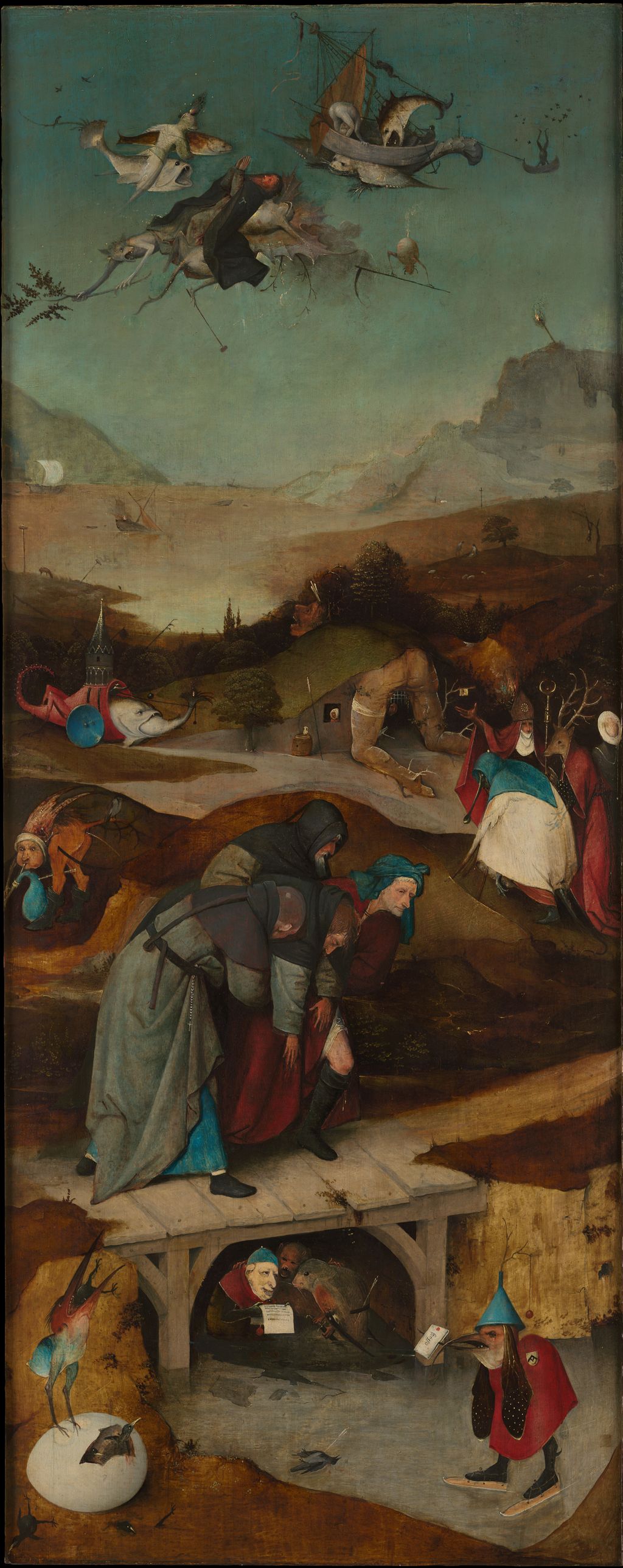
This panel is important because it refuses to make holiness look untouched. Anthony is not shown as an invulnerable figure who never suffers. He is battered and supported. His endurance is not the absence of pain, but the refusal to surrender to it. That distinction gives the triptych much of its emotional force. Bosch shows a saint who can be attacked, weakened and carried, yet not spiritually defeated.
The bridge or crossing motif also gives the scene moral tension. Anthony is being helped from one state to another, from assault toward renewed struggle. In Bosch's art, roads, bridges and thresholds often matter because they place human beings in motion through danger. The Wayfarer and the exterior of The Haywain Triptych also use travel as a moral condition. Here the crossing is not everyday pilgrimage but rescue after spiritual combat.
The left wing contains fire, airborne demons and unsettled terrain. It is tempting to treat each creature as a puzzle with a fixed meaning, but that approach weakens the painting. Bosch's symbolism works through pressure and relation rather than a simple dictionary. A flying hybrid, a burning structure or a damaged body may carry moral associations, but the larger point is how the panel makes the world feel hostile to contemplation. Anthony's sanctity is tested by interruption.
At the same time, the saint is not alone. The helpers around him are crucial. They make the panel less solitary than the central image. Human community appears as support, even in a painting so concerned with demonic danger. Bosch does not present the religious life as a fantasy of individual triumph only. In the midst of trial, hands assist the exhausted saint. The triptych's severity is therefore mixed with care.
The Central Panel: The Saint at the Still Point
The central panel is the triptych's visual and spiritual core. It is also the place where Bosch's invention is most elaborate. Around Anthony, demons gather across land, water and air. A ruined structure becomes a chapel and a stage; figures perform false rituals; monstrous bodies imitate religious, social and theatrical roles. The eye is pulled in every direction.
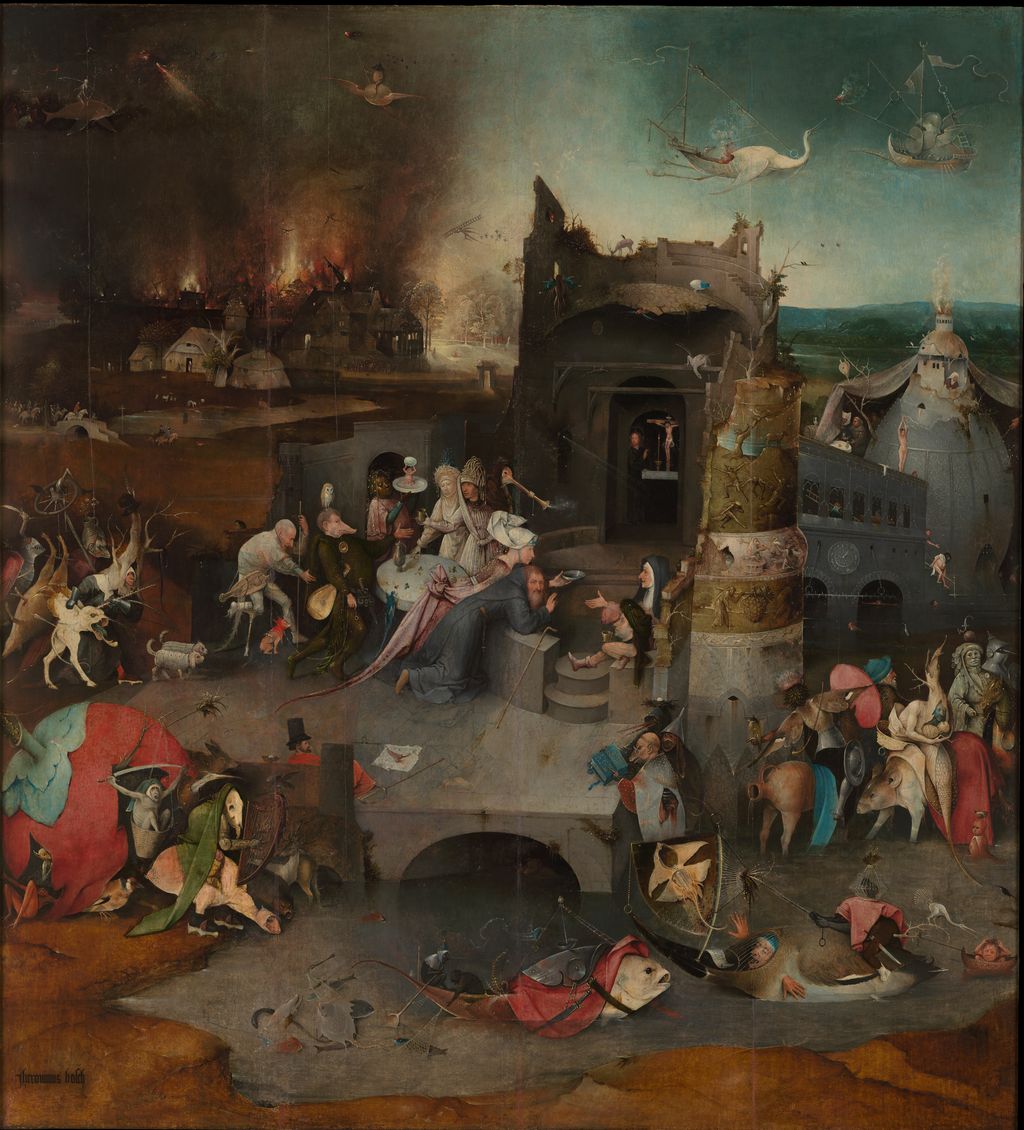
Yet Anthony himself is quiet. He kneels near the centre, turns toward the viewer and raises his hand in blessing. Behind him, inside the ruined chapel, Christ stands near an altar and crucifix, blessing in a gesture that Anthony echoes. The Bossche Encyclopedie summary of the BRCP catalogue tradition emphasizes this relationship: Anthony's gesture and gaze reassure the viewer because Christ is present behind the visible disorder.
The Clowes Collection catalogue, discussing a later copy of the central panel, makes the same visual point with particular clarity. In the Lisbon original, Anthony's calm gaze and gesture direct the viewer toward the small chapel where Christ appears. The viewer must move through the field of demonic distraction before finding that spiritual centre. That is not only an iconographic detail. It is an instruction in looking.
The central panel therefore stages temptation in two ways. Anthony is tempted by the scene around him, but the viewer is also tempted. The grotesque figures are fascinating. The eye wants to wander from one marvel to the next: a parody ceremony, a strange procession, a hybrid animal, a ruined tower, a fire, a body that seems to be both human and object. Bosch uses curiosity as part of the painting's religious mechanism. To look properly, the viewer must not stop at curiosity. The path through the image must eventually find Anthony and Christ.
This is why the chapel in the ruin is so important. The structure around it is broken, but the sacred presence remains. In Bosch's moral world, signs of salvation can be small, recessed or easy to miss. The central panel does not deny evil's force; it denies evil the final centre. Demons may fill the picture, but they do not occupy the deepest point of meaning.
The demonic activity around Anthony often parodies Christian order. False clerics, sham ceremonies and inverted sacred gestures appear among the crowd. Such details should be handled carefully, because Bosch is not offering a casual anti-religious joke. He is showing the horror of corrupted devotion. A parody Mass or false holy family matters precisely because the true sacred order is present nearby in the chapel. The painting's religious seriousness depends on the difference between imitation and truth.
The central panel also connects to medieval religious theatre and public performance. MASP's curatorial text on its related panel notes the banquet-like stage at the centre and relates the composition to sacred-popular theatre. The idea is persuasive when treated cautiously. Bosch's centre does feel staged: figures gather, perform, gesture and process as if temptation has become a public drama. But the painting is more than a theatre of monsters. It is a theatre of discernment, asking which spectacle deserves attention and which is meant to be resisted.
The Right Wing: False Beauty and Appetite
The right wing shifts the emphasis from assault to seduction. Here Satan's attack comes not only through violence but through the attractive surface of things. Bosch includes feminine beauty, food, social invitation and strange domestic or architectural forms. Anthony's temptation is not exhausted by horror. The world can also entice through pleasure.
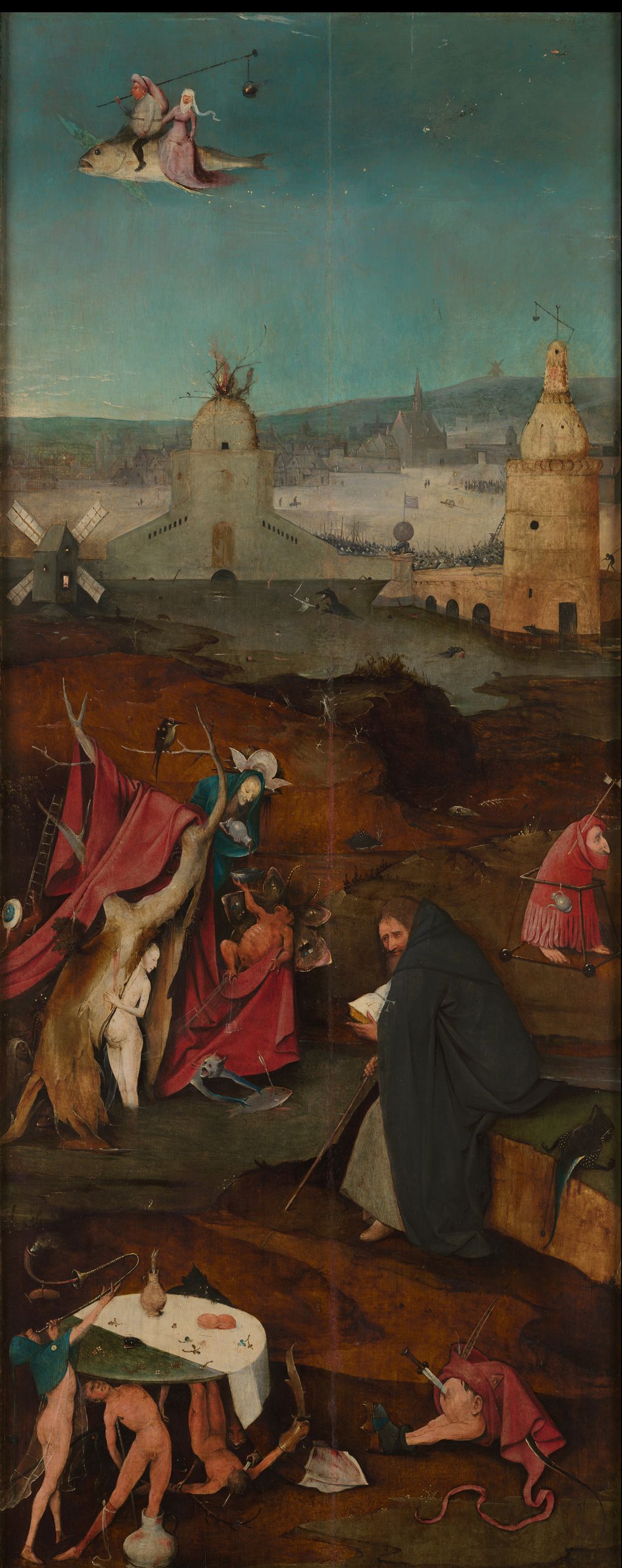
This side of the triptych is essential because it prevents a simple reading in which evil is always visibly ugly. Bosch's demons may be monstrous, but temptation often arrives under another guise. The MNAA specifically notes evil appearing either in the monstrous and hybrid or under false, provocative beauty. The right wing gives that claim pictorial force.
Anthony's monastic identity makes the right wing especially pointed. The saint's holiness depends on discipline: bodily restraint, prayer, withdrawal, endurance and attention to God. That is why food, sexuality, luxury and theatrical invitation are not random details. They are pressures aimed at the saint's chosen form of life. The hermit is tested by everything he has renounced.
The panel's world is unstable. Buildings behave strangely; figures look human and not human; ordinary objects seem caught in an atmosphere of temptation. As elsewhere in Bosch, the image works by making spiritual danger visible in material terms. Desire becomes costume, table, body, vessel, dwelling, animal and landscape.
The right wing also deepens the painting's account of Saint Anthony as a model of endurance. It is one thing to endure pain; it is another to withstand pleasure wrongly offered. Bosch shows both. The saint's resistance is not only courage under attack but discernment under attraction. That makes the triptych psychologically sharper than a simple battle between saint and devils.
Saint Anthony and Bosch's Devotional Culture
Saint Anthony was an ideal Boschian subject because his legend joins solitude, vision, bodily trial and spiritual perception. The desert is not empty in Anthony's story. It is crowded with imagined assaults, inner tests and demonic forms. For Bosch, that gave a way to paint temptation as both external spectacle and inward ordeal.
The subject also belonged to late medieval devotional culture. Anthony was associated with monastic endurance, healing, protection against disease and the care of suffering bodies. The Antonine order, known for tending those afflicted by Saint Anthony's fire, helped make the saint's image meaningful beyond abstract moral instruction. The Clowes catalogue notes that the Lisbon triptych may have been made for a monastery hospital, where the saint's perseverance would have carried particular force for viewers facing sickness and death.
Whether or not the first setting can be fixed with certainty, the devotional logic is clear. Anthony is not a superhero placed among monsters for entertainment. He is a figure of spiritual steadiness in a world of fear, pain and temptation. For a religious viewer, the painting could model endurance: look toward Christ, resist false spectacle, recognise evil even when it arrives disguised, and remain faithful through trial.
This devotional reading also helps correct a common modern misunderstanding of Bosch. His monsters are not free-floating fantasy. They belong to moral and religious thought. Bosch's paintings often expose sin through startling invention, but the shock serves a larger framework: pilgrimage, judgement, temptation, repentance, imitation of Christ and the danger of spiritual blindness.
Bosch's home city of 's-Hertogenbosch also matters. The surviving evidence for his life is sparse, but his biography places him in an urban world of family workshop practice, religious confraternities and devotional commissions. The Lisbon triptych is not a diary of Bosch's imagination. It is a highly crafted religious object made within a culture that expected images to teach, warn and move the viewer.
Demons Without a Symbol Dictionary
Few Bosch paintings make the problem of interpretation clearer than The Temptation of Saint Anthony. The triptych contains so many strange details that the viewer naturally wants to decode them. What does each hybrid mean? Why this animal, that vessel, this crumbling building, that flying fish, that false ceremony, that beautiful woman? The questions are good; the danger lies in answering too quickly.
A careful reading starts from the painting's larger structure. The triptych is about temptation, endurance and salvation. Its details should be read in relation to that structure, not as isolated riddles. A monster may embody spiritual threat, bodily appetite, false religion, social disorder or comic inversion, but its meaning depends on where it appears and what it does. Bosch's creatures are active participants in scenes, not labels attached to a diagram.
The central panel is a good example. The demonic crowd is not only a list of sins. It is a world of distraction. Its figures compete with Christ for the viewer's attention. The very abundance of detail becomes part of the temptation. Bosch makes the viewer experience the difficulty of focusing on the sacred amid spectacle.
The right wing works differently. Its temptations are more sensual and alluring. There, beauty itself becomes suspect, not because beauty is evil in itself, but because false beauty can mask spiritual harm. The left wing works differently again, with physical assault and rescue. The same triptych therefore gives at least three modes of demonic pressure: violence, distraction and seduction.
This is the best way to approach Bosch's wider Hell imagery as well. The demons are not merely sensational inventions. They make visible the disorder that Christian moral teaching locates in sin, appetite, pride, false worship and spiritual blindness. Bosch's originality lies in giving those conditions bodies and actions so vivid that the viewer cannot avoid them.
Technique, Surface and Close Looking
The Lisbon triptych has also become important within modern technical study of Bosch. The Bosch Research and Conservation Project and the Closer to Bosch platform identify The Temptation of Saint Anthony as catalogue number 4 and provide a route for high-resolution and technical comparison within the Bosch corpus. That modern research context matters because Bosch's art depends on close looking, and close looking now includes scientific and conservation methods as well as iconography.
Technical study can clarify how a composition was made, whether underdrawing is exploratory or mechanical, how panels were constructed, and how later copies relate to an original. In Bosch studies, these questions are central because his imagery was copied so widely. A work can look Boschian in subject while differing in method, handling or support. That is why style and technique and workshop and attribution belong close to any discussion of Saint Anthony.
The painting's surface also supports its meaning. Bosch moves between minute precision and broad theatrical arrangement. Some details demand microscopic attention; others work through the whole triptych's movement from closed Passion scenes to open temptation. The viewer is asked to oscillate between detail and structure. That oscillation is not incidental. It is part of the experience of temptation: the detail fascinates, while the structure gives judgment.
Modern imaging platforms can intensify that experience by allowing viewers to study demons, gestures, ruined architecture and underdrawn passages more closely. But higher resolution does not by itself produce better interpretation. It can even increase the temptation to detach details from the whole. The safest approach is to move back and forth: examine the creature, then ask what role it plays in the panel; examine the gesture, then ask how it relates to Anthony and Christ; examine the copy, then ask what it preserves, changes or omits.
Copies, Versions and After-Bosch Saint Anthony
The Lisbon triptych was not an isolated invention that disappeared into one museum. It became a source for copies, variants and after-Bosch images. This afterlife is one of the strongest pieces of evidence for the subject's power in the sixteenth century.
The Clowes Collection catalogue identifies its Temptation of St. Anthony as a follower's copy of the Lisbon triptych's central panel, made after 1531. It preserves the main figures but simplifies the composition and omits some marginal details. Its omissions are revealing. In the Lisbon original, Christ appears inside the chapel, giving the central panel its spiritual focus. The Clowes catalogue notes that this crucial presence is missing in the Clowes version, as it is in some other copies, changing the way the scene works.
That point is important for reception. Later viewers and owners could be fascinated by Bosch's grotesque world while reducing or altering the devotional centre. The copy may still be visually exciting, but the balance shifts. Without Christ in the chapel, Anthony risks becoming a figure inside a strange fantasy rather than a saint whose gaze leads the viewer toward salvation.
MASP's related Temptations of St. Anthony in Sao Paulo adds another layer. Its collection text records at least sixteen known versions of the composition and describes the Lisbon triptych as the signed model for the group. The MASP work has sometimes been discussed as a possible preparatory version, early version or copy, depending on the scholar. The museum's own text is careful to show the debate rather than settle it too quickly. For this Lisbon-focused article, MASP is most useful as evidence of the composition's long and complicated reception.
The Rijksmuseum holds a painting catalogued as a copy after Jheronimus Bosch, dated c. 1530-c. 1600. Its record identifies the work as a copy after the central group of figures from the Lisbon triptych and notes that many copies are known. This confirms that the Lisbon image became a repeatable Boschian model. It also shows why attribution language matters. A later copy can be historically important without being Bosch's own hand.
The Prado's Temptations of Saint Anthony Abbot is another related object, but it is not the Lisbon triptych. The Prado labels it "Workshop of Hieronymus Bosch" and dates it 1510-1515. Its text compares the saint's habit, Tau cross and rosary with the Lisbon triptych, then discusses whether the panel may copy a lost Bosch original or derive from workshop models. Such material helps readers understand the Boschian Saint Anthony tradition, but it should not be folded into the Lisbon object as if all versions had the same status.
Prints extended the afterlife still further. The Metropolitan Museum of Art preserves an etching after Bosch by Jan and Lucas van Doetecum, and another Met record for a 1561 Temptation of St. Anthony notes that Hieronymus Cock published prints after Bosch at a time when Bosch's name and imagery remained highly popular. The National Gallery of Art also holds the 1561 etching and engraving after Bosch by Johannes and Lucas van Doetechum, published by Cock, with public-domain media. These prints are central to Bosch prints as reception, not as autograph printmaking.
The copy and print tradition tells a larger story. Bosch's Saint Anthony offered later artists and buyers a portable formula: a holy figure, a landscape or architectural setting, a swarm of hybrid beings, a field of temptation and a moral warning. Some later makers preserved the devotional lesson. Others leaned harder into the grotesque. Across the sixteenth century, Saint Anthony became one of the ways Bosch's imagination circulated as a style.
Saint Anthony, the Garden and the Haywain
The Lisbon triptych becomes clearer when placed next to Bosch's other major works. Like The Garden of Earthly Delights, it fills the field with figures that seem at once comic, beautiful, threatening and morally charged. Like The Haywain Triptych, it turns human appetite into a public drama. Like The Last Judgement, it treats demonic invention as part of a larger Christian account of sin and consequence.
But The Temptation of Saint Anthony is more concentrated than those works because it has a single holy protagonist. The Garden's central panel contains no obvious saintly anchor; Haywain's crowd moves socially; Last Judgement unfolds at cosmic scale. In Lisbon, the viewer repeatedly returns to Anthony. He is not the largest or most visually spectacular figure, but he is the spiritual centre.
That difference changes the role of monstrosity. In the Garden, the strange bodies and actions can feel like a whole world of desire and disorder. In Haywain, grotesque invention serves a moral procession toward Hell. In Saint Anthony, the monsters press against a person. The question is not only "What kind of world is this?" but "How does one remain faithful inside it?"
The triptych also has a distinctive relation to Bosch's biography and reputation. Saint Anthony seems to have been a recurrent theme for Bosch and his circle, with autograph, workshop, copy and after-Bosch material forming a dense cluster around the subject. That density fits Bosch's reputation as a painter of temptations, demons and moral trials. Yet the Lisbon painting shows that his originality was devotional as much as fantastic. The monsters matter because Anthony does not yield to them.
Why the Lisbon Triptych Still Matters
The Lisbon Temptation of Saint Anthony remains one of Bosch's most important paintings because it gathers many of his strongest qualities into one coherent work. It has triptych structure, Passion framing, saintly narrative, grotesque invention, social satire, spiritual testing, technical complexity and a long reception through copies and prints. It is a flagship Bosch painting not only because it is strange, but because its strangeness is so firmly organised around endurance.
The painting also rewards modern viewers who may not share its original devotional assumptions. Even outside a medieval Christian framework, the image of a person holding attention amid spectacle remains powerful. Bosch imagines a world where every surface competes for the eye: horror, beauty, appetite, parody, violence, novelty and noise. Anthony's calm becomes an image of resistance to distraction.
Recent Portuguese scholarship has returned to that encounter from the painting's Lisbon setting. Joao Constancio's open-access IFILNOVA volume Sobre o Absurdo begins from the experience of sitting before the triptych at the MNAA and asks whether naming its religious themes fully removes the sense of being in an unknown land. That question is apt. Bosch's painting is grounded in Christian legend, but it keeps the viewer in a state of searching.
At the same time, the painting should not be secularised into a generic psychological allegory. Its structure is explicitly Christian. The closed wings show Christ's Passion. The central panel leads the eye to Christ in the chapel. Anthony's blessing echoes Christ's blessing. The saint's endurance makes sense within a theology of imitation, temptation and salvation. To read the work carefully is to let that devotional structure remain visible.
The copies and later prints also make the Lisbon triptych historically important. A painting that generated so many related images shaped how later Europe imagined "Bosch." It helped turn his name into a language of demons, temptations and moral fantasy. Yet the original is more disciplined than the later Boschian brand can suggest. Its monsters are not the centre. They are the test.
That is the painting's lasting challenge. The viewer enters through spectacle, but the triptych asks for discernment. Look at the demons, but do not stop there. Notice the false beauty, but do not be captured by it. Follow Anthony's gesture into the ruin and find the small figure of Christ. Bosch's art is often described as bizarre, fantastical or nightmarish; in the Lisbon Temptation of Saint Anthony, it is also quietly severe. It teaches the eye how temptation works, and then asks whether the eye can look past it.
Artworks and related attributions
Browse paintings, drawings and related attributions. Records group triptychs, fragments and two-sided sheets where appropriate. Dates follow the cited museum records or catalogue headings and are generally estimates. Rows marked “2016 catalogue” report that publication’s attribution and collection information; these are dated opinions, rather than a claim that every work is an accepted autograph Bosch.
| Name | Date | Medium, attribution and collection |
|---|---|---|
| A Crossbowman | Second half of the sixteenth century | Oil on oak panel · Copy after Hieronymus Bosch · Museo Nacional del Prado, Madrid · P002695 Source 1. Source 2. |
| A Woman Spinning and an Old Woman | Museum estimates: about 1480–1490 for the women and 1500–1505 for the reverse; the precise chronology is disputed | Pen and brown and grey ink on the front; pen and brown ink on the reverse · Hieronymus Bosch · Museum Boijmans Van Beuningen, Rotterdam · N 190 recto and verso (PK) Source 1. Source 2. |
| Adoration of the Child in Cologne | Second half of the sixteenth century | Oil on oak panel · Imitator of Hieronymus Bosch, in the city collection record · Wallraf-Richartz-Museum & Fondation Corboud, Cologne · WRM 0474 Source 1. Source 2. |
| Adoration of the Magi in Philadelphia | Early sixteenth century in the museum record; around 1495–1520 in the BRCP catalogue | Oil on oak panel · Hieronymus Bosch in the museum record; workshop of Bosch in the 2016 BRCP catalogue · Philadelphia Museum of Art, John G. Johnson Collection, 1917 · 1321; museum object 103592 Source 1. Source 2. |
| Adoration of the Magi — New York | c.1470–1480 | 2016 catalogue: Bosch; oil on oak · Metropolitan Museum 13.26 2016 catalogue. |
| Adoration of the Magi — Prado triptych | c.1494 | Oil on oak; grisaille exterior · Bosch · Prado P002048 Object source. |
| Adoration of the Magi — three associated fragments | c.1515–1535 | 2016 catalogue: Follower of Bosch · Two Shepherds / Retinue in Philadelphia; associated Adoration in private collection in 2016 2016 catalogue. |
| Ascent of the Blessed — Venice | c.1505–1515 | Oil on panel · Bosch · Gallerie dell’Accademia; Visions of the Hereafter Object source. |
| Battle of the Birds and Mammals | Not specified in catalogue heading | 2016 catalogue: Bosch; pen and brown ink · Berlin KdZ 14715 2016 catalogue. |
| Beggars and Musicians | Around 1530–1540 | Ink and wash on paper · Unknown follower of Hieronymus Bosch · Albertina, Vienna · 7798 Source 1. Source 2. |
| Christ Carrying the Cross Drawing | Around 1470 in the museum catalogue | Black chalk or charcoal, pen and brush in brown ink, white corrections · Anonymous, workshop of Rogier van der Weyden · Museum Boijmans Van Beuningen, Rotterdam · N 81 recto and verso (PK) Source 1. Source 2. |
| Christ Carrying the Cross in Vienna | Around 1490–1510 in the current KHM record and BRCP catalogue | Oil on oak, painted on both sides · Hieronymus Bosch; possible workshop involvement in the Passion side discussed by the BRCP · Kunsthistorisches Museum, Vienna · Gemäldegalerie, GG 6429 Source 1. Source 2. |
| Christ Carrying the Cross — El Escorial | c.1495–1505 | 2016 catalogue: Bosch; oil on oak · Patrimonio Nacional 10014739 2016 catalogue. |
| Christ Carrying the Cross — Ghent | c.1510–1516 (museum) | Oil on panel · Bosch in museum listing; authorship disputed · MSK Ghent 1902-H Object source. |
| Christ Mocked — London | c.1510 | Oil on wood · Bosch · National Gallery NG4744 Object source. |
| Concert in the Egg, After Hieronymus Bosch | Around 1561; third quarter of the sixteenth century | Oil on canvas · Anonymous, after Hieronymus Bosch · Palais des Beaux-Arts, Lille · P 816 Source 1. Source 2. |
| Conjurer / Comical Concert — Louvre drawing | Not specified in catalogue heading | 2016 catalogue: Bosch (recto), follower (concert verso) · Pen and brown ink · Louvre INV 19197 2016 catalogue. |
| Conjurer / Cross-bearing and beggars — Liège sheet | Not specified in catalogue heading | 2016 catalogue: Bosch (verso), follower (recto) · Pen and brown ink · Album d’Arenberg 534 2016 catalogue. |
| Crowning with Thorns — El Escorial | c.1530–1540 | 2016 catalogue: Follower of Bosch; oil on oak · Patrimonio Nacional 10014743 2016 catalogue. |
| Crucifixion with a Donor | Circa 1495–1505; Circa 1490–1500 | Oil on oak panel · Hieronymus Bosch · Royal Museums of Fine Arts of Belgium, Brussels · 6639 Source 1. Source 2. |
| Death and the Miser Drawing | Not securely established; probably made after the painting | Pen and brush, dark ink and white highlights on prepared paper · Workshop of Hieronymus Bosch in the BRCP catalogue; alternatives recorded by the Louvre · Musée du Louvre, Department of Prints and Drawings, Paris · RF 6947, Recto Source 1. Source 2. |
| Death and the Miser — Washington | c.1485/1490 (NGA) | Oil on panel · Bosch · National Gallery of Art 1952.5.33 Object source. |
| Ecce Homo Triptych — Boston | c.1495–1500; wings c.1500/1503 | 2016 catalogue: Workshop of Bosch; oil on oak · Museum of Fine Arts Boston; several production phases 2016 catalogue. |
| Ecce Homo — Frankfurt | c.1490 | Mixed technique on oak · Bosch · Städel 1577 Object source. |
| Fall of the Damned — Venice | c.1505–1515 | 2016 catalogue: Bosch; oil on panel · Visions of the Hereafter · Venice 2016 catalogue. |
| Garden of Earthly Delights | 1490–1500 (Prado) | Oil on oak; grisaille exterior · Bosch · Prado; triptych Object source. |
| Gluttony and Lust / Allegory of Intemperance — Yale fragment | c.1500–1510 (group dating) | 2016 catalogue: Bosch; oil on oak · Yale 1959.15.22; fragment associated with Ship of Fools 2016 catalogue. |
| Group of Ten Spectators, a Follower of Bosch | Around 1510–1540 in the current museum record | Pen and two brown inks on paper, with a brown framing line · Follower of Hieronymus Bosch in the Morgan record; Bosch in the BRCP catalogue · Morgan Library & Museum, New York · I, 112 Source 1. Source 2. |
| Head of an Old Woman | About 1500 | Oil on panel · Attributed to Jacob Cornelisz. van Oostsanen · Museum Boijmans Van Beuningen, Rotterdam · 2439 (OK) Source 1. Source 2. |
| Hell and the Flood — Rotterdam panels | Around 1515 in the museum records; around 1510–1520 in the BRCP catalogue | Oil on oak panels · Jheronimus Bosch in the museum records; workshop of Bosch in the BRCP catalogue · Museum Boijmans Van Beuningen, Rotterdam Source 1. Source 2. |
| Hermit Saints Triptych | Circa 1495–1505 | Oil on oak panels · Hieronymus Bosch · Gallerie dell’Accademia, Venice · 2044 Source 1. Source 2. |
| Infernal Landscape | Not specified in catalogue heading | 2016 catalogue: Bosch; pen and brown ink, red accent · Private collection in 2016 2016 catalogue. |
| Infernal Scene with Anvil / Monster Studies | Not specified in catalogue heading | 2016 catalogue: Bosch; attribution debated in entry · Pen and brown ink · Berlin KdZ 548 2016 catalogue. |
| Infernal Scene with Tree-Man / Standing Man | Not specified in catalogue heading | 2016 catalogue: Workshop of Bosch; pen and brown ink · Dresden C 1875; historical reverse title includes a proposed prophet 2016 catalogue. |
| Job Triptych — Bruges | c.1510–1520 | 2016 catalogue: Workshop of Bosch; oil on oak · Groeningemuseum / Hoeke loan in 2016 2016 catalogue. |
| Last Judgement — Bruges triptych | c.1495–1505 | 2016 catalogue: Bosch; oil on oak · Groeningemuseum 2016 catalogue. |
| Last Judgement — Munich fragment | c.1530–1540 | 2016 catalogue: Follower of Bosch; oil on oak · Alte Pinakothek 5752 2016 catalogue. |
| Last Judgement — Vienna triptych | c.1500–1505 (BRCP 2016) | Oil on oak · Bosch and workshop (BRCP 2016) · Academy of Fine Arts Vienna 2016 catalogue. |
| Man in a Basket and Comic Figures | Around 1500–1515 in the museum record | Pen and brown ink on paper; the reverse is catalogued as iron-gall ink · Hieronymus Bosch in the current Albertina record; attribution has been debated · Albertina, Vienna · 7797 recto and verso Source 1. Source 2. |
| Man Seen from Behind | About 1550–1569; About 1565–1570 | Traces of black chalk, pen and brush in light brown ink · Anonymous, circle of Pieter Bruegel the Elder · Museum Boijmans Van Beuningen, Rotterdam Source 1. Source 2. |
| Mary and John at the Foot of the Cross | About 1440 | Brush in grey and black · Unknown, possibly Netherlandish · Kupferstich-Kabinett, Staatliche Kunstsammlungen Dresden · C 815 Source 1. Source 2. |
| Model Sheet with ‘Witches’ | Disputed; proposals depend on the attribution | Pen and brown ink; the BRCP also records underlying black chalk · Hieronymus Bosch; follower attributions also recorded · Musée du Louvre, Département des Arts graphiques, Paris · INV 19721 recto Source 1. Source 2. |
| Peasant and Three Bust-Length Figures | 1401–1500 | Brown pen over a black preliminary drawing · Attributed to the Master of the Drapery Studies; Bosch circle also recorded · Kupferstichkabinett, Staatliche Museen zu Berlin · KdZ 777 Source 1. Source 2. |
| River to Hell — Venice | c.1505–1515 | 2016 catalogue: Bosch; oil on panel · Visions of the Hereafter · Venice 2016 catalogue. |
| Saint Anthony and a Concert in an Egg | Around 1510–1525 in the museum’s 2016–17 exhibition texts | Pen in light and dark brown inks · Workshop of Hieronymus Bosch; underlying monsters: Bosch (BRCP), possibly Bosch (exhibition text) · Kupferstichkabinett, Staatliche Museen zu Berlin · KdZ 711 recto and verso Source 1. Source 2. |
| Saint Christopher Carrying the Christ Child | c.1500; 1490–1505 in restoration material | Oil on panel · Bosch · Boijmans St 26 Object source. |
| Saint James and Hermogenes | About 1551–1575 in the KIK-IRPA catalogue | Oil on wood, painted on both sides · Anonymous follower of Hieronymus Bosch · Musée des Beaux-Arts, Valenciennes · P.46.1.44; older number 176 Source 1. Source 2. |
| Saint Jerome at Prayer | Circa 1485–1495 | Oil on oak panel · Hieronymus Bosch · Museum of Fine Arts, Ghent · 1908-H Source 1. Source 2. |
| Saint John on Patmos / Passion Scenes | c.1495–1505; estimates vary | Oil on oak · Bosch · Gemäldegalerie Berlin 1647A Object source. |
| Saint John the Baptist in Meditation | Late 15th century; c.1485–1510 (Prado exhibition) | Oil on panel · Bosch · Lázaro Galdiano 8155 Object source. |
| Saint Liberata Triptych | Circa 1495–1505 | Oil on oak panels · Hieronymus Bosch · Gallerie dell’Accademia, Venice · 2045 Source 1. Source 2. |
| Seven Deadly Sins and the Four Last Things | 1505–1510 (Prado) | Oil on poplar · Bosch (Prado); workshop/follower disputed · Prado Object source. |
| Ship of Fools — Louvre painting | 1475–1500 (record); c.1505–1515 (exhibition) | Oil on oak · Bosch · Louvre RF 2218; fragment Object source. |
| Ship of Fools — Louvre workshop drawing | Not specified in catalogue heading | 2016 catalogue: Workshop of Bosch · Pen, brush, grey-brown ink and white highlights on prepared paper · Louvre RF 3714 2016 catalogue. |
| Studies of Monsters | About 1530–1550, according to the current Ashmolean record | Pen and brown ink on laid paper, both faces · Anonymous follower of Hieronymus Bosch · Ashmolean Museum, University of Oxford · WA1863.155 Source 1. Source 2. |
| Studies of Saint Anthony and Monsters | No execution date specified in the current Louvre records | Pen and brown ink on paper · Bosch listed; reverse questioned by Louvre; BRCP accepts both faces · Musée du Louvre, Département des Arts graphiques, Paris · INV 20871 recto and verso Source 1. Source 2. |
| Temptation of Saint Anthony — Kansas City fragment | c.1500–1510 | 2016 catalogue: Bosch; oil on oak · Nelson-Atkins 35–22 2016 catalogue. |
| Temptation of Saint Anthony — Lisbon triptych | c.1500 | Oil on oak · Bosch · Museu Nacional de Arte Antiga 1498 Pint Museum. |
| Temptation of Saint Anthony — Prado panel | c.1530–1540 | 2016 catalogue: Follower of Bosch (2016 opinion); oil on oak · Prado P002049 2016 catalogue. |
| Terrestrial Paradise | Approximately 1505–1515 | Oil on oak panel · Hieronymus Bosch · Gallerie dell'Accademia, Venice Source 1. Source 2. |
| The Burning Ship Drawing | 1500–1520 | Pen and iron gall ink on paper · Attributed to Hieronymus Bosch · Academy of Fine Arts Vienna, Graphic Collection · HZ-2554; numbered 2554 in the BRCP catalogue Source 1. Source 2. |
| The Comical Barber Scene | About 1550–1580, according to the British Museum | Pen and brown ink, grey and brown wash, over black chalk · Anonymous follower, after Hieronymus Bosch · British Museum, Department of Prints and Drawings, London · 1854,0628.46 Source 1. Source 2. |
| The Conjuror, After Hieronymus Bosch | Probably after 1525; around 1530–1540 in the BRCP technical report | Oil on oak panel · Anonymous follower of Hieronymus Bosch · Musée Ducastel-Vera, Saint-Germain-en-Laye · 872.1.87 Source 1. Source 2. |
| The Cure of Folly / Extraction of the Stone of Madness | 1501–1505 (Prado) | Oil on oak · Bosch (Prado); workshop/follower disputed · Prado P002056 Object source. |
| The Entombment Drawing | About 1505–1515, current museum record | Brush and black and grey ink, with grey wash, over black chalk · Workshop of Hieronymus Bosch; drawn by the Master of the Prado Haywain Triptych; Hieronymus Bosch, argued by the BRCP in 2016 · British Museum, Department of Prints and Drawings, London · 1952,0405.9 Source 1. Source 2. |
| The Gathering of the Birds | Not specified in catalogue heading | 2016 catalogue: Bosch; pen and brown ink · Berlin KdZ 13136 2016 catalogue. |
| The Haywain — Prado triptych | 1510–1516 (BRCP 2016) | Oil on oak · Bosch (BRCP 2016) · Prado; separate Escorial version exists 2016 catalogue. |
| The Hearing Forest and the Seeing Field | Circa 1500–1505 | Pen and brown ink on paper · Hieronymus Bosch; reverse: Bosch and workshop · Kupferstichkabinett, Staatliche Museen zu Berlin · KdZ 549, front and reverse Source 1. Source 2. |
| The Owl’s Nest — Rotterdam | Not specified in catalogue heading | 2016 catalogue: Bosch; pen and brown ink · Boijmans N 175 2016 catalogue. |
| The Passion Triptych in Valencia | Workshop of Bosch, about 1510–1520; Follower of Bosch; centre about 1530–1540, wings about 1540–1550 | Oil and gold on oak panels · Workshop of Bosch, about 1510–1520; Follower of Bosch; centre about 1530–1540, wings about 1540–1550 · Museu de Belles Arts de València Source 1. Source 2. |
| The Pedlar / Wayfarer — Rotterdam | c.1500 (museum) | Oil on panel · Bosch · Boijmans 1079 (OK); rejoined exterior Object source. |
| The Tree-Man — Vienna drawing | c.1505 | Pen and brown ink · Bosch · Albertina, Vienna Object source. |
| The Wedding at Cana, After Hieronymus Bosch | Approximately 1560 in the current museum record | Oil on panel, 93 cm high × 72 cm wide · Anonymous, after Hieronymus Bosch · Museum Boijmans Van Beuningen, Rotterdam, St 25 Source 1. Source 2. |
| Two Fantastical Creatures — Berlin KdZ 550 | Around 1505–1515 in the museum’s 2016 exhibition text | Pen in brown ink on reddish prepared laid paper · Hieronymus Bosch · Kupferstichkabinett, Staatliche Museen zu Berlin · KdZ 550, recto and verso Source 1. Source 2. |
| Two Figures Wearing Mitres | About 1480 | Oil on panel · Anonymous (Boijmans); Bosch circle (RKD) · Museum Boijmans Van Beuningen, Rotterdam · 1177 (OK) Source 1. Source 2. |
| Two Men and the Temptation of Eve | About 1505–1515 in the Prado’s 2016 exhibition guide | Pen and grey-brown ink on paper · Hieronymus Bosch in the 2016 catalogues discussed here · Private collection, as recorded in 2016 Source 1. Source 2. |
| Two Men Fighting | Not specified in the current Louvre record | Pen and brown ink · In the manner of Hieronymus Bosch · Musée du Louvre, Département des Arts graphiques, Paris · INV 20660 recto; formerly NIII 8896 and MA 8400 Source 1. Source 2. |
| Two Men — Berlin KdZ 5210 | Not specified in catalogue heading | 2016 catalogue: Bosch questioned · Pen, brush, ink, chalk and white highlights · Berlin KdZ 5210; historical title Two Oriental Men 2016 catalogue. |
| Two Monsters — Berlin KdZ 547 | Approximately 1500–1510 in Berlin's 2016 exhibition catalogue; an estimated range | Pen and brown ink on paper · Hieronymus Bosch · Kupferstichkabinett, Staatliche Museen zu Berlin · KdZ 547, drawn on both sides Source 1. Source 2. |
Frequently Asked Questions
The Temptation of Saint Anthony belongs to the Museu Nacional de Arte Antiga in Lisbon, inventory 1498 Pint.[3]
The MNAA records Bosch’s signature at the lower left of the central panel. The museum identifies the work as Bosch’s triptych.[3]
The triptych is usually dated around 1500 in the museum information discussed here. The estimate should not be turned into a precise documented year.[3]
It is painted in oil on oak, with a central panel and two wings that also carry exterior paintings. The MNAA gives 131.5 × 119 cm for the centre and 131.5 × 53 cm for each wing.[3]
Discussion
Find the saint’s still point within the three panels and their painted exterior.
Reader Insights
Where do you first find the saint among the surrounding activity?
Compare his stillness with the movement in the wings.
How does the closed exterior alter your reading of the open scenes?
Join the Conversation
Share a detail, comparison or question about Temptation of Saint Anthony below.
References
- BRCP Catalogue Raisonné (2016), object dates in catalogues 1, 2, 8, 15 and 20; catalogue 20 object metadata only for the Haywain comparison. View source
- Staatliche Museen zu Berlin, 2016 exhibition wall texts, p. 3: approximate date of KdZ 549. View source
- MNAA Museu Nacional de Arte Antiga, Temptations of St. Anthony: View source
- Google Arts & Culture / MNAA, The Temptations of St. Anthony: View source
- Closer to Bosch, Bosch Research and Conservation Project platform: View source
- Bossche Encyclopedie / Bosch Project, The Temptation of Saint Anthony: View source
- IFILNOVA, Joao Constancio, Sobre o Absurdo: View source
- MASP, The Temptations of St. Anthony: View source
- Clowes Collection, Temptation of St. Anthony: View source
- Museo Nacional del Prado, The Temptations of Saint Anthony Abbot: View source
- Rijksmuseum, The Temptation of St Anthony: View source
- The Metropolitan Museum of Art, The Temptation of St. Anthony, after Hieronymus Bosch, Jan and Lucas van Doetecum: View source
- The Metropolitan Museum of Art, The Temptation of St. Anthony, 1561, after Hieronymus Bosch: View source
- National Gallery of Art, Washington, The Temptation of Saint Anthony, Johannes and Lucas van Doetechum after Hieronymus Bosch: View source
- Royal Museums of Fine Arts of Belgium / Google Arts & Culture, The Temptation of Saint Anthony, atelier of Bosch: View source