 by Tom Gurney
Tom Gurney BSc (Hons) is an art history expert with over 20 years experience
Page Created on / Page Updated on
Email: tomgurney1@gmail.com / Phone: +44 7429 011000
Young Sick Bacchus by Caravaggio
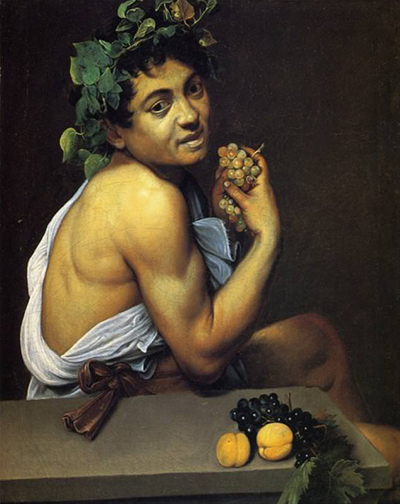
The young man in Caravaggio's Young Sick Bacchus wears an ivy wreath and holds pale grapes toward the viewer. His skin looks cool beside the vivid fruit, a contrast that helped give the picture its familiar “sick” title. The Galleria Borghese, which owns the canvas, catalogues it as an early work of about 1595 and identifies the figure as Bacchus, the wine god. It treats the suggestion that the painter portrayed himself while recovering from illness as an interpretation, not a proven medical record contained in the image.[1]
The painting is also called Self-Portrait in the Guise of Bacchus. Those names carry questions. Is the face Caravaggio's? Does its colour reflect sickness, lighting, pigment condition or artistic choice? What does the fruit mean? The museum's detailed record allows these questions to be asked without presenting every answer as settled fact.[1]
Caravaggio in context
The Cardsharps
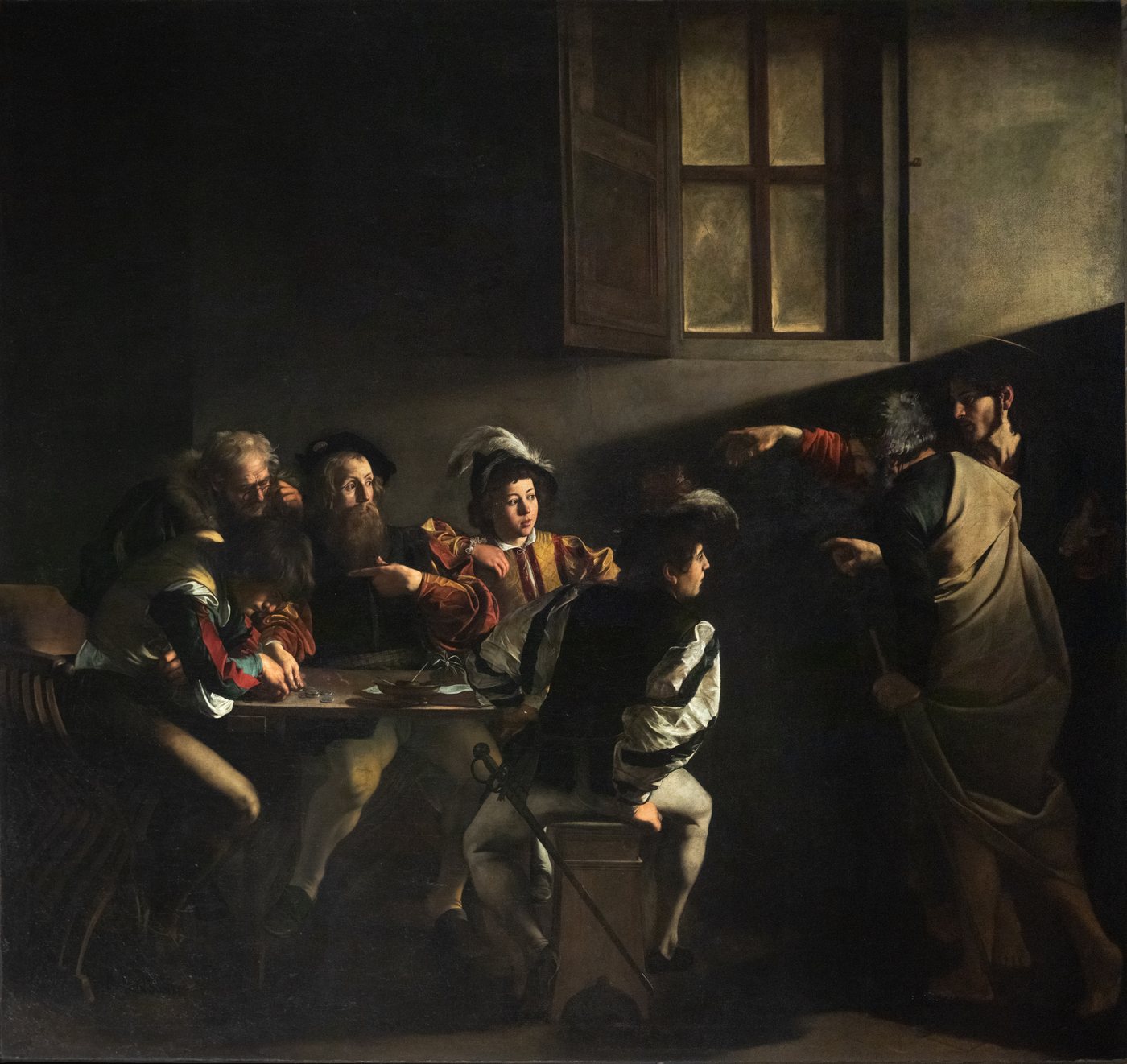
c.1595Calling of Saint Matthew
1599–1600Supper at Emmaus
1601At a Glance
- ArtistMichelangelo Merisi da Caravaggio[1]
- TitleYoung Sick Bacchus (Bacchino malato); also Self-Portrait in the Guise of Bacchus[1]
- Dateabout 1595 in the Galleria Borghese catalogue[1]
- Mediumoil on canvas[1]
- Dimensions67 × 53 cm, height × width[1]
- CollectionGalleria Borghese, Rome, inventory 534[1]
- Early collection routeGiuseppe Cesari before 1607; transferred to Scipione Borghese after the 1607 confiscation[1]
Contents
- The Figure and the Grapes
- Why “Sick” Appears in the Title
- Is This a Self-Portrait?
- Other Ways Scholars Have Read the Fruit and Figure
- When Was the Painting Made?
- Bacchus as an Early Subject
- The Cesari and Borghese History
- Peterzano and Caravaggio's Early Visual Sources
- What Material Study Can Tell Us
- Can the Complexion Identify an Illness?
- Did Later Artists Respond to the Picture?
- Comparing the Uffizi Bacchus
- Frequently Asked Questions
Look closer: Young Sick Bacchus
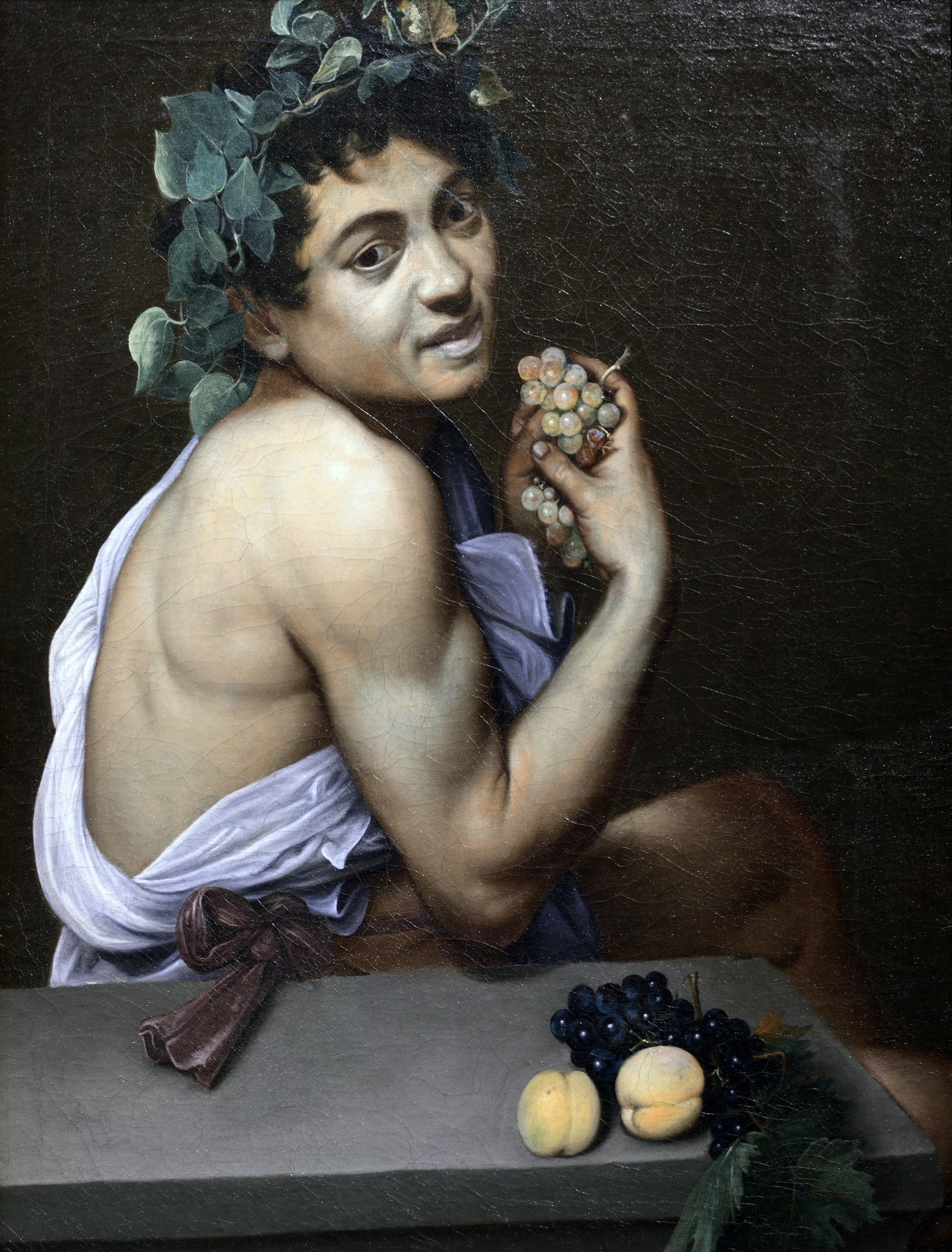
The figure turns toward the viewer with grapes in hand. These details set the cool facial tones against the fruit and folded cloth.
 123
Details from Young Sick Bacchus
Select a detail image to open the full-size gallery, then use the arrows to compare views.
Face and leaf crown
The figure’s face is cool in tone beneath a crown of broad leaves, with the eyes turning outward.
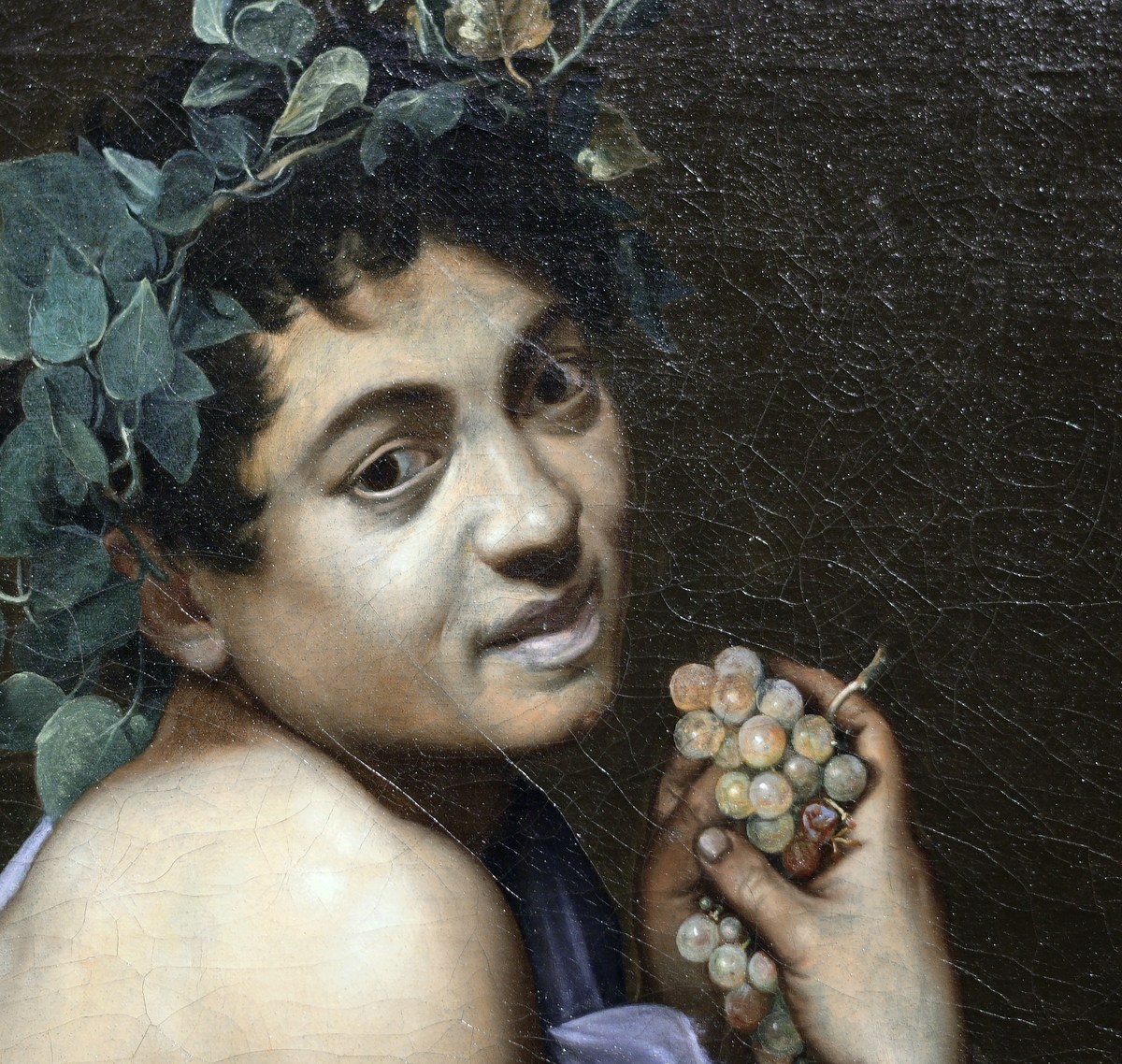
Grapes in the hand
One hand grips a bunch of pale grapes beside the cheek, bringing the fruit close to the body.
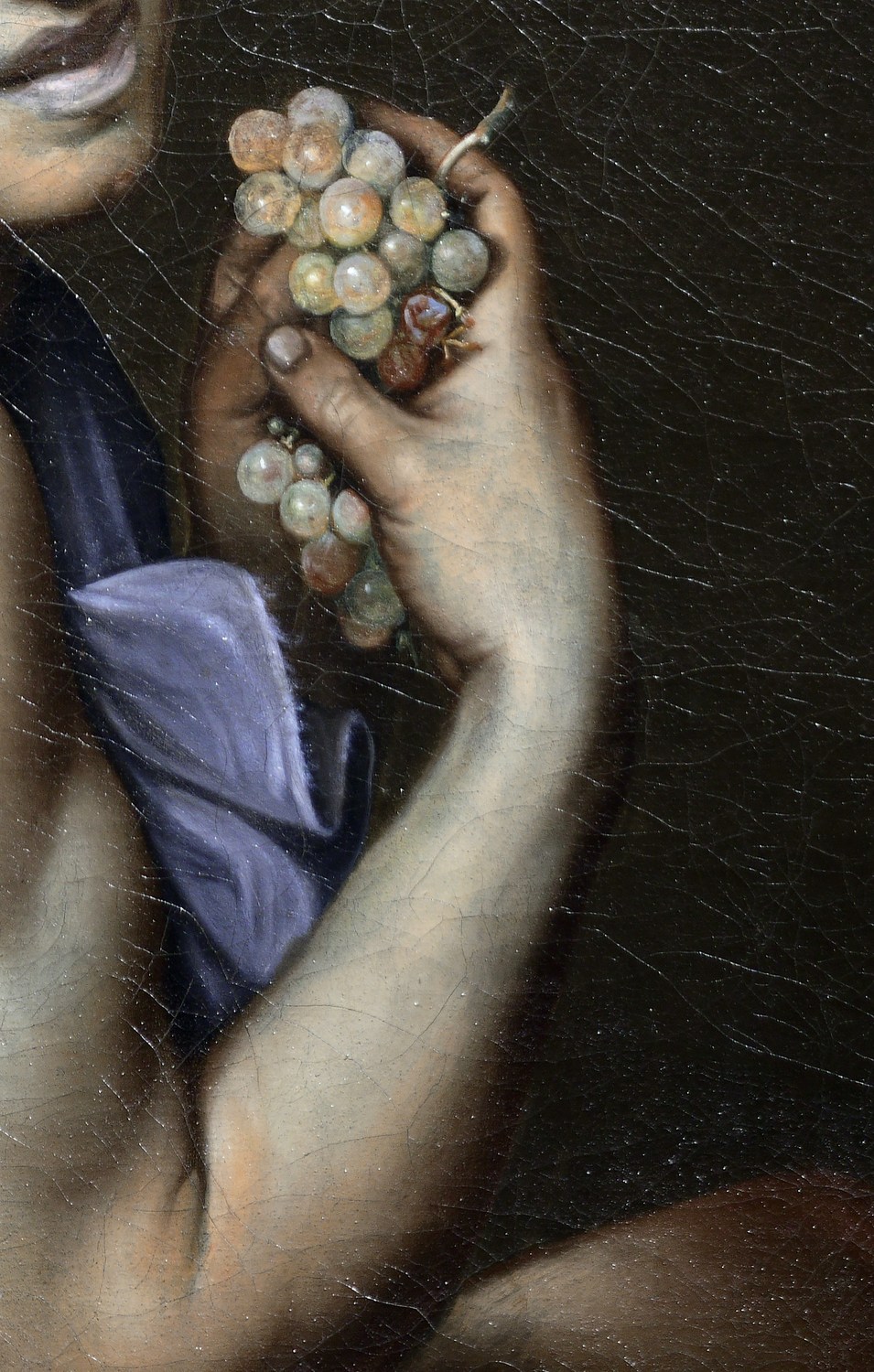
Fruit on the table
Dark grapes and two pale fruits rest on the stone surface below the figure’s wrapped arm.
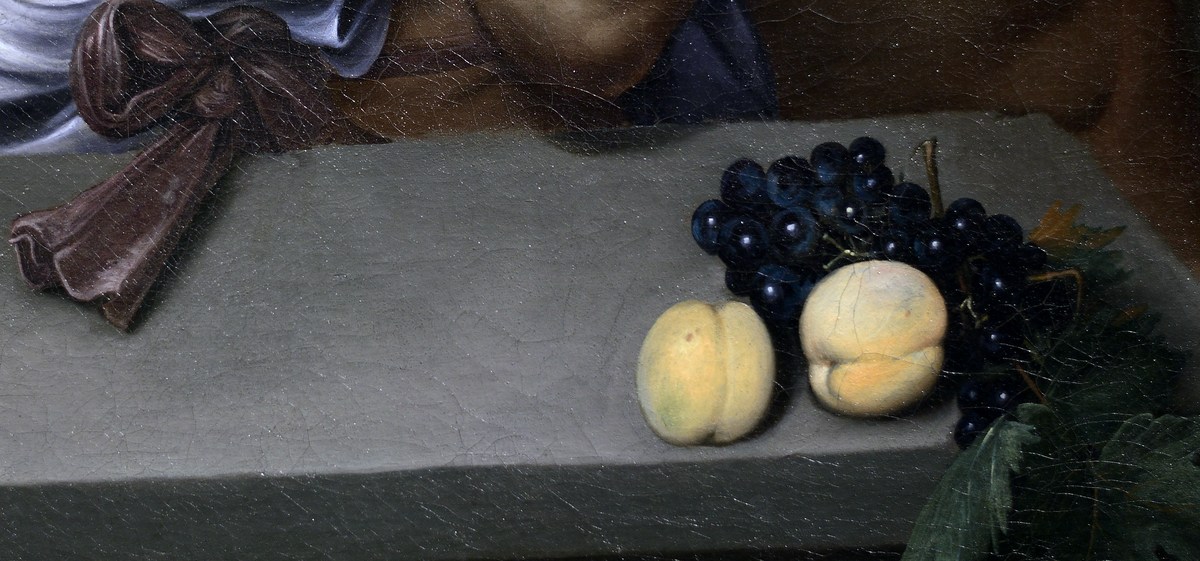
The Figure and the Grapes
The youth turns toward the viewer with his upper body exposed and a wreath of leaves on his head. One hand displays a bunch of white grapes; a cluster of darker fruit rests nearby. The pose is close and compressed. There is no wide landscape or crowded scene to distract from the figure's face, hand and fruit. The Galleria Borghese points to the contrast between the lively pale grapes and his unusually cool, unhealthy-looking complexion.[1]
The wine god is recognisable through attributes rather than a grand mythological setting. The ivy wreath and grapes do the identifying work. Two peaches and black grapes lie on the stone surface, while the paler bunch is held up near the face. The 1693 Borghese inventory already names the two peaches and both kinds of grapes, although it calls the crown laurel.[1] Horticulturist Jules Janick independently lists peach and grape among this painting's fruit in his study of Caravaggio's still lifes.[10] The botanical distinction matters because the wreath is not simply another bunch of vine leaves. The figure looks like a person Caravaggio could have studied at close range. Myth enters a small painting through ordinary skin and perishable fruit, rather than through idealised anatomy or divine splendour.
An exact psychological reading of the expression is harder. The half-open mouth and direct gaze may seem tired, challenging or theatrical. Those impressions differ among viewers and cannot be verified against a statement by the sitter. A responsible description stays with the visible contrast and labels the rest as interpretation.
Why “Sick” Appears in the Title
Roberto Longhi popularised the “sick Bacchus” name. The Galleria Borghese says critics connected the possible self-portrait to a documented hospitalisation in Rome and read the pallor as a sign of convalescence. The museum also records continuing debate around the picture's meanings. The title reflects this history of interpretation; it is not the original artist's caption or a medical diagnosis of a person in the painting.[1]
Colour in an old painting depends on materials, ageing, lighting, conservation and reproduction. A photograph viewed on a bright phone can intensify or flatten the strange complexion. Without a specific technical finding showing that the skin was painted to document illness, the safest wording is that it appears unhealthy and has long been understood that way. The owner's catalogue calls the flesh “cerulean” and “unhealthy-looking” in contrast to the grapes.[1]
The nickname thus joins a visible quality to a later biographical interpretation. It does not turn the 1590s canvas into a hospital portrait simply because a later critic saw a resemblance.
Is This a Self-Portrait?
The full Italian catalogue title is Autoritratto in veste di Bacco (Bacchino malato) — self-portrait in the guise of Bacchus. Yet the owner text describes a possible self-portrait identified by critics. Those two forms of wording should be read together. The current title preserves a scholarly tradition while the prose acknowledges that likeness is a claim requiring interpretation.[1]
Caravaggio's own face is not documented by a surviving series of secure self-portraits labelled by him. Later images and proposed appearances in his paintings have their own attribution problems. The similarity between this face and another painting can add to a case, but it cannot function as a signed photograph. The same caution applies to claims that he hid his face in David with the Head of Goliath or among the spectators in The Martyrdom of Saint Matthew: discuss the evidence for each work separately.
The self-portrait reading does help explain why the picture has drawn strong biographical attention. A youthful painter representing himself as Bacchus would turn a mythological role into an experiment in identity and observed flesh. That is a plausible interpretation of the image's effect, not an established statement of Caravaggio's intent.
Other Ways Scholars Have Read the Fruit and Figure
The illness reading is prominent, but it has never exhausted the subject. The Borghese catalogue names Kurt Bauch's interpretation of the grapes as an image of taste, James B. Lynch's melancholy reading, Herwarth Röttgen's emphasis on intoxication, and Maurizio Calvesi's proposal that Bacchus and the grapes foreshadow Christ's Passion and the Eucharist.[1] These are named scholarly arguments, not different facts discovered inside the paint. The presence of grapes supports more than one association, and the picture does not supply a written key choosing among them.
A further reading treats Bacchus as a figure of artistic making. The museum credits Kristina Herrmann Fiore with an early account of inspiration and describes Philip Morel's proposal that the youth is about to squeeze the grapes, acting out the invention of wine. For Morel, the ivy crown also points to a poet-painter's inspiration, while the carefully rendered grapes recall the ancient story of Zeuxis painting fruit convincing enough to attract birds.[1] The physical gesture, ivy and fruit are visible; the full chain from them to a claim about Caravaggio's intentions is Morel's interpretation. It offers a useful alternative to treating the complexion as the whole subject.
The peaches have also prompted a more playful reading. Adrienne von Lates's 1995 study describes the half-draped figure, the fruit at the table's edge and the trailing ribbon as an invitation that could carry erotic wit for a contemporary viewer.[11] This is an argument about the effect of the pose and objects, not evidence of a named sitter's sexuality or of an identifiable original patron. It also points to a feature the illness story can obscure: Bacchus turns toward an audience and offers fruit. The picture can appear uneasy and deliberately enticing at the same time.
When Was the Painting Made?
The Galleria Borghese's catalogue header gives about 1595, while Rome's official itinerary uses 1593–94. The owner's longer entry says many scholars have placed the painting nearer 1593 because of its close relation to Lombard painting. It explains why the date moves if Caravaggio's arrival in Rome is placed later, around 1595, and mentions a possible Milanese origin only to note its tension with early biographical testimony.[1][4] A firm year cannot be extracted from those competing chronologies.
The early ownership provides a useful outer limit: the canvas was in Giuseppe Cesari's possession before the 1607 confiscation.[1] Giulio Mancini's later note, as read by the Borghese catalogue, associates an early Bacchus with Caravaggio's stay in the home of Monsignor Pandolfo Pucci. That account can help place the work in his early Roman circumstances, but the identification of the note with this surviving canvas and its exact date require historical judgment. The museum still regards it as one of his earliest surviving paintings.[1]
The 2020 Peterzano exhibition catalogue develops a later alternative: the first months of 1597, before Caravaggio entered Cardinal del Monte's household.[8] It combines a proposed reading of Mancini's difficult annotation as placing the picture with dealer Costantino Spada with Baglione's sequence, which puts an early Bacchus after work in Cesari's shop. On that reconstruction, the hospital stay could precede the painting, but it would still not prove that the figure depicts convalescence. If the Spada reading or the identification of Baglione's Bacchus changes, the date argument changes with it. The owner's circa-1595 date remains a catalogue estimate, and neither date is an inscription on the canvas.
Bacchus as an Early Subject
Caravaggio returned to the wine god in the Uffizi Bacchus, a larger and differently staged painting dated later by its owner. Comparing the two makes the distinction clear. The Borghese youth has a close, uneasy presence and holds the grapes near his body. The Uffizi figure invites the viewer toward wine and a table of fruit. Both use fruit and a human figure, but they are separate canvases with separate dates, patrons and collection histories.[1][2]
The Galleria Borghese's record also discusses Giovanni Baglione's 1642 account of an early Bacchus painted with a mirror. Scholars debated whether that description refers to the Borghese painting or the later Uffizi one. The museum says most current critics associate the passage with its Roman picture, in part because of dating and facial differences. That is an attribution of a written description to a physical object; it does not prove that every mark in the canvas was made with a mirror.[1]
This distinction matters to the painting-technique guide. Technical studies can establish ground layers, pigments, incisions and revisions in specific works. A biographer's statement about a mirror can be important historical evidence, but it should not be turned into a universal rule that Caravaggio painted all early pictures optically or without planning.
The Cesari and Borghese History
The owner records the canvas among works in the possession of Giuseppe Cesari, known as the Cavalier d'Arpino, before 1607. That year papal officials confiscated Cesari's collection in a firearms case. Pope Paul V then gave the paintings to his nephew, Cardinal Scipione Borghese. Young Sick Bacchus and Boy with a Basket of Fruit were the two Caravaggio pictures in that group.[1][3]
The confiscation was not a commission. It tells us how the works entered Borghese ownership, not who first sat for them or exactly what Caravaggio was paid. The gallery record gives the work inventory number 534 and later Borghese inventory references. Those are anchors for object identity when titles change or multiple Bacchus paintings are discussed.[1]
Those later records show why a title alone can be deceptive. A 1693 Borghese inventory describes a Bacchus with grapes and peaches; the 1790 inventory calls the work a satyr. In the nineteenth-century fideicommissary inventory it was assigned to Ludovico Carracci, and some twentieth-century scholars treated it as a copy. Roberto Longhi argued for Caravaggio and gave the painting the familiar “Sick Bacchus” name. This history shows that the present combination of artist and title emerged through comparison and reassessment, even though the canvas had remained in a long-recorded collection.[1]
The owner also notes a difficult-to-read annotation in an early source that some scholars interpret as naming the dealer Costantino Spada as a first owner. That is a proposal, not a secure transfer document. It should not displace the firm Cesari-to-Borghese provenance or be turned into a definite commission from Spada.[1]
The Borghese inventory trail continues through 1693, 1790 and 1833, and the catalogue records the Italian state's acquisition of the collection in 1902.[1] Its 1693 description mentions both white and black grapes and two peaches. That wording is useful for following the physical object when a later inventory calls it a satyr, even though an inventory description cannot by itself settle what the fruit was intended to signify.
The owner's catalogue also observes that Iacomo Manilli's 1650 description of the villa does not mention this picture.[1] That absence should not be turned into a claim that it had left the Borghese collection: the Cesari confiscation and later inventories provide a stronger ownership sequence than one guide's silence. It does limit how precisely we can reconstruct where a visitor saw the canvas in the mid-seventeenth century.
Peterzano and Caravaggio's Early Visual Sources
The Borghese essay relates the young man's pose to work by Simone Peterzano, Caravaggio's Milanese teacher, especially the Persian Sibyl at the Certosa di Garegnano. Treccani's specialist biography of Peterzano likewise identifies the Garegnano Sibyls as visual precedents for the Bacchino malato.[1][5] This is a comparison of compositions, not proof that the two paintings were made in the same place or year. It helps explain why a Roman early work could retain forms learned in Lombardy.
Kristina Herrmann Fiore has also proposed a connection to a Dürer Ecce Homo print, with the thorn crown and tombstone transformed into Bacchic ivy and a tabletop.[1] That is a more ambitious interpretive comparison, and it should remain attributed. Together, these proposals make the figure more than a spontaneous likeness caught in a mirror: the image can draw on observed flesh and older art at once, without making any one source a documented template.
Another Lombard comparison gives the ivy a different setting. Giovan Paolo Lomazzo's Self-Portrait as Abbot of the Accademia della Val di Blenio, now at the Pinacoteca di Brera, presents an artist in the role of a Bacchic literary society's leader. Brera identifies the ivy-covered staff as an attribute of Bacchus and the compass as a sign of Lomazzo's profession.[6] The Borghese catalogue says Philip Morel used this earlier self-portrait to develop his reading of Caravaggio's youth as an inspired maker.[1] The two pictures do not have identical costumes or gestures, and the comparison does not prove that Caravaggio saw Lomazzo's canvas. It does show why a Bacchic guise could signify artistic identity as well as drinking or ill health.
What Material Study Can Tell Us
The Borghese catalogue says the 2001 examination ruled out Maurizio Marini's proposal that the pale flesh resulted merely from a poor restoration.[1] The museum's conservation archive gives the history behind that conclusion. It lists radiography as early as 1953, removal of yellowed varnish in 1965, and X-ray fluorescence work in 1991. The 2001 campaign then combined X-radiography, infrared reflectography, examination of paint cross-sections and photographs under different lighting with cleaning and structural treatment. A further 2009 investigation used longer-wavelength infrared, X-ray fluorescence and electron microscopy with elemental analysis, and reread the 2001 cross-sections.[7] Those are different kinds of inquiry: photographs and imaging examine the object at larger scales, while cross-sections and microanalysis can clarify the order and composition of sampled layers.
A catalogue entry published for the 2020 Peterzano exhibition reports a more specific finding from the restoration and diagnostic studies: the unusual grey-blue cast of the face was achieved with very thin paint layers over a lead-rich grey preparation, rather than simply caused by altered pigment.[8] The 2026 medical-history review describes two grey ground layers beneath the painted surface.[9] This makes the ground part of an explanation for the appearance, but it is not a colour photograph of Caravaggio's skin. A technical account of how the complexion was made can rule out some later-damage explanations; it cannot identify the sitter or determine the painter's health.
The painted contrast itself is visible: cool flesh, warm cloth and pale fruit. A viewer can compare these surfaces without claiming to know every layer beneath them. Digital colour, however, is an unreliable medical test; screen settings and photographic lighting alter the appearance of the flesh.
The picture's small scale matters. At 67 × 53 cm it invites near viewing, unlike the later church canvases that address a whole chapel. A reproduction may magnify the face far beyond life size, making blemishes or brushwork appear more decisive than they are in front of the object.[1]
Can the Complexion Identify an Illness?
The hospital story and the painted complexion have sometimes been combined into specific diagnoses. In a 2026 review, surgeon T. M. van Gulik examined published suggestions of jaundice and Addison's disease. He argues that the jaundice claim relied on a misleading yellowish reproduction, whereas the original appears greyish, and that the grey preparation complicates an explanation based on darkened skin from Addison's disease. His conclusion is that the assumption of illness at the time of painting needs reconsideration.[9] This is a critique of the proposed diagnoses, not a clinical examination of a sixteenth-century patient.
The evidential steps remain separate. An early account of Caravaggio's hospital stay can be relevant to biography; the face's identity is a scholarly attribution; and paint analysis explains some of the canvas's present appearance. None alone connects a named disease, a date of recovery and this particular pose. The title Bacchino malato remains useful for finding the work, but readers should not treat it as a diagnosis built into the original image.
Did Later Artists Respond to the Picture?
The Peterzano exhibition catalogue identifies two proposed signs of the Bacchino's early reception.[8] It compares a Portrait of a Young Man as Bacchus, assigned by Giuseppe Porzio to the elusive painter known as Pseudo-Salini, and a reprise of the Borghese figure within Paolo Finoglio's much larger Triumph of Bacchus. The comparison raises a useful question: was this small early canvas known as a model before modern scholars restored its Caravaggio attribution? Similarity can show a visual relationship without telling us who saw the original, a copy or another intermediary image.
The Prado catalogues Finoglio's painting after 1635 and connects it to the decorative programme for Philip IV's Buen Retiro Palace. Its own entry emphasises Finoglio's Neapolitan context and the influence of Battistello Caracciolo; it does not claim to document his access to the Borghese canvas.[12] Thus the Peterzano catalogue's specific Bacchino comparison is a specialist reading of Finoglio's image, while the Prado supplies the later work's identity, approximate date and collection history. The Pseudo-Salini attribution and its proposed link are less secure still. Neither later painting is another autograph Young Sick Bacchus.
Comparing the Uffizi Bacchus
The Uffizi catalogues its Bacchus around 1598, a later date than Borghese's c.1595. The two paintings show a similar mythological figure in different visual situations. The Uffizi work is associated with Cardinal Francesco Maria del Monte and the Medici; the Borghese picture's firm early collection link is Cesari. It would confuse the objects to import the later work's patron or still-life table into this smaller canvas.[1][2]
The comparison can be made around questions rather than a forced narrative of improvement. How does the figure address the viewer? How much space is given to fruit? Does Bacchus seem inviting, vulnerable or role-playing? Which details come from the paintings and which from later scholarship? Those questions keep the work visible as art while letting the hospital and self-portrait interpretations be considered in proportion to their evidence.
Explore the Caravaggio collection
| Name | Date | Type |
|---|---|---|
| Adoration of the Shepherds by Caravaggio: The Messina Nativity | 1608–09; precise order relative to Resurrection of Lazarus remains unresolved | Artwork |
| Amor Victorious by Caravaggio | 1601–02 in the Berlin owner record | Artwork |
| Bacchus by Caravaggio: The Uffizi Painting | about 1598, according to the Uffizi | Artwork |
| Basket of Fruit by Caravaggio | after 1597, probably around the turn of the seventeenth century, according to the Ambrosiana | Artwork |
| Boy Bitten by a Lizard: Caravaggio's London Painting | about 1594–95 in the National Gallery's current catalogue; URL suffix “1596” is inherited | Artwork |
| Boy Bitten by a Lizard: The Florence Version Attributed to Caravaggio | disputed; Longhi's catalogue record preserves historical 1592–93 and other proposed ranges, including c.1597 | Artwork |
| Boy Peeling Fruit by Caravaggio: The Royal Collection Painting | about 1592–93 in the owner's current exhibition record | Artwork |
| Boy Peeling Fruit in Florence: A Derivation from Caravaggio | — | Artwork |
| Boy with a Basket of Fruit by Caravaggio | about 1595 in the Galleria Borghese catalogue | Artwork |
| Caravaggio Paintings in Rome: Churches, Museums and a Practical Route | — | Guide |
| Caravaggio Quotes: What the Documents Actually Record | — | Guide |
| Caravaggio's Lute Player: The Del Monte Painting Once Shown at the Met | about 1596–97 in the Met catalogue | Artwork |
| Caravaggio's Painting Technique: Grounds, Incisions, Revisions and Light | — | Guide |
| Christ at the Column by Caravaggio: The Rouen Flagellation | c.1606 in the owner caption; owner prose gives 1606–07 | Artwork |
| Christ on the Mount of Olives by Caravaggio: The Lost Berlin Painting | — | Artwork |
| Conversion on the Way to Damascus by Caravaggio | about 1601 in the Roma Capitale church record | Artwork |
| Crowning with Thorns by Caravaggio: The Vienna Painting | about 1603 in the 2019 KHM record; “1607” is an inherited URL suffix | Artwork |
| Crowning with Thorns in Prato: Attributed to Caravaggio | about 1602–03 in the collection presentation | Artwork |
| David with the Head of Goliath by Caravaggio: The Borghese Painting | 1606–07 or 1609–10 in the Galleria Borghese catalogue; the later Naples period is favoured by many scholars, while the owner keeps the question open | Artwork |
| David with the Head of Goliath by Caravaggio: The Prado Painting | about 1600 in Prado material; “1599” survives only in the legacy URL | Artwork |
| David with the Head of Goliath by Caravaggio: The Vienna Painting | about 1600–01 in the KHM's 2019 exhibition record; “1607” is a legacy route label | Artwork |
| Did Caravaggio Make Drawings? What Survives and What Paintings Reveal | — | Guide |
| Ecce Homo: Caravaggio's Madrid Rediscovery and the Genoa Painting | — | Artwork |
| John the Baptist in Caravaggio's Paintings: A Guide to the Different Versions | — | Artwork |
| Judith Beheading Holofernes by Caravaggio | beginning of the seventeenth century in the owning museum's account; about 1599–1600 in the Kimbell's 2025 loan label; around 1602 in one specialist catalogue | Artwork |
| Jupiter, Neptune and Pluto: Caravaggio's Ludovisi Ceiling | about 1597; the archive connects the work with Cardinal del Monte's 1597 commission | Artwork |
| Madonna and Child with Saint Anne by Caravaggio: The Palafrenieri Altarpiece | 1605 in the Galleria Borghese object field; completed and delivered by 8 April 1606 | Artwork |
| Madonna of Loreto by Caravaggio: The Pilgrims at Sant'Agostino | broadly c.1604–06; institutional records differ slightly in their starting year | Artwork |
| Madonna of the Rosary by Caravaggio: The Vienna Altarpiece | around 1603 in the Kunsthistorisches Museum's object record | Artwork |
| Martha and Mary Magdalene by Caravaggio: The Detroit Painting | about 1598 in the Detroit Institute of Arts record | Artwork |
| Medusa by Caravaggio: The Uffizi Painted Shield | 1596–98 in the Uffizi's virtual exhibition; specialist research reports the shield delivered to the Medici wardrobe by 7 September 1598 | Artwork |
| Narcissus, Attributed to Caravaggio | dependent on attribution; the Zeri catalogue gives a broad 1610–50 range under Spadarino | Artwork |
| Nativity with Saint Francis and Saint Lawrence: Caravaggio's Missing Painting | somewhere in 1600–09 in the parliamentary report; a specific 1609 execution and place remain debated | Artwork |
| Penitent Mary Magdalene by Caravaggio | 1597 in the owner's catalogue, during Caravaggio's early Roman activity | Artwork |
| Portrait of a Courtesan: Caravaggio's Lost Berlin Portrait | Berlin's data field says c.1590, while its own text compares a Caravaggio work of c.1598; precise date unresolved | Artwork |
| Portrait of Alof de Wignacourt and His Page by Caravaggio | — | Artwork |
| Portrait of Fra Antonio Martelli? Caravaggio's Pitti Knight of Malta | 1608 in the Restituzioni object heading; within Caravaggio's Malta period | Artwork |
| Portrait of Maffeo Barberini: The Seated Corsini Painting | c.1596–97 in the national catalogue | Artwork |
| Portrait of Monsignor Maffeo Barberini: Caravaggio's Newly Acquired Painting | around the late 1590s / age thirty; “1598” in the inherited address is approximate, not an exact document date | Artwork |
| Portrait of Pope Paul V: A Caravaggio Attribution and a Borghese Copy | — | Artwork |
| Prints After Caravaggio: Who Made Them and What They Show | — | Guide |
| Reclining Saint John the Baptist: A Disputed Caravaggio Attribution | often proposed for the artist's final years; the later museum list does not give a precise year. | Artwork |
| Rest on the Flight into Egypt by Caravaggio | about 1597 in the owner's catalogue | Artwork |
| Saint Catherine of Alexandria by Caravaggio: The Thyssen Painting | about 1598–99 in the Museo Nacional Thyssen-Bornemisza catalogue | Artwork |
| Saint Francis in Meditation by Caravaggio: The Cremona Painting | 1603–06 in the owner account; c.1605–06 in a KHM exhibition caption | Artwork |
| Saint Francis in Prayer: Caravaggio's Carpineto Painting | 1606 in a 2016–17 exhibition work list | Artwork |
| Saint Francis of Assisi in Ecstasy by Caravaggio | c.1595–96 in the owner wall text | Artwork |
| Saint Jerome in Meditation: Caravaggio's Montserrat Painting | 1605 in the owner record; an owner publication reports scholarship placing it about 1605–06 | Artwork |
| Saint Jerome Writing by Caravaggio: The Borghese Painting | c.1606 in the owner catalogue; the “1605” URL suffix is inherited | Artwork |
| Saint Jerome Writing by Caravaggio: The Malta Painting | around 1607–08; foundation dates Malaspina's commission to 1608 | Artwork |
| Saint John in the Wilderness at Toledo Cathedral | exact 1598 not established by the cited cathedral account. | Artwork |
| Saint John the Baptist at Galleria Corsini, Rome | about 1606 in the national record; older proposals ranged from the late 1590s onward. | Artwork |
| Saint John the Baptist at the Capitoline Museums, Rome | 1602. | Artwork |
| Saint John the Baptist at the Galleria Borghese | 1609–10 in the current Borghese record. | Artwork |
| Saint John the Baptist at the Spring: The Bonello Painting in Malta | early seventeenth century in the institutional account; a precise 1608 is not established there. | Artwork |
| Saint Matthew and the Angel: Caravaggio's Lost First Altarpiece | — | Artwork |
| Salome Receives the Head of John the Baptist: Caravaggio's London Painting | about 1609–10, likely late Naples period in the Gallery's account | Artwork |
| Salome with the Head of John the Baptist: Caravaggio's Madrid Painting | — | Artwork |
| Sleeping Cupid by Caravaggio: The Painting Made in Malta | about 1608, Malta period | Artwork |
| Still Life with Fruit on a Stone Ledge: Is It by Caravaggio? | — | Artwork |
| Supper at Emmaus (1606): Caravaggio's Brera Painting | — | Artwork |
| The Annunciation by Caravaggio in Nancy | c.1607–10 in the collection record; 1608–10 in the museum's restoration account | Artwork |
| The Basel Saint John the Baptist: Once Labelled Caravaggio, Now Maíno | about 1608–10 in that schedule, rather than the legacy URL's 1600. | Artwork |
| The Beheading of Saint John the Baptist by Caravaggio | about 1608; installed in the Oratory on 29 August 1608 | Artwork |
| The Burial of Saint Lucy by Caravaggio in Syracuse | 1608, during Caravaggio's Syracuse stay | Artwork |
| The Calling of Saint Matthew by Caravaggio | about 1599–1600 | Artwork |
| The Calling of Saints Peter and Andrew by Caravaggio | about 1602–04 in the Trust's object text | Artwork |
| The Cardsharps by Caravaggio | about 1596–97 in the Kimbell's current object record | Artwork |
| The Conversion of Saint Paul: Caravaggio's Odescalchi Panel | commissioned in 1600; painted around 1600–01 | Artwork |
| The Crucifixion of Saint Andrew by Caravaggio | 1606–07 | Artwork |
| The Crucifixion of Saint Peter by Caravaggio | about 1601 | Artwork |
| The Death of the Virgin by Caravaggio | commissioned 1601; completed late 1605 or early 1606, according to the Louvre | Artwork |
| The Denial of Saint Peter by Caravaggio | 1610 | Artwork |
| The Doria Pamphilj Saint John the Baptist: A Second Youth with a Ram | linked compositionally to the Capitoline 1602 picture; an exact production year for this canvas is not established by the owner pages used here. | Artwork |
| The Entombment of Christ by Caravaggio: The Vatican Deposition | about 1600–04 in Vatican Museums publication material | Artwork |
| The Flagellation of Christ by Caravaggio: The Capodimonte Altarpiece | around 1607, in the first Naples period | Artwork |
| The Fortune Teller by Caravaggio: The Louvre Version and Its Roman Counterpart | — | Artwork |
| The Holy Family with the Infant Saint John the Baptist by Caravaggio | early 1600s in the Met catalogue; no more exact owner date asserted here | Artwork |
| The Incredulity of Saint Thomas by Caravaggio | about 1601 in the SPSG presentation | Artwork |
| The Inspiration of Saint Matthew by Caravaggio | usually 1602; also catalogued 1602–03, for the installed final altarpiece | Artwork |
| The Lute Player by Caravaggio: The Hermitage Painting | about 1596 in the Hermitage collection publication; the Hermitage Friends restoration page gives about 1595–96 | Artwork |
| The Magdalen in Ecstasy: Caravaggio, Copies and a Disputed Original | — | Artwork |
| The Martyrdom of Saint Matthew by Caravaggio | 1599–1600; unveiled with The Calling in 1600 | Artwork |
| The Martyrdom of Saint Ursula by Caravaggio | — | Artwork |
| The Musicians by Caravaggio | 1597 | Artwork |
| The Resurrection of Lazarus by Caravaggio in Messina | 1609; delivered 10 June 1609 in the owner account | Artwork |
| The Sacrifice of Isaac by Bartolomeo Cavarozzi: A Former Caravaggio Attribution | about 1615–17 in the Nicholas Hall catalogue; “1598” is an inherited URL label, not the accepted date | Artwork |
| The Sacrifice of Isaac by Caravaggio: The Uffizi Painting | about 1603 in the Uffizi catalogue | Artwork |
| The Seven Works of Mercy by Caravaggio | 1606–07, according to the Pio Monte | Artwork |
| The Supper at Emmaus by Caravaggio: The London Painting | 1601 | Artwork |
| The Taking of Christ by Caravaggio | 1602 | Artwork |
| The Toulouse *Judith Beheading Holofernes*: A Caravaggio Attribution Debate | c.1606–07 if identified with the recorded Naples work; that identification is debated | Artwork |
| Young Sick Bacchus by Caravaggio | about 1595 in the Galleria Borghese catalogue | Artwork |
| Youth with a Ram: Why Caravaggio's Saint John Looks So Unusual | — | Artwork |
No matching pages found.
Discussion
Share a close observation about Young Sick Bacchus by Caravaggio or a source that clarifies its history.
Which detail changes your reading?
Is there a collection record or document worth comparing?
What remains uncertain?
Join the Conversation
Frequently Asked Questions
Where is Young Sick Bacchus?
It belongs to the Galleria Borghese, Rome, inventory 534. Its catalogue lists Room 8 but currently flags the painting as not exhibited; check the museum's current display notice before visiting.[1]
When was it painted?
Is the figure definitely Caravaggio?
The self-portrait identification is a long-standing interpretation reflected in one of the painting's titles. The owner describes it as possible rather than as a documented sitter identification.[1]
Was Caravaggio ill when he painted it?
The “sick” reading has been linked to a reported hospitalisation and the figure's appearance. Material studies show that the greyish complexion is part of the painting's construction, while a recent review questions proposed diagnoses based on reproductions. Neither finding proves when Caravaggio was ill or whether he portrayed himself here.[1][8][9]
References
- Galleria Borghese, Autoritratto in veste di Bacco (Bacchino malato), inv. 534, owner object, interpretation and provenance record.
- Uffizi Galleries, Bacchus, distinct later Florence painting.
- Galleria Borghese, Giovane con canestra di frutta, inv. 136, paired Cesari and Borghese provenance.
- Roma Capitale, “I luoghi di Caravaggio”, early Borghese works and approximate dating.
- Treccani, “Peterzano, Simone,” Dizionario Biografico degli Italiani, specialist account of the Garegnano comparisons and Caravaggio's training.
- Pinacoteca di Brera, Self-Portrait as Abbot of the Accademia della Val di Blenio, Lomazzo's Bacchic artist portrait and attributes.
- Galleria Borghese digital archives, conservation and diagnostic record for inventory 534, dated examination and restoration entries from 1953 to 2009.
- Peterzano. Allievo di Tiziano, maestro di Caravaggio, catalogue entry VI.3, 2020 exhibition catalogue text on the face's thin glazes and grey preparation, hosted by the University of Pavia.
- T. M. van Gulik, “Which illness is depicted in Caravaggio's Sick Bacchus?”, Ethics, Medicine and Public Health 34 (2026), article 101276, doi:10.1016/j.jemep.2026.101276; abstract and review conclusion.
- Jules Janick, “Caravaggio's Fruit: A Mirror on Baroque Horticulture”, Chronica Horticulturae 44, no. 4 (2004), Purdue University-hosted version, fruit identification.
- Adrienne von Lates, “Caravaggio's Peaches and Academic Puns”, Word & Image 11, no. 1 (1995), 55–60; accessible opening text and bibliographic record.
- Museo Nacional del Prado, Paolo Finoglio, The Triumph of Bacchus, owner catalogue and collection history of the later work.
- Annotated image source: Wikimedia Commons, File:Sick young Bacchus by Caravaggio.jpg, high-resolution reproduction used for the annotated details.