 by Tom Gurney
Tom Gurney BSc (Hons) is an art history expert with over 20 years experience
Page Created on / Page Updated on
Email: tomgurney1@gmail.com / Phone: +44 7429 011000
The Calling of Saints Peter and Andrew by Caravaggio
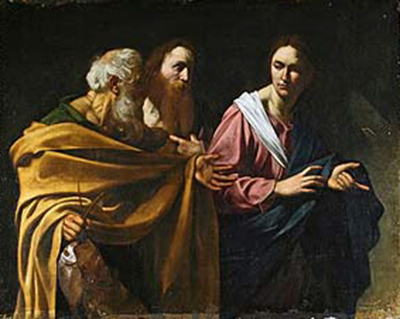
Christ turns toward two fishermen and gestures for them to follow him. Simon, later called Peter, and his brother Andrew register the sudden interruption in their faces and hands. Caravaggio's Calling of Saints Peter and Andrew belongs to the Royal Collection, inventory RCIN 402824, and is dated about 1602–04 by Royal Collection Trust. A Trust announcement places it in the Buckingham Palace Picture Gallery redisplay that opened in July 2026, replacing older visitor labels that point to Hampton Court.[1][2]
The painting has a notable modern attribution history. Royal Collection Trust says conservation and research changed its designation from a work by a follower of Caravaggio to one firmly attributed to Caravaggio himself. The history of that reassessment should be stated, rather than pretending every catalogue has always agreed.[3]
Caravaggio in context
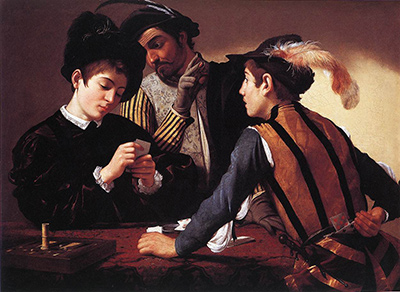
The Cardsharps
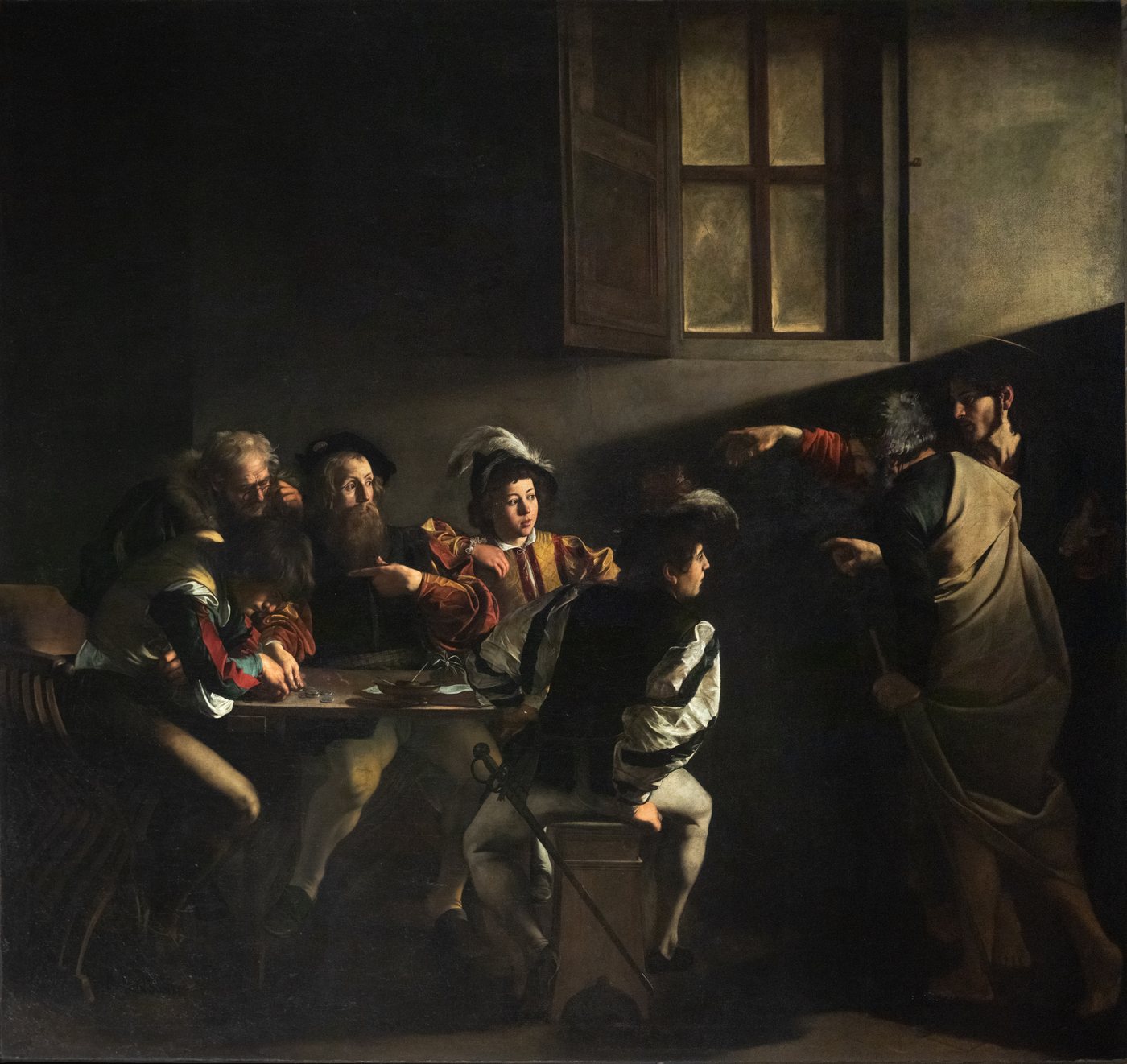
c.1595Calling of Saint Matthew
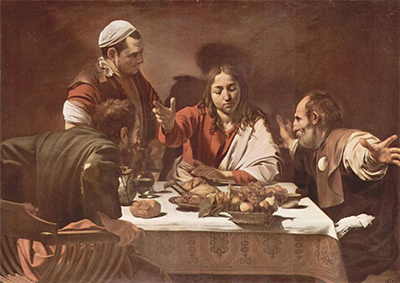
1599–1600Supper at Emmaus
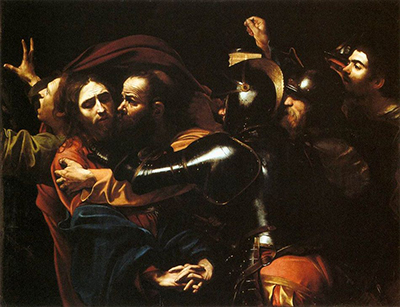
1601At a Glance
- ArtistCaravaggio, Royal Collection Trust's current attribution[1][3]
- TitleThe Calling of Saints Peter and Andrew[1]
- Dateabout 1602–04 in the Trust's object text[1]
- Collection and inventoryRoyal Collection, RCIN 402824[1]
- SubjectChrist calls the fishermen Simon/Peter and Andrew beside the Sea of Galilee[1][4]
- Early royal ownershipCharles I bought the painting from William Frizell in 1637, according to the Trust[5]
- Display recordBuckingham Palace Picture Gallery redisplay from 9 July 2026; visitors should confirm current access[2]
- Medium and exact sizeobtain current Royal Collection item-level technical record; a secondary 140.1 × 176 cm lead should not be presented as owner-verified here
Contents
- The Moment of the Call
- Christ's Gesture and the Fishermen's Response
- The Gospel Setting
- What Conservation Changed
- Charles I and the Royal Collection
- The 2026 Buckingham Palace Display
- Comparisons and Image Notes
- Frequently Asked Questions
The Moment of the Call
The Royal Collection's description gives the key action plainly: Christ moves ahead while turning back to the brothers Simon and Andrew, who have been fishing at the Sea of Galilee. He calls them to follow. The fishermen's weathered faces and hands show a mixture of astonishment, confusion and apprehension.[1]
Caravaggio does not need to paint a crowd or a grand miracle to make this an event. The moment changes the brothers' lives through a brief encounter. Christ's turn makes motion visible—he is already going, yet pauses to draw them with him.[1][4]
This is distinct from the artist's Calling of Saint Matthew in the Contarelli Chapel. Both subjects involve a call and a decisive gesture, but one addresses fishermen by a shore and the other a tax collector in a Roman chapel painting. The two routes should have separate images, verses and collection identities.[1][6]
The Royal Collection composition should be identified by its owner record and its visible arrangement of Christ, Peter and Andrew. A small reproduction can establish broad subject identity, but not the fine condition or handling of the painted surface.
Christ's Gesture and the Fishermen's Response
Christ's body turns between two directions: the path ahead and the brothers behind him. The brothers' hands and faces hold the viewer near their uncertain answer. The Royal Collection describes their rough appearance as eloquent of shock, confusion and fear, an interpretation anchored in visible gesture.[1]
The scene's psychology is compact. The viewer can identify the invitation before reading a long account of the Gospel. Yet the image leaves room to ask what the brothers are thinking; no precise spoken sentence can be assigned to either from the painting alone.[1][4]
Caravaggio's close human figures make the call present rather than remote. Light separates the heads and hands from a dark setting, directing attention toward the exchange. An annotation feature could trace the gesture from Christ to the fishermen, but should be deferred until a high-resolution Royal Collection file and crop rights are obtained.[1]
The expression of fear mentioned by the owner is not the painting's only possible response. Astonishment and uncertainty can coexist with the beginning of trust. The Gospel account gives the narrative result; the painted instant makes the transition feel as though it is still being decided.[1][4]
The Gospel Setting
Mark 1:16–18 says Jesus saw Simon and Andrew casting a net in the Sea of Galilee and called them to follow him, promising to make them “fishers of men.” They left their nets and followed. The Royal Collection's description invokes that phrase when identifying the painting's subject.[1][4]
The painting's focus is the call, not an illustrated inventory of every word of Mark. Christ turns, the fishermen react, and a former way of life is about to be left behind. The image compresses time before and after their answer into a small number of gestures.[1][4]
Matthew 4:18–20 also recounts the call of Simon Peter and Andrew. The two Gospel accounts are related; a short scriptural note can point to both without claiming that Caravaggio followed every visual detail of one text word for word.[4][7]
This subject should not be confused with The Crucifixion of Saint Peter, which shows a much later episode in Peter's traditional life. Linking the pages chronologically can help readers follow the figure from first call to martyrdom, while making clear that the paintings were made for different contexts.[1][8]
What Conservation Changed
Royal Collection Trust's publication description says recent cleaning, conservation and research transformed critical opinion of this painting. It had been assigned to a follower of Caravaggio and is now firmly attributed to Caravaggio by the Trust.[3]
The Royal Collection's updated attribution is the current institutional view and reflects a reassessment of earlier doubt. Its publication does not identify one decisive pigment test or a specific underdrawing discovery as the cause of that change.[3]
Conservation can make a painting easier to see and compare, but the Trust's broad publication note does not detail every step. It documents a change in critical opinion and attribution without establishing technique-specific findings.[3]
This work is also a reminder that not every old royal inventory name maps cleanly to a modern artist. The current RCIN 402824 anchors the object through changes in attribution and hanging. Its identity must not be merged with RCIN 906830, a different Royal Collection work on a similar calling subject.[1][9]
Charles I and the Royal Collection
Royal Collection Trust says Charles I bought this picture from William Frizell in 1637. That gives the painting a documented place in the seventeenth-century British royal collection. Its acquisition history should be kept separate from the unknown details of Caravaggio's original commission around 1602–04.[5]
The Trust's account of Charles I's collection uses the picture to show how works can be identified across old records. The painting's early royal ownership is stronger evidence than a generic claim that it “was always at Hampton Court.” Collection ownership and display venue are not the same thing.[5]
As a work cared for by the Royal Collection Trust, it has moved among royal settings and exhibitions. The owner provides an object number that remains stable while galleries change. The Royal Collection remains the stable collection identity; the present display is a time-sensitive visitor detail.[1][2][5]
The present attribution to Caravaggio also makes this a rare object within British royal holdings. That significance is supported by the Trust's own publication account, but it does not justify turning the page into a broad claim about all Caravaggio works in Britain.[3]
The 2026 Buckingham Palace Display
In a 2026 press notice, Royal Collection Trust announced a transformed Buckingham Palace Picture Gallery opening to visitors from 9 July, with The Calling of Saints Peter and Andrew newly added to its display. The same statement describes nearby works by Van Dyck and the Le Nain brothers to illuminate Caravaggio's visual influence.[2]
This is a better current location lead than an older Hampton Court label from a previous display. It remains a lead, not a perpetual guarantee: the picture could move, and Buckingham Palace access follows scheduled visitor arrangements. Check the Trust’s latest gallery information before visiting.[2]
The old Holyroodhouse exhibition page linked in the references is also a past exhibition. It is valuable for the owner's attribution, date and subject description, but its venue title should not be copied into a current location statement.[1]
The accessible owner record does not confirm exact canvas dimensions. Secondary databases circulate roughly 140 × 176 cm, but it is unclear here whether that figure includes a frame or reflects a current Royal Collection measurement.
Comparisons and Image Notes
The Calling of Saint Matthew is the closest thematic companion. In both works an encounter is organized by a gesture that asks someone to change course. The light, cast of figures and original viewing situations differ. A comparison card can show those differences with correct, separately licensed images.[1][6]
The Holy Family with the Infant Saint John the Baptist provides another early-1600s religious subject, but it is privately owned and on loan to the Met. Linking it should never suggest the two share a Royal Collection provenance.[1][10]
An image caption needs Caravaggio, The Calling of Saints Peter and Andrew, Royal Collection, RCIN 402824, plus the actual photographer/license credit. Alt text can state that Christ gestures while Peter and Andrew turn towards him, with the fishermen's expressive faces and hands. It should not call the work a Hampton Court painting as if that were its permanent address.[1][2]
Explore the Caravaggio collection
| Name | Date | Type |
|---|---|---|
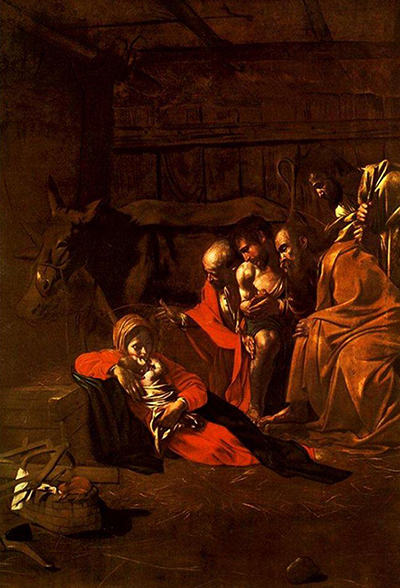
| Adoration of the Shepherds by Caravaggio: The Messina Nativity | 1608–09; precise order relative to Resurrection of Lazarus remains unresolved | Artwork |
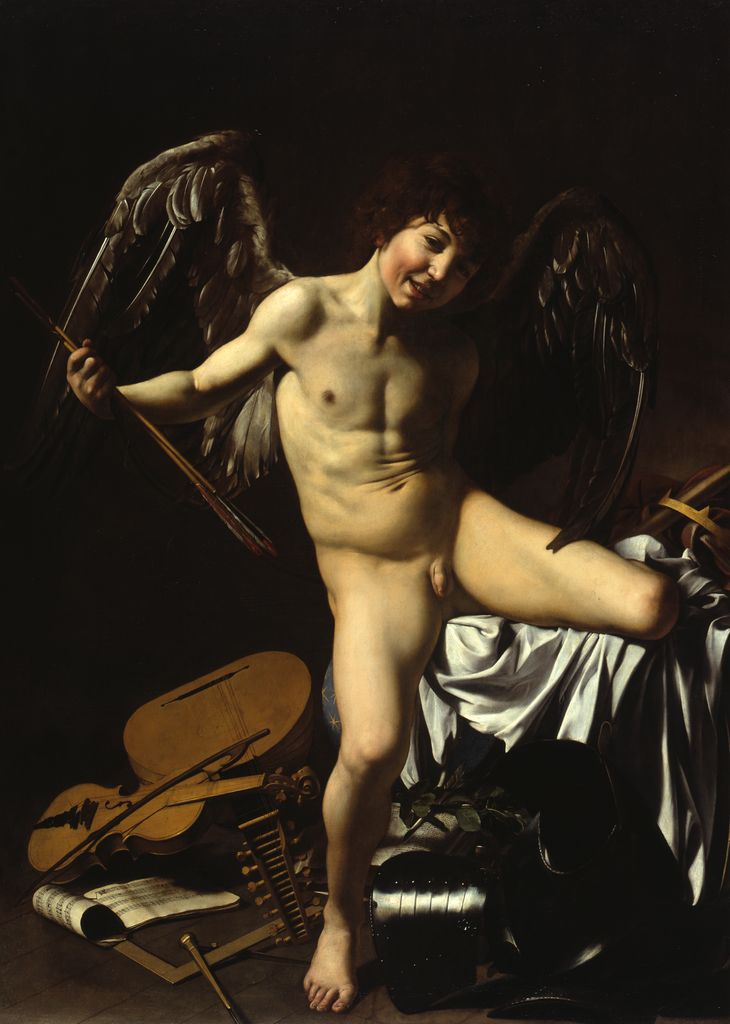
| Amor Victorious by Caravaggio | 1601–02 in the Berlin owner record | Artwork |
| Bacchus by Caravaggio: The Uffizi Painting | about 1598, according to the Uffizi | Artwork |
| Basket of Fruit by Caravaggio | after 1597, probably around the turn of the seventeenth century, according to the Ambrosiana | Artwork |
| Boy Bitten by a Lizard: Caravaggio's London Painting | about 1594–95 in the National Gallery's current catalogue; URL suffix “1596” is inherited | Artwork |
| Boy Bitten by a Lizard: The Florence Version Attributed to Caravaggio | disputed; Longhi's catalogue record preserves historical 1592–93 and other proposed ranges, including c.1597 | Artwork |
| Boy Peeling Fruit by Caravaggio: The Royal Collection Painting | about 1592–93 in the owner's current exhibition record | Artwork |
| Boy Peeling Fruit in Florence: A Derivation from Caravaggio | — | Artwork |
| Boy with a Basket of Fruit by Caravaggio | about 1595 in the Galleria Borghese catalogue | Artwork |
| Caravaggio Paintings in Rome: Churches, Museums and a Practical Route | — | Guide |
| Caravaggio Quotes: What the Documents Actually Record | — | Guide |
| Caravaggio's Lute Player: The Del Monte Painting Once Shown at the Met | about 1596–97 in the Met catalogue | Artwork |
| Caravaggio's Painting Technique: Grounds, Incisions, Revisions and Light | — | Guide |
| Christ at the Column by Caravaggio: The Rouen Flagellation | c.1606 in the owner caption; owner prose gives 1606–07 | Artwork |
| Christ on the Mount of Olives by Caravaggio: The Lost Berlin Painting | — | Artwork |
| Conversion on the Way to Damascus by Caravaggio | about 1601 in the Roma Capitale church record | Artwork |
| Crowning with Thorns by Caravaggio: The Vienna Painting | about 1603 in the 2019 KHM record; “1607” is an inherited URL suffix | Artwork |
| Crowning with Thorns in Prato: Attributed to Caravaggio | about 1602–03 in the collection presentation | Artwork |
| David with the Head of Goliath by Caravaggio: The Borghese Painting | 1606–07 or 1609–10 in the Galleria Borghese catalogue; the later Naples period is favoured by many scholars, while the owner keeps the question open | Artwork |
| David with the Head of Goliath by Caravaggio: The Prado Painting | about 1600 in Prado material; “1599” survives only in the legacy URL | Artwork |
| David with the Head of Goliath by Caravaggio: The Vienna Painting | about 1600–01 in the KHM's 2019 exhibition record; “1607” is a legacy route label | Artwork |
| Did Caravaggio Make Drawings? What Survives and What Paintings Reveal | — | Guide |
| Ecce Homo: Caravaggio's Madrid Rediscovery and the Genoa Painting | — | Artwork |
| John the Baptist in Caravaggio's Paintings: A Guide to the Different Versions | — | Artwork |
| Judith Beheading Holofernes by Caravaggio | beginning of the seventeenth century in the owning museum's account; about 1599–1600 in the Kimbell's 2025 loan label; around 1602 in one specialist catalogue | Artwork |
| Jupiter, Neptune and Pluto: Caravaggio's Ludovisi Ceiling | about 1597; the archive connects the work with Cardinal del Monte's 1597 commission | Artwork |
| Madonna and Child with Saint Anne by Caravaggio: The Palafrenieri Altarpiece | 1605 in the Galleria Borghese object field; completed and delivered by 8 April 1606 | Artwork |
| Madonna of Loreto by Caravaggio: The Pilgrims at Sant'Agostino | broadly c.1604–06; institutional records differ slightly in their starting year | Artwork |
| Madonna of the Rosary by Caravaggio: The Vienna Altarpiece | around 1603 in the Kunsthistorisches Museum's object record | Artwork |
| Martha and Mary Magdalene by Caravaggio: The Detroit Painting | about 1598 in the Detroit Institute of Arts record | Artwork |
| Medusa by Caravaggio: The Uffizi Painted Shield | 1596–98 in the Uffizi's virtual exhibition; specialist research reports the shield delivered to the Medici wardrobe by 7 September 1598 | Artwork |
| Narcissus, Attributed to Caravaggio | dependent on attribution; the Zeri catalogue gives a broad 1610–50 range under Spadarino | Artwork |
| Nativity with Saint Francis and Saint Lawrence: Caravaggio's Missing Painting | somewhere in 1600–09 in the parliamentary report; a specific 1609 execution and place remain debated | Artwork |
| Penitent Mary Magdalene by Caravaggio | 1597 in the owner's catalogue, during Caravaggio's early Roman activity | Artwork |
| Portrait of a Courtesan: Caravaggio's Lost Berlin Portrait | Berlin's data field says c.1590, while its own text compares a Caravaggio work of c.1598; precise date unresolved | Artwork |
| Portrait of Alof de Wignacourt and His Page by Caravaggio | — | Artwork |
| Portrait of Fra Antonio Martelli? Caravaggio's Pitti Knight of Malta | 1608 in the Restituzioni object heading; within Caravaggio's Malta period | Artwork |
| Portrait of Maffeo Barberini: The Seated Corsini Painting | c.1596–97 in the national catalogue | Artwork |
| Portrait of Monsignor Maffeo Barberini: Caravaggio's Newly Acquired Painting | around the late 1590s / age thirty; “1598” in the inherited address is approximate, not an exact document date | Artwork |
| Portrait of Pope Paul V: A Caravaggio Attribution and a Borghese Copy | — | Artwork |
| Prints After Caravaggio: Who Made Them and What They Show | — | Guide |
| Reclining Saint John the Baptist: A Disputed Caravaggio Attribution | often proposed for the artist's final years; the later museum list does not give a precise year. | Artwork |
| Rest on the Flight into Egypt by Caravaggio | about 1597 in the owner's catalogue | Artwork |
| Saint Catherine of Alexandria by Caravaggio: The Thyssen Painting | about 1598–99 in the Museo Nacional Thyssen-Bornemisza catalogue | Artwork |
| Saint Francis in Meditation by Caravaggio: The Cremona Painting | 1603–06 in the owner account; c.1605–06 in a KHM exhibition caption | Artwork |
| Saint Francis in Prayer: Caravaggio's Carpineto Painting | 1606 in a 2016–17 exhibition work list | Artwork |
| Saint Francis of Assisi in Ecstasy by Caravaggio | c.1595–96 in the owner wall text | Artwork |
| Saint Jerome in Meditation: Caravaggio's Montserrat Painting | 1605 in the owner record; an owner publication reports scholarship placing it about 1605–06 | Artwork |
| Saint Jerome Writing by Caravaggio: The Borghese Painting | c.1606 in the owner catalogue; the “1605” URL suffix is inherited | Artwork |
| Saint Jerome Writing by Caravaggio: The Malta Painting | around 1607–08; foundation dates Malaspina's commission to 1608 | Artwork |
| Saint John in the Wilderness at Toledo Cathedral | exact 1598 not established by the cited cathedral account. | Artwork |
| Saint John the Baptist at Galleria Corsini, Rome | about 1606 in the national record; older proposals ranged from the late 1590s onward. | Artwork |
| Saint John the Baptist at the Capitoline Museums, Rome | 1602. | Artwork |
| Saint John the Baptist at the Galleria Borghese | 1609–10 in the current Borghese record. | Artwork |
| Saint John the Baptist at the Spring: The Bonello Painting in Malta | early seventeenth century in the institutional account; a precise 1608 is not established there. | Artwork |
| Saint Matthew and the Angel: Caravaggio's Lost First Altarpiece | — | Artwork |
| Salome Receives the Head of John the Baptist: Caravaggio's London Painting | about 1609–10, likely late Naples period in the Gallery's account | Artwork |
| Salome with the Head of John the Baptist: Caravaggio's Madrid Painting | — | Artwork |
| Sleeping Cupid by Caravaggio: The Painting Made in Malta | about 1608, Malta period | Artwork |
| Still Life with Fruit on a Stone Ledge: Is It by Caravaggio? | — | Artwork |
| Supper at Emmaus (1606): Caravaggio's Brera Painting | — | Artwork |
| The Annunciation by Caravaggio in Nancy | c.1607–10 in the collection record; 1608–10 in the museum's restoration account | Artwork |
| The Basel Saint John the Baptist: Once Labelled Caravaggio, Now Maíno | about 1608–10 in that schedule, rather than the legacy URL's 1600. | Artwork |
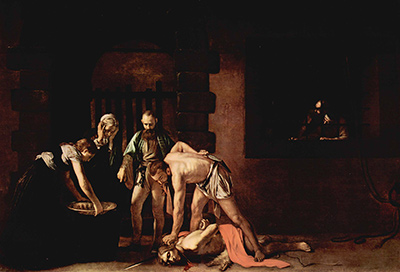
| The Beheading of Saint John the Baptist by Caravaggio | about 1608; installed in the Oratory on 29 August 1608 | Artwork |
| The Burial of Saint Lucy by Caravaggio in Syracuse | 1608, during Caravaggio's Syracuse stay | Artwork |
| The Calling of Saint Matthew by Caravaggio | about 1599–1600 | Artwork |
| The Calling of Saints Peter and Andrew by Caravaggio | about 1602–04 in the Trust's object text | Artwork |
| The Cardsharps by Caravaggio | about 1596–97 in the Kimbell's current object record | Artwork |
| The Conversion of Saint Paul: Caravaggio's Odescalchi Panel | commissioned in 1600; painted around 1600–01 | Artwork |
| The Crucifixion of Saint Andrew by Caravaggio | 1606–07 | Artwork |
| The Crucifixion of Saint Peter by Caravaggio | about 1601 | Artwork |
| The Death of the Virgin by Caravaggio | commissioned 1601; completed late 1605 or early 1606, according to the Louvre | Artwork |
| The Denial of Saint Peter by Caravaggio | 1610 | Artwork |
| The Doria Pamphilj Saint John the Baptist: A Second Youth with a Ram | linked compositionally to the Capitoline 1602 picture; an exact production year for this canvas is not established by the owner pages used here. | Artwork |
| The Entombment of Christ by Caravaggio: The Vatican Deposition | about 1600–04 in Vatican Museums publication material | Artwork |
| The Flagellation of Christ by Caravaggio: The Capodimonte Altarpiece | around 1607, in the first Naples period | Artwork |
| The Fortune Teller by Caravaggio: The Louvre Version and Its Roman Counterpart | — | Artwork |
| The Holy Family with the Infant Saint John the Baptist by Caravaggio | early 1600s in the Met catalogue; no more exact owner date asserted here | Artwork |
| The Incredulity of Saint Thomas by Caravaggio | about 1601 in the SPSG presentation | Artwork |
| The Inspiration of Saint Matthew by Caravaggio | usually 1602; also catalogued 1602–03, for the installed final altarpiece | Artwork |
| The Lute Player by Caravaggio: The Hermitage Painting | about 1596 in the Hermitage collection publication; the Hermitage Friends restoration page gives about 1595–96 | Artwork |
| The Magdalen in Ecstasy: Caravaggio, Copies and a Disputed Original | — | Artwork |
| The Martyrdom of Saint Matthew by Caravaggio | 1599–1600; unveiled with The Calling in 1600 | Artwork |
| The Martyrdom of Saint Ursula by Caravaggio | — | Artwork |
| The Musicians by Caravaggio | 1597 | Artwork |
| The Resurrection of Lazarus by Caravaggio in Messina | 1609; delivered 10 June 1609 in the owner account | Artwork |
| The Sacrifice of Isaac by Bartolomeo Cavarozzi: A Former Caravaggio Attribution | about 1615–17 in the Nicholas Hall catalogue; “1598” is an inherited URL label, not the accepted date | Artwork |
| The Sacrifice of Isaac by Caravaggio: The Uffizi Painting | about 1603 in the Uffizi catalogue | Artwork |
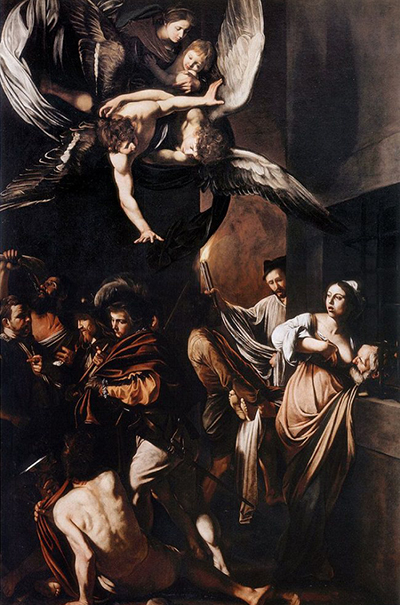
| The Seven Works of Mercy by Caravaggio | 1606–07, according to the Pio Monte | Artwork |
| The Supper at Emmaus by Caravaggio: The London Painting | 1601 | Artwork |
| The Taking of Christ by Caravaggio | 1602 | Artwork |
| The Toulouse *Judith Beheading Holofernes*: A Caravaggio Attribution Debate | c.1606–07 if identified with the recorded Naples work; that identification is debated | Artwork |
| Young Sick Bacchus by Caravaggio | about 1595 in the Galleria Borghese catalogue | Artwork |
| Youth with a Ram: Why Caravaggio's Saint John Looks So Unusual | — | Artwork |
No matching pages found.
Discussion
Share a close observation about The Calling of Saints Peter and Andrew by Caravaggio or a source that clarifies its history.
Which detail changes your reading?
Is there a collection record or document worth comparing?
What remains uncertain?
Join the Conversation
Frequently Asked Questions
Who painted The Calling of Saints Peter and Andrew?
When was it painted?
The Trust dates it about 1602–04.[1]
Where is it now?
The Royal Collection Trust announced it for the Buckingham Palace Picture Gallery redisplay opening 9 July 2026. Check current hanging and visitor access before travelling.[2]
What is its Royal Collection number?
RCIN 402824.[1]
References
- Royal Collection Trust, Caravaggio, The Calling of Saints Peter and Andrew, RCIN 402824.
- Royal Collection Trust, 2026 Buckingham Palace Picture Gallery redisplay announcement.
- Royal Collection Trust, The Art of Italy in the Royal Collection publication description.
- US Conference of Catholic Bishops, Mark 1.
- Royal Collection Trust, Charles I's lost collection and the 1637 Frizell purchase.
- Fondazione di Studi di Storia dell'Arte Roberto Longhi, Vocazione di san Matteo Evangelista.
- US Conference of Catholic Bishops, Matthew 4.
- Roma Capitale, Basilica di Santa Maria del Popolo.
- Royal Collection Trust, The Calling of Sts Andrew and Peter, RCIN 906830.
- Metropolitan Museum of Art, Caravaggio, The Holy Family with the Infant Saint John the Baptist.