 by Tom Gurney
Tom Gurney BSc (Hons) is an art history expert with over 20 years experience
Page Created on / Page Updated on
Email: tomgurney1@gmail.com / Phone: +44 7429 011000
The Martyrdom of Saint Matthew by Caravaggio
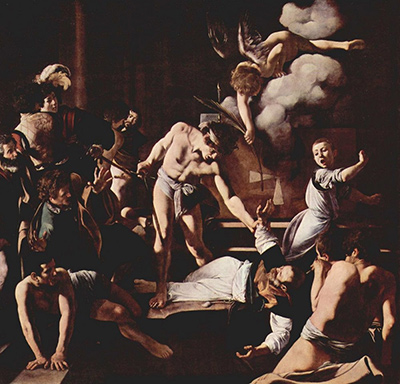
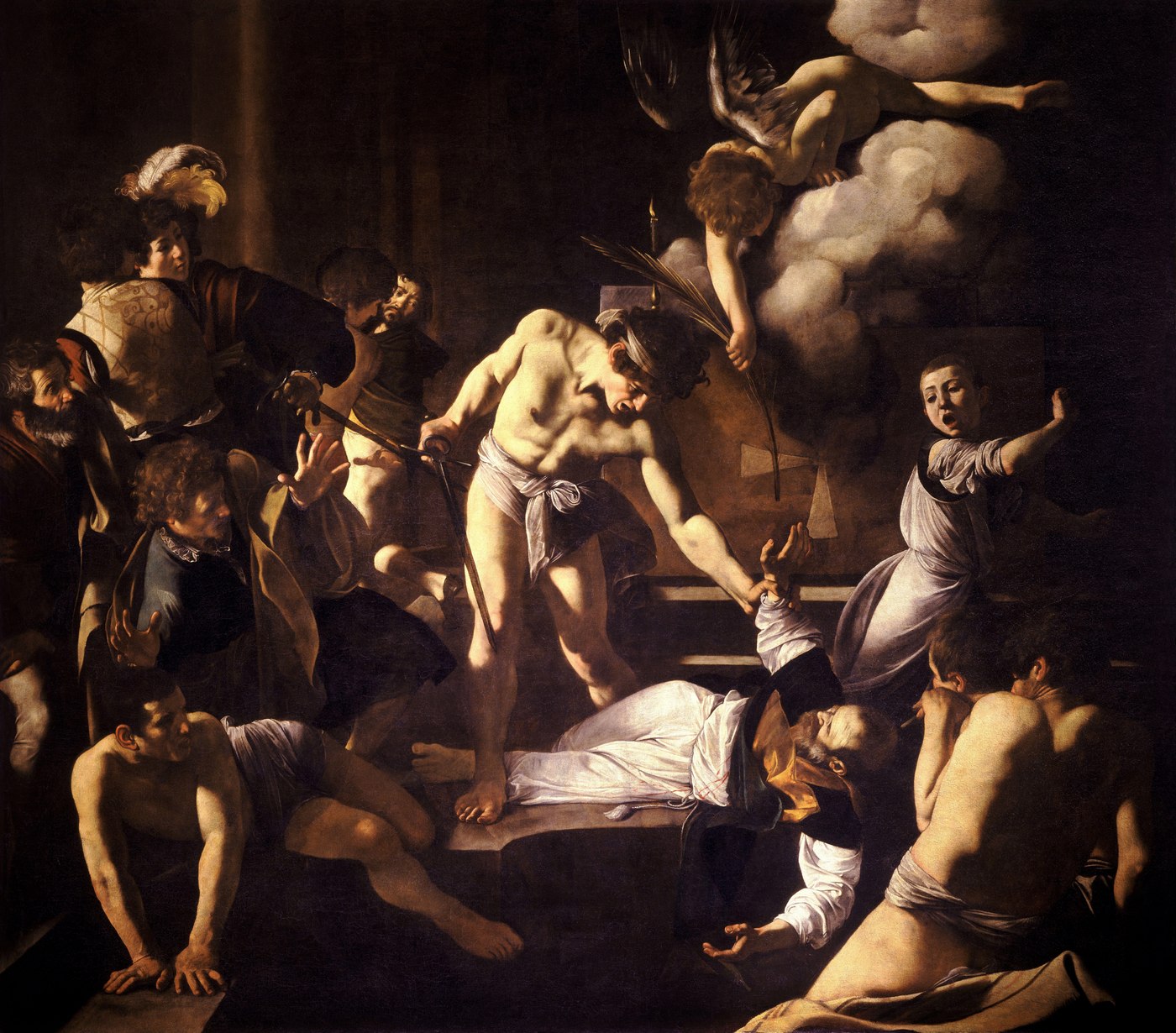
Caravaggio's Martyrdom of Saint Matthew turns a saint's death into an event unfolding at the viewer's edge. Matthew lies wounded at the centre as a nearly naked attacker grips him and raises a blade. People scatter or stare; above, an angel extends the martyr's palm. The painting occupies the right wall of the Contarelli Chapel in San Luigi dei Francesi, Rome, opposite The Calling of Saint Matthew.[1][2]
The two large side canvases were completed around 1599–1600 and unveiled in 1600. The final altarpiece of Matthew writing with an angel followed in 1602. Seen together, the three works move from a summons, through a martyr's last moments, to the evangelist's Gospel. They are a chapel program, not three unrelated museum pictures.[1][3]
Caravaggio in context
The Cardsharps
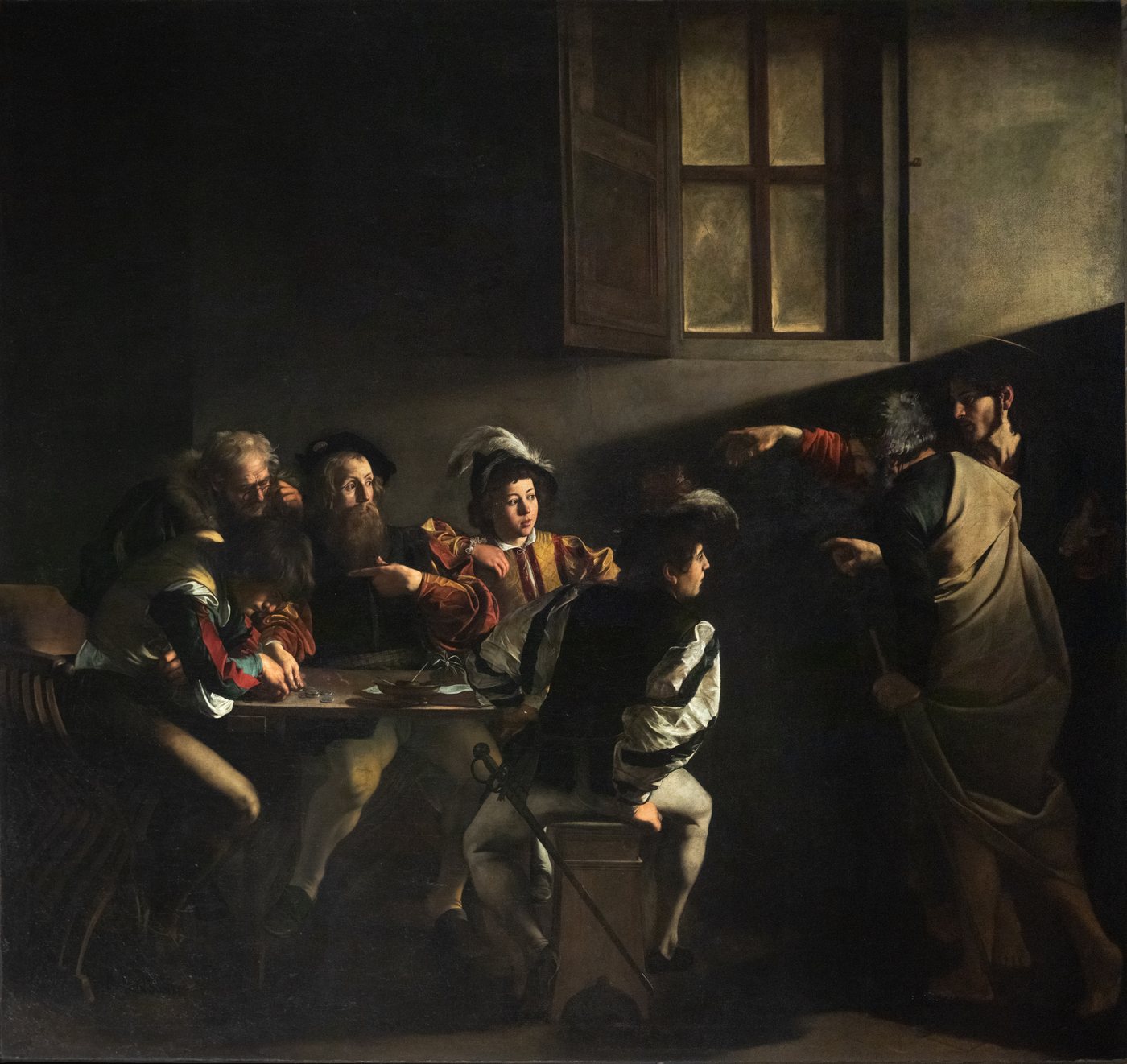
c.1595Calling of Saint Matthew
1599–1600Supper at Emmaus
1601At a Glance
- ArtistMichelangelo Merisi da Caravaggio[1][3]
- TitleThe Martyrdom of Saint Matthew (Martirio di san Matteo)[1][2]
- Date1599–1600; unveiled with The Calling in 1600[2][3]
- Mediumoil on canvas[4]
- Dimensionsabout 323 × 343 cm, height × width[4]
- Locationright wall of the Contarelli Chapel, San Luigi dei Francesi, Rome[1][2]
- Related worksThe Calling opposite; The Inspiration of Saint Matthew above the altar[1][2]
Contents
- A Scene Made for the Chapel
- What Contarelli First Planned
- What Happens in the Picture
- The Attacker and the Fallen Saint
- The Witnesses and the Angel
- Light, Space and the Viewer
- How the Design Changed
- The Painting's Conservation History
- The Three Saint Matthew Paintings
- Frequently Asked Questions
Look closer: The Martyrdom of Saint Matthew
Violence interrupts a crowded chapel scene. These details isolate the attacker, the fallen saint and the angel entering above.
 123
Details from The Martyrdom of Saint Matthew
Select a detail image to open the full-size gallery, then use the arrows to compare views.
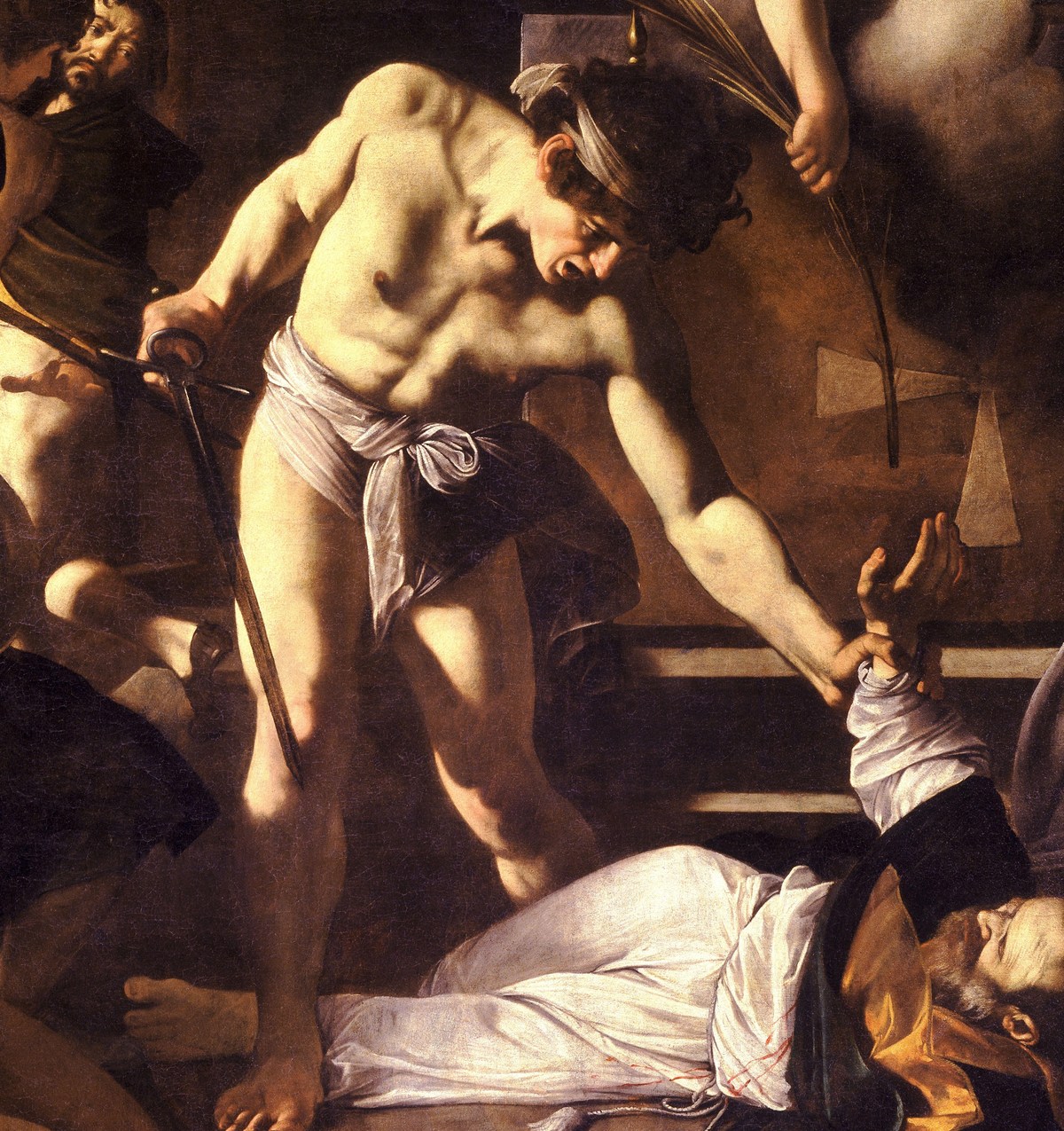
The attacker’s movement
The half-dressed attacker leans across the centre, reaching down as bodies recoil around him.
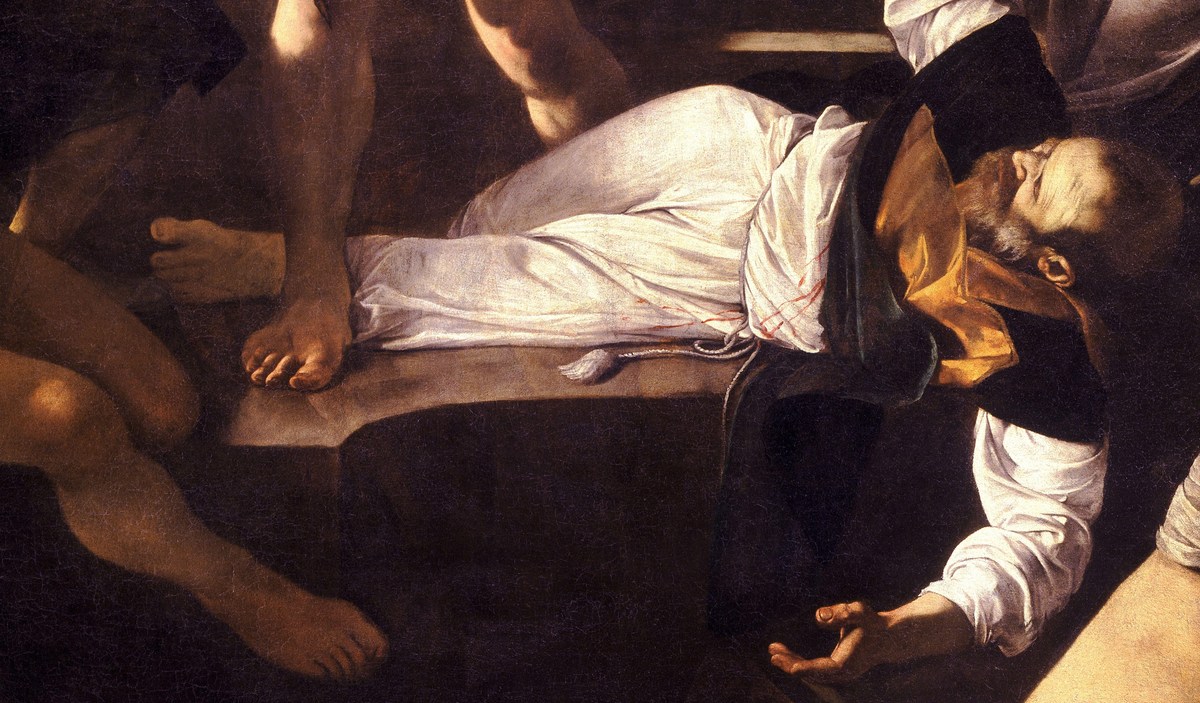
Matthew on the ground
Matthew lies at the altar steps, his white vestment bright against the surrounding dark figures.
The angel above
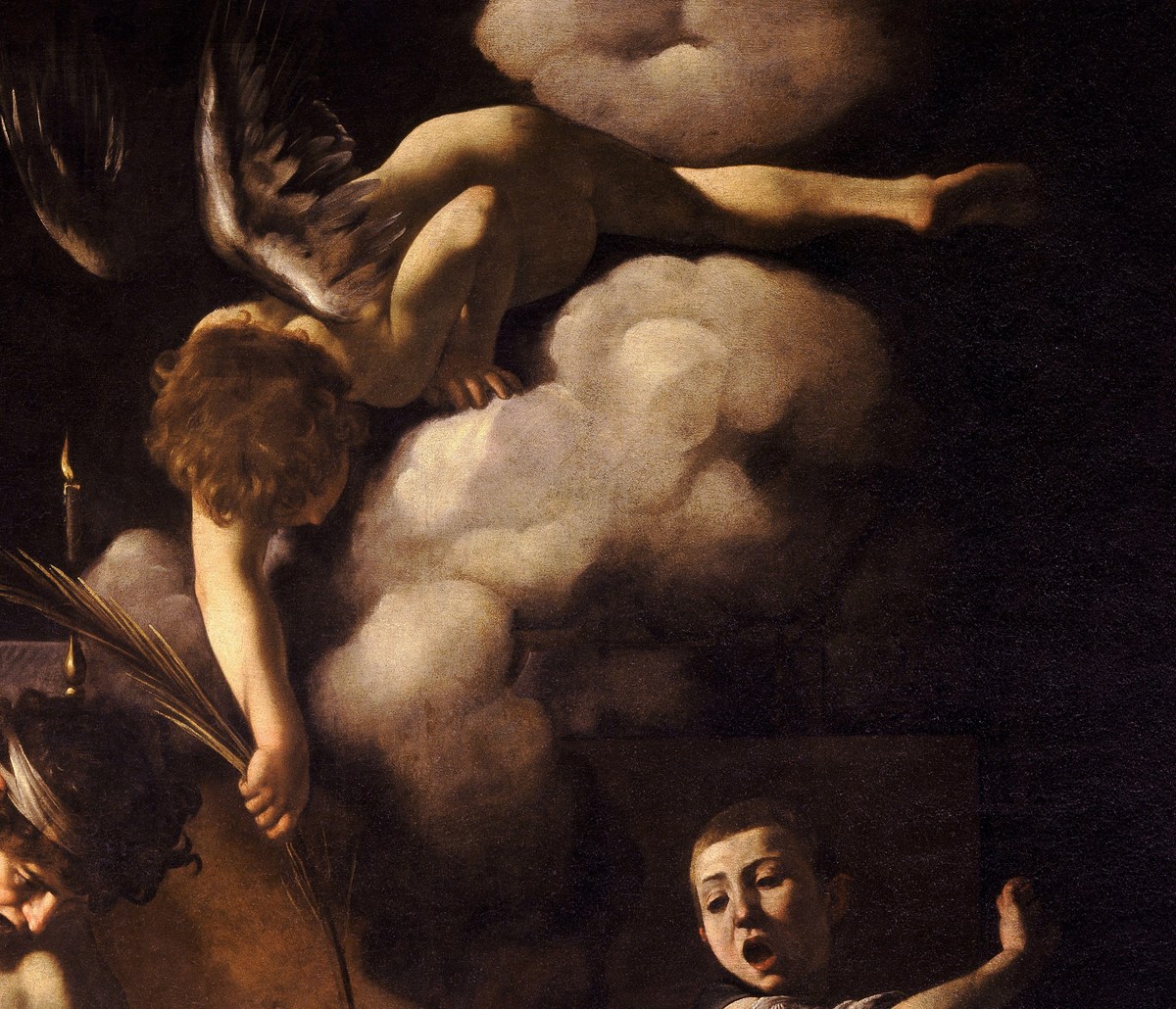
An angel descends from the upper darkness, extending a palm toward the violence below.
A Scene Made for the Chapel
The Contarelli Chapel takes its name from the French cardinal Mathieu Cointrel, Italianised as Matteo Contarelli. Its program honours his name saint. Rome's official visitor record identifies Caravaggio's three Saint Matthew paintings in the chapel and dates the group between 1599 and 1602. The artist executed the two side scenes first; a painting of Matthew and the angel later occupied the altar.[1][2]
The Martyrdom is therefore a site-specific work. Its large, near-square surface answers the chapel wall and the painting across it. A reproduction on a phone can show the narrative, but it cannot fully convey the pressure of a scene painted more than three metres high beside the altar. The saint's body and the attacker are large enough to confront a visitor who has turned from one side wall to the other.[4]
The work was part of a major public commission. The Metropolitan Museum of Art notes that the unveiling of The Calling and The Martyrdom in 1600 established Caravaggio's reputation. Its account emphasises how he brought figures close to the picture plane and used light to make a distant religious story seem immediate. Those effects are especially clear in the sudden, crowded violence here.[3]
An Italian Senate exhibition record gives 23 July 1599 as the date Caravaggio signed the contract for the two side canvases, in the approach to the 1600 Jubilee. This anchors the commission more firmly than a stylistic guess at when the canvas might have been started. It also explains the order of the chapel works: the contract concerned the scenes on the two walls, while the altar painting followed later. The signed date is a commission date, not a record of the exact day Caravaggio first put paint on The Martyrdom.[10]
What Contarelli First Planned
Caravaggio entered a project begun long before he arrived. Gigliola Fragnito's archival biography records that Contarelli bought the chapel in 1565 and on 13 September contracted Girolamo Muziano for a scheme that included the Martyrdom and Calling as side-wall frescoes, three vault scenes from Matthew's life, and an oil altarpiece of the evangelist with an angel.[12] The decision to pair conversion with death therefore preceded Caravaggio by more than three decades. His canvases changed the medium and visual language of the walls, but the two subjects were already prescribed.
The long delay affected what viewers eventually saw. Fragnito cites a 1596 petition describing the chapel as still closed; disputes over Contarelli's inheritance had held up the work. In 1597 the administration of the funds passed from the Crescenzi executors to the Fabbrica di San Pietro. By then Cavalier d'Arpino had received the vault commission, while the side walls remained to be completed.[12] Caravaggio's 1599 contract belongs to this effort to finish an inherited chapel before the Jubilee, rather than to a wholly new patron choosing an isolated subject for him.[10][12]
Muziano's planned vault scenes included Matthew baptising an Ethiopian king and queen.[12] That earlier program is relevant when scholars discuss whether the lightly clad figures low in The Martyrdom suggest converts near a baptismal pool. It gives the baptism reading a wider chapel context; it does not turn an indistinct patch of the finished canvas into visible water or prove that Caravaggio followed every detail of the 1565 scheme.[11]
What Happens in the Picture
Matthew's martyrdom is shown during the attack, before the final blow. The saint is down, dressed in white and stretched across a raised platform or steps. His attacker stands over him, one hand fastening onto Matthew while the other holds the weapon. A group of people in the surrounding dimness respond with fear, movement and attention. Rome's official Caravaggio itinerary describes the saint as wounded and on the ground, held by an assassin preparing a fatal strike.[2]
The reason for the attack comes from later saints' lives, not from the Gospel of Matthew. In Jacobus de Voragine's medieval Golden Legend, Matthew preaches in Ethiopia and supports the vow of Ephigenia, a converted king's daughter. His successor, Hirtacus, wants to marry her; Matthew opposes him, and the king sends a swordsman who kills the apostle at the church altar after Mass. This is evidence for the story available to later Christians and artists, not independent evidence that the events happened as written. Caravaggio concentrates on the violent instant and does not paint Ephigenia or the king into a complete narrative cycle.[7]
The picture does not offer a calm sequence of episodes. It shows a charged instant. The attacker faces outward, his bare body catching the brightest light. Matthew turns up from the ground, raising an arm. That gesture can be read both as a human response to violence and as a movement toward the angel above. The viewer has to look through urgent bodies to grasp the sacred meaning of the scene.
The setting is compressed and partially lost in shadow. A few steps and the suggestion of an interior locate the action without describing a complete building. The event is recognisable through the saint, his killer, the fleeing witnesses and the angel's palm, not through an elaborate architectural backdrop.
The Attacker and the Fallen Saint
The executioner's near-naked body is a startling centre of force. He is not placed at a safe distance from Matthew. His foot, bent torso and extended arms occupy the same tight space as the saint's white clothing. Caravaggio lets the viewer see the physical imbalance: one man upright and active, the other fallen and exposed.
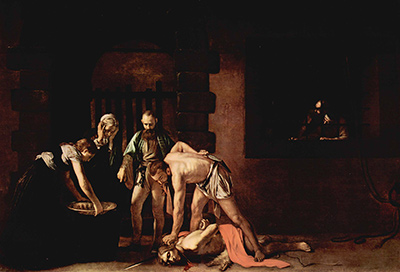
The blade is raised for the decisive act. It is easy to call the painting a beheading, but that description imports a particular type of death and confuses this episode with The Beheading of Saint John the Baptist in Malta. This is Matthew's martyrdom in a chapel dedicated to him. The visible action should be described rather than replaced with a formula borrowed from a different canvas.
Matthew's clothing creates a broad light form beneath the attacker. That white area stops the scene from dissolving into darkness and makes the saint's body legible from farther away. It also carries the eye toward the pale arm and hand he extends upward. There is no need to invent a precise final line of dialogue for him; the painting communicates through posture and proximity.
The Witnesses and the Angel
The surrounding figures do not share a single response. Some turn away or run. A man at the right opens his arms in alarm, while another figure in the foreground withdraws toward the edge. Others look back toward the centre. These reactions make the scene feel unstable: the violence is still happening, and the witnesses have not yet found a settled way to understand it.
The bystanders also matter because the saint's body does not occupy the whole canvas. Todd P. Olson's study of the painting asks how a martyr can remain the subject when the attacker's force and the crowd's flight command so much attention. In his reading, the body's threatened integrity gives the scene a relation to early Christian relics and to religious images of violence circulating in Caravaggio's Rome. That is a specialist interpretation, rather than a documented instruction from the patron; it helps explain why the scattered reactions are central to the work instead of incidental stage business.[9]
Olson places the picture beside the martyrdom cycles and prints that appeared in Rome during the religious conflicts of the late sixteenth century, including images at Santo Stefano Rotondo and the English College. He also reads the revival of the chapel in the French national church around 1600 against French religious war and Henry IV's conversion.[9] That historical setting helps explain why a saint's violent death might have carried urgency for contemporary viewers. It is Olson's account of the painting's possible political force, not evidence that a figure in this crowd depicts a named combatant or that the contract specified a political message.
Even the near-naked figures low in the picture have elicited different readings. Franca Trinchieri Camiz notes that some scholars treat them as devices framing the scene, while others see new converts at a baptismal pool. She argues that baptism beside martyrdom would have suited this burial chapel, but also acknowledges that the pool's water is no longer discernible. Her argument gives the foreground a possible religious function without making a vanished pool or every witness's identity certain. It is useful precisely because the painting rewards a second look beyond the dominant attacker.[11]
Above the attacker, an angel descends from cloud and extends a palm toward Matthew. In Christian art the palm is a sign of martyrdom and victory through faith. Its placement connects the low, endangered saint to a meaning unavailable to the people fleeing the event. The angel does not erase the wound or stop the knife. Caravaggio lets earthly harm and the promise of a spiritual reward coexist in one image.[2]
One spectator sometimes identified in discussions as a possible likeness of Caravaggio looks toward the event from the rear. A resemblance claim is interpretive and should remain qualified unless anchored by reliable portrait evidence. The painting's effect does not depend on proving that the artist put himself in the crowd.
Light, Space and the Viewer
The illumination isolates the attacker and Matthew while other bodies partly vanish. This directs attention first to the crisis, then to the angel and witnesses. A dark church setting would have made the strong light-dark contrast especially useful for legibility; the effect is visible even in a reproduction. The Met's account of the public chapel commission links Caravaggio's close figures and dramatic light to the extraordinary immediacy of these scenes.[3]
The viewer is not stationed above the action as a detached judge. Figures turn, flee and reach across the front of the composition. The attacker seems to step into space near the edge; the fallen saint almost meets the viewer's level. This is an interpretation of the image's visual organisation, not a documented statement of what Caravaggio intended every visitor to feel.
The contrast with The Calling is instructive. Across the chapel, a hand and shaft of light interrupt a group at a table. Here a blow interrupts a gathered group and light exposes the body at risk. Both pictures ask the viewer to locate Matthew within a crowd, then recognise a decisive moment in his life.
How the Design Changed
The changes beneath The Martyrdom are documented, although their exact sequence remains a subject of interpretation. A report on the 2011 exhibition of the Contarelli Chapel's technical findings identifies 1951 radiographs by Italy's Central Institute for Restoration as evidence of a substantially different earlier composition. Conservation historian Simona Rinaldi, however, found a 1941 newspaper notice already describing X-ray traces beneath the painting. That earlier notice predates the 1951 examination cited in the exhibition report; it should not be erased from the history of the discovery. A later campaign examined all three chapel canvases with digital radiography, infrared reflectography and X-ray fluorescence, allowing researchers to reconstruct a developed first arrangement that Caravaggio abandoned. This concerns changes within this canvas, not a separate rejected side-wall painting.[8][13]
The earlier design appears to have given more space to architecture. The 2011 report links its perspective setting to the Prevedari engraving, made after a design by Bramante. In discussing the published X-ray photographs, Olson describes several threatening men whose bodies partly obscure Matthew. The finished painting moves the struggle forward and makes the fallen saint more legible beneath one dominant attacker. These are observable differences between an underlying design and the surface; the claim that Caravaggio changed it for a single psychological reason would go beyond the examination.[8][9]
The X-ray makes that visual problem more specific. In Olson's reading, a helmeted assailant stood in the foreground with his back to the viewer, while two further men repeated the downward threat toward a Matthew partly hidden between them. A young nude figure near the saint echoed his defensive gesture.[9] Compared with that crowded arrangement, the visible painting gives one attacker a clear dominant body and opens a more direct view of the fallen apostle. The radiograph documents the changed positions; Olson's explanation of why the first group weakened Matthew's prominence is a critical interpretation.
The exhibition report concerns a technically examined earlier composition, but it does not establish a simple count of two or three fully finished and displayed versions. The earlier arrangement remained beneath the present paint. Likewise, the first Saint Matthew and the Angel was a different altar canvas, not a first version of The Martyrdom. Keeping those histories apart makes the artist's revisions more interesting: the right-wall picture itself records a change in how a large crowd, architecture and a vulnerable saint could be made readable together.[8][9][5]
The Painting's Conservation History
The painting's modern technical record arose partly from a threat to its survival. Rinaldi and conservation researcher Claudio Seccaroni describe a 1939 water-pipe break in rooms adjoining The Martyrdom's chapel wall. Water entered the masonry and reached the canvas; Rinaldi identifies damage especially at the upper left. Contemporary accounts described the picture as soaked and reported mould. The side paintings were removed to the Galleria Borghese. The history of their examination therefore includes an emergency intervention, not just scholarly curiosity about Caravaggio's revisions.[13][14]
In July 1940, the ministry requested an estimate from restorer Mauro Pellicioli for the two side paintings. Rinaldi says they were dried, then treated in the rooms being prepared for the Central Institute for Restoration; Pellicioli completed lining, cleaning, filling and retouching by April 1941. Seccaroni notes that the institute did not officially open until October 1941, so the treatment's institutional label is more complicated than calling it a routine later ICR restoration. His research identifies six damage photographs from around 1940 for The Martyrdom, including a view of its reverse. Those records help document condition and treatment; they are not images of Caravaggio's original paint before all restorations.[13][14]
The chapel paintings already had a longer history of care. From the French establishment's archive, Seccaroni documents Pietro Palmaroli's 1824 work on the side canvases, paid at 30 scudi each, and Giuseppe Ceppari's 1842 treatment at the French Academy, where the two pictures were transported and returned to the church. Neither episode changes the identity of the paintings; both matter when a dark passage or surface alteration is judged from the canvas as it appears today.[14]
During the Second World War, Seccaroni places the canvases at Carpegna from June to December 1943, then back in Rome at Palazzo Venezia. The two side pictures appeared there in a public exhibition opened on 27 August 1944. A further ICR restoration and systematic radiographic campaign followed in 1965–67, before the imaging reported in 2011. These dated interventions explain why the evidence for the hidden composition comes from more than one generation of photographs and X-rays. They do not disclose Caravaggio's single motive for repainting the scene.[13][14]
A newly recorded chapel
In June 2026 Factum Foundation and the Pious Establishments of France completed a high-resolution record of the entire Contarelli Chapel. The campaign included The Martyrdom, the two companion canvases, Cesari's vault frescoes, marbles and the architectural space. It also began recording documents from the church's historical archives. This is useful for future study because a side-wall painting can be compared with the setting that shapes its sightline and illumination, and its present surface can be documented in detail.[6]
The recording is a condition and research resource, not evidence that the 1599–1600 design has changed or that a newly discovered first state has been authenticated. It makes the relation among painting, chapel and documents more precisely examinable. A cropped photograph of the canvas remains helpful for figures and gestures, but it cannot reproduce the experience of turning from one wall to the altar and across to The Calling.[6]
The Three Saint Matthew Paintings
The chapel's narrative begins on the left wall with The Calling of Saint Matthew. Christ calls the tax collector at a table. The right wall shows the saint's death. At the altar, the installed Inspiration of Saint Matthew shows him writing under an angel's guidance. Rome's visitor record names all three; its itinerary assigns the side canvases to 1599–1600 and the definitive altarpiece to 1602.[1][2]
There was an earlier Caravaggio painting of Matthew and the angel intended for the altar. It entered the Giustiniani collection and later Berlin; the Berlin museum says it was most likely destroyed in May 1945. That separate object belongs to the Saint Matthew and the Angel page. It is not the painting visible in the chapel today.[5]
The chapel also includes work by other artists. The vault frescoes are by Cavalier d'Arpino, according to Rome's official church record. The three Caravaggio canvases are central to the visitor's experience, but they do not constitute every surface of the chapel.[1]
Explore the Caravaggio collection
| Name | Date | Type |
|---|---|---|
| Adoration of the Shepherds by Caravaggio: The Messina Nativity | 1608–09; precise order relative to Resurrection of Lazarus remains unresolved | Artwork |
| Amor Victorious by Caravaggio | 1601–02 in the Berlin owner record | Artwork |
| Bacchus by Caravaggio: The Uffizi Painting | about 1598, according to the Uffizi | Artwork |
| Basket of Fruit by Caravaggio | after 1597, probably around the turn of the seventeenth century, according to the Ambrosiana | Artwork |
| Boy Bitten by a Lizard: Caravaggio's London Painting | about 1594–95 in the National Gallery's current catalogue; URL suffix “1596” is inherited | Artwork |
| Boy Bitten by a Lizard: The Florence Version Attributed to Caravaggio | disputed; Longhi's catalogue record preserves historical 1592–93 and other proposed ranges, including c.1597 | Artwork |
| Boy Peeling Fruit by Caravaggio: The Royal Collection Painting | about 1592–93 in the owner's current exhibition record | Artwork |
| Boy Peeling Fruit in Florence: A Derivation from Caravaggio | — | Artwork |
| Boy with a Basket of Fruit by Caravaggio | about 1595 in the Galleria Borghese catalogue | Artwork |
| Caravaggio Paintings in Rome: Churches, Museums and a Practical Route | — | Guide |
| Caravaggio Quotes: What the Documents Actually Record | — | Guide |
| Caravaggio's Lute Player: The Del Monte Painting Once Shown at the Met | about 1596–97 in the Met catalogue | Artwork |
| Caravaggio's Painting Technique: Grounds, Incisions, Revisions and Light | — | Guide |
| Christ at the Column by Caravaggio: The Rouen Flagellation | c.1606 in the owner caption; owner prose gives 1606–07 | Artwork |
| Christ on the Mount of Olives by Caravaggio: The Lost Berlin Painting | — | Artwork |
| Conversion on the Way to Damascus by Caravaggio | about 1601 in the Roma Capitale church record | Artwork |
| Crowning with Thorns by Caravaggio: The Vienna Painting | about 1603 in the 2019 KHM record; “1607” is an inherited URL suffix | Artwork |
| Crowning with Thorns in Prato: Attributed to Caravaggio | about 1602–03 in the collection presentation | Artwork |
| David with the Head of Goliath by Caravaggio: The Borghese Painting | 1606–07 or 1609–10 in the Galleria Borghese catalogue; the later Naples period is favoured by many scholars, while the owner keeps the question open | Artwork |
| David with the Head of Goliath by Caravaggio: The Prado Painting | about 1600 in Prado material; “1599” survives only in the legacy URL | Artwork |
| David with the Head of Goliath by Caravaggio: The Vienna Painting | about 1600–01 in the KHM's 2019 exhibition record; “1607” is a legacy route label | Artwork |
| Did Caravaggio Make Drawings? What Survives and What Paintings Reveal | — | Guide |
| Ecce Homo: Caravaggio's Madrid Rediscovery and the Genoa Painting | — | Artwork |
| John the Baptist in Caravaggio's Paintings: A Guide to the Different Versions | — | Artwork |
| Judith Beheading Holofernes by Caravaggio | beginning of the seventeenth century in the owning museum's account; about 1599–1600 in the Kimbell's 2025 loan label; around 1602 in one specialist catalogue | Artwork |
| Jupiter, Neptune and Pluto: Caravaggio's Ludovisi Ceiling | about 1597; the archive connects the work with Cardinal del Monte's 1597 commission | Artwork |
| Madonna and Child with Saint Anne by Caravaggio: The Palafrenieri Altarpiece | 1605 in the Galleria Borghese object field; completed and delivered by 8 April 1606 | Artwork |
| Madonna of Loreto by Caravaggio: The Pilgrims at Sant'Agostino | broadly c.1604–06; institutional records differ slightly in their starting year | Artwork |
| Madonna of the Rosary by Caravaggio: The Vienna Altarpiece | around 1603 in the Kunsthistorisches Museum's object record | Artwork |
| Martha and Mary Magdalene by Caravaggio: The Detroit Painting | about 1598 in the Detroit Institute of Arts record | Artwork |
| Medusa by Caravaggio: The Uffizi Painted Shield | 1596–98 in the Uffizi's virtual exhibition; specialist research reports the shield delivered to the Medici wardrobe by 7 September 1598 | Artwork |
| Narcissus, Attributed to Caravaggio | dependent on attribution; the Zeri catalogue gives a broad 1610–50 range under Spadarino | Artwork |
| Nativity with Saint Francis and Saint Lawrence: Caravaggio's Missing Painting | somewhere in 1600–09 in the parliamentary report; a specific 1609 execution and place remain debated | Artwork |
| Penitent Mary Magdalene by Caravaggio | 1597 in the owner's catalogue, during Caravaggio's early Roman activity | Artwork |
| Portrait of a Courtesan: Caravaggio's Lost Berlin Portrait | Berlin's data field says c.1590, while its own text compares a Caravaggio work of c.1598; precise date unresolved | Artwork |
| Portrait of Alof de Wignacourt and His Page by Caravaggio | — | Artwork |
| Portrait of Fra Antonio Martelli? Caravaggio's Pitti Knight of Malta | 1608 in the Restituzioni object heading; within Caravaggio's Malta period | Artwork |
| Portrait of Maffeo Barberini: The Seated Corsini Painting | c.1596–97 in the national catalogue | Artwork |
| Portrait of Monsignor Maffeo Barberini: Caravaggio's Newly Acquired Painting | around the late 1590s / age thirty; “1598” in the inherited address is approximate, not an exact document date | Artwork |
| Portrait of Pope Paul V: A Caravaggio Attribution and a Borghese Copy | — | Artwork |
| Prints After Caravaggio: Who Made Them and What They Show | — | Guide |
| Reclining Saint John the Baptist: A Disputed Caravaggio Attribution | often proposed for the artist's final years; the later museum list does not give a precise year. | Artwork |
| Rest on the Flight into Egypt by Caravaggio | about 1597 in the owner's catalogue | Artwork |
| Saint Catherine of Alexandria by Caravaggio: The Thyssen Painting | about 1598–99 in the Museo Nacional Thyssen-Bornemisza catalogue | Artwork |
| Saint Francis in Meditation by Caravaggio: The Cremona Painting | 1603–06 in the owner account; c.1605–06 in a KHM exhibition caption | Artwork |
| Saint Francis in Prayer: Caravaggio's Carpineto Painting | 1606 in a 2016–17 exhibition work list | Artwork |
| Saint Francis of Assisi in Ecstasy by Caravaggio | c.1595–96 in the owner wall text | Artwork |
| Saint Jerome in Meditation: Caravaggio's Montserrat Painting | 1605 in the owner record; an owner publication reports scholarship placing it about 1605–06 | Artwork |
| Saint Jerome Writing by Caravaggio: The Borghese Painting | c.1606 in the owner catalogue; the “1605” URL suffix is inherited | Artwork |
| Saint Jerome Writing by Caravaggio: The Malta Painting | around 1607–08; foundation dates Malaspina's commission to 1608 | Artwork |
| Saint John in the Wilderness at Toledo Cathedral | exact 1598 not established by the cited cathedral account. | Artwork |
| Saint John the Baptist at Galleria Corsini, Rome | about 1606 in the national record; older proposals ranged from the late 1590s onward. | Artwork |
| Saint John the Baptist at the Capitoline Museums, Rome | 1602. | Artwork |
| Saint John the Baptist at the Galleria Borghese | 1609–10 in the current Borghese record. | Artwork |
| Saint John the Baptist at the Spring: The Bonello Painting in Malta | early seventeenth century in the institutional account; a precise 1608 is not established there. | Artwork |
| Saint Matthew and the Angel: Caravaggio's Lost First Altarpiece | — | Artwork |
| Salome Receives the Head of John the Baptist: Caravaggio's London Painting | about 1609–10, likely late Naples period in the Gallery's account | Artwork |
| Salome with the Head of John the Baptist: Caravaggio's Madrid Painting | — | Artwork |
| Sleeping Cupid by Caravaggio: The Painting Made in Malta | about 1608, Malta period | Artwork |
| Still Life with Fruit on a Stone Ledge: Is It by Caravaggio? | — | Artwork |
| Supper at Emmaus (1606): Caravaggio's Brera Painting | — | Artwork |
| The Annunciation by Caravaggio in Nancy | c.1607–10 in the collection record; 1608–10 in the museum's restoration account | Artwork |
| The Basel Saint John the Baptist: Once Labelled Caravaggio, Now Maíno | about 1608–10 in that schedule, rather than the legacy URL's 1600. | Artwork |
| The Beheading of Saint John the Baptist by Caravaggio | about 1608; installed in the Oratory on 29 August 1608 | Artwork |
| The Burial of Saint Lucy by Caravaggio in Syracuse | 1608, during Caravaggio's Syracuse stay | Artwork |
| The Calling of Saint Matthew by Caravaggio | about 1599–1600 | Artwork |
| The Calling of Saints Peter and Andrew by Caravaggio | about 1602–04 in the Trust's object text | Artwork |
| The Cardsharps by Caravaggio | about 1596–97 in the Kimbell's current object record | Artwork |
| The Conversion of Saint Paul: Caravaggio's Odescalchi Panel | commissioned in 1600; painted around 1600–01 | Artwork |
| The Crucifixion of Saint Andrew by Caravaggio | 1606–07 | Artwork |
| The Crucifixion of Saint Peter by Caravaggio | about 1601 | Artwork |
| The Death of the Virgin by Caravaggio | commissioned 1601; completed late 1605 or early 1606, according to the Louvre | Artwork |
| The Denial of Saint Peter by Caravaggio | 1610 | Artwork |
| The Doria Pamphilj Saint John the Baptist: A Second Youth with a Ram | linked compositionally to the Capitoline 1602 picture; an exact production year for this canvas is not established by the owner pages used here. | Artwork |
| The Entombment of Christ by Caravaggio: The Vatican Deposition | about 1600–04 in Vatican Museums publication material | Artwork |
| The Flagellation of Christ by Caravaggio: The Capodimonte Altarpiece | around 1607, in the first Naples period | Artwork |
| The Fortune Teller by Caravaggio: The Louvre Version and Its Roman Counterpart | — | Artwork |
| The Holy Family with the Infant Saint John the Baptist by Caravaggio | early 1600s in the Met catalogue; no more exact owner date asserted here | Artwork |
| The Incredulity of Saint Thomas by Caravaggio | about 1601 in the SPSG presentation | Artwork |
| The Inspiration of Saint Matthew by Caravaggio | usually 1602; also catalogued 1602–03, for the installed final altarpiece | Artwork |
| The Lute Player by Caravaggio: The Hermitage Painting | about 1596 in the Hermitage collection publication; the Hermitage Friends restoration page gives about 1595–96 | Artwork |
| The Magdalen in Ecstasy: Caravaggio, Copies and a Disputed Original | — | Artwork |
| The Martyrdom of Saint Matthew by Caravaggio | 1599–1600; unveiled with The Calling in 1600 | Artwork |
| The Martyrdom of Saint Ursula by Caravaggio | — | Artwork |
| The Musicians by Caravaggio | 1597 | Artwork |
| The Resurrection of Lazarus by Caravaggio in Messina | 1609; delivered 10 June 1609 in the owner account | Artwork |
| The Sacrifice of Isaac by Bartolomeo Cavarozzi: A Former Caravaggio Attribution | about 1615–17 in the Nicholas Hall catalogue; “1598” is an inherited URL label, not the accepted date | Artwork |
| The Sacrifice of Isaac by Caravaggio: The Uffizi Painting | about 1603 in the Uffizi catalogue | Artwork |
| The Seven Works of Mercy by Caravaggio | 1606–07, according to the Pio Monte | Artwork |
| The Supper at Emmaus by Caravaggio: The London Painting | 1601 | Artwork |
| The Taking of Christ by Caravaggio | 1602 | Artwork |
| The Toulouse *Judith Beheading Holofernes*: A Caravaggio Attribution Debate | c.1606–07 if identified with the recorded Naples work; that identification is debated | Artwork |
| Young Sick Bacchus by Caravaggio | about 1595 in the Galleria Borghese catalogue | Artwork |
| Youth with a Ram: Why Caravaggio's Saint John Looks So Unusual | — | Artwork |
No matching pages found.
Discussion
Share a close observation about The Martyrdom of Saint Matthew by Caravaggio or a source that clarifies its history.
Which detail changes your reading?
Is there a collection record or document worth comparing?
What remains uncertain?
Join the Conversation
Frequently Asked Questions
Where is The Martyrdom of Saint Matthew?
When was it painted?
Who is the near-naked man in the centre?
He is the attacker about to deliver the fatal blow to Matthew. The saint is the fallen, white-clothed figure beneath him.[2]
What does the angel hold?
The angel extends a palm, a traditional emblem of a martyr's spiritual victory. It gives the violent scene a second, sacred register.
Was The Martyrdom rejected and repainted?
References
- Roma Capitale, San Luigi dei Francesi visitor record, Contarelli Chapel and three paintings.
- Roma Capitale, “I luoghi di Caravaggio”, chapel dates and description of The Martyrdom; see also its Caravaggio itinerary guide, pp. 23–24.
- Metropolitan Museum of Art, “Caravaggio (Michelangelo Merisi) (1571–1610) and His Followers”, 1600 unveiling and public impact.
- Metropolitan Museum of Art, “The Petrifying Art,” Metropolitan Museum Journal 26 (1991), fig. 11, dimensions and medium.
- Staatliche Museen zu Berlin, Der Evangelist Matthäus, record of the earlier Contarelli altarpiece and probable 1945 destruction.
- Factum Foundation, “Digitising the Contarelli Chapel in Rome”, 2026 recording account.
- Jacobus de Voragine, Golden Legend, life of Saint Matthew, medieval narrative in William Caxton's translation.
- 2011 account of the Soprintendenza's Contarelli Chapel technical exhibition, Gazzetta Antiquaria, pp. 69–70.
- Todd P. Olson, “Pitiful Relics: Caravaggio's Martyrdom of St. Matthew”, Representations 77 (2002), pp. 107–142; article PDF.
- Italian Senate, Antiquorum Habet exhibition record for San Luigi dei Francesi, 1599 commission date and Jubilee setting.
- Franca Trinchieri Camiz, “Death and Rebirth in Caravaggio's Martyrdom of St. Matthew,” Artibus et Historiae 22 (1990), abstract, baptismal interpretation and its visual limit.
- Gigliola Fragnito, “Contarelli, Matteo,” Dizionario Biografico degli Italiani 28 (1983), documented 1565 chapel scheme, later delays and 1597 transfer of funds.
- Simona Rinaldi, “Roberto Longhi e la diagnostica sui dipinti di Caravaggio,” in Storie dell’arte: Studi in onore di Francesco Federico Mancini, vol. II (2020), pp. 505–513, archival account of the 1939 damage, 1940–41 treatment and 1941 press notice of earlier X-ray traces.
- Claudio Seccaroni, “I restauri dei dipinti di Caravaggio in San Luigi dei Francesi precedenti all’intervento ICR del 1965–67,” Kermes 79 (2010), author-uploaded text, French-establishment records of earlier restorations, 1939 flood and wartime movements.
- Annotated image source: Wikimedia Commons, File:The Martyrdom of Saint Matthew-Caravaggio (c. 1599-1600).jpg, high-resolution reproduction used for the annotated details.