 by Tom Gurney
Tom Gurney BSc (Hons) is an art history expert with over 20 years experience
Page Created on / Page Updated on
Email: tomgurney1@gmail.com / Phone: +44 7429 011000
The Seven Works of Mercy by Caravaggio
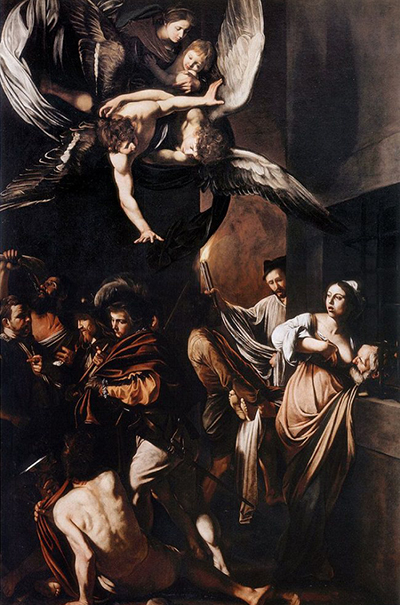
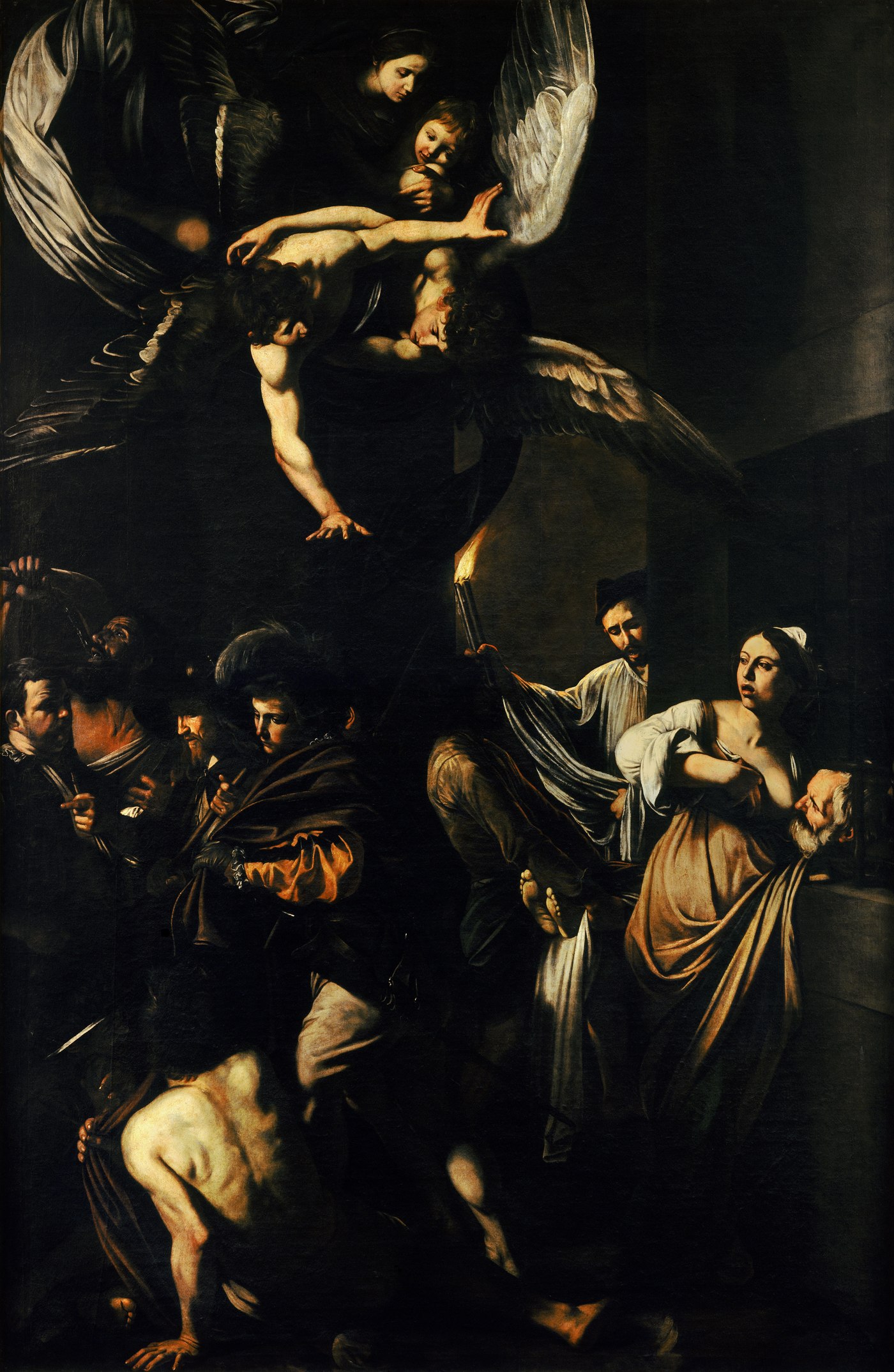
At first the painting looks like a crowded Naples street at night. A woman feeds an imprisoned man, another figure carries a body, a traveller is received, and a soldier divides his cloak. Above them, the Virgin and Child appear among angels. Caravaggio's Seven Works of Mercy brings seven acts of bodily charity into one dense scene, asking the viewer to discover how a religious obligation can be carried out by people close to everyday life.[1]
The work was made in 1606–07 for the Pio Monte della Misericordia, the Naples institution that still preserves it in its chapel. Its current account records a payment of 400 ducats and explains the individual acts within the picture. That owner account is essential because the actions overlap: one pair of figures can represent more than one work of mercy, and several figures are partly hidden in the dark.[1]
Caravaggio in context
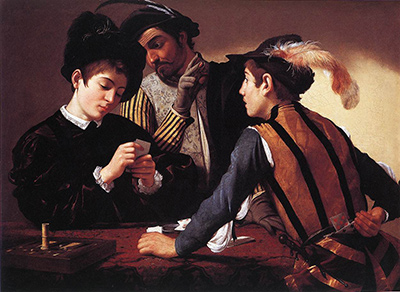
The Cardsharps
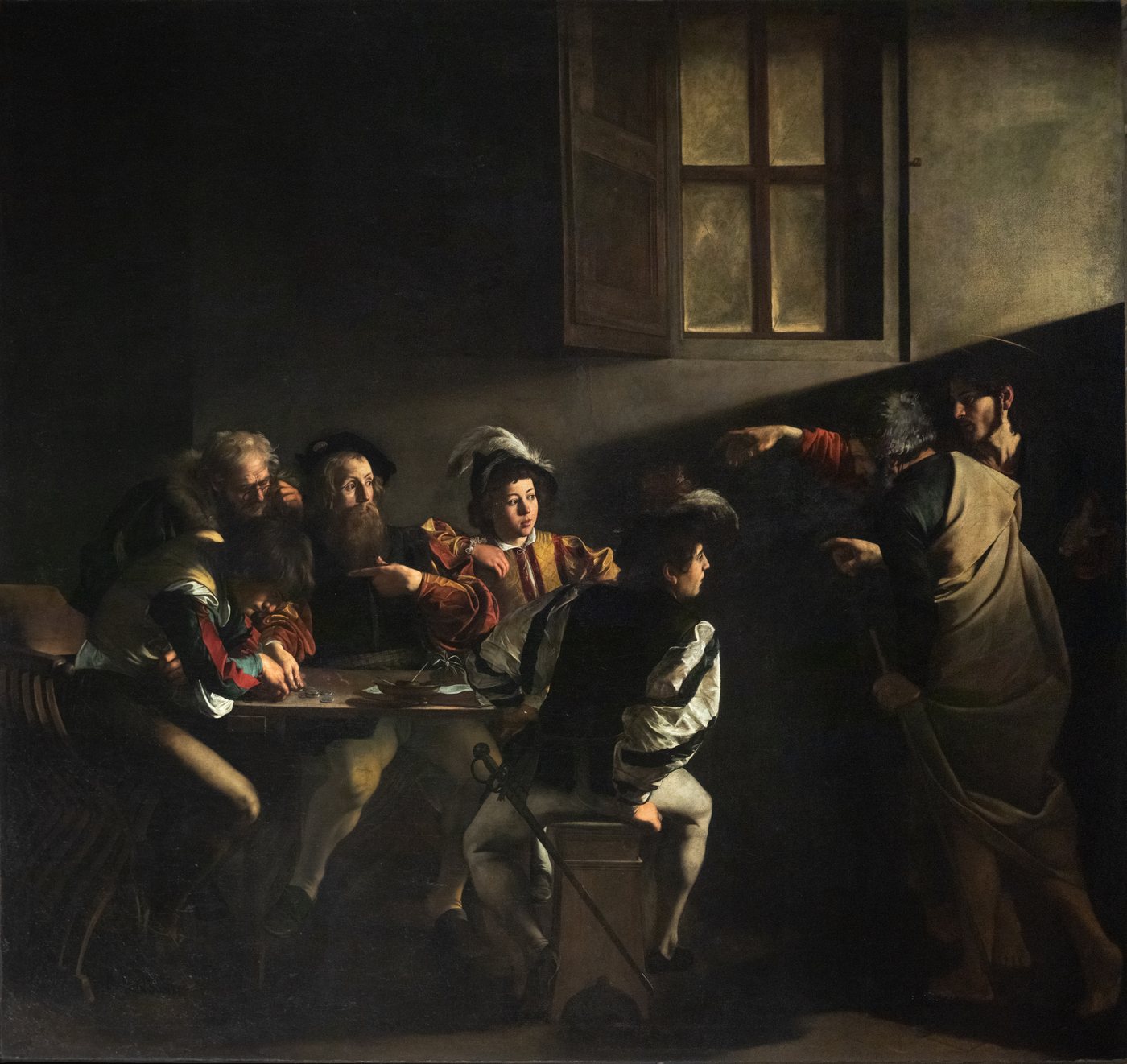
c.1595Calling of Saint Matthew
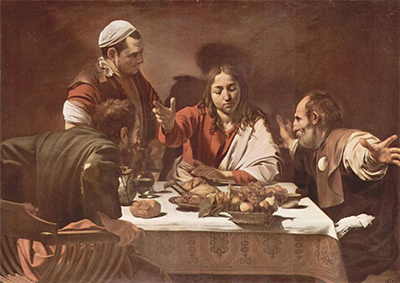
1599–1600Supper at Emmaus
1601At a Glance
- ArtistMichelangelo Merisi, called Caravaggio (1571–1610)
- TitleThe Seven Works of Mercy (Le Sette Opere di Misericordia)
- Date1606–07, according to the Pio Monte[1]
- Mediumoil on canvas[2]
- Dimensionsapproximately 390 × 260 cm in the national catalogue and the researchers' technical account[2][13]
- Original commission and present locationPio Monte della Misericordia, Naples; the present church replaced its first building in the later seventeenth century[1][6]
- Commission payment400 ducats in the institution's account[1]
- Subjectthe seven corporal works of mercy, with Madonna and Child above the street scene[1]
- Italian national catalogue record1500409817[2]
Contents
- What Are the Seven Works?
- How to Find the Acts in the Painting
- A Street Scene and a Heavenly Presence
- Why the Composition Is Crowded
- Light, Gestures and the Viewer's Path
- The Pio Monte Commission
- Naples in Caravaggio's Career
- Seeing the Work in Its Chapel
- Frequently Asked Questions
Look closer: The Seven Works of Mercy
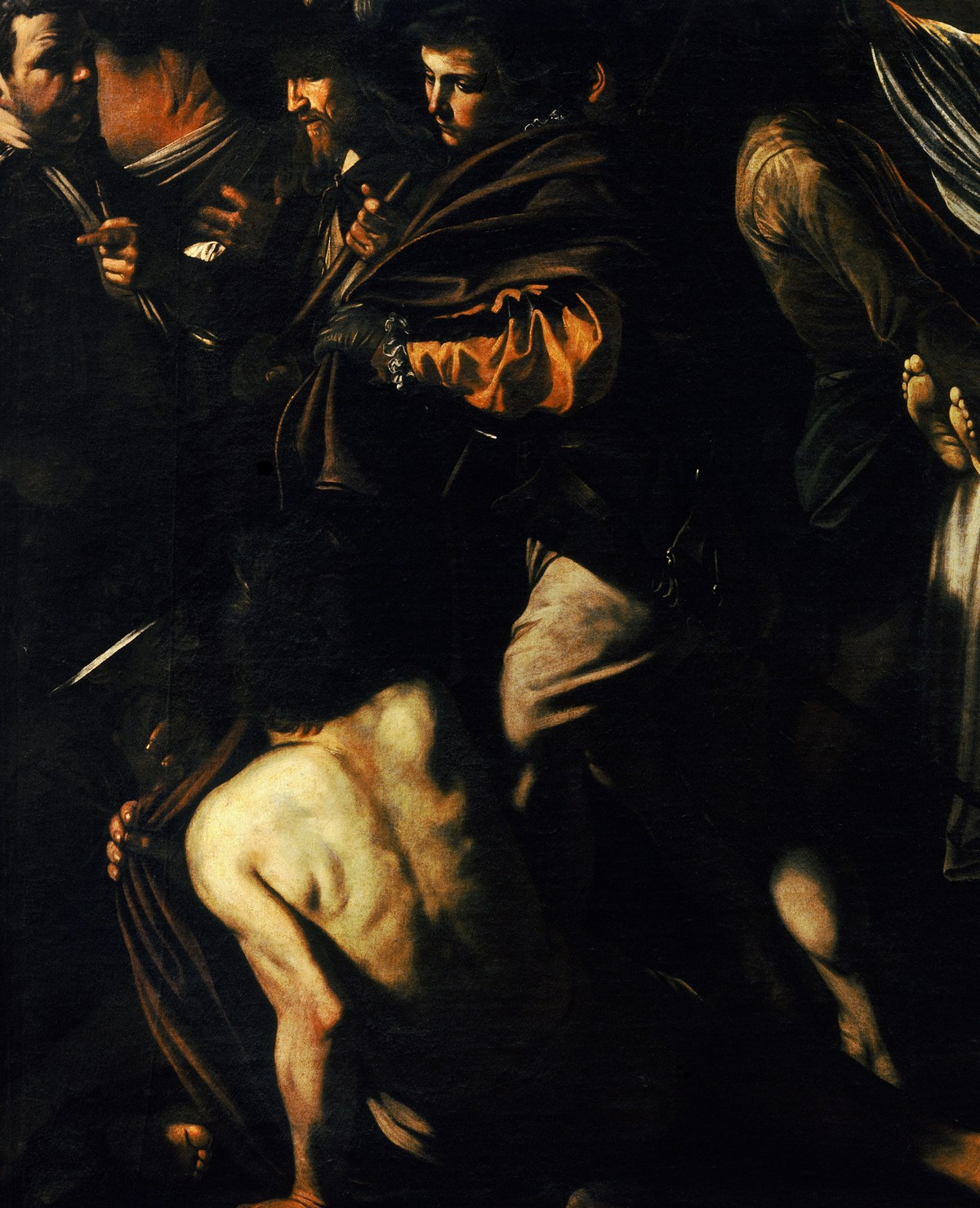
The painting compresses separate acts of charity into one night street. These details help untangle its crowded upper and lower zones.
 123
Details from The Seven Works of Mercy
Select a detail image to open the full-size gallery, then use the arrows to compare views.
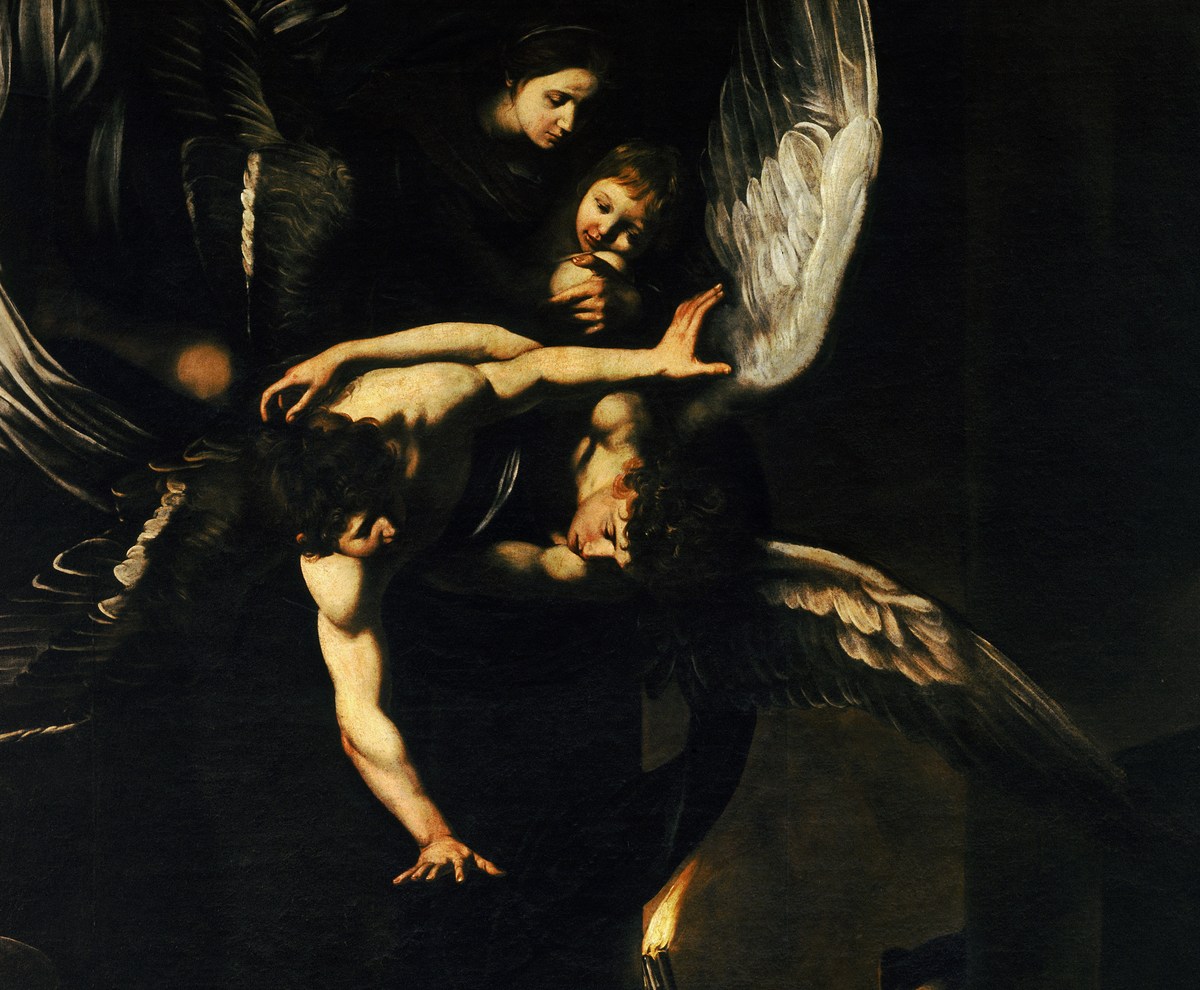
The descending angels
Angels sweep through the upper darkness with outstretched arms, joining the heavenly and earthly halves of the scene.
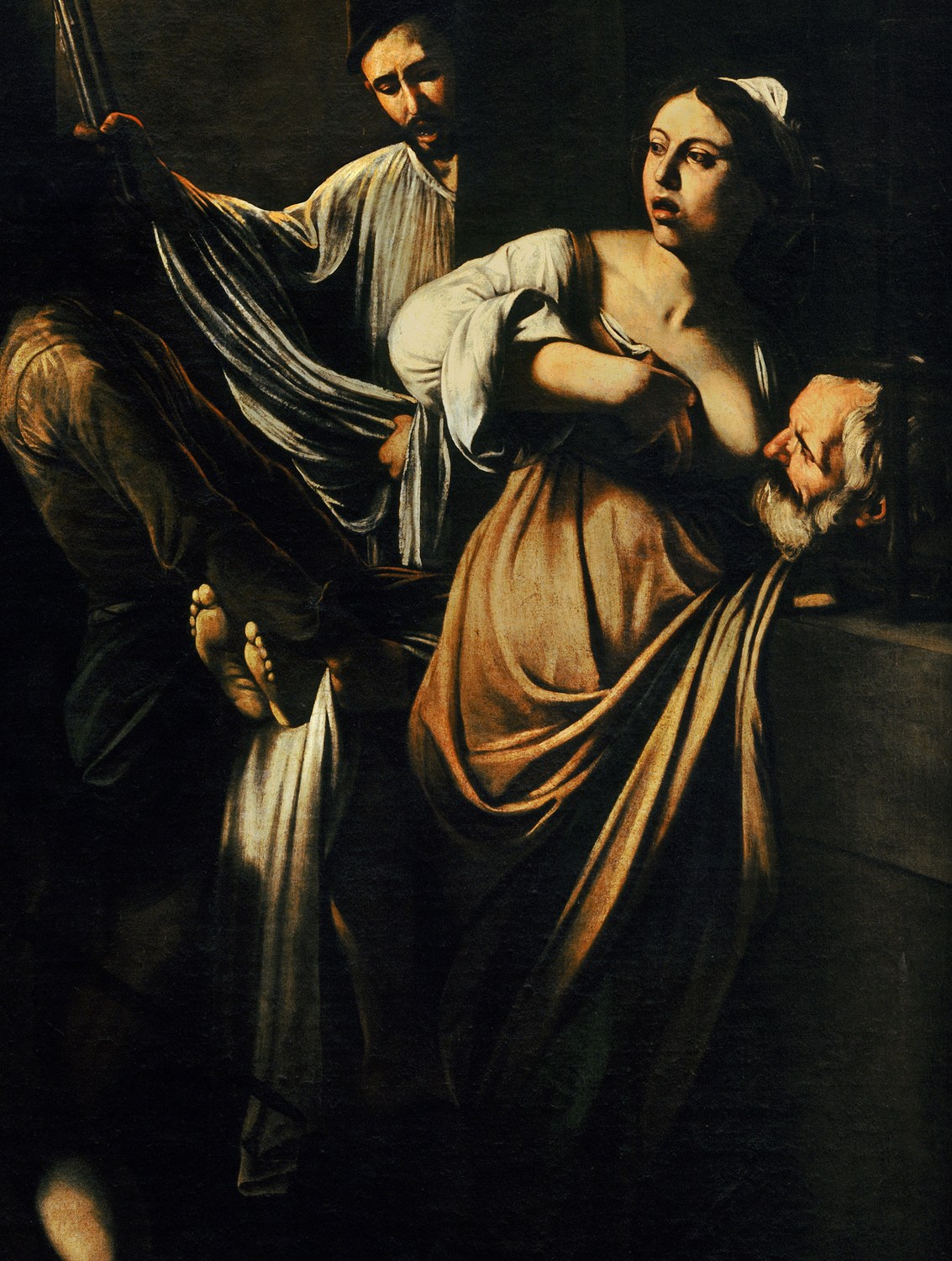
The figures at the right
A woman leans toward an older imprisoned man, one of the painting’s most closely joined pairs.
The street at the left
Bodies overlap near the lower left, where acts of care are staged in a narrow strip of light.
What Are the Seven Works?
The seven corporal works of mercy are practical acts of care: feed the hungry, give drink to the thirsty, clothe the naked, shelter travellers, visit the sick, visit prisoners, and bury the dead. The Pio Monte was founded around such charitable aims and describes Caravaggio's altarpiece as a continuing image of its mission.[1][3]
The number seven is not a single quoted list from one Gospel verse. In Matthew 25, Christ names six situations of need: hunger, thirst, estrangement, nakedness, illness and imprisonment. Burial is another biblical act of mercy, exemplified by Tobit, who describes giving food and clothing and burying the dead. The later seven-part Christian list brings these strands together. That explains why the burial group is indispensable to the picture even though it is not one of Matthew's six examples.[7][8]
Painting all seven could have produced a sequence of separate panels, each with its own easily labelled episode. Caravaggio instead interlocks actions in one urban scene. A viewer has to look again and again to discover them. The painting turns a list into a network of people who need help and people who provide it.
The picture does not show charity as a single heroic gesture by one central figure. It moves through feeding, receiving, covering and tending. That variety suits an institution whose work was ongoing and practical. The title names seven duties; the composition lets them seem to happen simultaneously in a living city.[1]
How to Find the Acts in the Painting
At the right, a woman feeds an elderly man through a prison opening. The Pio Monte identifies them as Pero and her imprisoned father Cimon, a classical story often called Roman Charity. Here one encounter stands for feeding the hungry and visiting prisoners. The image does not provide two unrelated little scenes for those duties; it lets one act satisfy both.[1]
Behind the prison wall, a bearer carries a corpse. Only the dead person's feet are easy to see, and a priest follows with a torch. The institution identifies this as burying the dead. The action is partly concealed, which makes it one of the discoveries a viewer must work to make.[1]
Art historian Gianluca Forgione proposes a more specific identity for this burial: the carrying of Christ to his tomb. His case draws on earlier illustrated treatments of the works of mercy, in which Christ's burial could stand for the seventh work, and on the Pio Monte's later choice of Giovanni Baglione's Deposition for the altar devoted to it. He also compares the visible bearers with figures in Entombment imagery. The Pio Monte's identification of the charitable act is secure; the corpse's identity is not visible enough to settle Forgione's further proposal. An ordinary funeral and a biblical model of burial remain different levels of interpretation.[12]
At the left foreground, a knightly figure with a feather, identified as Saint Martin, divides his cloak with a nearly naked man whose back is to us. Nearby is a sick person with clasped hands. The Pio Monte reads these together as clothing the naked and visiting the sick. The acts share space rather than occupying separate moral emblems.[1]
Farther back, a gaunt traveller with a shell on his hat is received by another man. The Pio Monte associates the shell with Saint James and the encounter with sheltering travellers. At the far left, Samson drinks from the jawbone of an ass, a sign of giving drink to the thirsty. These identifications come from the institution's reading of the pictorial details; they should guide close looking without pretending that every dark shape is equally clear in a small reproduction.[1]
The shell identifies a pilgrim but does not by itself name him. Forgione revisits an earlier suggestion that the traveller could be the risen Christ on the road to Emmaus, received before his hosts recognise him. He compares images of Christ as a pilgrim and points to radiographic evidence of an earlier cap on the receiving figure, resembling the innkeeper's cap in Caravaggio's Brera Supper at Emmaus. Those comparisons make the Emmaus reading plausible, but they do not turn the radiograph into a caption for the traveller. The work of mercy remains hospitality whether the visitor is read as Christ, Saint James, or an unnamed pilgrim.[12]
A Street Scene and a Heavenly Presence
The actions unfold in a narrow, dark space that the Pio Monte likens to a Naples crossroads. Above the people, the Virgin and Child are supported by angels. The upper group does not replace the practical work below. It connects a heavenly presence with acts of care happening among ordinary-looking bodies.[1]
This two-level design is important. The street figures are not merely a prelude to the sacred group, and the sacred group is not just decoration over a genre scene. A visitor can read the painting from above to below, relating divine mercy to human action, or from below to above, starting with the needs of the hungry, sick and imprisoned.
The Virgin's presence also marks the picture as an altarpiece for a religious charity. Without the Pio Monte's institutional context, a modern viewer might see only dramatic fragments of urban life. The painting's purpose was to make the organisation's works of mercy visible within a devotional setting.[1][3]
Forgione offers a closer reading of the cloth around the upper group. He distinguishes the pale sheet accompanying the angels from a dark green drapery that appears to continue from Mary's clothing and spread towards the people below. In his interpretation, the angels extend the protective mantle of the Madonna of Mercy, making the link between the upper and lower groups more literal than a general heavenly blessing. He also reads published technical examinations as showing angelic paint laid over parts of Mary's earlier drapery. That is an argument about the painting's sequence, not proof that every part of the upper group was fixed from the start; earlier scholars have interpreted the imaging differently. The visible drapery, its proposed meaning and the disputed sequence need to be kept distinct.[12]
Why the Composition Is Crowded
Caravaggio gives the figures little free space. Bodies overlap; gestures cross; one action partly masks another. The crowd is not a failure to separate the seven duties cleanly. It makes help feel like something happening in a shared world where needs coexist.[1]
The complexity also affects time. A list has an order, but these acts seem simultaneous. The viewer cannot complete the picture in a quick glance. One begins with a bright face or arm, then discovers a foot, shell or raised vessel at the edge of attention. Looking becomes an act of patient recognition.
The painting was meant for an altar, so the composition has to hold together at some distance as well as reward closer study. Broad light-and-dark divisions create a visual structure; individual gestures fill it with meaning. The Pio Monte describes this strong contrast and identifies the work as a turning point for local painters. Its account relates the canvas to a new Neapolitan naturalism without reducing that influence to one technical trick.[1]
Light, Gestures and the Viewer's Path
Light finds portions of bodies, faces, fabric and the upper Virgin group while much of the street remains obscure. A viewer follows it from one cluster to another. Unlike the focused three-person encounter in the late Denial of Saint Peter, the light here must help organise several episodes at once.
The darkness has a material as well as a narrative side. In a Capodimonte study comparing Battistello Caracciolo's painting materials with Caravaggio's Neapolitan work, the museum identifies a mineral “black earth” in the preparation of the Seven Works. That finding belongs to this canvas's ground layer; it does not tell us by itself which figures Caravaggio painted first or make every dark passage a visible patch of bare preparation. It does help place the picture's strong tonal structure within an examined physical object.[10]
A later scientific campaign offers more object-specific evidence of revision. In 2019, a mobile laboratory examined the canvas where it hangs, using macro X-ray fluorescence imaging to map elements across the painted surface. The researchers report 25 scans covering the nearly four-metre-high picture, with the actual survey made at one-millimetre lateral resolution. Their published maps identify paint materials associated especially with calcium, copper, iron and lead. The method maps the distribution of elements; it does not, on its own, supply the names or motives of the figures Caravaggio painted.[13]
The team also reports an unfinished male figure concealed beneath the final composition. In its interpretation, Caravaggio covered that figure and painted the man again in different clothing elsewhere in the design. This is stronger evidence of a change than an impression based on the crowded visible surface, but it does not identify the man as a particular saint or charity worker. The researchers used lead, copper and calcium maps to discuss the painter's a risparmio practice, in which preparation or earlier tones remain visible or serve within the finished image. Their results add a material history to the picture's many overlapping actions without deciding the disputed identities of the corpse, the pilgrim or the Madonna's drapery.[12][13]
Gestures carry the specific acts. A hand offers food; another divides cloth; bodies bend towards someone in need; a mourner or priest accompanies the dead. The picture's ethical meaning is in these actions rather than in a set of labels hovering over the figures. It is possible to miss one act at first and still feel the overall pressure of many needs on one small street.
The image also places the viewer outside the group but close to it. The figures' scale and the street's narrowness make them seem accessible, while the chapel's altar setting asks us to look upward towards the complete composition. That combination makes the painting a guide to conduct as well as an object of visual attention.
The Pio Monte Commission
The Pio Monte della Misericordia describes The Seven Works of Mercy as its first painting for the church. Its account records that Giovan Battista Manso, one of the seven founders and a knowledgeable patron, was among those who could commission new works in Naples. It gives the price paid to Caravaggio as 400 ducats. The painting remains with the institution, which calls it a visual expression of its charitable mission.[1]
The Banco di Napoli archive makes the payment more precise. Its account of a record dated 9 January 1607 names Tiberio del Pezzo acting for the Pio Monte and a 370-ducat payment to Caravaggio that completed a 400-ducat total for the painting. Thus 400 ducats is the full recorded price, not the amount of that final payment alone. The archive also preserves a separate October 1606 payment order from Niccolò Radolovich for another proposed altarpiece. Its specified saints and composition differ from the Seven Works; the two banking records should not be collapsed into one commission.[9]
The organisation's broader history explains why this was an apt subject. Its central church layout and paintings relate to its activities, beginning with Caravaggio's altarpiece. The work is not simply an illustration of a textbook list imported into any church. It was made for people and an institution that carried out the listed acts.[3]
The Pio Monte says seven young Neapolitan nobles founded the organisation in 1602 to put the corporal works of mercy into practice. That date is close to the commission, so the painting belongs to the foundation's first years rather than to a later retrospective account of its mission. The group also records the admission of women as Dame Benefattrici in 1611. Those details show a charitable body developing its membership and work across time; the seven acts were an operating programme, not merely an attractive subject for an altarpiece.[5]
The present church is organised around a central octagonal space. The Pio Monte explains that the other altar paintings also correspond to its charitable activities, while Caravaggio's work at the main altar gathers all seven into one image. Today the picture functions as a centre for a wider visual programme, a relationship lost in a cropped reproduction. The later arrangement helps a visitor read the work, although it cannot explain every choice Caravaggio made for the first church.[3][6]
This is the painting's present architectural setting, rather than an unchanged room from 1607. The Pio Monte dates the current church, designed by Francesco Antonio Picchiatti, to 1656–71. Caravaggio's canvas predates it by about half a century and was retained by the same institution for the main altar of the rebuilt church. The present octagon is valuable for understanding how the institution has displayed and interpreted the picture over time, but its later design cannot be treated as the exact space for which Caravaggio first composed the work.[6]
This documentary context is more useful than a claim that Caravaggio painted it only because of his own flight from Rome. He was in Naples after leaving Rome, but the subject, location and payment have their own institutional explanation. Biography matters; it does not replace patronage.[1]
Naples in Caravaggio's Career
The Pio Monte dates the painting to 1606–07, soon after Caravaggio arrived in Naples. Its busy composition contrasts with some later works that use a smaller group in a wider dark space. The Crucifixion of Saint Andrew, now in Cleveland and dated 1606–07, offers another Neapolitan solution to a large religious subject: fewer figures close to one cross.[1][4]
The Pio Monte's account says Caravaggio's work influenced local painters. Such influence is not a list of identical copies; the crowded street, direct bodies and stark illumination gave artists new possibilities for religious narrative. The artist guide and paintings directory set this altarpiece among the Naples, Malta and Sicily works.
Seeing the Work in Its Chapel
The painting remains with the Pio Monte in Naples. That institutional continuity matters even though the church around it was rebuilt. A viewer can encounter the seven acts within the charity that commissioned the work and still presents it as a statement of purpose. The altarpiece's size and distance of view matter, while the present architectural surround records a later chapter of its display.[1][6]
The governors made a striking decision about its future on 27 August 1613. In a later statement on the institution's own behalf, superintendent Alessandro Pasca di Magliano explains that the resolution forbade selling the painting at any price or placing it permanently elsewhere. He distinguishes that permanent-retention rule from temporary loans and lists past exhibitions for which it travelled. The resolution documents the work's early value to its owners; it should not be paraphrased as a ban that made every later move impossible.[11]
A government response to Italy's parliament preserves a further detail of that decision. On the same day in 1613, the governors allowed the Count of Villamediana to have a copy made, provided the original was not moved from its altar. A later resolution of 1 June 1621 prohibited making copies of works in the church, especially the main-altarpiece painting, to avoid favouring private requests over the institution's public setting. These are rules about distinct actions: keeping and selling the original, making a copy, and granting a temporary loan. Permission for Villamediana to obtain a copy is not proof that a particular surviving copy was made for him.[14]
The same parliamentary response explains why a proposed move to Capodimonte for its 2019 Caravaggio exhibition was refused despite the short distance across Naples. Inspectors described the canvas as well conserved in place but difficult to remove: it stands about four metres high, is mounted around three metres above the floor, and the narrow space behind the altar would make scaffolding and movement hazardous to the stretcher and canvas. The exhibition was extended to include the Pio Monte itself. This was a decision about that proposed transfer, not a finding that the historical 1613 resolution legally forbade every temporary loan.[14]
The institution publishes current visitor information. Opening arrangements and access can change, so its site should be checked before travel. Its explanation of the individual acts is also a useful companion when viewing the densely layered painting in the chapel.[1]
Explore the Caravaggio collection
| Name | Date | Type |
|---|---|---|
| Adoration of the Shepherds by Caravaggio: The Messina Nativity | 1608–09; precise order relative to Resurrection of Lazarus remains unresolved | Artwork |
| Amor Victorious by Caravaggio | 1601–02 in the Berlin owner record | Artwork |
| Bacchus by Caravaggio: The Uffizi Painting | about 1598, according to the Uffizi | Artwork |
| Basket of Fruit by Caravaggio | after 1597, probably around the turn of the seventeenth century, according to the Ambrosiana | Artwork |
| Boy Bitten by a Lizard: Caravaggio's London Painting | about 1594–95 in the National Gallery's current catalogue; URL suffix “1596” is inherited | Artwork |
| Boy Bitten by a Lizard: The Florence Version Attributed to Caravaggio | disputed; Longhi's catalogue record preserves historical 1592–93 and other proposed ranges, including c.1597 | Artwork |
| Boy Peeling Fruit by Caravaggio: The Royal Collection Painting | about 1592–93 in the owner's current exhibition record | Artwork |
| Boy Peeling Fruit in Florence: A Derivation from Caravaggio | — | Artwork |
| Boy with a Basket of Fruit by Caravaggio | about 1595 in the Galleria Borghese catalogue | Artwork |
| Caravaggio Paintings in Rome: Churches, Museums and a Practical Route | — | Guide |
| Caravaggio Quotes: What the Documents Actually Record | — | Guide |
| Caravaggio's Lute Player: The Del Monte Painting Once Shown at the Met | about 1596–97 in the Met catalogue | Artwork |
| Caravaggio's Painting Technique: Grounds, Incisions, Revisions and Light | — | Guide |
| Christ at the Column by Caravaggio: The Rouen Flagellation | c.1606 in the owner caption; owner prose gives 1606–07 | Artwork |
| Christ on the Mount of Olives by Caravaggio: The Lost Berlin Painting | — | Artwork |
| Conversion on the Way to Damascus by Caravaggio | about 1601 in the Roma Capitale church record | Artwork |
| Crowning with Thorns by Caravaggio: The Vienna Painting | about 1603 in the 2019 KHM record; “1607” is an inherited URL suffix | Artwork |
| Crowning with Thorns in Prato: Attributed to Caravaggio | about 1602–03 in the collection presentation | Artwork |
| David with the Head of Goliath by Caravaggio: The Borghese Painting | 1606–07 or 1609–10 in the Galleria Borghese catalogue; the later Naples period is favoured by many scholars, while the owner keeps the question open | Artwork |
| David with the Head of Goliath by Caravaggio: The Prado Painting | about 1600 in Prado material; “1599” survives only in the legacy URL | Artwork |
| David with the Head of Goliath by Caravaggio: The Vienna Painting | about 1600–01 in the KHM's 2019 exhibition record; “1607” is a legacy route label | Artwork |
| Did Caravaggio Make Drawings? What Survives and What Paintings Reveal | — | Guide |
| Ecce Homo: Caravaggio's Madrid Rediscovery and the Genoa Painting | — | Artwork |
| John the Baptist in Caravaggio's Paintings: A Guide to the Different Versions | — | Artwork |
| Judith Beheading Holofernes by Caravaggio | beginning of the seventeenth century in the owning museum's account; about 1599–1600 in the Kimbell's 2025 loan label; around 1602 in one specialist catalogue | Artwork |
| Jupiter, Neptune and Pluto: Caravaggio's Ludovisi Ceiling | about 1597; the archive connects the work with Cardinal del Monte's 1597 commission | Artwork |
| Madonna and Child with Saint Anne by Caravaggio: The Palafrenieri Altarpiece | 1605 in the Galleria Borghese object field; completed and delivered by 8 April 1606 | Artwork |
| Madonna of Loreto by Caravaggio: The Pilgrims at Sant'Agostino | broadly c.1604–06; institutional records differ slightly in their starting year | Artwork |
| Madonna of the Rosary by Caravaggio: The Vienna Altarpiece | around 1603 in the Kunsthistorisches Museum's object record | Artwork |
| Martha and Mary Magdalene by Caravaggio: The Detroit Painting | about 1598 in the Detroit Institute of Arts record | Artwork |
| Medusa by Caravaggio: The Uffizi Painted Shield | 1596–98 in the Uffizi's virtual exhibition; specialist research reports the shield delivered to the Medici wardrobe by 7 September 1598 | Artwork |
| Narcissus, Attributed to Caravaggio | dependent on attribution; the Zeri catalogue gives a broad 1610–50 range under Spadarino | Artwork |
| Nativity with Saint Francis and Saint Lawrence: Caravaggio's Missing Painting | somewhere in 1600–09 in the parliamentary report; a specific 1609 execution and place remain debated | Artwork |
| Penitent Mary Magdalene by Caravaggio | 1597 in the owner's catalogue, during Caravaggio's early Roman activity | Artwork |
| Portrait of a Courtesan: Caravaggio's Lost Berlin Portrait | Berlin's data field says c.1590, while its own text compares a Caravaggio work of c.1598; precise date unresolved | Artwork |
| Portrait of Alof de Wignacourt and His Page by Caravaggio | — | Artwork |
| Portrait of Fra Antonio Martelli? Caravaggio's Pitti Knight of Malta | 1608 in the Restituzioni object heading; within Caravaggio's Malta period | Artwork |
| Portrait of Maffeo Barberini: The Seated Corsini Painting | c.1596–97 in the national catalogue | Artwork |
| Portrait of Monsignor Maffeo Barberini: Caravaggio's Newly Acquired Painting | around the late 1590s / age thirty; “1598” in the inherited address is approximate, not an exact document date | Artwork |
| Portrait of Pope Paul V: A Caravaggio Attribution and a Borghese Copy | — | Artwork |
| Prints After Caravaggio: Who Made Them and What They Show | — | Guide |
| Reclining Saint John the Baptist: A Disputed Caravaggio Attribution | often proposed for the artist's final years; the later museum list does not give a precise year. | Artwork |
| Rest on the Flight into Egypt by Caravaggio | about 1597 in the owner's catalogue | Artwork |
| Saint Catherine of Alexandria by Caravaggio: The Thyssen Painting | about 1598–99 in the Museo Nacional Thyssen-Bornemisza catalogue | Artwork |
| Saint Francis in Meditation by Caravaggio: The Cremona Painting | 1603–06 in the owner account; c.1605–06 in a KHM exhibition caption | Artwork |
| Saint Francis in Prayer: Caravaggio's Carpineto Painting | 1606 in a 2016–17 exhibition work list | Artwork |
| Saint Francis of Assisi in Ecstasy by Caravaggio | c.1595–96 in the owner wall text | Artwork |
| Saint Jerome in Meditation: Caravaggio's Montserrat Painting | 1605 in the owner record; an owner publication reports scholarship placing it about 1605–06 | Artwork |
| Saint Jerome Writing by Caravaggio: The Borghese Painting | c.1606 in the owner catalogue; the “1605” URL suffix is inherited | Artwork |
| Saint Jerome Writing by Caravaggio: The Malta Painting | around 1607–08; foundation dates Malaspina's commission to 1608 | Artwork |
| Saint John in the Wilderness at Toledo Cathedral | exact 1598 not established by the cited cathedral account. | Artwork |
| Saint John the Baptist at Galleria Corsini, Rome | about 1606 in the national record; older proposals ranged from the late 1590s onward. | Artwork |
| Saint John the Baptist at the Capitoline Museums, Rome | 1602. | Artwork |
| Saint John the Baptist at the Galleria Borghese | 1609–10 in the current Borghese record. | Artwork |
| Saint John the Baptist at the Spring: The Bonello Painting in Malta | early seventeenth century in the institutional account; a precise 1608 is not established there. | Artwork |
| Saint Matthew and the Angel: Caravaggio's Lost First Altarpiece | — | Artwork |
| Salome Receives the Head of John the Baptist: Caravaggio's London Painting | about 1609–10, likely late Naples period in the Gallery's account | Artwork |
| Salome with the Head of John the Baptist: Caravaggio's Madrid Painting | — | Artwork |
| Sleeping Cupid by Caravaggio: The Painting Made in Malta | about 1608, Malta period | Artwork |
| Still Life with Fruit on a Stone Ledge: Is It by Caravaggio? | — | Artwork |
| Supper at Emmaus (1606): Caravaggio's Brera Painting | — | Artwork |
| The Annunciation by Caravaggio in Nancy | c.1607–10 in the collection record; 1608–10 in the museum's restoration account | Artwork |
| The Basel Saint John the Baptist: Once Labelled Caravaggio, Now Maíno | about 1608–10 in that schedule, rather than the legacy URL's 1600. | Artwork |
| The Beheading of Saint John the Baptist by Caravaggio | about 1608; installed in the Oratory on 29 August 1608 | Artwork |
| The Burial of Saint Lucy by Caravaggio in Syracuse | 1608, during Caravaggio's Syracuse stay | Artwork |
| The Calling of Saint Matthew by Caravaggio | about 1599–1600 | Artwork |
| The Calling of Saints Peter and Andrew by Caravaggio | about 1602–04 in the Trust's object text | Artwork |
| The Cardsharps by Caravaggio | about 1596–97 in the Kimbell's current object record | Artwork |
| The Conversion of Saint Paul: Caravaggio's Odescalchi Panel | commissioned in 1600; painted around 1600–01 | Artwork |
| The Crucifixion of Saint Andrew by Caravaggio | 1606–07 | Artwork |
| The Crucifixion of Saint Peter by Caravaggio | about 1601 | Artwork |
| The Death of the Virgin by Caravaggio | commissioned 1601; completed late 1605 or early 1606, according to the Louvre | Artwork |
| The Denial of Saint Peter by Caravaggio | 1610 | Artwork |
| The Doria Pamphilj Saint John the Baptist: A Second Youth with a Ram | linked compositionally to the Capitoline 1602 picture; an exact production year for this canvas is not established by the owner pages used here. | Artwork |
| The Entombment of Christ by Caravaggio: The Vatican Deposition | about 1600–04 in Vatican Museums publication material | Artwork |
| The Flagellation of Christ by Caravaggio: The Capodimonte Altarpiece | around 1607, in the first Naples period | Artwork |
| The Fortune Teller by Caravaggio: The Louvre Version and Its Roman Counterpart | — | Artwork |
| The Holy Family with the Infant Saint John the Baptist by Caravaggio | early 1600s in the Met catalogue; no more exact owner date asserted here | Artwork |
| The Incredulity of Saint Thomas by Caravaggio | about 1601 in the SPSG presentation | Artwork |
| The Inspiration of Saint Matthew by Caravaggio | usually 1602; also catalogued 1602–03, for the installed final altarpiece | Artwork |
| The Lute Player by Caravaggio: The Hermitage Painting | about 1596 in the Hermitage collection publication; the Hermitage Friends restoration page gives about 1595–96 | Artwork |
| The Magdalen in Ecstasy: Caravaggio, Copies and a Disputed Original | — | Artwork |
| The Martyrdom of Saint Matthew by Caravaggio | 1599–1600; unveiled with The Calling in 1600 | Artwork |
| The Martyrdom of Saint Ursula by Caravaggio | — | Artwork |
| The Musicians by Caravaggio | 1597 | Artwork |
| The Resurrection of Lazarus by Caravaggio in Messina | 1609; delivered 10 June 1609 in the owner account | Artwork |
| The Sacrifice of Isaac by Bartolomeo Cavarozzi: A Former Caravaggio Attribution | about 1615–17 in the Nicholas Hall catalogue; “1598” is an inherited URL label, not the accepted date | Artwork |
| The Sacrifice of Isaac by Caravaggio: The Uffizi Painting | about 1603 in the Uffizi catalogue | Artwork |
| The Seven Works of Mercy by Caravaggio | 1606–07, according to the Pio Monte | Artwork |
| The Supper at Emmaus by Caravaggio: The London Painting | 1601 | Artwork |
| The Taking of Christ by Caravaggio | 1602 | Artwork |
| The Toulouse *Judith Beheading Holofernes*: A Caravaggio Attribution Debate | c.1606–07 if identified with the recorded Naples work; that identification is debated | Artwork |
| Young Sick Bacchus by Caravaggio | about 1595 in the Galleria Borghese catalogue | Artwork |
| Youth with a Ram: Why Caravaggio's Saint John Looks So Unusual | — | Artwork |
No matching pages found.
Discussion
Share a close observation about The Seven Works of Mercy by Caravaggio or a source that clarifies its history.
Which detail changes your reading?
Is there a collection record or document worth comparing?
What remains uncertain?
Join the Conversation
Frequently Asked Questions
Where is The Seven Works of Mercy?
When was it painted?
How are all seven works shown in one picture?
Several duties share one encounter. Pero feeding Cimon represents both feeding the hungry and visiting prisoners; Saint Martin dividing his cloak and a nearby sick person cover clothing and visiting the sick. Other figures show burial, hospitality and giving drink.[1]
Who are the figures above the street?
The Pio Monte identifies the Virgin and Child supported by angels. Their presence connects the bodily acts below to the painting's devotional setting.[1]
Why is the picture so crowded?
Caravaggio interlocks the seven acts rather than separating them into panels. The tight space gives the viewer a path of discovery through gestures and partly concealed figures; that is a reading of the composition supported by the owner's identifications.[1]
References
- Pio Monte della Misericordia, Caravaggio and the Seven Works.
- Italian national cultural-property catalogue, Sette opere di Misericordia, record 1500409817.
- Pio Monte della Misericordia, the institution's art and history.
- Cleveland Museum of Art, The Crucifixion of Saint Andrew, 1976.2.
- Pio Monte della Misericordia, mission and history of the charitable institution.
- Pio Monte della Misericordia, present church and altar programme.
- United States Conference of Catholic Bishops, Matthew 25:35–36.
- United States Conference of Catholic Bishops, Tobit 1:17–18.
- Il Cartastorie, Historical Archives of the Banco di Napoli, Caravaggio's payment and the separate Radolovich order.
- Museo e Real Bosco di Capodimonte, Battistello Caracciolo exhibition and comparison of preparatory materials.
- Alessandro Pasca di Magliano, Pio Monte superintendent, on the 1613 resolution and loans.
- Gianluca Forgione, “«L’avete fatto a me». Per una nuova lettura delle Sette opere di Misericordia di Caravaggio,” Studi di Memofonte 23 (2019), 114–167.
- Claudia Caliri, Francesco Paolo Romano, Brenda Doherty, Francesca Rosi and Costanza Miliani, “MOLAB: A European Mobile Laboratory Enabling Advanced Studies in Archaeometry,” Archeometriai Műhely 17, no. 3 (2020), Seven Works case study.
- Italian Chamber of Deputies, written government response on the proposed Capodimonte loan, Atti Parlamentari, 2 April 2020, PDF pp. 65–66.
- Annotated image source: Wikimedia Commons, File:The Seven Works of Mercy-Caravaggio (1607).jpg, high-resolution reproduction used for the annotated details.