 by Tom Gurney
Tom Gurney BSc (Hons) is an art history expert with over 20 years experience
Page Created on / Page Updated on
Email: tomgurney1@gmail.com / Phone: +44 7429 011000
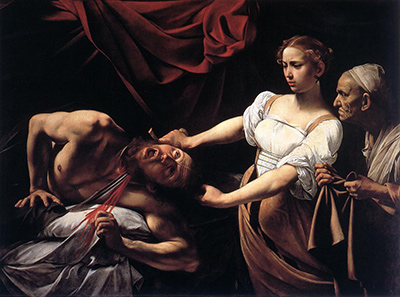
Judith Beheading Holofernes by Caravaggio
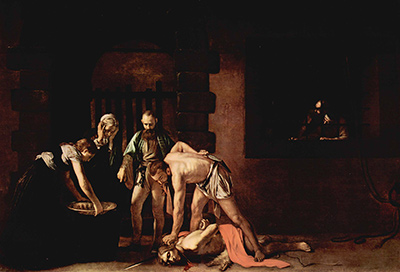
Judith grips Holofernes's hair and cuts his throat. The general is still alive enough to struggle; an older attendant waits beside her. Caravaggio chooses the act itself, not a later moment of triumph with the severed head. The painting belongs to Palazzo Barberini in Rome. Its museum dates it to the beginning of the seventeenth century; the banker Ottavio Costa was an early owner.[1][3]
This is the accepted Barberini Judith. A separate picture discovered near Toulouse has been discussed as a possible second Caravaggio Judith, but its attribution and relationship to a recorded lost work remain disputed. The two works have different collections and different degrees of attribution certainty.[3]
Caravaggio in context
The Cardsharps
c.1595Calling of Saint Matthew
1599–1600Supper at Emmaus
1601At a Glance
- ArtistMichelangelo Merisi, called Caravaggio (1571–1610)
- TitleJudith Beheading Holofernes, also Judith and Holofernes[1]
- Datebeginning of the seventeenth century in the owning museum's account; about 1599–1600 in the Kimbell's 2025 loan label; around 1602 in one specialist catalogue[1][6][13]
- Mediumoil on canvas[6]
- Dimensions145 × 195 cm[6]
- CollectionGallerie Nazionali di Arte Antica, Palazzo Barberini, Rome[1][2]
- Early ownerGenoese banker Ottavio Costa[3]
- Modern collection historyrediscovered around 1950 and acquired by the Italian state in 1971[1][2]
Contents
- The Instant Caravaggio Paints
- Judith, Holofernes and the Attendant
- The Book of Judith and the Painter's Choice
- Light, Colour and Distance
- What Examination Contributes to the Date
- Ottavio Costa and the Painting's Later History
- What the Costa Documents Establish
- Other Judith Paintings and Attribution Questions
- Frequently Asked Questions
Look closer: Judith Beheading Holofernes
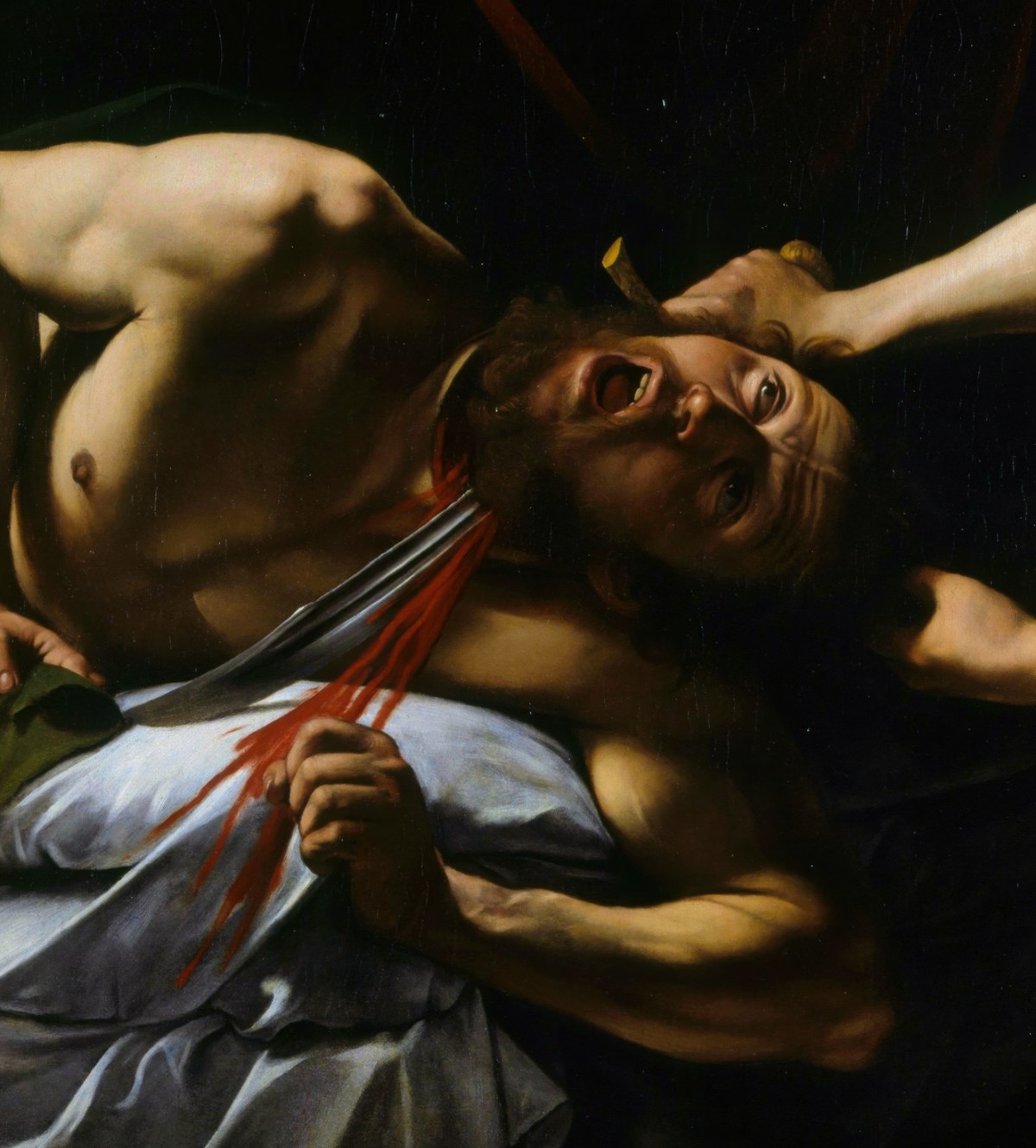
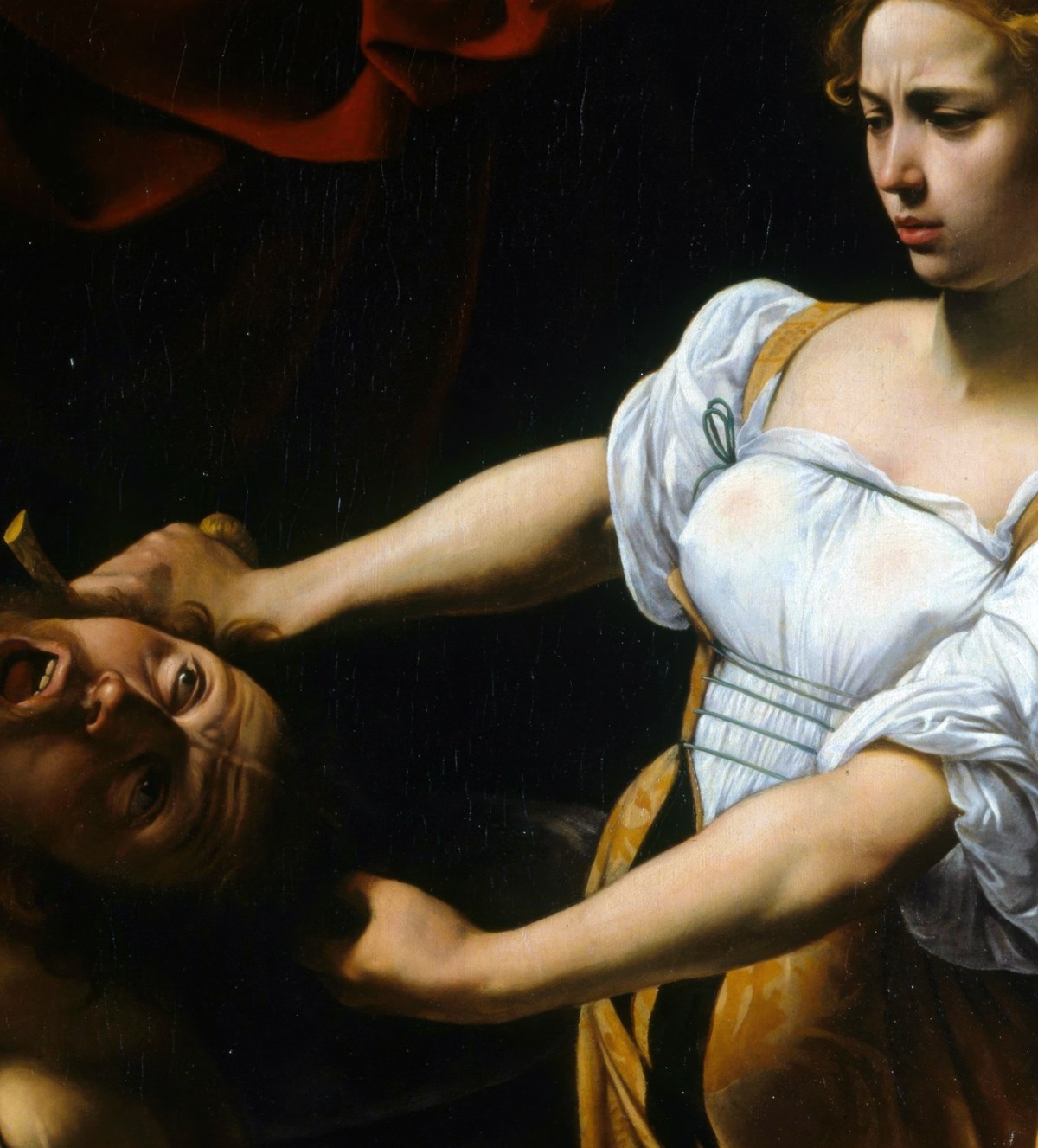
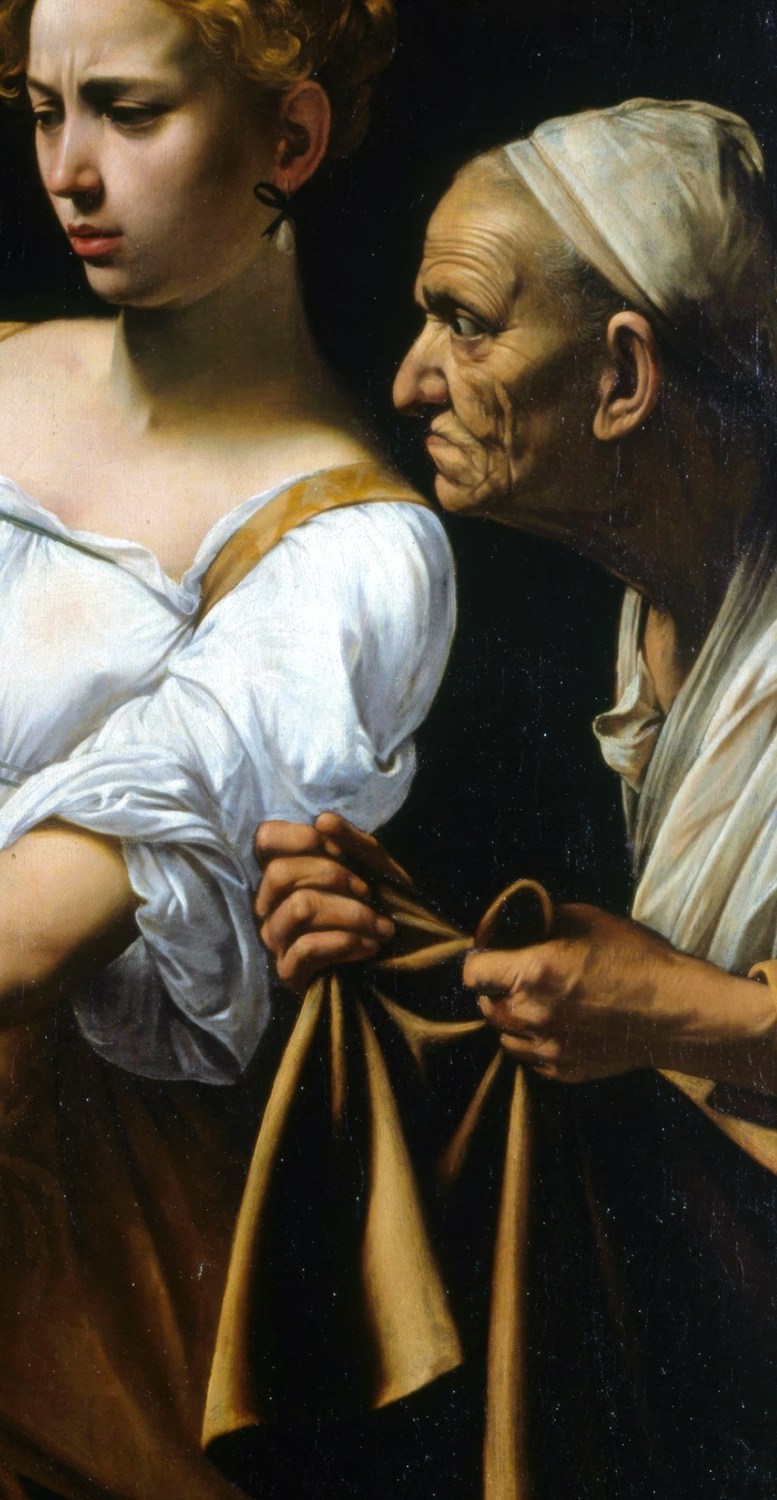
Three close views follow the action across the canvas: Holofernes's recoil, Judith's controlled gesture and the servant waiting with a cloth.
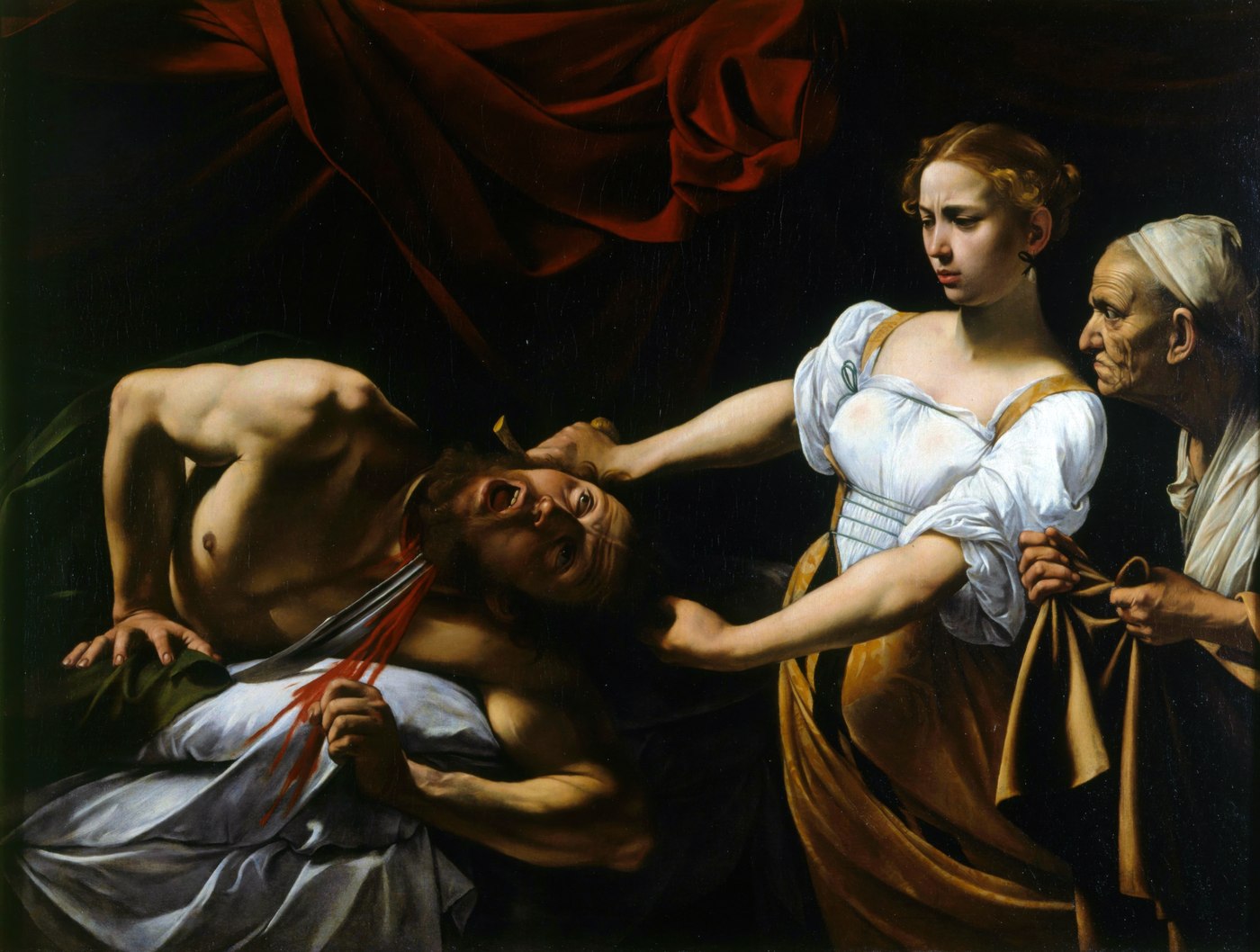 123
Details from Judith Beheading Holofernes
Select a detail image to open the full-size gallery, then use the arrows to compare views.
Holofernes's recoil
The body strains away from the blade while the head turns toward the viewer. Caravaggio makes the resistance visible through taut arms and neck.
Judith's hands
Judith's extended arms connect the sword and the head, while her pale sleeves stand out sharply against the dark background.
The waiting servant
The older servant watches closely and gathers a cloth. Her compressed position intensifies the narrow space around the act.
The Instant Caravaggio Paints
The sword has entered the general's neck, and the violence is still happening. Judith's arm reaches across the bed while her other hand pulls his hair. Holofernes's mouth opens; his body resists. Blood leaves the wound in a bright arc. Caravaggio holds all three figures close to the picture plane, so the spectator sees the physical action without the protection of a distant battlefield or elaborate tent interior.[2][4]
This timing differs from many images of Judith carrying the completed trophy. The head has not yet been placed in the attendant's bag. The picture therefore keeps the outcome suspended even though the story is familiar. The viewer is asked to register Judith's determined action and the victim's last resistance at the same time. The painting's suspense is not a claim that the biblical ending was uncertain; it is an effect of the chosen instant.
The Gallerie Nazionali’s exhibition account calls the canvas a turning point in how the subject was pictured by Caravaggio's contemporaries. It assembled later interpretations by other painters around the Barberini work. That reception helps explain the painting's art-historical importance, but the most direct evidence remains the object itself: a stark trio and the act of decapitation placed before us.[1]
Judith, Holofernes and the Attendant
Judith's face is tense and concentrated. She leans forward, yet her body seems to keep a measure of distance from the wound. The white of her blouse draws light and makes her figure stand out. The red cloth above the scene deepens the theatre-like setting without supplying a fully furnished room. She is not presented as a calm emblem already celebrating victory. The strain of doing the deed is visible in her posture.[2]
Holofernes is a substantial body, not merely a head attached to a symbol of evil. His open mouth, turning torso and raised arm keep the event in the present tense. The viewer can understand the moral purpose of Judith's act in the story and still confront its bodily violence. Caravaggio does not make the killing painless or abstract.
The older attendant stands at the right with the cloth or bag needed for what comes next. Her face and position suggest alert expectation. She is a different age and type from Judith; their proximity gives the scene a human collaboration rather than a solitary heroic pose. In the Book of Judith, the maid waits outside Holofernes's bedroom while Judith strikes, then receives the head. Caravaggio places her within the pictured action. The difference between text and painting is a compositional choice worth noticing.[4]
These three roles shape the image: Judith acts, Holofernes suffers and resists, the attendant prepares for the aftermath. The painting does not need to show the army outside the tent to make the broader conflict intelligible. The bodies and gestures concentrate the story into one difficult moment.
The Book of Judith and the Painter's Choice
The biblical book tells how Judith enters the camp of an enemy general threatening her people. After a banquet, Holofernes is drunk and alone in his chamber. Judith takes his sword, grasps his hair and strikes his neck; her maid helps carry the head away. The passage supplies the hair, sword and immediate consequence that Caravaggio uses, while his arrangement of three figures in one painted space adapts the sequence.[4]
The story has long been read as deliverance by courage and faith. A painting can convey that end without suppressing the horror of the means. Caravaggio chooses the part where the moral exemplar must perform a violent act with her own hands. The strong contrast between Judith's youthful appearance and the blood-spattered body makes the dilemma visible without turning the scene into a simple moral slogan.
The attendant also anchors the narrative beyond the split second. Her waiting bag points toward the head's removal and the return to Judith's people. She brings the “after” into a painting focused on “during.” The stage-like darkness omits most setting, so small practical details must do more of the storytelling.
Light, Colour and Distance
Light falls selectively on Judith's face and blouse, the exposed body and the attendant's features. The deep background reduces distraction. White fabric, red drapery and bright blood create a limited group of colour accents that guide the eye through the action. The sword's line connects Judith's arm to Holofernes's neck, while the attendant's gaze and bag keep attention within the trio.[2]
The figures are close and nearly life-size in effect. The canvas is wider than it is high, leaving room for Judith to reach across the bed and for the attendant to stand beside her. Its 145 × 195 cm dimensions make it a substantial object, though the image itself feels even more immediate because the background offers little distance.[6]
Strong light against darkness is a visible feature, but it does not establish a particular lamp, camera or psychological cause. The painting technique guide explains which material conclusions can be drawn from technical studies of named paintings. Here, light directs the viewer between the three actors and keeps the bodily action clear.
What Examination Contributes to the Date
The date is less exact than the familiar label “1599” suggests. The museum places the canvas at the beginning of the seventeenth century. Michele Cuppone's 2016 catalogue entry proposes about 1602, drawing on the painting's manner and technical features as well as Costa's surviving receipt. His later study sets out the competing earlier and later dates rather than treating one year as documented.[1][6][8]
The technical argument is specific. Cuppone reports the assessment by Rossella Vodret and Maria Beatrice De Ruggieri that numerous incised layout marks work together with light and dark brushed sketches on the ground. They regard this combination as closer to Caravaggio's procedure after the Contarelli Chapel canvases than to his earlier work. Such marks are evidence about how the figures were set out. Their place in a changing technique supports a relative chronology; it cannot by itself prove a calendar year.[6][8]
Keith Christiansen, who examined the painting with conservators during the Metropolitan Museum's 1985 Age of Caravaggio exhibition, describes a more particular revision. Brushstrokes beneath the final image located Holofernes's eyes, nose and mouth before Caravaggio shifted the head to the right. Christiansen and his colleagues interpreted the shift as a way to show Judith pulling the head away from the torso as she cut. The earlier head position is material evidence that the visible design developed while the canvas was being made. Their suggestion that the model may have posed a second time remains an interpretation of the adjustment, rather than a documented sitting.[12]
This revision helps explain the image's uncomfortable physical logic. Holofernes still has the weight of a body on the bed, yet his head is being separated from it by Judith's grip. The buried position does not show an entirely different subject or a finished second version. It records Caravaggio changing the spacing of one decisive part of the action on this same canvas. Nor can the alteration decide between a late-1590s and an early-1600s date: a change of design establishes a sequence of work, not the year in which it happened.[12]
A 2024 experiment led by painter Timothy Joseph Allen used X-rays, infrared and ultraviolet images, together with direct study of the Barberini painting, to make two trial copies. The exercise tests how technical findings might translate into the order of painting and colour mixtures. Allen explicitly notes that a named earth pigment in an analysis can cover several possible materials, and that the canvas's present colour has aged. The copies offer a way to investigate execution, not a recovered recipe or independent proof of the painting's date.[11]
Ottavio Costa and the Painting's Later History
The museum identifies Ottavio Costa, a Genoese banker active in Rome, as an early owner. The Galleria Borghese catalogue calls the picture one Caravaggio executed for Costa, though the surviving payment does not name it.[7][8] It was rediscovered around 1950 and acquired by the Italian state in 1971. These details explain why the work is both central to Caravaggio scholarship and relatively late in the history of public museum access.[1][8]
The museum's 2021–22 exhibition placed the painting at the centre of a survey of Judith in sixteenth- and seventeenth-century art. It considered both earlier solutions and later painters responding to Caravaggio's violent, immediate design. Exhibition history is evidence of its reception, not an excuse to turn every later Judith into a copy. Artemisia Gentileschi, for example, developed her own forceful interpretations of the subject.[1]
The canvas subsequently travelled as a named loan from the Gallerie Nazionali to the Kimbell Art Museum in Fort Worth for a focused exhibition dated 14 September 2025 to 11 January 2026. The borrower labelled it about 1599–1600 and presented it near its own Cardsharps. That temporary display is a useful reminder that museum labels can put different dates on the same secure painting. The loan dates do not change its ownership or establish where the work is hanging now.[13]
The current owner is the Gallerie Nazionali di Arte Antica at Palazzo Barberini. A visitor should check present display arrangements before travel, but the collection identity is clear. The Rome guide places it among the museum's Caravaggio holdings and keeps it apart from works still in their church settings.
What the Costa Documents Establish
Costa's connection with the picture rests on more than a modern attribution of patronage. His will of 1632 singles out the Judith among his Caravaggios, and the inventory taken after his death in 1639 describes a large painting of Judith by Michelangelo Caravaggio. These records place a named work in Costa's possession decades after its making. They do not, by themselves, record the day Caravaggio painted it or the terms on which Costa first acquired it.[8]
Cuppone's catalogue records the initials “C.O.C.” on the back of the original canvas, interpreted there as Costa's title and name. That physical mark reinforces the documentary association, although it is not a signed commission contract. His catalogue also lists a now-illegible “D'Orazio” on the seventeenth-century frame. An old frame label, especially one no longer readable, should not be turned into a secure attribution to Orazio Gentileschi or confused with the canvas's accepted authorship.[6]
Michele Cuppone's study of the Costa documents also reports that the banker kept the painting behind a silk curtain and forbade faithful copies of it. These are signs of how particularly he valued the Judith, though they cannot tell us how often visitors saw it. The curtain is a feature of its historical display, not a painted curtain inside Caravaggio's scene.[8]
That distinction matters for its date. The museum places the work at the beginning of the seventeenth century, while the Metropolitan Museum's catalogue describes it as painted about 1600 for Costa and the Kimbell labels it about 1599–1600.[1][9][13] Cuppone proposes about 1602. The autograph receipt of 21 May 1602 records Caravaggio accepting 20 scudi as an advance for a painting he was making for Costa. It does not name Judith or give a total price. It shows that the painter was then working on a picture for Costa, not which one. Cuppone argues for identifying it with Judith partly because Costa's Saint John the Baptist is linked to a later oratory project; that is a reasoned identification, not an explicit statement in the receipt.[6][8]
The disagreement is consequential but limited. A late-1590s date positions Judith nearer Caravaggio's early Roman experiments with figures at close range; about 1602 places it after his Contarelli Chapel breakthrough. Both chronologies can acknowledge Costa's ownership and the 1630s records. The 1602 receipt becomes decisive only if its unnamed painting can independently be identified as this canvas. The technical comparisons are relevant evidence, but they cannot supply the missing title in the payment record.[6][8][12][13]
The later ownership trail also helps explain the painting's modern visibility. Cuppone's catalogue places it in the Origo-del Palagio collection by 1732, with the Operai della Divina Pietà in 1834–46, and in the de' Cinque Quintili and Coppi family histories thereafter. These stages make the long interval between Costa and the state acquisition more concrete without implying uninterrupted public display.[6] Restorer Pico Cellini recognised it in Vincenzo Coppi's Roman collection and drew Roberto Longhi's attention to it. Longhi included it, too late for the printed catalogue, in the closing days of his 1951 Milan exhibition. Italy acquired it for the national collection in 1971.[1][8] The painting had an early documented identity, yet its prominence in public exhibitions is largely a twentieth-century development.
Other Judith Paintings and Attribution Questions
The Barberini canvas is the secure work discussed here. A second painting of Judith and Holofernes surfaced near Toulouse and has been proposed by some as a Caravaggio. That attribution is contested. Brera’s study of the Toulouse picture discusses records of another Judith offered for sale in Naples in 1607; those records do not establish that the Toulouse candidate is the documented work.[3][5]
The separate 1607 Judith candidate page presents its evidence and uncertainty. The artist's name on the secure Barberini canvas does not automatically authenticate another version with a similar subject.
This subject also had a long afterlife among Caravaggio's followers. The museum’s exhibition account places later painters in conversation with Caravaggio’s composition. Similarity can demonstrate influence or copying without proving that every later picture is an autograph variant. Collection records and object examination are needed for each claim.[3]
Costa's restriction on faithful copies and the composition's influence can coexist. A painter could hear about the work, encounter it briefly, or adapt a distinctive arrangement without making an exact replica. Cuppone notes that Costa's other two Caravaggios were copied in ways this Judith apparently was not. The museum's later exhibition reconstructed a wide field of responses, but those pictures do not provide a visitor list for Costa's room or prove direct access to the original in each case.[3][8]
Giovanni Baglione's Judith and Holofernes at the Galleria Borghese offers a documented comparison. Borghese payment records date Baglione's painting to 1608. He shows the next stage of the story: Judith lowers the severed head into a bag held by her servant, with Holofernes already dead. Caravaggio holds the action at the cut; Baglione makes the transfer of the head the centre of his composition. The Borghese catalogue observes that both painters depict the maid as elderly, although the biblical account presents her as young, and reports a scholarly proposal that Baglione had seen Costa's painting. The shared detail makes the proposal plausible, but the catalogue does not present direct evidence of a meeting between Baglione and the canvas.[7]
The comparison shows why a later Judith can matter without being a second version of Caravaggio's work. Baglione changes the narrative instant and the arrangement of its figures while retaining a conspicuous feature of the earlier painting. Valentin de Boulogne's Judith and Holofernes, dated about 1627–29 in the Metropolitan Museum's catalogue, returns to the killing itself but gives Judith a different composure. The catalogue discusses it in relation to Caravaggio's Costa picture. Such works document the subject's varied response to Caravaggio; they cannot settle the authorship of the separate Toulouse candidate.[7][9]
Artemisia Gentileschi's Uffizi Judith Beheading Holofernes, dated about 1620 by its owner, also chooses the act rather than the displayed head. In her composition the servant helps hold Holofernes down, while Caravaggio's attendant waits to receive the head. The blood reaches Judith's clothing in Artemisia's canvas. These are observable differences in how the two painters distribute force and responsibility among their figures.[6][10] The Uffizi says Artemisia completed its picture in Rome, where she could again see Caravaggio's works. That general opportunity is not evidence that she saw the closely guarded Costa Judith itself; Cuppone explicitly leaves that encounter unknown.[6][10]
Explore the Caravaggio collection
| Name | Date | Type |
|---|---|---|
| Adoration of the Shepherds by Caravaggio: The Messina Nativity | 1608–09; precise order relative to Resurrection of Lazarus remains unresolved | Artwork |
| Amor Victorious by Caravaggio | 1601–02 in the Berlin owner record | Artwork |
| Bacchus by Caravaggio: The Uffizi Painting | about 1598, according to the Uffizi | Artwork |
| Basket of Fruit by Caravaggio | after 1597, probably around the turn of the seventeenth century, according to the Ambrosiana | Artwork |
| Boy Bitten by a Lizard: Caravaggio's London Painting | about 1594–95 in the National Gallery's current catalogue; URL suffix “1596” is inherited | Artwork |
| Boy Bitten by a Lizard: The Florence Version Attributed to Caravaggio | disputed; Longhi's catalogue record preserves historical 1592–93 and other proposed ranges, including c.1597 | Artwork |
| Boy Peeling Fruit by Caravaggio: The Royal Collection Painting | about 1592–93 in the owner's current exhibition record | Artwork |
| Boy Peeling Fruit in Florence: A Derivation from Caravaggio | — | Artwork |
| Boy with a Basket of Fruit by Caravaggio | about 1595 in the Galleria Borghese catalogue | Artwork |
| Caravaggio Paintings in Rome: Churches, Museums and a Practical Route | — | Guide |
| Caravaggio Quotes: What the Documents Actually Record | — | Guide |
| Caravaggio's Lute Player: The Del Monte Painting Once Shown at the Met | about 1596–97 in the Met catalogue | Artwork |
| Caravaggio's Painting Technique: Grounds, Incisions, Revisions and Light | — | Guide |
| Christ at the Column by Caravaggio: The Rouen Flagellation | c.1606 in the owner caption; owner prose gives 1606–07 | Artwork |
| Christ on the Mount of Olives by Caravaggio: The Lost Berlin Painting | — | Artwork |
| Conversion on the Way to Damascus by Caravaggio | about 1601 in the Roma Capitale church record | Artwork |
| Crowning with Thorns by Caravaggio: The Vienna Painting | about 1603 in the 2019 KHM record; “1607” is an inherited URL suffix | Artwork |
| Crowning with Thorns in Prato: Attributed to Caravaggio | about 1602–03 in the collection presentation | Artwork |
| David with the Head of Goliath by Caravaggio: The Borghese Painting | 1606–07 or 1609–10 in the Galleria Borghese catalogue; the later Naples period is favoured by many scholars, while the owner keeps the question open | Artwork |
| David with the Head of Goliath by Caravaggio: The Prado Painting | about 1600 in Prado material; “1599” survives only in the legacy URL | Artwork |
| David with the Head of Goliath by Caravaggio: The Vienna Painting | about 1600–01 in the KHM's 2019 exhibition record; “1607” is a legacy route label | Artwork |
| Did Caravaggio Make Drawings? What Survives and What Paintings Reveal | — | Guide |
| Ecce Homo: Caravaggio's Madrid Rediscovery and the Genoa Painting | — | Artwork |
| John the Baptist in Caravaggio's Paintings: A Guide to the Different Versions | — | Artwork |
| Judith Beheading Holofernes by Caravaggio | beginning of the seventeenth century in the owning museum's account; about 1599–1600 in the Kimbell's 2025 loan label; around 1602 in one specialist catalogue | Artwork |
| Jupiter, Neptune and Pluto: Caravaggio's Ludovisi Ceiling | about 1597; the archive connects the work with Cardinal del Monte's 1597 commission | Artwork |
| Madonna and Child with Saint Anne by Caravaggio: The Palafrenieri Altarpiece | 1605 in the Galleria Borghese object field; completed and delivered by 8 April 1606 | Artwork |
| Madonna of Loreto by Caravaggio: The Pilgrims at Sant'Agostino | broadly c.1604–06; institutional records differ slightly in their starting year | Artwork |
| Madonna of the Rosary by Caravaggio: The Vienna Altarpiece | around 1603 in the Kunsthistorisches Museum's object record | Artwork |
| Martha and Mary Magdalene by Caravaggio: The Detroit Painting | about 1598 in the Detroit Institute of Arts record | Artwork |
| Medusa by Caravaggio: The Uffizi Painted Shield | 1596–98 in the Uffizi's virtual exhibition; specialist research reports the shield delivered to the Medici wardrobe by 7 September 1598 | Artwork |
| Narcissus, Attributed to Caravaggio | dependent on attribution; the Zeri catalogue gives a broad 1610–50 range under Spadarino | Artwork |
| Nativity with Saint Francis and Saint Lawrence: Caravaggio's Missing Painting | somewhere in 1600–09 in the parliamentary report; a specific 1609 execution and place remain debated | Artwork |
| Penitent Mary Magdalene by Caravaggio | 1597 in the owner's catalogue, during Caravaggio's early Roman activity | Artwork |
| Portrait of a Courtesan: Caravaggio's Lost Berlin Portrait | Berlin's data field says c.1590, while its own text compares a Caravaggio work of c.1598; precise date unresolved | Artwork |
| Portrait of Alof de Wignacourt and His Page by Caravaggio | — | Artwork |
| Portrait of Fra Antonio Martelli? Caravaggio's Pitti Knight of Malta | 1608 in the Restituzioni object heading; within Caravaggio's Malta period | Artwork |
| Portrait of Maffeo Barberini: The Seated Corsini Painting | c.1596–97 in the national catalogue | Artwork |
| Portrait of Monsignor Maffeo Barberini: Caravaggio's Newly Acquired Painting | around the late 1590s / age thirty; “1598” in the inherited address is approximate, not an exact document date | Artwork |
| Portrait of Pope Paul V: A Caravaggio Attribution and a Borghese Copy | — | Artwork |
| Prints After Caravaggio: Who Made Them and What They Show | — | Guide |
| Reclining Saint John the Baptist: A Disputed Caravaggio Attribution | often proposed for the artist's final years; the later museum list does not give a precise year. | Artwork |
| Rest on the Flight into Egypt by Caravaggio | about 1597 in the owner's catalogue | Artwork |
| Saint Catherine of Alexandria by Caravaggio: The Thyssen Painting | about 1598–99 in the Museo Nacional Thyssen-Bornemisza catalogue | Artwork |
| Saint Francis in Meditation by Caravaggio: The Cremona Painting | 1603–06 in the owner account; c.1605–06 in a KHM exhibition caption | Artwork |
| Saint Francis in Prayer: Caravaggio's Carpineto Painting | 1606 in a 2016–17 exhibition work list | Artwork |
| Saint Francis of Assisi in Ecstasy by Caravaggio | c.1595–96 in the owner wall text | Artwork |
| Saint Jerome in Meditation: Caravaggio's Montserrat Painting | 1605 in the owner record; an owner publication reports scholarship placing it about 1605–06 | Artwork |
| Saint Jerome Writing by Caravaggio: The Borghese Painting | c.1606 in the owner catalogue; the “1605” URL suffix is inherited | Artwork |
| Saint Jerome Writing by Caravaggio: The Malta Painting | around 1607–08; foundation dates Malaspina's commission to 1608 | Artwork |
| Saint John in the Wilderness at Toledo Cathedral | exact 1598 not established by the cited cathedral account. | Artwork |
| Saint John the Baptist at Galleria Corsini, Rome | about 1606 in the national record; older proposals ranged from the late 1590s onward. | Artwork |
| Saint John the Baptist at the Capitoline Museums, Rome | 1602. | Artwork |
| Saint John the Baptist at the Galleria Borghese | 1609–10 in the current Borghese record. | Artwork |
| Saint John the Baptist at the Spring: The Bonello Painting in Malta | early seventeenth century in the institutional account; a precise 1608 is not established there. | Artwork |
| Saint Matthew and the Angel: Caravaggio's Lost First Altarpiece | — | Artwork |
| Salome Receives the Head of John the Baptist: Caravaggio's London Painting | about 1609–10, likely late Naples period in the Gallery's account | Artwork |
| Salome with the Head of John the Baptist: Caravaggio's Madrid Painting | — | Artwork |
| Sleeping Cupid by Caravaggio: The Painting Made in Malta | about 1608, Malta period | Artwork |
| Still Life with Fruit on a Stone Ledge: Is It by Caravaggio? | — | Artwork |
| Supper at Emmaus (1606): Caravaggio's Brera Painting | — | Artwork |
| The Annunciation by Caravaggio in Nancy | c.1607–10 in the collection record; 1608–10 in the museum's restoration account | Artwork |
| The Basel Saint John the Baptist: Once Labelled Caravaggio, Now Maíno | about 1608–10 in that schedule, rather than the legacy URL's 1600. | Artwork |
| The Beheading of Saint John the Baptist by Caravaggio | about 1608; installed in the Oratory on 29 August 1608 | Artwork |
| The Burial of Saint Lucy by Caravaggio in Syracuse | 1608, during Caravaggio's Syracuse stay | Artwork |
| The Calling of Saint Matthew by Caravaggio | about 1599–1600 | Artwork |
| The Calling of Saints Peter and Andrew by Caravaggio | about 1602–04 in the Trust's object text | Artwork |
| The Cardsharps by Caravaggio | about 1596–97 in the Kimbell's current object record | Artwork |
| The Conversion of Saint Paul: Caravaggio's Odescalchi Panel | commissioned in 1600; painted around 1600–01 | Artwork |
| The Crucifixion of Saint Andrew by Caravaggio | 1606–07 | Artwork |
| The Crucifixion of Saint Peter by Caravaggio | about 1601 | Artwork |
| The Death of the Virgin by Caravaggio | commissioned 1601; completed late 1605 or early 1606, according to the Louvre | Artwork |
| The Denial of Saint Peter by Caravaggio | 1610 | Artwork |
| The Doria Pamphilj Saint John the Baptist: A Second Youth with a Ram | linked compositionally to the Capitoline 1602 picture; an exact production year for this canvas is not established by the owner pages used here. | Artwork |
| The Entombment of Christ by Caravaggio: The Vatican Deposition | about 1600–04 in Vatican Museums publication material | Artwork |
| The Flagellation of Christ by Caravaggio: The Capodimonte Altarpiece | around 1607, in the first Naples period | Artwork |
| The Fortune Teller by Caravaggio: The Louvre Version and Its Roman Counterpart | — | Artwork |
| The Holy Family with the Infant Saint John the Baptist by Caravaggio | early 1600s in the Met catalogue; no more exact owner date asserted here | Artwork |
| The Incredulity of Saint Thomas by Caravaggio | about 1601 in the SPSG presentation | Artwork |
| The Inspiration of Saint Matthew by Caravaggio | usually 1602; also catalogued 1602–03, for the installed final altarpiece | Artwork |
| The Lute Player by Caravaggio: The Hermitage Painting | about 1596 in the Hermitage collection publication; the Hermitage Friends restoration page gives about 1595–96 | Artwork |
| The Magdalen in Ecstasy: Caravaggio, Copies and a Disputed Original | — | Artwork |
| The Martyrdom of Saint Matthew by Caravaggio | 1599–1600; unveiled with The Calling in 1600 | Artwork |
| The Martyrdom of Saint Ursula by Caravaggio | — | Artwork |
| The Musicians by Caravaggio | 1597 | Artwork |
| The Resurrection of Lazarus by Caravaggio in Messina | 1609; delivered 10 June 1609 in the owner account | Artwork |
| The Sacrifice of Isaac by Bartolomeo Cavarozzi: A Former Caravaggio Attribution | about 1615–17 in the Nicholas Hall catalogue; “1598” is an inherited URL label, not the accepted date | Artwork |
| The Sacrifice of Isaac by Caravaggio: The Uffizi Painting | about 1603 in the Uffizi catalogue | Artwork |
| The Seven Works of Mercy by Caravaggio | 1606–07, according to the Pio Monte | Artwork |
| The Supper at Emmaus by Caravaggio: The London Painting | 1601 | Artwork |
| The Taking of Christ by Caravaggio | 1602 | Artwork |
| The Toulouse *Judith Beheading Holofernes*: A Caravaggio Attribution Debate | c.1606–07 if identified with the recorded Naples work; that identification is debated | Artwork |
| Young Sick Bacchus by Caravaggio | about 1595 in the Galleria Borghese catalogue | Artwork |
| Youth with a Ram: Why Caravaggio's Saint John Looks So Unusual | — | Artwork |
No matching pages found.
Discussion
Share a close observation about Judith Beheading Holofernes by Caravaggio or a source that clarifies its history.
Which detail changes your reading?
Is there a collection record or document worth comparing?
What remains uncertain?
Join the Conversation
Frequently Asked Questions
Where is Caravaggio's accepted Judith Beheading Holofernes?
When was it painted?
Did the execution of Beatrice Cenci inspire it?
The connection has been proposed, but no cited document establishes that Caravaggio attended the 1599 execution or used it as the source for this scene. Cuppone presents that association as a later hypothesis, not an event in the painting's recorded history.[6]
Who is the older woman?
She is Judith's attendant, positioned to receive the severed head. The biblical narrative places the maid outside the bedroom until after the strike; Caravaggio includes her within the scene to connect the act to its aftermath.[4]
Is this the Toulouse Judith?
References
- Gallerie Nazionali Barberini Corsini, “Caravaggio and Artemisia: the Challenge of Judith,” exhibition account.
- Finestre sull’Arte, review of Caravaggio 2025.
- Gallerie Nazionali Barberini Corsini, Caravaggio e Artemisia exhibition account.
- The Holy See, New American Bible, Judith 13.
- Pinacoteca di Brera, 2017 study-day report on the Toulouse and Naples Judith paintings.
- Michele Cuppone, catalogue entry for Caravaggio's Giuditta che taglia la testa a Oloferne, in Artemisia Gentileschi e il suo tempo, 2016.
- Galleria Borghese, collection catalogue entry for Giovanni Baglione's Judith and Holofernes.
- Michele Cuppone, “Un quadro ch’io gli dipingo”: new research on Caravaggio's paintings for Ottavio Costa, 2017.
- The Metropolitan Museum of Art, Valentin de Boulogne: Beyond Caravaggio, catalogue entry for Judith and Holofernes.
- Uffizi Galleries, collection entry for Artemisia Gentileschi's Judith Beheading Holofernes.
- Timothy Joseph Allen, “Decoding Caravaggio: Bridging the Gap between Technical Analysis, Theory and Performance,” 2024.
- Keith Christiansen, “Beneath the Surface,” first-hand account of examination of Caravaggio's Judith, The Brooklyn Rail, 2019.
- Kimbell Art Museum, Caravaggio's Judith Beheading Holofernes, 2025–26 focus exhibition and loan label.
- Annotated image source: High-resolution digital reproduction supplied by the site owner for the annotated details.