 by Tom Gurney
Tom Gurney BSc (Hons) is an art history expert with over 20 years experience
Page Created on / Page Updated on
Email: tomgurney1@gmail.com / Phone: +44 7429 011000
Caravaggio's Lute Player: The Del Monte Painting Once Shown at the Met
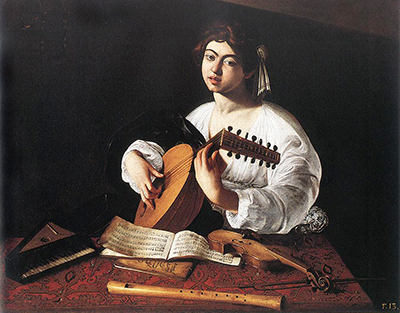
This Lute Player is the canvas associated with Cardinal Francesco Maria del Monte and the Barberini collection. The Metropolitan Museum of Art exhibited it in 1990 and published a substantial catalogue about it. The catalogue identifies the painting as being in a private collection, not as a Met-owned work. The inherited page address contains “Metropolitan Museum of Art,” so that distinction belongs at the start of the page.[1]
A youth sings and plays a lute before a table covered in patterned fabric. A little keyboard instrument, violin, recorder and open music surround him. The painting's “F.13” mark, recorded at lower right, connects the object to a nineteenth-century Barberini inventory. These features identify it separately from the Hermitage Lute Player, with its flower vase and fruit.[1][2]
Caravaggio in context
The Cardsharps
c.1595Calling of Saint Matthew
1599–1600Supper at Emmaus
1601At a Glance
- ArtistMichelangelo Merisi da Caravaggio in the Met's 1990 catalogue[1]
- TitleThe Lute Player, Del Monte/Barberini version[1]
- Dateabout 1596–97 in the Met catalogue[1]
- Mediumoil on canvas[1]
- Dimensions100 × 126.5 cm, height × width[1]
- Collectionprivate collection in the published catalogue; current owner and display location should not be assumed from that 1990 record[1]
- Historical associationCardinal del Monte, later Barberini inventories; “F.13” inscription[1]
- Met connectionexhibited and catalogued there, historically on loan; no evidence in the catalogue of Met ownership[1]
Contents
- A Painting with a Misleading Inherited Label
- The Singer and His Instruments
- Del Monte's Musical World
- Barberini Inventories and “F.13”
- Comparing the Hermitage Painting
- What the Met Catalogue Established
- Open Questions
- Frequently Asked Questions
A Painting with a Misleading Inherited Label
The page address has long suggested that the Lute Player belongs to the Metropolitan Museum of Art. It does not. Keith Christiansen's 1990 Met exhibition catalogue prints “Private collection” in its object entry and gives measurements of 100 × 126.5 cm. A museum can research and exhibit a loan without owning it. A reader should be able to understand that distinction before relying on the page for a visit or citing its facts.[1]
The catalogue's identification is also more precise than the generic title. Several paintings and copies use the Lute Player composition. This object is the version associated with Cardinal del Monte, subsequently recorded in Barberini inventories. The small “F.13” on the painting corresponds to the number assigned under the Barberini entail in 1817. It is a useful identifier when images and captions disagree.[1]
The Met catalogue says the canvas passed through Barberini family records and was sold to the father of the then current owner in 1948. That is a history of the object as documented in 1990; it is not a license to claim a named current owner or public display today. The page title uses “Del Monte painting once shown at the Met” so the old route can continue to work while the factual label is corrected.[1]
The Singer and His Instruments
The player faces us across a crowded tabletop, absorbed in song as his hand touches the lute strings. A white shirt and softly lit face rise from the dark ground. The lute's rounded wooden body occupies the middle of the picture, making the instrument both a tool for performance and a feat of depiction. The table adds a miniature concert of other forms: open part-books, a recorder, violin and a small keyboard instrument.[1][2]
The patterned cloth is one of this version's practical visual signs. Its design gives the foreground an active surface, different from the stone table and prominent flowers of the Hermitage painting. The small keyboard instrument also belongs to the Del Monte version. These are not incidental decorations that can be moved between descriptions of two canvases; they are how a reader can tell the objects apart.[1][2]
The music is legible enough to have attracted scholarly study. Yet a precise reading of notes and text should be tied to a specific score in a specific version. The same general subject does not guarantee that the books in both paintings carry identical music. The Met's catalogue and subsequent museum scholarship offer a basis for discussing the musical setting without inventing a tune from a low-resolution reproduction.[1][2]
The painter brings the viewer close to the objects while withholding the sound. The open book implies a performance a musically literate viewer might recognize. The player's lips and hand fix an instant in time; the still instruments suggest other music that could begin. This combination of a person in action and carefully described things recalls The Musicians, another work connected to Del Monte's circle, but the group scene and this solitary player have different designs.[3]
Del Monte's Musical World
Cardinal Francesco Maria del Monte was a major patron in Caravaggio's Roman career. The Met catalogue associates this version with him, and its broader discussion places musical pictures among the interests of his household. A subsequent article in The Metropolitan Museum Journal examines music and painting in that setting and illustrates the private-collection canvas.[1][2]
This context helps explain the elaborate instruments. They could register cultivated skill, costly craftsmanship and the social experience of music. It is still an interpretation of a patron's world rather than proof that a specific concert happened before this painting, or that the singer is a named performer. The catalogue's documentary thread concerns ownership and inventories; it does not preserve the artist's verbal account of every detail.[1][2]
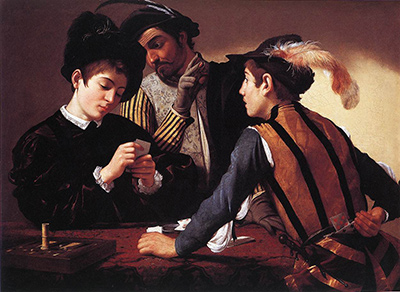
Caravaggio's early subjects often ask spectators to read hands. The Cardsharps makes a small movement of fingers into the centre of a deception. Here fingers sound a lute, and the connection between gesture and object is gentler. The Fortune Teller similarly turns an intimate exchange into a reason to inspect hands and glances. These comparisons illuminate an artistic method without claiming the scenes were painted as a formal series.[4][5]
Barberini Inventories and “F.13”
The history after Del Monte gives the picture an unusually helpful sequence of written anchors. The Met catalogue traces it through Barberini inventories and notes the “F.13” assigned in the 1817 fidecommesso, a legal entail. The physical mark and the archive records work together. They are stronger evidence for object identity than a later webpage title or an unsourced photograph caption.[1]
This does not mean that every old textual description is unambiguous. Caravaggio painted more than one lute player, and an inventory may use a short title. The mark, dimensions, visual details and collection trajectory make the Del Monte/Barberini identification more specific. The catalogue also discusses how seventeenth-century writers Baglione and Bellori knew the musical painting. Their descriptions are part of its reception history, not a substitute for examining the surviving object.[1]
The 1948 sale is the last ownership transition documented in the cited catalogue. A later loan or exhibition at the Met did not make the painting its property. Its current location is not established by that exhibition record.[1]
Comparing the Hermitage Painting
The Hermitage version measures 94 × 119 cm according to the owner publication. It belonged to Vincenzo Giustiniani's collection and was acquired in Paris in 1808. Its flowers, fruit and stone table distinguish it at a glance from the cloth and keyboard instrument here. The Hermitage publication gives it an approximate date of 1596; the Met catalogue gives the private canvas about 1596–97.[1][6]
Scholars have discussed their relative order and the relationship of one design to the other. Christiansen's catalogue treats the Hermitage work as an earlier, variant composition in relation to the Del Monte painting. That is a scholarly assessment based on the evidence available in 1990. It should be attributed to the catalogue rather than presented as an artist-signed chronology. The two patrons' different collection histories remain distinct even if the works were made near one another.[1]
Comparing versions offers more than a matching exercise. The patterned cloth changes the surface against which instruments stand. The Hermitage flowers make botanical display prominent; this version foregrounds a richer equipment of music. Those changes affect how a viewer imagines the singer's world. They also show why a generic image file named simply “lute-player.jpg” is inadequate for an evidence-led page.
What the Met Catalogue Established
The 1990 exhibition, A Caravaggio Rediscovered, brought the private canvas into public scholarly view. Its object entry supplies artist, approximate date, medium, measurements, inscription and private-collection designation. Its essay examines documentary and stylistic grounds for identifying the Del Monte painting. It also displays the Hermitage version as a separate catalogue object.[1]
The catalogue's private-collection designation also corrects a common confusion: the Met exhibited this painting but does not own it. The “F.13” mark, patterned textile, keyboard and music distinguish it from the Hermitage version.
The catalogue is a dated scholarly source. Its “private collection” status describes the position documented for the exhibition; the available record does not establish where the painting hangs now.
Open Questions
The singer's identity is not established. The precise circumstances of the commission and how Del Monte displayed the work also remain more open than the basic patron association. A reader can see that a lute is played and that other instruments surround it, but cannot reconstruct a real performance or identify every sound from a photograph.[1][2]
The two Lute Player canvases invite careful questions about repetition, patronage and changing motifs. They do not need to be collapsed into one painting, nor does the Met's exhibition history make one a museum holding. This page's lasting value is to give the Del Monte/Barberini object its own verifiable identity: 100 × 126.5 cm, “F.13,” a private collection in the catalogue, and a visual arrangement different from the Hermitage work.[1]
Explore the Caravaggio collection
| Name | Date | Type |
|---|---|---|
| Adoration of the Shepherds by Caravaggio: The Messina Nativity | 1608–09; precise order relative to Resurrection of Lazarus remains unresolved | Artwork |
| Amor Victorious by Caravaggio | 1601–02 in the Berlin owner record | Artwork |
| Bacchus by Caravaggio: The Uffizi Painting | about 1598, according to the Uffizi | Artwork |
| Basket of Fruit by Caravaggio | after 1597, probably around the turn of the seventeenth century, according to the Ambrosiana | Artwork |
| Boy Bitten by a Lizard: Caravaggio's London Painting | about 1594–95 in the National Gallery's current catalogue; URL suffix “1596” is inherited | Artwork |
| Boy Bitten by a Lizard: The Florence Version Attributed to Caravaggio | disputed; Longhi's catalogue record preserves historical 1592–93 and other proposed ranges, including c.1597 | Artwork |
| Boy Peeling Fruit by Caravaggio: The Royal Collection Painting | about 1592–93 in the owner's current exhibition record | Artwork |
| Boy Peeling Fruit in Florence: A Derivation from Caravaggio | — | Artwork |
| Boy with a Basket of Fruit by Caravaggio | about 1595 in the Galleria Borghese catalogue | Artwork |
| Caravaggio Paintings in Rome: Churches, Museums and a Practical Route | — | Guide |
| Caravaggio Quotes: What the Documents Actually Record | — | Guide |
| Caravaggio's Lute Player: The Del Monte Painting Once Shown at the Met | about 1596–97 in the Met catalogue | Artwork |
| Caravaggio's Painting Technique: Grounds, Incisions, Revisions and Light | — | Guide |
| Christ at the Column by Caravaggio: The Rouen Flagellation | c.1606 in the owner caption; owner prose gives 1606–07 | Artwork |
| Christ on the Mount of Olives by Caravaggio: The Lost Berlin Painting | — | Artwork |
| Conversion on the Way to Damascus by Caravaggio | about 1601 in the Roma Capitale church record | Artwork |
| Crowning with Thorns by Caravaggio: The Vienna Painting | about 1603 in the 2019 KHM record; “1607” is an inherited URL suffix | Artwork |
| Crowning with Thorns in Prato: Attributed to Caravaggio | about 1602–03 in the collection presentation | Artwork |
| David with the Head of Goliath by Caravaggio: The Borghese Painting | 1606–07 or 1609–10 in the Galleria Borghese catalogue; the later Naples period is favoured by many scholars, while the owner keeps the question open | Artwork |
| David with the Head of Goliath by Caravaggio: The Prado Painting | about 1600 in Prado material; “1599” survives only in the legacy URL | Artwork |
| David with the Head of Goliath by Caravaggio: The Vienna Painting | about 1600–01 in the KHM's 2019 exhibition record; “1607” is a legacy route label | Artwork |
| Did Caravaggio Make Drawings? What Survives and What Paintings Reveal | — | Guide |
| Ecce Homo: Caravaggio's Madrid Rediscovery and the Genoa Painting | — | Artwork |
| John the Baptist in Caravaggio's Paintings: A Guide to the Different Versions | — | Artwork |
| Judith Beheading Holofernes by Caravaggio | beginning of the seventeenth century in the owning museum's account; about 1599–1600 in the Kimbell's 2025 loan label; around 1602 in one specialist catalogue | Artwork |
| Jupiter, Neptune and Pluto: Caravaggio's Ludovisi Ceiling | about 1597; the archive connects the work with Cardinal del Monte's 1597 commission | Artwork |
| Madonna and Child with Saint Anne by Caravaggio: The Palafrenieri Altarpiece | 1605 in the Galleria Borghese object field; completed and delivered by 8 April 1606 | Artwork |
| Madonna of Loreto by Caravaggio: The Pilgrims at Sant'Agostino | broadly c.1604–06; institutional records differ slightly in their starting year | Artwork |
| Madonna of the Rosary by Caravaggio: The Vienna Altarpiece | around 1603 in the Kunsthistorisches Museum's object record | Artwork |
| Martha and Mary Magdalene by Caravaggio: The Detroit Painting | about 1598 in the Detroit Institute of Arts record | Artwork |
| Medusa by Caravaggio: The Uffizi Painted Shield | 1596–98 in the Uffizi's virtual exhibition; specialist research reports the shield delivered to the Medici wardrobe by 7 September 1598 | Artwork |
| Narcissus, Attributed to Caravaggio | dependent on attribution; the Zeri catalogue gives a broad 1610–50 range under Spadarino | Artwork |
| Nativity with Saint Francis and Saint Lawrence: Caravaggio's Missing Painting | somewhere in 1600–09 in the parliamentary report; a specific 1609 execution and place remain debated | Artwork |
| Penitent Mary Magdalene by Caravaggio | 1597 in the owner's catalogue, during Caravaggio's early Roman activity | Artwork |
| Portrait of a Courtesan: Caravaggio's Lost Berlin Portrait | Berlin's data field says c.1590, while its own text compares a Caravaggio work of c.1598; precise date unresolved | Artwork |
| Portrait of Alof de Wignacourt and His Page by Caravaggio | — | Artwork |
| Portrait of Fra Antonio Martelli? Caravaggio's Pitti Knight of Malta | 1608 in the Restituzioni object heading; within Caravaggio's Malta period | Artwork |
| Portrait of Maffeo Barberini: The Seated Corsini Painting | c.1596–97 in the national catalogue | Artwork |
| Portrait of Monsignor Maffeo Barberini: Caravaggio's Newly Acquired Painting | around the late 1590s / age thirty; “1598” in the inherited address is approximate, not an exact document date | Artwork |
| Portrait of Pope Paul V: A Caravaggio Attribution and a Borghese Copy | — | Artwork |
| Prints After Caravaggio: Who Made Them and What They Show | — | Guide |
| Reclining Saint John the Baptist: A Disputed Caravaggio Attribution | often proposed for the artist's final years; the later museum list does not give a precise year. | Artwork |
| Rest on the Flight into Egypt by Caravaggio | about 1597 in the owner's catalogue | Artwork |
| Saint Catherine of Alexandria by Caravaggio: The Thyssen Painting | about 1598–99 in the Museo Nacional Thyssen-Bornemisza catalogue | Artwork |
| Saint Francis in Meditation by Caravaggio: The Cremona Painting | 1603–06 in the owner account; c.1605–06 in a KHM exhibition caption | Artwork |
| Saint Francis in Prayer: Caravaggio's Carpineto Painting | 1606 in a 2016–17 exhibition work list | Artwork |
| Saint Francis of Assisi in Ecstasy by Caravaggio | c.1595–96 in the owner wall text | Artwork |
| Saint Jerome in Meditation: Caravaggio's Montserrat Painting | 1605 in the owner record; an owner publication reports scholarship placing it about 1605–06 | Artwork |
| Saint Jerome Writing by Caravaggio: The Borghese Painting | c.1606 in the owner catalogue; the “1605” URL suffix is inherited | Artwork |
| Saint Jerome Writing by Caravaggio: The Malta Painting | around 1607–08; foundation dates Malaspina's commission to 1608 | Artwork |
| Saint John in the Wilderness at Toledo Cathedral | exact 1598 not established by the cited cathedral account. | Artwork |
| Saint John the Baptist at Galleria Corsini, Rome | about 1606 in the national record; older proposals ranged from the late 1590s onward. | Artwork |
| Saint John the Baptist at the Capitoline Museums, Rome | 1602. | Artwork |
| Saint John the Baptist at the Galleria Borghese | 1609–10 in the current Borghese record. | Artwork |
| Saint John the Baptist at the Spring: The Bonello Painting in Malta | early seventeenth century in the institutional account; a precise 1608 is not established there. | Artwork |
| Saint Matthew and the Angel: Caravaggio's Lost First Altarpiece | — | Artwork |
| Salome Receives the Head of John the Baptist: Caravaggio's London Painting | about 1609–10, likely late Naples period in the Gallery's account | Artwork |
| Salome with the Head of John the Baptist: Caravaggio's Madrid Painting | — | Artwork |
| Sleeping Cupid by Caravaggio: The Painting Made in Malta | about 1608, Malta period | Artwork |
| Still Life with Fruit on a Stone Ledge: Is It by Caravaggio? | — | Artwork |
| Supper at Emmaus (1606): Caravaggio's Brera Painting | — | Artwork |
| The Annunciation by Caravaggio in Nancy | c.1607–10 in the collection record; 1608–10 in the museum's restoration account | Artwork |
| The Basel Saint John the Baptist: Once Labelled Caravaggio, Now Maíno | about 1608–10 in that schedule, rather than the legacy URL's 1600. | Artwork |
| The Beheading of Saint John the Baptist by Caravaggio | about 1608; installed in the Oratory on 29 August 1608 | Artwork |
| The Burial of Saint Lucy by Caravaggio in Syracuse | 1608, during Caravaggio's Syracuse stay | Artwork |
| The Calling of Saint Matthew by Caravaggio | about 1599–1600 | Artwork |
| The Calling of Saints Peter and Andrew by Caravaggio | about 1602–04 in the Trust's object text | Artwork |
| The Cardsharps by Caravaggio | about 1596–97 in the Kimbell's current object record | Artwork |
| The Conversion of Saint Paul: Caravaggio's Odescalchi Panel | commissioned in 1600; painted around 1600–01 | Artwork |
| The Crucifixion of Saint Andrew by Caravaggio | 1606–07 | Artwork |
| The Crucifixion of Saint Peter by Caravaggio | about 1601 | Artwork |
| The Death of the Virgin by Caravaggio | commissioned 1601; completed late 1605 or early 1606, according to the Louvre | Artwork |
| The Denial of Saint Peter by Caravaggio | 1610 | Artwork |
| The Doria Pamphilj Saint John the Baptist: A Second Youth with a Ram | linked compositionally to the Capitoline 1602 picture; an exact production year for this canvas is not established by the owner pages used here. | Artwork |
| The Entombment of Christ by Caravaggio: The Vatican Deposition | about 1600–04 in Vatican Museums publication material | Artwork |
| The Flagellation of Christ by Caravaggio: The Capodimonte Altarpiece | around 1607, in the first Naples period | Artwork |
| The Fortune Teller by Caravaggio: The Louvre Version and Its Roman Counterpart | — | Artwork |
| The Holy Family with the Infant Saint John the Baptist by Caravaggio | early 1600s in the Met catalogue; no more exact owner date asserted here | Artwork |
| The Incredulity of Saint Thomas by Caravaggio | about 1601 in the SPSG presentation | Artwork |
| The Inspiration of Saint Matthew by Caravaggio | usually 1602; also catalogued 1602–03, for the installed final altarpiece | Artwork |
| The Lute Player by Caravaggio: The Hermitage Painting | about 1596 in the Hermitage collection publication; the Hermitage Friends restoration page gives about 1595–96 | Artwork |
| The Magdalen in Ecstasy: Caravaggio, Copies and a Disputed Original | — | Artwork |
| The Martyrdom of Saint Matthew by Caravaggio | 1599–1600; unveiled with The Calling in 1600 | Artwork |
| The Martyrdom of Saint Ursula by Caravaggio | — | Artwork |
| The Musicians by Caravaggio | 1597 | Artwork |
| The Resurrection of Lazarus by Caravaggio in Messina | 1609; delivered 10 June 1609 in the owner account | Artwork |
| The Sacrifice of Isaac by Bartolomeo Cavarozzi: A Former Caravaggio Attribution | about 1615–17 in the Nicholas Hall catalogue; “1598” is an inherited URL label, not the accepted date | Artwork |
| The Sacrifice of Isaac by Caravaggio: The Uffizi Painting | about 1603 in the Uffizi catalogue | Artwork |
| The Seven Works of Mercy by Caravaggio | 1606–07, according to the Pio Monte | Artwork |
| The Supper at Emmaus by Caravaggio: The London Painting | 1601 | Artwork |
| The Taking of Christ by Caravaggio | 1602 | Artwork |
| The Toulouse *Judith Beheading Holofernes*: A Caravaggio Attribution Debate | c.1606–07 if identified with the recorded Naples work; that identification is debated | Artwork |
| Young Sick Bacchus by Caravaggio | about 1595 in the Galleria Borghese catalogue | Artwork |
| Youth with a Ram: Why Caravaggio's Saint John Looks So Unusual | — | Artwork |
No matching pages found.
Discussion
Share a close observation about Lute Player or a source that clarifies its history.
Which detail changes your reading?
Is there a collection record or document worth comparing?
What remains uncertain?
Join the Conversation
Frequently Asked Questions
Does the Metropolitan Museum of Art own this Lute Player?
No. Its 1990 catalogue labels this canvas “Private collection.” The Met exhibited and researched the painting; that is why the museum name became attached to the inherited route.[1]
Is it the same as the Hermitage Lute Player?
What does “F.13” mean?
The Met catalogue says the mark at lower right is the number assigned to the painting in the Barberini entail of 1817.[1]
When was the private-collection painting made?
The Met's catalogue dates it about 1596–97. That is an approximate art-historical dating, not a dated artist inscription.[1]
Can visitors see it at the Met now?
The 1990 exhibition and loan history do not establish a current display. Consult current museum listings for any announced loan; this page does not promise the painting is on view.[1]
References
- Keith Christiansen, A Caravaggio Rediscovered: The Lute Player, Metropolitan Museum of Art, 1990, especially catalogue no. 5, museum publication and full catalogue PDF.
- Music and Painting in Cardinal del Monte's Household, The Metropolitan Museum Journal 26 (1991).
- Metropolitan Museum of Art, The Musicians collection record.
- Kimbell Art Museum, The Cardsharps collection record.
- Musée du Louvre, The Fortune Teller collection record.
- State Hermitage Museum, collection publication on The Lute Player.