 by Tom Gurney
Tom Gurney BSc (Hons) is an art history expert with over 20 years experience
Page Created on / Page Updated on
Email: tomgurney1@gmail.com / Phone: +44 7429 011000
David with the Head of Goliath by Caravaggio: The Prado Painting
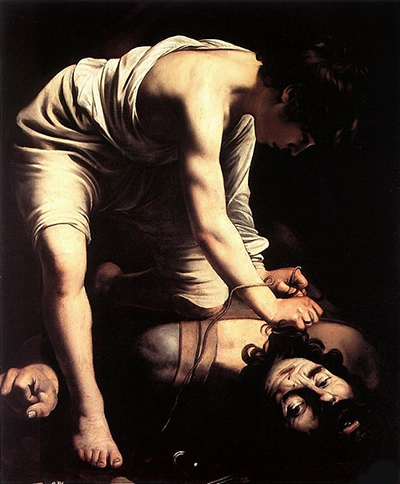
The Prado's David with the Head of Goliath shows a young David bending over the fallen giant. He gathers Goliath's head by the hair after the fight, close to the body rather than holding it up before the viewer. The Museo Nacional del Prado dates this painting about 1600. The inherited web address ends in “1599,” but that is not a date written on the canvas or the museum's current catalogue date.[1]
The Prado work is one of three distinct Caravaggio paintings of the subject discussed in this cluster. The Vienna David presents the head outward, and the Borghese David shows a grave youth contemplating Goliath's face. This page follows the Madrid canvas, whose restoration history and changing physical format are part of its story.[1][2][3]
Caravaggio in context
The Cardsharps
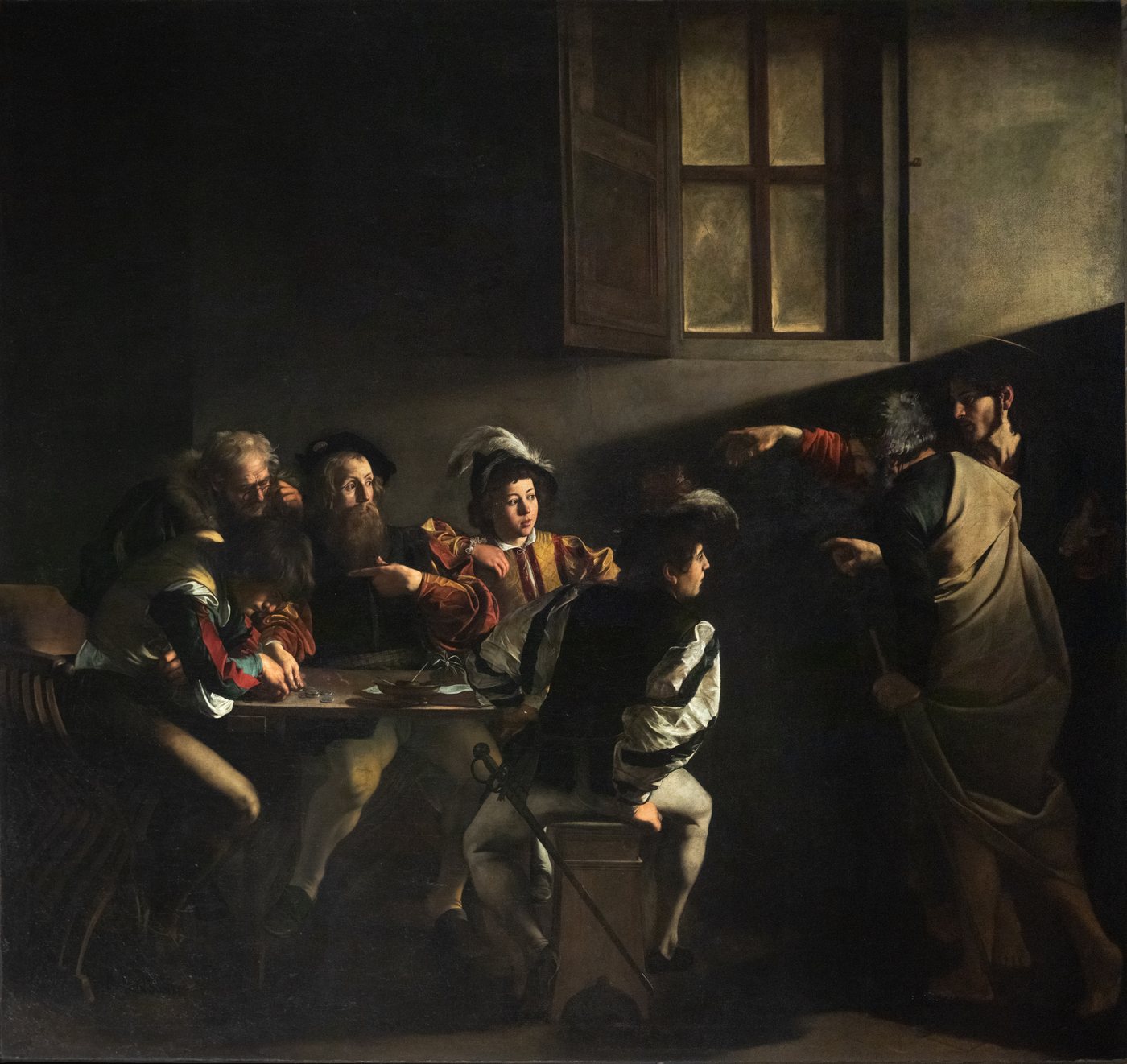
c.1595Calling of Saint Matthew
1599–1600Supper at Emmaus
1601At a Glance
- ArtistMichelangelo Merisi da Caravaggio in the Prado catalogue[1]
- TitleDavid with the Head of Goliath; also called David Victorious over Goliath[1]
- Dateabout 1600 in Prado material; “1599” survives only in the legacy URL[1]
- Mediumoil on canvas[1]
- Current dimensions110.4 × 91.3 cm, height × width, as discussed in the Prado's conservation account[1]
- CollectionMuseo Nacional del Prado, Madrid[1]
- CompositionDavid stoops over Goliath's body and takes hold of the head[1]
- Important qualificationthe canvas's dimensions changed historically, so present measurements should not be treated as its unchanged original format[1]
Contents
- A Victory Seen from Close Range
- David's Pose and the Fallen Giant
- Why the Date Says About 1600
- The Painting's Changing Format
- Attribution and Restoration
- Comparing the Three Davids
- What Remains Open
- Frequently Asked Questions
A Victory Seen from Close Range
The biblical story describes how David, a young shepherd, defeats the armed Goliath with a sling and then uses the giant's sword to cut off his head. Caravaggio's Prado painting chooses the aftermath. David is near Goliath, reaching to handle the head. The scene is physical and immediate, without a distant battlefield or triumphant crowd.[1][4]
David's bent body fills much of the picture. The pose makes the viewer look down toward the task rather than straight at a trophy. The dead giant is partly in shadow, while light catches David's flesh and clothing. The contest's result is certain, but the image lingers on the awkward work of taking possession of the head. Victory is shown as an action involving weight and touch.
That choice distinguishes the Prado composition from the later-looking Borghese picture, where the head hangs at the end of David's arm and receives his pensive gaze. It also differs from Vienna's outward presentation. The differences are more than small variations in costume. Each arrangement changes how the viewer meets the violence and the young victor.[2][3]
David's Pose and the Fallen Giant
The Prado's David has the scale and movement of a boy. He crouches above the giant, working close to the ground. His arm and torso lead the eye to Goliath, so the two bodies remain visibly connected. This is not the calm display of a severed head after it has been carried away. The painting compresses the immediate consequence of combat into a small field.[1]
The darkness around the figures keeps attention on the exposed forms. Caravaggio's light is selective, but it does not turn the scene into a simple diagram. The viewer still has to read how David bends, where his hand reaches and how Goliath's form lies below. The motion is easy to understand as a whole and worth inspecting detail by detail.
An accessible Prado description says the work's condition and later changes once complicated how its original design was understood. That is especially relevant to composition. If a canvas has been enlarged and later restored, an account of how close a figure stands to its edge needs to consider the painting's physical history. A present-day digital crop alone cannot reveal every earlier state.[1]
The subject invites moral interpretation: courage overcoming great force, a youth defeating an intimidating enemy. Those themes are in the biblical story. The Prado canvas, however, does not supply an artist-authored statement naming every emotional nuance in David's posture. It is enough to describe the action precisely and consider what its unusual closeness does to a viewer.
Why the Date Says About 1600
The Prado dates the painting about 1600. The suffix “1599” in this site's route arose from an earlier labelling practice and should be treated as an address, not a secure year of production. A single-year heading would imply precision the museum does not claim.[1]
About 1600 places the work near Caravaggio's major Roman breakthrough with the Contarelli Chapel paintings, such as The Calling of Saint Matthew. That broad comparison helps locate the painter's developing treatment of bodies and light. It does not prove this David was made immediately before or after a particular chapel canvas, or that it had the same patron.[5]
Dating by style is complicated by the painting's conservation history. The Prado's account refers to research undertaken during a 2023 restoration and to older restorations that affected critical judgment. A chronology should take that object-specific evidence seriously while acknowledging the limit of an approximate date.[1]
Another problem is that “David with the Head of Goliath” names several Caravaggio paintings. A date found beside an image of Vienna or the Borghese Gallery should not simply be copied onto Madrid's canvas. The Prado's owner record is the first anchor for this page's date, as the other owners' records are for theirs.
The Painting's Changing Format
The Prado's conservation discussion says the canvas was enlarged after its creation. It compares recorded dimensions in historical inventories with the current measurement of 110.4 × 91.3 cm. Those observations are important because the painting has not always presented the same boundaries to viewers.[1]
An enlarged canvas may change the balance of dark space and figure, and later treatment may reveal or conceal details. The museum's 2023 research revisited provenance questions and considered how the picture looked at earlier stages. This is a reminder to describe the current object accurately without pretending that its format was fixed from the day Caravaggio painted it.[1]
The conservation history does not reveal exact lost brushwork or assign every added area to a named hand. The Prado reports alterations and gives dimensions for the painting's present state; finer claims require its object-specific technical evidence.
Attribution and Restoration
The Prado notes that this David's place in Caravaggio's accepted oeuvre has not always been straightforward. A restoration in 1946–47 and subsequent reassessment helped its attribution gain broader acceptance. The current owner catalogues it to Caravaggio. That history is different from saying its authorship is presently rejected or that every past critic agreed.[1]
The 2023 restoration provided another chance to examine the painting and revisit its provenance. The Prado's account says gaps about its arrival in Spain and presence in the Royal Collections have been investigated, with some questions resolved. Other links in the ownership chain remain uncertain.[1]
Attribution has practical consequences for a public page. A search result could join a Prado photograph to text about Vienna's poplar panel or Borghese's sword inscription. The Prado object should instead carry its own medium, current dimensions, composition and catalogue history. Keeping those facts together makes the attribution discussion intelligible.
Comparing the Three Davids
The Vienna version is a broad poplar panel, 90.5 × 116 cm in the Kunsthistorisches Museum's 2019 exhibition record. David shows the head outward while bearing a sword on his shoulder. That museum dated it about 1600–01, despite the “1607” suffix in this site's route.[3]
The Borghese version is a taller oil canvas, 125 × 101 cm. Its museum gives alternative dates of 1606–07 or 1609–10. The giant's head is commonly read as a self-portrait of Caravaggio, and the letters on the sword have prompted debate. Neither feature belongs automatically to the Prado picture.[2]
Here in Madrid, David bends toward the fallen giant. In Vienna, he brings the head out toward us. In Rome, he seems to look on it with sorrow. One biblical narrative supports three choices of moment and emotional distance. The Metropolitan Museum's catalogue on Valentin de Boulogne also distinguishes these three Caravaggio designs when discussing later artists' handling of the subject.[6]
The point is not to force them into a single exact sequence from weakest to strongest. Their owners' current dates and technical records have different levels of certainty. Looking across them shows how a repeated story can become different paintings with different histories.
What Remains Open
The Prado's conservation research has improved knowledge of the canvas, yet its original format and earliest provenance require careful treatment. A current measurement describes the object now, not every phase of its life. Its attribution is accepted by the owner after a complicated critical history. The approximate date remains about 1600.[1]
There is also no need to borrow the Borghese painting's psychological narrative to make this work engaging. The Prado David gives the viewer a decisive, awkward instant after combat. His physical effort and the giant's closeness make a powerful image of victory at human scale. Those are visible qualities of this particular canvas, supported by its museum identity.[1]
Explore the Caravaggio collection
| Name | Date | Type |
|---|---|---|
| Adoration of the Shepherds by Caravaggio: The Messina Nativity | 1608–09; precise order relative to Resurrection of Lazarus remains unresolved | Artwork |
| Amor Victorious by Caravaggio | 1601–02 in the Berlin owner record | Artwork |
| Bacchus by Caravaggio: The Uffizi Painting | about 1598, according to the Uffizi | Artwork |
| Basket of Fruit by Caravaggio | after 1597, probably around the turn of the seventeenth century, according to the Ambrosiana | Artwork |
| Boy Bitten by a Lizard: Caravaggio's London Painting | about 1594–95 in the National Gallery's current catalogue; URL suffix “1596” is inherited | Artwork |
| Boy Bitten by a Lizard: The Florence Version Attributed to Caravaggio | disputed; Longhi's catalogue record preserves historical 1592–93 and other proposed ranges, including c.1597 | Artwork |
| Boy Peeling Fruit by Caravaggio: The Royal Collection Painting | about 1592–93 in the owner's current exhibition record | Artwork |
| Boy Peeling Fruit in Florence: A Derivation from Caravaggio | — | Artwork |
| Boy with a Basket of Fruit by Caravaggio | about 1595 in the Galleria Borghese catalogue | Artwork |
| Caravaggio Paintings in Rome: Churches, Museums and a Practical Route | — | Guide |
| Caravaggio Quotes: What the Documents Actually Record | — | Guide |
| Caravaggio's Lute Player: The Del Monte Painting Once Shown at the Met | about 1596–97 in the Met catalogue | Artwork |
| Caravaggio's Painting Technique: Grounds, Incisions, Revisions and Light | — | Guide |
| Christ at the Column by Caravaggio: The Rouen Flagellation | c.1606 in the owner caption; owner prose gives 1606–07 | Artwork |
| Christ on the Mount of Olives by Caravaggio: The Lost Berlin Painting | — | Artwork |
| Conversion on the Way to Damascus by Caravaggio | about 1601 in the Roma Capitale church record | Artwork |
| Crowning with Thorns by Caravaggio: The Vienna Painting | about 1603 in the 2019 KHM record; “1607” is an inherited URL suffix | Artwork |
| Crowning with Thorns in Prato: Attributed to Caravaggio | about 1602–03 in the collection presentation | Artwork |
| David with the Head of Goliath by Caravaggio: The Borghese Painting | 1606–07 or 1609–10 in the Galleria Borghese catalogue; the later Naples period is favoured by many scholars, while the owner keeps the question open | Artwork |
| David with the Head of Goliath by Caravaggio: The Prado Painting | about 1600 in Prado material; “1599” survives only in the legacy URL | Artwork |
| David with the Head of Goliath by Caravaggio: The Vienna Painting | about 1600–01 in the KHM's 2019 exhibition record; “1607” is a legacy route label | Artwork |
| Did Caravaggio Make Drawings? What Survives and What Paintings Reveal | — | Guide |
| Ecce Homo: Caravaggio's Madrid Rediscovery and the Genoa Painting | — | Artwork |
| John the Baptist in Caravaggio's Paintings: A Guide to the Different Versions | — | Artwork |
| Judith Beheading Holofernes by Caravaggio | beginning of the seventeenth century in the owning museum's account; about 1599–1600 in the Kimbell's 2025 loan label; around 1602 in one specialist catalogue | Artwork |
| Jupiter, Neptune and Pluto: Caravaggio's Ludovisi Ceiling | about 1597; the archive connects the work with Cardinal del Monte's 1597 commission | Artwork |
| Madonna and Child with Saint Anne by Caravaggio: The Palafrenieri Altarpiece | 1605 in the Galleria Borghese object field; completed and delivered by 8 April 1606 | Artwork |
| Madonna of Loreto by Caravaggio: The Pilgrims at Sant'Agostino | broadly c.1604–06; institutional records differ slightly in their starting year | Artwork |
| Madonna of the Rosary by Caravaggio: The Vienna Altarpiece | around 1603 in the Kunsthistorisches Museum's object record | Artwork |
| Martha and Mary Magdalene by Caravaggio: The Detroit Painting | about 1598 in the Detroit Institute of Arts record | Artwork |
| Medusa by Caravaggio: The Uffizi Painted Shield | 1596–98 in the Uffizi's virtual exhibition; specialist research reports the shield delivered to the Medici wardrobe by 7 September 1598 | Artwork |
| Narcissus, Attributed to Caravaggio | dependent on attribution; the Zeri catalogue gives a broad 1610–50 range under Spadarino | Artwork |
| Nativity with Saint Francis and Saint Lawrence: Caravaggio's Missing Painting | somewhere in 1600–09 in the parliamentary report; a specific 1609 execution and place remain debated | Artwork |
| Penitent Mary Magdalene by Caravaggio | 1597 in the owner's catalogue, during Caravaggio's early Roman activity | Artwork |
| Portrait of a Courtesan: Caravaggio's Lost Berlin Portrait | Berlin's data field says c.1590, while its own text compares a Caravaggio work of c.1598; precise date unresolved | Artwork |
| Portrait of Alof de Wignacourt and His Page by Caravaggio | — | Artwork |
| Portrait of Fra Antonio Martelli? Caravaggio's Pitti Knight of Malta | 1608 in the Restituzioni object heading; within Caravaggio's Malta period | Artwork |
| Portrait of Maffeo Barberini: The Seated Corsini Painting | c.1596–97 in the national catalogue | Artwork |
| Portrait of Monsignor Maffeo Barberini: Caravaggio's Newly Acquired Painting | around the late 1590s / age thirty; “1598” in the inherited address is approximate, not an exact document date | Artwork |
| Portrait of Pope Paul V: A Caravaggio Attribution and a Borghese Copy | — | Artwork |
| Prints After Caravaggio: Who Made Them and What They Show | — | Guide |
| Reclining Saint John the Baptist: A Disputed Caravaggio Attribution | often proposed for the artist's final years; the later museum list does not give a precise year. | Artwork |
| Rest on the Flight into Egypt by Caravaggio | about 1597 in the owner's catalogue | Artwork |
| Saint Catherine of Alexandria by Caravaggio: The Thyssen Painting | about 1598–99 in the Museo Nacional Thyssen-Bornemisza catalogue | Artwork |
| Saint Francis in Meditation by Caravaggio: The Cremona Painting | 1603–06 in the owner account; c.1605–06 in a KHM exhibition caption | Artwork |
| Saint Francis in Prayer: Caravaggio's Carpineto Painting | 1606 in a 2016–17 exhibition work list | Artwork |
| Saint Francis of Assisi in Ecstasy by Caravaggio | c.1595–96 in the owner wall text | Artwork |
| Saint Jerome in Meditation: Caravaggio's Montserrat Painting | 1605 in the owner record; an owner publication reports scholarship placing it about 1605–06 | Artwork |
| Saint Jerome Writing by Caravaggio: The Borghese Painting | c.1606 in the owner catalogue; the “1605” URL suffix is inherited | Artwork |
| Saint Jerome Writing by Caravaggio: The Malta Painting | around 1607–08; foundation dates Malaspina's commission to 1608 | Artwork |
| Saint John in the Wilderness at Toledo Cathedral | exact 1598 not established by the cited cathedral account. | Artwork |
| Saint John the Baptist at Galleria Corsini, Rome | about 1606 in the national record; older proposals ranged from the late 1590s onward. | Artwork |
| Saint John the Baptist at the Capitoline Museums, Rome | 1602. | Artwork |
| Saint John the Baptist at the Galleria Borghese | 1609–10 in the current Borghese record. | Artwork |
| Saint John the Baptist at the Spring: The Bonello Painting in Malta | early seventeenth century in the institutional account; a precise 1608 is not established there. | Artwork |
| Saint Matthew and the Angel: Caravaggio's Lost First Altarpiece | — | Artwork |
| Salome Receives the Head of John the Baptist: Caravaggio's London Painting | about 1609–10, likely late Naples period in the Gallery's account | Artwork |
| Salome with the Head of John the Baptist: Caravaggio's Madrid Painting | — | Artwork |
| Sleeping Cupid by Caravaggio: The Painting Made in Malta | about 1608, Malta period | Artwork |
| Still Life with Fruit on a Stone Ledge: Is It by Caravaggio? | — | Artwork |
| Supper at Emmaus (1606): Caravaggio's Brera Painting | — | Artwork |
| The Annunciation by Caravaggio in Nancy | c.1607–10 in the collection record; 1608–10 in the museum's restoration account | Artwork |
| The Basel Saint John the Baptist: Once Labelled Caravaggio, Now Maíno | about 1608–10 in that schedule, rather than the legacy URL's 1600. | Artwork |
| The Beheading of Saint John the Baptist by Caravaggio | about 1608; installed in the Oratory on 29 August 1608 | Artwork |
| The Burial of Saint Lucy by Caravaggio in Syracuse | 1608, during Caravaggio's Syracuse stay | Artwork |
| The Calling of Saint Matthew by Caravaggio | about 1599–1600 | Artwork |
| The Calling of Saints Peter and Andrew by Caravaggio | about 1602–04 in the Trust's object text | Artwork |
| The Cardsharps by Caravaggio | about 1596–97 in the Kimbell's current object record | Artwork |
| The Conversion of Saint Paul: Caravaggio's Odescalchi Panel | commissioned in 1600; painted around 1600–01 | Artwork |
| The Crucifixion of Saint Andrew by Caravaggio | 1606–07 | Artwork |
| The Crucifixion of Saint Peter by Caravaggio | about 1601 | Artwork |
| The Death of the Virgin by Caravaggio | commissioned 1601; completed late 1605 or early 1606, according to the Louvre | Artwork |
| The Denial of Saint Peter by Caravaggio | 1610 | Artwork |
| The Doria Pamphilj Saint John the Baptist: A Second Youth with a Ram | linked compositionally to the Capitoline 1602 picture; an exact production year for this canvas is not established by the owner pages used here. | Artwork |
| The Entombment of Christ by Caravaggio: The Vatican Deposition | about 1600–04 in Vatican Museums publication material | Artwork |
| The Flagellation of Christ by Caravaggio: The Capodimonte Altarpiece | around 1607, in the first Naples period | Artwork |
| The Fortune Teller by Caravaggio: The Louvre Version and Its Roman Counterpart | — | Artwork |
| The Holy Family with the Infant Saint John the Baptist by Caravaggio | early 1600s in the Met catalogue; no more exact owner date asserted here | Artwork |
| The Incredulity of Saint Thomas by Caravaggio | about 1601 in the SPSG presentation | Artwork |
| The Inspiration of Saint Matthew by Caravaggio | usually 1602; also catalogued 1602–03, for the installed final altarpiece | Artwork |
| The Lute Player by Caravaggio: The Hermitage Painting | about 1596 in the Hermitage collection publication; the Hermitage Friends restoration page gives about 1595–96 | Artwork |
| The Magdalen in Ecstasy: Caravaggio, Copies and a Disputed Original | — | Artwork |
| The Martyrdom of Saint Matthew by Caravaggio | 1599–1600; unveiled with The Calling in 1600 | Artwork |
| The Martyrdom of Saint Ursula by Caravaggio | — | Artwork |
| The Musicians by Caravaggio | 1597 | Artwork |
| The Resurrection of Lazarus by Caravaggio in Messina | 1609; delivered 10 June 1609 in the owner account | Artwork |
| The Sacrifice of Isaac by Bartolomeo Cavarozzi: A Former Caravaggio Attribution | about 1615–17 in the Nicholas Hall catalogue; “1598” is an inherited URL label, not the accepted date | Artwork |
| The Sacrifice of Isaac by Caravaggio: The Uffizi Painting | about 1603 in the Uffizi catalogue | Artwork |
| The Seven Works of Mercy by Caravaggio | 1606–07, according to the Pio Monte | Artwork |
| The Supper at Emmaus by Caravaggio: The London Painting | 1601 | Artwork |
| The Taking of Christ by Caravaggio | 1602 | Artwork |
| The Toulouse *Judith Beheading Holofernes*: A Caravaggio Attribution Debate | c.1606–07 if identified with the recorded Naples work; that identification is debated | Artwork |
| Young Sick Bacchus by Caravaggio | about 1595 in the Galleria Borghese catalogue | Artwork |
| Youth with a Ram: Why Caravaggio's Saint John Looks So Unusual | — | Artwork |
No matching pages found.
Discussion
Share a close observation about David with the Head of Goliath by Caravaggio or a source that clarifies its history.
Which detail changes your reading?
Is there a collection record or document worth comparing?
What remains uncertain?
Join the Conversation
Frequently Asked Questions
Is the Prado David dated 1599?
The Museo Nacional del Prado dates it about 1600. “1599” is an inherited URL suffix, not a secure creation date.[1]
How is it different from Caravaggio's Borghese David?
How large is the Prado painting?
The Prado's conservation discussion gives its current size as 110.4 × 91.3 cm. Historical enlargement means that should not be called its unchanged original measurement.[1]
Did restoration change its attribution?
The Prado describes a history of disputed or changing critical reception. The 1946–47 restoration and later scholarship contributed to the acceptance of the painting as a Caravaggio. The museum currently catalogues it to him.[1]
Where is it?
It is in the Museo Nacional del Prado, Madrid. Check the museum's current display listing before visiting.[1]
References
- Museo Nacional del Prado, David with the Head of Goliath, collection and conservation account.
- Galleria Borghese, David with the Head of Goliath, inventory 455.
- Kunsthistorisches Museum Vienna, Horror & the Terrifying: Caravaggio's David with the Head of Goliath.
- Vatican, 1 Samuel 17, David and Goliath.
- San Luigi dei Francesi, official church information.
- Metropolitan Museum of Art, Valentin de Boulogne: Beyond Caravaggio catalogue.