 by Tom Gurney
Tom Gurney BSc (Hons) is an art history expert with over 20 years experience
Page Created on / Page Updated on
Email: tomgurney1@gmail.com / Phone: +44 7429 011000
John the Baptist in Caravaggio's Paintings: A Guide to the Different Versions
Caravaggio returned to the young John the Baptist in more than one painting, but the pictures often grouped under that name are not interchangeable. The Kansas City youth bows over a reed cross; the Corsini figure sits beside a bowl; the late Borghese John faces the viewer beside a ram. A further painting shown in Malta and a privately held reclining youth carry disputed attributions. This guide identifies the objects, explains what can be compared, and keeps uncertain versions separate from securely catalogued works.[1][2][3][4][5]
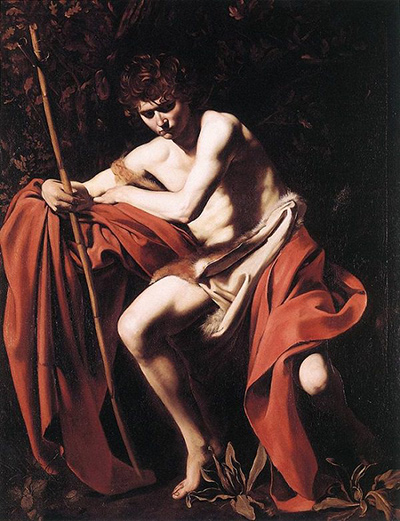
The image traditionally used at the top of this overview is specifically the Nelson-Atkins Museum of Art's Saint John the Baptist in the Wilderness, object 52-25, dated 1604 by its owner. It can introduce the subject only when its caption names that object. It must not stand in for every Caravaggio Baptist or imply that all the listed versions have the same attribution.[1]
Caravaggio in context
The Cardsharps
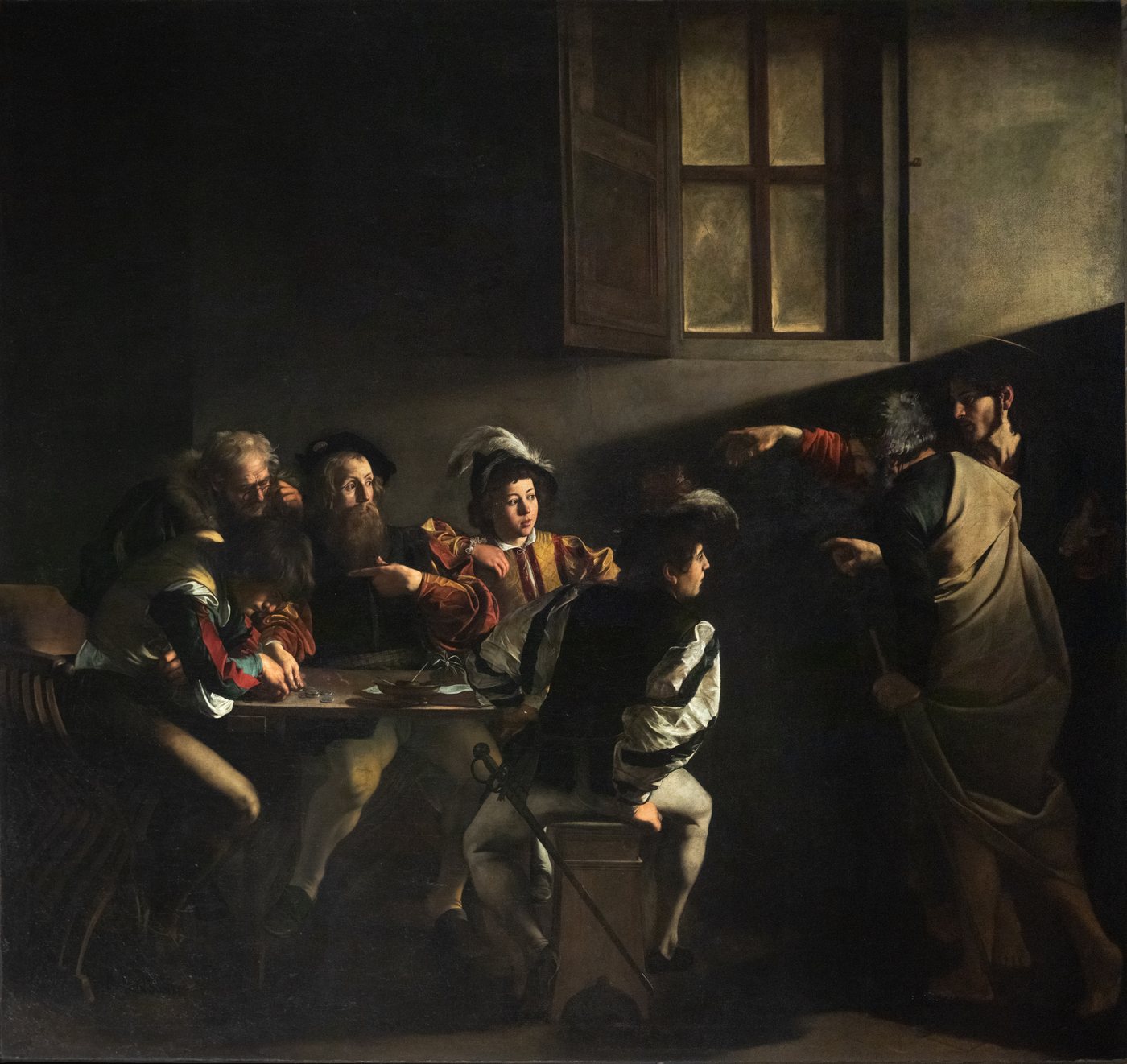
c.1595Calling of Saint Matthew
1599–1600Supper at Emmaus
1601At a Glance
- SubjectJohn the Baptist as a young figure in a wilderness or resting setting; individual paintings differ in composition, date and status.[1][2][3]
- Kansas City anchorSaint John the Baptist in the Wilderness, 1604, Nelson-Atkins 52-25, commissioned by Ottavio Costa.[1]
- Rome, CorsiniSaint John the Baptist, about 1606 in the Italian national catalogue, Galleria Corsini inventory 433.[2]
- Rome, BorgheseSaint John the Baptist, 1609–10, Galleria Borghese inventory 267.[3]
- Further secure comparisonthe Capitoline Baptist is a separate Mattei-associated composition.[6]
- Disputed versionsMalta's Saint John at the Spring and the private Reclining Baptist need explicit attribution labels.[4][5]
Contents
- Why Are There Several Paintings Called John the Baptist?
- The Kansas City Painting
- The Corsini and Borghese Paintings
- The Capitoline Version and Repeated Motifs
- Disputed Versions in Malta and Private Hands
- How to Identify a Version Safely
- Frequently Asked Questions
Look closer: Saint John the Baptist
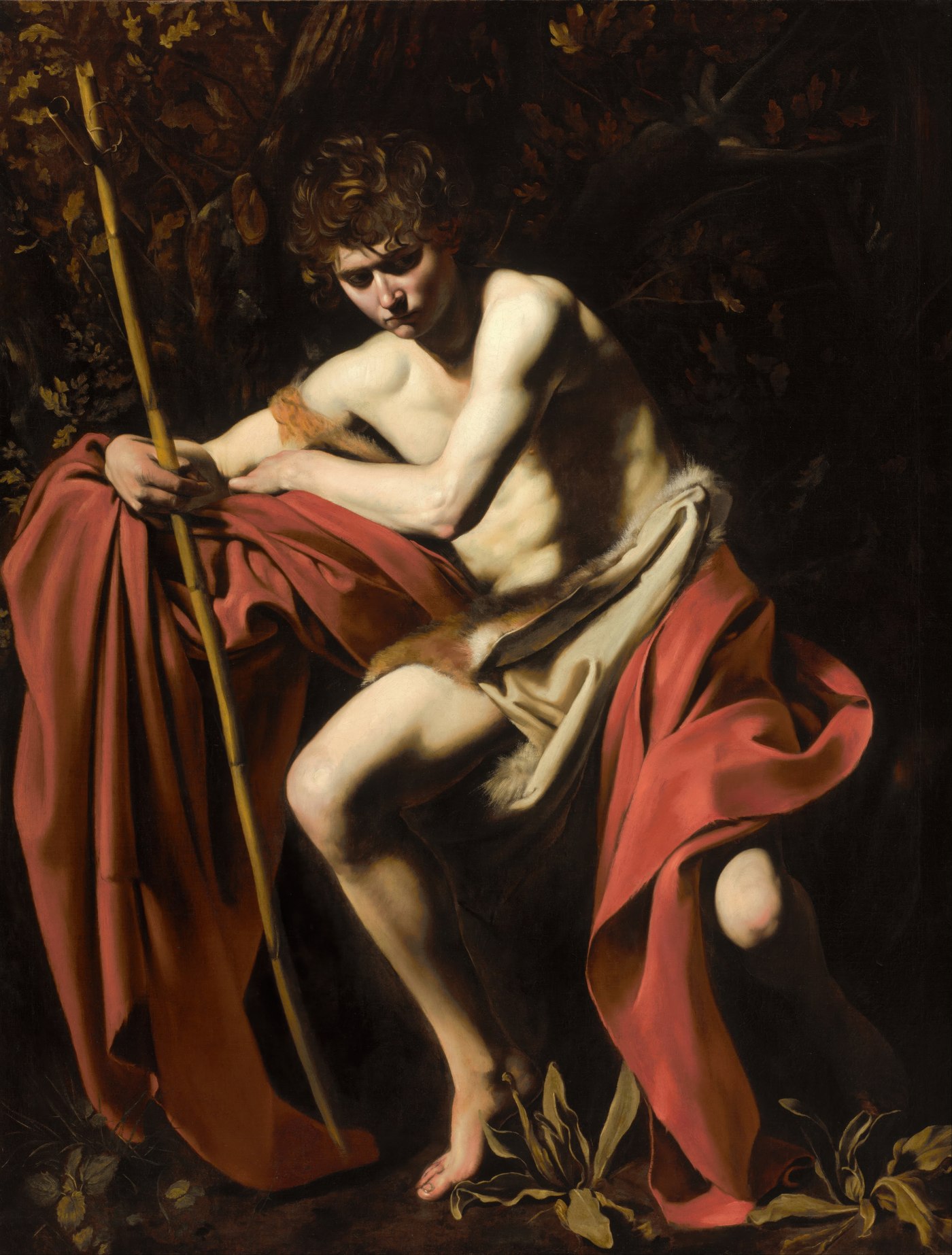
The Kansas City Baptist is built from a few emphatic forms: a reed cross, a turned body and a sweep of red cloth. The details show how those elements carry the figure's identity.
 123
Details from Saint John the Baptist
Select a detail image to open the full-size gallery, then use the arrows to compare views.
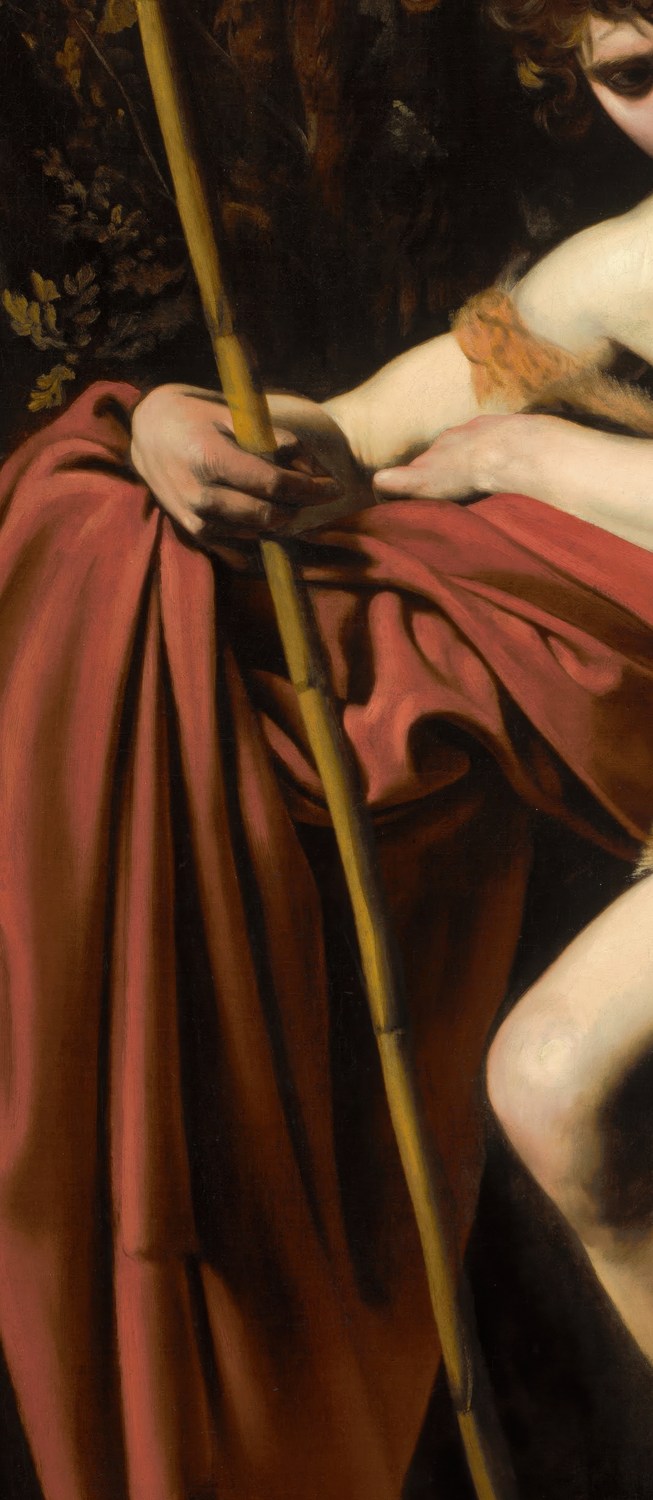
The reed cross
John holds a slender reed cross at the left edge. It is easy to miss in the surrounding branches, yet it identifies the seated youth.
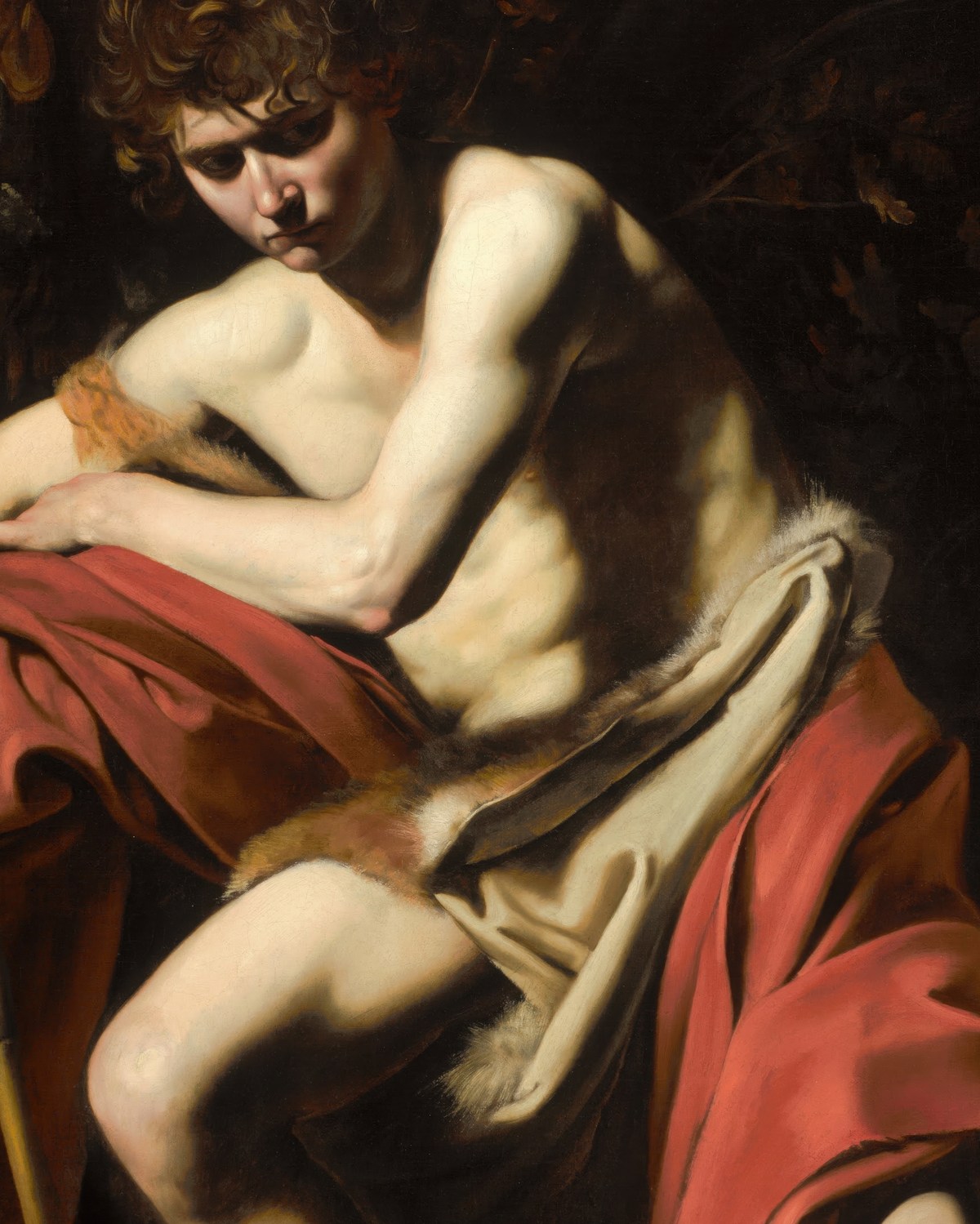
The turned figure
John's downward glance and folded arms pull attention inward. Light isolates the shoulders and forearms from the dark wilderness.
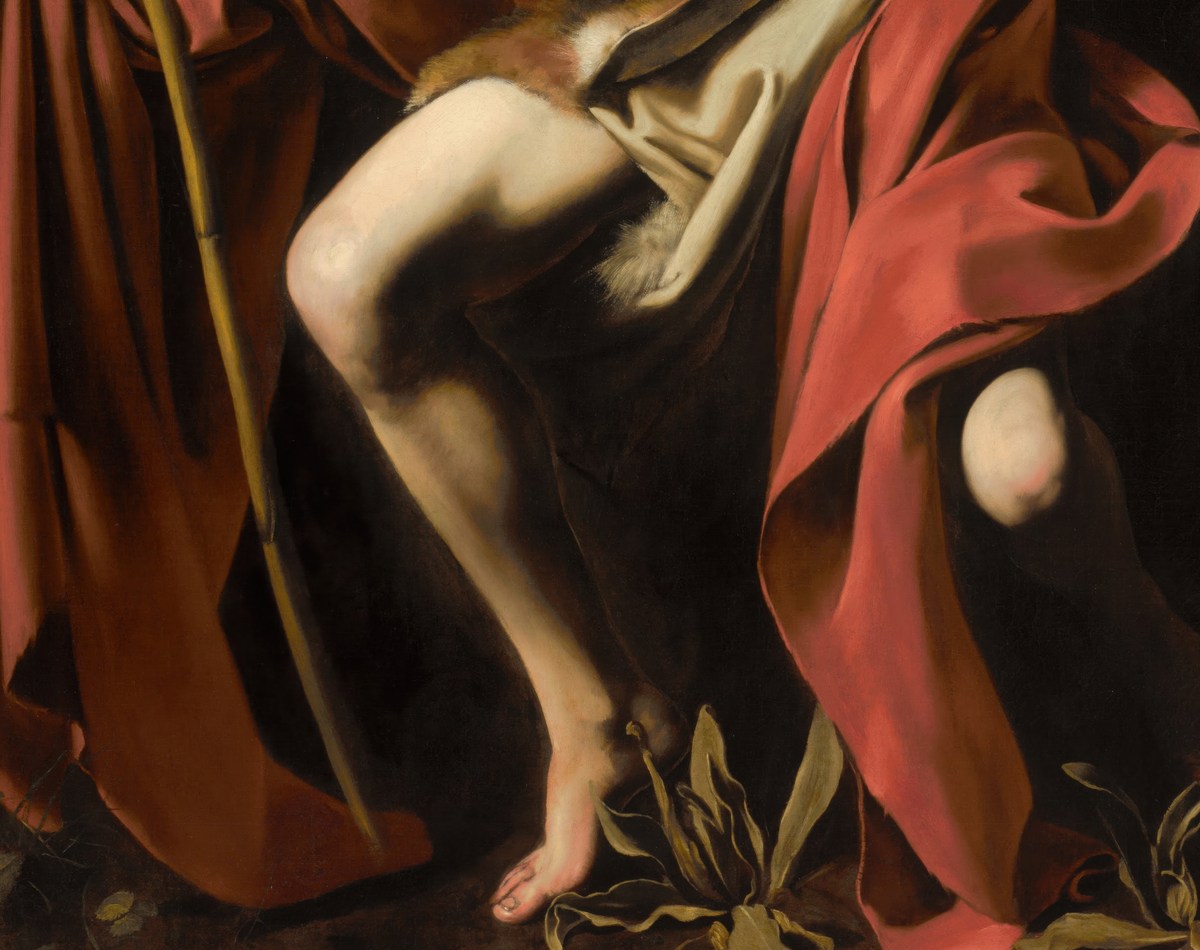
Red cloth and bare feet
The red drapery folds around the rock and descends beside John's exposed legs, leading the eye to the stony ground.
Why Are There Several Paintings Called John the Baptist?
John was a familiar religious subject whose identity could be suggested by a reed cross, austere clothing, wilderness setting or an animal. Caravaggio could return to the young figure without repeating the same composition. That makes a title alone unreliable. A reader searching “Caravaggio John the Baptist” may encounter paintings in Kansas City and Rome, older labels with different years, and contested candidates shown in exhibitions.[1][2][3][4]
The biblical John lived in the wilderness and proclaimed a call to repentance before Jesus' public ministry. The Gospels give the religious background, but they do not describe any of Caravaggio's particular poses, red cloths or facial expressions. Those are choices made in pictures for viewers and patrons, not literal illustrations of one recorded scene.[7]
There is no fixed count that works without qualification. Counting only works accepted by their present owning museums gives a different answer from adding paintings that some scholars attribute to Caravaggio and others reject. This guide therefore names each object and states its evidence instead of announcing that he painted exactly seven or eight Baptists.[1][2][3][4][5]
The existing article's speculation about a model called Cecco and a personal relationship has no support in the object records used here. A resemblance among painted youths cannot establish a sitter's legal identity, much less a private relationship. Claims of that kind need documentary evidence, so they have no place in an object guide.[1][2][3]
The Kansas City Painting
The Nelson-Atkins version gives this series a clear starting point. Its owner dates it 1604, lists an unframed size of 173.36 × 133.35 cm, and records the commission by Ottavio Costa for a small private chapel near Genoa. Its collection number is 52-25.[1]
The figure bends his head and holds a reed cross while red cloth and fur-lined clothing cross his body. He is close to the front edge of a shadowy stand of trees. The museum notes how stripped back the saint's familiar attributes have become: there is no obvious halo or inscribed banner, and his mood carries much of the picture's devotional force.[1]
The documented Costa patronage is especially valuable. It ties this particular Baptist to a private chapel and traces its later ownership. A similar red drape in another painting does not show that the same patron ordered it. Compare the compositions, but keep their provenance separate.[1][3]
The Kansas City picture is also a useful example of Caravaggio's working method because the museum reports incised guide lines in its ground near the sitter's leg. That is an object-specific observation, not proof that every Baptist was made with precisely the same handling or in a neat chronological sequence.[1]
The Corsini and Borghese Paintings
The Corsini Saint John the Baptist is a horizontal canvas in Rome, 97 × 131.5 cm, inventory 433. The Italian national catalogue dates it around 1606. The old route name says “1604”, but that exact date is not the current catalogue position; the owner-backed date is the more reliable chronology.[2]
Its youth sits partly in shadow, with red cloth, a reed and a bowl. The earliest cited Corsini inventory of 1784 describes it as “in the style of Caravaggio”. The catalogue says most scholars support Caravaggio's authorship, while recording dissenting follower attributions and technical investigations that strengthened a later Roman date. That history is worth presenting, because “attributed” and “securely documented from the artist's hand” are different kinds of claim.[2]
The Borghese John is another distinct painting, a vertical canvas of 152 × 125 cm, inventory 267, dated 1609–10 by the gallery. This youth sits on a long red drape beside a ram and holds a slender reed. The gallery's account connects it to Caravaggio's difficult final journey and to letters concerning works intended for Cardinal Scipione Borghese.[3]
The Borghese picture's path does not make it the “last painting” by an exact date. The owner explains how its attribution and dating have been debated, and how the later documentary discovery affected its placement. The safest short description is one of Caravaggio's late Baptist paintings, now in the Galleria Borghese.[3]
The Capitoline Version and Repeated Motifs
The Capitoline John the Baptist is yet another object in Rome. The Musei Capitolini discuss its Mattei setting and technical examination, and describe the young figure leaning with a ram. Its prominent animal invites comparison with the Borghese version, but the bodies, poses and ownership histories are not the same.[6][3]
Animals, reeds, red fabric and exposed shoulders recur because they can identify or evoke John while leaving room for a painter's new arrangement. They are comparison points, not fingerprints proving that pictures were made on the same day or by the same model. A useful comparison asks what the gesture and gaze do: Kansas City bends inward, Corsini settles into shadow, and Borghese meets the viewer more directly.[1][2][3]
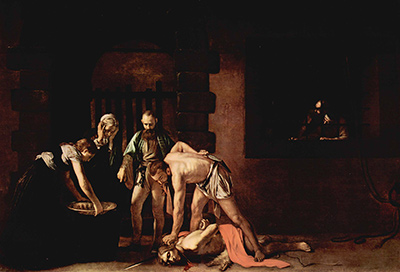
John's later death belongs to another phase of the saint's story. Caravaggio's Beheading of Saint John the Baptist is a major Maltese altarpiece, not another name for one of these solitary youth portraits. Linking it here gives readers a narrative path while retaining the distinction between a portrait-like wilderness figure and a public execution scene.[8]
Disputed Versions in Malta and Private Hands
The painting shown at Malta's MUŻA, Saint John the Baptist at the Spring, belongs to the Bonello heirs and was loaned to Heritage Malta. The museum says some named scholars have accepted it as Caravaggio, while others dispute the attribution or reserve judgment. The route's “1608” does not establish a precise year; the owner describes it more broadly as early seventeenth century.[4]
The Reclining Baptist is a privately held horizontal picture exhibited at the Rembrandt House in 2010–11 as Caravaggio's last work. A later museum exhibition list prints the artist with a question mark. Both facts matter: its exhibition history is real, and its authorship cannot be presented as settled. Its precise present location and image rights have not been verified for this project.[5][9]
These candidates are useful for understanding attribution debates, but they remain separate from confirmed works. A future technical report or owner catalogue could change their assessment; the present labels follow the dated institutional evidence cited here.[4][5][9]
How to Identify a Version Safely
Start with a collection and number, not the year in a search-result headline. “Nelson-Atkins 52-25”, “Corsini 433” and “Borghese 267” identify three different physical paintings. Record the owner date separately; a route or old caption may preserve an older scholarly estimate.[1][2][3]
Then inspect distinctive composition features: Kansas City is a tall bowed youth with a cross; Corsini is a wide canvas with bowl and drapery; Borghese is a tall seated youth beside a ram. The overview's inherited splash image is the Kansas City composition. That visual match does not provide the photo license required to republish it or make a zoom feature.[1][2][3]
Finally, distinguish what an institution actually says from a site author's inference. A museum's catalogue may establish a date range, measurements and provenance. An attribution debate should be reported as such. The same discipline makes links between these pages useful: the reader can compare objects without being given a false single sequence.[1][2][3][4][5]
Explore the Caravaggio collection
| Name | Date | Type |
|---|---|---|
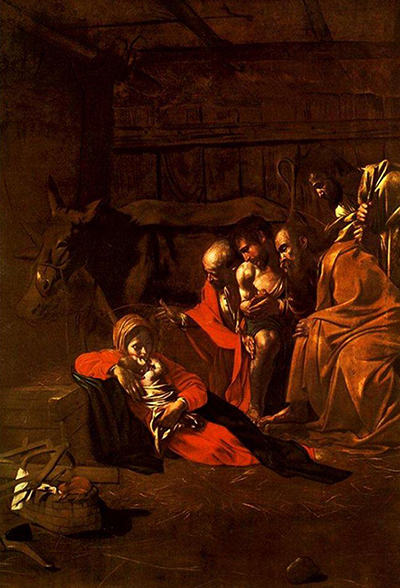
| Adoration of the Shepherds by Caravaggio: The Messina Nativity | 1608–09; precise order relative to Resurrection of Lazarus remains unresolved | Artwork |
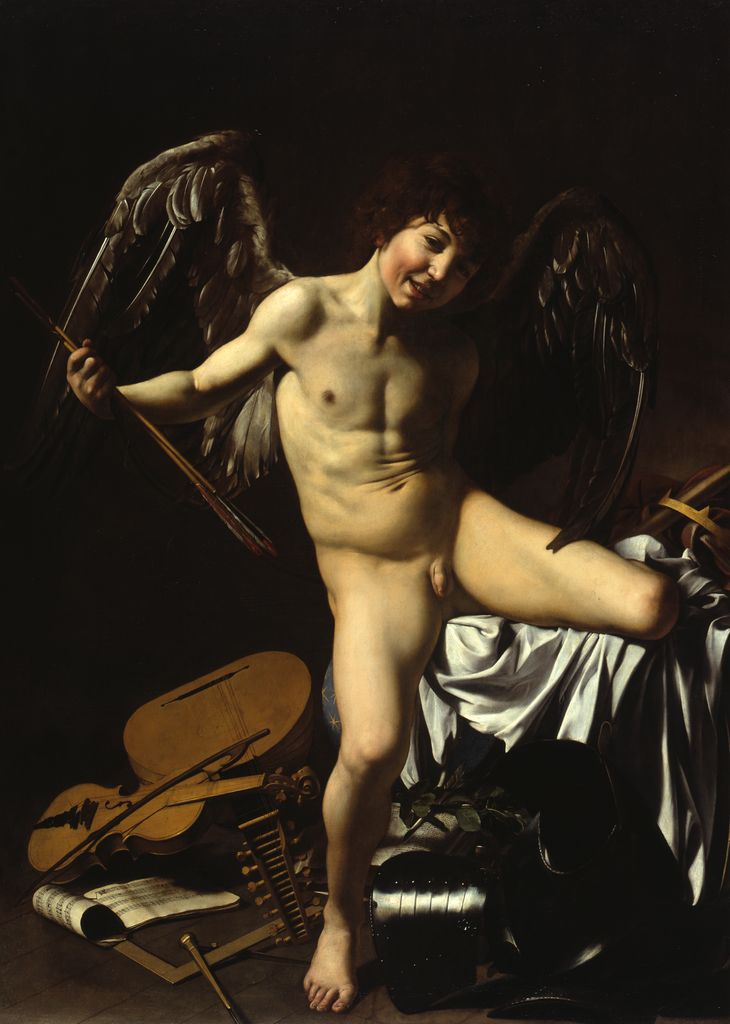
| Amor Victorious by Caravaggio | 1601–02 in the Berlin owner record | Artwork |
| Bacchus by Caravaggio: The Uffizi Painting | about 1598, according to the Uffizi | Artwork |
| Basket of Fruit by Caravaggio | after 1597, probably around the turn of the seventeenth century, according to the Ambrosiana | Artwork |
| Boy Bitten by a Lizard: Caravaggio's London Painting | about 1594–95 in the National Gallery's current catalogue; URL suffix “1596” is inherited | Artwork |
| Boy Bitten by a Lizard: The Florence Version Attributed to Caravaggio | disputed; Longhi's catalogue record preserves historical 1592–93 and other proposed ranges, including c.1597 | Artwork |
| Boy Peeling Fruit by Caravaggio: The Royal Collection Painting | about 1592–93 in the owner's current exhibition record | Artwork |
| Boy Peeling Fruit in Florence: A Derivation from Caravaggio | — | Artwork |
| Boy with a Basket of Fruit by Caravaggio | about 1595 in the Galleria Borghese catalogue | Artwork |
| Caravaggio Paintings in Rome: Churches, Museums and a Practical Route | — | Guide |
| Caravaggio Quotes: What the Documents Actually Record | — | Guide |
| Caravaggio's Lute Player: The Del Monte Painting Once Shown at the Met | about 1596–97 in the Met catalogue | Artwork |
| Caravaggio's Painting Technique: Grounds, Incisions, Revisions and Light | — | Guide |
| Christ at the Column by Caravaggio: The Rouen Flagellation | c.1606 in the owner caption; owner prose gives 1606–07 | Artwork |
| Christ on the Mount of Olives by Caravaggio: The Lost Berlin Painting | — | Artwork |
| Conversion on the Way to Damascus by Caravaggio | about 1601 in the Roma Capitale church record | Artwork |
| Crowning with Thorns by Caravaggio: The Vienna Painting | about 1603 in the 2019 KHM record; “1607” is an inherited URL suffix | Artwork |
| Crowning with Thorns in Prato: Attributed to Caravaggio | about 1602–03 in the collection presentation | Artwork |
| David with the Head of Goliath by Caravaggio: The Borghese Painting | 1606–07 or 1609–10 in the Galleria Borghese catalogue; the later Naples period is favoured by many scholars, while the owner keeps the question open | Artwork |
| David with the Head of Goliath by Caravaggio: The Prado Painting | about 1600 in Prado material; “1599” survives only in the legacy URL | Artwork |
| David with the Head of Goliath by Caravaggio: The Vienna Painting | about 1600–01 in the KHM's 2019 exhibition record; “1607” is a legacy route label | Artwork |
| Did Caravaggio Make Drawings? What Survives and What Paintings Reveal | — | Guide |
| Ecce Homo: Caravaggio's Madrid Rediscovery and the Genoa Painting | — | Artwork |
| John the Baptist in Caravaggio's Paintings: A Guide to the Different Versions | — | Artwork |
| Judith Beheading Holofernes by Caravaggio | beginning of the seventeenth century in the owning museum's account; about 1599–1600 in the Kimbell's 2025 loan label; around 1602 in one specialist catalogue | Artwork |
| Jupiter, Neptune and Pluto: Caravaggio's Ludovisi Ceiling | about 1597; the archive connects the work with Cardinal del Monte's 1597 commission | Artwork |
| Madonna and Child with Saint Anne by Caravaggio: The Palafrenieri Altarpiece | 1605 in the Galleria Borghese object field; completed and delivered by 8 April 1606 | Artwork |
| Madonna of Loreto by Caravaggio: The Pilgrims at Sant'Agostino | broadly c.1604–06; institutional records differ slightly in their starting year | Artwork |
| Madonna of the Rosary by Caravaggio: The Vienna Altarpiece | around 1603 in the Kunsthistorisches Museum's object record | Artwork |
| Martha and Mary Magdalene by Caravaggio: The Detroit Painting | about 1598 in the Detroit Institute of Arts record | Artwork |
| Medusa by Caravaggio: The Uffizi Painted Shield | 1596–98 in the Uffizi's virtual exhibition; specialist research reports the shield delivered to the Medici wardrobe by 7 September 1598 | Artwork |
| Narcissus, Attributed to Caravaggio | dependent on attribution; the Zeri catalogue gives a broad 1610–50 range under Spadarino | Artwork |
| Nativity with Saint Francis and Saint Lawrence: Caravaggio's Missing Painting | somewhere in 1600–09 in the parliamentary report; a specific 1609 execution and place remain debated | Artwork |
| Penitent Mary Magdalene by Caravaggio | 1597 in the owner's catalogue, during Caravaggio's early Roman activity | Artwork |
| Portrait of a Courtesan: Caravaggio's Lost Berlin Portrait | Berlin's data field says c.1590, while its own text compares a Caravaggio work of c.1598; precise date unresolved | Artwork |
| Portrait of Alof de Wignacourt and His Page by Caravaggio | — | Artwork |
| Portrait of Fra Antonio Martelli? Caravaggio's Pitti Knight of Malta | 1608 in the Restituzioni object heading; within Caravaggio's Malta period | Artwork |
| Portrait of Maffeo Barberini: The Seated Corsini Painting | c.1596–97 in the national catalogue | Artwork |
| Portrait of Monsignor Maffeo Barberini: Caravaggio's Newly Acquired Painting | around the late 1590s / age thirty; “1598” in the inherited address is approximate, not an exact document date | Artwork |
| Portrait of Pope Paul V: A Caravaggio Attribution and a Borghese Copy | — | Artwork |
| Prints After Caravaggio: Who Made Them and What They Show | — | Guide |
| Reclining Saint John the Baptist: A Disputed Caravaggio Attribution | often proposed for the artist's final years; the later museum list does not give a precise year. | Artwork |
| Rest on the Flight into Egypt by Caravaggio | about 1597 in the owner's catalogue | Artwork |
| Saint Catherine of Alexandria by Caravaggio: The Thyssen Painting | about 1598–99 in the Museo Nacional Thyssen-Bornemisza catalogue | Artwork |
| Saint Francis in Meditation by Caravaggio: The Cremona Painting | 1603–06 in the owner account; c.1605–06 in a KHM exhibition caption | Artwork |
| Saint Francis in Prayer: Caravaggio's Carpineto Painting | 1606 in a 2016–17 exhibition work list | Artwork |
| Saint Francis of Assisi in Ecstasy by Caravaggio | c.1595–96 in the owner wall text | Artwork |
| Saint Jerome in Meditation: Caravaggio's Montserrat Painting | 1605 in the owner record; an owner publication reports scholarship placing it about 1605–06 | Artwork |
| Saint Jerome Writing by Caravaggio: The Borghese Painting | c.1606 in the owner catalogue; the “1605” URL suffix is inherited | Artwork |
| Saint Jerome Writing by Caravaggio: The Malta Painting | around 1607–08; foundation dates Malaspina's commission to 1608 | Artwork |
| Saint John in the Wilderness at Toledo Cathedral | exact 1598 not established by the cited cathedral account. | Artwork |
| Saint John the Baptist at Galleria Corsini, Rome | about 1606 in the national record; older proposals ranged from the late 1590s onward. | Artwork |
| Saint John the Baptist at the Capitoline Museums, Rome | 1602. | Artwork |
| Saint John the Baptist at the Galleria Borghese | 1609–10 in the current Borghese record. | Artwork |
| Saint John the Baptist at the Spring: The Bonello Painting in Malta | early seventeenth century in the institutional account; a precise 1608 is not established there. | Artwork |
| Saint Matthew and the Angel: Caravaggio's Lost First Altarpiece | — | Artwork |
| Salome Receives the Head of John the Baptist: Caravaggio's London Painting | about 1609–10, likely late Naples period in the Gallery's account | Artwork |
| Salome with the Head of John the Baptist: Caravaggio's Madrid Painting | — | Artwork |
| Sleeping Cupid by Caravaggio: The Painting Made in Malta | about 1608, Malta period | Artwork |
| Still Life with Fruit on a Stone Ledge: Is It by Caravaggio? | — | Artwork |
| Supper at Emmaus (1606): Caravaggio's Brera Painting | — | Artwork |
| The Annunciation by Caravaggio in Nancy | c.1607–10 in the collection record; 1608–10 in the museum's restoration account | Artwork |
| The Basel Saint John the Baptist: Once Labelled Caravaggio, Now Maíno | about 1608–10 in that schedule, rather than the legacy URL's 1600. | Artwork |
| The Beheading of Saint John the Baptist by Caravaggio | about 1608; installed in the Oratory on 29 August 1608 | Artwork |
| The Burial of Saint Lucy by Caravaggio in Syracuse | 1608, during Caravaggio's Syracuse stay | Artwork |
| The Calling of Saint Matthew by Caravaggio | about 1599–1600 | Artwork |
| The Calling of Saints Peter and Andrew by Caravaggio | about 1602–04 in the Trust's object text | Artwork |
| The Cardsharps by Caravaggio | about 1596–97 in the Kimbell's current object record | Artwork |
| The Conversion of Saint Paul: Caravaggio's Odescalchi Panel | commissioned in 1600; painted around 1600–01 | Artwork |
| The Crucifixion of Saint Andrew by Caravaggio | 1606–07 | Artwork |
| The Crucifixion of Saint Peter by Caravaggio | about 1601 | Artwork |
| The Death of the Virgin by Caravaggio | commissioned 1601; completed late 1605 or early 1606, according to the Louvre | Artwork |
| The Denial of Saint Peter by Caravaggio | 1610 | Artwork |
| The Doria Pamphilj Saint John the Baptist: A Second Youth with a Ram | linked compositionally to the Capitoline 1602 picture; an exact production year for this canvas is not established by the owner pages used here. | Artwork |
| The Entombment of Christ by Caravaggio: The Vatican Deposition | about 1600–04 in Vatican Museums publication material | Artwork |
| The Flagellation of Christ by Caravaggio: The Capodimonte Altarpiece | around 1607, in the first Naples period | Artwork |
| The Fortune Teller by Caravaggio: The Louvre Version and Its Roman Counterpart | — | Artwork |
| The Holy Family with the Infant Saint John the Baptist by Caravaggio | early 1600s in the Met catalogue; no more exact owner date asserted here | Artwork |
| The Incredulity of Saint Thomas by Caravaggio | about 1601 in the SPSG presentation | Artwork |
| The Inspiration of Saint Matthew by Caravaggio | usually 1602; also catalogued 1602–03, for the installed final altarpiece | Artwork |
| The Lute Player by Caravaggio: The Hermitage Painting | about 1596 in the Hermitage collection publication; the Hermitage Friends restoration page gives about 1595–96 | Artwork |
| The Magdalen in Ecstasy: Caravaggio, Copies and a Disputed Original | — | Artwork |
| The Martyrdom of Saint Matthew by Caravaggio | 1599–1600; unveiled with The Calling in 1600 | Artwork |
| The Martyrdom of Saint Ursula by Caravaggio | — | Artwork |
| The Musicians by Caravaggio | 1597 | Artwork |
| The Resurrection of Lazarus by Caravaggio in Messina | 1609; delivered 10 June 1609 in the owner account | Artwork |
| The Sacrifice of Isaac by Bartolomeo Cavarozzi: A Former Caravaggio Attribution | about 1615–17 in the Nicholas Hall catalogue; “1598” is an inherited URL label, not the accepted date | Artwork |
| The Sacrifice of Isaac by Caravaggio: The Uffizi Painting | about 1603 in the Uffizi catalogue | Artwork |
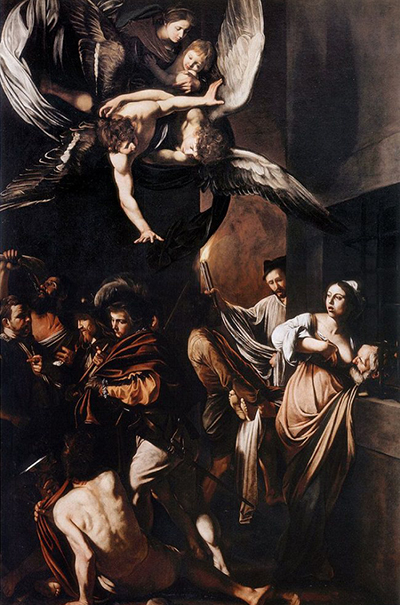
| The Seven Works of Mercy by Caravaggio | 1606–07, according to the Pio Monte | Artwork |
| The Supper at Emmaus by Caravaggio: The London Painting | 1601 | Artwork |
| The Taking of Christ by Caravaggio | 1602 | Artwork |
| The Toulouse *Judith Beheading Holofernes*: A Caravaggio Attribution Debate | c.1606–07 if identified with the recorded Naples work; that identification is debated | Artwork |
| Young Sick Bacchus by Caravaggio | about 1595 in the Galleria Borghese catalogue | Artwork |
| Youth with a Ram: Why Caravaggio's Saint John Looks So Unusual | — | Artwork |
No matching pages found.
Discussion
Share a close observation about John the Baptist in Paintings or a source that clarifies its history.
Which detail changes your reading?
Is there a collection record or document worth comparing?
What remains uncertain?
Join the Conversation
Frequently Asked Questions
How many John the Baptist paintings did Caravaggio make?
Which painting appears on this guide's old splash?
It depicts the Nelson-Atkins Saint John the Baptist in the Wilderness, object 52-25, dated 1604 by the museum. A publication image still needs its own source and rights check.[1]
Is the “1604, Rome” Corsini work securely dated 1604?
No. The Italian national catalogue currently gives about 1606 and discusses earlier proposals. The old route name is a navigation label, not decisive evidence.[2]
Is the Maltese picture definitely by Caravaggio?
Heritage Malta says scholars are divided about Saint John the Baptist at the Spring. It should be labelled attributed to Caravaggio rather than presented as an undisputed autograph.[4]
References
- Nelson-Atkins Museum of Art, Saint John the Baptist in the Wilderness, object 52-25.
- Catalogo Generale dei Beni Culturali, San Giovanni Battista, Corsini inventory 433, record 1201007596.
- Galleria Borghese, San Giovanni Battista, inventory 267.
- Heritage Malta, A painting historically attributed to Caravaggio displayed at MUŻA.
- Museum Het Rembrandthuis, 2011 annual report, De laatste Caravaggio exhibition.
- Musei Capitolini, restoration of the John the Baptist.
- US Conference of Catholic Bishops, Mark 1.
- St John's Co-Cathedral Foundation, Caravaggio at the Co-Cathedral.
- Akita Museum of Art, Caravaggio exhibition checklist, Saint John the Baptist Reclining as Caravaggio (?) .
- Annotated image source: High-resolution digital reproduction supplied by the site owner for the annotated details.