 by Tom Gurney
Tom Gurney BSc (Hons) is an art history expert with over 20 years experience
Page Created on / Page Updated on
Email: tomgurney1@gmail.com / Phone: +44 7429 011000
Caravaggio Quotes: What the Documents Actually Record
Many sayings attributed to Caravaggio circulate without a date, witness or document. A smaller set of his words survives in legal testimony, especially the deposition taken on 13 September 1603 during painter Giovanni Baglione's defamation case. Those are statements in a dispute, recorded by a clerk; they are more firmly sourced than a modern quotation card, but they are not a private diary of the artist's beliefs.[1][2]
This guide gives short verified excerpts and paraphrases in context. It also shows how to check a line before repeating it. No quotation here should be treated as a timeless artistic manifesto merely because its wording suits Caravaggio's paintings.
Caravaggio in context
The Cardsharps
c.1595Calling of Saint Matthew
1599–1600Supper at Emmaus
1601At a Glance
- Best documented speechCaravaggio's testimony in the Baglione proceedings, 13 September 1603.[1][2]
- Other first-person recordsa 1598 statement about carrying a sword and an October 1605 account of his injuries survive through judicial records.[1][4][9]
- Other attributed speechVincenzo Giustiniani later reports Caravaggio's comparison of painting flowers and figures; it is the collector's account, not a deposition.[6]
- Document typea legal deposition, written by a court clerk; it records answers within a case.[1][2]
- Subjecta rival painter, his religious picture, other artists and artistic ability.[1][3]
- TranslationEnglish forms vary; cite the document or a named translation, not a detached slogan.[2][3]
- Cautionwords attributed to Caravaggio by a later biographer or a fictional character have a different status from a recorded deposition.
Contents
- Why There Are So Few Secure Quotations
- A Statement About Cardinal del Monte in 1598
- What Happened in 1603
- A Short Set of Documented Statements
- What “Imitating Natural Things” Meant in Context
- The Painters He Named in Court
- A Collector's Report About Flowers
- Did Caravaggio Write the Poems?
- Other Dated Interrogations in 1604 and 1605
- Direct Testimony, Reported Speech and Fiction
- Common Quotation Traps
- A Method for Checking a Quote
- Frequently Asked Questions
Why There Are So Few Secure Quotations
Caravaggio left paintings, contracts and traces in civic and judicial records. He did not leave a collected book of aphorisms. The abundance of modern one-line “Caravaggio quotes” therefore calls for caution. An attractive line can have originated in a later biography, an exhibition text, a translation of a court record, a novel, a film or an anonymous web list. Those sources answer different questions.
The direct record is still mediated. A court clerk wrote a deposition for a legal purpose. A published Italian transcription may normalise spelling or punctuation, and an English version introduces translator choices. The sound of Caravaggio's voice cannot be recovered from a typescript. But a dated court document allows the reader to identify who was speaking, why and what was being asked. The National Museum of Western Art, Tokyo listed the Baglione trial transcript as an archival object in its 2016 exhibition checklist, giving its date and Roman State Archive provenance.[1]
Archives can also change a biography. Italy's Ministry of Culture reported newly examined Roman records on Caravaggio's movements, clothing, lodging and disputes. Their existence is a reminder that a colourful story is strongest when attached to a document; even familiar dates and anecdotes can be revised by fresh archival work.[4]
The Archivio di Stato di Roma now presents the 1603 case on its own site. Its account identifies the seized poems, complaint, witness statements and interrogations as different parts of the file, and prints passages from Caravaggio's answers. The archivists note that the original papers were displayed publicly in the 1951 Milan exhibition and again in a later Rome exhibition. An online quotation should point to those transcribed answers or a scholarly edition, not merely to the existence of the trial.[5]
A Statement About Cardinal del Monte in 1598
An earlier recorded answer concerns Caravaggio's position in Rome rather than painting theory. On 4 May 1598, after an officer found him carrying a sword near Piazza Navona, he told a judge that he belonged to Cardinal Francesco Maria del Monte's household: he was the cardinal's painter, received a salary for himself and a servant, lived in the house and was entered on its roll. The Art Gallery of New South Wales prints an English excerpt from the testimony, while the National Museum of Western Art's 2016 checklist identifies the original Roman State Archive record down to its register and folio.[1][9]
The officer's account and Caravaggio's answer are separate voices. The officer said he found a sword carried without permission and took the painter to Tor di Nona; Caravaggio invoked household service to explain why he carried it. The statement helps document how he presented his professional standing at that date. It is not a general claim about artistic independence, nor does his assertion alone establish the legal outcome or the precise terms of a weapons licence.[9]
What Happened in 1603
Giovanni Baglione brought a defamation complaint against Caravaggio and others over insulting verse circulating in Rome. Caravaggio was questioned on 13 September 1603. The surviving testimony includes his opinions of Baglione's painting and his sense of who counted as a capable painter. It is evidence of a rivalry at a specific moment, not a calm lecture on aesthetics.[2][3]
One of the works under discussion was Baglione's religious painting for the church of the Gesù. L'Osservatore Romano, quoting the trial record in Italian, notes that Caravaggio said he had seen it on visits to the church and criticised it as awkward. The article places the words in the rivalry and discusses possible links with the Crescenzi family; those further motives are the author's interpretations, not statements that Caravaggio himself made.[2]
The legal setting matters for tone. A witness or defendant may be defensive, combative or strategic. Quoting only the line about painting “natural things” can make it sound like an isolated declaration of artistic creed. Reading the exchange around Baglione shows that Caravaggio was also judging a competitor and responding to a court's questions.[2][3]
A Short Set of Documented Statements
On Baglione's picture. In the 1603 deposition Caravaggio said, in Italian, that he did not like the painting because it was “goffa” — awkward or clumsy. The phrase is tied to that particular work in the church of the Gesù. It is a sharp judgment in a lawsuit, not a verdict on all religious painting by Baglione.[2]
On a capable painter. In the same record he described a worthy painter as someone who can paint well and imitate natural things well. English renderings vary slightly in whether they say “nature” or “natural things.” What can safely be attributed to the recorded testimony is the pairing of skill with observation of the natural world; the sentence should retain its 1603 context.[2][3]
On seeing the work. Caravaggio said he had seen Baglione's painting on earlier visits to the Gesù, but could not remember whether other painters had accompanied him. This small uncertainty is instructive: the recorded speaker did not claim perfect recollection. A retelling that supplies named companions or a decisive confrontation in the church goes beyond the cited words.[2]
On Tommaso Salini. The State Archive prints another tart answer about a painter called “Mao.” Caravaggio suggested Salini might dabble in painting, but immediately qualified the judgment: he said he had never seen any work by him. It is evidence of a hostile opinion in the hearing, not evidence that Caravaggio had inspected and rejected Salini's paintings.[5]
These are short extracts and close paraphrases rather than a page of verbatim transcript. Readers who need a critical transcription should consult the archival record and a scholarly edition. The 2016 Tokyo exhibition's listing documents that record as a historical object; it does not itself turn every English quote on the web into a verified translation.[1]
The Sydney gallery's education pack is useful here because it places excerpts from Caravaggio's 13 September deposition beside Orazio Gentileschi's 14 September testimony. Gentileschi discusses Baglione's Divine Love, rivalry between the painters and items he had lent Caravaggio. Those are Gentileschi's answers about Caravaggio, not Caravaggio's own remarks. The speaker label printed beside each passage matters as much as its memorable wording.[9]
What “Imitating Natural Things” Meant in Context
The phrase is often used to explain Caravaggio's painting technique. It has a real documentary basis, but the leap from court testimony to a complete method requires care. It shows that Caravaggio valued the ability to depict natural things well when judging painters. It does not specify that he never used preparatory work, chose every model from the street, or rejected all earlier art.[2][3]
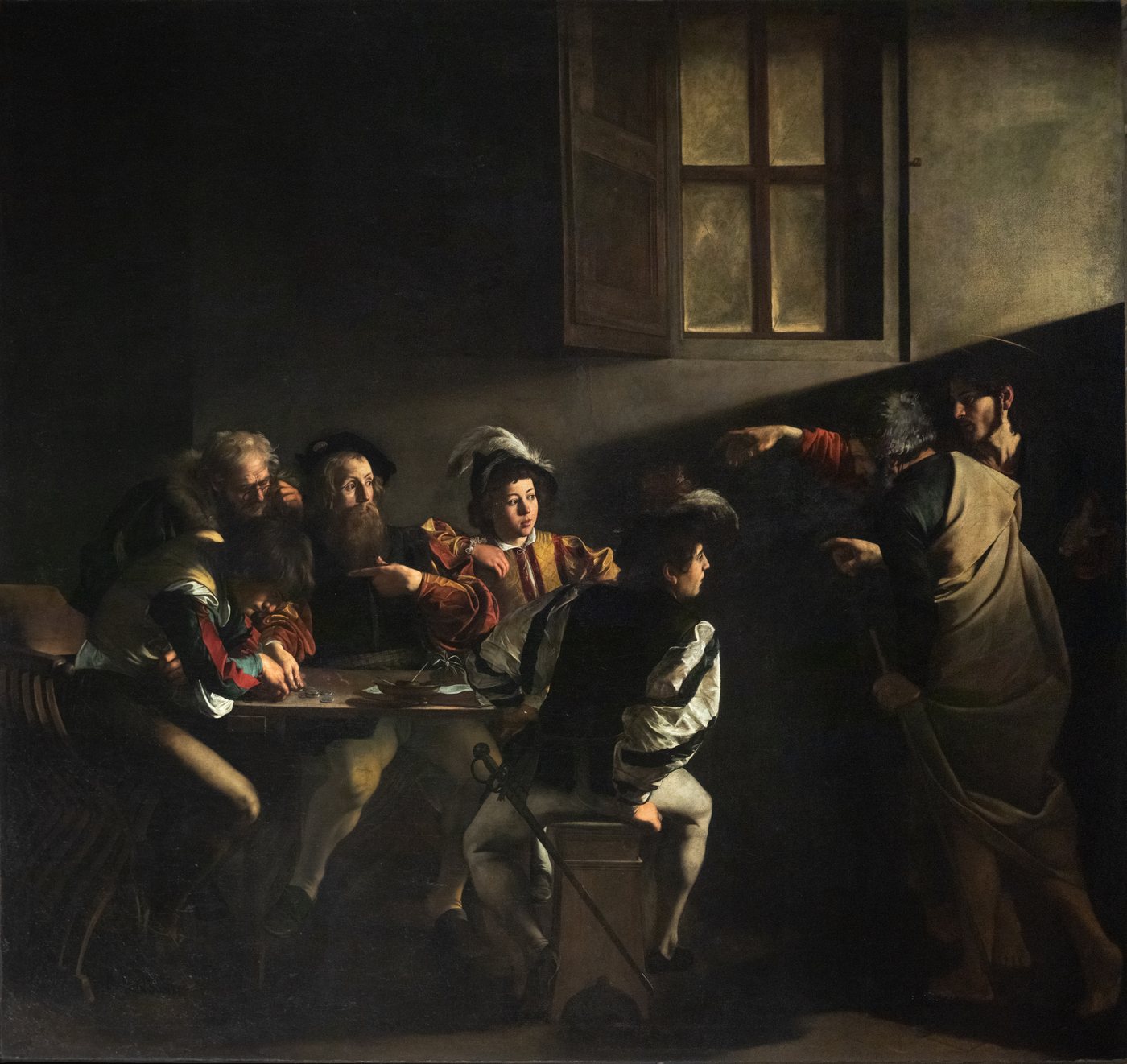
Look at The Calling of Saint Matthew or the Martyrdom of Saint Matthew to see figures and gestures observed with force. The paintings also show composed narrative choices: where light falls, which action is visible, how the figures are grouped. One short statement from litigation should not replace close looking or material study of the works.
The later biographer Giovanni Pietro Bellori is often invoked for claims about Caravaggio and nature. His writing is historically important, but it is a later account, with its own rhetorical aims. If Bellori reports a remark without an independent contemporary record, a caption should say “Bellori reported that Caravaggio said…” rather than present the words as court-attested direct speech. The distinction is about provenance, not whether the anecdote is interesting.[3]
The Painters He Named in Court
The State Archive's transcription shows Caravaggio doing more than stating an abstract rule. He names Cavalier d'Arpino, Federico Zuccaro, Cristoforo Roncalli (Pomarancio) and Annibale Carracci among painters he considered capable, then adds Antonio Tempesta as a name he had forgotten. That list complicates the easy story that he rejected every established painter. It records judgments voiced in a particular legal exchange; it does not prove that he admired every work those artists made.[5]
He also said that knowledgeable painters would recognise the good and bad painters as he did, whereas ignorant painters would favour their own kind. The sharp boundary is part of his defence in a quarrel involving Baglione. A short excerpt about imitating nature loses some of its force if the surrounding assertions of expertise and rivalry are hidden. The names and the pointed claim belong together when the deposition is used to describe his artistic views.[5]
A Collector's Report About Flowers
Vincenzo Giustiniani's Discorso sopra la pittura gives a different, valuable report. While discussing the skill needed to paint flowers and small objects, the collector says Caravaggio held that making a good flower painting took as much work as painting figures. Giustiniani knew and collected the painter's work, but he wrote this account after Caravaggio's death. It is attributed speech in a collector's argument, without a surviving occasion, date or verbatim transcript of Caravaggio saying it.[6][7]
The context matters. Giustiniani describes the difficulty of arranging small forms, controlling colour and varying light; he then places Caravaggio with the Carracci and Guido Reni among artists able to combine work from nature with artistic invention. His flower remark is therefore no licence to claim Caravaggio thought composition or figures unimportant. Nor can one infer from it which surviving still life was on his mind. A careful caption can say “Giustiniani reported that Caravaggio valued the labour of painting flowers as highly as figures.”[6][7]
Keith Christiansen's Metropolitan Museum essay identifies an even earlier but more distant report: Karel van Mander published a statement about Caravaggio following nature, passed to him by the painter Floris van Dijck, who had been in Rome around 1600. This is a chain of transmission, not a transcript of an interview. Christiansen warns that such reputed declarations were polemical and should not be read as proof that Caravaggio always painted only from a posed model. The court record, Giustiniani's report and van Mander's account have different witnesses and dates; they should remain separately labelled.[7]
Did Caravaggio Write the Poems?
The 1603 file contains Caravaggio's own answer to a question about making verse. He said he did not amuse himself by composing in the vernacular or in Latin. Giacomo Berra's study prints the Italian wording and places it within Caravaggio's defence against Baglione's complaint.[8] It is a recorded denial in a lawsuit, not a test of whether the artist was literate or capable of writing a satirical poem. Nor does the existence of the seized poems turn them automatically into signed works by his hand.
The other witnesses did not speak with one voice. On 28 August 1603, Tommaso Salini told the court that Filippo Trisegni had said Caravaggio and Onorio Longhi made the first insulting poem. When Trisegni was questioned on 13 September, he denied having named its authors to Salini. Berra argues that Caravaggio probably composed most of that first text, using Salini's report and its manner of expression; that is a scholar's assessment of conflicting testimony, not an undisputed attribution supplied by the papers themselves.[8] A quotation page can report the accusation and the scholarly argument without printing the poem as a securely authored “Caravaggio quote.” The second poem has its own disputed attribution and should not be bundled with the first as though both had a single proven writer.[5][8]
Other Dated Interrogations in 1604 and 1605
The Baglione hearing is not the only setting in which court papers preserve or report speech linked to Caravaggio. Berra cites a 24 October 1604 interrogation after an arrest involving an accusation of throwing stones and insulting officers. Caravaggio complained that a corporal repeatedly troubled him and denied having used the particular insults put to him.[8] The record supports the fact that he made that defence; it does not prove that his denial was true or establish a general attitude toward authority. Its subject is a street incident, not painting theory.
A separate 25 April 1604 witness account, also discussed by Berra, reports an insult Caravaggio allegedly directed at a tavern server during the dispute over artichokes. In that instance the words come to us through the witness, not through a recorded answer by Caravaggio. The two 1604 cases show why even dated legal material needs a speaker label: “Caravaggio told the magistrate” and “a witness said Caravaggio said” are different claims.[8] They also explain why a list limited to art-related testimony would be much shorter than a list of every colourful utterance associated with his name.
A further example comes from 24 October 1605. Recovering from cuts to his throat and left ear, Caravaggio told an official questioning him at Andrea Ruffetti's house that he had injured himself after falling with his own sword. When pressed, he said he could say no more. Italy's Ministry of Culture publishes the first statement in historical Italian; Francesca Saraceno's account of the interrogations gives the date, setting and follow-up answer.[4][10]
These words document his explanation, not the cause of the wounds. Saraceno considers possible reasons he might have withheld a different account, but the quoted answers do not identify an attacker, prove an accident or resolve what happened in the street. A list of “Caravaggio quotes” that prints only the vivid falling-on-the-sword line can easily turn an unresolved incident into a colourful biographical fact.[4][10]
Direct Testimony, Reported Speech and Fiction
Three formulations signal three levels of evidence. “The 1603 deposition records Caravaggio saying…” points to a dated document. “A later writer attributes this remark to Caravaggio…” reports another person's account. “A character playing Caravaggio says…” belongs to fiction. These are different kinds of quotation.
Even a real legal record does not guarantee that every famous English sentence has a single canonical form. If an article quotes Italian and a museum education pack gives a translation, the wording may differ. Translate the sense consistently, label a translation as such, and link the original or its scholarly publication. When an exact line matters, include the source, date and relevant page or folio if available.[1][2][3]
The archival documents published by the Italian Ministry include speech by other people about Caravaggio as well as statements by Caravaggio himself. A barber's observation about his clothes is not a Caravaggio quote. A clerk's narrative summary is not necessarily direct speech. Attribution begins with identifying the grammatical speaker in the document.[4]
The 1603 case file also preserves two obscene poems aimed at Baglione. Their presence among seized papers proves that the verses were part of the dispute; it does not by itself establish Caravaggio as their author or turn the poems into his spoken testimony. The State Archive distinguishes the poems from the interrogations. The conflicting witness accounts and Berra's argued attribution need to be stated if a line from the first poem is discussed.[5][8]
Common Quotation Traps
The familiar story in which Caravaggio supposedly answered a question about the horse dominating his Conversion on the Way to Damascus is often printed as a neat dialogue. The sources checked here do not establish a primary record of that exchange, so it cannot be counted among verified quotations.
Another trap is turning a commentator's summary into the painter's own voice. “He painted from life” or “he brought the sacred into the street” may be fair critical descriptions in a particular argument. They are not quotations merely because quotation marks make a social post more striking.
Translation can create a third trap. The term goffa has a range of English equivalents; “clumsy” is reasonable in the Baglione exchange, but a dramatic insult invented by a modern retelling is not. The phrase about “natural things” likewise should not be silently expanded into a polished manifesto. Source text, date and context belong beside any reproduced line.[2]
A Method for Checking a Quote
First, locate a document or a named early author rather than a repetition site. Record the date and whether Caravaggio is the direct speaker. Second, compare the exact passage with a reputable transcription or translation; note omitted words and the question that prompted the answer. Third, identify whether the passage describes a particular rival painting or offers a general claim. Finally, cite the source with enough detail that a reader can check it.[1][2]
The method produces a shorter quote list, but each line teaches more. It also prevents a site from giving the artist a sentence he never said. The biography can use documentary speech to illuminate a moment in his Roman life; the drawings and technique pages can use it as one piece of evidence for artistic practice, with the material record alongside it.
Explore the Caravaggio collection
| Name | Date | Type |
|---|---|---|
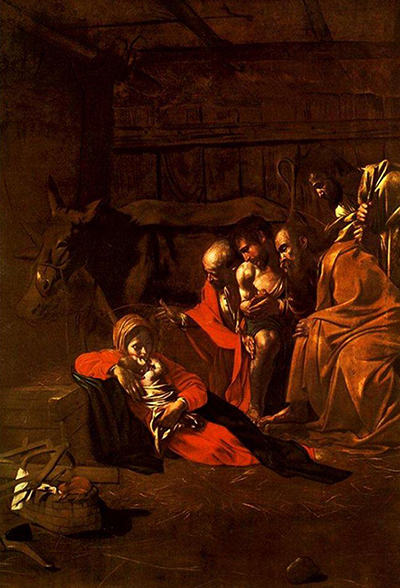
| Adoration of the Shepherds by Caravaggio: The Messina Nativity | 1608–09; precise order relative to Resurrection of Lazarus remains unresolved | Artwork |
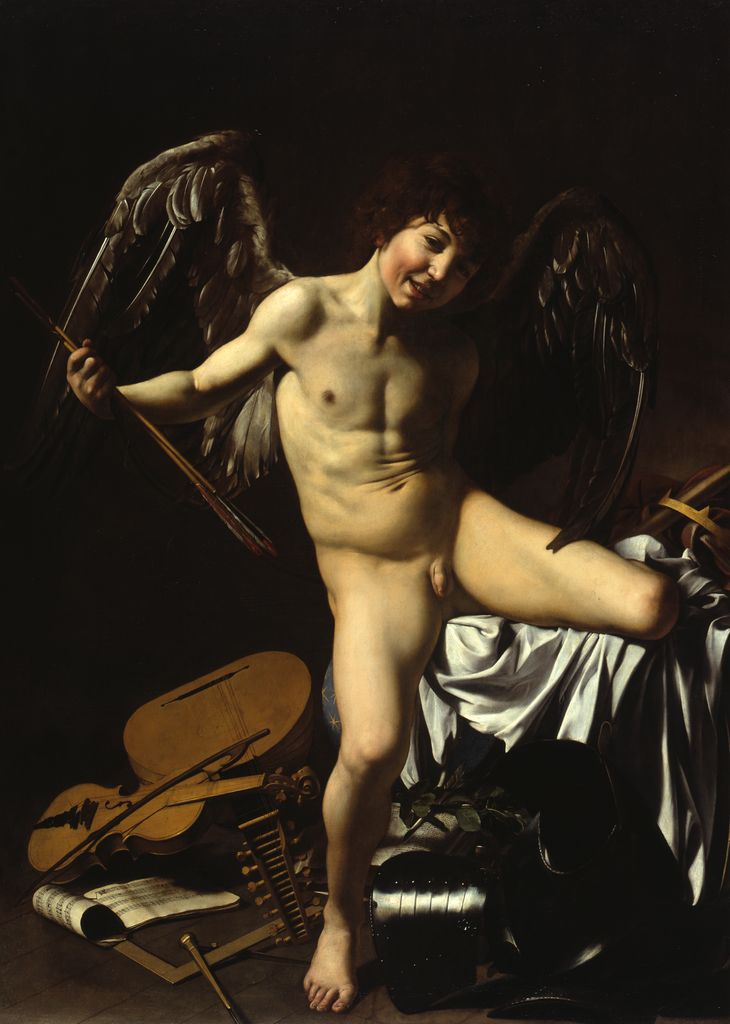
| Amor Victorious by Caravaggio | 1601–02 in the Berlin owner record | Artwork |
| Bacchus by Caravaggio: The Uffizi Painting | about 1598, according to the Uffizi | Artwork |
| Basket of Fruit by Caravaggio | after 1597, probably around the turn of the seventeenth century, according to the Ambrosiana | Artwork |
| Boy Bitten by a Lizard: Caravaggio's London Painting | about 1594–95 in the National Gallery's current catalogue; URL suffix “1596” is inherited | Artwork |
| Boy Bitten by a Lizard: The Florence Version Attributed to Caravaggio | disputed; Longhi's catalogue record preserves historical 1592–93 and other proposed ranges, including c.1597 | Artwork |
| Boy Peeling Fruit by Caravaggio: The Royal Collection Painting | about 1592–93 in the owner's current exhibition record | Artwork |
| Boy Peeling Fruit in Florence: A Derivation from Caravaggio | — | Artwork |
| Boy with a Basket of Fruit by Caravaggio | about 1595 in the Galleria Borghese catalogue | Artwork |
| Caravaggio Paintings in Rome: Churches, Museums and a Practical Route | — | Guide |
| Caravaggio Quotes: What the Documents Actually Record | — | Guide |
| Caravaggio's Lute Player: The Del Monte Painting Once Shown at the Met | about 1596–97 in the Met catalogue | Artwork |
| Caravaggio's Painting Technique: Grounds, Incisions, Revisions and Light | — | Guide |
| Christ at the Column by Caravaggio: The Rouen Flagellation | c.1606 in the owner caption; owner prose gives 1606–07 | Artwork |
| Christ on the Mount of Olives by Caravaggio: The Lost Berlin Painting | — | Artwork |
| Conversion on the Way to Damascus by Caravaggio | about 1601 in the Roma Capitale church record | Artwork |
| Crowning with Thorns by Caravaggio: The Vienna Painting | about 1603 in the 2019 KHM record; “1607” is an inherited URL suffix | Artwork |
| Crowning with Thorns in Prato: Attributed to Caravaggio | about 1602–03 in the collection presentation | Artwork |
| David with the Head of Goliath by Caravaggio: The Borghese Painting | 1606–07 or 1609–10 in the Galleria Borghese catalogue; the later Naples period is favoured by many scholars, while the owner keeps the question open | Artwork |
| David with the Head of Goliath by Caravaggio: The Prado Painting | about 1600 in Prado material; “1599” survives only in the legacy URL | Artwork |
| David with the Head of Goliath by Caravaggio: The Vienna Painting | about 1600–01 in the KHM's 2019 exhibition record; “1607” is a legacy route label | Artwork |
| Did Caravaggio Make Drawings? What Survives and What Paintings Reveal | — | Guide |
| Ecce Homo: Caravaggio's Madrid Rediscovery and the Genoa Painting | — | Artwork |
| John the Baptist in Caravaggio's Paintings: A Guide to the Different Versions | — | Artwork |
| Judith Beheading Holofernes by Caravaggio | beginning of the seventeenth century in the owning museum's account; about 1599–1600 in the Kimbell's 2025 loan label; around 1602 in one specialist catalogue | Artwork |
| Jupiter, Neptune and Pluto: Caravaggio's Ludovisi Ceiling | about 1597; the archive connects the work with Cardinal del Monte's 1597 commission | Artwork |
| Madonna and Child with Saint Anne by Caravaggio: The Palafrenieri Altarpiece | 1605 in the Galleria Borghese object field; completed and delivered by 8 April 1606 | Artwork |
| Madonna of Loreto by Caravaggio: The Pilgrims at Sant'Agostino | broadly c.1604–06; institutional records differ slightly in their starting year | Artwork |
| Madonna of the Rosary by Caravaggio: The Vienna Altarpiece | around 1603 in the Kunsthistorisches Museum's object record | Artwork |
| Martha and Mary Magdalene by Caravaggio: The Detroit Painting | about 1598 in the Detroit Institute of Arts record | Artwork |
| Medusa by Caravaggio: The Uffizi Painted Shield | 1596–98 in the Uffizi's virtual exhibition; specialist research reports the shield delivered to the Medici wardrobe by 7 September 1598 | Artwork |
| Narcissus, Attributed to Caravaggio | dependent on attribution; the Zeri catalogue gives a broad 1610–50 range under Spadarino | Artwork |
| Nativity with Saint Francis and Saint Lawrence: Caravaggio's Missing Painting | somewhere in 1600–09 in the parliamentary report; a specific 1609 execution and place remain debated | Artwork |
| Penitent Mary Magdalene by Caravaggio | 1597 in the owner's catalogue, during Caravaggio's early Roman activity | Artwork |
| Portrait of a Courtesan: Caravaggio's Lost Berlin Portrait | Berlin's data field says c.1590, while its own text compares a Caravaggio work of c.1598; precise date unresolved | Artwork |
| Portrait of Alof de Wignacourt and His Page by Caravaggio | — | Artwork |
| Portrait of Fra Antonio Martelli? Caravaggio's Pitti Knight of Malta | 1608 in the Restituzioni object heading; within Caravaggio's Malta period | Artwork |
| Portrait of Maffeo Barberini: The Seated Corsini Painting | c.1596–97 in the national catalogue | Artwork |
| Portrait of Monsignor Maffeo Barberini: Caravaggio's Newly Acquired Painting | around the late 1590s / age thirty; “1598” in the inherited address is approximate, not an exact document date | Artwork |
| Portrait of Pope Paul V: A Caravaggio Attribution and a Borghese Copy | — | Artwork |
| Prints After Caravaggio: Who Made Them and What They Show | — | Guide |
| Reclining Saint John the Baptist: A Disputed Caravaggio Attribution | often proposed for the artist's final years; the later museum list does not give a precise year. | Artwork |
| Rest on the Flight into Egypt by Caravaggio | about 1597 in the owner's catalogue | Artwork |
| Saint Catherine of Alexandria by Caravaggio: The Thyssen Painting | about 1598–99 in the Museo Nacional Thyssen-Bornemisza catalogue | Artwork |
| Saint Francis in Meditation by Caravaggio: The Cremona Painting | 1603–06 in the owner account; c.1605–06 in a KHM exhibition caption | Artwork |
| Saint Francis in Prayer: Caravaggio's Carpineto Painting | 1606 in a 2016–17 exhibition work list | Artwork |
| Saint Francis of Assisi in Ecstasy by Caravaggio | c.1595–96 in the owner wall text | Artwork |
| Saint Jerome in Meditation: Caravaggio's Montserrat Painting | 1605 in the owner record; an owner publication reports scholarship placing it about 1605–06 | Artwork |
| Saint Jerome Writing by Caravaggio: The Borghese Painting | c.1606 in the owner catalogue; the “1605” URL suffix is inherited | Artwork |
| Saint Jerome Writing by Caravaggio: The Malta Painting | around 1607–08; foundation dates Malaspina's commission to 1608 | Artwork |
| Saint John in the Wilderness at Toledo Cathedral | exact 1598 not established by the cited cathedral account. | Artwork |
| Saint John the Baptist at Galleria Corsini, Rome | about 1606 in the national record; older proposals ranged from the late 1590s onward. | Artwork |
| Saint John the Baptist at the Capitoline Museums, Rome | 1602. | Artwork |
| Saint John the Baptist at the Galleria Borghese | 1609–10 in the current Borghese record. | Artwork |
| Saint John the Baptist at the Spring: The Bonello Painting in Malta | early seventeenth century in the institutional account; a precise 1608 is not established there. | Artwork |
| Saint Matthew and the Angel: Caravaggio's Lost First Altarpiece | — | Artwork |
| Salome Receives the Head of John the Baptist: Caravaggio's London Painting | about 1609–10, likely late Naples period in the Gallery's account | Artwork |
| Salome with the Head of John the Baptist: Caravaggio's Madrid Painting | — | Artwork |
| Sleeping Cupid by Caravaggio: The Painting Made in Malta | about 1608, Malta period | Artwork |
| Still Life with Fruit on a Stone Ledge: Is It by Caravaggio? | — | Artwork |
| Supper at Emmaus (1606): Caravaggio's Brera Painting | — | Artwork |
| The Annunciation by Caravaggio in Nancy | c.1607–10 in the collection record; 1608–10 in the museum's restoration account | Artwork |
| The Basel Saint John the Baptist: Once Labelled Caravaggio, Now Maíno | about 1608–10 in that schedule, rather than the legacy URL's 1600. | Artwork |
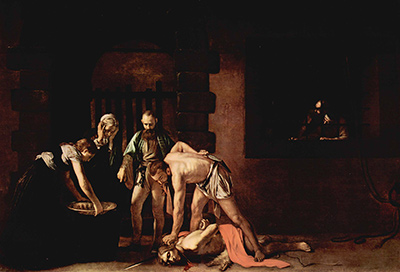
| The Beheading of Saint John the Baptist by Caravaggio | about 1608; installed in the Oratory on 29 August 1608 | Artwork |
| The Burial of Saint Lucy by Caravaggio in Syracuse | 1608, during Caravaggio's Syracuse stay | Artwork |
| The Calling of Saint Matthew by Caravaggio | about 1599–1600 | Artwork |
| The Calling of Saints Peter and Andrew by Caravaggio | about 1602–04 in the Trust's object text | Artwork |
| The Cardsharps by Caravaggio | about 1596–97 in the Kimbell's current object record | Artwork |
| The Conversion of Saint Paul: Caravaggio's Odescalchi Panel | commissioned in 1600; painted around 1600–01 | Artwork |
| The Crucifixion of Saint Andrew by Caravaggio | 1606–07 | Artwork |
| The Crucifixion of Saint Peter by Caravaggio | about 1601 | Artwork |
| The Death of the Virgin by Caravaggio | commissioned 1601; completed late 1605 or early 1606, according to the Louvre | Artwork |
| The Denial of Saint Peter by Caravaggio | 1610 | Artwork |
| The Doria Pamphilj Saint John the Baptist: A Second Youth with a Ram | linked compositionally to the Capitoline 1602 picture; an exact production year for this canvas is not established by the owner pages used here. | Artwork |
| The Entombment of Christ by Caravaggio: The Vatican Deposition | about 1600–04 in Vatican Museums publication material | Artwork |
| The Flagellation of Christ by Caravaggio: The Capodimonte Altarpiece | around 1607, in the first Naples period | Artwork |
| The Fortune Teller by Caravaggio: The Louvre Version and Its Roman Counterpart | — | Artwork |
| The Holy Family with the Infant Saint John the Baptist by Caravaggio | early 1600s in the Met catalogue; no more exact owner date asserted here | Artwork |
| The Incredulity of Saint Thomas by Caravaggio | about 1601 in the SPSG presentation | Artwork |
| The Inspiration of Saint Matthew by Caravaggio | usually 1602; also catalogued 1602–03, for the installed final altarpiece | Artwork |
| The Lute Player by Caravaggio: The Hermitage Painting | about 1596 in the Hermitage collection publication; the Hermitage Friends restoration page gives about 1595–96 | Artwork |
| The Magdalen in Ecstasy: Caravaggio, Copies and a Disputed Original | — | Artwork |
| The Martyrdom of Saint Matthew by Caravaggio | 1599–1600; unveiled with The Calling in 1600 | Artwork |
| The Martyrdom of Saint Ursula by Caravaggio | — | Artwork |
| The Musicians by Caravaggio | 1597 | Artwork |
| The Resurrection of Lazarus by Caravaggio in Messina | 1609; delivered 10 June 1609 in the owner account | Artwork |
| The Sacrifice of Isaac by Bartolomeo Cavarozzi: A Former Caravaggio Attribution | about 1615–17 in the Nicholas Hall catalogue; “1598” is an inherited URL label, not the accepted date | Artwork |
| The Sacrifice of Isaac by Caravaggio: The Uffizi Painting | about 1603 in the Uffizi catalogue | Artwork |
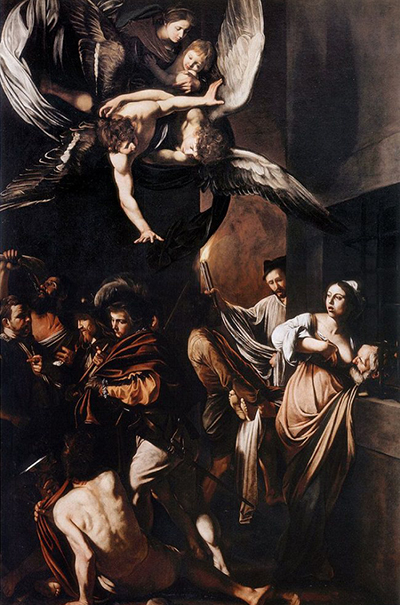
| The Seven Works of Mercy by Caravaggio | 1606–07, according to the Pio Monte | Artwork |
| The Supper at Emmaus by Caravaggio: The London Painting | 1601 | Artwork |
| The Taking of Christ by Caravaggio | 1602 | Artwork |
| The Toulouse *Judith Beheading Holofernes*: A Caravaggio Attribution Debate | c.1606–07 if identified with the recorded Naples work; that identification is debated | Artwork |
| Young Sick Bacchus by Caravaggio | about 1595 in the Galleria Borghese catalogue | Artwork |
| Youth with a Ram: Why Caravaggio's Saint John Looks So Unusual | — | Artwork |
No matching pages found.
Discussion
Share a close observation about Caravaggio Quotes or a source that clarifies its history.
Which detail changes your reading?
Is there a collection record or document worth comparing?
What remains uncertain?
Join the Conversation
Frequently Asked Questions
Did Caravaggio say that a good painter imitates nature?
Are all Caravaggio quotes from the Baglione trial?
No. A 1598 answer about Cardinal del Monte and a 1605 answer about his injuries are also recorded. Other records report words through witnesses. The 1603 testimony remains the clearest cited source for his art-related comments here, and each additional saying needs its own provenance.[1][4][8][9][10]
Did Caravaggio leave an artist's manifesto?
No such text is established by the documents cited here. The short legal statements should not be assembled into a manifesto or used as a substitute for studying his paintings.
Did he explain why the horse is so large in The Conversion of Saint Paul?
The tidy dialogue often attributed to him has no primary record established in the sources checked for this page. It should be treated as unverified, not quoted as his words.
References
- National Museum of Western Art, Tokyo, Caravaggio exhibition checklist, 2016, listing the 13 September 1603 Baglione trial transcript as an archival exhibit.
- Lydia Salviucci Insolera, “Un nuovo Caravaggio,” L'Osservatore Romano, 18 July 2010, quotations from the 1603 deposition and contemporary context.
- John Varriano, Caravaggio: The Art of Realism, Pennsylvania State University Press, discussion of the Baglione testimony and reports by later writers.
- Italian Ministry of Culture, “Dagli archivi nuovi documenti sulla vita di Caravaggio a Roma”, report on Roman archival documents.
- Archivio di Stato di Roma, “Il processo del 1603 — Caravaggio una vita dal vero”, case description and transcribed testimony.
- Vincenzo Giustiniani, Discorso sopra la pittura, later report of Caravaggio's flower-painting remark.
- Keith Christiansen, “Painting from Life,” in Valentin de Boulogne: Beyond Caravaggio, Metropolitan Museum of Art, 2016.
- Giacomo Berra, “La formazione culturale del Caravaggio: ‘io non me deletto de compor versi ne volgari ne latini’”, in Caravaggio e i letterati, ed. Sybille Ebert-Schifferer and Laura Teza, Ediart, 2020, pp. 20–44, especially the 1603 denials and disputed poems and the 1604 recorded incidents.
- Art Gallery of New South Wales and National Gallery of Victoria, Darkness & Light: Caravaggio & His World, education kit, “Caravaggio: For the Record,” p. 37 (2003), English excerpts attributed to the 1598 and 1603 records and Gentileschi's 1603 testimony, after Puglisi 1998.
- Francesca Saraceno, “Caravaggio ‘colpevole’. Fino a prova contraria,” About Art Online, discussion and transcription of the 24 October 1605 questioning.