 by Tom Gurney
Tom Gurney BSc (Hons) is an art history expert with over 20 years experience
Page Created on / Page Updated on
Email: tomgurney1@gmail.com / Phone: +44 7429 011000
Still Life with Fruit on a Stone Ledge: Is It by Caravaggio?
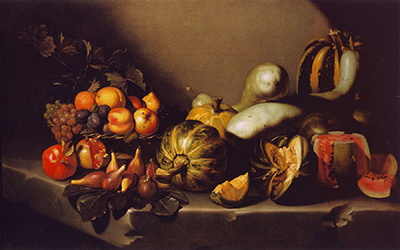
A basket of fruit, figs, striped melons, long pale gourds and cut watermelon stretch across a worn stone shelf. The large painting often called Still Life with Fruit on a Stone Ledge has a powerful Caravaggesque appearance. Yet its authorship is disputed. When it was offered by Sotheby's in 2013, the catalogue heading read “Roman School, circa 1605–1610”, not “Caravaggio.” Its earlier 1992 auction description called it Follower of Caravaggio. Scholars have argued for Caravaggio's hand, but those arguments have not produced a settled attribution.[1]
This is therefore an attribution story as well as a close look at an exceptional early Roman still life. The work should not be added to an undisputed list of Caravaggio paintings, and it should not be confused with his securely catalogued Basket of Fruit in Milan's Biblioteca Ambrosiana. The old local image shows the wide stone-ledge composition, but its file source and commercial reuse terms remain unverified.[1][2]
Caravaggio in context
The Cardsharps
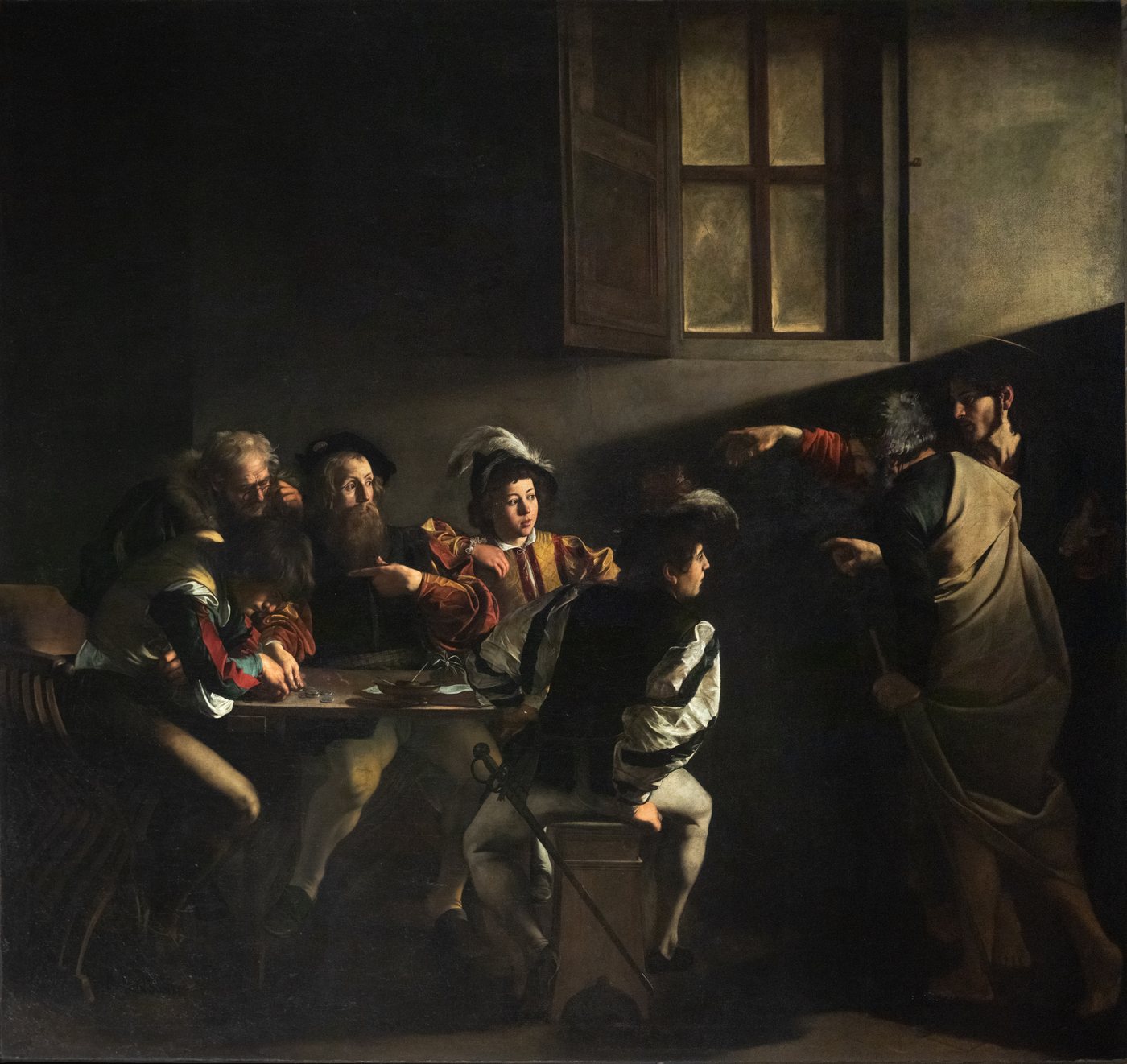
c.1595Calling of Saint Matthew
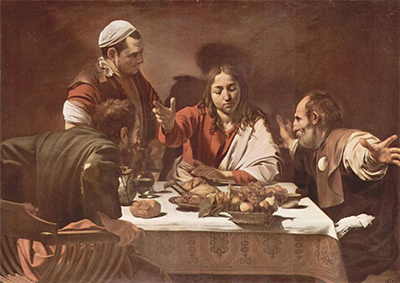
1599–1600Supper at Emmaus
1601At a Glance
- TitleStill Life with Fruit on a Stone Ledge.[1]
- Auction attribution in 2013Roman School, circa 1605–1610; oil on canvas, then in a private collection.[1]
- Caravaggio statusproposed by some scholars, questioned by others; the 2013 catalogue explicitly discusses the debate.[1]
- Documentary linka Barberini inventory may describe a related still life, but its match with this canvas is possible, not proven.[1]
- Separate secure workCaravaggio's Basket of Fruit in the Biblioteca Ambrosiana is a different, smaller composition.[2]
Contents
- What Can We See on the Stone Ledge?
- Why Was Caravaggio Proposed?
- What Keeps the Attribution Open?
- The Possible Barberini Connection
- A Rediscovery Through the Market
- How It Compares With Basket of Fruit
- Frequently Asked Questions
What Can We See on the Stone Ledge?
The eye travels from a dense gathering of apples, pears, grapes and figs at the left towards melons and long gourds at the right. Several watermelons have been opened to show red flesh and dark seeds. The shelf is a hard horizontal plane, and the fruit does not sit in a tidy emblematic bowl. Objects crowd one another, overlap the edge and cast shadows. Sotheby's catalogue describes the ensemble as deliberately arranged across the ledge, with illumination entering from the upper left.[1]
That arrangement gives the picture momentum. The rounded fruits create a mass on the left, while the elongated gourds pull the gaze sideways. Cut and uncut fruit offer different textures: intact skin, bruised surfaces, soft flesh and seeds. The old photograph makes these broad relationships legible, although it is not detailed enough for a confident analysis of individual paint handling. An eventual cleared high-resolution file would allow more precise visual annotation.[1]
Still life was developing rapidly in Italy around 1600. Fruit could be a subject in its own right rather than only an accessory in a narrative scene. The dramatic light and convincing surfaces of this painting help explain why it has been repeatedly connected to Caravaggio. But style is a clue, not a signature; other Roman painters were looking at similar effects.[1]
Why Was Caravaggio Proposed?
Caravaggio was renowned for closely observed objects. Fruit appears in paintings securely accepted as his, including the London Supper at Emmaus and the separate Basket of Fruit. The stone-ledge picture also uses a strong light against deep shade and makes imperfect fruit visually important. Those affinities prompted scholars to ask whether he painted it.[1][2][3]
The 2013 Sotheby's catalogue gives that case substantial space while retaining the broader Roman School heading. It notes scholarly advocates for Caravaggio and records other writers who doubted the attribution. This is a useful example of how an auction essay can describe a serious hypothesis without promoting it to an established catalogue label. The heading and the discussion have to be read together.[1]
One argument draws on seventeenth-century references to a Caravaggio still life in the Barberini collection. If the historical description could be firmly connected to the surviving stone-ledge painting, it would strengthen the claim. But there is a gap between “Caravaggio made a still life for this patron” and “this is that canvas.” Sotheby's itself treats the provenance and identification as possible.[1]
The unusual composition also deserves attention without settling the painter. Sotheby's relates the design to earlier fruit imagery, including a Venetian printed woodcut, and to late sixteenth-century still-life practice. Such comparisons show the visual ideas available to a Roman artist of the period; they are not a chain of ownership or a maker's signature.[1]
What Keeps the Attribution Open?
The clearest current caution is the market record. Sotheby's named the painter Roman School in 2013. The catalogue says the painting was rediscovered at a Madrid sale in 1992, where it was listed as Follower of Caravaggio. Its subsequent discussion has been lively, but that history does not create consensus. A large price estimate likewise measures market interest under stated conditions; it does not prove an author.[1]
The visual case can be read both ways. Strong light, battered fruit and a direct encounter with objects recall Caravaggio. Yet those features spread among painters working in or responding to Rome. Attributing a painting requires weighing technique, materials, documentary history, comparison with secure works and possible changes beneath the visible surface. The sources consulted here do not provide a settled technical packet sufficient to resolve those issues.[1]
There is also a risk in treating the painting's fame as evidence. The composition has been reproduced widely with the artist's name attached, so each online repetition can make the attribution feel firmer. The 2013 catalogue's exact wording is a better anchor: “Roman School, circa 1605–1610”, with a discussed Caravaggio hypothesis.[1]
The Possible Barberini Connection
Sotheby's provenance opens with “Possibly Cardinal Antonio Barberini” by 1671, followed by a possible transfer to Cardinal Francesco Barberini. The word possibly matters. The catalogue explores whether an inventory reference to a still life by Caravaggio could fit the present painting, and notes uncertainties including the correspondence of historical measurements.[1]
It further considers whether the picture might relate to works acquired from Caravaggio by Maffeo Barberini, later Pope Urban VIII, around 1603–04. It expressly says that the surviving records do not name or describe all those paintings in a way that securely identifies this one. The fact that a major patron commissioned works does not let us assign every later Barberini still life to Caravaggio.[1]
For readers, this is an instructive distinction between a documented patron relationship and a proven provenance for an object. It is honest to explain a possible route into the Barberini family. It would be misleading to turn the first word of the auction provenance into a firm statement that the picture definitely hung in a named palace in 1671.[1]
A Rediscovery Through the Market
The known modern trail runs through a private Madrid collection and the 20 February 1992 Madrid auction, where the painting was presented as a follower's work. It was purchased there by the owner who consigned it to Sotheby's in 2013. In between, the picture was lent to institutions including the Wadsworth Atheneum, Nelson-Atkins Museum of Art, Ringling Museum, and Australian museums. Those exhibitions helped make the painting visible for study.[1]
A museum loan should not be mistaken for ownership or endorsement of an attribution. In this case, the loans show that the picture was of serious interest, while the auction catalogue still chose a broad school designation. The current owner and location after the 2013 sale have not been verified in this project, so they should not be invented in the page's object card.[1]
The painting's market history also shapes what can be seen publicly. Sotheby's photograph documents the auctioned object, but a visible auction image is separate from the painting's attribution or an authorization to reproduce the photograph elsewhere.
How It Compares With Basket of Fruit
The Ambrosiana Basket of Fruit is a compact image organised around one wicker basket on a ledge. The present painting is a much wider display with multiple groups of fruit and large gourds. They are not two titles for the same object.[2]
Comparison is still valuable. Both invite attention to spotted, uneven and vulnerable fruit, and both put ordinary material in a prominent place. But a family resemblance does not establish identical authorship. We can use the Ambrosiana picture as a secure reference point for what Caravaggio did in still life and still say that the stone-ledge canvas remains debated.[1][2]
The Caravaggio painting-technique guide explains why investigators look beyond subject and lighting when testing a proposed attribution. An open question can make a page more useful than a false certainty if it gives the reader a clear map of evidence and limits.
Explore the Caravaggio collection
| Name | Date | Type |
|---|---|---|
| Adoration of the Shepherds by Caravaggio: The Messina Nativity | 1608–09; precise order relative to Resurrection of Lazarus remains unresolved | Artwork |
| Amor Victorious by Caravaggio | 1601–02 in the Berlin owner record | Artwork |
| Bacchus by Caravaggio: The Uffizi Painting | about 1598, according to the Uffizi | Artwork |
| Basket of Fruit by Caravaggio | after 1597, probably around the turn of the seventeenth century, according to the Ambrosiana | Artwork |
| Boy Bitten by a Lizard: Caravaggio's London Painting | about 1594–95 in the National Gallery's current catalogue; URL suffix “1596” is inherited | Artwork |
| Boy Bitten by a Lizard: The Florence Version Attributed to Caravaggio | disputed; Longhi's catalogue record preserves historical 1592–93 and other proposed ranges, including c.1597 | Artwork |
| Boy Peeling Fruit by Caravaggio: The Royal Collection Painting | about 1592–93 in the owner's current exhibition record | Artwork |
| Boy Peeling Fruit in Florence: A Derivation from Caravaggio | — | Artwork |
| Boy with a Basket of Fruit by Caravaggio | about 1595 in the Galleria Borghese catalogue | Artwork |
| Caravaggio Paintings in Rome: Churches, Museums and a Practical Route | — | Guide |
| Caravaggio Quotes: What the Documents Actually Record | — | Guide |
| Caravaggio's Lute Player: The Del Monte Painting Once Shown at the Met | about 1596–97 in the Met catalogue | Artwork |
| Caravaggio's Painting Technique: Grounds, Incisions, Revisions and Light | — | Guide |
| Christ at the Column by Caravaggio: The Rouen Flagellation | c.1606 in the owner caption; owner prose gives 1606–07 | Artwork |
| Christ on the Mount of Olives by Caravaggio: The Lost Berlin Painting | — | Artwork |
| Conversion on the Way to Damascus by Caravaggio | about 1601 in the Roma Capitale church record | Artwork |
| Crowning with Thorns by Caravaggio: The Vienna Painting | about 1603 in the 2019 KHM record; “1607” is an inherited URL suffix | Artwork |
| Crowning with Thorns in Prato: Attributed to Caravaggio | about 1602–03 in the collection presentation | Artwork |
| David with the Head of Goliath by Caravaggio: The Borghese Painting | 1606–07 or 1609–10 in the Galleria Borghese catalogue; the later Naples period is favoured by many scholars, while the owner keeps the question open | Artwork |
| David with the Head of Goliath by Caravaggio: The Prado Painting | about 1600 in Prado material; “1599” survives only in the legacy URL | Artwork |
| David with the Head of Goliath by Caravaggio: The Vienna Painting | about 1600–01 in the KHM's 2019 exhibition record; “1607” is a legacy route label | Artwork |
| Did Caravaggio Make Drawings? What Survives and What Paintings Reveal | — | Guide |
| Ecce Homo: Caravaggio's Madrid Rediscovery and the Genoa Painting | — | Artwork |
| John the Baptist in Caravaggio's Paintings: A Guide to the Different Versions | — | Artwork |
| Judith Beheading Holofernes by Caravaggio | beginning of the seventeenth century in the owning museum's account; about 1599–1600 in the Kimbell's 2025 loan label; around 1602 in one specialist catalogue | Artwork |
| Jupiter, Neptune and Pluto: Caravaggio's Ludovisi Ceiling | about 1597; the archive connects the work with Cardinal del Monte's 1597 commission | Artwork |
| Madonna and Child with Saint Anne by Caravaggio: The Palafrenieri Altarpiece | 1605 in the Galleria Borghese object field; completed and delivered by 8 April 1606 | Artwork |
| Madonna of Loreto by Caravaggio: The Pilgrims at Sant'Agostino | broadly c.1604–06; institutional records differ slightly in their starting year | Artwork |
| Madonna of the Rosary by Caravaggio: The Vienna Altarpiece | around 1603 in the Kunsthistorisches Museum's object record | Artwork |
| Martha and Mary Magdalene by Caravaggio: The Detroit Painting | about 1598 in the Detroit Institute of Arts record | Artwork |
| Medusa by Caravaggio: The Uffizi Painted Shield | 1596–98 in the Uffizi's virtual exhibition; specialist research reports the shield delivered to the Medici wardrobe by 7 September 1598 | Artwork |
| Narcissus, Attributed to Caravaggio | dependent on attribution; the Zeri catalogue gives a broad 1610–50 range under Spadarino | Artwork |
| Nativity with Saint Francis and Saint Lawrence: Caravaggio's Missing Painting | somewhere in 1600–09 in the parliamentary report; a specific 1609 execution and place remain debated | Artwork |
| Penitent Mary Magdalene by Caravaggio | 1597 in the owner's catalogue, during Caravaggio's early Roman activity | Artwork |
| Portrait of a Courtesan: Caravaggio's Lost Berlin Portrait | Berlin's data field says c.1590, while its own text compares a Caravaggio work of c.1598; precise date unresolved | Artwork |
| Portrait of Alof de Wignacourt and His Page by Caravaggio | — | Artwork |
| Portrait of Fra Antonio Martelli? Caravaggio's Pitti Knight of Malta | 1608 in the Restituzioni object heading; within Caravaggio's Malta period | Artwork |
| Portrait of Maffeo Barberini: The Seated Corsini Painting | c.1596–97 in the national catalogue | Artwork |
| Portrait of Monsignor Maffeo Barberini: Caravaggio's Newly Acquired Painting | around the late 1590s / age thirty; “1598” in the inherited address is approximate, not an exact document date | Artwork |
| Portrait of Pope Paul V: A Caravaggio Attribution and a Borghese Copy | — | Artwork |
| Prints After Caravaggio: Who Made Them and What They Show | — | Guide |
| Reclining Saint John the Baptist: A Disputed Caravaggio Attribution | often proposed for the artist's final years; the later museum list does not give a precise year. | Artwork |
| Rest on the Flight into Egypt by Caravaggio | about 1597 in the owner's catalogue | Artwork |
| Saint Catherine of Alexandria by Caravaggio: The Thyssen Painting | about 1598–99 in the Museo Nacional Thyssen-Bornemisza catalogue | Artwork |
| Saint Francis in Meditation by Caravaggio: The Cremona Painting | 1603–06 in the owner account; c.1605–06 in a KHM exhibition caption | Artwork |
| Saint Francis in Prayer: Caravaggio's Carpineto Painting | 1606 in a 2016–17 exhibition work list | Artwork |
| Saint Francis of Assisi in Ecstasy by Caravaggio | c.1595–96 in the owner wall text | Artwork |
| Saint Jerome in Meditation: Caravaggio's Montserrat Painting | 1605 in the owner record; an owner publication reports scholarship placing it about 1605–06 | Artwork |
| Saint Jerome Writing by Caravaggio: The Borghese Painting | c.1606 in the owner catalogue; the “1605” URL suffix is inherited | Artwork |
| Saint Jerome Writing by Caravaggio: The Malta Painting | around 1607–08; foundation dates Malaspina's commission to 1608 | Artwork |
| Saint John in the Wilderness at Toledo Cathedral | exact 1598 not established by the cited cathedral account. | Artwork |
| Saint John the Baptist at Galleria Corsini, Rome | about 1606 in the national record; older proposals ranged from the late 1590s onward. | Artwork |
| Saint John the Baptist at the Capitoline Museums, Rome | 1602. | Artwork |
| Saint John the Baptist at the Galleria Borghese | 1609–10 in the current Borghese record. | Artwork |
| Saint John the Baptist at the Spring: The Bonello Painting in Malta | early seventeenth century in the institutional account; a precise 1608 is not established there. | Artwork |
| Saint Matthew and the Angel: Caravaggio's Lost First Altarpiece | — | Artwork |
| Salome Receives the Head of John the Baptist: Caravaggio's London Painting | about 1609–10, likely late Naples period in the Gallery's account | Artwork |
| Salome with the Head of John the Baptist: Caravaggio's Madrid Painting | — | Artwork |
| Sleeping Cupid by Caravaggio: The Painting Made in Malta | about 1608, Malta period | Artwork |
| Still Life with Fruit on a Stone Ledge: Is It by Caravaggio? | — | Artwork |
| Supper at Emmaus (1606): Caravaggio's Brera Painting | — | Artwork |
| The Annunciation by Caravaggio in Nancy | c.1607–10 in the collection record; 1608–10 in the museum's restoration account | Artwork |
| The Basel Saint John the Baptist: Once Labelled Caravaggio, Now Maíno | about 1608–10 in that schedule, rather than the legacy URL's 1600. | Artwork |
| The Beheading of Saint John the Baptist by Caravaggio | about 1608; installed in the Oratory on 29 August 1608 | Artwork |
| The Burial of Saint Lucy by Caravaggio in Syracuse | 1608, during Caravaggio's Syracuse stay | Artwork |
| The Calling of Saint Matthew by Caravaggio | about 1599–1600 | Artwork |
| The Calling of Saints Peter and Andrew by Caravaggio | about 1602–04 in the Trust's object text | Artwork |
| The Cardsharps by Caravaggio | about 1596–97 in the Kimbell's current object record | Artwork |
| The Conversion of Saint Paul: Caravaggio's Odescalchi Panel | commissioned in 1600; painted around 1600–01 | Artwork |
| The Crucifixion of Saint Andrew by Caravaggio | 1606–07 | Artwork |
| The Crucifixion of Saint Peter by Caravaggio | about 1601 | Artwork |
| The Death of the Virgin by Caravaggio | commissioned 1601; completed late 1605 or early 1606, according to the Louvre | Artwork |
| The Denial of Saint Peter by Caravaggio | 1610 | Artwork |
| The Doria Pamphilj Saint John the Baptist: A Second Youth with a Ram | linked compositionally to the Capitoline 1602 picture; an exact production year for this canvas is not established by the owner pages used here. | Artwork |
| The Entombment of Christ by Caravaggio: The Vatican Deposition | about 1600–04 in Vatican Museums publication material | Artwork |
| The Flagellation of Christ by Caravaggio: The Capodimonte Altarpiece | around 1607, in the first Naples period | Artwork |
| The Fortune Teller by Caravaggio: The Louvre Version and Its Roman Counterpart | — | Artwork |
| The Holy Family with the Infant Saint John the Baptist by Caravaggio | early 1600s in the Met catalogue; no more exact owner date asserted here | Artwork |
| The Incredulity of Saint Thomas by Caravaggio | about 1601 in the SPSG presentation | Artwork |
| The Inspiration of Saint Matthew by Caravaggio | usually 1602; also catalogued 1602–03, for the installed final altarpiece | Artwork |
| The Lute Player by Caravaggio: The Hermitage Painting | about 1596 in the Hermitage collection publication; the Hermitage Friends restoration page gives about 1595–96 | Artwork |
| The Magdalen in Ecstasy: Caravaggio, Copies and a Disputed Original | — | Artwork |
| The Martyrdom of Saint Matthew by Caravaggio | 1599–1600; unveiled with The Calling in 1600 | Artwork |
| The Martyrdom of Saint Ursula by Caravaggio | — | Artwork |
| The Musicians by Caravaggio | 1597 | Artwork |
| The Resurrection of Lazarus by Caravaggio in Messina | 1609; delivered 10 June 1609 in the owner account | Artwork |
| The Sacrifice of Isaac by Bartolomeo Cavarozzi: A Former Caravaggio Attribution | about 1615–17 in the Nicholas Hall catalogue; “1598” is an inherited URL label, not the accepted date | Artwork |
| The Sacrifice of Isaac by Caravaggio: The Uffizi Painting | about 1603 in the Uffizi catalogue | Artwork |
| The Seven Works of Mercy by Caravaggio | 1606–07, according to the Pio Monte | Artwork |
| The Supper at Emmaus by Caravaggio: The London Painting | 1601 | Artwork |
| The Taking of Christ by Caravaggio | 1602 | Artwork |
| The Toulouse *Judith Beheading Holofernes*: A Caravaggio Attribution Debate | c.1606–07 if identified with the recorded Naples work; that identification is debated | Artwork |
| Young Sick Bacchus by Caravaggio | about 1595 in the Galleria Borghese catalogue | Artwork |
| Youth with a Ram: Why Caravaggio's Saint John Looks So Unusual | — | Artwork |
No matching pages found.
Discussion
Share a close observation about Still Life with Fruit on a Stone Ledge or a source that clarifies its history.
Which detail changes your reading?
Is there a collection record or document worth comparing?
What remains uncertain?
Join the Conversation
Frequently Asked Questions
Is Still Life with Fruit on a Stone Ledge definitely by Caravaggio?
No. Some scholars support the attribution, while Sotheby's catalogued it as Roman School in 2013 and recorded earlier descriptions as Follower of Caravaggio.[1]
Is it the same as Basket of Fruit?
No. Basket of Fruit is the separate Ambrosiana painting in Milan, with a single basket rather than a wide spread of fruit and gourds.[2]
Was it owned by the Barberini family?
That has been proposed, but the 2013 provenance marks the connection possible. The historical inventory has not been securely tied to this particular canvas.[1]
Where can I see it now?
The verified 2013 record describes a privately owned work and earlier museum loans. A current public display or owner has not been confirmed here.[1]
References
- Sotheby's, lot 29, Still Life with Fruit on a Stone Ledge, catalogued Roman School, 2013.
- Biblioteca Ambrosiana, Pinacoteca Ambrosiana collection and Basket of Fruit.
- National Gallery, London, Caravaggio, The Supper at Emmaus, NG172.