 by Tom Gurney
Tom Gurney BSc (Hons) is an art history expert with over 20 years experience
Page Created on / Page Updated on
Email: tomgurney1@gmail.com / Phone: +44 7429 011000
Nativity with Saint Francis and Saint Lawrence: Caravaggio's Missing Painting
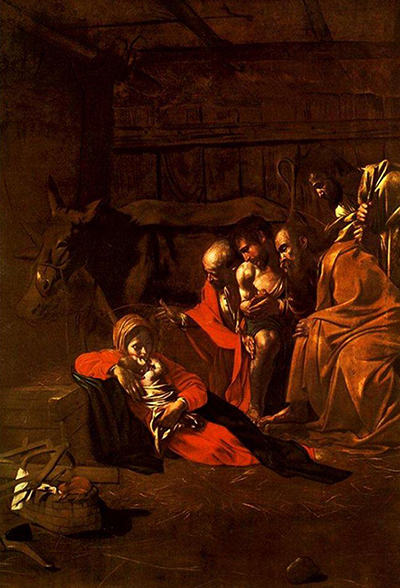
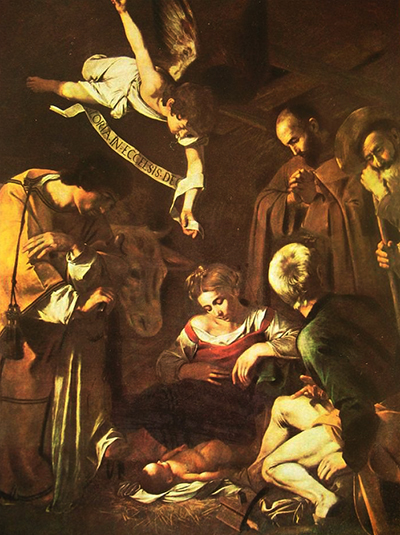
Mary sits beside the newborn Jesus while Joseph, an angel and saints gather in a dark, crowded Nativity. Caravaggio's Nativity with Saint Francis and Saint Lawrence once hung in the Oratory of San Lorenzo in Palermo. Thieves cut it from its frame in October 1969, and the original has not been recovered. A carefully made 2015 facsimile now occupies its former place. The image a visitor sees at the oratory is not Caravaggio's seventeenth-century painted surface.[1][2][3]
The missing original demands unusual precision. An Italian parliamentary investigation describes its date, original patron and some of its iconography as unresolved; it gives a broad 1600–09 range rather than a proven Palermo completion in 1609. The disappearance also prevents new direct technical study. Reports about its fate after the theft include investigative conclusions and unverified stories, neither of which amounts to physical recovery.[2]
Caravaggio in context
The Cardsharps
c.1595Calling of Saint Matthew
1599–1600Supper at Emmaus
1601At a Glance
- ArtistCaravaggio, as identified in the FBI and Italian parliamentary records[1][2]
- TitleNativity with Saint Francis and Saint Lawrence / Natività con i santi Lorenzo e Francesco d'Assisi[1][2]
- Datesomewhere in 1600–09 in the parliamentary report; a specific 1609 execution and place remain debated[2]
- Original destinationOratory of San Lorenzo, Palermo, beside the Basilica of Saint Francis of Assisi[2]
- Owner of the missing originalArchiepiscopal Curia of Palermo, according to the parliamentary report[2]
- Theftoriginal cut from its frame in October 1969; FBI still lists it as stolen[1][2]
- Current object in the oratoryFactum Foundation facsimile, unveiled 12 December 2015 and installed in the original position[3]
- Image recordpre-theft 1968 colour photograph by Enzo Brai informed the reconstruction; no commercial-use right to that photograph or facsimile has been established[3]
Contents
- The Nativity in the Surviving Image
- Francis, Lawrence and the Palermo Setting
- What Is Known About Its Making
- The Theft of 1969
- What Investigators Do and Do Not Know
- The 2015 Facsimile
- How to Caption a Missing Original
- Frequently Asked Questions
The Nativity in the Surviving Image
The painting is known today through photographs made before the theft and through later reconstructions. A child lies low in the picture, with Mary near him; an angel descends above, and men surround the family. The arrangement is more intimate than a distant view of Bethlehem. The saints named in the title place the Nativity within the devotional setting of the Palermo oratory and its neighbouring church.[2][3]
The image should be read with the limits of a reproduction in mind. We cannot stand before the original to examine the exact colour, surface, later alterations or Caravaggio's brushwork. Even a sophisticated facsimile translates evidence from photographs and comparisons into a new physical object.[2][3]
Factum Foundation describes how a 1968 Enzo Brai colour transparency, only a few inches across, became a key source for its full-scale reconstruction. The team combined photographic interpretation with knowledge from other Caravaggio paintings. That work can restore an experience of scale and setting, but not the missing original's material truth.[3]
Francis, Lawrence and the Palermo Setting
The painting was held at the Oratory of San Lorenzo in Palermo's historic centre. The Italian parliamentary report explains the names in the title: Saint Lawrence belongs to the oratory's dedication, while Saint Francis relates to the nearby basilica. Their presence connects the biblical birth scene to the religious setting in which the work was displayed.[2]
The oratory's location is secure history, but it does not by itself prove who ordered the picture or exactly where Caravaggio painted it. The parliamentary investigation explicitly says the occasion and patron remain unknown.[2]
Other Caravaggio Nativity and Adoration pages in the cluster need careful separation. The Messina Adoration of the Shepherds is a surviving painting in the Museo Regionale Accascina, with its own Capuchin high-altar history. It is not the stolen Palermo canvas or its facsimile.[4]
The Palermo composition was a devotional image shaped for a specific room. Current visitors see a reconstruction there: the historical placement survives, but the original object does not.[2][3]
What Is Known About Its Making
Many short accounts date the picture to 1609 and link it to Caravaggio's Sicilian stay. The Italian parliamentary report is more cautious: it gives a broad period between 1600 and 1609 and says scholars do not know precisely where, when, for what occasion or for whose benefit it was made.[2]
Those uncertainties matter because physical inspection of the original is impossible. A reliable chronology can describe the Palermo ownership and 1969 theft with confidence, then label the proposed late-Sicilian date as debated. An exact year should not be inferred solely from the painting's eventual presence in Palermo.[2]
The report also says the iconography has not been fully deciphered. The visible figures and titled saints can be identified, but a complete symbolic programme should not be asserted as settled. The image's loss has narrowed the evidence available to test such readings.[2]
The work is not unknowable. Pre-theft photographs, older records and the oratory setting give substantial evidence. Its physical location before 1969, theft date and owner are firmer than any unrecorded conversation about the commission.[1][2][3]
The Theft of 1969
The FBI's current stolen-art page says two thieves entered the Oratory of San Lorenzo in October 1969 and removed the painting from its frame. The Italian parliamentary inquiry treats the theft as a major crime against cultural heritage and identifies the Archiepiscopal Curia of Palermo as the rightful owner of the missing work.[1][2]
The original has not reappeared in a documented, publicly verifiable way. An online page must not say it is “on display in Palermo” without specifying that the displayed object is a facsimile. The FBI's ongoing public appeal is a clear indication that the original remains a missing artwork.[1][3]
The loss affected more than possession. It prevented later conservators and historians from inspecting the original surface with modern instruments. Factum Foundation's work and archival photographs are valuable responses to that absence, but they cannot supply a direct physical examination of the missing canvas.[2][3]
The theft is often surrounded by dramatic claims. Those stories should not displace the observable facts: a painting was removed in 1969, its whereabouts remain unverified, and a replica was installed decades later. A reader can understand the seriousness of the case without an invented certainty about its final fate.[1][2][3]
What Investigators Do and Do Not Know
The 2018 Italian parliamentary anti-mafia report reviews accounts from people who collaborated with investigators and describes a reconstruction in which the painting passed through criminal hands and may have gone abroad, possibly in pieces. It also discusses claims that it was destroyed or kept for private display, noting that many theories were not backed by evidence. These are findings and testimony from an investigation, not a located canvas.[2]
The report states that an earlier claim of destruction was withdrawn by a witness. It expresses confidence in parts of the theft and transfer reconstruction while withholding further details for prosecutors. These conclusions are the parliamentary report’s assessment, not a map of confirmed current locations.[2]
The FBI still invites information about the stolen work. That current status is more useful to a reader than retelling every rumour. It also avoids giving a false impression that a theory of fragmentation equals recovered pieces or an authenticated sale.[1][2]
Until a competent institution verifies a recovery, the original remains missing. The replica's presence in the oratory does not change that status.[1][3]
The 2015 Facsimile
Factum Foundation documents a 2015 facsimile project that used pre-theft imagery and detailed reconstruction to recreate the Nativity at full scale. It was installed in the original oratory frame and unveiled on 12 December 2015. The foundation explicitly presents it as a reconstruction, not an original painting returned from theft.[3]
The project helps visitors grasp how the large image once occupied the altar space. A small web photograph cannot provide that spatial relation. This is a genuine interpretive benefit, even though the copy cannot preserve every pigment, brushstroke or age mark of the original.[3]
The foundation describes how photographic colour information had to be interpreted alongside tonal and surface evidence from other works. Such processes involve decisions. An article can explain that care and craft without treating the facsimile's modern material as direct evidence of Caravaggio's hand.[3]
A visual feature could show a documented pre-theft image beside a clearly labelled 2015 installation photograph, if both files' separate rights permit it. A side-by-side view would help readers distinguish original image evidence from the new object, but only if captions remain unambiguous.
How to Caption a Missing Original
For a pre-theft photograph, alt text can describe Mary, child, angel and the surrounding saints, while the caption states that the original is stolen and credits the photographer and archive if known. For a photograph of the facsimile, the caption must say Factum Foundation reconstruction, installed 2015. Neither should be labelled simply “Caravaggio, on view at the Oratory of San Lorenzo.”[1][3]
Visitors can go to the oratory to see the reconstruction in context. A visitor note should say so plainly and check current access. It should not promise a view of Caravaggio's missing original.[3]
Explore the Caravaggio collection
| Name | Date | Type |
|---|---|---|
| Adoration of the Shepherds by Caravaggio: The Messina Nativity | 1608–09; precise order relative to Resurrection of Lazarus remains unresolved | Artwork |
| Amor Victorious by Caravaggio | 1601–02 in the Berlin owner record | Artwork |
| Bacchus by Caravaggio: The Uffizi Painting | about 1598, according to the Uffizi | Artwork |
| Basket of Fruit by Caravaggio | after 1597, probably around the turn of the seventeenth century, according to the Ambrosiana | Artwork |
| Boy Bitten by a Lizard: Caravaggio's London Painting | about 1594–95 in the National Gallery's current catalogue; URL suffix “1596” is inherited | Artwork |
| Boy Bitten by a Lizard: The Florence Version Attributed to Caravaggio | disputed; Longhi's catalogue record preserves historical 1592–93 and other proposed ranges, including c.1597 | Artwork |
| Boy Peeling Fruit by Caravaggio: The Royal Collection Painting | about 1592–93 in the owner's current exhibition record | Artwork |
| Boy Peeling Fruit in Florence: A Derivation from Caravaggio | — | Artwork |
| Boy with a Basket of Fruit by Caravaggio | about 1595 in the Galleria Borghese catalogue | Artwork |
| Caravaggio Paintings in Rome: Churches, Museums and a Practical Route | — | Guide |
| Caravaggio Quotes: What the Documents Actually Record | — | Guide |
| Caravaggio's Lute Player: The Del Monte Painting Once Shown at the Met | about 1596–97 in the Met catalogue | Artwork |
| Caravaggio's Painting Technique: Grounds, Incisions, Revisions and Light | — | Guide |
| Christ at the Column by Caravaggio: The Rouen Flagellation | c.1606 in the owner caption; owner prose gives 1606–07 | Artwork |
| Christ on the Mount of Olives by Caravaggio: The Lost Berlin Painting | — | Artwork |
| Conversion on the Way to Damascus by Caravaggio | about 1601 in the Roma Capitale church record | Artwork |
| Crowning with Thorns by Caravaggio: The Vienna Painting | about 1603 in the 2019 KHM record; “1607” is an inherited URL suffix | Artwork |
| Crowning with Thorns in Prato: Attributed to Caravaggio | about 1602–03 in the collection presentation | Artwork |
| David with the Head of Goliath by Caravaggio: The Borghese Painting | 1606–07 or 1609–10 in the Galleria Borghese catalogue; the later Naples period is favoured by many scholars, while the owner keeps the question open | Artwork |
| David with the Head of Goliath by Caravaggio: The Prado Painting | about 1600 in Prado material; “1599” survives only in the legacy URL | Artwork |
| David with the Head of Goliath by Caravaggio: The Vienna Painting | about 1600–01 in the KHM's 2019 exhibition record; “1607” is a legacy route label | Artwork |
| Did Caravaggio Make Drawings? What Survives and What Paintings Reveal | — | Guide |
| Ecce Homo: Caravaggio's Madrid Rediscovery and the Genoa Painting | — | Artwork |
| John the Baptist in Caravaggio's Paintings: A Guide to the Different Versions | — | Artwork |
| Judith Beheading Holofernes by Caravaggio | beginning of the seventeenth century in the owning museum's account; about 1599–1600 in the Kimbell's 2025 loan label; around 1602 in one specialist catalogue | Artwork |
| Jupiter, Neptune and Pluto: Caravaggio's Ludovisi Ceiling | about 1597; the archive connects the work with Cardinal del Monte's 1597 commission | Artwork |
| Madonna and Child with Saint Anne by Caravaggio: The Palafrenieri Altarpiece | 1605 in the Galleria Borghese object field; completed and delivered by 8 April 1606 | Artwork |
| Madonna of Loreto by Caravaggio: The Pilgrims at Sant'Agostino | broadly c.1604–06; institutional records differ slightly in their starting year | Artwork |
| Madonna of the Rosary by Caravaggio: The Vienna Altarpiece | around 1603 in the Kunsthistorisches Museum's object record | Artwork |
| Martha and Mary Magdalene by Caravaggio: The Detroit Painting | about 1598 in the Detroit Institute of Arts record | Artwork |
| Medusa by Caravaggio: The Uffizi Painted Shield | 1596–98 in the Uffizi's virtual exhibition; specialist research reports the shield delivered to the Medici wardrobe by 7 September 1598 | Artwork |
| Narcissus, Attributed to Caravaggio | dependent on attribution; the Zeri catalogue gives a broad 1610–50 range under Spadarino | Artwork |
| Nativity with Saint Francis and Saint Lawrence: Caravaggio's Missing Painting | somewhere in 1600–09 in the parliamentary report; a specific 1609 execution and place remain debated | Artwork |
| Penitent Mary Magdalene by Caravaggio | 1597 in the owner's catalogue, during Caravaggio's early Roman activity | Artwork |
| Portrait of a Courtesan: Caravaggio's Lost Berlin Portrait | Berlin's data field says c.1590, while its own text compares a Caravaggio work of c.1598; precise date unresolved | Artwork |
| Portrait of Alof de Wignacourt and His Page by Caravaggio | — | Artwork |
| Portrait of Fra Antonio Martelli? Caravaggio's Pitti Knight of Malta | 1608 in the Restituzioni object heading; within Caravaggio's Malta period | Artwork |
| Portrait of Maffeo Barberini: The Seated Corsini Painting | c.1596–97 in the national catalogue | Artwork |
| Portrait of Monsignor Maffeo Barberini: Caravaggio's Newly Acquired Painting | around the late 1590s / age thirty; “1598” in the inherited address is approximate, not an exact document date | Artwork |
| Portrait of Pope Paul V: A Caravaggio Attribution and a Borghese Copy | — | Artwork |
| Prints After Caravaggio: Who Made Them and What They Show | — | Guide |
| Reclining Saint John the Baptist: A Disputed Caravaggio Attribution | often proposed for the artist's final years; the later museum list does not give a precise year. | Artwork |
| Rest on the Flight into Egypt by Caravaggio | about 1597 in the owner's catalogue | Artwork |
| Saint Catherine of Alexandria by Caravaggio: The Thyssen Painting | about 1598–99 in the Museo Nacional Thyssen-Bornemisza catalogue | Artwork |
| Saint Francis in Meditation by Caravaggio: The Cremona Painting | 1603–06 in the owner account; c.1605–06 in a KHM exhibition caption | Artwork |
| Saint Francis in Prayer: Caravaggio's Carpineto Painting | 1606 in a 2016–17 exhibition work list | Artwork |
| Saint Francis of Assisi in Ecstasy by Caravaggio | c.1595–96 in the owner wall text | Artwork |
| Saint Jerome in Meditation: Caravaggio's Montserrat Painting | 1605 in the owner record; an owner publication reports scholarship placing it about 1605–06 | Artwork |
| Saint Jerome Writing by Caravaggio: The Borghese Painting | c.1606 in the owner catalogue; the “1605” URL suffix is inherited | Artwork |
| Saint Jerome Writing by Caravaggio: The Malta Painting | around 1607–08; foundation dates Malaspina's commission to 1608 | Artwork |
| Saint John in the Wilderness at Toledo Cathedral | exact 1598 not established by the cited cathedral account. | Artwork |
| Saint John the Baptist at Galleria Corsini, Rome | about 1606 in the national record; older proposals ranged from the late 1590s onward. | Artwork |
| Saint John the Baptist at the Capitoline Museums, Rome | 1602. | Artwork |
| Saint John the Baptist at the Galleria Borghese | 1609–10 in the current Borghese record. | Artwork |
| Saint John the Baptist at the Spring: The Bonello Painting in Malta | early seventeenth century in the institutional account; a precise 1608 is not established there. | Artwork |
| Saint Matthew and the Angel: Caravaggio's Lost First Altarpiece | — | Artwork |
| Salome Receives the Head of John the Baptist: Caravaggio's London Painting | about 1609–10, likely late Naples period in the Gallery's account | Artwork |
| Salome with the Head of John the Baptist: Caravaggio's Madrid Painting | — | Artwork |
| Sleeping Cupid by Caravaggio: The Painting Made in Malta | about 1608, Malta period | Artwork |
| Still Life with Fruit on a Stone Ledge: Is It by Caravaggio? | — | Artwork |
| Supper at Emmaus (1606): Caravaggio's Brera Painting | — | Artwork |
| The Annunciation by Caravaggio in Nancy | c.1607–10 in the collection record; 1608–10 in the museum's restoration account | Artwork |
| The Basel Saint John the Baptist: Once Labelled Caravaggio, Now Maíno | about 1608–10 in that schedule, rather than the legacy URL's 1600. | Artwork |
| The Beheading of Saint John the Baptist by Caravaggio | about 1608; installed in the Oratory on 29 August 1608 | Artwork |
| The Burial of Saint Lucy by Caravaggio in Syracuse | 1608, during Caravaggio's Syracuse stay | Artwork |
| The Calling of Saint Matthew by Caravaggio | about 1599–1600 | Artwork |
| The Calling of Saints Peter and Andrew by Caravaggio | about 1602–04 in the Trust's object text | Artwork |
| The Cardsharps by Caravaggio | about 1596–97 in the Kimbell's current object record | Artwork |
| The Conversion of Saint Paul: Caravaggio's Odescalchi Panel | commissioned in 1600; painted around 1600–01 | Artwork |
| The Crucifixion of Saint Andrew by Caravaggio | 1606–07 | Artwork |
| The Crucifixion of Saint Peter by Caravaggio | about 1601 | Artwork |
| The Death of the Virgin by Caravaggio | commissioned 1601; completed late 1605 or early 1606, according to the Louvre | Artwork |
| The Denial of Saint Peter by Caravaggio | 1610 | Artwork |
| The Doria Pamphilj Saint John the Baptist: A Second Youth with a Ram | linked compositionally to the Capitoline 1602 picture; an exact production year for this canvas is not established by the owner pages used here. | Artwork |
| The Entombment of Christ by Caravaggio: The Vatican Deposition | about 1600–04 in Vatican Museums publication material | Artwork |
| The Flagellation of Christ by Caravaggio: The Capodimonte Altarpiece | around 1607, in the first Naples period | Artwork |
| The Fortune Teller by Caravaggio: The Louvre Version and Its Roman Counterpart | — | Artwork |
| The Holy Family with the Infant Saint John the Baptist by Caravaggio | early 1600s in the Met catalogue; no more exact owner date asserted here | Artwork |
| The Incredulity of Saint Thomas by Caravaggio | about 1601 in the SPSG presentation | Artwork |
| The Inspiration of Saint Matthew by Caravaggio | usually 1602; also catalogued 1602–03, for the installed final altarpiece | Artwork |
| The Lute Player by Caravaggio: The Hermitage Painting | about 1596 in the Hermitage collection publication; the Hermitage Friends restoration page gives about 1595–96 | Artwork |
| The Magdalen in Ecstasy: Caravaggio, Copies and a Disputed Original | — | Artwork |
| The Martyrdom of Saint Matthew by Caravaggio | 1599–1600; unveiled with The Calling in 1600 | Artwork |
| The Martyrdom of Saint Ursula by Caravaggio | — | Artwork |
| The Musicians by Caravaggio | 1597 | Artwork |
| The Resurrection of Lazarus by Caravaggio in Messina | 1609; delivered 10 June 1609 in the owner account | Artwork |
| The Sacrifice of Isaac by Bartolomeo Cavarozzi: A Former Caravaggio Attribution | about 1615–17 in the Nicholas Hall catalogue; “1598” is an inherited URL label, not the accepted date | Artwork |
| The Sacrifice of Isaac by Caravaggio: The Uffizi Painting | about 1603 in the Uffizi catalogue | Artwork |
| The Seven Works of Mercy by Caravaggio | 1606–07, according to the Pio Monte | Artwork |
| The Supper at Emmaus by Caravaggio: The London Painting | 1601 | Artwork |
| The Taking of Christ by Caravaggio | 1602 | Artwork |
| The Toulouse *Judith Beheading Holofernes*: A Caravaggio Attribution Debate | c.1606–07 if identified with the recorded Naples work; that identification is debated | Artwork |
| Young Sick Bacchus by Caravaggio | about 1595 in the Galleria Borghese catalogue | Artwork |
| Youth with a Ram: Why Caravaggio's Saint John Looks So Unusual | — | Artwork |
No matching pages found.
Discussion
Share a close observation about Nativity with Saint Francis and Saint Lawrence or a source that clarifies its history.
Which detail changes your reading?
Is there a collection record or document worth comparing?
What remains uncertain?
Join the Conversation
Frequently Asked Questions
Where is Caravaggio's original Nativity with Saint Francis and Saint Lawrence?
Its whereabouts are unknown after its theft from the Oratory of San Lorenzo, Palermo, in October 1969. The FBI still lists it as stolen.[1]
What hangs in the Palermo oratory now?
A Factum Foundation facsimile installed and unveiled in 2015, in the former position of the original.[3]
Was it painted in Palermo in 1609?
That is a common proposal, but a parliamentary report says the exact date, place and original commission remain unresolved and gives a broader 1600–09 range.[2]
Who owns the missing painting?
The Italian parliamentary report identifies the Archiepiscopal Curia of Palermo as the original's rightful owner.[2]
References
- FBI, theft record for Caravaggio's Nativity with San Lorenzo and San Francesco.
- Italian Parliamentary Anti-Mafia Committee, 2018 investigation report, section 4.12, theft of Caravaggio's Nativity.
- Factum Foundation, Caravaggio's Nativity with Saint Francis and Saint Lawrence: 2015 facsimile project.
- Museo Regionale Accascina, Caravaggio, Natività / Adorazione dei pastori.