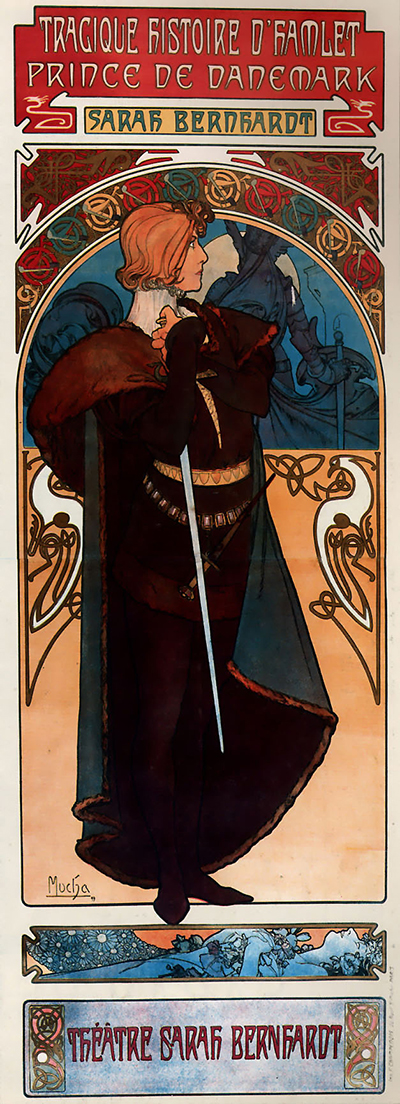
Hamlet (1899), a colour-lithograph theatre poster for Sarah Bernhardt.
Buy Art Prints Nowfrom Amazon
* As an Amazon Associate I earn from qualifying purchases.
 by Tom Gurney
Tom Gurney BSc (Hons) is an art history expert with over 20 years experience
Page Created on / Page Updated on
Email: tomgurney1@gmail.com / Phone: +44 7429 011000
Hamlet: Sarah Bernhardt in Mucha’s Final Theatre Poster for Her
Sarah Bernhardt stands alone as Hamlet, a skull held close to her chest. Behind her, a spectral figure moves through a blue arch; below her feet, Ophelia lies among flowers in a narrow horizontal panel. Alphonse Mucha's 1899 Hamlet poster turns a theatre advertisement into a compressed account of the tragedy. The lettering names the play, the star and the Théâtre Sarah Bernhardt, while the images suggest the dead father and drowned lover who haunt Hamlet's thoughts.[1][3][4]
The local route calls the work As Hamlet, but the object is a colour lithograph advertising Bernhardt in the title role of a French adaptation. It is not a painted portrait of the actress. The Mucha Foundation calls it the last poster Mucha made for Bernhardt, a culminating work in their influential theatre collaboration.[1][2]
At a Glance
- ArtistAlphonse Mucha
- WorkPoster for 'Hamlet'; this page's route is As Hamlet[1]
- Date1899[1][4]
- Mediumcolour lithograph[1][4]
- Foundation dimensions207.5 × 76.5 cm for its catalogued object[1]
- PerformerSarah Bernhardt as Hamlet[1]
- ProductionFrench adaptation of Shakespeare's Hamlet, translated by Eugène Morand and Marcel Schwob[1]
- Venue named on posterThéâtre Sarah Bernhardt, Paris[3][4]
Hamlet in Mucha’s career
Contents
- Bernhardt takes Hamlet's role
- The production behind the advertisement
- Why Hamlet appealed to Bernhardt
- The ghost in the arch
- Ophelia below Hamlet's feet
- A theatre poster that works from a distance
- The last poster in a celebrated series
- From Paris stage to an early film
- What the surviving image can and cannot tell us
- Looking again
Bernhardt takes Hamlet's role
The poster's most immediate surprise is the performer. Sarah Bernhardt plays Shakespeare's male protagonist, and Mucha presents her in character rather than as a separate celebrity portrait. The Foundation names Eugène Morand and Marcel Schwob as the translators of the French version prepared for her.[1] Its exhibition account dates the production's premiere to 20 May 1899 at Bernhardt's new theatre.[3]
At the top, large lettering announces Tragique histoire d'Hamlet prince de Danemark. Bernhardt's name occupies a second, brighter band. At the bottom, Théâtre Sarah Bernhardt fixes the venue. These words make the sheet usable as publicity even to someone who only glances at it in the street. A longer look reveals how the story has been built into the image around the star.[4]
Bernhardt appears in profile, her hair bright against the dark costume and blue arch. She holds a skull at her chest while a sword runs down the vertical centre of the design. The skull signals the play's meditation on death; Mucha lets the actor's still pose, rather than a scene of action, carry that thought. The image offers the audience a concentrated version of Hamlet before they enter the theatre.[1][3]
The gender of the performer matters without requiring us to treat the poster as an exact record of a stage costume. Mucha's design gives Bernhardt a recognisable face and commanding posture in the role. She is advertised as both actor and Hamlet, so her public identity becomes inseparable from the character on the sheet. The full-length, isolated figure also belongs to Mucha's established way of presenting her, giving this unusual casting a familiar visual form.[2]
The production behind the advertisement
Bernhardt did more than accept a role in an existing French Hamlet. She commissioned Morand and Schwob to make a new prose adaptation for her. The Folger Shakespeare Library describes a performance that reportedly lasted more than four hours and preserved more of Shakespeare's text than the adaptations then in use.[6] These details matter to the poster: its brief title and few symbolic figures promoted a long and newly prepared theatrical event, not a familiar painting of an actor.
The Bibliothèque nationale de France's performance record fixes the opening at 20 May 1899 and names Gabriel Pierné as composer of the production's music. It also identifies Marthe Mellot as Ophelia and Léon Brémont as the king.[5] A fuller cast record names an actor for the ghost and others for Laertes, Horatio and Gertrude.[7] Mucha's sheet suppresses nearly all this collective labour in order to put Bernhardt at the centre. The Ophelia and ghost on the poster are characters in its visual story; they should not be mistaken for documented portraits of the actors who played them.
The surviving records even differ over how the production was divided. One BnF performance notice calls it a drama in twelve tableaux, while another BnF notice and Les Archives du spectacle give fifteen.[5][7][8] The records agree on the opening date, translators and principal performer. The disagreement is a reason to avoid assigning a confident scene count to the poster itself; it does not change what the printed advertisement identifies.
A chapter added to the 1899 English edition of Jules Huret's Sarah Bernhardt reports another count, but of a different unit. It quotes Paris critic Henry Fouquier saying that Morand and Schwob reduced Shakespeare's thirty-two scenes to fifteen.[13] “Scenes” in this account need not be the same as the BnF records' “tableaux”; the passage therefore cannot silently settle their twelve-versus-fifteen discrepancy. It does help explain the adapted play's scale. A tall poster with one actor, one ghost and one small Ophelia is an extreme visual compression of a production whose script and staging had already condensed a long tragedy.[13]
Why Hamlet appealed to Bernhardt
Bernhardt later explained her attraction to Hamlet in L'Art du théâtre (1923). In an excerpt reproduced by the Opéra-Comique, she describes the prince's mind as at once subtle, tormented and coherent, and the role as an unusually broad field in which to investigate human feeling and suffering.[9] This is her retrospective account, written decades after the premiere. It helps explain why she valued the part, without proving that Mucha designed any particular line or symbol in response to those later words.
The 1899 volume offers a nearer voice. In a conversation with its English chapter writer, Bernhardt described Hamlet as a person who recognises a duty and repeatedly returns to it despite hesitation. She rejected the suggestion that she had tried to emphasise a feminine side of the character and said she had aimed to play him as masculine.[13] She also treated him as a young, sane man wounded by distrust, rather than as a figure whose actions must be explained by madness. These are her stated choices about acting, not instructions to Mucha. Still, they make the figure standing upright in the poster more than a novelty of casting: it advertised an interpretation Bernhardt was prepared to defend in public.[13]
The same chapter quotes several Paris critics, and their differences are worth retaining. Gustave Larroumet praised the clarity Bernhardt brought to a young, nervous Hamlet; Émile Faguet found some of the melancholy obscured even while calling the result compelling.[13] The chapter's author presents the reception as nearly unanimous admiration, but his selected excerpts show variation over the character's age, temperament and emotional balance. They also show the review conversation concentrated on Bernhardt's performance and the French adaptation. No cited response here is an appraisal of Mucha's printed poster. The poster can be read against that contemporary debate without being mistaken for its source or verdict.
Her choice was part of an established practice rather than a single experiment in playing a male role. The Mucha Museum's Czech account also identifies Bernhardt as the male protagonist Lorenzo de' Medici in the earlier Lorenzaccio poster of 1896.[10] In Hamlet, however, the role adds an especially public contest over who may embody Shakespeare's prince. The Folger describes passionate audiences and divided criticism as Bernhardt carried the production from Paris to London and Stratford-upon-Avon.[6] Mucha's advertisement belongs to the beginning of that debate: it states her casting plainly and makes the actress the monumental centre of the design.
The ghost in the arch
Behind Hamlet is a blue, moonlike space containing the ghost of the murdered father. The Mucha Foundation identifies him as looming in the background, on the ramparts of Elsinore.[1] The figure is easy to miss at first because Hamlet occupies the bright foreground. Once seen, the ghost changes the arch from ornament into an image of memory and command.
The arched frame is densely patterned with interlaced lines. The Foundation's exhibition text calls its decoration Celtic-inspired.[3] Those knots and curves carry the eye around Bernhardt's head and back toward the darker figure behind her. Ornament is doing narrative work: it frames the star while containing a second presence that explains part of Hamlet's inward struggle.
Mucha does not depict the ghost as a separate scene below or beside the protagonist. He puts the spectre within the same vertical space. That choice lets the poster hold two times at once: Bernhardt as the living Hamlet in the foreground and the murder that drives the play behind her. The viewer can grasp a psychological relationship without reading a full synopsis on the street.[1]
Ophelia below Hamlet's feet
The lower strip carries another compressed episode. The Foundation identifies the reclining, flower-decked figure as the drowned Ophelia and describes the band as coffin-like.[1] Blue and white tones separate it from the warm field around Bernhardt. Its horizontal shape interrupts the poster's long upward movement, making death a literal base for the figure above.
Ophelia's small scale is significant. A passer-by might read the bold title and standing star first, then discover the tragic fate in the narrow panel. Mucha therefore works at two speeds: the poster's large forms announce the production, while its smaller image rewards a closer look. The flowers soften the lower scene without erasing what the Foundation says it depicts.[1]
Hamlet holds a skull above, Ophelia lies below, and the father's ghost is behind. These three presences are not one literal stage tableau. They bring separate threads of the tragedy into one designed surface. Mucha's poster becomes a map of what preoccupies the character, while still fulfilling the practical purpose of selling a performance.[1][3]
A theatre poster that works from a distance
The sheet has an exceptionally tall, narrow format. The Foundation measures its catalogued lithograph at 207.5 × 76.5 cm; the Bibliothèque nationale de France records a Hamlet impression at 210 × 78 cm.[1][4] A Japanese exhibition list records a Sakai City-held colour lithograph at 207.7 × 75.2 cm.[11] These are measurements of catalogued objects, not evidence that the design changed between them. This page does not assign any of them to the untraced source of the local image. All three support the central design fact: the printed poster was around two metres high and much narrower than it was tall.
This shape gave Mucha a clear hierarchy. Large title and performer lettering at the top identify the event. Bernhardt's body occupies the middle. The tiny Ophelia image and theatre name anchor the bottom. A person could notice the star and title from a distance, then come nearer to read the ghost, interlace and lower scene. The poster's decorative richness never completely hides its advertising message.
The colour contrast helps. Red and cream title panels sit above a dark costume, blue ghost-space and lighter field. Bernhardt's head and the skull meet near the visual centre; the sword draws a line toward the bottom. Mucha controls a large public surface by placing a few immediately legible signs inside an intricate border. The design shows how a theatre poster can invite attention through beauty and then hold it through story.
The last poster in a celebrated series
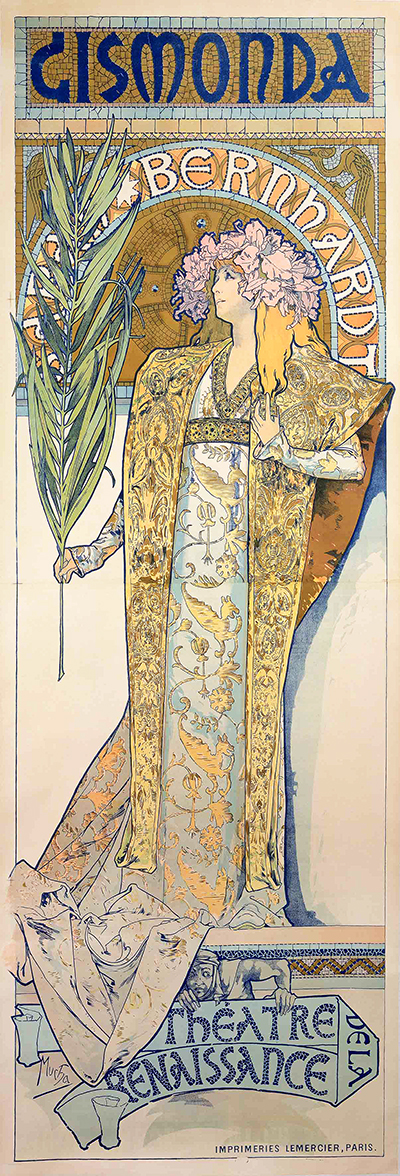
Mucha's collaboration with Bernhardt began with Gismonda, designed in 1894 and seen on Paris streets at the start of 1895. The Foundation says its success led to a six-year contract for posters, stage sets and costumes. It lists six more production posters after Gismonda, ending with Hamlet in 1899.[2] The sequence matters because this image both repeats and changes a successful formula.
As in earlier Bernhardt sheets, one full-length figure stands in a tall frame. The Foundation compares that alcove-like presentation to a devotional image.[2] Yet Hamlet also makes room for a ghost and a separate Ophelia panel. The added narrative elements are tightly controlled. They complicate the central portrait without pushing Bernhardt aside.
Calling it Mucha's final poster for Bernhardt follows the Foundation's wording.[1] It does not imply that the people never met again or that all possible collaboration ended in 1899. The specific claim is about this series of theatrical posters. Within that series, Hamlet gives the familiar commanding star image a distinctly troubled story.
From Paris stage to an early film
The role outlived the Paris opening. Bernhardt took her French Hamlet to Britain, where the Folger records performances in London and Stratford-upon-Avon.[6] The passage across the Channel also changed the work's audience: spectators could admire her celebrity and theatrical daring while critics argued about Shakespeare, translation and a woman playing the prince. Those responses concerned the performance, not necessarily Mucha's printed sheet.
In 1900, Bernhardt appeared as Hamlet in Le Duel d'Hamlet, a short film excerpt of the duel with Laertes. The Cineteca di Bologna identifies Pierre Magnier as Laertes and places the film within the Phono-Cinéma-Théâtre project at the Paris Exposition Universelle.[12] This was a separate moving-image work, made after the poster and focused on a particular late scene. Together the records show the role travelling beyond the advertising moment, across stage and early cinema, while Mucha's lithograph remained a distinct object with its own purpose.
What the surviving image can and cannot tell us
The local JPEG matches the composition described and reproduced by the Foundation: top and bottom lettering, Bernhardt with skull and sword, father-ghost in the arch and Ophelia in the lower strip.[1] It is sufficiently clear for a whole-poster reading. At 400 pixels wide, it cannot establish the exact impression, paper, colour condition or every small printed mark.
The BnF catalogue identifies a Champenois-printed 1899 colour lithograph and cites the poster under Rennert and Weill number 63.[4] Its physical dimensions differ modestly from the Foundation's. That is an object-record distinction, not a reason to treat the local image as a new artwork or to state that the difference proves a particular edition. The page keeps the two records visible without claiming a provenance the JPEG cannot supply.
Likewise, the ghost and Ophelia are identified by the Foundation, not by a speculative reading of indistinct pixels. The poster is a designed advertisement for Bernhardt's production, and its imagery is an interpretation of Shakespeare's characters. It does not document exactly how the stage looked on premiere night.[1][3]
Looking again
Read the page first as a passer-by might: title, Bernhardt's name, standing figure and theatre. Then return to the skull against her chest, trace the arch behind her to the ghost, and finish with Ophelia amid flowers below. The poster reveals more tragedy with each step closer.[1][3]
That layered reading is its achievement. Mucha gives Bernhardt a commanding public image while placing loss and memory around her. His final poster for the actress advertises a single production and, within the same tall sheet, shows why its protagonist cannot stand entirely alone.[1][2]
Watch: Alphonse Mucha
Explore Mucha’s theatre posters and his collaboration with Sarah Bernhardt.
Alfons Mucha: Gismonda
A National Gallery Prague highlight centred on the breakthrough Sarah Bernhardt poster.
Watch on YouTubeArtworks directory
| Name | Date | Medium |
|---|---|---|
| 'Accept Love and Enthusiasm from Your Son, Mother of the Holy Nation': study for the mural 'By Own Strength III' at the Lord Mayor's Hall, Obecní Dům, Prague | 1910-1911 | Pencil and charcoal on canvas |
| 'By force towards freedom, with love towards unity!': study for the mural 'By Own Strength II' at the Lord Mayor's Hall, Obecní Dům, Prague | 1910-1911 | Pencil and charcoal on canvas |
| 'The Passing Wind Takes Youth Away': design for a fan and the façade of the 'Pavilion of Man' (unrealised) | 1899 | Colour lithograph |
| 'Through humiliated and tortured, you will live again, my country!': study for the mural 'By Own Strength II' at the Lord Mayor's Hall, Obecní Dům, Prague | 1910-1911 | Pencil and charcoal on canvas |
| 1918-1928: Poster for the 10th Anniversary of the Independence of the Republic of Czechoslovakia | 1928 | Colour lithograph |
| 6th Sokol Festival | 1912 | Colour lithograph |
| 8th Sokol Festival | 1925 | Colour lithograph |
| After the Battle of Grunwald | 1924 | egg tempera on canvas |
| After the Battle of Vitkov Hill | 1923 | egg tempera on canvas |
| Age of Love | 1936–1938 | |
| Age of Reason | 1936–1938 | |
| Age of Wisdom | 1936–1938 | |
| Amants | 1895 | Colour lithograph |
| Apotheosis of the Slavs | 1926 | Egg tempera on canvas |
| As Hamlet | 1899 | colour lithograph |
| Au Quartier Latin | 1898 | Magazine cover |
| Banknotes of Czechoslovakia, designed by Mucha: 500 crown; 50 Crown; 10 Crown | 1929 | Banknotes |
| Bieres de la Meuse | 1897 | Colour lithograph |
| Biscuits Champagne Lefevre Utile | 1896 | Colour lithograph |
| Biscuits Lefevre Utile | 1896 design for 1897 calendar; Foundation object/Carnavalet 1897 | Colour lithograph |
| Blessed are the Pure in Heart | 1906 | Printed magazine illustration |
| Bleu Deschamps | 1903 (deposit) | Colour lithograph |
| Bosnia & Herzegovina Pavilion - illustration featured in 'Le Figaro Illustré' (1 March 1900) | 1900 | Reproduction from Le Figaro Illustré after watercolour original |
| Bosnia-Herzegovina Pavilion: cartoon for the mural 'The Roman Period and the Arrival of the Slavs' | 1899-1900 | ink and crayon on paper |
| Bosnia-Herzegovina Pavilion: fragment of the upper frieze featuring Ivo and Anica, characters from Bosnian legends | 1899-1900 | tempera and watercolour on canvas |
| Bosnian Legends: Death of Hasanaga's Bride | 1899 | Charcoal on paper |
| Bosnian Legends: Murcia - The Plague Lady | 1899 | Charcoal on paper |
| Bosnian Pavilion Restaurant at the Paris Exhibition 1900: design for the menu | 1900 | Pencil and watercolour on paper |
| Boutique Fouquet (interior design) | 1901 | Shop interior design |
| Boutique Fouquet: sketches of the shop's signboard and decorative details | c.1900 | Pencil, ink and watercolour on paper |
| Box for Lefèvre-Utile biscuits: Gaufrettes Vanille | c.1900 | Tin box covered with lithographed label |
| Box for Lefèvre-Utile biscuits: Madère | c.1900 | Tin box covered with lithographed label |
| Brightness of the Day | 1899 | Colour lithograph |
| Broach with Pendant | 1900 | Gold, ivory, mother-of-pearl and semi-precious stones |
| Byzantine Head - The Blonde | 1897 | Colour lithograph |
| Byzantine Heads (pair) | 1897 | Colour lithograph |
| Byzantine Heads: Brunette | 1897 | Colour lithograph |
| Bénédictine | 1898 (BnF deposit); Hamburg 1899; MNAC 1896 or 1898 | Colour lithograph |
| Champagne Ruinart | 1896 | Colour lithograph |
| Chocolat Ideal | before or in 1897 (catalogue conflict) | Colour lithograph |
| Chocolat Masson (1897 calendar) | 1896–1897 | Colour lithograph |
| Choirboys at Petrov Church, Brno | 1905 | Watercolour on cardboard |
| Cloches de Noel | 1900 | Illustrated book |
| Comedy: study for a mural for the German Theatre, New York | 1908 | Oil on canvas |
| Cours Mucha: poster advertising Mucha's art classes held at the Académie Colarossi, Paris | 1900 | colour lithograph |
| Creative Force - Jan z Pernštýna: study for a pendentive of the Lord Mayor’s Hall, Obecní Dům, Prague | 1910-1911 | Oil on canvas |
| Crucifixion | c.1868 | Pencil, crayon and watercolour on paper |
| Cycles Perfecta | 1897 or 1902 (catalogue conflict) | Colour lithograph |
| Dance | 1898 | Colour lithograph |
| Dead Couple - Abandoned | c.1899-1900 | Charcoal and pastel on blue paper |
| Defense of Sziget against the Turks by Nicholas Zrinsky | 1914 | egg tempera on canvas |
| Design for a champagne poster | c. 1896 | Charcoal and pastel on paper |
| Design for a display stand at the Paris Exhibition 1900 | c.1899-1900 | Pencil and wash on paper |
| Design for Champagne Ruinart | c. 1896 | Pencil, watercolour and gold leaf on paper |
| Design for the cover of the magazine 'Fantaz' | 1882 | Ink and watercolour on paper |
| Design for the heading of the cover of the magazine 'Krokodil' | 1885 | Pen and ink on cardboard |
| Design for the poster for the Mucha Exhibition at the Brooklyn Museum, New York, January-February 1921 | 1920 | Pen and ink and watercolour on paper |
| Designs for cutlery | c.1900 | Charcoal and white on card |
| Designs for tableware | c.1900 | Charcoal, coloured pencil and white on card |
| Diadem for 'La princesse lointaine' | 1895 | metal and pearls |
| Diploma of Ivančice: Mock diploma honouring a local celebrity, with illustration of the first line of 'May', a poem by Karel Hynek Mácha | 1882 | Pen and ink and watercolour on paper |
| Documents décoratifs: designs for a watch and accessories (unused) | 1901-1902 | Pencil, ink and white on paper |
| Documents décoratifs: final study for Plate 25, featuring studies of lily | 1901-1902 | Pencil on paper |
| Documents décoratifs: final study for Plate 43 | 1901-1902 | Pencil, ink and wash, heightened with white on paper |
| Documents décoratifs: final study for Plate 49 | 1901-1902 | Pencil and white on paper |
| Documents décoratifs: final study for Plate 50 | 1901-1902 | Pencil and white on paper |
| Documents décoratifs: final study for Plate 60 | 1901-1902 | Pencil, ink and wash, heightened with white on paper |
| Documents décoratifs: final study for Plate 63 | 1901-1902 | Pencil and white on paper |
| Documents décoratifs: final study for Plate 67 | 1901-1902 | Pencil and white on paper |
| Documents décoratifs: final study for Plate 71 | 1901-1902 | Pencil and white on paper |
| Documents décoratifs: final study for Plate 72 | 1901-1902 | Pencil and wash, heightened with white on paper |
| Documents décoratifs: line drawing for Plate 33, featuring lily motifs | 1901-1902 | Pencil, pen and ink on paper |
| Documents décoratifs: Plate 54 | 1902 | Lithograph |
| Dreaming of Freedom: study for a Panel of the Small Reception Room at the Lord Mayor’s Hall, Obecní Dům, Prague | 1910-1911 | Pen and ink and watercolour on paper |
| Dusk | 1899 | Colour lithograph |
| Evening | 1899 | Colour lithograph |
| F. Champenois (Rêverie imprint) | 1898 | Colour lithograph |
| F. Guillot-Pelletier calendar (1898) | 1897–1898 | Colour lithograph |
| Feather | 1899 | Colour lithograph |
| Figures décoratives: final study for Plate 2 | 1904-1905 | Pencil and white on paper |
| Figures décoratives: final study for Plate 3 | 1904-1905 | Pencil and white on paper |
| Figures décoratives: final study for Plate14 | 1904-1905 | Pencil with white on paper |
| Figures décoratives: sketch study for Plate14 | 1904-1905 | Blue pencil on paper |
| Flirt Lefevre Utile | 1899 (Foundation design); BnF legal deposit 1900 | Colour lithograph |
| Flower | 1897 | Colour lithograph |
| Flower: final study for decorative panel | 1897 | Pencil, ink and watercolour on paper |
| France Embraces Bohemia | 1918 | oil on canvas |
| Fruit | 1897 | Colour lithograph |
| Georges Fouquet (1858-1929), Paris, after design by Mucha: Ornamental Chain with pendants | 1900 | Gold, enamel, fresh-water pearls, mother of pearl and semi-precious stones |
| Georges Fouquet (1858-1929), Paris, after Mucha design: 'Peacock' Ring (Exhibited at the Paris Exhibition 1900) | 1900 | Opal and gold |
| Girl Weeping | c.1899-1900 | Black chalk and pastel on paper |
| Girl with Loose Hair and Tulips | 1920 | Oil on canvas |
| Gismonda | 1894 | Colour lithograph |
| Head of a Girl, statue for the stand of the Houbigant Perfumery at the Paris Exhibition 1900 | 1900 | Bronze, silver and parcel gilt |
| Head of Sarah Bernhardt: Study for 'Lorenzaccio' | 1896 | Pencil on paper |
| Heather from Coastal Cliffs | 1902 | Colour lithograph |
| Heidsieck & Co | 1901 | Colour lithograph |
| Holy Mount Athos | 1926 | Egg tempera on canvas |
| Ilsée, Princesse de Tripoli | 1897 | Illustrated book |
| In the Desert: Study for an illustration for the Světozor magazine | 1889 | Pencil, watercolour and gouache on paper |
| Incantation (Salammbô) | 1897 | Lithograph |
| Independence - Jiří z Poděbrad: study for a pendentive of the Lord Mayor’s Hall, Obecní Dům, Prague | 1910-1911 | Oil on canvas |
| Interior and furniture designs | c.1900 | Pencil on paper |
| Interior of Boutique Fouquet: design for a wall-mounted display cabinet with statuette and mirror | c.1900 | Pencil on paper |
| Interior of Boutique Fouquet: design for the fireplace with statuettes, mirror, and the ornamental details of the wall | c.1900 | Pencil and watercolour on cardboard |
| Interior of Boutique Fouquet: sketches of the fireplace with statue, mirror, display cabinet, and the ornamental details of the wall | c.1900 | Pencil, pen and ink on paper |
| Ivy | 1901 | Colour lithograph |
| Jan Milic of Kromeriz | 1916 | egg tempera on canvas |
| Jaroslava and Jiří, the Artist’s Children | 1918 | Oil on canvas |
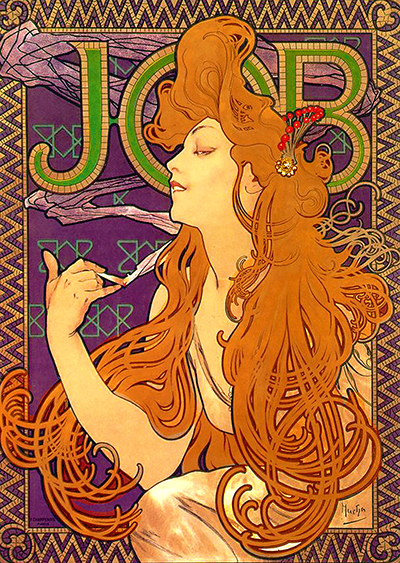
| JOB poster | 1896 | Colour lithograph |
| Judgement of Paris (calendar for Vieillemard printing company) | 1895 | Colour lithograph |
| Justice - Master Jan Hus: study for a pendentive of the Lord Mayor's Hall, Obecní dům, Prague | 1910-1911 | Oil on canvas |
| L'Annee Qui Vient | 1897 | red chalk on paper |
| L'Illustration magazine - cover for Christmas 1896/1897 | 1896 | Magazine cover |
| L'Illustré Soleil du Dimanche | 1897 | Magazine cover |
| La Dame aux Camélias: designs for cover and interior of special programme | 1896 | Pencil and watercolour on paper |
| La Nature | 1899-1900 | Bronze and amethyst |
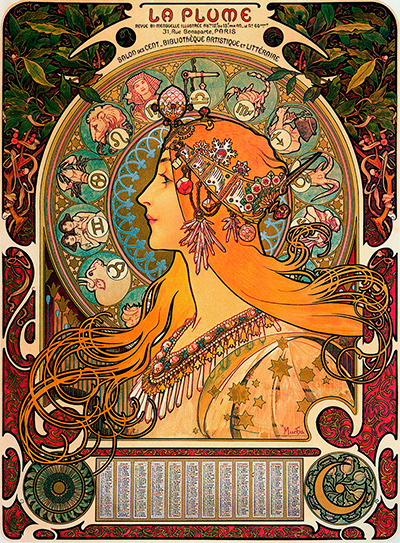
| La Plume | 1897 | Magazine cover |
| La Samaritaine | 1897 | colour lithograph |
| Lance Parfum Rodo | 1896; Albertina print c. 1900 | Colour lithograph |
| Laurel | 1901 | Colour lithograph |
| Le Monde Illustré | 1900 | Magazine cover |
| Le Pater | 1899 | Illustrated book |
| Le Pater: early study for the 1st allegorical scene 'Our Father who art in Heaven' (1899) (Mucha Foundation object 300) | 1899 | Pencil on paper |
| Le Pater: early study for the 1st allegorical scene 'Our Father who art in Heaven' (1899) (Mucha Foundation object 302) | 1899 | Pastel on paper |
| Le Pater: study for the 6th allegorical scene 'Forgive us our debts, as we forgive our debtors' | 1899 | Charcoal and ink wash on paper |
| Lefevre Utile | 1904 | Advertisement |
| Leslie Carter | 1908 | Colour lithograph |
| Letem Českým Světem | 1898 | Printed book |
| Lorenzaccio | 1896 | Colour lithograph |
| Luchon poster (attributed to Mucha) | 1895 | Colour lithograph |
| Madonna of the Lilies | 1905 | Tempera on canvas |
| Master Jan Hus Preaching at the Bethlehem Chapel | 1916 | egg tempera on canvas |
| Maude Adams | 1908 | Lithograph, hand-coloured in watercolour and gouache |
| Maude Adams as Joan of Arc | 1909 | Oil on canvas |
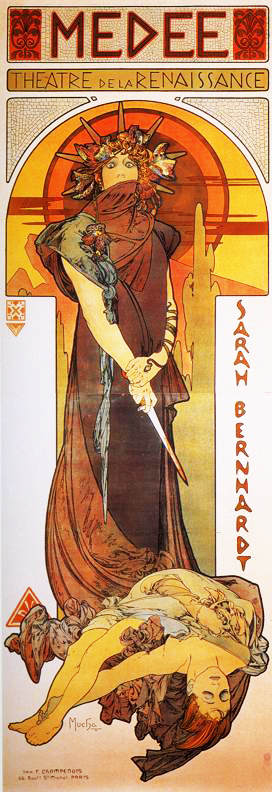
| Medea | 1898 | Colour lithograph |
| Menu for the Bosnian Pavilion Restaurant at the Paris Exhibition 1900 | 1900 | Colour lithograph |
| Militancy - Jan Žižka: study for a pendentive of the Lord Mayor's Hall, Obecní dům, Prague | 1910-1911 | Oil on canvas |
| Military Camp in Winter, near a City on Fire | c.1899-1900 | Pastel on paper |
| Moet et Chandon | 1899 | Colour lithograph |
| Monaco Monte Carlo | 1897 | Colour lithograph |
| Moon | 1902 | |
| Moravian Teachers' Choir | 1911 | Colour lithograph |
| Morning Alphonse Mucha Painting / AlphonseMucha.org | 1899 | Colour lithograph |
| Morning Star | 1902 | Colour lithograph |
| Moët & Chandon White Star | 1899 | Colour lithograph |
| Mrs Mucha’s Necklace | 1906 | gold, enamel and semi-precious stones |
| Mural for the Bosnia-Herzegovina Pavilion: The Roman Period and the Arrival of the Slavs | 1900 | tempera and watercolour on canvas |
| Murals by Mucha in the Lord Mayor's Hall, Obecní Dům (Municipal House), Prague (1910-1911) | ||
| Music | 1898 | Colour lithograph |
| Nativity | c. 1934 | oil on canvas |
| Nestle's Food for Infants | 1897 | Colour lithograph |
| Night | 1899 | Colour lithograph |
| Nude on a Rock | 1898-1899 | Bronze |
| Official Banquet of the Paris Exhibition 1900: design for the menu featuring a fashionable woman wearing a Mucha-style jewellery | 1900 | Pencil, gouache and wash on grey paper |
| Ornamental motifs designed for 'Combinaisons Ornementales se Multipliant à l'Infini à l'Aide du Miroir' (1901) | c.1900-1901 | Blue and red pencil on paper |
| Packaging for 'Savon Mucha Violette' | 1906 | Colour lithograph |
| Packaging for Lefèvre-Utile biscuits: Boudoir | 1901 | Colour lithograph |
| Page's Costume: study for an illustration for 'Le Costume au Théâtre' | 1890 | Pencil and watercolour on cardboard |
| Painting | 1898 | Colour lithograph |
| Peonies | 1897–1898 | Ink and watercolour |
| Petr Chelcicky at Vodnany | 1918 | egg tempera on canvas |
| Poetry | 1898 | Colour lithograph |
| Portrait of Jaroslava | c.1927-1935 | Oil on canvas |
| Portrait of Josephine Crane Bradley as Slavia | 1908 | Oil and tempera on canvas |
| Portrait of Marie Chytilová (Maruška), Mucha's Future Wife | 1903 | pastel on paper |
| Portrait of Mucha's Sister, Angela | c.1880 | Oil on canvas |
| Portrait of Mucha's Sister, Anna | c.1885 | Oil on canvas |
| Portrait of Mucha's Son, Jiří | 1925 | Oil on canvas |
| Portrait of Mucha's Wife, Maruška | 1908/17 | Oil on canvas |
| Portrait of Woman | c. mid 1910s - 1925 | Blue pastel on grey paper |
| Poster for 'Hommage Respectueux de Nestlé' (the Nestlé Company's tribute to Queen Victoria's 60th Jubilee) | 1897 | Colour lithograph |
| Poster for 'Imprimerie Cassan Fils' | 1896 | Colour lithograph |
| JOB poster (1898) | 1898 | Colour lithograph |
| Poster for 'La Dame aux Camélias' | 1896 | Colour lithograph |
| Poster for 'La Tosca' | 1899 | Colour lithograph |
| Poster for 'Regional Exhibition at Ivančice 1913' | 1912 | Colour lithograph |
| Poster for 'The Slav Epic Exhibition, Brno, 1930' | 1928-1930 | Colour lithograph |
| Poster for 'Waverley Cycles' | 1898 | Colour lithograph |
| Poster for the 'Lottery of the Union of Southwestern Moravia' | 1912 | Colour lithograph |
| Poster for the Austrian Pavilion at the Paris Exhibition 1900 | 1900 | Colour lithograph |
| Prague Subjugated: study for a Panel of the Small Reception Room at the Lord Mayor’s Hall, Obecní Dům, Prague | 1910-1911 | Pen and ink and watercolour on paper |
| Primrose | 1899 | Colour lithograph |
| Primrose and Feather (paired image) | 1899 | Colour lithographs (paired image) |
| Princess Hyacinth (Princezna Hyacinta) | 1911 | Colour lithograph |
| Print proof for the Biscuits Lefèvre-Utile tin | 1899 | Lithograph |
| Reverie | 1898 | Colour lithograph |
| Russia Restituenda [Russia Must Recover] | 1922 | Colour lithograph |
| Salome | 1897 | Colour lithograph |
| Salon des Cent | 1896 | Colour lithograph |
| Salon of the Hundred | 1897 | Colour lithograph |
| Sarah Bernhardt - La Princesse Lointaine - Lefevre Utile | 1903 | Colour lithograph |
| Sarah Bernhardt as La Princesse Lointaine: poster for 'La Plume' magazine | 1897 | Colour lithograph |
| Sarah Bernhardt in the role of the Duc de Reichstadt in L’Aiglon | 1900 | Pencil on paper |
| Sarah Bernhardt: study of her full-standing figure | c.1896 | Pen and ink on paper |
| Savonnerie de Bagnolet calendar | 1898 (calendar) | Printed advertising calendar |
| Self-portrait (1899) | 1899 | Oil on board |
| Self-portrait (1907) | 1907 | Blue and white crayon on blue Ingres paper |
| Self-portrait, sketching in his apartment, Paris | late 1880s | oil on canvas |
| Sketches of flowers for Documents décoratifs | c.1900-1901 | Pen and ink on paper |
| Slavia insurance poster | 1907 | Poster |
| Slavs in their Original Homeland | 1912 | Egg tempera on canvas |
| Snake Bracelet with a Ring | 1899 | Gold, enamel, opal, ruby and diamond |
| Société Populaire des Beaux Arts | 1897 | Colour lithograph |
| Song of Bohemia | 1918 | oil on canvas |
| St. Vitus Cathedral Stained-glass Window, Prague: final design for the central panels, featuring SS Cyril and Methodius | 1931 | Ink and watercolour on paper |
| St. Vitus Cathedral Stained-glass Window, Prague: final design for the central panels, featuring St. Ludmila | 1931 | Ink and watercolour on paper |
| St. Vitus Cathedral Stained-glass Window, Prague: final design for the central panels, featuring St. Wenceslas (Duke of Bohemia) kneeling next to his Grandmother, St. Ludmila | 1931 | Ink and watercolour on paper |
| St.Vitus Cathedral Stained-glass Window, Prague: final design for the bottom left panels | 1931 | Ink and watercolour on paper |
| St.Vitus Cathedral Stained-glass Window, Prague: final design for the bottom right panels | 1931 | Ink and watercolour on paper |
| Stained-glass Window designed by Mucha at St. Vitus Cathedral, Prague | Early 1930s | N/A |
| Study for 'The Age of Reason' | 1936-1938 | Pencil and watercolour on paper |
| Study for 'The Slav Epic cycle' No.19: The Abolition of Serfdom in Russia | 1913-1914 | Watercolour and gouache on paper |
| Study for 'The Slav Epic' cycle No.14: The Sacrifice at Szigetvár by Nikola Zrinski | c.1913-1914 | Photographed drawings stuck together, tinted with watercolour and gouache |
| Study for 'The Slav Epic' cycle No.17: The Holy Mount Athos (1926) | c.1925-26 | Charcoal heightened with white on cardboard |
| Study for 'The Slav Epic' cycle No.18: The Oath of Omladina under the Slavic Linden Tree | c.1925-1926 | Pencil and watercolour on paper |
| Study for 'The Slav Epic' cycle No.1: The Slavs in Their Original Homeland (1912) | c.1910-1912 | Oil on canvas |
| Study for 'The Slav Epic' cycle No.2: The Celebration of Svantovít | c.1910-1912 | Oil on canvas |
| Study for 'The Slav Epic' cycle No.7: Jan Milíč of Kroměříž | c.1915-1916 | Oil on canvas |
| Study for 'The Slav Epic' cycle No.9: Master Jan Hus Preaching at the Bethlehem Chapel. The Magic of the Word: Truth Prevails (1412). | c.1915-1916 | Oil on canvas |
| Study for 'The Three Ages' triptych: Reason, Wisdom and Love [unfinished project] | 1936-1938 | Pencil and watercolour on paper |
| Study for 'Woman in the Wilderness' (c. 1922-1923) (Mucha Foundation object 315) | c. 1922-1923 | oil on canvas |
| Study for 'Woman in the Wilderness' (c. 1922-1923) (Mucha Foundation object 316) | c. 1922-1923 | oil on canvas |
| Study for Savon Notre Dame | c. 1896 | pencil and watercolour on paper |
| Study for the poster 'Russia Restituenda [Russia Must Recover]' | 1922 | Pen and ink and watercolour on paper |
| Study of a Male Nude | 1885-1887 | Oil on canvas |
| The Abolition of Serfdom in Russia | 1914 | Egg tempera on canvas |
| The Arts (series) | 1898 | Colour lithograph |
| The Arts: study for 'Dance' | 1898 | Pencil and watercolour on paper |
| The Arts: study for 'Music' | 1898 | Pencil and watercolour on paper |
| The Arts: study for 'Painting' | 1898 | Pencil and watercolour on paper |
| The Arts: study for 'Poetry' | 1898 | Pencil and watercolour on paper |
| The Bohemian King Premysl Otakar II | 1924 | egg tempera on canvas |
| The Bulgarian Tsar Simeon | 1923 | egg tempera on canvas |
| The Burr McIntosh Monthly, 1907 | 1907 | Magazine cover |
| The Celebration of Svantovit | 1912 | egg tempera on canvas |
| The Coronation of the Serbian Tsar Stefan Dusan as East Roman Emperor | 1923 | egg tempera on canvas |
| The Devil and Mr Twardowsky: study for an illustration for 'The Tale of Pan Twardowsky' (a variation of 'Faust') | c.1887-1888 | Charcoal on paper |
| The Flowers (series) | 1898 | Colour lithographs |
| The Flowers: Carnation | 1898 | Colour lithograph |
| The Flowers: Iris | 1898 | Colour lithograph |
| The Flowers: Lily | 1898 | Colour lithograph |
| The Flowers: Rose | 1898 | Colour lithograph |
| The Hussite King Jiri of Podebrady | 1923 | Egg tempera on canvas |
| The Introduction of the Slavonic Liturgy | 1912 | egg tempera on canvas |
| The Last Days of Jan Amos Komensky (Comenius) in Naarden | 1918 | Egg tempera on canvas |
| The Light of Hope | 1933 | Oil on canvas |
| The Meeting at Krizky | 1916 | egg tempera on canvas |
| The Months (January-June) | 1899 | Colour lithograph |
| The Months (July-December) | 1899 | Colour lithograph |
| The Moon and the Stars (four-panel montage) | 1902 | Colour lithographs (four-panel montage) |
| The Moon and the Stars (series) | 1902 | Colour lithograph |
| The Moon and the Stars: study for 'The Evening Star' | 1902 | Ink and watercolour on paper |
| The Moon and the Stars: study for 'The Pole Star' | 1902 | Ink and watercolour on paper |
| The New York Daily News art supplement | 1904 | Printed art supplement |
| The Oath of Concord of the Slavs (unfinished) | 1939 | oil on canvas |
| The Oath of Omladina under the Slavic Linden Tree | 1926, unfinished | Egg tempera on canvas |
| The Precious Stones (four-panel montage) | 1900 | Colour lithographs (four-panel montage) |
| The Precious Stones (series) | 1900 | Colour lithograph |
| The Precious Stones: Amethyst | 1900 | Colour lithograph |
| The Precious Stones: Emerald | 1900 | Colour lithograph |
| The Precious Stones: Ruby | 1900 | Colour lithograph |
| The Printing of the Bible of Kralice in Ivancice | 1914 | egg tempera on canvas |
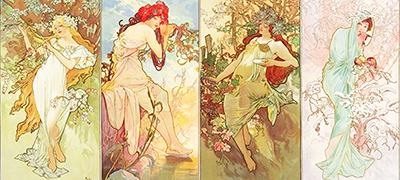
| The Seasons (series) | 1896 | Colour lithograph |
| The Seasons (series) (1900) | 1900 | Colour lithograph |
| The Seasons (variation in screen format) | 1896 | Colour lithograph |
| The Seasons: Autumn (1896) | 1896 | Colour lithograph |
| The Seasons: Autumn (1900) | 1900 | Colour lithograph |
| The Seasons: Spring | 1900 | Colour lithograph |
| The Seasons: Spring (1896) | 1896 | Colour lithograph |
| The Seasons: Summer | 1900 | Colour lithograph |
| The Seasons: Summer (1896) | 1896 | Colour lithograph |
| The Seasons: Winter | 1900 | Colour lithograph |
| The Seasons: Winter (1896) | 1896 | Colour lithograph |
| The Slavonic Concord: study for the ceiling painting for the Lord Mayor's Hall, Obecní Dům, Prague | 1910-1911 | Oil on canvas |
| The Threat | 1912 | Colour lithograph |
| The Times of the Day (series) | 1899 | Colour lithograph |
| The West End Review | 1897 (Foundation); 1898 promotional cover | Colour lithograph |
| Thistle from the Sands | 1902 | Colour lithograph |
| Théâtre de la Renaissance: design for poster advertising Sarah Bernhardt's theatre | c.1895 | Pen and ink on paper |
| Tin for Lefèvre-Utile biscuits | 1899 | Circular tin with lid and handle; colour print on metal |
| Topaz | 1900 | Colour lithograph |
| Tragedy - study for a mural for the German theatre New York | 1908 | Oil and tempera on canvas |
| Trappistine Liquors | 1897 | colour lithograph |
| Wiener Chic | 1905 | Magazine cover |
| Woman in the Wilderness | 1923 | Oil on canvas |
| Woman masked in white head-scarf - study for the illustration of the Bosnia & Herzegovina Pavilion featured in 'Le Figaro Illustré' (1 March 1900) | 1899 | Pencil and wash heightened with white on paper |
| Woman with a Daisy - textile designed by Mucha | 1900 | Printed upholstery fabric |
| Zdenka Cerny | 1913 | Colour lithograph |
| Zodiac (La Plume calendar) | 1896–97 | Colour lithograph |
| Zodiac (textless decorative panel) | 1896 | Colour lithograph |
| ‘At the sight of the two storks the owl rose.’ Study for an illustration for Contes de Grand-mères | 1891 | Watercolour and gouache on paper |
Frequently Asked Questions
Who is shown in Mucha’s Hamlet poster?
What are the ghost and the figure below Hamlet?
Was Hamlet Mucha’s last poster for Bernhardt?
Discussion
Mucha shows Bernhardt as Hamlet between her father’s ghost and the drowned Ophelia.
The poster advertises a named performance while carrying several parts of its story.
Reader Insights
Where does your eye go first: Bernhardt, the title or the ghost?
How does the narrow Ophelia panel change the poster’s mood?
What do the skull and sword add to Bernhardt’s still pose?
Join the Conversation
Share what you notice about the star image and the tragedy around it.
References
- Mucha Foundation, “Poster for 'Hamlet',” object 323, date, medium, dimensions and iconography. View source.
- Mucha Foundation, “Sarah Bernhardt,” thematic catalogue account of the Gismonda contract and the six later theatre posters. View source.
- Mucha Foundation, “Original Full Version,” exhibition text presented through Google Arts & Culture, 20 May 1899 premiere and Celtic-inspired framing. View source.
- Bibliothèque nationale de France, catalogue notice ark:/12148/cb40461546b, title lettering, 1899 Champenois colour lithograph and its recorded impression dimensions. View source.
- Bibliothèque nationale de France, performance notice FRBNF39460034, opening date, twelve-tableau description, adaptation, music and principal cast. View source.
- Folger Shakespeare Library, Elizabeth DeBold, “To Madame Sarah,” on the commissioned prose adaptation, touring and reception. View source.
- Les Archives du spectacle, La Tragique Histoire d'Hamlet, prince de Danemark, cast, music, performance dates and fifteen-tableau description. View source.
- Bibliothèque nationale de France, separate performance notice FRBNF47229130 describing fifteen tableaux. View source.
- Opéra-Comique, Hamlet programme (2022), p. 28, reproducing Bernhardt's 1923 account of why she chose the role. View source.
- Mucha Museum, Prague, Czech exhibition text on Bernhardt as Lorenzo and Hamlet. View source.
- National Art Center, Tokyo, 2017 annual report, exhibition works list, Sakai City-held Hamlet colour lithograph and dimensions. View source.
- Cineteca di Bologna, Le Duel d'Hamlet catalogue entry, 1900 film credits and exposition context. View source.
- G. A. Raper, “Sarah Bernhardt’s ‘Hamlet’,” chapter in the 1899 English edition of Jules Huret's Sarah Bernhardt, pp. 179–192; near-contemporary interview, French review excerpts and adapted-scene account. Raper is credited as translator of the volume and signs this added chapter “G. A. R.” Read text.