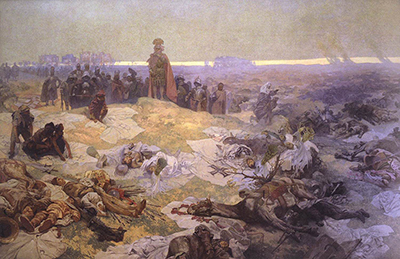
After the Battle of Grunwald (1924), the eighth canvas in Mucha’s Slav Epic.
Buy Art Prints Nowfrom Amazon
* As an Amazon Associate I earn from qualifying purchases.
 by Tom Gurney
Tom Gurney BSc (Hons) is an art history expert with over 20 years experience
Page Created on / Page Updated on
Email: tomgurney1@gmail.com / Phone: +44 7429 011000
After the Battle of Grunwald by Alphonse Mucha: Victory at a Cost
A solitary crowned figure stands on a low rise beneath a pale strip of sky. Around him, fallen bodies, horses and white cloaks stretch across the field. Alphonse Mucha called this eighth Slav Epic canvas After the Battle of Grunwald. He did not paint the charge, the clash of armies or the moment a victor claimed the field. He pictured the morning after a battle won on 15 July 1410, when King Władysław II Jagiełło surveys what victory has cost.[1][2]
The painting itself dates to 1924. That gap of more than five centuries is central to reading it. Mucha was constructing a historical memory of the battle, not reporting from the scene. His catalogue subtitle, “The Solidarity of the Northern Slavs,” states his interpretation of the alliance. The actual coalition included Polish and Lithuanian forces and other supporters; its participants cannot all be collapsed into one ethnic group.[1][3]
At a Glance
- ArtistAlphonse Mucha
- CycleThe Slav Epic, No. 8 of 20 in the Foundation's individual catalogue[1]
- Foundation titleAfter the Battle of Grunewald. The Solidarity of the Northern Slavs (1410)[1]
- Local route titleAfter the Battle of Grunwald
- Painting date1924[1]
- Mediumlisted as egg tempera on canvas by the Foundation and tempera plus oil by the Czech exhibition; a 2016 technical survey argues that the paint examined on this canvas is oil[1][7][9]
- Dimensions405 × 610 cm, for the finished painting[1]
- Depicted momentdawn after the Battle of Grunwald, fought on 15 July 1410[1][2]
The eighth Epic canvas in Mucha’s career
Contents
- The morning after
- What happened at Grunwald?
- An alliance with people on both sides
- What the next day meant
- The king in a later chronicle
- A victory told from different sides
- A field instead of a charge
- White cloaks and a pale horizon
- A later painting method
- Numbered eighth, painted later
The morning after
The horizon runs almost flat across the upper part of the scene. A narrow band of light separates a smoky sky from the dark shapes of an army and distant buildings. In the middle, the king rises above his retinue on a mound. His height makes him unmistakable, yet his gesture refuses the confidence we might expect of a victor. The Mucha Foundation and Prague City Gallery both describe him covering his face as he looks over the dead.[1][2]
That vertical figure sets the scale for the broad field around him. Bodies and horses lie across the foreground; pale cloaks catch the eye among earth tones and bruised purples. The Gallery identifies the white garments with black crosses as belonging to the defeated Teutonic Knights.[2] Mucha spreads them across the scene, but he does not confine the cost to one side. The Gallery says the king sees losses among his own warriors too.[2] Victory is visible in the defeated order's scattered insignia, while grief is written into the king's posture.
The composition moves a viewer from one body to another before arriving at the king. It reverses the direction of a conventional victory image. Instead of first meeting a triumphant ruler and then noticing the casualties, we cross the casualties to understand why the ruler cannot celebrate. The 400-pixel local image preserves this structure, though its small figures are hard to separate. The larger reproduction makes the broken line of bodies, cloth and equipment easier to follow.
What happened at Grunwald?
On 15 July 1410, a coalition led by Poland and Lithuania defeated the Teutonic Order at Grunwald during the war of 1409–11. A Polish government educational account describes Ruthenian, Tatar and Czech or Moravian participation among the allies.[3] This was a broad political and military alliance. Mucha's subtitle draws a pan-Slavic lesson from it, but the full historical coalition included non-Slavic Lithuanians and Tatars. That distinction matters because the canvas can express solidarity without serving as an exact ethnic map of the armies.
The Gallery names the Polish king Władysław II Jagiełło as the central figure and identifies the fallen Grand Master of the Teutonic Knights, Ulrich von Jungingen, below the mound.[2] Those names give the scene a precise historical frame. Mucha, however, paints the king as a figure of response rather than command. The decision to look at him the next morning lets the painting ask what a commander sees when a battle's noise has ended.
The Gallery proposes other identifications, including Jan Sokol of Lamberg and Jan Žižka of Trocnov, while treating Žižka's participation as probable.[2] The inherited reproductions do not make those distant figures independently secure to a reader. It is enough to recognise a retinue behind the king and a field that extends beyond any one named person. The image's argument depends on the whole aftermath, not on finding every face.
An alliance with people on both sides
Mucha's subtitle asks viewers to see northern Slavic solidarity in the coalition. The military record is more entangled. The Polish Army Museum names Jagiełło and his cousin Vytautas, grand duke of Lithuania, as the allied commanders and notes Ruthenian and Tatar support.[5] Vytautas matters because the Lithuanian army was a partner in the victory, not simply a supporting branch of a Polish or Slavic host. The same museum records the death of Grand Master Ulrich von Jungingen and other senior officers of the Order. These are the battlefield facts behind the dispersed white cloaks, although Mucha reorganised them into a later moral image.[5]
The Moravian Jan Sokol of Lamberk supplied a Czech link that the Gallery foregrounds, but Bohemian and Moravian service was not confined to the allied side. Solomiya Kozak's study of Czech warriors uses the later chronicler Jan Długosz and other scholarship to identify men from Bohemian lands in both armies.[6] It describes Sokol's contingent with the Polish–Lithuanian force and separate Bohemian knights among the Order's supporters. That complexity does not make Mucha's title meaningless; it shows that “solidarity” is his chosen historical lesson, rather than a roster of every fighter's allegiance. Kozak argues for Žižka's presence among the allies, while the Gallery calls it probable; his exact participation should remain qualified.[2][6]
What the next day meant
The Museum of the Battle of Grunwald gives the aftermath a more concrete sequence. It reports that Ulrich von Jungingen's body was found on the field on 16 July, the day after the battle. The king ordered it covered with purple cloth and sent with four other high officers' bodies to Malbork for burial. He also ordered other notable dead, including Poles, buried at Stębark.[8] This record makes Mucha's chosen morning more than an abstract pause: it was a time when victors had to identify, move and bury those who had fallen. It does not prove that Jagiełło stood on the pictured mound or made the exact gesture Mucha gives him.
The same museum traces what followed. The allies moved toward Malbork, the Order's capital, but reached it on 25 July; Henryk von Plauen had organised a defence, and the siege failed.[8] Thus the battle's result did not end the 1409–11 war or destroy the Order. Mucha's still field has two horizons: the immediate human cost already visible and the uncertain political work still ahead. His anti-violence reading gains force when victory is understood as consequential but incomplete, rather than as a simple final conquest.[2][8]
The king in a later chronicle
A close textual parallel to Mucha's mournful king appears in Jan Długosz's Annals, written decades after the battle. In the available Polish translation of its 16 July account, Jagiełło orders the bodies of the Grand Master and other Order leaders found at dawn so that they can receive honourable burial. Długosz then describes the king looking at their wounds without mockery or jubilation and weeping over their fate. The chronicler adds orders to bury other notable dead at Stębark and to care for wounded men from both armies.[12] The sequence is more detailed than the museum's concise aftermath history, but its emotional portrait belongs to a later authored narrative. Nothing in the sources reviewed here proves that Mucha read this particular passage before painting.
That distinction leaves the comparison useful. Długosz makes royal compassion a virtue of the victor; Mucha turns the king's covered face into the centre of a picture filled with casualties. Both give mercy more prominence than an immediate triumphal pose, but they do different work. The chronicle presents a ruler's conduct through words and names. The canvas holds the viewer in a field where most of the dead have no names. It can be read beside Długosz without becoming an illustration certified by his account.[1][2][12]
Długosz's attention to burial and wounded men also makes the aftermath an interval of work, not simply an emotional pause. Mucha suppresses that sequence of orders and actions. His figures appear suspended between the completed fighting and the tasks to come. The stillness lets the viewer dwell on bodies that a military chronicle must soon count, identify or move. The painting's moral emphasis arises partly from stopping that sequence at the moment of recognition.[1][2][12]
The chronicle's rhetoric also complicates an easy claim that a grieving king is an entirely modern anti-war invention. Medieval writers could already use pity and restraint to praise a successful commander. Historian Sven Ekdahl describes this as part of a Polish image of the just king, contrasted with the Order's accusations and its own religious case for the war.[13] Mucha made his painting in another political age and for another audience. His decision to let the dead dominate the foreground changes the balance between royal virtue and common human cost, even if the ethical pose has older precedents.
A victory told from different sides
The 1410 result generated competing accounts almost immediately. Ekdahl's study follows Polish and Teutonic written traditions and the propaganda each drew from them. Polish authors cast Jagiełło as a restrained, pious victor; the Order stressed the participation of people it labelled “heathen” in the opposing coalition.[13] The latter rhetoric matters because the alliance included Tatars and Orthodox Ruthenians as well as Catholic Poles and recently Christianised Lithuanians. Neither side's polemical language provides a simple ethnic or religious key to all those who fought. Mucha's 1924 subtitle adds a further, twentieth-century frame of northern Slavic solidarity.[1][5][13]
The king's own battlefield correspondence gives another kind of evidence. A scholarly inventory identifies a letter from Jagiełło to Queen Anna, dated 16 July 1410 on the battlefield, among the immediate sources.[14] That dated communication confirms that the king was announcing and explaining the result while the burial work took place. The letter's existence cannot confirm the exact feeling, gesture or vantage point Mucha paints. It places the image's reflective “morning after” beside an urgent contemporary task: turning military success into news for the court and wider political world. The surviving record of an announcement and the later record of compassionate conduct answer different questions.
Even the location of the post-battle camp has been debated through the wording of the anonymous, near-contemporary Cronica conflictus and Długosz's later Annals. Marek A. Janicki's source-critical study treats their phrasing and Długosz's knowledge of the battlefield landscape as problems requiring close comparison.[14] Mucha's mound is therefore best understood as a compositional place for his king, not as an identified patch of ground recovered from the chronicles. The painting offers moral clarity where the historian's map and the textual traditions still require qualification.
A field instead of a charge
Mucha had many ways to picture a battle. A clash of cavalry could have given him banners, movement and a clear instant of triumph. He chose stillness after violence. The Polish king's body is upright, but those around him cannot rise. Distant figures gather in shadow; the foreground remains exposed. The eye has time to linger on the consequences of action because the decisive action has already passed.
The Prague City Gallery reads this choice as a condemnation of violence and an appeal for peaceful coexistence.[2] That is a persuasive interpretation of the picture's pose and timing. It is also a claim about Mucha's purpose, not an assertion that the historical war had no political stakes. The Polish–Lithuanian alliance won a major victory. The painting holds that fact alongside the cost of winning. Its title begins “After” because the moral question comes when military success is settled.
One comparison helps show how unusual this is. Jan Matejko's earlier Battle of Grunwald, painted in 1878, plunges viewers into combat. The National Museum in Warsaw describes its central struggle and its later role in Polish historical memory.[4] Mucha paints a different hour. He does not ask a viewer to pick out the turning point of the fight; he asks us to face the ground left behind. This comparison concerns two distinct artworks, and the Matejko image is not reproduced here.
Ekdahl makes the comparison more precise: in Matejko's crowded combat scene, Jagiełło appears small and high at the edge, while Vytautas becomes a conspicuous central hero.[13] Mucha gives Jagiełło the prominent upright position but withholds a heroic action. The two artists selected different instants and distributed attention differently, each turning a disputed medieval past into a later public image. This does not mean Mucha was correcting Matejko, a relationship the reviewed sources do not establish. It shows how much the placement of the king can change what viewers believe the battle is about.
White cloaks and a pale horizon
The white cloaks repeat across the battlefield, sometimes nearly merging with the grey bodies of horses and the light ground. The black crosses described by the Gallery mark the fallen knights' allegiance.[2] Repetition gives the defeated order a visual presence even though no army stands intact. Their former power appears as fragments of a uniform, not as a living formation.
The narrow bright horizon works differently. It offers distance and the arrival of day, but it does not erase what is close to us. Mucha could have let morning light turn the field into a hopeful conclusion. Instead, the foreground remains crowded and heavy. The picture contains light without allowing an easy release from the scene. Viewers may feel that the day after battle is a time for reckoning rather than simple renewal.
At 405 × 610 cm, the finished canvas is monumental.[1] Its broad format lets Mucha place the king, the retinue and the dead within one continuous field. On a small screen, the centre can seem relatively spare while the foreground is dense. That contrast is a deliberate visual experience: public victory in the middle distance, bodily loss immediately before the viewer.
A later painting method
The material labels attached to this canvas require care. The Mucha Foundation lists egg tempera on canvas; the Czech exhibition lists egg tempera and oil.[1][7] A 2019 published conservation study by Tomáš Berger, reporting a 2016 technical survey of the Epic, reaches a sharper conclusion for After the Battle of Grunwald: in his assessment, the examined paint here is oil, with no tempera evident. His team used laboratory analysis and radiography across selected works, and he specifically describes oil-painted passages, a thin ground and lead white in parts of this canvas.[9] A sample and observed passages do not by themselves rewrite an entire collection catalogue, but this is direct technical evidence that the short “egg tempera” label leaves something out.
Berger places the work in a wider shift within the cycle from the thin tempera layers of earlier canvases toward oil in later ones.[9] He says Mucha kept the oil layers unusually thin and found evidence of revised drapery on the Grunwald canvas. That matters to the reading of the apparently swift, open battlefield: the painting was not merely a fixed historical tableau executed by one method across all twenty canvases. Its material construction and revisions belong to Mucha's working process, even as its subject belongs to 1410. The differing medium labels should remain attributed until the collection's own technical catalogue reconciles them.[1][7][9]
Numbered eighth, painted later
The Foundation's individual object record calls this No. 8 in the Slav Epic.[1] The preceding Jan Milíč of Kroměříž canvas is dated 1916, while Grunwald was painted in 1924. The sequence therefore does not represent a steady production calendar. It moves historically from fourteenth-century reform to the 1410 battle. Mucha used the cycle to build a narrative across subjects and centuries, sometimes making adjacent panels years apart.[1]
The Foundation's Czech individual-object record instead calls Grunwald No. 10, matching its timeline's number for the canvas.[10][11] Its English object record calls it No. 8.[1] The article retains the English object's number with explicit attribution; the two catalogue languages differ on the ordering of three canvases, without changing Grunwald's subject or 1924 painting date.
In that narrative, the Grunwald canvas adds a hard question to the Slav Epic. What does solidarity look like when it is won through violence? The artist's answer is neither a denial of victory nor an uncomplicated celebration of it. He gives the winning king the most conspicuous upright position and then turns his face away from glory. The field around him supplies the reason.[1][2]
Look from the bright line on the horizon to the king and then toward the white cloaks at your feet. The route makes victory and loss part of the same image. Mucha's choice of the following morning keeps the battle's result clear while refusing to let it be the painting's only meaning.[1][2]
Watch: Alphonse Mucha
Place Mucha’s Czech and Slavic projects beside his better known Paris work.
Prague’s Art Nouveau, Mucha, and the Slav Epic
A short view of Mucha’s Prague legacy and the Slav Epic cycle.
Watch on YouTubeArtworks directory
| Name | Date | Medium |
|---|---|---|
| 'Accept Love and Enthusiasm from Your Son, Mother of the Holy Nation': study for the mural 'By Own Strength III' at the Lord Mayor's Hall, Obecní Dům, Prague | 1910-1911 | Pencil and charcoal on canvas |
| 'By force towards freedom, with love towards unity!': study for the mural 'By Own Strength II' at the Lord Mayor's Hall, Obecní Dům, Prague | 1910-1911 | Pencil and charcoal on canvas |
| 'The Passing Wind Takes Youth Away': design for a fan and the façade of the 'Pavilion of Man' (unrealised) | 1899 | Colour lithograph |
| 'Through humiliated and tortured, you will live again, my country!': study for the mural 'By Own Strength II' at the Lord Mayor's Hall, Obecní Dům, Prague | 1910-1911 | Pencil and charcoal on canvas |
| 1918-1928: Poster for the 10th Anniversary of the Independence of the Republic of Czechoslovakia | 1928 | Colour lithograph |
| 6th Sokol Festival | 1912 | Colour lithograph |
| 8th Sokol Festival | 1925 | Colour lithograph |
| After the Battle of Grunwald | 1924 | egg tempera on canvas |
| After the Battle of Vitkov Hill | 1923 | egg tempera on canvas |
| Age of Love | 1936–1938 | |
| Age of Reason | 1936–1938 | |
| Age of Wisdom | 1936–1938 | |
| Amants | 1895 | Colour lithograph |
| Apotheosis of the Slavs | 1926 | Egg tempera on canvas |
| As Hamlet | 1899 | colour lithograph |
| Au Quartier Latin | 1898 | Magazine cover |
| Banknotes of Czechoslovakia, designed by Mucha: 500 crown; 50 Crown; 10 Crown | 1929 | Banknotes |
| Bieres de la Meuse | 1897 | Colour lithograph |
| Biscuits Champagne Lefevre Utile | 1896 | Colour lithograph |
| Biscuits Lefevre Utile | 1896 design for 1897 calendar; Foundation object/Carnavalet 1897 | Colour lithograph |
| Blessed are the Pure in Heart | 1906 | Printed magazine illustration |
| Bleu Deschamps | 1903 (deposit) | Colour lithograph |
| Bosnia & Herzegovina Pavilion - illustration featured in 'Le Figaro Illustré' (1 March 1900) | 1900 | Reproduction from Le Figaro Illustré after watercolour original |
| Bosnia-Herzegovina Pavilion: cartoon for the mural 'The Roman Period and the Arrival of the Slavs' | 1899-1900 | ink and crayon on paper |
| Bosnia-Herzegovina Pavilion: fragment of the upper frieze featuring Ivo and Anica, characters from Bosnian legends | 1899-1900 | tempera and watercolour on canvas |
| Bosnian Legends: Death of Hasanaga's Bride | 1899 | Charcoal on paper |
| Bosnian Legends: Murcia - The Plague Lady | 1899 | Charcoal on paper |
| Bosnian Pavilion Restaurant at the Paris Exhibition 1900: design for the menu | 1900 | Pencil and watercolour on paper |
| Boutique Fouquet (interior design) | 1901 | Shop interior design |
| Boutique Fouquet: sketches of the shop's signboard and decorative details | c.1900 | Pencil, ink and watercolour on paper |
| Box for Lefèvre-Utile biscuits: Gaufrettes Vanille | c.1900 | Tin box covered with lithographed label |
| Box for Lefèvre-Utile biscuits: Madère | c.1900 | Tin box covered with lithographed label |
| Brightness of the Day | 1899 | Colour lithograph |
| Broach with Pendant | 1900 | Gold, ivory, mother-of-pearl and semi-precious stones |
| Byzantine Head - The Blonde | 1897 | Colour lithograph |
| Byzantine Heads (pair) | 1897 | Colour lithograph |
| Byzantine Heads: Brunette | 1897 | Colour lithograph |
| Bénédictine | 1898 (BnF deposit); Hamburg 1899; MNAC 1896 or 1898 | Colour lithograph |
| Champagne Ruinart | 1896 | Colour lithograph |
| Chocolat Ideal | before or in 1897 (catalogue conflict) | Colour lithograph |
| Chocolat Masson (1897 calendar) | 1896–1897 | Colour lithograph |
| Choirboys at Petrov Church, Brno | 1905 | Watercolour on cardboard |
| Cloches de Noel | 1900 | Illustrated book |
| Comedy: study for a mural for the German Theatre, New York | 1908 | Oil on canvas |
| Cours Mucha: poster advertising Mucha's art classes held at the Académie Colarossi, Paris | 1900 | colour lithograph |
| Creative Force - Jan z Pernštýna: study for a pendentive of the Lord Mayor’s Hall, Obecní Dům, Prague | 1910-1911 | Oil on canvas |
| Crucifixion | c.1868 | Pencil, crayon and watercolour on paper |
| Cycles Perfecta | 1897 or 1902 (catalogue conflict) | Colour lithograph |
| Dance | 1898 | Colour lithograph |
| Dead Couple - Abandoned | c.1899-1900 | Charcoal and pastel on blue paper |
| Defense of Sziget against the Turks by Nicholas Zrinsky | 1914 | egg tempera on canvas |
| Design for a champagne poster | c. 1896 | Charcoal and pastel on paper |
| Design for a display stand at the Paris Exhibition 1900 | c.1899-1900 | Pencil and wash on paper |
| Design for Champagne Ruinart | c. 1896 | Pencil, watercolour and gold leaf on paper |
| Design for the cover of the magazine 'Fantaz' | 1882 | Ink and watercolour on paper |
| Design for the heading of the cover of the magazine 'Krokodil' | 1885 | Pen and ink on cardboard |
| Design for the poster for the Mucha Exhibition at the Brooklyn Museum, New York, January-February 1921 | 1920 | Pen and ink and watercolour on paper |
| Designs for cutlery | c.1900 | Charcoal and white on card |
| Designs for tableware | c.1900 | Charcoal, coloured pencil and white on card |
| Diadem for 'La princesse lointaine' | 1895 | metal and pearls |
| Diploma of Ivančice: Mock diploma honouring a local celebrity, with illustration of the first line of 'May', a poem by Karel Hynek Mácha | 1882 | Pen and ink and watercolour on paper |
| Documents décoratifs: designs for a watch and accessories (unused) | 1901-1902 | Pencil, ink and white on paper |
| Documents décoratifs: final study for Plate 25, featuring studies of lily | 1901-1902 | Pencil on paper |
| Documents décoratifs: final study for Plate 43 | 1901-1902 | Pencil, ink and wash, heightened with white on paper |
| Documents décoratifs: final study for Plate 49 | 1901-1902 | Pencil and white on paper |
| Documents décoratifs: final study for Plate 50 | 1901-1902 | Pencil and white on paper |
| Documents décoratifs: final study for Plate 60 | 1901-1902 | Pencil, ink and wash, heightened with white on paper |
| Documents décoratifs: final study for Plate 63 | 1901-1902 | Pencil and white on paper |
| Documents décoratifs: final study for Plate 67 | 1901-1902 | Pencil and white on paper |
| Documents décoratifs: final study for Plate 71 | 1901-1902 | Pencil and white on paper |
| Documents décoratifs: final study for Plate 72 | 1901-1902 | Pencil and wash, heightened with white on paper |
| Documents décoratifs: line drawing for Plate 33, featuring lily motifs | 1901-1902 | Pencil, pen and ink on paper |
| Documents décoratifs: Plate 54 | 1902 | Lithograph |
| Dreaming of Freedom: study for a Panel of the Small Reception Room at the Lord Mayor’s Hall, Obecní Dům, Prague | 1910-1911 | Pen and ink and watercolour on paper |
| Dusk | 1899 | Colour lithograph |
| Evening | 1899 | Colour lithograph |
| F. Champenois (Rêverie imprint) | 1898 | Colour lithograph |
| F. Guillot-Pelletier calendar (1898) | 1897–1898 | Colour lithograph |
| Feather | 1899 | Colour lithograph |
| Figures décoratives: final study for Plate 2 | 1904-1905 | Pencil and white on paper |
| Figures décoratives: final study for Plate 3 | 1904-1905 | Pencil and white on paper |
| Figures décoratives: final study for Plate14 | 1904-1905 | Pencil with white on paper |
| Figures décoratives: sketch study for Plate14 | 1904-1905 | Blue pencil on paper |
| Flirt Lefevre Utile | 1899 (Foundation design); BnF legal deposit 1900 | Colour lithograph |
| Flower | 1897 | Colour lithograph |
| Flower: final study for decorative panel | 1897 | Pencil, ink and watercolour on paper |
| France Embraces Bohemia | 1918 | oil on canvas |
| Fruit | 1897 | Colour lithograph |
| Georges Fouquet (1858-1929), Paris, after design by Mucha: Ornamental Chain with pendants | 1900 | Gold, enamel, fresh-water pearls, mother of pearl and semi-precious stones |
| Georges Fouquet (1858-1929), Paris, after Mucha design: 'Peacock' Ring (Exhibited at the Paris Exhibition 1900) | 1900 | Opal and gold |
| Girl Weeping | c.1899-1900 | Black chalk and pastel on paper |
| Girl with Loose Hair and Tulips | 1920 | Oil on canvas |
| Gismonda | 1894 | Colour lithograph |
| Head of a Girl, statue for the stand of the Houbigant Perfumery at the Paris Exhibition 1900 | 1900 | Bronze, silver and parcel gilt |
| Head of Sarah Bernhardt: Study for 'Lorenzaccio' | 1896 | Pencil on paper |
| Heather from Coastal Cliffs | 1902 | Colour lithograph |
| Heidsieck & Co | 1901 | Colour lithograph |
| Holy Mount Athos | 1926 | Egg tempera on canvas |
| Ilsée, Princesse de Tripoli | 1897 | Illustrated book |
| In the Desert: Study for an illustration for the Světozor magazine | 1889 | Pencil, watercolour and gouache on paper |
| Incantation (Salammbô) | 1897 | Lithograph |
| Independence - Jiří z Poděbrad: study for a pendentive of the Lord Mayor’s Hall, Obecní Dům, Prague | 1910-1911 | Oil on canvas |
| Interior and furniture designs | c.1900 | Pencil on paper |
| Interior of Boutique Fouquet: design for a wall-mounted display cabinet with statuette and mirror | c.1900 | Pencil on paper |
| Interior of Boutique Fouquet: design for the fireplace with statuettes, mirror, and the ornamental details of the wall | c.1900 | Pencil and watercolour on cardboard |
| Interior of Boutique Fouquet: sketches of the fireplace with statue, mirror, display cabinet, and the ornamental details of the wall | c.1900 | Pencil, pen and ink on paper |
| Ivy | 1901 | Colour lithograph |
| Jan Milic of Kromeriz | 1916 | egg tempera on canvas |
| Jaroslava and Jiří, the Artist’s Children | 1918 | Oil on canvas |
| JOB poster | 1896 | Colour lithograph |
| Judgement of Paris (calendar for Vieillemard printing company) | 1895 | Colour lithograph |
| Justice - Master Jan Hus: study for a pendentive of the Lord Mayor's Hall, Obecní dům, Prague | 1910-1911 | Oil on canvas |
| L'Annee Qui Vient | 1897 | red chalk on paper |
| L'Illustration magazine - cover for Christmas 1896/1897 | 1896 | Magazine cover |
| L'Illustré Soleil du Dimanche | 1897 | Magazine cover |
| La Dame aux Camélias: designs for cover and interior of special programme | 1896 | Pencil and watercolour on paper |
| La Nature | 1899-1900 | Bronze and amethyst |
| La Plume | 1897 | Magazine cover |
| La Samaritaine | 1897 | colour lithograph |
| Lance Parfum Rodo | 1896; Albertina print c. 1900 | Colour lithograph |
| Laurel | 1901 | Colour lithograph |
| Le Monde Illustré | 1900 | Magazine cover |
| Le Pater | 1899 | Illustrated book |
| Le Pater: early study for the 1st allegorical scene 'Our Father who art in Heaven' (1899) (Mucha Foundation object 300) | 1899 | Pencil on paper |
| Le Pater: early study for the 1st allegorical scene 'Our Father who art in Heaven' (1899) (Mucha Foundation object 302) | 1899 | Pastel on paper |
| Le Pater: study for the 6th allegorical scene 'Forgive us our debts, as we forgive our debtors' | 1899 | Charcoal and ink wash on paper |
| Lefevre Utile | 1904 | Advertisement |
| Leslie Carter | 1908 | Colour lithograph |
| Letem Českým Světem | 1898 | Printed book |
| Lorenzaccio | 1896 | Colour lithograph |
| Luchon poster (attributed to Mucha) | 1895 | Colour lithograph |
| Madonna of the Lilies | 1905 | Tempera on canvas |
| Master Jan Hus Preaching at the Bethlehem Chapel | 1916 | egg tempera on canvas |
| Maude Adams | 1908 | Lithograph, hand-coloured in watercolour and gouache |
| Maude Adams as Joan of Arc | 1909 | Oil on canvas |
| Medea | 1898 | Colour lithograph |
| Menu for the Bosnian Pavilion Restaurant at the Paris Exhibition 1900 | 1900 | Colour lithograph |
| Militancy - Jan Žižka: study for a pendentive of the Lord Mayor's Hall, Obecní dům, Prague | 1910-1911 | Oil on canvas |
| Military Camp in Winter, near a City on Fire | c.1899-1900 | Pastel on paper |
| Moet et Chandon | 1899 | Colour lithograph |
| Monaco Monte Carlo | 1897 | Colour lithograph |
| Moon | 1902 | |
| Moravian Teachers' Choir | 1911 | Colour lithograph |
| Morning Alphonse Mucha Painting / AlphonseMucha.org | 1899 | Colour lithograph |
| Morning Star | 1902 | Colour lithograph |
| Moët & Chandon White Star | 1899 | Colour lithograph |
| Mrs Mucha’s Necklace | 1906 | gold, enamel and semi-precious stones |
| Mural for the Bosnia-Herzegovina Pavilion: The Roman Period and the Arrival of the Slavs | 1900 | tempera and watercolour on canvas |
| Murals by Mucha in the Lord Mayor's Hall, Obecní Dům (Municipal House), Prague (1910-1911) | ||
| Music | 1898 | Colour lithograph |
| Nativity | c. 1934 | oil on canvas |
| Nestle's Food for Infants | 1897 | Colour lithograph |
| Night | 1899 | Colour lithograph |
| Nude on a Rock | 1898-1899 | Bronze |
| Official Banquet of the Paris Exhibition 1900: design for the menu featuring a fashionable woman wearing a Mucha-style jewellery | 1900 | Pencil, gouache and wash on grey paper |
| Ornamental motifs designed for 'Combinaisons Ornementales se Multipliant à l'Infini à l'Aide du Miroir' (1901) | c.1900-1901 | Blue and red pencil on paper |
| Packaging for 'Savon Mucha Violette' | 1906 | Colour lithograph |
| Packaging for Lefèvre-Utile biscuits: Boudoir | 1901 | Colour lithograph |
| Page's Costume: study for an illustration for 'Le Costume au Théâtre' | 1890 | Pencil and watercolour on cardboard |
| Painting | 1898 | Colour lithograph |
| Peonies | 1897–1898 | Ink and watercolour |
| Petr Chelcicky at Vodnany | 1918 | egg tempera on canvas |
| Poetry | 1898 | Colour lithograph |
| Portrait of Jaroslava | c.1927-1935 | Oil on canvas |
| Portrait of Josephine Crane Bradley as Slavia | 1908 | Oil and tempera on canvas |
| Portrait of Marie Chytilová (Maruška), Mucha's Future Wife | 1903 | pastel on paper |
| Portrait of Mucha's Sister, Angela | c.1880 | Oil on canvas |
| Portrait of Mucha's Sister, Anna | c.1885 | Oil on canvas |
| Portrait of Mucha's Son, Jiří | 1925 | Oil on canvas |
| Portrait of Mucha's Wife, Maruška | 1908/17 | Oil on canvas |
| Portrait of Woman | c. mid 1910s - 1925 | Blue pastel on grey paper |
| Poster for 'Hommage Respectueux de Nestlé' (the Nestlé Company's tribute to Queen Victoria's 60th Jubilee) | 1897 | Colour lithograph |
| Poster for 'Imprimerie Cassan Fils' | 1896 | Colour lithograph |
| JOB poster (1898) | 1898 | Colour lithograph |
| Poster for 'La Dame aux Camélias' | 1896 | Colour lithograph |
| Poster for 'La Tosca' | 1899 | Colour lithograph |
| Poster for 'Regional Exhibition at Ivančice 1913' | 1912 | Colour lithograph |
| Poster for 'The Slav Epic Exhibition, Brno, 1930' | 1928-1930 | Colour lithograph |
| Poster for 'Waverley Cycles' | 1898 | Colour lithograph |
| Poster for the 'Lottery of the Union of Southwestern Moravia' | 1912 | Colour lithograph |
| Poster for the Austrian Pavilion at the Paris Exhibition 1900 | 1900 | Colour lithograph |
| Prague Subjugated: study for a Panel of the Small Reception Room at the Lord Mayor’s Hall, Obecní Dům, Prague | 1910-1911 | Pen and ink and watercolour on paper |
| Primrose | 1899 | Colour lithograph |
| Primrose and Feather (paired image) | 1899 | Colour lithographs (paired image) |
| Princess Hyacinth (Princezna Hyacinta) | 1911 | Colour lithograph |
| Print proof for the Biscuits Lefèvre-Utile tin | 1899 | Lithograph |
| Reverie | 1898 | Colour lithograph |
| Russia Restituenda [Russia Must Recover] | 1922 | Colour lithograph |
| Salome | 1897 | Colour lithograph |
| Salon des Cent | 1896 | Colour lithograph |
| Salon of the Hundred | 1897 | Colour lithograph |
| Sarah Bernhardt - La Princesse Lointaine - Lefevre Utile | 1903 | Colour lithograph |
| Sarah Bernhardt as La Princesse Lointaine: poster for 'La Plume' magazine | 1897 | Colour lithograph |
| Sarah Bernhardt in the role of the Duc de Reichstadt in L’Aiglon | 1900 | Pencil on paper |
| Sarah Bernhardt: study of her full-standing figure | c.1896 | Pen and ink on paper |
| Savonnerie de Bagnolet calendar | 1898 (calendar) | Printed advertising calendar |
| Self-portrait (1899) | 1899 | Oil on board |
| Self-portrait (1907) | 1907 | Blue and white crayon on blue Ingres paper |
| Self-portrait, sketching in his apartment, Paris | late 1880s | oil on canvas |
| Sketches of flowers for Documents décoratifs | c.1900-1901 | Pen and ink on paper |
| Slavia insurance poster | 1907 | Poster |
| Slavs in their Original Homeland | 1912 | Egg tempera on canvas |
| Snake Bracelet with a Ring | 1899 | Gold, enamel, opal, ruby and diamond |
| Société Populaire des Beaux Arts | 1897 | Colour lithograph |
| Song of Bohemia | 1918 | oil on canvas |
| St. Vitus Cathedral Stained-glass Window, Prague: final design for the central panels, featuring SS Cyril and Methodius | 1931 | Ink and watercolour on paper |
| St. Vitus Cathedral Stained-glass Window, Prague: final design for the central panels, featuring St. Ludmila | 1931 | Ink and watercolour on paper |
| St. Vitus Cathedral Stained-glass Window, Prague: final design for the central panels, featuring St. Wenceslas (Duke of Bohemia) kneeling next to his Grandmother, St. Ludmila | 1931 | Ink and watercolour on paper |
| St.Vitus Cathedral Stained-glass Window, Prague: final design for the bottom left panels | 1931 | Ink and watercolour on paper |
| St.Vitus Cathedral Stained-glass Window, Prague: final design for the bottom right panels | 1931 | Ink and watercolour on paper |
| Stained-glass Window designed by Mucha at St. Vitus Cathedral, Prague | Early 1930s | N/A |
| Study for 'The Age of Reason' | 1936-1938 | Pencil and watercolour on paper |
| Study for 'The Slav Epic cycle' No.19: The Abolition of Serfdom in Russia | 1913-1914 | Watercolour and gouache on paper |
| Study for 'The Slav Epic' cycle No.14: The Sacrifice at Szigetvár by Nikola Zrinski | c.1913-1914 | Photographed drawings stuck together, tinted with watercolour and gouache |
| Study for 'The Slav Epic' cycle No.17: The Holy Mount Athos (1926) | c.1925-26 | Charcoal heightened with white on cardboard |
| Study for 'The Slav Epic' cycle No.18: The Oath of Omladina under the Slavic Linden Tree | c.1925-1926 | Pencil and watercolour on paper |
| Study for 'The Slav Epic' cycle No.1: The Slavs in Their Original Homeland (1912) | c.1910-1912 | Oil on canvas |
| Study for 'The Slav Epic' cycle No.2: The Celebration of Svantovít | c.1910-1912 | Oil on canvas |
| Study for 'The Slav Epic' cycle No.7: Jan Milíč of Kroměříž | c.1915-1916 | Oil on canvas |
| Study for 'The Slav Epic' cycle No.9: Master Jan Hus Preaching at the Bethlehem Chapel. The Magic of the Word: Truth Prevails (1412). | c.1915-1916 | Oil on canvas |
| Study for 'The Three Ages' triptych: Reason, Wisdom and Love [unfinished project] | 1936-1938 | Pencil and watercolour on paper |
| Study for 'Woman in the Wilderness' (c. 1922-1923) (Mucha Foundation object 315) | c. 1922-1923 | oil on canvas |
| Study for 'Woman in the Wilderness' (c. 1922-1923) (Mucha Foundation object 316) | c. 1922-1923 | oil on canvas |
| Study for Savon Notre Dame | c. 1896 | pencil and watercolour on paper |
| Study for the poster 'Russia Restituenda [Russia Must Recover]' | 1922 | Pen and ink and watercolour on paper |
| Study of a Male Nude | 1885-1887 | Oil on canvas |
| The Abolition of Serfdom in Russia | 1914 | Egg tempera on canvas |
| The Arts (series) | 1898 | Colour lithograph |
| The Arts: study for 'Dance' | 1898 | Pencil and watercolour on paper |
| The Arts: study for 'Music' | 1898 | Pencil and watercolour on paper |
| The Arts: study for 'Painting' | 1898 | Pencil and watercolour on paper |
| The Arts: study for 'Poetry' | 1898 | Pencil and watercolour on paper |
| The Bohemian King Premysl Otakar II | 1924 | egg tempera on canvas |
| The Bulgarian Tsar Simeon | 1923 | egg tempera on canvas |
| The Burr McIntosh Monthly, 1907 | 1907 | Magazine cover |
| The Celebration of Svantovit | 1912 | egg tempera on canvas |
| The Coronation of the Serbian Tsar Stefan Dusan as East Roman Emperor | 1923 | egg tempera on canvas |
| The Devil and Mr Twardowsky: study for an illustration for 'The Tale of Pan Twardowsky' (a variation of 'Faust') | c.1887-1888 | Charcoal on paper |
| The Flowers (series) | 1898 | Colour lithographs |
| The Flowers: Carnation | 1898 | Colour lithograph |
| The Flowers: Iris | 1898 | Colour lithograph |
| The Flowers: Lily | 1898 | Colour lithograph |
| The Flowers: Rose | 1898 | Colour lithograph |
| The Hussite King Jiri of Podebrady | 1923 | Egg tempera on canvas |
| The Introduction of the Slavonic Liturgy | 1912 | egg tempera on canvas |
| The Last Days of Jan Amos Komensky (Comenius) in Naarden | 1918 | Egg tempera on canvas |
| The Light of Hope | 1933 | Oil on canvas |
| The Meeting at Krizky | 1916 | egg tempera on canvas |
| The Months (January-June) | 1899 | Colour lithograph |
| The Months (July-December) | 1899 | Colour lithograph |
| The Moon and the Stars (four-panel montage) | 1902 | Colour lithographs (four-panel montage) |
| The Moon and the Stars (series) | 1902 | Colour lithograph |
| The Moon and the Stars: study for 'The Evening Star' | 1902 | Ink and watercolour on paper |
| The Moon and the Stars: study for 'The Pole Star' | 1902 | Ink and watercolour on paper |
| The New York Daily News art supplement | 1904 | Printed art supplement |
| The Oath of Concord of the Slavs (unfinished) | 1939 | oil on canvas |
| The Oath of Omladina under the Slavic Linden Tree | 1926, unfinished | Egg tempera on canvas |
| The Precious Stones (four-panel montage) | 1900 | Colour lithographs (four-panel montage) |
| The Precious Stones (series) | 1900 | Colour lithograph |
| The Precious Stones: Amethyst | 1900 | Colour lithograph |
| The Precious Stones: Emerald | 1900 | Colour lithograph |
| The Precious Stones: Ruby | 1900 | Colour lithograph |
| The Printing of the Bible of Kralice in Ivancice | 1914 | egg tempera on canvas |
| The Seasons (series) | 1896 | Colour lithograph |
| The Seasons (series) (1900) | 1900 | Colour lithograph |
| The Seasons (variation in screen format) | 1896 | Colour lithograph |
| The Seasons: Autumn (1896) | 1896 | Colour lithograph |
| The Seasons: Autumn (1900) | 1900 | Colour lithograph |
| The Seasons: Spring | 1900 | Colour lithograph |
| The Seasons: Spring (1896) | 1896 | Colour lithograph |
| The Seasons: Summer | 1900 | Colour lithograph |
| The Seasons: Summer (1896) | 1896 | Colour lithograph |
| The Seasons: Winter | 1900 | Colour lithograph |
| The Seasons: Winter (1896) | 1896 | Colour lithograph |
| The Slavonic Concord: study for the ceiling painting for the Lord Mayor's Hall, Obecní Dům, Prague | 1910-1911 | Oil on canvas |
| The Threat | 1912 | Colour lithograph |
| The Times of the Day (series) | 1899 | Colour lithograph |
| The West End Review | 1897 (Foundation); 1898 promotional cover | Colour lithograph |
| Thistle from the Sands | 1902 | Colour lithograph |
| Théâtre de la Renaissance: design for poster advertising Sarah Bernhardt's theatre | c.1895 | Pen and ink on paper |
| Tin for Lefèvre-Utile biscuits | 1899 | Circular tin with lid and handle; colour print on metal |
| Topaz | 1900 | Colour lithograph |
| Tragedy - study for a mural for the German theatre New York | 1908 | Oil and tempera on canvas |
| Trappistine Liquors | 1897 | colour lithograph |
| Wiener Chic | 1905 | Magazine cover |
| Woman in the Wilderness | 1923 | Oil on canvas |
| Woman masked in white head-scarf - study for the illustration of the Bosnia & Herzegovina Pavilion featured in 'Le Figaro Illustré' (1 March 1900) | 1899 | Pencil and wash heightened with white on paper |
| Woman with a Daisy - textile designed by Mucha | 1900 | Printed upholstery fabric |
| Zdenka Cerny | 1913 | Colour lithograph |
| Zodiac (La Plume calendar) | 1896–97 | Colour lithograph |
| Zodiac (textless decorative panel) | 1896 | Colour lithograph |
| ‘At the sight of the two storks the owl rose.’ Study for an illustration for Contes de Grand-mères | 1891 | Watercolour and gouache on paper |
Frequently Asked Questions
When did Mucha paint After the Battle of Grunwald?
Does the painting show the battle itself?
Why is the king covering his face?
Discussion
Mucha places a victorious king above a field of fallen soldiers on the morning after battle.
The bright horizon and pale cloaks hold victory and loss in the same view.
Reader Insights
Where does your eye land before it reaches the king?
How do the repeated white cloaks change your reading of the field?
What does the king’s gesture add to this image of victory?
Join the Conversation
Share what you notice about the horizon, the king and the figures nearest you.
References
- Mucha Foundation, “The Slav Epic cycle No. 8: After the Battle of Grunewald,” object 219, finished-canvas identity, date, medium, dimensions and aftermath interpretation. View source.
- Prague City Gallery, “After the Battle of Grünewald,” illustrated story presented through Google Arts & Culture, based on the 2022 Moravský Krumlov exhibition catalogue. View source.
- Polish government educational portal, “The Great War with the Teutonic Knights,” battle date and coalition account. View source.
- National Museum in Warsaw, “The Battle of Grunwald [Tannenberg],” Jan Matejko's 1878 painting and its historical-memory context, presented through Google Arts & Culture. View source.
- Polish Army Museum, “Bitwa pod Grunwaldem,” account of the coalition, commanders, battle and Order losses. Museum history.
- Solomiya Kozak, “Czech Warriors on the Field of the Battle of Grunwald,” Problems of World History 17 (2022), pp. 85–97, on Bohemian men in both armies and the debated participation of Žižka. Full scholarly article.
- Moravský Krumlov Slav Epic exhibition / Prague City Gallery, “Po bitvě u Grunwaldu,” Czech curatorial text by Vlasta Čiháková-Noshiro; lists egg tempera and oil for the canvas. Exhibition account.
- Museum of the Battle of Grunwald, “Po bitwie,” Polish account of 16 July recovery and burial orders, the march to Malbork and the failed siege. Museum history.
- Tomáš Berger, “Alfons Mucha: Slovanská epopej. Technologický a restaurátorský průzkum,” Staletá Praha 35, no. 1 (2019), pp. 98–137, especially the analysis of the 1924 Grunwald canvas; reports the 2016 conservation survey and argues for oil paint in examined passages. Journal article PDF.
- Mucha Foundation, Czech individual object 572, “10. plátno cyklu Slovanská epopej: Po bitvě u Grunwaldu,” competing cycle number for this finished canvas. View source.
- Mucha Foundation, timeline, 1924 entry naming Grunwald as the tenth canvas. View source.
- Jan Długosz, Annals, account of 16 July 1410 in Polish translation, describing the king's search for the Order's dead, compassion, burial orders and treatment of wounded from both armies. A later chronicle, not an eyewitness statement by Mucha. Read text.
- Sven Ekdahl, “Different points of view on the Battle of Grunwald/Tannenberg 1410 from Poland and Germany and their roots in handwritten and printed traditions,” Z Badań nad Książką i Księgozbiorami Historycznymi 13 (2019), original historical study of the just-king image, religious polemics, Długosz and Matejko. Read article.
- Marek A. Janicki, “O pewnych dogmatach i kontrowersjach historiografii grunwaldzkiej,” Średniowiecze Polskie i Powszechne 6 (2014), 202–254, source-critical comparison of Cronica conflictus and Długosz on camp location; notes the king's 16 July letter to Queen Anna. Read article.