in Naarden Alphonse Mucha.jpg)
Jan Amos Komenský (1918), the sixteenth canvas in Mucha’s Slav Epic according to the Foundation’s individual catalogue.
Buy Art Prints Nowfrom Amazon
* As an Amazon Associate I earn from qualifying purchases.
 by Tom Gurney
Tom Gurney BSc (Hons) is an art history expert with over 20 years experience
Page Created on / Page Updated on
Email: tomgurney1@gmail.com / Phone: +44 7429 011000
Jan Amos Komenský: Mucha’s Glimmer of Hope
A solitary man sits above a grey shoreline. His companions gather at a distance, and a small lantern burns between them. In Jan Amos Komenský, the sixteenth canvas of Alphonse Mucha's Slav Epic, the educator's final days become a scene of exile and mourning. The Mucha Foundation dates the finished canvas to 1918 and gives its historical subject as 1670, the year Komenský, also known as Comenius, died.[1]
The painting's inherited English route calls the scene The Last Days of Jan Amos Komenský in Naarden. That wording follows the picture's imagined setting and his burial place. The Comenius Museum records that he actually spent his last fourteen years in Amsterdam, died there on 15 November 1670, and was buried at Naarden.[3] Keeping those places distinct lets the painting speak as a work of historical memory, not as an eyewitness record of the place of death.
At a Glance
- ArtistAlphonse Mucha
- CycleThe Slav Epic, No. 16 of 20[1]
- Foundation titleJan Amos Komenský. A Glimmer of Hope (1670)[1]
- Painting date1918, for the finished canvas[1]
- Mediumegg tempera on canvas[1]
- Dimensions405 × 620 cm, for the finished canvas[1]
- Historical subjectKomenský's last days and death in 1670, imaginatively set by a shore near Naarden[1][2][3]
The sixteenth Epic canvas in Mucha’s career
Contents
- An educator in exile
- Work that outlived its author
- A shore that belongs to the painting
- The mourners and the chair
- A small flame in a wide field
- A last letter and an uncertain date
- Painted in 1918
- Looking again
An educator in exile
Jan Amos Komenský was a theologian, pastor and teacher in the Unity of the Brethren. His life was disrupted by the religious and political conflict that followed the 1620 Battle of White Mountain. According to the Comenius Museum, he hid for several years and left his homeland in 1628. He later lived and worked in several European countries before settling in Amsterdam in 1656.[3]
The museum describes him as an influential educational reformer who argued that schooling should reach girls and boys, rich and poor. It also records his roles within the Brethren as teacher, rector, preacher and bishop.[3] These commitments matter to the painting even though it shows no classroom. Mucha presents a person whose ideas could travel beyond the homeland he could not regain. The scene's sadness comes from that distance between a life of teaching and an ending far from home.
Prague City Gallery links Komenský's exile to the pressure on Protestants after White Mountain and to the loss of hope that displaced Brethren would return soon.[2] The painting condenses those long decades into one final gathering. It asks viewers to remember the community around the educator as well as the individual whose name titles the canvas.
His late work makes the painting's quiet title more concrete. A Czech Comenius research portal records that he published Unum necessarium in Amsterdam in 1668. Its title asks what is necessary in life, in death and beyond death; the portal describes it as a reflection on his own life's activity.[5] Mucha did not paint the book or illustrate a passage from it. But a scholar writing about mortality two years before his death gives the canvas's “glimmer” a more specific human setting than the label “educational reformer” alone can provide.
His Amsterdam years were productive as well as exilic. The Dutch-Czech historical study traces his move there after Leszno burned in 1656, destroying his house, library and many unpublished manuscripts. It says the De Geer family invited him, while Amsterdam's council helped fund publication of his educational writings, including the large Opera Didactica Omnia issued in 1657.[8] Near the end of his life he also addressed peace negotiations at Breda through Angelus Pacis in 1667.[8] Mucha's isolated seated figure therefore condenses a life still engaged with teaching, religious argument and peace. The mournful setting describes an ending, not fourteen years of inactivity.
Work that outlived its author
The Naarden Comenius Museum's catalogue gives a fuller sense of what was still in motion during his Amsterdam years. Alongside the 1667 peace appeal and the 1668 Unum necessarium, it lists Via lucis in 1668 and the vast Consultatio catholica, written across roughly 1645–1670 but not published as a whole until 1966.[9] The first was a printed work; the latter remained an unfinished, long-running programme for reforming human affairs. Putting both beside the late meditation on mortality keeps the subject from being reduced to a man who had stopped thinking and teaching.
A Czech Comenius research catalogue describes a related working manuscript, Clamores Eliae. Between 1665 and 1670, Komenský assembled extracts from scripture and other writers with his own notes, mostly in Czech and Latin but also partly in German, Greek and Hebrew. The research catalogue calls it an unrealised work on the improvement of society and records that the difficult original survives in a Polish archive in Poznań. It was edited only centuries later.[10] The unfinished, revised character of those pages matters: they show an author still gathering and reshaping ideas, rather than delivering a final settled testament on a dune.
The Clamores material also shows that his hopes were broader and more religiously charged than a simple wish to return home. The Czech catalogue connects the projected work to his plan for moral and social renewal and to prophetic expectations of change.[10] Those beliefs do not appear as legible text in Mucha's painting, and there is no evidence here that the artist used this manuscript. Yet they sharpen the difference between the historical Komenský, whose unfinished writing reached toward a transformed world, and Mucha's small painted light, which gives that aspiration a quiet symbol.[1][10]
A shore that belongs to the painting
The Foundation describes Mucha's scene as Komenský facing death on a coast near Naarden, with followers behind him.[1] The Gallery similarly places a distant silhouette of Naarden across the water and reads the seated figure as looking toward his lost homeland.[2] In the inherited image, water and sky meet across nearly the full width of the canvas. The low horizon makes the people appear small within an open, cold landscape.
The location needs a historical qualification. The Comenius Museum says Komenský moved to Amsterdam in 1656, died in Amsterdam in 1670, and was buried at Naarden.[3] The Foundation's account of his final years at Naarden and a death by the shore is therefore best read as an explanation of Mucha's dramatic construction, not a verified biography. The title's Naarden association remains meaningful because it is where his grave and later memorial are located.
Mucha does not supply the details of a room or a bedside. He sets his final scene outdoors, where distance can carry emotional weight. Komenský's chair stands on a slight rise to the right. The people who mourn him cannot close the broad interval between their group and his isolated figure. The compositional choice makes exile visible: he is near his companions, yet alone at the edge of the picture's expansive water and sky.
The museum supplies the interval hidden by the painted scene: he died on 15 November 1670 and was buried in Naarden’s Walloon Church on 22 November.[3][4] That is a journey after death, not a final walk to the shore. A later museum report notes a family connection between his Amsterdam patrons, the De Geers, and a minister of the Naarden congregation, but says the precise reason for choosing that burial place remains uncertain.[7] It would be too neat to turn the painting's Naarden shore into a documented last wish.
The mourners and the chair
The largest figure at the left stretches his arms outward. Others bend or sit on the sand around him. Prague City Gallery reads the gesture as that of a despairing friend and identifies one grieving figure as Komenský's wife.[2] Those are the Gallery's identifications of Mucha's painted roles, not proof of who stood at his actual deathbed. The larger inherited reproduction shows the poses and grouping more clearly than the 400-pixel splash, but not every face.
The dark coat and long pale scarf of the standing mourner create a strong vertical against the horizontal water. His open arms draw attention toward the low lantern and then across to the chair. Mucha lets the viewer follow that movement without filling the space with action. The companions' sorrow is physical; the seated man's stillness is harder to read. His turned body denies a clear portrait, so his significance comes from his position in the scene and the knowledge of his life.
Across the canvas, the dune grasses bend through pale sand. Small marks of vegetation make the foreground feel exposed and windswept. On the far horizon, the clustered town forms offer little shelter. The canvas turns a historical figure often celebrated for books and teaching into a vulnerable person reaching the end of a long exile.
A small flame in a wide field
The lantern near the centre is the painting's most concentrated point of warm colour. It is tiny against the blue-grey sky, the water and the pale dunes. The Foundation calls it a sign of hope that exiles might one day return to Bohemia; the Gallery reads its weakening flame as a dream fading with Komenský's life.[1][2] Those readings need not be reduced to a single answer. The flame is visible but precarious.
Mucha's title offers “A Glimmer of Hope.”[1] The phrase does not turn the mourning scene into a promise of immediate return. Its scale is deliberate: one light held close to the ground, almost swallowed by the enormous landscape. The lamp stands between Komenský and the people who remain. It can point forward to their continuing effort even as his own time ends.
The colour arrangement reinforces this uncertainty. Greys, mauves and muted blues extend across the shore, while the flame interrupts them only briefly. The effect is quieter than the crowded historical episodes elsewhere in the Slav Epic. Here, endurance is neither a victory procession nor a rescued life. It is the possibility that an idea might remain after a person has gone.
A last letter and an uncertain date
Petr Peňáz, writing for Masaryk University's journal, reports that illness had made Komenský depend on dictation to his son Daniel. He describes a letter dated 2 November 1670 to Mikuláš Drabík as the last known one in this account, with the elder writer adding a difficult note by hand.[11] This is evidence of work and relationships near the end, but it does not place the writer on the Naarden shore. It brings the historical final days back to documents made in Amsterdam, with family help, rather than to the solitary outdoor vigil invented for the canvas.
Peňáz also describes the manuscript of the unfinished Consultatio passing to Daniel and the Brethren minister Kristián Vladislav Nigrin for attempted completion. The project proved larger than they could finish and was eventually issued as a whole in the twentieth century.[11] This is one concrete way to understand an idea surviving its maker. The lantern need not signify an immediately successful return to Bohemia to suggest that writings, questions and a community continued after the death of one person.
There was already a language of hope in the first years after his death. Peňáz records a 1671 epitaph by the young Gottfried Wilhelm Leibniz, who had not met Komenský but admired his work. The poem imagined the teacher's efforts bearing fruit after his lifetime.[11] That earlier response is a parallel in the history of remembrance, not evidence for Mucha's source. It helps explain why a later artist might choose a fragile flame over a triumphant monument: the outcome of Komenský's work was still being argued and awaited by people who came after him.
The published chronology is not perfectly uniform. The Comenius Museum gives 15 November 1670 for death and 22 November for burial; Peňáz points out that a contemporary Dutch annual placed news of the death among events of early December and raises a calendar-style question.[3][4][11] The museum dates remain the clearest institutional facts used here, while the other notice warns against pretending every early record can be placed on one unquestioned modern timeline. None of these sources makes Mucha's coast a recorded death site.
Painted in 1918
The Foundation's individual object record dates the finished canvas to 1918.[1] The Gallery story's image caption instead says 1912, although its narrative discusses the same Komenský scene.[2] This page follows the Foundation's object-specific date for the finished painting and records the caption discrepancy in the source packet. The 1670 date belongs to the historical subject, not to the artwork's production.
Mucha painted the scene more than two centuries after Komenský's death. The canvas can be read in light of its own era, but the sources used here do not prove that each colour or gesture was meant to comment on a specific event of 1918. The image itself provides a more secure starting point: an isolated teacher, companions in grief, and a light that has not disappeared.
The year 1918 also carried a new political future. Czechoslovakia was established on 28 October of that year, according to the National Museum.[6] The Foundation gives only the painting's year, not a day or month.[1] We cannot know from these records whether Mucha laid down the final paint before or after independence. What we can say is that a canvas about an exile's incomplete hope was completed in the year a new state emerged from the old Habsburg order. That historical proximity adds a possible resonance without converting the lantern into a proven prediction or celebration of a specific October event.
Naarden's commemoration changed again after Mucha's work. The Comenius Museum says the grave's location was investigated anew in the nineteenth and twentieth centuries, examined by a Dutch-Czechoslovak commission in 1929, and incorporated into a mausoleum inaugurated in 1937.[4] Mucha's 1918 shore preceded that formal memorial. The canvas, the burial record and the later mausoleum are three different ways of keeping Komenský's name visible; treating them as one scene would erase the time that separates them.
The burial has a documentary trace more specific than a later tradition. A bilingual Dutch-Czech historical study reproduces the Walloon congregation's burial-register entry for grave no. 8, naming Comenius and 22 November 1670; it also reports a separate church account book recording the minister's contribution to the funeral.[8] This is a published transcription of the record, not a view of the original register. It strengthens the Naarden burial date while leaving the choice of burial town unexplained. The same study notes that a monument had already been erected in Naarden in 1892, before Mucha painted the canvas; the formal grave mausoleum came later.[8]
Looking again
Follow the mourner's open arms from the left foreground toward the lantern, then look across the unoccupied sand to Komenský's chair. That route through the picture stretches a small human gathering across a vast shore. The distance is what makes the flame necessary. It holds attention where the figures cannot meet.[1][2]
In Mucha's Jan Amos Komenský, Naarden is an imagined setting tied to a real burial place, while Amsterdam remains the historical place of death.[1][3] The painting remembers the cost of exile without letting loss close the story. Its glimmer is modest, but it gives the mourners and the viewer a point of light beyond the seated figure's final days.
Watch: Alphonse Mucha
Place Mucha’s Czech and Slavic projects beside his better known Paris work.
Prague’s Art Nouveau, Mucha, and the Slav Epic
A short view of Mucha’s Prague legacy and the Slav Epic cycle.
Watch on YouTubeArtworks directory
| Name | Date | Medium |
|---|---|---|
| 'Accept Love and Enthusiasm from Your Son, Mother of the Holy Nation': study for the mural 'By Own Strength III' at the Lord Mayor's Hall, Obecní Dům, Prague | 1910-1911 | Pencil and charcoal on canvas |
| 'By force towards freedom, with love towards unity!': study for the mural 'By Own Strength II' at the Lord Mayor's Hall, Obecní Dům, Prague | 1910-1911 | Pencil and charcoal on canvas |
| 'The Passing Wind Takes Youth Away': design for a fan and the façade of the 'Pavilion of Man' (unrealised) | 1899 | Colour lithograph |
| 'Through humiliated and tortured, you will live again, my country!': study for the mural 'By Own Strength II' at the Lord Mayor's Hall, Obecní Dům, Prague | 1910-1911 | Pencil and charcoal on canvas |
| 1918-1928: Poster for the 10th Anniversary of the Independence of the Republic of Czechoslovakia | 1928 | Colour lithograph |
| 6th Sokol Festival | 1912 | Colour lithograph |
| 8th Sokol Festival | 1925 | Colour lithograph |
| After the Battle of Grunwald | 1924 | egg tempera on canvas |
| After the Battle of Vitkov Hill | 1923 | egg tempera on canvas |
| Age of Love | 1936–1938 | |
| Age of Reason | 1936–1938 | |
| Age of Wisdom | 1936–1938 | |
| Amants | 1895 | Colour lithograph |
| Apotheosis of the Slavs | 1926 | Egg tempera on canvas |
| As Hamlet | 1899 | colour lithograph |
| Au Quartier Latin | 1898 | Magazine cover |
| Banknotes of Czechoslovakia, designed by Mucha: 500 crown; 50 Crown; 10 Crown | 1929 | Banknotes |
| Bieres de la Meuse | 1897 | Colour lithograph |
| Biscuits Champagne Lefevre Utile | 1896 | Colour lithograph |
| Biscuits Lefevre Utile | 1896 design for 1897 calendar; Foundation object/Carnavalet 1897 | Colour lithograph |
| Blessed are the Pure in Heart | 1906 | Printed magazine illustration |
| Bleu Deschamps | 1903 (deposit) | Colour lithograph |
| Bosnia & Herzegovina Pavilion - illustration featured in 'Le Figaro Illustré' (1 March 1900) | 1900 | Reproduction from Le Figaro Illustré after watercolour original |
| Bosnia-Herzegovina Pavilion: cartoon for the mural 'The Roman Period and the Arrival of the Slavs' | 1899-1900 | ink and crayon on paper |
| Bosnia-Herzegovina Pavilion: fragment of the upper frieze featuring Ivo and Anica, characters from Bosnian legends | 1899-1900 | tempera and watercolour on canvas |
| Bosnian Legends: Death of Hasanaga's Bride | 1899 | Charcoal on paper |
| Bosnian Legends: Murcia - The Plague Lady | 1899 | Charcoal on paper |
| Bosnian Pavilion Restaurant at the Paris Exhibition 1900: design for the menu | 1900 | Pencil and watercolour on paper |
| Boutique Fouquet (interior design) | 1901 | Shop interior design |
| Boutique Fouquet: sketches of the shop's signboard and decorative details | c.1900 | Pencil, ink and watercolour on paper |
| Box for Lefèvre-Utile biscuits: Gaufrettes Vanille | c.1900 | Tin box covered with lithographed label |
| Box for Lefèvre-Utile biscuits: Madère | c.1900 | Tin box covered with lithographed label |
| Brightness of the Day | 1899 | Colour lithograph |
| Broach with Pendant | 1900 | Gold, ivory, mother-of-pearl and semi-precious stones |
| Byzantine Head - The Blonde | 1897 | Colour lithograph |
| Byzantine Heads (pair) | 1897 | Colour lithograph |
| Byzantine Heads: Brunette | 1897 | Colour lithograph |
| Bénédictine | 1898 (BnF deposit); Hamburg 1899; MNAC 1896 or 1898 | Colour lithograph |
| Champagne Ruinart | 1896 | Colour lithograph |
| Chocolat Ideal | before or in 1897 (catalogue conflict) | Colour lithograph |
| Chocolat Masson (1897 calendar) | 1896–1897 | Colour lithograph |
| Choirboys at Petrov Church, Brno | 1905 | Watercolour on cardboard |
| Cloches de Noel | 1900 | Illustrated book |
| Comedy: study for a mural for the German Theatre, New York | 1908 | Oil on canvas |
| Cours Mucha: poster advertising Mucha's art classes held at the Académie Colarossi, Paris | 1900 | colour lithograph |
| Creative Force - Jan z Pernštýna: study for a pendentive of the Lord Mayor’s Hall, Obecní Dům, Prague | 1910-1911 | Oil on canvas |
| Crucifixion | c.1868 | Pencil, crayon and watercolour on paper |
| Cycles Perfecta | 1897 or 1902 (catalogue conflict) | Colour lithograph |
| Dance | 1898 | Colour lithograph |
| Dead Couple - Abandoned | c.1899-1900 | Charcoal and pastel on blue paper |
| Defense of Sziget against the Turks by Nicholas Zrinsky | 1914 | egg tempera on canvas |
| Design for a champagne poster | c. 1896 | Charcoal and pastel on paper |
| Design for a display stand at the Paris Exhibition 1900 | c.1899-1900 | Pencil and wash on paper |
| Design for Champagne Ruinart | c. 1896 | Pencil, watercolour and gold leaf on paper |
| Design for the cover of the magazine 'Fantaz' | 1882 | Ink and watercolour on paper |
| Design for the heading of the cover of the magazine 'Krokodil' | 1885 | Pen and ink on cardboard |
| Design for the poster for the Mucha Exhibition at the Brooklyn Museum, New York, January-February 1921 | 1920 | Pen and ink and watercolour on paper |
| Designs for cutlery | c.1900 | Charcoal and white on card |
| Designs for tableware | c.1900 | Charcoal, coloured pencil and white on card |
| Diadem for 'La princesse lointaine' | 1895 | metal and pearls |
| Diploma of Ivančice: Mock diploma honouring a local celebrity, with illustration of the first line of 'May', a poem by Karel Hynek Mácha | 1882 | Pen and ink and watercolour on paper |
| Documents décoratifs: designs for a watch and accessories (unused) | 1901-1902 | Pencil, ink and white on paper |
| Documents décoratifs: final study for Plate 25, featuring studies of lily | 1901-1902 | Pencil on paper |
| Documents décoratifs: final study for Plate 43 | 1901-1902 | Pencil, ink and wash, heightened with white on paper |
| Documents décoratifs: final study for Plate 49 | 1901-1902 | Pencil and white on paper |
| Documents décoratifs: final study for Plate 50 | 1901-1902 | Pencil and white on paper |
| Documents décoratifs: final study for Plate 60 | 1901-1902 | Pencil, ink and wash, heightened with white on paper |
| Documents décoratifs: final study for Plate 63 | 1901-1902 | Pencil and white on paper |
| Documents décoratifs: final study for Plate 67 | 1901-1902 | Pencil and white on paper |
| Documents décoratifs: final study for Plate 71 | 1901-1902 | Pencil and white on paper |
| Documents décoratifs: final study for Plate 72 | 1901-1902 | Pencil and wash, heightened with white on paper |
| Documents décoratifs: line drawing for Plate 33, featuring lily motifs | 1901-1902 | Pencil, pen and ink on paper |
| Documents décoratifs: Plate 54 | 1902 | Lithograph |
| Dreaming of Freedom: study for a Panel of the Small Reception Room at the Lord Mayor’s Hall, Obecní Dům, Prague | 1910-1911 | Pen and ink and watercolour on paper |
| Dusk | 1899 | Colour lithograph |
| Evening | 1899 | Colour lithograph |
| F. Champenois (Rêverie imprint) | 1898 | Colour lithograph |
| F. Guillot-Pelletier calendar (1898) | 1897–1898 | Colour lithograph |
| Feather | 1899 | Colour lithograph |
| Figures décoratives: final study for Plate 2 | 1904-1905 | Pencil and white on paper |
| Figures décoratives: final study for Plate 3 | 1904-1905 | Pencil and white on paper |
| Figures décoratives: final study for Plate14 | 1904-1905 | Pencil with white on paper |
| Figures décoratives: sketch study for Plate14 | 1904-1905 | Blue pencil on paper |
| Flirt Lefevre Utile | 1899 (Foundation design); BnF legal deposit 1900 | Colour lithograph |
| Flower | 1897 | Colour lithograph |
| Flower: final study for decorative panel | 1897 | Pencil, ink and watercolour on paper |
| France Embraces Bohemia | 1918 | oil on canvas |
| Fruit | 1897 | Colour lithograph |
| Georges Fouquet (1858-1929), Paris, after design by Mucha: Ornamental Chain with pendants | 1900 | Gold, enamel, fresh-water pearls, mother of pearl and semi-precious stones |
| Georges Fouquet (1858-1929), Paris, after Mucha design: 'Peacock' Ring (Exhibited at the Paris Exhibition 1900) | 1900 | Opal and gold |
| Girl Weeping | c.1899-1900 | Black chalk and pastel on paper |
| Girl with Loose Hair and Tulips | 1920 | Oil on canvas |
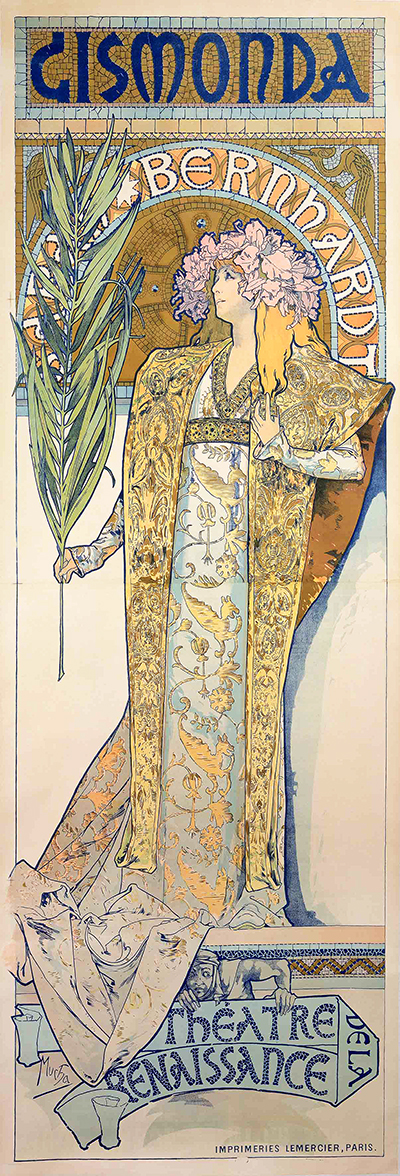
| Gismonda | 1894 | Colour lithograph |
| Head of a Girl, statue for the stand of the Houbigant Perfumery at the Paris Exhibition 1900 | 1900 | Bronze, silver and parcel gilt |
| Head of Sarah Bernhardt: Study for 'Lorenzaccio' | 1896 | Pencil on paper |
| Heather from Coastal Cliffs | 1902 | Colour lithograph |
| Heidsieck & Co | 1901 | Colour lithograph |
| Holy Mount Athos | 1926 | Egg tempera on canvas |
| Ilsée, Princesse de Tripoli | 1897 | Illustrated book |
| In the Desert: Study for an illustration for the Světozor magazine | 1889 | Pencil, watercolour and gouache on paper |
| Incantation (Salammbô) | 1897 | Lithograph |
| Independence - Jiří z Poděbrad: study for a pendentive of the Lord Mayor’s Hall, Obecní Dům, Prague | 1910-1911 | Oil on canvas |
| Interior and furniture designs | c.1900 | Pencil on paper |
| Interior of Boutique Fouquet: design for a wall-mounted display cabinet with statuette and mirror | c.1900 | Pencil on paper |
| Interior of Boutique Fouquet: design for the fireplace with statuettes, mirror, and the ornamental details of the wall | c.1900 | Pencil and watercolour on cardboard |
| Interior of Boutique Fouquet: sketches of the fireplace with statue, mirror, display cabinet, and the ornamental details of the wall | c.1900 | Pencil, pen and ink on paper |
| Ivy | 1901 | Colour lithograph |
| Jan Milic of Kromeriz | 1916 | egg tempera on canvas |
| Jaroslava and Jiří, the Artist’s Children | 1918 | Oil on canvas |
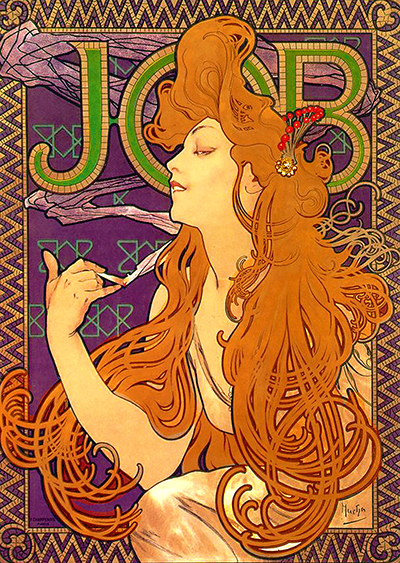
| JOB poster | 1896 | Colour lithograph |
| Judgement of Paris (calendar for Vieillemard printing company) | 1895 | Colour lithograph |
| Justice - Master Jan Hus: study for a pendentive of the Lord Mayor's Hall, Obecní dům, Prague | 1910-1911 | Oil on canvas |
| L'Annee Qui Vient | 1897 | red chalk on paper |
| L'Illustration magazine - cover for Christmas 1896/1897 | 1896 | Magazine cover |
| L'Illustré Soleil du Dimanche | 1897 | Magazine cover |
| La Dame aux Camélias: designs for cover and interior of special programme | 1896 | Pencil and watercolour on paper |
| La Nature | 1899-1900 | Bronze and amethyst |
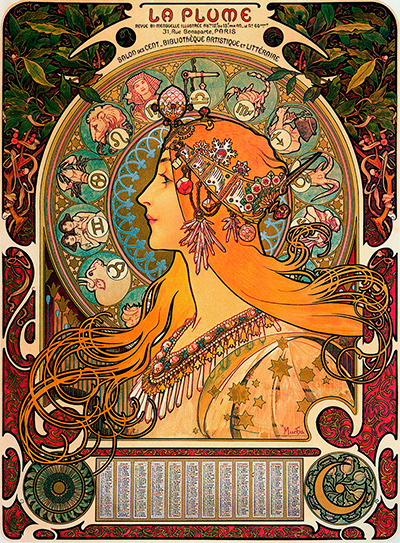
| La Plume | 1897 | Magazine cover |
| La Samaritaine | 1897 | colour lithograph |
| Lance Parfum Rodo | 1896; Albertina print c. 1900 | Colour lithograph |
| Laurel | 1901 | Colour lithograph |
| Le Monde Illustré | 1900 | Magazine cover |
| Le Pater | 1899 | Illustrated book |
| Le Pater: early study for the 1st allegorical scene 'Our Father who art in Heaven' (1899) (Mucha Foundation object 300) | 1899 | Pencil on paper |
| Le Pater: early study for the 1st allegorical scene 'Our Father who art in Heaven' (1899) (Mucha Foundation object 302) | 1899 | Pastel on paper |
| Le Pater: study for the 6th allegorical scene 'Forgive us our debts, as we forgive our debtors' | 1899 | Charcoal and ink wash on paper |
| Lefevre Utile | 1904 | Advertisement |
| Leslie Carter | 1908 | Colour lithograph |
| Letem Českým Světem | 1898 | Printed book |
| Lorenzaccio | 1896 | Colour lithograph |
| Luchon poster (attributed to Mucha) | 1895 | Colour lithograph |
| Madonna of the Lilies | 1905 | Tempera on canvas |
| Master Jan Hus Preaching at the Bethlehem Chapel | 1916 | egg tempera on canvas |
| Maude Adams | 1908 | Lithograph, hand-coloured in watercolour and gouache |
| Maude Adams as Joan of Arc | 1909 | Oil on canvas |
| Medea | 1898 | Colour lithograph |
| Menu for the Bosnian Pavilion Restaurant at the Paris Exhibition 1900 | 1900 | Colour lithograph |
| Militancy - Jan Žižka: study for a pendentive of the Lord Mayor's Hall, Obecní dům, Prague | 1910-1911 | Oil on canvas |
| Military Camp in Winter, near a City on Fire | c.1899-1900 | Pastel on paper |
| Moet et Chandon | 1899 | Colour lithograph |
| Monaco Monte Carlo | 1897 | Colour lithograph |
| Moon | 1902 | |
| Moravian Teachers' Choir | 1911 | Colour lithograph |
| Morning Alphonse Mucha Painting / AlphonseMucha.org | 1899 | Colour lithograph |
| Morning Star | 1902 | Colour lithograph |
| Moët & Chandon White Star | 1899 | Colour lithograph |
| Mrs Mucha’s Necklace | 1906 | gold, enamel and semi-precious stones |
| Mural for the Bosnia-Herzegovina Pavilion: The Roman Period and the Arrival of the Slavs | 1900 | tempera and watercolour on canvas |
| Murals by Mucha in the Lord Mayor's Hall, Obecní Dům (Municipal House), Prague (1910-1911) | ||
| Music | 1898 | Colour lithograph |
| Nativity | c. 1934 | oil on canvas |
| Nestle's Food for Infants | 1897 | Colour lithograph |
| Night | 1899 | Colour lithograph |
| Nude on a Rock | 1898-1899 | Bronze |
| Official Banquet of the Paris Exhibition 1900: design for the menu featuring a fashionable woman wearing a Mucha-style jewellery | 1900 | Pencil, gouache and wash on grey paper |
| Ornamental motifs designed for 'Combinaisons Ornementales se Multipliant à l'Infini à l'Aide du Miroir' (1901) | c.1900-1901 | Blue and red pencil on paper |
| Packaging for 'Savon Mucha Violette' | 1906 | Colour lithograph |
| Packaging for Lefèvre-Utile biscuits: Boudoir | 1901 | Colour lithograph |
| Page's Costume: study for an illustration for 'Le Costume au Théâtre' | 1890 | Pencil and watercolour on cardboard |
| Painting | 1898 | Colour lithograph |
| Peonies | 1897–1898 | Ink and watercolour |
| Petr Chelcicky at Vodnany | 1918 | egg tempera on canvas |
| Poetry | 1898 | Colour lithograph |
| Portrait of Jaroslava | c.1927-1935 | Oil on canvas |
| Portrait of Josephine Crane Bradley as Slavia | 1908 | Oil and tempera on canvas |
| Portrait of Marie Chytilová (Maruška), Mucha's Future Wife | 1903 | pastel on paper |
| Portrait of Mucha's Sister, Angela | c.1880 | Oil on canvas |
| Portrait of Mucha's Sister, Anna | c.1885 | Oil on canvas |
| Portrait of Mucha's Son, Jiří | 1925 | Oil on canvas |
| Portrait of Mucha's Wife, Maruška | 1908/17 | Oil on canvas |
| Portrait of Woman | c. mid 1910s - 1925 | Blue pastel on grey paper |
| Poster for 'Hommage Respectueux de Nestlé' (the Nestlé Company's tribute to Queen Victoria's 60th Jubilee) | 1897 | Colour lithograph |
| Poster for 'Imprimerie Cassan Fils' | 1896 | Colour lithograph |
| JOB poster (1898) | 1898 | Colour lithograph |
| Poster for 'La Dame aux Camélias' | 1896 | Colour lithograph |
| Poster for 'La Tosca' | 1899 | Colour lithograph |
| Poster for 'Regional Exhibition at Ivančice 1913' | 1912 | Colour lithograph |
| Poster for 'The Slav Epic Exhibition, Brno, 1930' | 1928-1930 | Colour lithograph |
| Poster for 'Waverley Cycles' | 1898 | Colour lithograph |
| Poster for the 'Lottery of the Union of Southwestern Moravia' | 1912 | Colour lithograph |
| Poster for the Austrian Pavilion at the Paris Exhibition 1900 | 1900 | Colour lithograph |
| Prague Subjugated: study for a Panel of the Small Reception Room at the Lord Mayor’s Hall, Obecní Dům, Prague | 1910-1911 | Pen and ink and watercolour on paper |
| Primrose | 1899 | Colour lithograph |
| Primrose and Feather (paired image) | 1899 | Colour lithographs (paired image) |
| Princess Hyacinth (Princezna Hyacinta) | 1911 | Colour lithograph |
| Print proof for the Biscuits Lefèvre-Utile tin | 1899 | Lithograph |
| Reverie | 1898 | Colour lithograph |
| Russia Restituenda [Russia Must Recover] | 1922 | Colour lithograph |
| Salome | 1897 | Colour lithograph |
| Salon des Cent | 1896 | Colour lithograph |
| Salon of the Hundred | 1897 | Colour lithograph |
| Sarah Bernhardt - La Princesse Lointaine - Lefevre Utile | 1903 | Colour lithograph |
| Sarah Bernhardt as La Princesse Lointaine: poster for 'La Plume' magazine | 1897 | Colour lithograph |
| Sarah Bernhardt in the role of the Duc de Reichstadt in L’Aiglon | 1900 | Pencil on paper |
| Sarah Bernhardt: study of her full-standing figure | c.1896 | Pen and ink on paper |
| Savonnerie de Bagnolet calendar | 1898 (calendar) | Printed advertising calendar |
| Self-portrait (1899) | 1899 | Oil on board |
| Self-portrait (1907) | 1907 | Blue and white crayon on blue Ingres paper |
| Self-portrait, sketching in his apartment, Paris | late 1880s | oil on canvas |
| Sketches of flowers for Documents décoratifs | c.1900-1901 | Pen and ink on paper |
| Slavia insurance poster | 1907 | Poster |
| Slavs in their Original Homeland | 1912 | Egg tempera on canvas |
| Snake Bracelet with a Ring | 1899 | Gold, enamel, opal, ruby and diamond |
| Société Populaire des Beaux Arts | 1897 | Colour lithograph |
| Song of Bohemia | 1918 | oil on canvas |
| St. Vitus Cathedral Stained-glass Window, Prague: final design for the central panels, featuring SS Cyril and Methodius | 1931 | Ink and watercolour on paper |
| St. Vitus Cathedral Stained-glass Window, Prague: final design for the central panels, featuring St. Ludmila | 1931 | Ink and watercolour on paper |
| St. Vitus Cathedral Stained-glass Window, Prague: final design for the central panels, featuring St. Wenceslas (Duke of Bohemia) kneeling next to his Grandmother, St. Ludmila | 1931 | Ink and watercolour on paper |
| St.Vitus Cathedral Stained-glass Window, Prague: final design for the bottom left panels | 1931 | Ink and watercolour on paper |
| St.Vitus Cathedral Stained-glass Window, Prague: final design for the bottom right panels | 1931 | Ink and watercolour on paper |
| Stained-glass Window designed by Mucha at St. Vitus Cathedral, Prague | Early 1930s | N/A |
| Study for 'The Age of Reason' | 1936-1938 | Pencil and watercolour on paper |
| Study for 'The Slav Epic cycle' No.19: The Abolition of Serfdom in Russia | 1913-1914 | Watercolour and gouache on paper |
| Study for 'The Slav Epic' cycle No.14: The Sacrifice at Szigetvár by Nikola Zrinski | c.1913-1914 | Photographed drawings stuck together, tinted with watercolour and gouache |
| Study for 'The Slav Epic' cycle No.17: The Holy Mount Athos (1926) | c.1925-26 | Charcoal heightened with white on cardboard |
| Study for 'The Slav Epic' cycle No.18: The Oath of Omladina under the Slavic Linden Tree | c.1925-1926 | Pencil and watercolour on paper |
| Study for 'The Slav Epic' cycle No.1: The Slavs in Their Original Homeland (1912) | c.1910-1912 | Oil on canvas |
| Study for 'The Slav Epic' cycle No.2: The Celebration of Svantovít | c.1910-1912 | Oil on canvas |
| Study for 'The Slav Epic' cycle No.7: Jan Milíč of Kroměříž | c.1915-1916 | Oil on canvas |
| Study for 'The Slav Epic' cycle No.9: Master Jan Hus Preaching at the Bethlehem Chapel. The Magic of the Word: Truth Prevails (1412). | c.1915-1916 | Oil on canvas |
| Study for 'The Three Ages' triptych: Reason, Wisdom and Love [unfinished project] | 1936-1938 | Pencil and watercolour on paper |
| Study for 'Woman in the Wilderness' (c. 1922-1923) (Mucha Foundation object 315) | c. 1922-1923 | oil on canvas |
| Study for 'Woman in the Wilderness' (c. 1922-1923) (Mucha Foundation object 316) | c. 1922-1923 | oil on canvas |
| Study for Savon Notre Dame | c. 1896 | pencil and watercolour on paper |
| Study for the poster 'Russia Restituenda [Russia Must Recover]' | 1922 | Pen and ink and watercolour on paper |
| Study of a Male Nude | 1885-1887 | Oil on canvas |
| The Abolition of Serfdom in Russia | 1914 | Egg tempera on canvas |
| The Arts (series) | 1898 | Colour lithograph |
| The Arts: study for 'Dance' | 1898 | Pencil and watercolour on paper |
| The Arts: study for 'Music' | 1898 | Pencil and watercolour on paper |
| The Arts: study for 'Painting' | 1898 | Pencil and watercolour on paper |
| The Arts: study for 'Poetry' | 1898 | Pencil and watercolour on paper |
| The Bohemian King Premysl Otakar II | 1924 | egg tempera on canvas |
| The Bulgarian Tsar Simeon | 1923 | egg tempera on canvas |
| The Burr McIntosh Monthly, 1907 | 1907 | Magazine cover |
| The Celebration of Svantovit | 1912 | egg tempera on canvas |
| The Coronation of the Serbian Tsar Stefan Dusan as East Roman Emperor | 1923 | egg tempera on canvas |
| The Devil and Mr Twardowsky: study for an illustration for 'The Tale of Pan Twardowsky' (a variation of 'Faust') | c.1887-1888 | Charcoal on paper |
| The Flowers (series) | 1898 | Colour lithographs |
| The Flowers: Carnation | 1898 | Colour lithograph |
| The Flowers: Iris | 1898 | Colour lithograph |
| The Flowers: Lily | 1898 | Colour lithograph |
| The Flowers: Rose | 1898 | Colour lithograph |
| The Hussite King Jiri of Podebrady | 1923 | Egg tempera on canvas |
| The Introduction of the Slavonic Liturgy | 1912 | egg tempera on canvas |
| The Last Days of Jan Amos Komensky (Comenius) in Naarden | 1918 | Egg tempera on canvas |
| The Light of Hope | 1933 | Oil on canvas |
| The Meeting at Krizky | 1916 | egg tempera on canvas |
| The Months (January-June) | 1899 | Colour lithograph |
| The Months (July-December) | 1899 | Colour lithograph |
| The Moon and the Stars (four-panel montage) | 1902 | Colour lithographs (four-panel montage) |
| The Moon and the Stars (series) | 1902 | Colour lithograph |
| The Moon and the Stars: study for 'The Evening Star' | 1902 | Ink and watercolour on paper |
| The Moon and the Stars: study for 'The Pole Star' | 1902 | Ink and watercolour on paper |
| The New York Daily News art supplement | 1904 | Printed art supplement |
| The Oath of Concord of the Slavs (unfinished) | 1939 | oil on canvas |
| The Oath of Omladina under the Slavic Linden Tree | 1926, unfinished | Egg tempera on canvas |
| The Precious Stones (four-panel montage) | 1900 | Colour lithographs (four-panel montage) |
| The Precious Stones (series) | 1900 | Colour lithograph |
| The Precious Stones: Amethyst | 1900 | Colour lithograph |
| The Precious Stones: Emerald | 1900 | Colour lithograph |
| The Precious Stones: Ruby | 1900 | Colour lithograph |
| The Printing of the Bible of Kralice in Ivancice | 1914 | egg tempera on canvas |
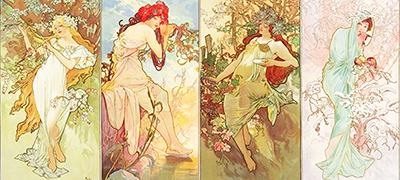
| The Seasons (series) | 1896 | Colour lithograph |
| The Seasons (series) (1900) | 1900 | Colour lithograph |
| The Seasons (variation in screen format) | 1896 | Colour lithograph |
| The Seasons: Autumn (1896) | 1896 | Colour lithograph |
| The Seasons: Autumn (1900) | 1900 | Colour lithograph |
| The Seasons: Spring | 1900 | Colour lithograph |
| The Seasons: Spring (1896) | 1896 | Colour lithograph |
| The Seasons: Summer | 1900 | Colour lithograph |
| The Seasons: Summer (1896) | 1896 | Colour lithograph |
| The Seasons: Winter | 1900 | Colour lithograph |
| The Seasons: Winter (1896) | 1896 | Colour lithograph |
| The Slavonic Concord: study for the ceiling painting for the Lord Mayor's Hall, Obecní Dům, Prague | 1910-1911 | Oil on canvas |
| The Threat | 1912 | Colour lithograph |
| The Times of the Day (series) | 1899 | Colour lithograph |
| The West End Review | 1897 (Foundation); 1898 promotional cover | Colour lithograph |
| Thistle from the Sands | 1902 | Colour lithograph |
| Théâtre de la Renaissance: design for poster advertising Sarah Bernhardt's theatre | c.1895 | Pen and ink on paper |
| Tin for Lefèvre-Utile biscuits | 1899 | Circular tin with lid and handle; colour print on metal |
| Topaz | 1900 | Colour lithograph |
| Tragedy - study for a mural for the German theatre New York | 1908 | Oil and tempera on canvas |
| Trappistine Liquors | 1897 | colour lithograph |
| Wiener Chic | 1905 | Magazine cover |
| Woman in the Wilderness | 1923 | Oil on canvas |
| Woman masked in white head-scarf - study for the illustration of the Bosnia & Herzegovina Pavilion featured in 'Le Figaro Illustré' (1 March 1900) | 1899 | Pencil and wash heightened with white on paper |
| Woman with a Daisy - textile designed by Mucha | 1900 | Printed upholstery fabric |
| Zdenka Cerny | 1913 | Colour lithograph |
| Zodiac (La Plume calendar) | 1896–97 | Colour lithograph |
| Zodiac (textless decorative panel) | 1896 | Colour lithograph |
| ‘At the sight of the two storks the owl rose.’ Study for an illustration for Contes de Grand-mères | 1891 | Watercolour and gouache on paper |
Frequently Asked Questions
When did Mucha paint Jan Amos Komenský?
Did Komenský die in Naarden?
What does the small lantern represent?
Discussion
Mucha places Komenský alone on a rise while mourners gather at a distance on the shore.
A small lantern between them offers a fragile point of light.
Reader Insights
Where does your eye first settle in this quiet scene?
How does the space between Komenský and the mourners affect the mood?
What does the lantern add to the otherwise muted colours?
Join the Conversation
Share what you notice about distance, mourning and the lantern.
References
- Mucha Foundation, “The Slav Epic cycle No. 16: Jan Amos Komenský,” object 227, finished-canvas identity, medium, dimensions and interpretation. View source.
- Prague City Gallery, “The Last Days of Jan Amos Komenský,” illustrated story presented through Google Arts & Culture, based on the 2022 Moravský Krumlov exhibition catalogue. View source.
- Comenius Museum, Naarden, “Biografie,” institutional biography with exile, Amsterdam residence, death and Naarden burial facts. View source.
- Comenius Museum, Naarden, “Mausoleum,” death and burial interval, grave investigation and the 1937 memorial. View source.
- J. A. Komenský: Life, Work, Legacy, “Unum necessarium,” 1668 Amsterdam publication and summary of Komenský’s reflection on life and death. View source.
- National Museum, “Masaryk a vznik Československa,” historical account of the Czechoslovak state's establishment on 28 October 1918. View source.
- Stichting Comenius Museum, annual report (2022), section 2.2 on the 22 November 1670 Naarden burial, the De Geer family connection and uncertainty over why that church was chosen. Read report.
- Dutch-Czech bilingual historical study, “The Search for the Grave of Comenius,” in N & B 17 (2017), pp. 18–21, transcribing grave-register no. 8 and discussing the minister's account-book entry and Naarden's earlier commemorations. Read source.
- Comenius Museum, Naarden, “Werken van Comenius,” Dutch-language catalogue of major works, Amsterdam printing and the publication history of Consultatio catholica. View source.
- Comenius Museum, Uherský Brod, “Clamores,” Czech-language research catalogue for the 1665–70 notes, surviving manuscript, languages and later editions. View source.
- Petr Peňáz, “Komenského životní dramata (2. část),” Masaryk University Faculty of Education (January 2023), Czech-language account of the late letter, unfinished reform work and burial-date question. View source.